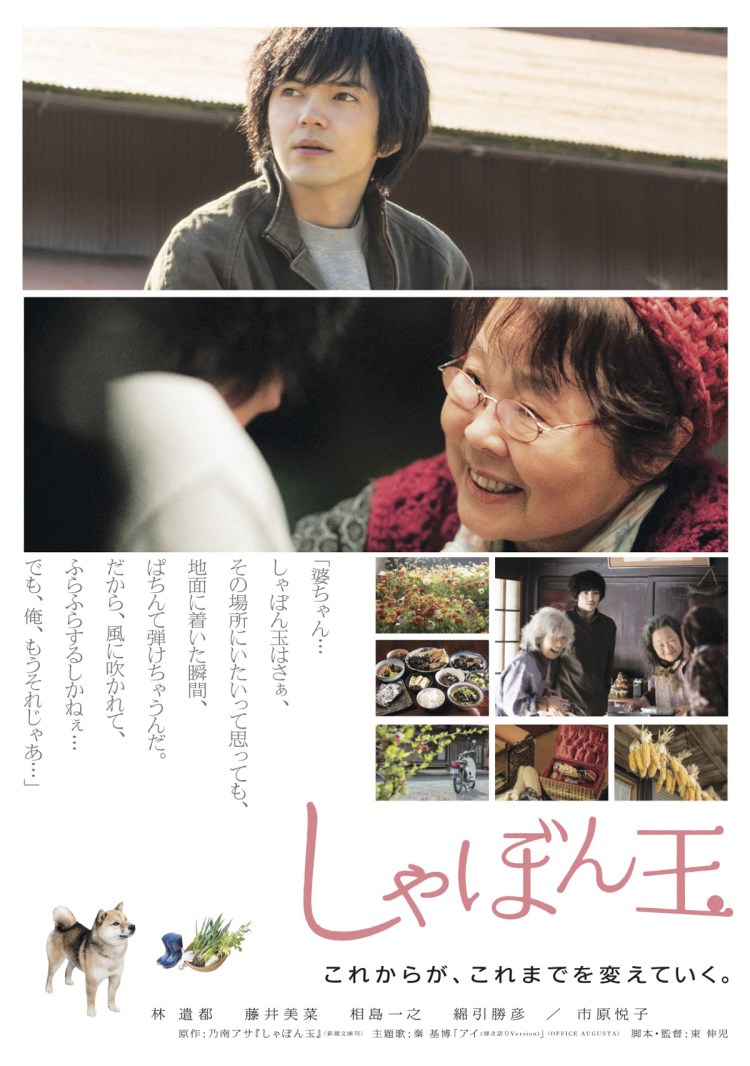
Where I Belong (しゃぼん玉, Shinji Azuma, 2017)

Where I Belong PosterTo the rest of the world Japan often seems as if it exists in the future, all gleaming city scapes and high-tech living, but Japanese cinema has a noticeable ambivalence about urbanisation. Where I Belong (しゃぼん玉, Shabondama) is the latest in a long series of films to lament the coldness and disconnection brokered by the anonymity of life in a metropolis and long for a return to a simpler time in which small communities supported each other in good times and bad, taking care to reinforce positive social values through mutual responsibility. Of course, such pictures of rural life tend towards the optimistic – these communities are accepting rather than judgemental and usually free from extreme hardships, but there is something universally comforting in the solidarity of community providing a home for those otherwise cast out.

Izumi (Kento Hayashi), a young man of indefinite age, was abandoned by his mother after his parents divorced and has lived the majority of his life on the streets. He gets by by bag snatching – mostly targeting the vulnerable, elderly and lone women. To make the job faster he carries a knife to cut the handles, never meaning to hurt anyone with it, but one night an attempted mugging in a rainy underpass ends in tragedy when his target is injured during the struggle. Getting out of town, Izumi finds himself kicked out of a truck in the middle of the mountains where he later finds an apparently abandoned scooter. Just as he’s about to continue his escape, an old woman cries out from the grassy verge. Izumi can’t quite bring himself to just ride off and helps the woman, Suma (Etsuko Ichihara), back to her home, after which he is rewarded by a hearty meal prepared by the warmhearted old ladies of the village and finds himself beginning to fight the urge to run in favour of hiding out in this strange little place where the people are unexpectedly warm.

Izumi’s not a bad guy, but he’s had a lot of bad luck. Let down so badly by family, his life has led him to believe all connections are necessarily suspect and it’s everyman for himself when it comes to surviving on the streets. He wanted to steal Suma’s scooter, but his better nature wouldn’t let him leave a little old lady bleeding on the side of the road where no one else might see her for days. The film’s central message is that kindness repays kindness, but kindness requires mutual trust – something of which the city robs its citizens though its persistent quality of anonymity and abnegation of one’s responsibility for others.

Describing himself as the soap bubble of the Japanese title, Izumi’s sense of loss and restlessness at having no particular place to return to is the root cause of his despair and lack of belief in a credible future. Through meeting Suma who repeatedly tells him that he is “good”, trusts him implicitly, and instils in him a belief in himself that had long been absent, Izumi is at last able to begin moving forward and imagine a future for himself with a place to call home. Taking to the woods with harsh but wise forager Shige (Katsuhiko Watabiki) and then helping the village prepare for a festival, Izumi begins to feel as if he can finally become a part of something bigger but equally that in order to do so he will have to make peace with his life in the city by submitting himself to its justice and paying his debt to society so that he can return and make a fresh start as a man who has finally found his place.

The first feature from TV director Shinji Azuma, Where I Belong is not solely a tale of the importance of community, but also of Japan’s changing social structure as small mountain towns find themselves devoid of youngsters leaving the elderly to fend for themselves. Izumi’s restored hopes are not so much to do with the goodness of country people, benefits of hard work, or the crisp mountain air, but simple human kindness and a consequence of the gradual awakening of his sense of self worth thanks to the often blind faith placed in him by others for nothing other than his kind heart.


Screened as part of the Japan Foundation Touring Film Programme 2018.

Screening again:

  • HOME – 19 February 2018
  • Phoenix Leicester – 7 March 2018
  • Storyhouse – 11 March 2018
  • Depot – 13 March 2018
  • Midlands Arts Centre – 17 March 2018

Original trailer (no subtitles)

Initiation Love (イニシエーション・ラブ, Yukihiko Tsutsumi, 2015)

initiation loveMost romantic comedies don’t come with warnings about twist endings and a plea not to give them way, but Initiation Love (イニシエーション・ラブ) is not your average romantic comedy. Set in the early bubble era, Yukihiko Tsutsumi’s double sided feature is itself a wry look at the problematic nature of nostalgia. Harking back to a perhaps more innocent era in which lack of political and economic turmoil left plenty of time for romantic confusion coupled with the corruption of the consumerist dream, Initiation Love pits innocent romance against cynical success but subtly suggests that grown up love is a kind of compromise in itself.

Side A: In the summer of 1987, Yuki Suzuki (Kanro Morita) – a geeky, overweight young man who is shy but has a kind heart, is unexpectedly invited to a college drinking party where he earns some major white knight points for interrupting the increasingly inappropriate grilling of new invitee Mayuko (Atsuko Maeda). Mayuko is pretty, sweet, and cute if in a slightly affected way. She is way out of Suzuki’s league, but later confesses that she’s looking for someone a bit different, like Suzuki, an awkward-type who won’t lie to her or play around. Bonding over a shared love of reading, the pair grow closer, Mayuko rechristens Suzuki “Takkun”, and he vows to spruce himself up to become “worthy” of her.

Side B: Takkun (Shota Matsuda), now slim and handsome, is given a surprise promotion to Tokyo. Rather than suggest marriage or that Mayuko come with him, he settles on long distance and promises to come back to Shizuoka at weekends while waiting to be approved for a transfer back home. In Tokyo, however, Takkun’s personality begins to shift. Seduced by city sophistication and the promises of an elite salaryman lifestyle, Takkun draws closer to upper-class career woman Miyako (Fumino Kimura) whose jaded straightforward confidence he regards as “grown up” in contrast to the innocent charms of Mayuko waiting patiently at home.

The overarching narrative is provided to us via a melancholy voice over and accompanied, in the manner of a classic mix-tape, by a song from the era which is deliberately on the nose in terms of its aptness – a song about giving up on summer just as the couple are stuck in a traffic jam on the way to the beach and about to have a gigantic row, or a song about lucky chances coming up on TV just as our hero is plucking up the courage to allow himself to be bamboozled into going on a date with the girl of his dreams. The carefully placed positioning of the songs reminds us that we are inside someone’s carefully curated memories. Just as Takkun’s vision of Mayu-chan is one surrounded by flowers and light, the early days of romance are a condensed and romanticised version of real events seen entirely from one perspective and coloured with the gradual fading of time. Nostalgia is an unreliable narrator, recasting real life as Hollywood fiction.

The warm and fuzzy glow of Side A is undercut by the subtly questionable actions of Mayuko and our own prejudices about why she might be with a guy like Takkun. Self-consciously cute, Mayuko makes needling suggestions – dress better, get contacts, learn to drive, which, objectively speaking, might all help Takkun to gain some much needed confidence if only he were not doing all of them solely because he fears losing a woman like Mayuko. If Mayuko wanted a guy she could remake and boss around, she might have come to the right place but she does, at least, also try to insist that she likes Takkun anyway and so any changes he makes to himself will make no difference to her.

Side B, by contrast, turns the dynamic on its head as Takkun’s Tokyo persona becomes increasingly violent, resentful, and cruel while Mayuko seems genuine, innocent, and hurt by the increasing distance between herself and the man she loves. Seduced by city sophistications, Takkun leans ever closer to dumping the innocent country bumpkin, a love he has now outgrown, for a leg up into the middle-classes by marrying the elegant daughter of a wealthy Tokyo businessman. He is, however, torn – between the nostalgic glow of first love’s innocence, and the realities of adult life, the certain past and the uncertain future.

This is the philosophy ascribed by Miyako (apparently given to her by her own first love) that the first failed romance is a crucial part of growing up, an “Initiation Love” that breaks your heart by revealing the idea of true love as a romantic fallacy, allowing you move into the adult world with a degree of emotional clarity. A sound idea, but also sad and cruel in its own way. The final twist, offered as a cynical punchline, can’t help but feel cheap, carrying mildly misogynistic undertones dressed up as a kind of joke aimed at cowardly men who are incapable making clear choices and refuse to see their romantic partners as real people rather than the self created images of them they maintain. Takkun remains torn, between past and future, town and country, old love and new but nostalgia is always a trap – a false impression of a true emotion that impedes forward motion with a promise of a return to something which can never be delivered.


Screened as part of the Japan Foundation Touring Film Programme 2018.

Screening again:

  • QUAD – 10 February 2018
  • Brewery Arts Centre – 2 March 2018
  • Filmhouse – 9 March 2018

Playlist: Side A

Yureru Manazashi (Kei Ogura)

Kimi wa 1000% (1986 Omega Tribe)

Yes-No (Of Course)

Lucky Chance wo Mo Ichido (C-C-B)

Ai no Memory (Shigeru Matsuzaki)

Kimi Dake ni (Shonentai)

Side B:

Momen no Handkerchief (Hiromi Ota)

Dance (Shogo Hamada)

Natsu wo Akiramete (Naoko Ken)

Kokoro no Iro (Masatoshi Nakamura)

Ruby no Yubiwa (Akira Teruo)

Show Me (Yukari Morikawa)


Sing My Life (あやしい彼女, Nobuo Mizuta, 2016)

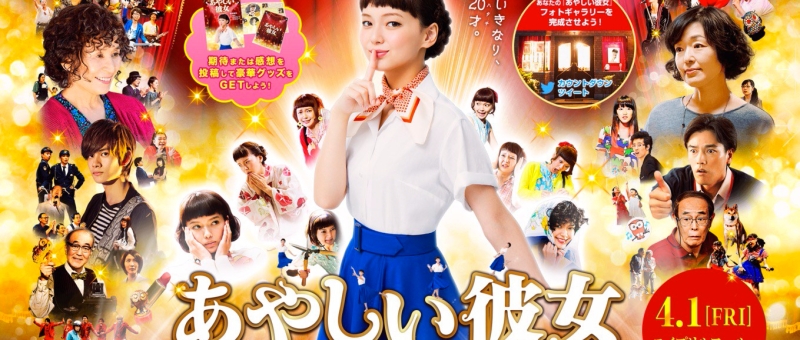
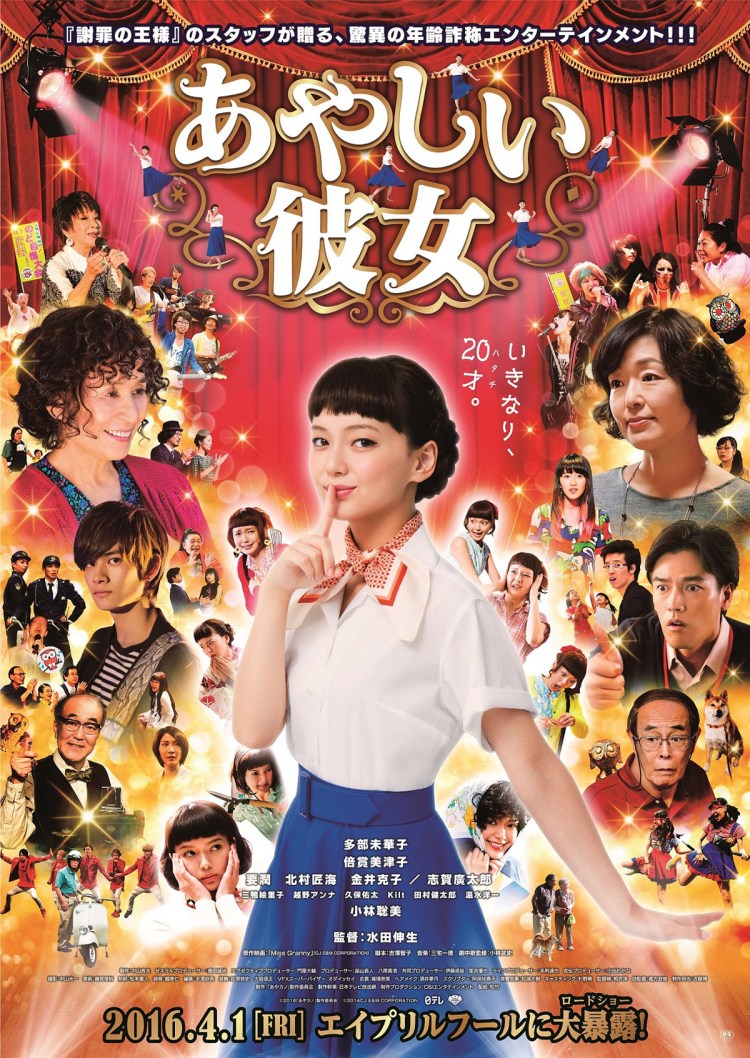
Sing my life posterWhen Miss Granny was released in Korea back in 2014, it became an instant smash hit with remake rights quickly bought by a host of Asian countries and Chinese (20 Once Again), and Vietnamese (Sweet 20) versions already proving popular in their respective nations. Sing My Life (あやしい彼女, Ayashii Kanojo) shifts away from the Korean film’s pervasive misery for a more typically Japanese determination to grin and bear one’s troubles. Structured like a classic musical, Sing My Life may only hint at the hardships of life in post-war Japan, but co-opts the classic “hahamono” for a musical tribute to motherhood in all of its complexities and complications.

Katsu Seyama (Mitsuko Baisho) is a 73-year-old woman who likes to sing and dance her way through life while making a point of haggling over her purchases and boasting loudly about how proud she is of her daughter who is the editor-in-chief of a famous fashion magazine. Her daughter Yukie (Satomi Kobayashi) has, however, unbeknownst to her been demoted in favour of a flashy, younger candidate. After getting caught by an ore ore scam and blaming Yukie for preventing her from doing all the things she wanted to do in life, Katsu runs away from home and finds herself at a strange photo studio from which she emerges as her 20-year-old self (Mikako Tabe). Suddenly given the chance to experience the youth she never knew, Katsu ends up joining her grandson’s punk band as the lead vocalist singing a number of her favourite retro hits in new, modern versions.

Unlike the Korean version, Katsu’s story is less one of resentment at a fall in social status than an ongoing struggle born of constant hardships. A war orphan with childhood friend Jiro (Kotaro Shiga) her only “familial” connection, Katsu has had to fight all her life just to survive. A shotgun wedding was followed immediately by widowhood and a serious illness for her child who she was told would not survive past infancy. Yet unlike the granny of Miss Granny, Katsu is not actively mean as much as she is irritating and occasionally petulant. Loving to boast of the successful career woman daughter she managed to raise alone, Katsu is not above playing the martyr in reminding those around her of everything she sacrificed to make it happen.

A single mother in the ‘60s, Katsu had to work day and night to support herself and her daughter leaving her with a lifelong love of thriftiness and a kind of no-nonsense bluntness that is occasionally (if accidentally) hurtful. In the original Korean version, a widowed mother pours all of her ambition and desires into her son who she hopes will become a successful member of society able to return the favour by supporting her in her old age. Katsu’s child is a girl but has also become a successful career woman and later a single mother herself following a brief marriage followed by divorce. There may be tension in the relationship between the two women, but Katsu’s returned youth provides the opportunity for greater intimacy and a return to the less complicated mother-child relationship of early childhood brokered by greater mutual understanding.

Though Katsu had not revealed any great dream of being a singer, her beautiful voice soon gets her noticed by the music biz and producer Takuto Kobayashi (Jun Kaname) who is sick to the back teeth of soulless teenage idols who lack the life experience to truly connect with the material they’ve been given. Encompassing a host of Showa era hits from the Kyu Sakamoto tune Miagete Goran Yoru no Hoshi wo, to Hibari Misora’s Makkana Taiyo, and the central performance of the depression themed Kanashikute Yarikirenai originated by Folk Crusaders, Sing My Life takes a (slightly) more cheerful run through ‘60s Japan emphasising the fortitude and determination of struggle rather than the misery and hardship of difficult times. Fun and touching, Nobuo Mizuta’s adaptation improves on the Korean version in adding a subtle commentary on the ironic invisibility of the elderly in ageing Japan whilst also refocusing the tale onto a deliberately female perspective, examining how two women from different generations have dealt with a similar problem, and allowing them the opportunity to repair their fractured relationship through a process of mutual understanding.


 Screened as part of the Japan Foundation Touring Film Programme 2018.

Screening again:

  • ICA – 8 February 2018
  • QUAD – 11 February 2018
  • Showroom Cinema – 20 February 2018
  • Firstsite – 25 February 2018
  • Depot – 27 February 2018
  • Phoenix Leicester – 10 March 2018
  • Midlands Arts Centre – 13 March 2018
  • Broadway – 18 March 2018

Original trailer (no subtitles)

Kyu Sakamoto’s Miagete Goran Yoru no Hoshi wo

Hibari Misora & The Blue Comets – Makkana Taiyo

Folk Crusaders – Kanashikute Yarikirenai

Joy of Man’s Desiring (人の望みの喜びよ, Masakazu Sugita, 2014)

Joy of Man's Desiring posterWhen disaster strikes false cheerfulness takes hold as those left behind attempt to push each other forward and away from the wreckage of their old lives, but refusing to deal with the reality causes more problems than it solves. This is doubly true when it comes to children who find themselves all alone when robbed of everything they’ve known by forces beyond their control. First time feature director Masakazu Sugita, himself a survivor of the 1995 Hanshin Earthquake which struck when he was just 14 years old, was led to the realisation of a long gestating project after the devastating earthquake and tsunami which struck Japan in March 2011 leaving many facing loss and bereavement. Though the children at the centre of Joy of Man’s Desiring (人の望みの喜びよ, Hito no Nozomi no Yorokobi yo) are lucky enough to have surviving relatives prepared to take them in and raise them with love and care, their lives are far from easy as they attempt to come to terms with the aftershocks of disaster.

12 year old Haruna (Ayane Ohmori) tugs at roof tiles now lying on the floor with no house underneath them. Her nightdress is covered in blood stains and dust and she has deep cuts on her heels, hands, and face. Finally someone drags her away from her broken home and towards a makeshift settlement with a oil drum fire where a relative later finds her. Though she and her brother Shota (five, still in the hospital) survive, both her parents have been killed. The relatives who’ve been looking after her don’t want to make it a long term arrangement and suggest sending the siblings to an orphanage all with Haruna lying awake listening in the next room. Her other aunt won’t hear of it and so Haruna and Shota (Riku Ohishi) are packed off to live in a quiet coastal town with their mother’s sister (Naoko Yoshimoto) and her family which includes their slightly older and very sulky cousin Katsutoshi (Shumpei Oba) as well as their uncle (Koichiro Nishi) and his father who is all too happy to have another two grandchildren to spoil.

The quiet coastal town with its natural beauty, wide open roads and winding streets dotted with pleasant looking houses should be the ideal place for the children to settle down in peace and they are indeed lucky in their aunt’s willingness to take them in as full members of the family (especially given the initial ugliness which exposed the relative lack of compassion from others) but moving to a completely new town to live with near strangers is a difficult prospect at the best of times, especially for young children, even if they aren’t also trying to process the loss of their parents. Whether because they didn’t have the heart, or they thought he wouldn’t understand, or perhaps just because they were waiting for his physical health to fully recover, no one has explained to little Shota that his parents will not be coming back. He can’t understand why they haven’t come to fetch him and has taken to hanging around the ferry terminal all day watching the figures coming off the boat in case they should eventually arrive.

Shota is lively and boisterous, adapting much more quickly to his new life than his older sister who remains quiet and withdrawn, sitting alone at school and staying in her room at home. Everyone is so caught up in the need to be cheerful and get on with life that no one has stopped think about the various effects the new living situation is having on all involved. The community is small and so new kids moving in is a rare event, making Haruna a mild novelty at her new school whether she likes it or not. People keep telling her to “hang in there” and they mean well, but all they really do is remind her that she’s been bereaved, that she’s “different” from the other children, and that she doesn’t quite belong in their world.

Meanwhile, they also discourage her from talking to them about her feelings of grief and guilt, but talking’s not something generally done by people making a great effort to get on with things as demonstrated by a final frustrated outburst by Haruna’s aunt who has been trying to care for the children while her own son turns his resentment back on her, her husband leaves everything to his wife, and Haruna offers some unkind words at just the wrong time. Katsutoshi is perhaps justified in his petulant resentment of his new siblings, fearing (as one unkind school friend indelicately puts it) that his parents don’t want him anymore, and that he’s unwittingly become associated with the mild whiff of intrigue surrounding the newcomers, but it’s his inability to voice any of his concerns in a more normal way that provokes the eventual family crisis which sees Shota and Haruna finally set out on a course of reconciliation with their past.

Haruna thinks she has to be strong for Shota, keeping the secret of their parents death to avoid causing him pain but also leaving her with no one to talk about them with. Shota, however, is equally devoted to his sister, gently patting her futon while she’s ill and arriving with a pretty daisy he’s picked to cheer her up in the film’s poignant final scenes. Sugita keeps things natural but enlivens the drama with interesting composition and a shift into the expressionist for the traumatic scenes of destruction which mark the film’s opening. A repeated motif of the sun shining through water serves an apt metaphor of the grief process as a kind of drowning, but like the daisy at the film’s closing it also offers hope in the possibility of life after disaster but only once the waters have receded.


 Screened as part of the Japan Foundation Touring Film Programme 2018.

Screening again at:

  • Queen’s Film Theatre – 11 February 2018
  • Firstsite – 18 February 2018
  • Depot – 21 February 2018
  • Filmhouse – 4 March 2018
  • Broadway – 19 March 2018

Original trailer (English subtitles)

Mumon: The Land of Stealth (忍びの国, Yoshihiro Nakamura, 2017)

MumonJapan prides itself on its harmonious society, but just like the Spartans of Ancient Greece, there have always been those who choose to do things differently. In the late 16th century, Japan was divided into a number of warring states but one visionary general, Oda Nobunaga, had begun a campaign of conquest which he intended to extend across the nation creating peace through unification under a single ruler. One tiny province held out – Iga, home to the ninja and renowned for the petty heartlessness of its mercenary men.

In the September of 1579, two rival ninja clans are engaging in a little practice fighting to the death during which Mumon (Satoshi Ohno), “the greatest ninja in Iga”, takes a commission to assassinate the younger son (Shinnosuke Mitsushima) of the opposing general, which he does with characteristic style and efficiency. The dead man’s older brother, Heibei (Ryohei Suzuki), is heartbroken not only by his brother’s death but by the relative lack of reaction it provokes in his father (Denden) who remarks that the loss of a younger son is no different to that of a foot soldier, and foot soldiers die all the time.

Ironically enough for a man nicknamed “no doors” because no doors can bar him, Mumon is currently locked out of his own house because his wife is upset about his meagre salary. When he stole her away from her noble home, Mumon exaggerated slightly in his tales of his great wealth and social standing and now Okuni (Satomi Ishihara) has decided he can’t come home ’til she gets what she was promised.

The death of Heibei’s brother sets in motion a chain of politically significant events which are set to change not only the course of history but the outlook of at least two men in the “land of stealth”. In Iga, the men are known are known for their beastliness and lack of common human decency. Skilled in stealth warfare, they have no allegiance to any but those with the biggest wallets and live by the doctrine of strength. The weak die alone, and that’s a good thing because it means the tribe is strong.

Later a retainer (Makita Sports) to the son of Oda Nobunaga, Nobukatsu (Yuri Chinen), says something similar – that only might can unite, the weak must either follow or be destroyed. He regards Iga as weak because it is small and alone, but Iga thinks it is strong for exactly the same reasons. The Nobunaga contingent have no idea just how beastly and petty minded the Igans can be when comes to defending their independence, little suspecting that they are embroiled in a well planned conspiracy.

Heibei, disillusioned with the inhumanity of his fellow ninja defects, offering his services to the new regime with the advice that they invade and wipe out the heartless warriors like the beasts they are. Mumon, sold to the Iga as a child, has known nothing but the Iga way of life and is as greedy and self-centred as any other ninja save being able to command a higher price thanks to his fame and abilities. He now has a problem on his hands in the form of Okuni who manages to dominate him fully with her insistence on replicating the way of life she was originally promised. Mumon cares deeply for his stolen bride and does not want to lose her, but she objects to his natural indifference to the cruelty of his people, opening his eyes to the harshness he had always regarded as normality.

When greed is the only accepted virtue, there can be no honour and without honour no unity. This Mumon eventually comes to understand. Far from the famed independence of the Iga, he, Heibei, and a host of others have been well and truly played by a corrupt and secretive tyranny. Daizen (Yusuke Iseya), an honourable samurai forced to betray his own code in killing his former lord, has a point when he says that the ninja spirit has not been destroyed but merely scattered and will endure through the ages – a chilling thought which results in an echo of the modern world and the horrors wrought by intensive individualism. Rather than embrace the traditional genre tropes of the jidaigeki, Nakamura opts for a post-modern style filled with punk and jazz while the ninjas perform their death defying stunts and Mumon pauses to wink at the camera. The result is an anarchic foray in a historical folly in which triumph is followed quickly by defeat and always by the futility of life without compassion.


Mumon: The Land of Stealth (忍びの国, Shinobi no Kuni) was screened as part of the Japan Foundation Touring Film Programme 2018.

Also screening at:

  • QUAD – 10 February 2018
  • Phoenix Leicester- 11 February 2018
  • Showroom Cinema – 13 March 2018
  • Eden Court – 15 March 2018
  • Broadway – 17 March 2018
  • Firstsite – 25 March 2018

Original trailer (English subtitles)

Birds Without Names (彼女がその名を知らない鳥たち, Kazuya Shiraishi, 2017)

Birds Without Names poster“Human beings are lonely by nature”, a statement offered by someone who could well think he’s lying but accidentally tells the truth in Kazuya Shiraishi’s Birds Without Names (彼女がその名を知らない鳥たち, Kanojo ga Sono Na wo Shiranai Toritachi). Loneliness, of an existential more than physical kind, eats away at the souls of those unable to connect with what it is they truly want until they eventually destroy themselves through explosive acts of irrepressible rage or, perhaps, of love. The bad look good and the good look bad but appearances can be deceptive, as can memory, and when it comes to the truths of emotional connection the sands are always shifting.

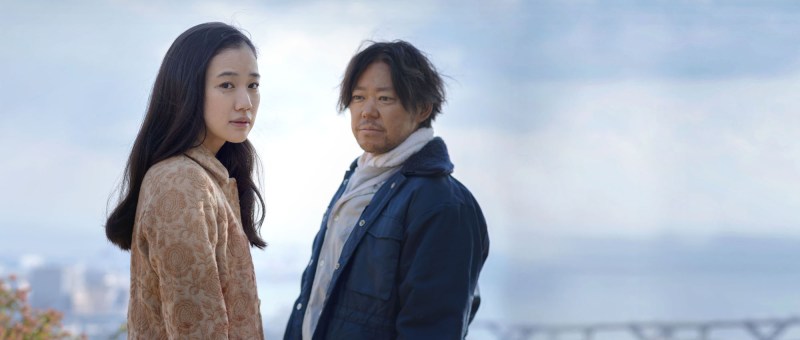
Towako (Yu Aoi), an unmarried woman in her 30s, does not work and spends most of her time angrily ringing up customer service departments to complain about things in the hope of getting some kind of compensation. She lives with an older man, Jinji (Sadao Abe) – a construction worker, who is completely devoted to her and provides both financial and emotional support despite Towako’s obvious contempt for him. Referring to him as a “slug”, Towako consistently rejects Jinji’s amorous advances and resents his, in her view, overly controlling behaviour in which he rings her several times a day and keeps general tabs on her whereabouts.

Depressed and on edge, Towako’s life takes a turn when she gets into a dispute with an upscale jewellery store over a watch repair and ends up beginning an affair with the handsome salesman who visits her apartment with a selection of possible replacements. Around the same time, Towako rings an ex-boyfriend’s number in a moment of weakness only to reconsider and hangup right away. The next day a policeman arrives and informs her that they’ve been monitoring her ex’s phone because his wife reported him missing five years ago and he’s not been seen since.

Towako views Jinji’s behaviour as possessive and his continuing devotion pathetic in his eagerness to debase himself for her benefit. Her sister Misuzu (Mukku Akazawa), however, thinks Jinji is good for her and berates Towako for her ill treatment of him. Despite the fact that Towako’s relationship with her ex, Kurosaki (Yutaka Takenouchi), ended eight years previously, Misuzu is paranoid Towako is still seeing him on the sly and will eventually try to get back together with him. Misuzu does not want this to happen because Kurosaki beat Towako so badly she landed in hospital, but despite this and worse, Towako cannot let the spectre of Kurosaki and the happiness promised in their earliest days go. She continues to pine for him, looking for other Kurosakis in the form of other handsome faces selling false promises and empty words.

Mizushima (Mukku Akazawa), the watch salesman, is just Towako’s type – something which Jinji seems to know when he violently pushes a Mizushima look-alike off a busy commuter train just because he saw the way Towako looked at him. Daring to kiss her when she abruptly starts crying while looking at his replacement watches, Mizushima spins her a line about an unhappy marriage and his craving for solitude which he sates through solo travel – most recently to a remote spot in the desert and cave they call an underground womb. Mizushima describes himself as a lonely soul and claims to have found a kindred spirit in Towako whose loneliness it was that first sparked his interest. Like all the men in the picture, Mizushima is not all he seems and there is reason to disbelieve much of what he says but he may well be correct in his assessment of Towako’s need for impossible connections with emotionally unavailable men who only ever cause her pain.

It just so happens that Kurosaki’s apparent disappearance happened around the time Towako began dating Jinji. Seeing as his behaviour is often controlling, paranoid and, as seen in the train incident, occasionally violent, Towako begins to suspect he may be involved in the mysterious absence of her one true love. Then again, Towako may well need protecting from herself and perhaps, as Misuzu seems to think, Jinji is just looking out for her. The deeper Jinji’s devotion descends, the more Towako’s contempt for him grows but the suspicion that he may be capable of something far darker provokes a series of strange and unexpected reactions in the already unsteady Towako.

A dark romance more than noirish mystery,  Birds Without Names takes place in a gloomy Osaka soaked in disappointment and post-industrial grime where the region’s distinctive accent loses its sometimes soft, comedic edge for a relentless bite in which words reject the connection they ultimately seek. Rejection, humiliation, degradation, and a hopeless sense of incurable loneliness push already strained minds towards an abyss but there’s a strange kind of purity in the intensity of selfless love which, uncomfortably enough, offers salvation in a final act of destruction.


 Screened as part of the Japan Foundation Touring Film Programme 2018.

Also screening at:

  • Firstsite (Colchester) 9 February 2018
  • HOME (Manchester) 12 February 2018
  • Watershed (Bristol) – 13 February 2018
  • Exeter Phoenix – 27 February 2018
  • Depot (Lewes) – 6 March 2018
  • Filmhouse (Edinburgh) – 8 March 2018

International trailer (English subtitles)

Tokyo Ghoul (東京喰種, Kentaro Hagiwara, 2017)

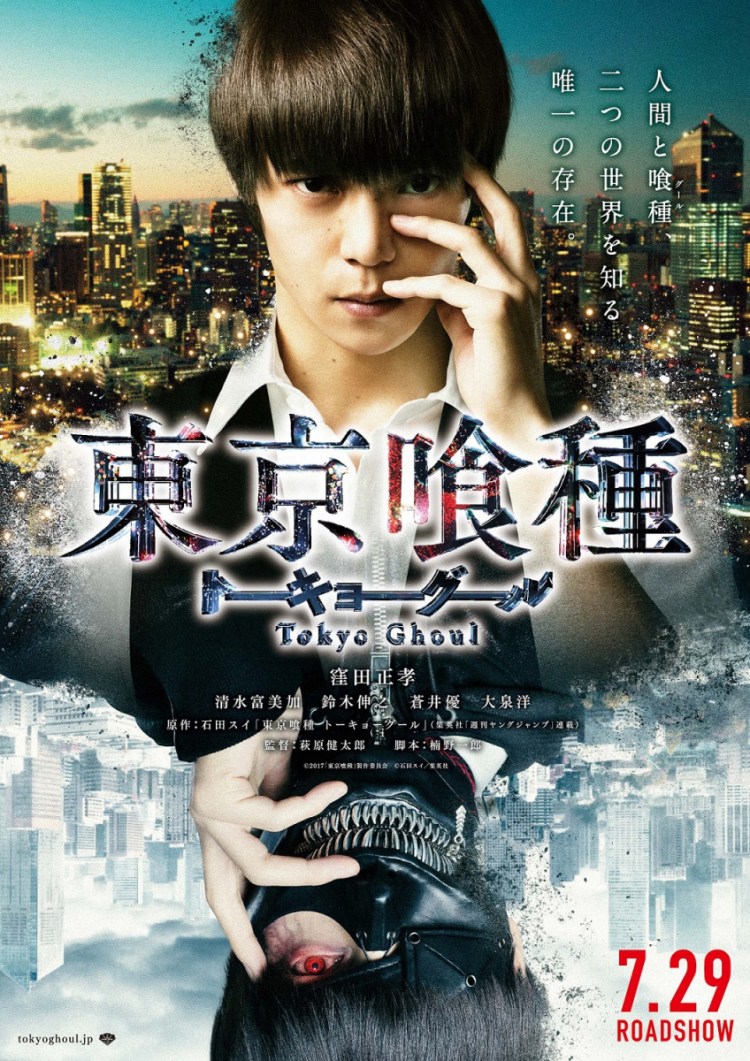
Tokyo Ghoul posterThough the idea has never been far away, Japanese cinema has largely steered clear of the enemy within. Recently however the “they walk among us” phenomenon seems to have gained traction from the horror-leaning Parasyte to the contemplative Before We Vanish. Parasyte would seem to be an appropriate point of departure for Kentaro Hagiwara’s debut feature, an adaptation of Sui Ishida’s hugely popular manga Tokyo Ghoul (東京喰種). Like Hitoshi Iwaaki’s ‘80s take on Invasion of the Body Snatchers, Tokyo Ghoul creates for itself a subsection of “humanity” which is not quite human yet apparently lives alongside “us” keeping its true nature and identity a secret in order to avoid detection. Unlike Parasyte, however, the intentions of the Ghouls are not so much destruction or colonisation as simple survival.

Ken Kaneki (Masataka Kubota), a shy bookworm with only one real friend, is trying to pluck up the courage to talk to another shy bookworm he often notices reading the kind of books he likes in a cafe they both seem to enjoy going to. It would seem that they have quite a lot in common already, but when Ken ends up on a successful date with Rize (Yu Aoi) he gets a little more than he bargained for. Far from the shy and mousy creature of his dreams, Rize is a raging Ghoul hungry for flesh rather than love. Luckily, Rize is killed in a freak accident just as she’s about devour poor Ken. Ken, however, survives but only thanks to a transplant of Rize’s organs meaning he is now part-Ghoul and can only live on human meat.

Neither one thing nor another, Ken struggles to accept his new nature as he craves flesh and has strange visions in which he imagines himself as Rize the crazed and ravenous Ghoul. Starving and alone he finally finds his way to the Anteiku cafe where he first met Rize and now finds a support network led by ethical Ghouls who sustain themselves on ethically sourced meat and high end coffee. These Ghouls do not want to kill, they simply want to survive which also means keeping one step ahead of the CCG which exists specifically in order to hunt down Ghouls with extreme prejudice.

In many a sci-fi tome, the CCG would be the good guys – protecting regular humans from a monstrous threat lurking in the shadows. After all, who would defend a substratum of cannibal serial killers who think nothing of devouring human flesh in front of its horrified offspring, but the CCG have perhaps begun to take too much pleasure in their work. Cold and calculating detective Amon (Nobuyuki Suzuki) has an idea that the world is “wrong” and it’s his job to put it right by exterminating the Ghouls, whereas creepy silver-haired detective Mado (Yo Oizumi) enjoys toying with his prey as much as Rize did and has even begun to harvest the various “Kagune” protuberances with which the Ghouls are endowed to use in his quest to defeat them.

The CCG may be justified in their fear in but in their methods they are little different than their quarry. The Ghouls too have a right to survive and are, after all, only being what they are. CCG might be better off working with Anteiku to minimise the Ghoul threat rather than engaging in a pointless and internecine war that guarantees only a continuation of violence and fear on both sides.

Having posited such interesting ideas it’s a shame that Tokyo Ghoul reverts to the classic super hero formula of resolving everything through a climactic battle in which Ken is forced to confront himself whilst battling CCG. Neither Ghoul nor human, Ken sees faults on both sides but perhaps learns to come into himself, no longer a diffident young man but one committed to protecting his friends even if it’s themselves they need protecting from.

Hagiwara opts for an artier approach than might expected though his noble intentions are often undercut by poor quality CGI and the inescapably outrageous quality of the source material. Nevertheless he gets impressive performances from his young cast even if some fan favourite characters are relegated to little more than background decoration and others scarcely written at all. Perhaps biting off more than it can chew, Tokyo Ghoul is an uneven experience but one that does its best to find heroism in villainy and villainy in heroism, negating the good/evil dichotomy of superhero morality for something altogether more complex.


Tokyo Ghoul was screened for one night only across the UK and will be released by Anime Limited later in the year.

UK release trailer (English subtitles)

YEAH (Yohei Suzuki, 2018)

Yeah still 2Following a series of high profile shorts in international festivals, Yohei Suzuki’s debut feature Ow became something of a cult hit in its surreal, sci-fi leaning tale of an unemployed young man who becomes transfixed by a mysterious round object that suddenly appears in his room, entering a kind of suspended animation which later claims several of his friends and family. Four years on Suzuki’s back with a second feature, but one which runs a scant 45 minutes. The enthusiastically titled “YEAH” takes a similarly surreal approach in dissecting the effects on ongoing national decline on the nation’s youth through the actions of a strange young woman who floats like a ghost through her rapidly disintegrating world.

There’s something a bit different about Ako. When we meet her, she appears to be in the middle of a difficult breakup with a scarecrow. Holding on to the bottom of a sleeve attached to a jacket which is being worn by a dressmaker’s mannequin, Ako laments that she likes how he doesn’t talk but hates not seeing him. Eventually she switches her attentions to a nearby tree which she praises for its constant services on behalf of “Man-kind”. Looking for her mother and sister, Ako wanders into other people’s apartments and confuses local shop keepers, carrying around a pot of coriander she’s collected for its cuteness and cradling it as if it were a baby. She hallucinates strange visions of a scary man and is taken to a mental hospital by another who seems to be her brother but is released back into his care only to wander off and meet another girl just like her who later confesses that she is, in fact, a bean and though she was at first frightened by her realisation, is OK with it now.

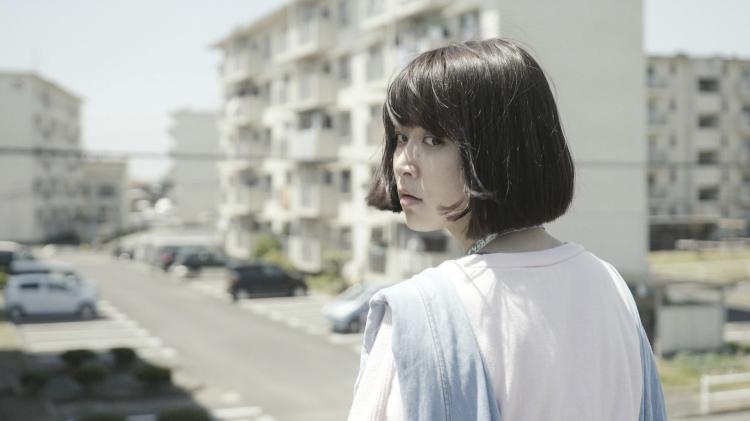
Set in Mito in rural Ibaraki, YEAH takes place entirely within a rundown housing estate. Ako, wandering around in wellies, is a lone figure in this oddly quiet settlement. Local teens hang out in the central courtyard where the grass is dying and the swings and climbing frames long rusty from underuse. A classic danchi with dingy open staircases, no lifts, and long corridors the atmosphere is one of decline and defeat. A symbol of an economic leap forward, farmlands giving way to a displaced urban populace, the estate could not be more out of step with modern times as the young make their way towards cities or back towards the land, forever abandoning this awkward liminal space which seems to have been eclipsed by a change in the economic weather.

Women like Ako are, perhaps, a kind of ghost – floating about unseen and unheeded, left with nothing other to do than go slowly mad in a world which is dying all around them. Rejected by the other young people on the estate who use her as a kind of entertainment, Ako literally slips in and out of the conscious world, disappearing from one place only to appear in another still carrying her beloved plant around with her. Lamenting that her home is gone and everything she loved has been taken away, Ako is left only with her worshipful devotion to “Atchy-ma” who “shines the light” on her, and a fierce love of the industry of plant life which works so tirelessly to maintain the environment human beings are so keen to destroy. 

Suzuki’s approach is surreal and obscure, making frequent use of dissolves and superimpositions to capture the various ways Ako is literally lost to or eliminated by her environment. Ako exclaims that she still doesn’t get “YEAH”, because she is “Japanese after all”, but keeps trying anyway, screaming into a void in search of some kind of light while those around her continue in similarly idle pursuits which, while less unusual, lack her otherwise idealistic sense of purpose.


Available to stream on Festival Scope until 20th February as part of their International Film Festival Rotterdam tie-up.

Respeto (Alberto Monteras II, 2017)

https://www.respetomovie.com/

https://www.respetomovie.com/“Respect” is a thorny issue, is it something which is conferred from a position of inferiority, an acceptance of equality, or taken by force? Should the older generation be “entitled” to the respect of the young simply for having been born earlier, lived longer, and have less time left, and should the state also be “entitled” to the respect of its citizens even if it abuses that respect? Respeto is the debut feature from Alberto (Treb) Monteras II but like much Philippine cinema it comes with heavy baggage as its scrappy youngster attempts to come of age in the hip hop dens of the Pandacan slums where all around him the increasingly oppressive Duterte regime brings back terrible memories for a generation only once removed from his own which paid a heavy price to rid themselves of a tyranny they now see returning.

Hendrix (Abra), a scrappy teen living with his older sister and her boyfriend who prides himself for his magnanimity in supporting his lover’s annoying kid brother, says he has the “mind of a gangster” and longs to prove himself in the underground rap battling world which represents a kind of escape from the harshness of his everyday existence. Hip hop maybe the music of the oppressed, but there’s little politicking in arcane world of petty gangsters and drugged up thugs. This is a world of humiliation – the rappers rap about rapping, about how their rhymes are sweeter than their opponent’s, how their opponent is weak and they are strong. Despite an often careful honing of a craft, this rap is vacuous – a misuse of words that could serve real purpose to do little more than replace the act of physical violence with macho male posturing.

This is certainly a very male, macho world. Inducted into the rap battle scene, Hendrix is tricked into battling an old veteran, Jambalaya – a larger lady with an intimidating presence, but all he can come up with is a steady stream of misogynistic fat jokes, badly delivered, before he wets himself live on stage. Jambalaya quite rightly destroys him with an elegantly delivered takedown which subtly suggests everything he’s just said is completely beneath him and is therefore doubly insulting. Hendrix is humiliated, as the loser of the battles is intended to be, but he’s slow to realise that the game itself is already a betrayal of its own power.

Having stolen the money to participate in the rap battle from Mondo (Brian Arda), his sister’s dodgy boyfriend, Hendrix hits on an extreme solution to pay him back – robbing the secondhand bookshop run by an old man, Doc (Dido De La Paz), seemingly suffering with the early stages of dementia. The plan fails because Hendrix and his buddies aren’t exactly master criminals, but as a result they find themselves tasked with having to repair the damage while Doc, mildly outraged by the youth of the day, begins to see enough potential in the obviously bright yet stubborn young man to want to try to save him.

What occurs between them is somewhere between a war of words and a war for words. Doc, now an old man, was an activist poet during the Marcos regime who lost a wife and child to its brutality. In the end, his words were not enough but unlike those of the rap battlers of Pandacan, they were both beautiful and filled with purpose. Doc’s verses were, in a sense, intended to humiliate a regime – in this they are not so different from Hendrix’s rhymes, but they failed to take the place of violence. A man of words faced with the possibility of revenge, Doc was not strong enough to resist but bought himself only more anguish in a single act of primal rage that soon forged another link in a chain stretching out in both directions across an eternity.

Peppered throughout, radio broadcasts make frequent reference to a debate surrounding the long delayed burial of former dictator Ferdinand Marcos who died in exile in 1989. The older generation fought an oppressive regime and thought they’d won only for their children to betray the revolution they gave birth to – literally in Doc’s case as his son became a corrupt policeman who abuses his power to humiliate those whose should “respect” he ought to earn through continued service. Rendered powerless by their oppressive environments, both Doc and Hendrix sought to reclaim their self respect by asserting their voice, but in the end their words find only empty air. Somehow awed by ancient technology, the kids find an old record of a Marcos era protest song in Doc’s bookshop and realise they already know the words. The singer, seemingly a young person, begs to be left out the political storm, not to be dragged into a war he sees as nothing to do with him, but an escape from this unending cycle of violence seems unlikely while words remain weightless.


Available to stream online via Festival Scope until 20th February 2018 as part of its International Film Festival Rotterdam tie-up.

Original trailer (English subtitles)

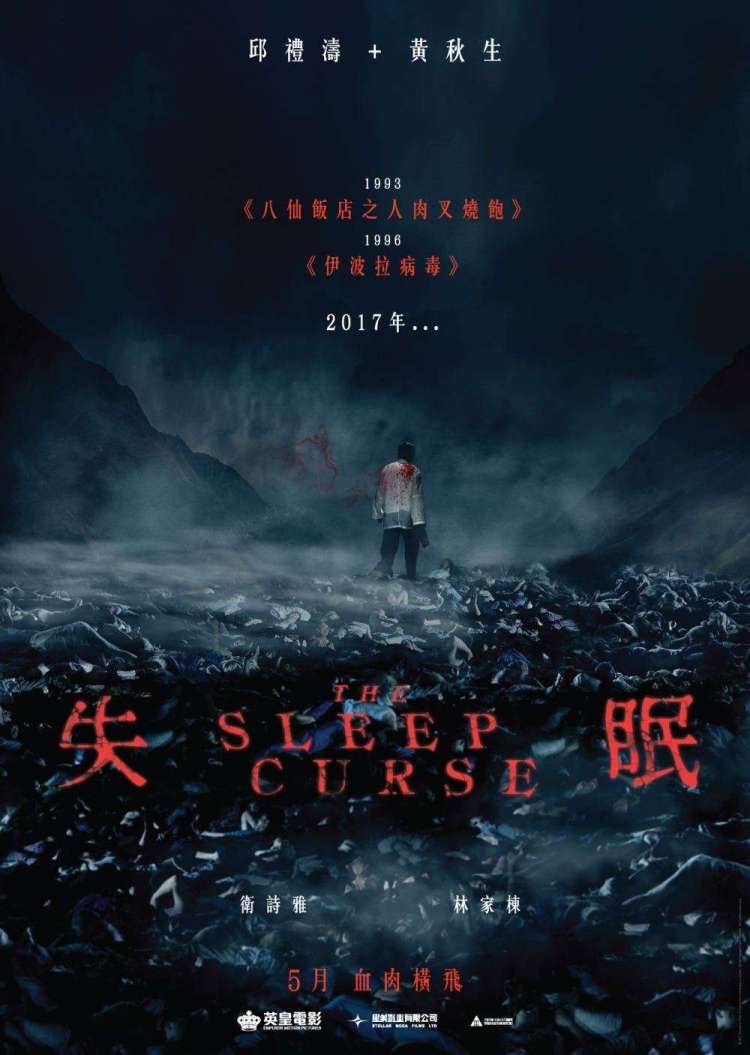
The Sleep Curse (失眠, Herman Yau, 2017)

sleep curse posterInsomnia can be like a curse, a yearning for sleep that yields no rest and paints the days with a lingering greyness but the regular kind of sleeplessness rarely has consequences as extreme as those experienced by the beleaguered protagonists of Herman Yau’s The Sleep Curse (失眠). Historical trauma and cultural memories continue to haunt the present, the refusal to lay the dead to rest giving rise to a hundred hungry ghosts all asking for recognition and some gesture of atonement from those that have come later. Yau’s film touches on some thorny, even taboo areas but doing so in the context of a Category III horror extravaganza that eventually descends into a bloodbath of perverse depravity might even push poor taste too far.

In 1990, a Malaysian Chinese grandfather celebrates his birthday and then develops chronic insomnia which eventually drives him insane, murderous, and suicidal. Meanwhile, abrasive professor Lam Sik-ka (Anthony Wong) is hard at work on a controversial research programme to discover a way for people to live without the need for sleep. His latest grant application has just been turned down because the university can’t see the benefit in his research and claim his methods are unethical. Sik-ka is, therefore, even happier than might be thought to reunite with a former girlfriend, Monique (Jojo Goh), who is the granddaughter of the Malaysian Chinese grandpa and suffers from a rare sleep disorder herself. It’s not for herself she’s approaching Sik-ka though, but for her brother.

For unrelated reasons, Sik-ka is also anxious to lay his own father’s ghost to rest by visiting a Taoist priest to help him remember what happened to his dad back in 1943. What ensues is two lengthy flashbacks to occupied Hong Kong in which Sik-ka’s father, Sing (also played by Wong), is coerced into collaborating with the Japanese when it is discovered that he was raised in Japan and has fluent command of the language. While Sing’s capitulation is guilt-ridden and born of fear for himself and his family, another turncoat, Chow Fok (Gordon Lam), has embraced his role as an active participant in Japanese rule, rounding up girls for the local “comfort station” which he himself runs.

The Japanese are an easy target, but Yau has his sights set on the evils of collaboration and his eye is particularly unforgiving. Sik-ka’s father is repeatedly described as a “good man”, though often by those seeking to justify his less good actions. The film acknowledges the difficulty of Sing’s position as a single father desperate to protect his son and mother yet fearing that one wrong move or unwise refusal may get them all killed. He does good where he can – helping a small number of young comfort women to escape, but finds that his “good” deed provokes only more harm when 40 are required to take the place of four escaped. Sing saves one of twins, “awarded” to him in place of a wife by the lecherous Japanese Colonel, but finds himself the subject of a curse by her supernaturally endowed sister who casts her evil eye upon all those who have wronged her.

This particular plot development makes little sense seeing as Sing is the one thing between her sister and the fate worse than death that she has just endured. Nevertheless, the vengeful ghost of a betrayed woman follows one generation to the next in her quest for retribution, remaining unseen and unremembered by those who should avenge her. Given the sensitivity of the issues, which maybe more pronounced in territories further North than Hong Kong, it is perhaps in poor taste to make them the centre of an exploitation leaning Category III horror film, offering only the message that the unresolved past will eventually consume the children who inherit only past trauma from their guilt ridden (or unrepentant) forebears.

Yau begins in the mode of tame absurdity as Sik-ka calmly breaks into a morgue for an impromptu bit of brain theft (later shoving his loot into a hollowed out durian fruit to hide his crime), but descends into blood soaked depravity in the increasingly strange final reel. Genuinely outrageous, though also incoherent, The Sleep Curse should provoke nightmares enough with its shocking, gore filled finale but may also leave a sour taste in the mouth.


Original trailer (Cantonese with English subtitles – contains intense gore/violence!)