Birds Without Names (彼女がその名を知らない鳥たち, Kazuya Shiraishi, 2017)

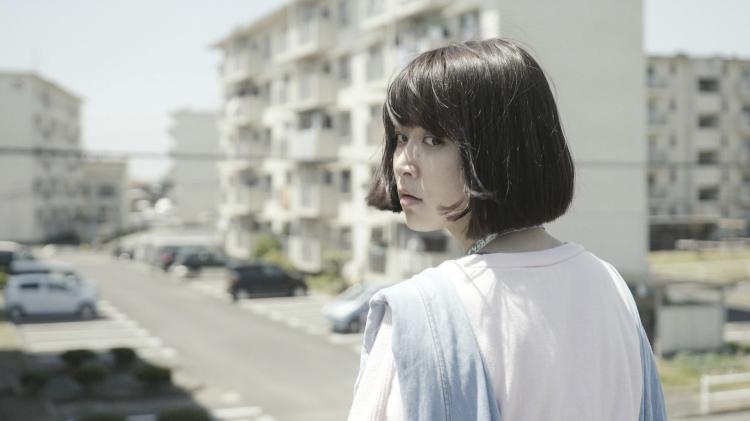
Birds Without Names poster“Human beings are lonely by nature”, a statement offered by someone who could well think he’s lying but accidentally tells the truth in Kazuya Shiraishi’s Birds Without Names (彼女がその名を知らない鳥たち, Kanojo ga Sono Na wo Shiranai Toritachi). Loneliness, of an existential more than physical kind, eats away at the souls of those unable to connect with what it is they truly want until they eventually destroy themselves through explosive acts of irrepressible rage or, perhaps, of love. The bad look good and the good look bad but appearances can be deceptive, as can memory, and when it comes to the truths of emotional connection the sands are always shifting.

Towako (Yu Aoi), an unmarried woman in her 30s, does not work and spends most of her time angrily ringing up customer service departments to complain about things in the hope of getting some kind of compensation. She lives with an older man, Jinji (Sadao Abe) – a construction worker, who is completely devoted to her and provides both financial and emotional support despite Towako’s obvious contempt for him. Referring to him as a “slug”, Towako consistently rejects Jinji’s amorous advances and resents his, in her view, overly controlling behaviour in which he rings her several times a day and keeps general tabs on her whereabouts.

Depressed and on edge, Towako’s life takes a turn when she gets into a dispute with an upscale jewellery store over a watch repair and ends up beginning an affair with the handsome salesman who visits her apartment with a selection of possible replacements. Around the same time, Towako rings an ex-boyfriend’s number in a moment of weakness only to reconsider and hangup right away. The next day a policeman arrives and informs her that they’ve been monitoring her ex’s phone because his wife reported him missing five years ago and he’s not been seen since.

Towako views Jinji’s behaviour as possessive and his continuing devotion pathetic in his eagerness to debase himself for her benefit. Her sister Misuzu (Mukku Akazawa), however, thinks Jinji is good for her and berates Towako for her ill treatment of him. Despite the fact that Towako’s relationship with her ex, Kurosaki (Yutaka Takenouchi), ended eight years previously, Misuzu is paranoid Towako is still seeing him on the sly and will eventually try to get back together with him. Misuzu does not want this to happen because Kurosaki beat Towako so badly she landed in hospital, but despite this and worse, Towako cannot let the spectre of Kurosaki and the happiness promised in their earliest days go. She continues to pine for him, looking for other Kurosakis in the form of other handsome faces selling false promises and empty words.

Mizushima (Mukku Akazawa), the watch salesman, is just Towako’s type – something which Jinji seems to know when he violently pushes a Mizushima look-alike off a busy commuter train just because he saw the way Towako looked at him. Daring to kiss her when she abruptly starts crying while looking at his replacement watches, Mizushima spins her a line about an unhappy marriage and his craving for solitude which he sates through solo travel – most recently to a remote spot in the desert and cave they call an underground womb. Mizushima describes himself as a lonely soul and claims to have found a kindred spirit in Towako whose loneliness it was that first sparked his interest. Like all the men in the picture, Mizushima is not all he seems and there is reason to disbelieve much of what he says but he may well be correct in his assessment of Towako’s need for impossible connections with emotionally unavailable men who only ever cause her pain.

It just so happens that Kurosaki’s apparent disappearance happened around the time Towako began dating Jinji. Seeing as his behaviour is often controlling, paranoid and, as seen in the train incident, occasionally violent, Towako begins to suspect he may be involved in the mysterious absence of her one true love. Then again, Towako may well need protecting from herself and perhaps, as Misuzu seems to think, Jinji is just looking out for her. The deeper Jinji’s devotion descends, the more Towako’s contempt for him grows but the suspicion that he may be capable of something far darker provokes a series of strange and unexpected reactions in the already unsteady Towako.

A dark romance more than noirish mystery,  Birds Without Names takes place in a gloomy Osaka soaked in disappointment and post-industrial grime where the region’s distinctive accent loses its sometimes soft, comedic edge for a relentless bite in which words reject the connection they ultimately seek. Rejection, humiliation, degradation, and a hopeless sense of incurable loneliness push already strained minds towards an abyss but there’s a strange kind of purity in the intensity of selfless love which, uncomfortably enough, offers salvation in a final act of destruction.


 Screened as part of the Japan Foundation Touring Film Programme 2018.

Also screening at:

  • Firstsite (Colchester) 9 February 2018
  • HOME (Manchester) 12 February 2018
  • Watershed (Bristol) – 13 February 2018
  • Exeter Phoenix – 27 February 2018
  • Depot (Lewes) – 6 March 2018
  • Filmhouse (Edinburgh) – 8 March 2018

International trailer (English subtitles)

Tokyo Ghoul (東京喰種, Kentaro Hagiwara, 2017)

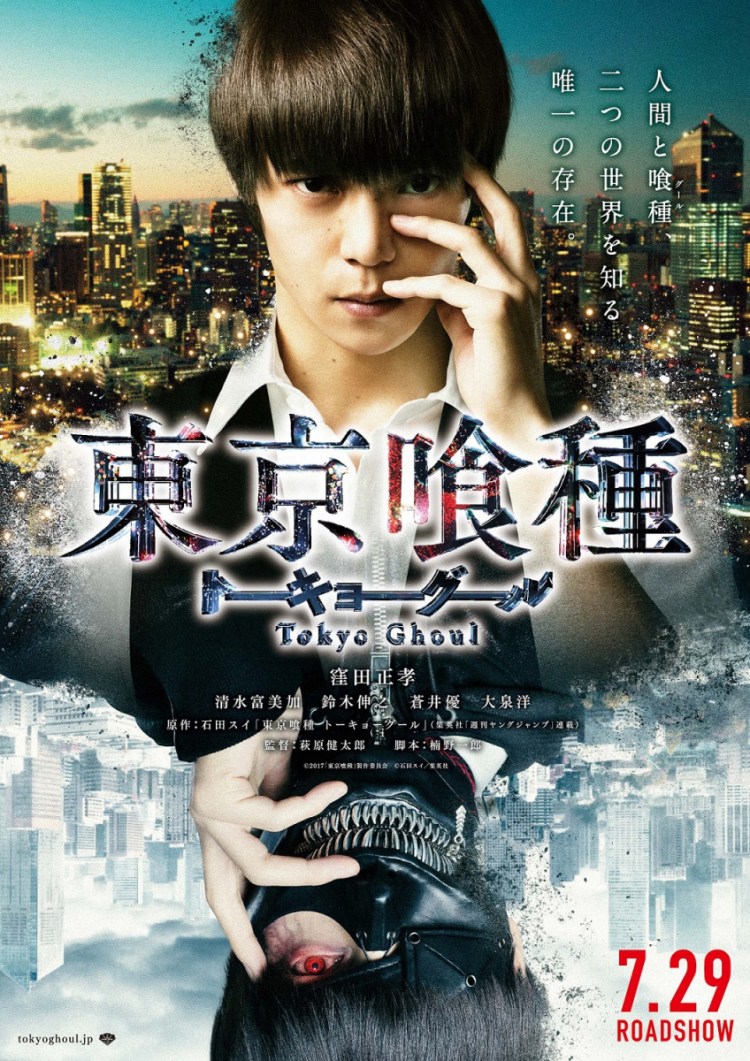
Tokyo Ghoul posterThough the idea has never been far away, Japanese cinema has largely steered clear of the enemy within. Recently however the “they walk among us” phenomenon seems to have gained traction from the horror-leaning Parasyte to the contemplative Before We Vanish. Parasyte would seem to be an appropriate point of departure for Kentaro Hagiwara’s debut feature, an adaptation of Sui Ishida’s hugely popular manga Tokyo Ghoul (東京喰種). Like Hitoshi Iwaaki’s ‘80s take on Invasion of the Body Snatchers, Tokyo Ghoul creates for itself a subsection of “humanity” which is not quite human yet apparently lives alongside “us” keeping its true nature and identity a secret in order to avoid detection. Unlike Parasyte, however, the intentions of the Ghouls are not so much destruction or colonisation as simple survival.

Ken Kaneki (Masataka Kubota), a shy bookworm with only one real friend, is trying to pluck up the courage to talk to another shy bookworm he often notices reading the kind of books he likes in a cafe they both seem to enjoy going to. It would seem that they have quite a lot in common already, but when Ken ends up on a successful date with Rize (Yu Aoi) he gets a little more than he bargained for. Far from the shy and mousy creature of his dreams, Rize is a raging Ghoul hungry for flesh rather than love. Luckily, Rize is killed in a freak accident just as she’s about devour poor Ken. Ken, however, survives but only thanks to a transplant of Rize’s organs meaning he is now part-Ghoul and can only live on human meat.

Neither one thing nor another, Ken struggles to accept his new nature as he craves flesh and has strange visions in which he imagines himself as Rize the crazed and ravenous Ghoul. Starving and alone he finally finds his way to the Anteiku cafe where he first met Rize and now finds a support network led by ethical Ghouls who sustain themselves on ethically sourced meat and high end coffee. These Ghouls do not want to kill, they simply want to survive which also means keeping one step ahead of the CCG which exists specifically in order to hunt down Ghouls with extreme prejudice.

In many a sci-fi tome, the CCG would be the good guys – protecting regular humans from a monstrous threat lurking in the shadows. After all, who would defend a substratum of cannibal serial killers who think nothing of devouring human flesh in front of its horrified offspring, but the CCG have perhaps begun to take too much pleasure in their work. Cold and calculating detective Amon (Nobuyuki Suzuki) has an idea that the world is “wrong” and it’s his job to put it right by exterminating the Ghouls, whereas creepy silver-haired detective Mado (Yo Oizumi) enjoys toying with his prey as much as Rize did and has even begun to harvest the various “Kagune” protuberances with which the Ghouls are endowed to use in his quest to defeat them.

The CCG may be justified in their fear in but in their methods they are little different than their quarry. The Ghouls too have a right to survive and are, after all, only being what they are. CCG might be better off working with Anteiku to minimise the Ghoul threat rather than engaging in a pointless and internecine war that guarantees only a continuation of violence and fear on both sides.

Having posited such interesting ideas it’s a shame that Tokyo Ghoul reverts to the classic super hero formula of resolving everything through a climactic battle in which Ken is forced to confront himself whilst battling CCG. Neither Ghoul nor human, Ken sees faults on both sides but perhaps learns to come into himself, no longer a diffident young man but one committed to protecting his friends even if it’s themselves they need protecting from.

Hagiwara opts for an artier approach than might expected though his noble intentions are often undercut by poor quality CGI and the inescapably outrageous quality of the source material. Nevertheless he gets impressive performances from his young cast even if some fan favourite characters are relegated to little more than background decoration and others scarcely written at all. Perhaps biting off more than it can chew, Tokyo Ghoul is an uneven experience but one that does its best to find heroism in villainy and villainy in heroism, negating the good/evil dichotomy of superhero morality for something altogether more complex.


Tokyo Ghoul was screened for one night only across the UK and will be released by Anime Limited later in the year.

UK release trailer (English subtitles)

YEAH (Yohei Suzuki, 2018)

Yeah still 2Following a series of high profile shorts in international festivals, Yohei Suzuki’s debut feature Ow became something of a cult hit in its surreal, sci-fi leaning tale of an unemployed young man who becomes transfixed by a mysterious round object that suddenly appears in his room, entering a kind of suspended animation which later claims several of his friends and family. Four years on Suzuki’s back with a second feature, but one which runs a scant 45 minutes. The enthusiastically titled “YEAH” takes a similarly surreal approach in dissecting the effects on ongoing national decline on the nation’s youth through the actions of a strange young woman who floats like a ghost through her rapidly disintegrating world.

There’s something a bit different about Ako. When we meet her, she appears to be in the middle of a difficult breakup with a scarecrow. Holding on to the bottom of a sleeve attached to a jacket which is being worn by a dressmaker’s mannequin, Ako laments that she likes how he doesn’t talk but hates not seeing him. Eventually she switches her attentions to a nearby tree which she praises for its constant services on behalf of “Man-kind”. Looking for her mother and sister, Ako wanders into other people’s apartments and confuses local shop keepers, carrying around a pot of coriander she’s collected for its cuteness and cradling it as if it were a baby. She hallucinates strange visions of a scary man and is taken to a mental hospital by another who seems to be her brother but is released back into his care only to wander off and meet another girl just like her who later confesses that she is, in fact, a bean and though she was at first frightened by her realisation, is OK with it now.

Set in Mito in rural Ibaraki, YEAH takes place entirely within a rundown housing estate. Ako, wandering around in wellies, is a lone figure in this oddly quiet settlement. Local teens hang out in the central courtyard where the grass is dying and the swings and climbing frames long rusty from underuse. A classic danchi with dingy open staircases, no lifts, and long corridors the atmosphere is one of decline and defeat. A symbol of an economic leap forward, farmlands giving way to a displaced urban populace, the estate could not be more out of step with modern times as the young make their way towards cities or back towards the land, forever abandoning this awkward liminal space which seems to have been eclipsed by a change in the economic weather.

Women like Ako are, perhaps, a kind of ghost – floating about unseen and unheeded, left with nothing other to do than go slowly mad in a world which is dying all around them. Rejected by the other young people on the estate who use her as a kind of entertainment, Ako literally slips in and out of the conscious world, disappearing from one place only to appear in another still carrying her beloved plant around with her. Lamenting that her home is gone and everything she loved has been taken away, Ako is left only with her worshipful devotion to “Atchy-ma” who “shines the light” on her, and a fierce love of the industry of plant life which works so tirelessly to maintain the environment human beings are so keen to destroy. 

Suzuki’s approach is surreal and obscure, making frequent use of dissolves and superimpositions to capture the various ways Ako is literally lost to or eliminated by her environment. Ako exclaims that she still doesn’t get “YEAH”, because she is “Japanese after all”, but keeps trying anyway, screaming into a void in search of some kind of light while those around her continue in similarly idle pursuits which, while less unusual, lack her otherwise idealistic sense of purpose.


Available to stream on Festival Scope until 20th February as part of their International Film Festival Rotterdam tie-up.

Respeto (Alberto Monteras II, 2017)

https://www.respetomovie.com/

https://www.respetomovie.com/“Respect” is a thorny issue, is it something which is conferred from a position of inferiority, an acceptance of equality, or taken by force? Should the older generation be “entitled” to the respect of the young simply for having been born earlier, lived longer, and have less time left, and should the state also be “entitled” to the respect of its citizens even if it abuses that respect? Respeto is the debut feature from Alberto (Treb) Monteras II but like much Philippine cinema it comes with heavy baggage as its scrappy youngster attempts to come of age in the hip hop dens of the Pandacan slums where all around him the increasingly oppressive Duterte regime brings back terrible memories for a generation only once removed from his own which paid a heavy price to rid themselves of a tyranny they now see returning.

Hendrix (Abra), a scrappy teen living with his older sister and her boyfriend who prides himself for his magnanimity in supporting his lover’s annoying kid brother, says he has the “mind of a gangster” and longs to prove himself in the underground rap battling world which represents a kind of escape from the harshness of his everyday existence. Hip hop maybe the music of the oppressed, but there’s little politicking in arcane world of petty gangsters and drugged up thugs. This is a world of humiliation – the rappers rap about rapping, about how their rhymes are sweeter than their opponent’s, how their opponent is weak and they are strong. Despite an often careful honing of a craft, this rap is vacuous – a misuse of words that could serve real purpose to do little more than replace the act of physical violence with macho male posturing.

This is certainly a very male, macho world. Inducted into the rap battle scene, Hendrix is tricked into battling an old veteran, Jambalaya – a larger lady with an intimidating presence, but all he can come up with is a steady stream of misogynistic fat jokes, badly delivered, before he wets himself live on stage. Jambalaya quite rightly destroys him with an elegantly delivered takedown which subtly suggests everything he’s just said is completely beneath him and is therefore doubly insulting. Hendrix is humiliated, as the loser of the battles is intended to be, but he’s slow to realise that the game itself is already a betrayal of its own power.

Having stolen the money to participate in the rap battle from Mondo (Brian Arda), his sister’s dodgy boyfriend, Hendrix hits on an extreme solution to pay him back – robbing the secondhand bookshop run by an old man, Doc (Dido De La Paz), seemingly suffering with the early stages of dementia. The plan fails because Hendrix and his buddies aren’t exactly master criminals, but as a result they find themselves tasked with having to repair the damage while Doc, mildly outraged by the youth of the day, begins to see enough potential in the obviously bright yet stubborn young man to want to try to save him.

What occurs between them is somewhere between a war of words and a war for words. Doc, now an old man, was an activist poet during the Marcos regime who lost a wife and child to its brutality. In the end, his words were not enough but unlike those of the rap battlers of Pandacan, they were both beautiful and filled with purpose. Doc’s verses were, in a sense, intended to humiliate a regime – in this they are not so different from Hendrix’s rhymes, but they failed to take the place of violence. A man of words faced with the possibility of revenge, Doc was not strong enough to resist but bought himself only more anguish in a single act of primal rage that soon forged another link in a chain stretching out in both directions across an eternity.

Peppered throughout, radio broadcasts make frequent reference to a debate surrounding the long delayed burial of former dictator Ferdinand Marcos who died in exile in 1989. The older generation fought an oppressive regime and thought they’d won only for their children to betray the revolution they gave birth to – literally in Doc’s case as his son became a corrupt policeman who abuses his power to humiliate those whose should “respect” he ought to earn through continued service. Rendered powerless by their oppressive environments, both Doc and Hendrix sought to reclaim their self respect by asserting their voice, but in the end their words find only empty air. Somehow awed by ancient technology, the kids find an old record of a Marcos era protest song in Doc’s bookshop and realise they already know the words. The singer, seemingly a young person, begs to be left out the political storm, not to be dragged into a war he sees as nothing to do with him, but an escape from this unending cycle of violence seems unlikely while words remain weightless.


Available to stream online via Festival Scope until 20th February 2018 as part of its International Film Festival Rotterdam tie-up.

Original trailer (English subtitles)

The Sleep Curse (失眠, Herman Yau, 2017)

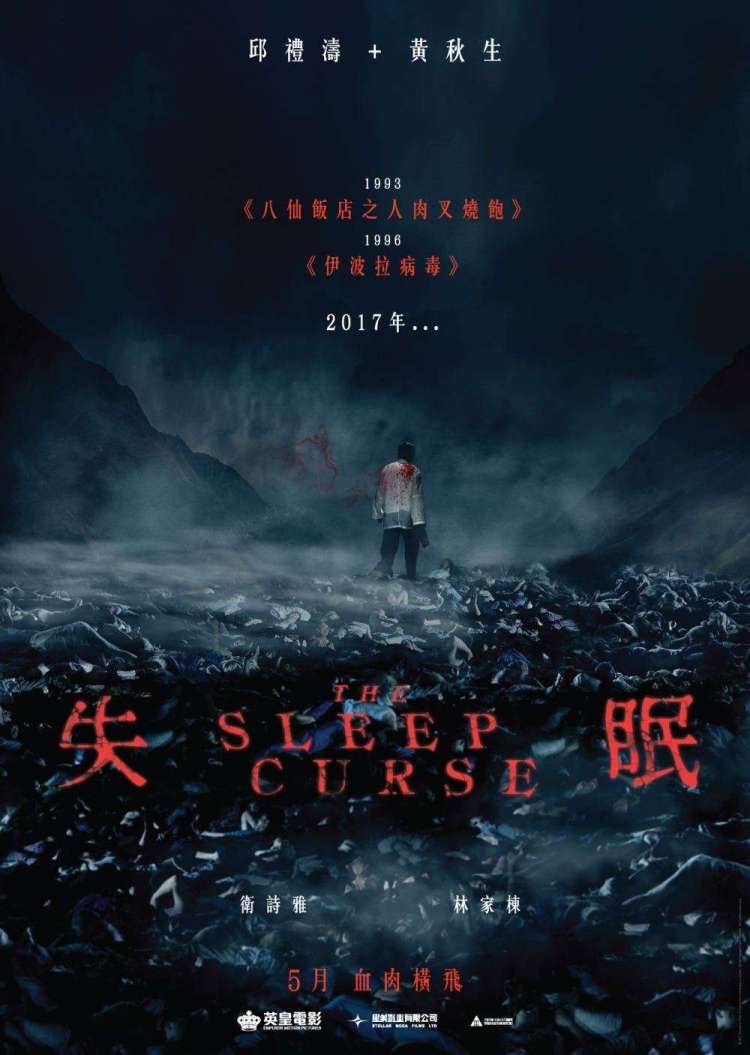
sleep curse posterInsomnia can be like a curse, a yearning for sleep that yields no rest and paints the days with a lingering greyness but the regular kind of sleeplessness rarely has consequences as extreme as those experienced by the beleaguered protagonists of Herman Yau’s The Sleep Curse (失眠). Historical trauma and cultural memories continue to haunt the present, the refusal to lay the dead to rest giving rise to a hundred hungry ghosts all asking for recognition and some gesture of atonement from those that have come later. Yau’s film touches on some thorny, even taboo areas but doing so in the context of a Category III horror extravaganza that eventually descends into a bloodbath of perverse depravity might even push poor taste too far.

In 1990, a Malaysian Chinese grandfather celebrates his birthday and then develops chronic insomnia which eventually drives him insane, murderous, and suicidal. Meanwhile, abrasive professor Lam Sik-ka (Anthony Wong) is hard at work on a controversial research programme to discover a way for people to live without the need for sleep. His latest grant application has just been turned down because the university can’t see the benefit in his research and claim his methods are unethical. Sik-ka is, therefore, even happier than might be thought to reunite with a former girlfriend, Monique (Jojo Goh), who is the granddaughter of the Malaysian Chinese grandpa and suffers from a rare sleep disorder herself. It’s not for herself she’s approaching Sik-ka though, but for her brother.

For unrelated reasons, Sik-ka is also anxious to lay his own father’s ghost to rest by visiting a Taoist priest to help him remember what happened to his dad back in 1943. What ensues is two lengthy flashbacks to occupied Hong Kong in which Sik-ka’s father, Sing (also played by Wong), is coerced into collaborating with the Japanese when it is discovered that he was raised in Japan and has fluent command of the language. While Sing’s capitulation is guilt-ridden and born of fear for himself and his family, another turncoat, Chow Fok (Gordon Lam), has embraced his role as an active participant in Japanese rule, rounding up girls for the local “comfort station” which he himself runs.

The Japanese are an easy target, but Yau has his sights set on the evils of collaboration and his eye is particularly unforgiving. Sik-ka’s father is repeatedly described as a “good man”, though often by those seeking to justify his less good actions. The film acknowledges the difficulty of Sing’s position as a single father desperate to protect his son and mother yet fearing that one wrong move or unwise refusal may get them all killed. He does good where he can – helping a small number of young comfort women to escape, but finds that his “good” deed provokes only more harm when 40 are required to take the place of four escaped. Sing saves one of twins, “awarded” to him in place of a wife by the lecherous Japanese Colonel, but finds himself the subject of a curse by her supernaturally endowed sister who casts her evil eye upon all those who have wronged her.

This particular plot development makes little sense seeing as Sing is the one thing between her sister and the fate worse than death that she has just endured. Nevertheless, the vengeful ghost of a betrayed woman follows one generation to the next in her quest for retribution, remaining unseen and unremembered by those who should avenge her. Given the sensitivity of the issues, which maybe more pronounced in territories further North than Hong Kong, it is perhaps in poor taste to make them the centre of an exploitation leaning Category III horror film, offering only the message that the unresolved past will eventually consume the children who inherit only past trauma from their guilt ridden (or unrepentant) forebears.

Yau begins in the mode of tame absurdity as Sik-ka calmly breaks into a morgue for an impromptu bit of brain theft (later shoving his loot into a hollowed out durian fruit to hide his crime), but descends into blood soaked depravity in the increasingly strange final reel. Genuinely outrageous, though also incoherent, The Sleep Curse should provoke nightmares enough with its shocking, gore filled finale but may also leave a sour taste in the mouth.


Original trailer (Cantonese with English subtitles – contains intense gore/violence!)

How to Steal a Dog (개를 훔치는 완벽한 방법, Kim Sung-ho, 2014)

how to steal a dog posterEverything seems so simple to children. The logic maybe surreal, but it is direct. Problems have solutions and there are clear pathways to achieve them even if they seem odd to a more adult way of thinking. Perhaps we’d all be better off if we thought about social issues in the same way children do, though naivety and innocence often prove blindspots in otherwise solid plans. How to Steal a Dog (개를 훔치는 완벽한 방법, Gaereul Hoomchineun Wanbyeokhan Bangbub) is basically a heist movie in which two adorable little girls plan to kidnap a beloved pooch from a rich old lady who will then be only too happy to part with her millions to get it back but it’s also a subtle social satire on class relations and the economic causes of family breakdown in modern Korea.

Little Ji-soo (Lee Re) tries her best to put brave face on it, but at home everything’s gone wrong. In fact, they don’t even have a home any more – Ji-soo’s dad’s pizza business failed and he’s run off and left them. Evicted, the family have been living in the old pizza van while Ji-soo’s mum (Kang Hye-jung) has convinced an old flame (Lee Chun-hee) to give her a job as a waitress in a posh cafe. It’s approaching crunch time because Ji-soo’s birthday is coming up and the other kids are expecting to be invited to a party at a house Ji-soo doesn’t have. When she spots an ad for a lost dog which promises a reward, Ji-soo strikes on an idea. Together with a new found friend (Lee Ji-won), she hatches a complicated plan to steal the beloved dog of the grumpy old lady (Kim Hye-ja) who owns the cafe where her mother works and extort enough money to buy a lovely new house for her family where she can have her birthday in style.

Ji-soo’s worldview is both cheerfully innocent and extremely cynical. Sad and lonely with her dad gone, she blames her mother’s fecklessness for their present plight, berating her lack of practicality and failure to get her kids into a proper home in good time. Playing the sensible one for her family of three, Ji-soo is always on the look out for scams and trickery, assuming most people are up to something especially when it comes to innocent little girls. Hence she quickly has the number of the local pizza boy (Lee Hong-ki) who takes orders for family size pizzas but writes regular on the order slips and then pockets the difference from the unsuspecting customer. When she spots an ad in an estate agent’s window for houses at 5 million won she becomes fixated on gaining exactly that amount of money, thinking “per three square metre” is the name of an area and little knowing that 5 million won won’t even buy you a front porch in Seoul let alone an entire house.

Though living in a van is not exactly pleasant, Ji-soo’s problem is more one of social shame than it is of actual discomfort. All the kids at school have already been indoctrinated with class competitiveness and everyone is still talking about the last birthday party, the subject of which is getting a little nervous in case Ji-soo’s house turns out to be nicer than his. No one knows Ji-soo’s dad has run off and they’re living in a van, even the teacher seems curious enough about Ji-soo’s putative birthday party to actively remind her about it and enquire when she plans to make some kind of announcement to her schoolmates.

Thankfully, Ji-soon does eventually learn that money and status aren’t everything. The mean old lady turns out just to be sad and lonely, filled with regrets about a mistake made in her past. The scary homeless man (Choi Min-soo) turns out to be a goodhearted free spirit, and Ji-soo’s mum finally finds her feet after buckling down in an honest yet low paying job which requires a lot of early morning starts. From Ji-soo’s point of view, adults are still a bit rubbish but everything seems to be working out for the best. Oddly pure hearted for a story about dognapping, How to Steal a Dog is a charming, whimsical adventure in which a little girl’s faith in the goodness of the world is finally rewarded, even if not quite in the way she imagined.


Original trailer (no subtitles)

Office (오피스, Hong Won-chan, 2015)

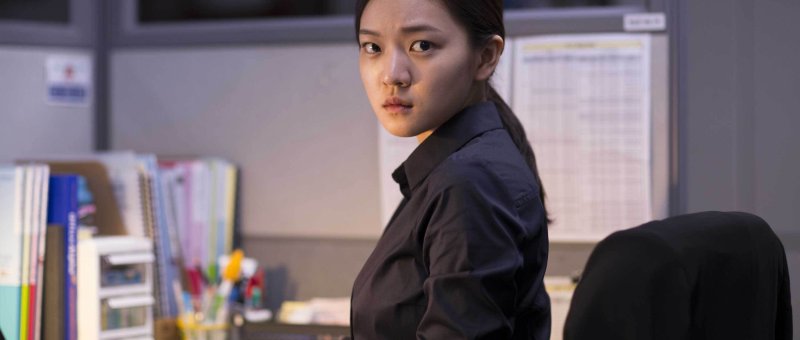
office posterThe pressure cooker society threatens to explode in Hong Won-chan’s Office (오피스). The writer of recent genre hits The Chaser and The Yellow Sea, Hong has long experience of examining those living on the edge but in his directorial debut he takes things one step further in depicting an entire society running to keep up with itself, furiously chasing its own tail with barely suppressed rage. Not so much survival of the fittest as survival of the least scrupulous, the world of Office is the one in which the mad become the most sane, escaping the constraints of corporate oppression through social revenge but taking the innocent along with them.

Salaryman Byun-guk (Bae Seong-woo) has the soulless eyes of one whose dreams have already died. Dejectedly he sits alone at a coffee shop before cramming himself into the commuter train home where he sits, silently, among his busy family. They wonder why he hasn’t changed out of his suit, shed his corporate persona for his familial one, but when Byung-guk gets up he returns brandishing a hammer which he then, as if in a trance, uses to bludgeon to death his loving wife, disabled son, and senile mother.

Byun-guk flees the scene of crime and is loose somewhere in the city. The police search his office for clues but his colleagues have already come up with their unified version of events, keeping the company out of it by claiming that they all loved Byun-guk and are shocked that he could have done something so horrifying. Meanwhile, intern Mi-rae (Go Ah-sung), who regarded Byun-guk as her only friend in the office, is upset but perhaps not quite so shocked. Excluded from the interoffice cliquery, no one has thought to brief Mi-rae on the party line leaving her a prime target for police inspector Choi (Park Sung-woong).

Byun-guk and Mi-rae are two of a piece – members of the upright and hardworking lower classes who have done everything right but somehow have never been accepted by their peers. Mi-rae, an ordinary girl from Gwangju who worked to lose her accent in her teens dreaming of the high life in Seoul, is shy and mousy but works hard – harder than anyone, to prove herself worthy of Seoul’s unrealistic demands. Her colleagues, privileged, confident, and also harried, do not forgive her for this. They find her earnestness “creepy”, her desire to succeed “suspicious”. Cruelly taken down a peg or two by a colleague taking out her own frustrations on the office nobody, another tries to comfort her with some advice – don’t try so hard, you make us all look bad and we wonder what your need is hiding. Mi-rae isn’t really hiding anything save her slowly fragmenting mental state and the overwhelming need to be accepted to a club that, in truth, is not open to people like her who value their integrity and still believe deep down that working hard and being honest are the only paths to true success.

Korean society, it seems, has become a giant chain of screaming. Byun-guk has been repeatedly passed over for promotion despite being the most reliable employee in the office but his ineffectual boss is overly wedded to the shouting school of business management. Faced with results he doesn’t like, Byun-guk’s boss picks someone to shout at to make them better but offers no further guidance. Railing at the police for not doing their job as if screaming will some how provoke major results even outside of the office, the boss can’t know that police also have their own chain of screaming and Choi has his own boss already taking care of that side of things, demanding results rather than truth or justice.

The meek are taking their inheritance ahead of schedule, but their revenge is born both of societal corruption and rejection. People like Byun-guk and Mi-rae, who are quiet, honest, kind but perhaps not good with people, become the bugs in a system which simultaneously holds them up as essential cogs. Those who cannot just pretend, grease the wheels with superficial social niceties, and accepted their place in the chain of screaming in order to climb further up it are condemned to wander idly around its lower levels going quietly mad until, perhaps, the system crushes them or else collapses.


International trailer (English subtitles)
The Liquidator (心理罪:城市之光, Xu Jizhou, 2017)

The Liquidator posterGiven a strangely ‘80s nonsensical two word title, Xu Jizhou’s The Liquidator (心理罪:城市之光, Xīnlǐ Zuì: Chéngshì Zhī Guāng) is a retro throwback to the lurid macho pulp which has largely faded from the crime procedural since its ‘90s heyday. Adapted from a novel by Lei Mi, the film follows last year’s Guilty of Mind as the second in the Fang Mu series only this time the eccentric profiler is played by marquee star Deng Chao rather than Guilty Mind’s Li Yifeng or Chen Ruo Xuan who starred in the Fang Mu TV drama, Evil Minds. A pulpy battle of wits between a crazed vigilante and a world weary cop, The Liquidator is already treading on some overly familiar territory but its main target is the rule of law apparently under threat of mob justice now that China too has entered the social media age.

Fang Mu (Deng Chao) is no longer a police officer after becoming the prime suspect in the disappearance of a man who escaped justice through judicial corruption, but he’s pulled back into the law enforcement fold when young policewoman Mi Nan (Cecilia Liu) is dispatched to get his profiling opinion on a difficult murder case. Calling himself “The Light of the City”, a vigilante killer is already amassing a collection of dedicated online followers thanks to his choice of targets which, to put it bluntly, are not law breakers just terrible people that most would like to get revenge on for one reason or another.

Originally reluctant, Fang Mu is soon hooked on the case only to realise that the crime scenes are being created entirely for his benefit – the killer is attempting to pull him into a battle of wits and taking innocent lives to do it. As it transpires the killer’s name, Light of the City, is inspired by something Fang Mu said in his graduation speech to the effect that the police are the light that shines in the darkness. The killer thinks the law doesn’t go far enough – his targets are bullying teachers, impious sons, and greedy lawyers, the immoral rather than the criminal. He exposes their transgressions online and then allows “netizens” to have their say. Netizens, as they have often been in the “real” world, are not a particularly understanding bunch and are firmly behind the “entertainment” the killer is providing, even down to the decision to live stream a murder.

Fang Mu’s defining trait is his liminal status as a law enforcement officer often pulled towards the dark side – hence why many of his colleagues think it’s perfectly possible that he’s guilty of the crime that got him kicked off the force. The vigilante’s “plan” is to pull him over the line by forcing Fang Mu to execute The City of Light and thereby become the thing he most fears. The Liquidator posits that a robust judicial system free from interference from both government and people is a prerequisite of a well functioning society and the police must be the shining beacons of these laws – if not even law enforcement obeys the law, then all is lost.

What transpires is a battle of minds between the brainy Fang Mu and the psychotic killer, but it’s also a battle for the soul of “society” which ought to place compassion and rationality over the sensationalism of trial by media and arbitrary mob justice. The killer works out his frustrations by proxy through attacking those who committed the same “crimes” which have led to their feelings of frustration and humiliation – chief among them being Fang Mu who has, apparently, offended solely in his continued excellence, but the killer’s personal vengeance is harsh and unforgiving, handing down a death sentence simply for unpleasant or anti-social behaviour.

Beginning in a promising vein, Xu nevertheless introduces his dedicated female cop only to sideline her in favour of Fang Mu before turning her into a mild love interest, potential victim, and sometime comic relief. Filled with macho histrionics (including, at one point, a gun fired in the air followed by a manly wail of grief), The Liquidator is an old fashioned action drama filtered through pulp noir and ‘90s horror with its grimy walls and dingy basements, but it straddles a fine line between ridiculous slasher serial killer thriller and serious cerebral procedural, landing somewhere around heroic bloodshed without the bromance. Ridiculous and melodramatic, Xu’s debut feature boasts excellent production design and innovative photography, but its slick aesthetic cannot overcome the more outlandish elements of the otherwise generic script.


Currently on limited release in UK cinemas courtesy of Cine Asia

Original trailer (Mandarin with English subtitles)

Namiya (解憂雜貨店, Han Jie, 2017)

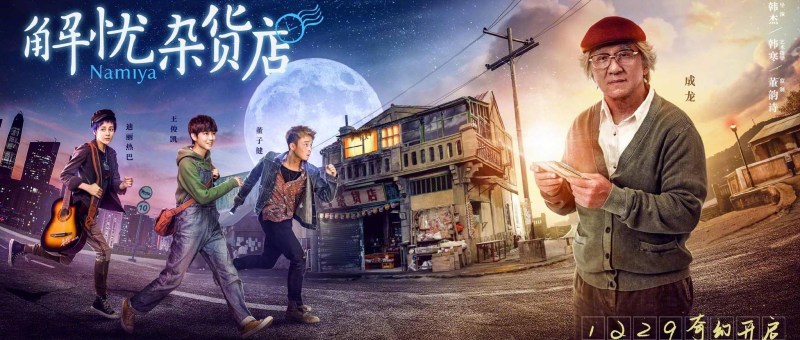
Namiya posterKeigo Higashino is almost certainly best known for his crime novels and in particular his most famous detective, Galileo, whose exploits have spawned a successful TV drama series and a fair few cinematic adaptations including the international bestseller, The Devotion of Suspect X. One might expect a writer of mystery novels to be a fierce rationalist, but Higashino occasionally dabbles in the fantastic – The Miracles of the Namiya General Store is more or less a nostalgia fest praising the pre-bubble Japan, implying that the modern world is colder and less kind than the aspiring society of 1979. Adapted for the Chinese market by Han Jie, Namiya (解憂雜貨店, Jiě Yōu Zá Huò Diàn) retains the corner shop where time stands still but locates it in 1993, which is not so much a significant date save being 25 years in the past.

On New Year’s Eve 2017, three teens break into a woman’s home with the idea of causing some damage, but the event goes south when she comes home early and one of the three decides to tie her up and steal a bunch of her stuff. Having gone further than they meant to, the trio wind up in an unfamiliar part of town when the car they’ve stolen runs out of petrol. An improbably quaint, apparently disused corner shop attracts their attention but when they break in to shelter for the night they discover that this is no ordinary store. A ghostly miasma gradually creeps its way in and the three youngsters find themselves answering a collection of letters meant for the store’s owner written in 1993 but only dropping through the letter box now. They funny thing is, they get almost immediate replies.

As one of the teens points out, they weren’t even born in 1993 – this store might as well be from 1793 as far as they’re concerned. Though it drips with nostalgia for a simpler time, Namiya treads (understandably) more carefully in painting early ‘90s Beijing and its rural backwater setting, strenuously avoiding any mention of politics and characterising China’s economic development as an entirely good thing despite the troubles the three teens at the centre have been subject to throughout their apparently difficult lives.

The letter writers have various problems but each in someway relates to being a little lost, a little bit confused about how to move forward in life. A frustrated musician (Lee Hong-chi) whose career is not taking off wants to know whether he should give up and come home, a little boy has a bad relationship with his go-getter parents who have lost all their money and got into trouble with loan sharks, and a melancholy bar hostess (Hao Lei) wants to know if she should become the mistress of a gangster who promises to set her up in a shop that would get her out of her dead end life and still enable her to support her family. The kids are not really qualified to offer any kind of real life advice, with sensitive Xiaobo (Karry Wang) and plucky Tong Tong (Dilraba Dilmurat) reacting in broadly sympathetic terms while the sullen Jie takes a hardline moralist stance in which he just wants to write angry letters to everyone telling them they’re doing everything wrong.

Jie has his own reasons for being so angry, especially as one of the letters touches a nerve in his own personal history but his ambivalence was at one point shared by Papa Namiya (Jackie Chan) himself after he feared his treasured advice might have ended up having a negative effect on people’s lives. Papa Namiya tells the troubled little boy to stick with his parents no matter what because family is the most important thing in a person’s life which might be true much of the time, but not when the parents actively endanger their child. What he finally reassures himself with is that his advice was largely meaningless because most people have already made up their minds what they’re going to do, they just want someone to help them feel like they’re doing the right thing. In fact, no one really follows Papa Namiya’s advice anyway, but the kids are able to make a concrete change when they reveal the economic realities of modern China to a young hopeful who then uses the knowledge to build an international business empire (but makes sure to pay it forward whilst paying tribute to their roots by committing to sponsor an orphanage in need of renovation/expansion).

The slightly awkward message Namiya leaves behind is that dreams come true when people work hard to achieve them but that the young are also free to forge their own destinies, that the world is, for them, infinite and filled with boundless possibility. Optimistic and inspiring as it is, it isn’t terribly realistic and does rather imply that those who haven’t made it are either lazy or dishonest as echoed in the mildly moralistic tone taken with the bar hostess’ dilemma or the odiousness of the corrupt businessman and his failure to protect his family from his own mistakes. Moral judgements and naivety aside, Namiya is an otherwise heartwarming, deliberately uncynical New Year tale which does its best to engender hope for the future in an otherwise cold and unforgiving month.


Currently on limited release in UK cinemas.

Original trailer (Mandarin with English subtitles)

Postcards from the Zoo (Kebun Binatang, Edwin, 2012)

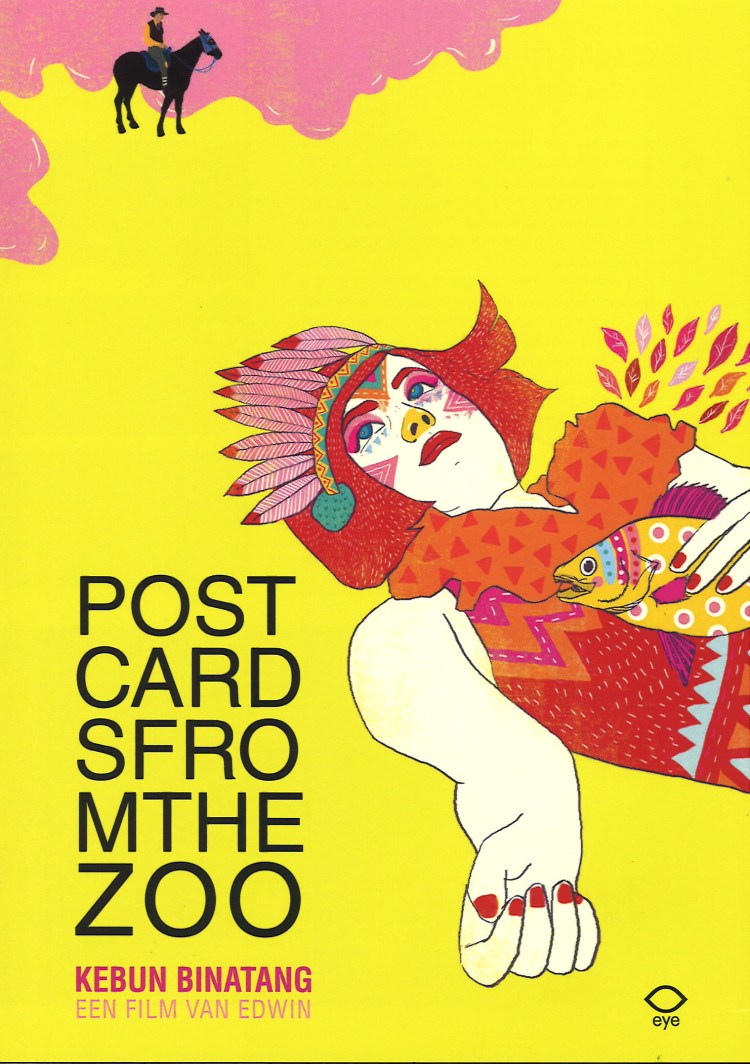
postcards from the zoo posterThe thing about zoos is, how can you be sure which side of the bars you’re really on? The heroine of Edwin’s whimsical adventure, Postcards From the Zoo (Kebun Binatang), finds herself at home among the animals after being abandoned by her human father with the consequence that, to her, the outside world is the inverted mirror of her theme park home. Themes of exploitation, exoticisation, innocence and experience run side by side but then perhaps Edwin has tried to pack too much into his day out lending a degree of incoherence to his meandering itinerary.

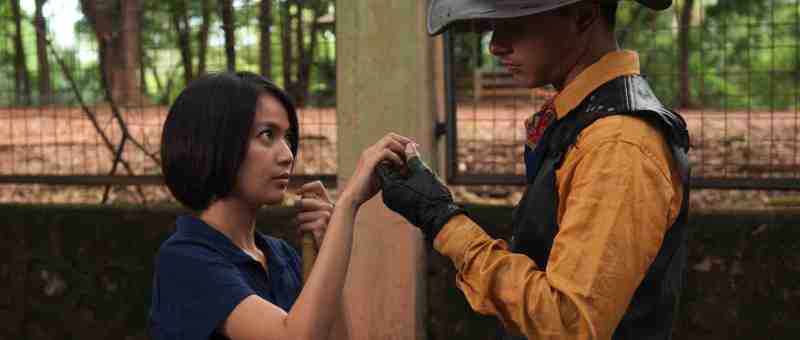
As a young child, Lana (Ladya Cheryl) is abandoned in the zoo by her father. All alone, trapped in the park overnight, she wanders around exploring and calling out for her dad to come and get her. He doesn’t, years pass and suddenly Lana is a beautiful young woman, still living in the zoo after having been taken in by a giraffe handler, Oom Dave. Her life changes when a new authority takes over and immediately sets about trying to evict the collection of people who’ve made the zoo their home without the proper permission. Taking off with a handsome magician (Nicholas Saputra), Lana begins to explore the world outside but quickly finds that there are invisible bars everywhere.

Edwin ties Lana to the figure of the zoo’s solitary giraffe – a herd animal forced to live alone in Jakarta’s zoo as the sole representative of its kind. Certifiably nuts about giraffes, Lana rolls off various animal facts and expresses the long held desire the touch the giraffe’s stomach. Her status is confused; she’s both visitor and exhibit, caretaker and resident. The zoo is all Lana has ever known or wanted to know, and so when she must leave it, she does so with curious eyes, examining the regular world like a traveller on a journey to untold lands.

Becoming the magician’s assistant – a Tiger Lily to his cowboy, Lana travels the city as a co-conspirator in his life of hustling. Their odyssey brings them into the seedy underbelly of the modern capital with its heartless gangsters and oppressed women. Once again abandoned, Lana finds herself sinking into this world as one of many generic young women dressed in white, given a number (33), and placed behind glass waiting to be called forth by male visitors. Now literally an exhibit in a human zoo, Lana finds that things on this side of the enclosure are no different. While her customer asks her to dress up in a “tiger” suit (it’s a leopard, she quickly corrects him), a family with young children pose with a “tamed” python at the zoo. The twin pictures of exploitation neatly ram Edwin’s point home even if he allows Lana’s experiences to remain in the realms of whimsy, only hinting at the darkness of the “massage” industry in an early humiliating scene in which a naked, frightened woman is awkwardly sat with a grinning gangster as a kind of living trophy.

Broken with a series of title cards explaining zoo-related terminology each of which relate to the latest stages of Lana’s journey – “ex-situ conservation”, “reintroduction”, etc, Postcards from the Zoo maintains a kind of distanced affectation which undermines the whimsy of its magical realist stance. Lana’s journey is one of youthful exploration in which the adolescent must venture away from home in order to become adult and return home with wiser eyes but Lana’s quest, with her series of abandonments and mysteries, may perhaps never be finished. Edwin finds the whimsy of the zoo with its dinosaur shaped carts and strangely designed cowbus mimicked in the outside world with monkeys wearing doll masks and wandering magicians selling snake oil claiming to provide “instant youth” and cure roundworm, fungus, and stab wounds,  returning him to the “all the world’s a zoo” ethos which seems to pervade but even if he fails to bring his tale full circle he does at least allow a kind of harmony in the reunion of his twin symbols of the solitary, imprisoned giraffe and the curious little girl.


Original trailer (no subtitles)