37 Seconds (Hikari, 2019)

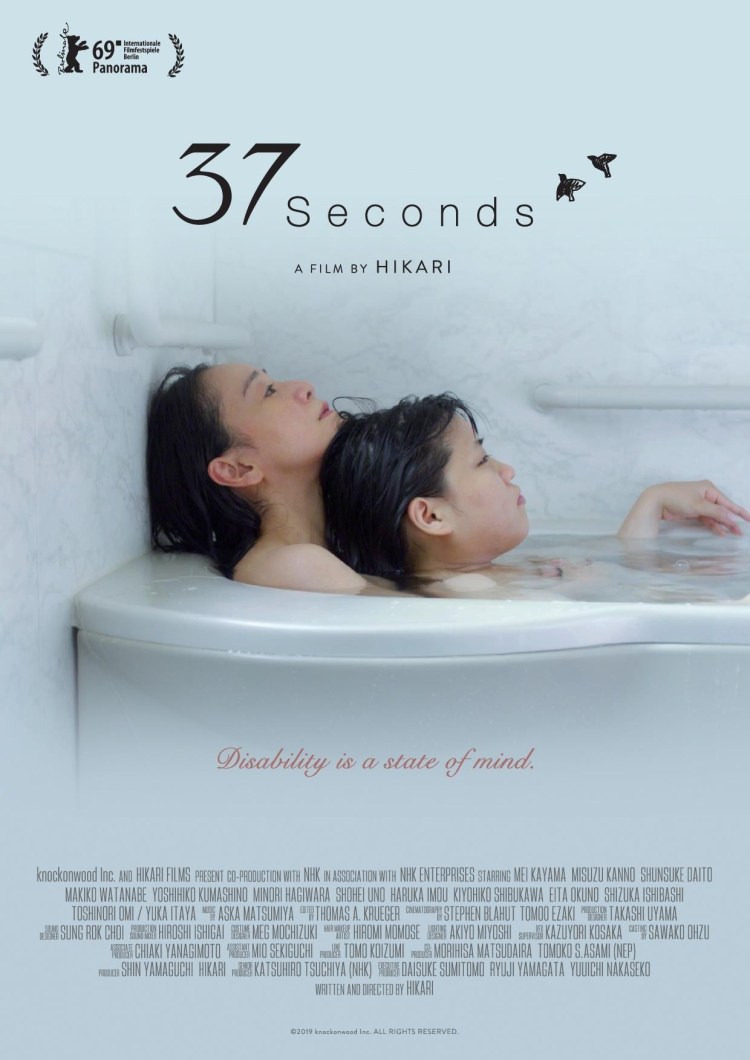
37 Seconds poster“We’re just like everybody else” the heroine of Hikari’s debut feature 37 Seconds replies in bemusement when a prospective date confesses he never thought he’d feel comfortable with “someone like” her. Quietly meditating on societal prejudice against disability, 37 Seconds takes its heroine on a journey of self discovery as a series of disappointments pushes her towards embracing a new side of herself as an individual in defiance of those who might feel they know what is best, or perhaps just most “appropriate”, for “someone like” her without bothering to consider how she might feel.

Softly spoken, 23-year-old Yuma (Mei Kayama) has cerebral palsy and uses a motorised wheelchair to get around. Although she has a degree of independence with a job as an assistant to a manga artist, her friend Sayaka now a giant YouTube star, to which she travels alone by train, Yuma otherwise has little life outside the home she shares with her increasingly overprotective mother Kyoko (Misuzu Kanno). Yuma’s dreams of becoming a manga artist in her own right are dealt a blow when she’s told that her style is too close to Sayaka’s, only Sayaka’s style is Yuma’s because Yuma is doing all the work while her friend steals the credit and gleefully gives interviews claiming she is 100% indie and has no assistants. Beginning to realise she’s being exploited, Yuma gets an idea when she spots some erotic manga abandoned in the park and starts ringing up magazines for work. One bites and likes her stuff but worries that her sex scenes lack authenticity because of her lack of experience. 

Though previously unbothered, Yuma decides to embrace her sexuality in the name of art but finds a series of obstacles in her way, not least among them her mother who continues to infantilise her claiming that she is too vulnerable to be allowed out alone because there are too many strange people in the world. Kyoko won’t let Yuma wear pretty dresses, or makeup, or go out in the same way other girls her age might, refusing to accept that her little girl has grown up and has the same desires as any other young woman including that to be independent. Unable to escape her mother’s control, Yuma begins lying to her to meet prospective dates but finds them all unsuitable until finally trying to hire a sex worker only for that to go horribly wrong too. It does however introduce her to the people who will change her life – empathetic sex worker Mai (Makiko Watanabe), and her assistant Toshiya (Shunsuke Daito), whom she meets in a love hotel corridor while waiting for a broken lift.

When Yuma first meets Mai, she’s in the company of another man with cerebral palsy using a wheelchair, Kuma – played by Yoshihiko Kumashiro, a real life activist raising awareness about sexuality in the disabled community whose life inspired Junpei Matsumoto’s 2017 feature Perfect Revolution. Seeing the warm and genuine relationship between Mai and Kuma gives Yuma a new hope that a different kind of life is possible, especially as Mai offers to take her under her wing. Having an older woman to confide in about things she could never discuss with her mother allows Yuma to explore her newfound desires with confidence knowing that there are people looking out for her and always ready to offer advice.

Not everyone, however, is quite so enlightened and Yuma’s problems are largely to do with the persistent social stigma she faces from the world around her as well as a resultant sense of internalised inferiority. Sayaka, her “friend”, views her as a kind of cash cow, taking advantage of her skills but denying her existence while Sayaka’s agent swings in the other direction by telling her she should go public because she’d get a lot of press once people know she employs a disabled woman as an assistant. The first place Yuma gets any kind of respect is the office of the erotic manga magazine where the boss treats her like any other prospective hire and offers her constructive advice. From the awful dates and bad faith friends to her mother’s well-meaning yet problematic attempts to trap her in childhood, Yuma struggles to find a sense of self-worth when everyone is telling her that her life is limited and she must conform to their stereotypical ideas of how “someone like” her should live.

Thanks to Mai and Toshiya, Yuma eventually gains the confidence to assert herself, but also the ability to accept that her mother’s actions, however misguided, came from a place of love tempered by regret and sadness she was unable to understand without engaging with her mother’s history. A beautifully empathetic exploration of a young woman’s gradual blossoming under the light of genuine connection, 37 Seconds is a unsubtle rebuke of a fiercely conformist society unwilling to accommodate difference but also a quiet hymn to defiance as its heroine learns to shake off the labels placed on her and claim her independence no matter what anyone else might have to say about it.


37 Seconds was screened as part of the 2019 BFI London Film Festival.

Festival trailer (English subtitles)
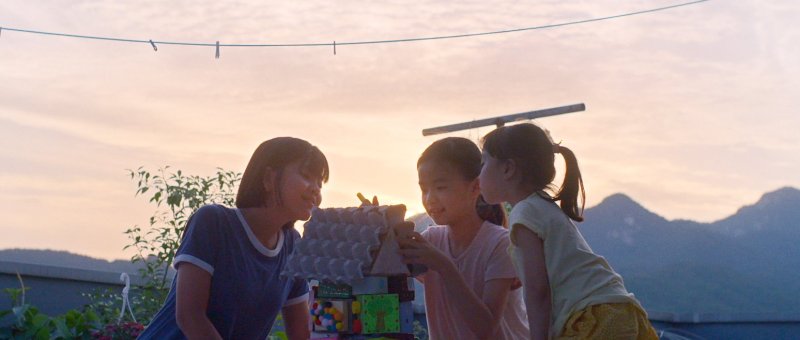
The House of Us (우리집, Yoon Ga-eun, 2019)

The world of us poster 2“People should eat with their families” a little girl points out dutifully declining an invitation to dinner, only to return home and dine alone. Hana (Kim Na-yeon), the heroine of Yoon Ga-eun’s The House of Us (우리집, Ulijib), is still young enough to think she can bend the world to her will but is about to discover that some things can’t, or perhaps shouldn’t, be changed only accepted. Meditating on the meaning of family in a changing society, Yoon’s World of Us followup finds its earnest heroine trying to escape familial disappointment through forging a home of her own but eventually realising home is not a house.

11-year-old Hana has just won the best classmate prize, but no one at home seems to be very excited for her, nor (perhaps strangely) does she seem to have many friends. In fact, despite her caring nature, she’s feeling intensely insecure because her family life is in disarray. Mum and dad are both busy and rarely home, but when they are they’re having blazing rows about how dissatisfying they each are as spouses while even going so far as to have retroactive arguments about the decision to have children while their kids are still in earshot. Hana can see her mum’s busy and she wants to help so she offers to do some of the cooking as part of her summer holiday “recipe book” project, but is flatly refused. Fearing that her parents are on the brink of divorce and longing to return to happier days, she pesters them about going on a trip, believing that would be enough to repair her fracturing family.

Wistfully staring at happy families wherever she goes, Hana ends up running into two little girls, nine-year-old Yoo-mi (Kim Shi-a) and her sister seven-year-old Yoo-jin (Joo Ye-rim), who are living more or less on their own while their parents are working away (an uncle checks in on them every now and then). Lonely as she is, Hana starts hanging out with the equally lonely sisters but takes on an oddly maternal rather than sisterly role, delighting in cooking for them the way her mother rarely does for her and would not allow her to do for their family. Generating an easy bond, the girls decide to build “the house of us” out of discarded cardboard boxes, declaring they’ll build it as high as they can.

Yet Hana, still a child herself, struggles with what it means to assume a parental role. She does to Yoo-mi and Yoo-jin the exact things that she most resented about her own parents – withholding information and making decisions which affect everyone without consulting anyone. Having moved around a lot, Yoo-mi and Yoo-jin are most anxious that their landlady says they’ll be moving but their parents haven’t told them anything. Hana vows to help them save their house while protecting her own home, but in reality she can do neither. The girls resort to a series of childish tricks to prevent prospective tenants from choosing to rent Yoo-mi and Yoo-jin’s apartment in the belief that that they could stay if no one wanted to move in, approaching the problem with innocent logic that makes perfect sense to a child but is little more than silliness to an adult.

Meanwhile, Hana struggles with twin discoveries of parental betrayal in finding her mother’s application for a transfer to Germany, and accidentally answering a call from a woman on her father’s phone that perhaps embarrasses her as she realises despite her young age that he has done something potentially destructive to their family. The less control she has in her family home, the more time she spends with Yoo-mi and Yoo-jin making a new one and trying to do it better. The sisters begin to look up to her as a little more than a big sister figure, allowing her to lead and expecting that she will know what to do even when she fails them.

Through her own failures, Hana begins to realise that her parents aren’t perfect and adults don’t always know what to do either. The girls accept that they belong to different families and can’t stay together, but discover that the “house” wasn’t what was important and that they’ll always be connected even if they’re far apart. No longer so insecure, Hana steps into herself and understands that her parents’ marriage is something they’ll sort out for themselves and if the family is scattered it’ll still be her family. A warm and empathetic, if melancholy, exploration of coming to terms with life’s disappointments, The House of Us finds serenity in the act of letting go as its heroine finds the strength to look forward rather than back towards a happy independence supported but not constrained by imperfect family.


The House of Us was screened as part of the 2019 BFI London Film Festival.

International trailer (English subtitles)

The Attorney (一级指控, Wong Kwok-fai, 2019)

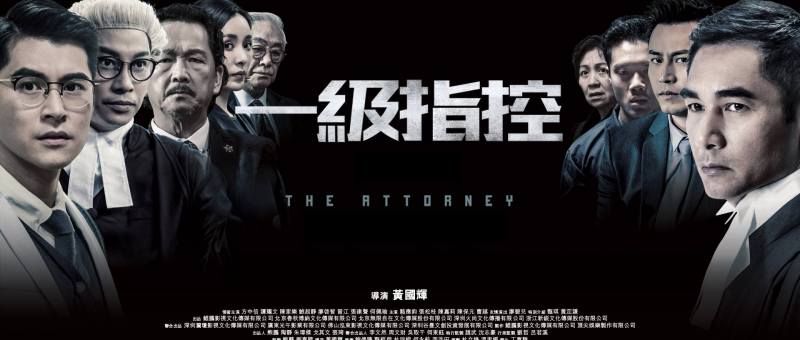
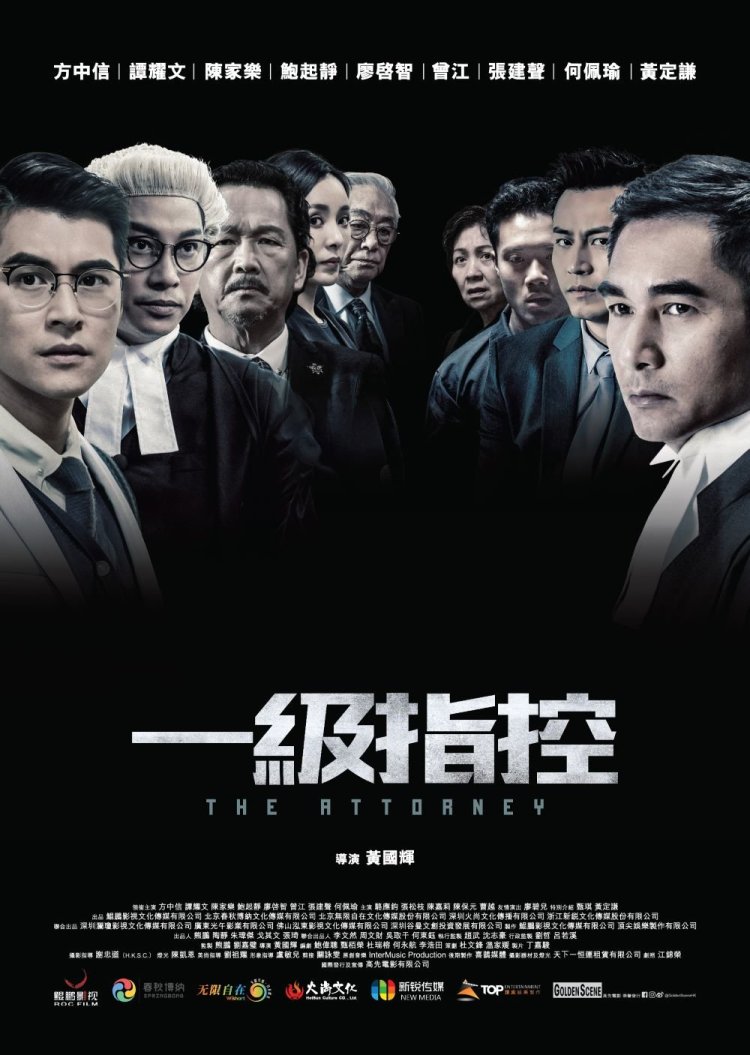
The Attorney poster 1What price justice? Wong Kwok-fai’s legal thriller The Attorney (一级指控) puts an unequal society on trial but discovers that to beat shadiness you might need to get a little shady and a healthy bit of deviousness may serve you well if it’s offered in service of a noble ideal. Then again, it’s a slippery slope towards the abyss if even the proponents of law aren’t above a little judicial finagling to ensure that “justice” gets done in a society which continues to defer to those with the biggest pockets rather than protecting those of meagre means.

We meet our two attorney heroes in the middle of their respective cases. Jaded hot shot Lei You Hui (Alex Fong Chung-sun) is defending a journalist who broke an important story about corruption in the competition for places at prestigious schools from a defamation charge, while the idealist rookie Kelvin (Carlos Chan) is defending a frail old woman held up on a charge of operating without a proper business licence. Lei wins his case, and Kelvin loses. Lei mocks Kelvin’s lack of success, and Kelvin has only contempt for Lei’s cavalier attitude towards the upholding of justice.

The action begins when a 25-year-old man, Lee, is found lying in a pool of blood next to the dead body of a young woman, Ka-yee, who is later discovered to be the daughter of a billionaire businessman, Kwok (Liu Kai-chi). The case seems open and shut. Lee claims he passed out and found the body when he woke up but the circumstantial evidence against him is overwhelming. His grandmother, Chu (Nina Paw Hee-ching), of course believes that he is innocent and enlists the best lawyers she can get access to, leading her to a solicitor who introduces her to Kelvin who is determined to see that the young man gets a fair trial. Lei, meanwhile, has a personal interest in the case in that his late wife was killed in a shopping mall collapse 10 years previously which also took the lives of Lee’s parents. Lei prosecuted a class action law suit, but lost. The shopping mall was constructed by Kwok’s company, which gives him an additional reason to want to help aside from trying to make things up to Lee and Chu whom he feels he failed all those years ago. 

Wong wastes no time in demonstrating that “justice” is a nebulous concept when society is necessarily set up to benefit the rich. Ka-yee’s body was discovered in a building belonging to a property magnate, Tsai Chi-wai (Patrick Tam), who is currently running for political office on a platform of equality for all. Chi-wai is, however, a member of the super rich elite who believes he can do as he pleases because he is protected by his wealth and privilege. Lee, by contrast, is a poor boy delinquent who ordinarily wouldn’t have access to a fancy lawyer to clear his name and most likely would have been torn apart by the elite prosecutor those with vested interests have ensured is attached to the case even though it’s a simple enough affair. 

Yet, as Lei discovers, the roots of corruption lie in the understandable desire to protect one’s children even when they’ve made terrible mistakes. Meeting with Chi-wai’s smarmy father, he discovers a man who talks up his youthful high ideals of union activities and working for the workers but later emphasises his hard won cynicism in insisting that no one with a brain seriously believes in things like truth and justice, only self interest. Tsai wants to protect his son at all costs, if only to protect himself by getting his boy into high office. Meanwhile, Kwok is left with questions about his own responsibility for his daughter’s death. If having literally billions in the bank can’t keep your little girl alive, then what use are they?

Then again, having billions in the bank is pretty useful leverage for getting your own way even if you eventually have a change of heart about enabling societal corruption. Chi-wai snarls that you need to be smart to survive, but according to Kelvin saving lives is more important than winning. Lei, who had given up his lofty ideals after being unable to get “justice” for his wife’s death begins to regain his faith in the law thanks to Kelvin’s influence and the accidental coincidence of getting a kind of revenge on Kwok by showing him the error of his ways in illuminating the truth behind his daughter’s death. To do that, however, he’ll have to bend the law a little which leaves him a compromised figure if for the best of reasons as he wilfully demonstrates the flaws in a legal system which is in itself inherently corrupt in its avowal that everyone is equal before the law while ignoring the fact that not everyone has access to the same level of “justice”. Wong’s conclusion may be a little rosy as even the most jaded of legal minds finds himself minded to rebel against the system, but there’s no denying his purpose as Lei decides to protect his daughter by protecting his society from the forces which threaten to blacken her future.


The Attorney screens in Chicago on Oct. 10 as the closing night gala of the ninth season of Asian Pop-Up Cinema. Actor Kenneth Tsang Kong, scriptwriter Frances To, and xxecutive producer Cherrie Lau will be in attendance for an introduction and Q&A.

Original trailer (English subtitles)

To the Ends of the Earth (旅のおわり、世界のはじまり, Kiyoshi Kurosawa, 2019)

To the Ends of the Earth poster 2“It’s like a little journey you can take without going too far from home” a bubbly variety TV presenter announces partway through To the Ends of the Earth (旅のおわり、世界のはじまり, Tabi no Owari Sekai no Hajimari), reporting from a rundown theme park the like of which she claims you hardly ever see in Japan anymore. It might as well encapsulate her life as the host of a TV travel programme directly aimed at people who prefer to take their pleasures vicariously. Kiyoshi Kurosawa’s long career has been, in an odd sense, moving into the light. Where death was once eternal loneliness, he now tells us love is what will save us in the end, if only we overcome our fear of each other.

Yoko (Atsuko Maeda), a 20-something TV “reporter” for a variety show, is an intensely anxious young woman. In her postcards home to her firefighter boyfriend, she tells him that she feels “safe” now that they’ve arrived in a big, modern city, but, somewhat ironically, asks him to try and stay away from dangerous places. Currently shooting in Uzbekistan, she finds herself doubly isolated – both because she is a lone woman travelling with an all male crew, and because she is the star and therefore not included as a part of their team. Though they call her a “reporter”, it’s clear that the temperamental, insensitive director Yoshioka (Shota Sometani) does not value her editorial opinion and sees Yoko more or less as a kind of prop.

When we first meet her, Yoko is being forced to deliver a direct to camera speech from the middle of a “fake lake” which, as she explains, is more like a big puddle created by accident during a Soviet-era irrigation project that didn’t quite go to plan. During the course of the filming, we watch her effortlessly switch between the super “kawaii’ presenter who has to pretend the undercooked food she’s just been handed (that will probably make her ill) is the best meal she’s ever tasted, and the dejected young woman growing ever more resentful about her corrupted authenticity. Nervous and under-confident, she finds herself bullied by the demanding director, feeling as if she’s obliged to put up with whatever he asks her to do even if it compromises her safety.

Later, at the theme park, the owner of the ride Yoko is supposed to “enjoy” expresses concern, firstly claiming that it’s not suitable for women, and then apparently mistaking Yoko for a child. He doesn’t clarify if there’s actually a safety issue, that the ride is calibrated for a certain size and weight and might be dangerous for a slight woman as opposed to a beefy man, but in any case Yoko is made to ride it three times in quick succession. Akin to something they put astronauts and fighter pilots in to prepare them for coping with G-force fluctuation, it is not particularly fun but still Yoko is obliged to giggle like a giddy school girl every time before finally collapsing as if she’s about to go into nervous shock. A few moments later, however, she stands in front of the camera to give another cheerful speech about just how much fun she’s having.

Yet we also see her attempt to fight back against her sense of anxious powerlessness by actively asserting her independence. She leaves her hotel and takes a bus, a complicated affair when she doesn’t speak the language or understand where she’s going, visiting a local bazaar where she attracts not a little attention, some of the saleswomen even attempting to physically grab her in order to sell their wares. She feels the male gaze constantly upon her and though you’ll rarely find a woman who says that skirting round groups of men in darkened alleyways doesn’t make her nervous, there is something about the unfamiliarity of the environment which has Yoko on edge. Men peek in through the windows of the van where she changes costumes to make it look like they were in Uzbekistan longer than they were, and like the ride owner, a fisherman they’d enlisted to help them catch a giant fish grows progressively more irritated, claiming that the fish aren’t coming because they don’t like a woman’s smell.

Exploring the town, Yoko’s mind quietens only when she begins to hear music pouring out of a local opera house. She wanders inside and sits down, envisioning herself on stage performing Ai no Sanka, a Japanese rendering of Edith Piaf’s Hymne à l’amour, but her reverie is cruelly interrupted by a security guard who sends her anxiously reeling away. Another encounter with authority provokes a similar reaction when she’s stopped for filming in a prohibited area but instead of calmly presenting the camera, she panics and runs away. As a sympathetic detective later tells her, if you run from the police they have to chase you, it’s the law. The detective is a little offended. Why was she so afraid of Uzbek policemen? Did they seem excessively mean, what does she know about Uzbeks anyway? If only she’d tried to listen to what they were saying, all of this could have been avoided.

The detective, echoed through sympathetic translator Temur (Adiz Rajabov), avows that if we don’t talk then we’ll never understand each other. Temur became a translator after hearing about the Japanese prisoners of war who built the theatre in which Yoko heard the music, painstakingly crafting rooms dedicated to six areas of a country which had been their enemy. Moved by their generosity, he learned Japanese to give something back. Identifying herself with a captive goat she longed to free from constraint and isolation, Yoko gains confidence from his words. She confesses that she’s preparing to follow her dream of becoming a singer, but worries that she lacks the emotional authenticity required to make the song resonate. Through her cross-cultural adventure, brush with the law, and a personal crisis back home, Yoko begins to realise that the world isn’t such a scary place after all. Yoko sings the song of love, less for the uncommunicative boyfriend she unconvincingly claimed it was her hope to marry, than for herself and for the world, now as open as her heart in the limitless vistas of the Uzbek mountains.


To the Ends of the Earth was screened as part of the 2019 BFI London Film Festival.

Original trailer (English subtitles)
Ai no Sanka as performed by Hibari Misora

Öndög (恐龙蛋, Wang Quan’an, 2019)

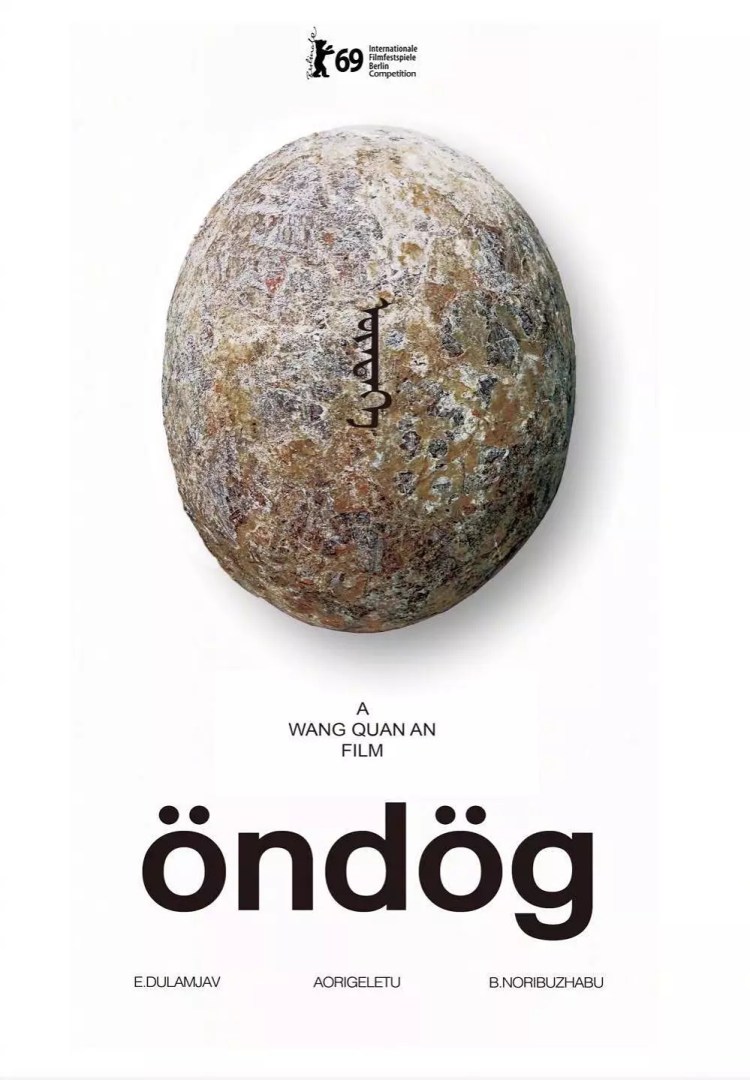
Öndög posterLife and death lie side by side in Wang Quan’an’s existential drama Öndög (恐龙蛋). Taking its name from that of a fossilised dinosaur egg, Wang’s Mongolian odyssey locates itself in a kind of perpetual, unchanging dreamspace where nothing is quite as it first seems. We think we’re here to solve a mystery, a unexpected death evidenced by an abandoned body, but what we witness is a rebirth, a woman returning to life after wilful isolation not weakened by love but perhaps fulfilled by it.

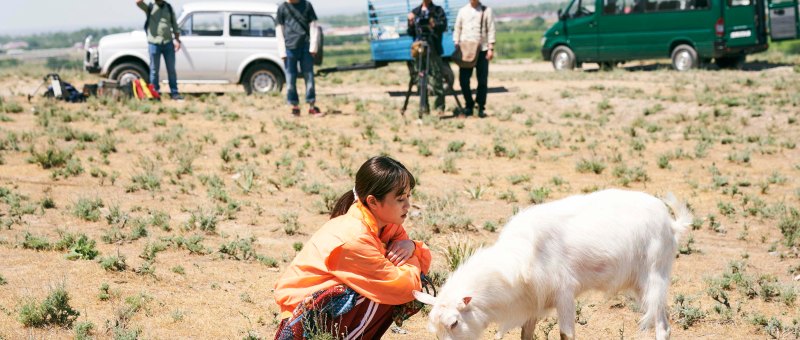
Wang opens with a lengthy sequence of two men driving through the desert and telling tales of huntsmen, who they say must hunt by instinct because the human eye is not as good a guide as good old fashioned intuition. You might think you see a wolf in the distance, but draw closer and it’s just a big grey dog. When the car’s lights illuminate a fallen body, one might initially think it to be one of the horses just seen rushing past but is in fact that of a young woman, naked and abandoned to the desert. As someone later puts it, if no one had found her she would have been returned to the earth, grass would grow over her, sheep would eat the grass, and men would eat the sheep. Now that the body has been discovered, however, it’s a problem for the local police, not exactly used to murder in the middle of the desert. Because they don’t have the proper resources and have to call for backup, they leave a young rookie (the only member of the team with no wife and family) to guard the body overnight, recruiting a local herdswoman to guard him.

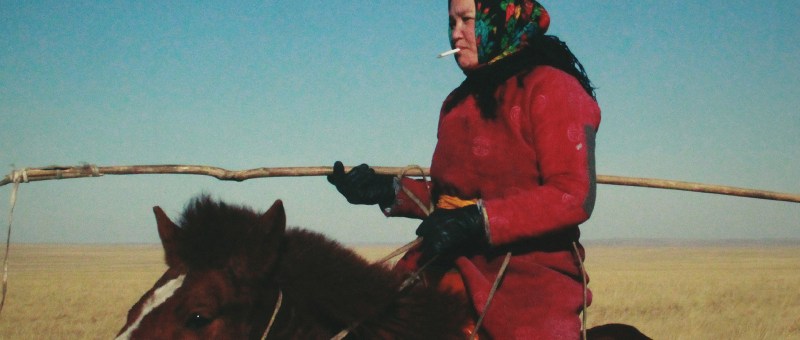
The police, apparently, would rather have had a male herdsman but there aren’t any, so this middle-aged, camel riding, rifle toting, and almost totally self sufficient woman will have to do because she’s all there is. Known as the Dinosaur, the woman is perhaps the last of her kind, but acts with an almost maternal warmth towards the inexperienced policeman, reminding him to pull the flaps down on his hat to keep his ears warm, but also making fun of his obvious distress at being left alone (well, except for the wolves) in the desert with a dead body.

Later she returns and teaches him something else with that dead body still in the background. She asks him if he’s ever been in love. He says he hasn’t, too nervous. She tells him what he needs to do is forget that he’s a human, pretend to be a wolf, stare at her as if you want to gobble her up. Truth be told, it’s slightly dangerous advice, even if she later adds that he needs to stare in a loving way after he complains that he doesn’t want his potential love interest to be afraid of him, but soon enough a belly full of liquor to ward off the cold and an animal pelt seem to have done the trick and solved two problems to mutual satisfaction (in one sense at least).

The kid tries out his new found animal magnetism on the pretty intern from the city but remains somewhat nervous and permanently between the corpse and the killer while his boss serenades his crush outside. The woman died because she rejected a man who wanted her on the grounds she loved someone else. To counter that, the older policeman tells his own sad story, that he discovered his wife in fact married him on the rebound. The herdswoman, meanwhile, muses on her strange relationship with a motorbike-riding male friend, apparently a former lover from whom she separated after losing two children they conceived together. He would like to try again, she remains unconvinced despite his urgings that she needs to get herself a man and settle down. Though largely self-sufficient, she calls on him twice – first for death (butchering a sheep to feed the rookie policeman), and then for life (birthing a reluctant calf). He gives to her the Öndög of the title, reminding her that the Americans found the first dinosaur skeletons here in Mongolia, and so in a sense they are all descendants of dinosaurs, and will be succeeded by something else.

The extinct egg nevertheless carries life, in a spiritual sense at least, a perfect embodiment of beginning and end or, perhaps, frozen potential. Maybe the dinosaurs won’t die out after all, or at least, not just yet. From death comes life, and from life death. Set against the dreamlike eternity of the desert night sky, Öndög is the story of a woman hunting by instinct, finding fresh hope in new possibility and old love in an otherwise desolate landscape.


Öndög was screened as part of the 2019 BFI London Film Festival.

Festival trailer (dialogue free)

The Captain (中国机长, Andrew Lau, 2019)

The Captain poster 2Chinese cinema loves the miraculous, but it loves stories of ordinary heroism even more. Inspired by real events which occurred on 14th May 2018, not quite 18 months before the film’s release, The Captain (中国机长, Zhōngguó Jīzhǎng), is a classic story of everything going right after everything goes wrong. Implicitly praising the efficacy of a system which values military precision over individualistic handwringing, Lau’s dramatisation reserves its admiration for those who keep their cool and follow the rules in the midst of extremely difficult circumstances.

Beginning in true disaster movie fashion, Lau opens with a brief yet humanising sequence which sees the otherwise austere pilot Captain Liu (Zhang Hanyu) say goodbye to his little girl, promising he’ll be back in time for her birthday party that very evening. Thereafter, everything is super normal. The pilots and cabin crew arrive at the airport, get to know each other if they haven’t flown together before, and run through their drills. The cabin crew laugh through the “we’re professionally trained and are confident we can ensure your safety” mantra rehearsed in case of emergency hoping they’ll never actually have to say it, but disaster strikes a little way into the flight when the windscreen cracks, eventually shattering and sucking rookie co-pilot Liang Peng (Oho Ou) halfway out.

Of course, the story is already very well known so we can be sure that the plane will land safely with no one (seriously) hurt, but it’s still an incredibly tense time for all. As Liu explains to Liang Peng, everything in the cockpit must be done with the upmost precision. It’s when you get complacent that things will start to go wrong. A former air force pilot, Liu is not the most personable of captains with his permanently furrowed brow and serious demeanour, but he’s exactly the sort of person you need in a crisis, calmly and coolly making rational decisions under intense pressure. While he’s doing his best at the controls, the entirety of the Chinese air aviation authorities are springing into action to try and ensure the plane’s safe landing – airspace is cleared, the military monitor the situation, and the fire and ambulance services are already on standby in the hope that Liu can safely land at Chengdu airport.

Keeping the tension high, Lau resists the temptation to sink into melodrama, more or less abandoning a hinted at subplot about stoical cabin supervisor Nan’s (Quan Yuan) possibly unhappy home life while introducing a fairly random diversion in a group of aircraft enthusiasts furiously tracking the plane’s trajectory online and then heading out to the airport in the hope of witnessing a miracle. Before the potential catastrophe takes hold, the crew have to deal with unpleasant passengers intent on throwing their weight around, nervous flyers, and people travelling with small children, but do their best to provide service with a smile even in the most trying of circumstances. They are frightened too, but have to muster all of their professionalism in order to be strong for the passengers, keeping them calm and preventing them from creating additional problems while the guys in the cockpit try to find a solution that keeps everyone safe.

Released for National Day, The Captain’s brand of propagandistic patriotism is of the more subtle kind, only really rearing its head during the final moments during which awkward captain Liu suddenly starts singing a folksong in praise of the motherland while celebrating their lucky escape on its one year anniversary in the time honoured fashion of a group hot pot. Nevertheless, the point it’s making is in the virtues that Liu states after landing, valuing life and duty. Liu landed the plane because he followed procedure perfectly, kept his head, and made well-informed decisions. A master of understatement, his speech on landing is simply an apology to his passengers that he wasn’t able to take them safely to Lhasa. After waiting for the investigators, he thinks the passengers are hanging round outside the plane because they’re angry and want an explanation, little realising they are just overjoyed to be alive and wish to thank him for saving all their lives. A tense tale of selfless heroism aided by good training and immense professionalism, The Captain is a subtle endorsement of an authoritarian system but also of the importance of keeping cool in a crisis as the best weapon against catastrophe.


The Captain is currently on limited release in UK cinemas courtesy of Cine Asia, and in the US from Well Go USA.

Original trailer (English subtitles)

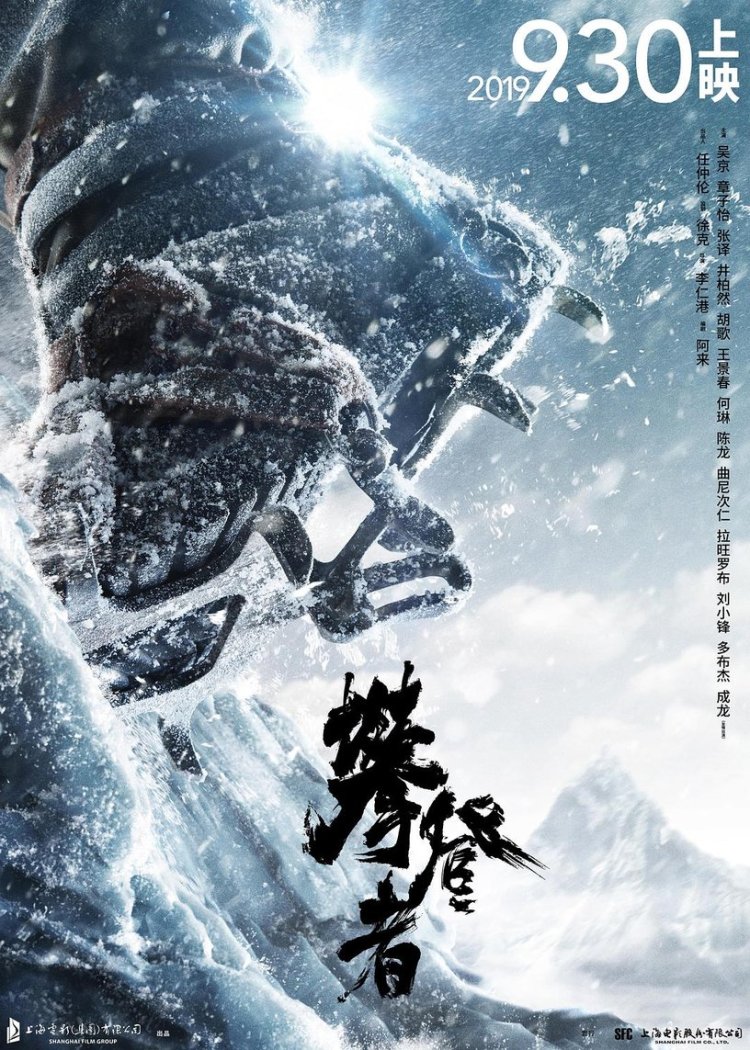
The Climbers (攀登者, Daniel Lee, 2019)

The Climbers poster 1“Because it’s there” George Mallory famously said when questioned why exactly he wanted to climb Mount Everest. The hero of Daniel Lee’s The Climbers (攀登者, Pāndēngzhĕ) who regards Mallory as his idol has a slightly more reasoned response when similarly questioned by a student, pausing before explaining that humans are always eager to climb towards the future. That will prove to be a rather ironic statement in that Fang Wuzhou (Wu Jing) is a man in many ways trapped by past injustice, unable to move on from simultaneously achieving his dream and being denied its glory.

Narrated by meteorologist and Wuzhou’s innocent love interest Xu Ying (Zhang Ziyi), the action begins in 1960 when the Chinese National Mountaineering Team makes an attempt to conquer Everest from the North Face in response to a territorial challenge from the other side. During the ascent, the team’s captain is killed leaving the three remaining members to press on to the summit alone. Having conquered the mountain, they are unable to record their achievement because they lost the camera during an avalanche and so their success goes unrecognised by the international community. This is particularly bad news for Wuzhou whose intensely romantic attempt to woo shy meteorology student Xu Ying is interrupted at the critical moment by the news they’ve been denied and all their dreams are dashed. Wuzhou becomes sullen and withdrawn, resentful at being thought a fraud. The failure costs him the courage he had mustered to pursue his romantic destiny, allowing Xu Ying to leave for many years of research in the Soviet Union without telling her how he really feels.

Xu Ying’s commentary opts for understatement when it briefly remarks that the nation entered a period of “darkness” following the “failure” of the Everest attempt after which the Chinese National Mountaineering Team was disbanded. Wuzhou is relegated to the boiler room in a factory while his surviving friends, Jiebu (Lawang Lop) and Songlin (Zhang Yi), pursue their separate destinies, Jiebu returning to his sheep farm and Songlin, whose foot was ruined by frostbite, joining a sports training facility. By 1975, times have changed and the powers that be see fit to mount another attempt on Everest in order to measure it “properly” and restore China’s international mountain climbing reputation.

For all that The Climbers is a propaganda epic filled with calls to “show the world what Chinese men can do”, it has its share of flawed heroes failing to measure up to a vision of themselves as fearless champions of their nation. Wuzhou is understandably an embittered man obsessed with the rejection of his first summit, but he’s also an emotional coward who ties the need to have his success validated with the right to speak his heart to the improbably patient Xu Ying who apparently continues holding a torch for him throughout her long years in Russia, only implying she can’t wait for him any longer by putting their relationship on a professional footing when she arrives to lead the meteorological department on the 1975 summit attempt. Nevertheless, the pair share an array of meaningful looks filled with poignant longing while Xu Ying laments the presence of the mountain which stands between them before seemingly deciding to sacrifice herself for Wuzhou’s dream in the forlorn hope of finally conquering it.

Songlin, meanwhile, is resentful not so much towards the mountain or the fact that he will never be able to climb it again but towards Wuzhou who saved his life and let the camera fall, thereby bringing shame on the Chinese nation. Later, a brave young man opts to sacrifice his life to ensure the camera’s survival, and as Songlin later comes to understand the climb is a heavy responsibility which puts young lives at risk for a fairly meaningless prize which may not bring the glory to their nation that the young men and women trying to reach the summit might expect. Nevertheless, they plough on regardless. 1960 leads to 1975, and then to 2019 in which intrepid Chinese climbers once again attempt to conquer Everest in the company of a (in some ways not terribly) surprising star cameo in order to reemphasise the nation’s manly prowess and overwhelming desire to protect what it sees as its territory. Lee makes the most of the snowy vistas for a series of death defying stunts as the team (repeatedly) encounter avalanches, rock falls, and dangerous storms, risking all to bring glory to China but remaining resolute in their determination to make it all the way to the top.


The Climbers is currently on limited release in UK cinemas courtesy of Cine Asia, and in the US from Well Go USA.

Original trailer (English subtitles)

Bento Harassment (今日も嫌がらせ弁当, Renpei Tsukamoto, 2019)

Bento harrassment posterChildhood’s a funny thing. Obviously lacking life experience and used to being the centre of someone’s universe, children can be curiously self-centred, little knowing the hard work their parents put in to try and make them happy until they suddenly realise years later that their mothers must have toiled through the night just to finish that costume for fancy dress that they didn’t really want to wear. Fed up with her teenage daughter’s sullen indifference, the heroine of Bento Harassment (今日も嫌がらせ弁当, Kyo mo Iyagarase Bento) comes up with an ingenious solution – increasingly elaborate lunchboxes designed to vent her frustration in a way that’s impossible for her daughter to ignore.

12 years previously Kaori (Ryoko Shinohara) was blissfully happy with her two little daughters, Wakaba (Rena Matsui) and Futaba (Kyoko Yoshine), but then her husband was killed in an accident and her life was turned upside down. Now she lives alone with her youngest daughter Futaba who has entered something of a rebellious phase, never directly talking to her mother but communicating through pithy, passive aggressive texts. In a bid to get her attention, Kaori decides to play her at her own game – by becoming so annoying that she’s impossible to ignore. From the day that Futaba enters high school she commits herself to making one “annoying” bento every day, eventually adding a message or two into the mix. Much to Futaba’s chagrin, her mother’s bento becomes a cause of daily excitement among her school friends who can’t wait to see how her mother has chosen to troll her on this particular day.

Perhaps tellingly, Kaori and her daughters live on a small island, Hachijojima, which is technically classed as “Tokyo” though in another sense almost as far from the bustling metropolis as it’s possible to get. There are no trains, or shopping malls, or convenience stores, just cows and wholesome wisdom. Caught between one thing and another, Futaba quits her after school athletics club to sit in a field and write angsty poetry about how she’s all alone in the universe. She doesn’t understand why her mum’s so extra and is confused by her attraction to a childhood friend (Kanta Sato) who has now become buff after developing an obsession with taiko drumming. Beginning to figure out why her daughter’s so moody lately, Kaori doubles down on the annoying bento plan but tries to put a little guidance in there too to push the indecisive Futaba towards making concrete decisions about her future.

Unlike the typically self-sacrificing mothers of “hahamono”, Kaori has her spiky side and never particularly looks for thanks or recognition from her daughters only basic civility. She works two jobs (one in a bento shop and another in a pub) and still makes time to devote herself to the petty art of annoying bento which she also posts online on a blog which becomes an instant hit with similarly stressed out parents looking for a little innocent revenge. Through the blog she finds herself bonding with Shunsuke (Ryuta Sato), a widowed father of a five-year-old boy who is struggling to perfect the art of bento though his aim is less revenge than trying to bond with his son who obviously misses his mum. Yet even “annoying” bento comes from a fundamental place of love – after all, you don’t spend all night cooking to send a passive aggressive message to someone you don’t like. Rising to the challenge, Futaba refuses to admit defeat and makes a point of eating all of the annoying bento without a word of complaint, allowing a kind of communication to arise between herself and her extremely patient mother.

Seeing all her dreams crushed on one extremely bad day, however, makes Futaba lose faith in her mother’s gentle wisdom. Kaori tries to convince her that nothing’s ever really “wasted” because even when things don’t work out the way you hoped they still teach you something else but that’s a hard lesson to learn when you’re young and unused to disappointment. Nevertheless, thanks to her mother’s relentless trolling and some careful words from her sister, she comes to realise just how much her mother has sacrificed on her behalf and understand her mother’s love. A warmhearted tale of mother daughter bonding and an ode to persevering through life’s various difficulties, Bento Harassment is a wholesome treat and inspirational tribute to living life without regrets.


Bento Harassment screens in Chicago on Sept. 27 as part of the ninth season of Asian Pop-Up Cinema.

Original trailer (English subtitles)

This Transient Life (無常, Akio Jissoji, 1970)

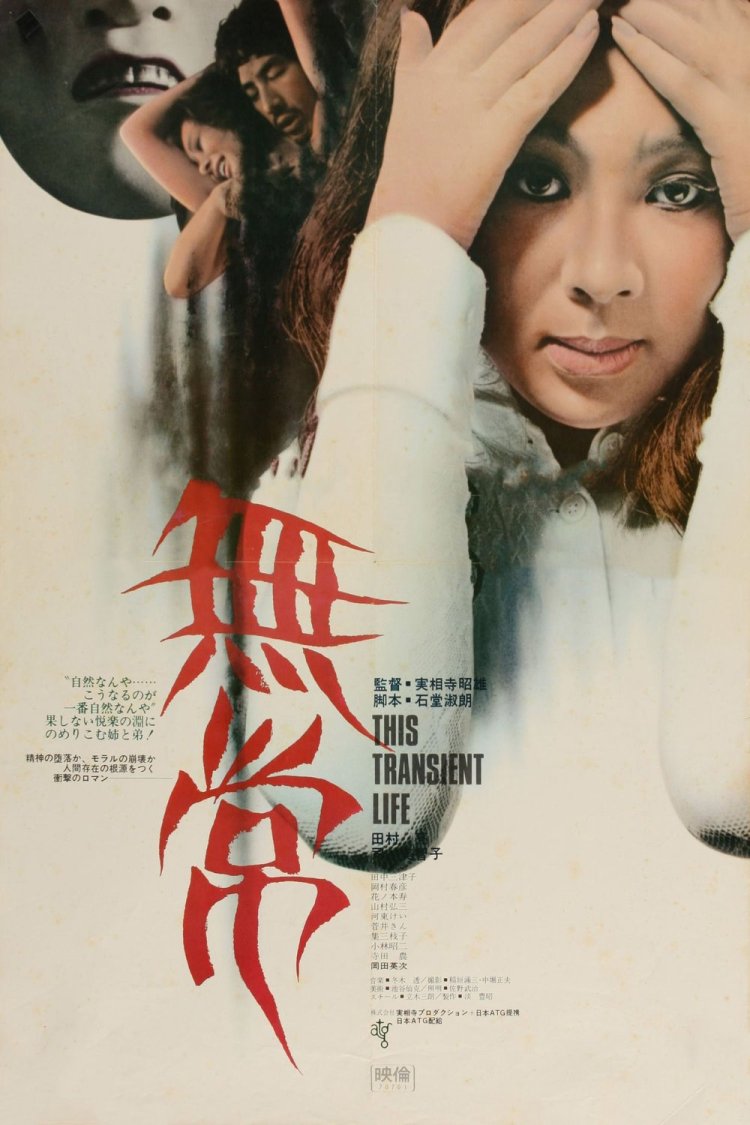
this transient life poster“People should do whatever pleases them, it’s because people suppress their desires that the world has become so complicated” the “hero” of Akio Jissoji’s 1970 Buddhist epic This Transient Life (無常, Mujo) impassively intones, “If we just do whatever pleases us, then everything will turn out fine”. As we will see, there are definite problems with Masao’s (Ryo Tamura) philosophy, but he may have something in the inherent paradox of Buddhism which finds serenity in nothingness while decrying nihilism.

We first meet Masao, a wealthy young man from a noble family, jumping over a wall in defiant violation of a no trespassing sign. He is in hiding, avoiding going home because his austere father (Kozo Yamamura) is due to arrive for another dose of parental oppression. His sister, Yuri (Michiko Tsukasa), comes to fetch him knowing that they cannot resist forever. Like her brother who rejects university and the corporate life, Yuri rejects marriage and seems intent on deciding her own future, only she does not seem to have any other path in mind. Left alone in the house while their parents attend a family function, disinviting the kids because of their ongoing recalcitrance, the siblings put on a pair of noh masks and chase each other around the house. Gradually a primal spirit takes over. Masao seduces his own sister, beginning a dangerous and necessarily illicit affair for no other reason than to prove that he can.

Ogino (Haruhiko Okamura), a reluctant Buddhist priest at the local temple who is perhaps himself in love with Yuri though apparently unwilling to pursue her even though there is nothing in his religion which forbids him, later takes Masao to task for his dark philosophy. Branding him a chaos agent who creates hell wherever he goes, Ogino urges him to absent himself from the society of others, go travelling, keep his hedonistic nihilism to himself. Masao, however, counters that he has only made the world more “colourful”, that in the end all he has done is dig out the true essence from the hearts of those around him. People do what they want, and nothing he says or does is in any way relevant save that they each faced their own destinies as they intersected with his. To Ogino’s mind, being overly aware of your destiny is no good thing, in fact Buddha will place his hand over your eyes to prevent just that, but to Masao the power to discern his own fate that which gives him the terrifying power to act solely according to his desires.

Meanwhile, the men around him seem to flounder in their own repression. Discovering the transgressive relationship between Masao and his sister, Ogino keeps quiet but finds himself caressing a statue of the goddess Kanon, while the family’s servant Iwashita (Kotobuki Hananomoto) secretly peeps on Yuri in the bath, and Masao’s later mentor, the sculptor Mori (Eiji Okada), actively encourages him to sleep with his much younger wife looking on as he does. “Women are nothing” Masao coldly exclaims, they are “curious animals” who want “immediate pleasure”. Seduced by Mori’s lonely wife Reiko (Mitsuko Tanaka), he later leaves decrying her as a whore who has commodified the act of love as if she were merely a receptacle for his desires much like the shapeless wood which receives the passions of the sculptor and eventually assumes its chosen form.

Masao and Yuri rebel against conventionality and bourgeois values through the ultimate taboo, bearing out Ogino’s criticism of Masao’s philosophy as “nothing but disorder”. Their transgression spirals and informs others. A disruptive influence in his master’s household, Masao pushes Mori’s resentful son (Isao Sasaki) into a quasi-incestuous relationship with his step-mother, while pushing his sister into a socially transgressive marriage to a servant to cover-up the “crime” of a child conceived not only out wedlock but with incestuous blood. He absolves himself for the blood on his hands claiming that every man makes his own choice, and posits himself as the only truly enlightened being as an embodiment of realised desire. Ogino calls him a mad man, but he alone is able to achieve a kind of enlightenment and enter a higher plane, transcending normal human consciousness. “Life and death are a great matter, treasure your time” the title card advises us. Masao rejects the “unappealing” simplicity of heaven for the chaotic pleasures of a transient existence, impressing his own desires on a repressive society and watching indifferently as their terrible flowers bloom.


This Transient Life is the first of four films included in Arrow’s Akio Jissoji: The Buddhist Trilogy box set which also features an introduction and selected scene commentaries by scholar of the Japanese New Wave David Desser plus a 60-page booklet with new writing by Tom Mes and Anton Bitel.

 Opening scene (English subtitles)

Tokyo Ghoul S (東京喰種 トーキョーグール【S】, Kazuhiko Hiramaki & Takuya Kawasaki, 2019)

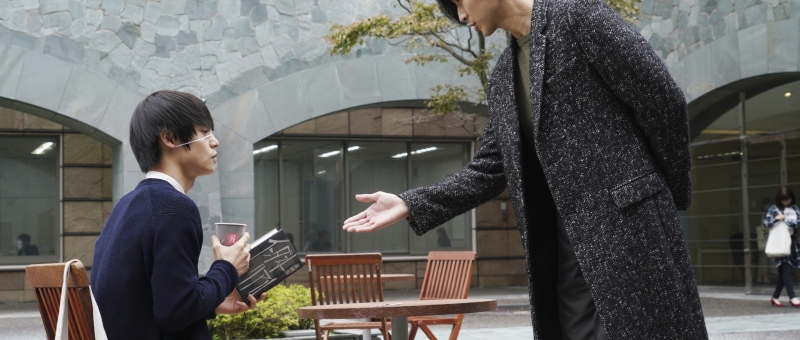
tg2_poster_3校B_ol_6In Tokyo Ghoul, regular university student Ken Kaneki (Masataka Kubota) had to learn to accept the parts of himself he didn’t like in order to become the kind of man he wanted to be. Of course, the situation was more complicated than that faced by most young men because Ken Kaneki’s darkness was born of being seduced by a beautiful woman who turned out to be a “ghoul” – a supernatural being craving human flesh, something he later became himself when they were both injured in a freak accident after which he got some of her organs. The sequel, Tokyo Ghoul S (東京喰種 トーキョーグール【S】) finds him in a more centred place, having accepted his new nature as neither human nor ghoul but a bridge between the two. Now he has a series of different questions to face in trying help others accept themselves in the same way as they too wonder if there are some parts of themselves so dark that if they revealed them they could never be loved.

While Ken goes about his regular student life working part-time at ethical ghoul cafe Anteiku, a ghoul serial killer known as “The Gourmet” (Shota Matsuda) has been making the news after targeting a high profile model (Maggy) whom he stalked and killed simply to taste her heterochromatic eyes. Tsukiyama, as we later learn his name to be, is a dandyish fopp living in a Western-style country house complete with servants who serve him only the finest meals well presented to hide their dark genesis. On catching a whiff of Ken’s unique human/ghoul scent, he knows he must taste him and puts a nefarious plan in motion in order to lure him to a mysterious ghoul-only restaurant where humans are butchered live for show while the clientele salivate over scenes of intense cruelty.

That’s all too much for poor Ken. He can’t understand how anybody could act with so little regard for life. The cafe owner pointedly asks him if he feels pity when looking at the butchered flesh of an animal, which he of course does not. The ghouls feel much the same, humans are their prey – they can’t help what they are, but living under the intense fear of discovery in an obviously hostile world has made them cruel and resentful to the extent that they no longer understand the value of life. The ghouls that Ken knows, the ones which frequent Anteiku, are different. They have resolved to live ethically and respect lives both human and ghoul equally.

Ken’s friend and colleague Touka (Maika Yamamoto), however, is beginning to have her doubts. In the first film we saw her pursue a touching friendship with classmate Yoriko (Nana Mori) whose cooking she made a point of eating solely as a means of connection despite the fact that human food makes her ill. Now she fears she’s doing the wrong thing, that it will only hurt more if her friend finds out her secret and rejects her, or worse that she may put her in danger. Therefore, she counsels Ken to distance himself from his overly cheerful friend Hide (Kai Ogasawara) and the human world in general, threatening that she herself will kill Hide if he discovers that Ken is a ghoul. As expected, Ken ignores her advice but is mildly shaken by it. Deciding to intervene when his sometime enemy Nishiki (Shunya Shiraishi) is being beaten up in the street, he discovers a better future on learning that Nishiki is living with a human woman who knows he is a ghoul, but loves him anyway.

Though Kimi’s (Mai Kiryu) justifications that she can live with the fact her boyfriend kills people and eats them so long as he leaves her friends and family alone is a little worrying, it is a touching example of the film’s positive message that there is no secret so terrible that it means someone can’t be loved. Kimi accepts Nishiki’s nature as a ghoul, aware of the fact he can’t help what he is and that if she had been born a ghoul she would be the same. Touka fears rejection, but on catching sight of her bright red wings Kimi utters the single word “beautiful”, seeing only goodness without fear or hate.

Tsukiyama meanwhile seems to have gone in the opposite direction, pursuing his desires to the point of obsession in a quest for ever greater sensation. He stalks and murders the model to devour her eyes in an especial piece of irony, while his pursuit of Ken takes on an intensely homoerotic quality. Using the same tactics as Tokyo Ghoul‘s Rize, Tsukiyama picks Ken up through bonding over books, invites him to “dinner” and later sends him an invitation accompanied by a single red rose. Despite the romanticism, however, he soon reverts to type in blaming Ken for his actions. “You’re making me this way”, he insists, “take responsibility”, like every abuser ever simultaneously accepting that his behaviour is inappropriate and justifying it as a consequence of someone else’s actions. In the end, Tsukiyama’s illicit desires consume him, while Ken’s act of self-sacrifice once again allows him to be the human/ghoul bridge combatting Tsukiyama’s rapacious cruelty with an open-hearted generosity which pushes Touka to the fore so that she too can learn that peaceful co-existence is possible when there is trust and understanding on both sides.

Nishiki tells Ken his problem is that he’s too nice, but that’s not a bad thing to be because he just might “save somebody someday”. Niceness as a superpower might be an odd message for a movie about flesh eating monsters almost indistinguishable from regular humans, but perhaps that’s what will save us in the end, a generosity of spirit that makes it possible for us each to accept each other’s darkness in acknowledgement of our own. Less stylistically interesting than the first instalment, Tokyo Ghoul S may be a kind of bridge movie in a possible trilogy (a sequel is teased in a brief mid-credits sequence featuring a mysterious character who makes several unexplained appearances throughout the film), but nevertheless does its best to further the Tokyo Ghoul mythology as its hero finds his strength in difference and mutual understanding.


Tokyo Ghoul S screens in the US for three nights only on Sept. 16/18/20 courtesy of Funimation. Check the official website to find out where it’s playing near you!

Original trailer (English subtitles)