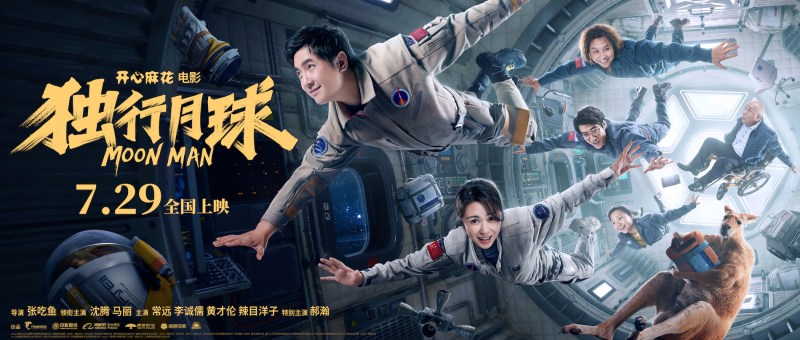
Moon Man (独行月球, Zhang Chiyu, 2022)

A diffident everyman battles loneliness and despair only to become a selfless sacrifice for a world that left him behind in the latest film from the Mahua FunAge gang, Moon Man (独行月球, Dúxíng Yuèqiú). Not quite the raucous comedy that Mahua FunAge has become known for with popular hits Never Say Die and Hello, Mrs. Money, Moon Man is a more contemplative affair adapted from a South Korean manhwa by Cho Seok and equal parts absurdist exploration of the human condition and cathartic post-pandemic dramedy that insists there is always a homecoming in one way or another. 

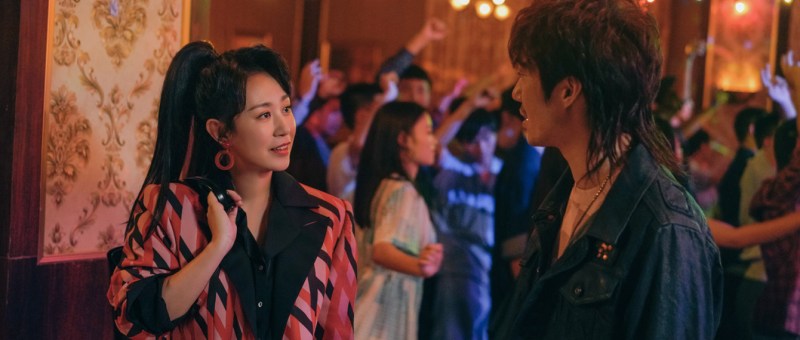
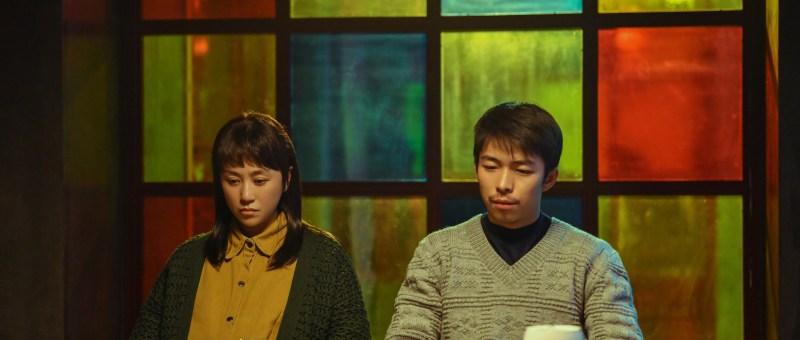
Yue Dugu (Shen Teng) is proud to refer to himself as a “middle man” in that he has deliberately cultivated the image of Mr. Average in an intense attempt never to stand out from the crowd. On applying for an engineering job on a space programme he’s told the position has been filled but there’s an opening in maintenance. Yue didn’t really want to take it but does, as we later learn, after falling in love at first sight with Xing (Ma Li), the commander of a mission set to save the Earth from a meteor strike some years in the future. Being the kind of guy he is, Yue never makes an attempt to get close to her but thinks his chance has finally come when the mission is concluded successfully though Xing doesn’t appear to even know he exists. He decides to write a long love letter while listening to romantic music and consequently misses all of the alarms alerting him to the fact that something has gone very wrong, the mission is being aborted, and they all need to evacuate as soon as possible. Left behind as the rockets take off he can only look on in horror as a meteor strikes the Earth leading him to believe he is the sole survivor of the human race. 

Of course, that turns out not quite to be the truth. What starts out as Robinson Crusoe quickly becomes The Truman Show as Xing, who has found safe refuge on a nearby space base, realises someone was left behind and plans to livestream their daily life to give hope to the survivors on Earth who are now living a dismal post-apocalyptic existence underground. Recruiting a former live-streaming king, they try to set Yue up as an idealised propaganda hero but, as they are unable to communicate with him, Yue still thinks he’s the last of his kind and his behaviour cannot really be called inspirational seeing as he spends most of his time trying to crack the code to enter Xing’s quarters and having dinner with a mannequin he’s pasted her face on. Meanwhile, he’s also discovered that he’s not quite as alone as he thought but is trapped with a very angry kangaroo left behind by a research team. 

Yue was a lonely man before, but begins to experience true despair while quite literally alone on the moon wondering what the point of his life is especially if, as he assumes, Xing is no longer in this world. He contemplates suicide and then, after hearing radio static and coming to believe there may be someone else out there comes into his own trying to plot his escape by thinking outside of the box and proving himself a talented scientist. Struck again by despair he realises that cure for loneliness is knowing there’s someone there to keep the light on for you to guide you home only to see the Earth light up with a message intended to read “you are not alone” but which accidentally reads “you are no one” reinforcing Yue’s everyman status as a middle of the road guy who shouldered the burden that was handed to him and set out to save the world all while locked outside of it. 

Yue’s accidental heroism begins to soften Xing’s austerity as she gradually falls for this “awkward” man, while he learns to step up to the plate to protect her and the rest of humanity all of which lends hope to those trapped in the bowels of the Earth and encourages them to begin rebuilding even if at great personal cost. Shifting into Armageddon territory, it’s a nobody who finally saves the world in a final act of selfless heroism. Over the past few years, many may have felt as if they were alone on the moon or found themselves trying to parse grief on a mass scale while mourning the world they knew which had been so abruptly taken from them. Yet as the final title card puts it, the universe is vast, “we will meet again” and there will always be a homecoming in one way or another. Boasting excellent production values including some adorable animated sequences, Moon Man is a strangely cathartic experience filled with zany humour but also genuine hope for brighter future on the other side of the darkness. 


Moon Man is in UK cinemas now.

Original trailer (Simplified Chinese subtitles only)
Bad City (バッド・シティ, Kensuke Sonomura, 2022)

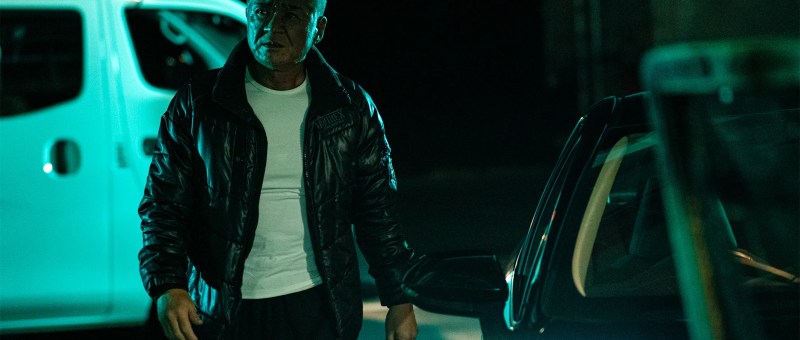
V-Cinema legend Hitoshi Ozawa returns in a tale of big city corruption helmed by Hydra’s Kensuke Sonomura. Scripted by Ozawa himself and apparently created in part as a celebration of his 60th birthday, Bad City (バッド・シティ) is a clear homage to the classic yakuza dramas of the early ’90s while boasting some of the best action choreography in recent Japanese cinema performed by the likes of Tak Sakaguchi along with Ozawa himself who performs all of his own stunts. 

According to dodgy CEO Gojo (Lily Franky) who has just inexplicably been acquitted of extortion and colluding with the yakuza, Kaiko City is riddled with crime and violence which is why he’s announcing his candidacy for mayor. Meanwhile, behind the scenes, a mysterious assassin (Tak Sakaguchi) is cutting swathes through the Sakurada gang who dominate the city’s western district which Gojo has earmarked for a redevelopment project he claims will improve the lives of citizens but is in reality just an excuse to build a massive casino complex intended to enrich himself and his company. The previous mayor had won a landslide victory thanks to his opposition to the redevelopment plan which enjoys little support from the local population but Gojo isn’t exactly interested in winning hearts and minds in the community. 

Really just another gangster himself, Gojo’s machinations are also destabilising the existing underworld equilibrium in seducing treacherous minions from other gangs including vicious Korean gangster Kim Seung-gi whose loyalty to ageing gang boss Madam Kim is clearly waning. Then again, an enemy’s enemy is a friend allowing unexpected alliances to emerge between previously warring factions especially given that the sudden offing of a high status gang boss is frowned upon in the gangster play book. 

With police and judicial collusion the only possible explanation for Gojo’s miraculous escape from justice, an earnest prosecutor sets up a secret task force under the command of Public Security agent Koizumi (Mitsu Dan) and led by veteran officer Torada (Hitoshi Ozawa) who is currently in prison awaiting trial on suspicion of offing Mrs Kim’s only son, Tae-gyun. Torada is an unreconstructed violent cop operating under the philosophy that if you beat up a good guy that’s violence but if he’s bad then it’s justice. He has perhaps learned to see the world as morally grey, not believing himself to be necessarily on the side of right so much as resisting the forces of darkness by doing whatever it takes to survive in this city which is indeed already quite corrupt. Partnered up with two veterans and a junior female officer from violent crimes who were assigned to investigate the Sakurada boss’ murder, the gang do their best to trap Gojo legally by uncovering incontrovertible evidence of his dodgy dealings they can use to nail him in court, or failing that the court of public opinion, that cannot be swept aside by his friends in high places. 

Sonomura opens as he means to go on with a series of bloody assassinations culminating the massacre of the Sakurada gang in a bathhouse, while building towards the final mass confrontation in which Ozawa and his team face off against hordes of foot soldiers trying to fight their way towards a confrontation with Kim Seung-gi. Dynamically choreographed, the action sequences are surprisingly bloody and heavy on knife action but crucially also displaying a high level of characterisation and dramatic sensibility as the earnest cops square off against amoral gangsters willing even to sacrifice their own. 

Though there might be something uncomfortable in setting up the major villain as a rogue Korean gangster, the film paints his defection in part as a reaction to Mrs Kim’s initial loathing of the Japanese while in the end allowing a kind of cross-cultural solidarity to emerge as the Sakurada gang become accidental allies and Mrs Kim receives a lost letter from her son that allows her to change her way of thinking while helping to take down the destabilising force of Gojo, restoring a kind of order at least to the streets of Bad City Kaiko. Ozawa may be an equally dangerous extra-judicial force, but at least for the moment he’s standing in the light where everyone can see him taking out the trash and leaving those like Gojo no quarter in an admittedly violent place.


Bad City screened as part of this year’s Camera Japan.

Original trailer (dialogue free)

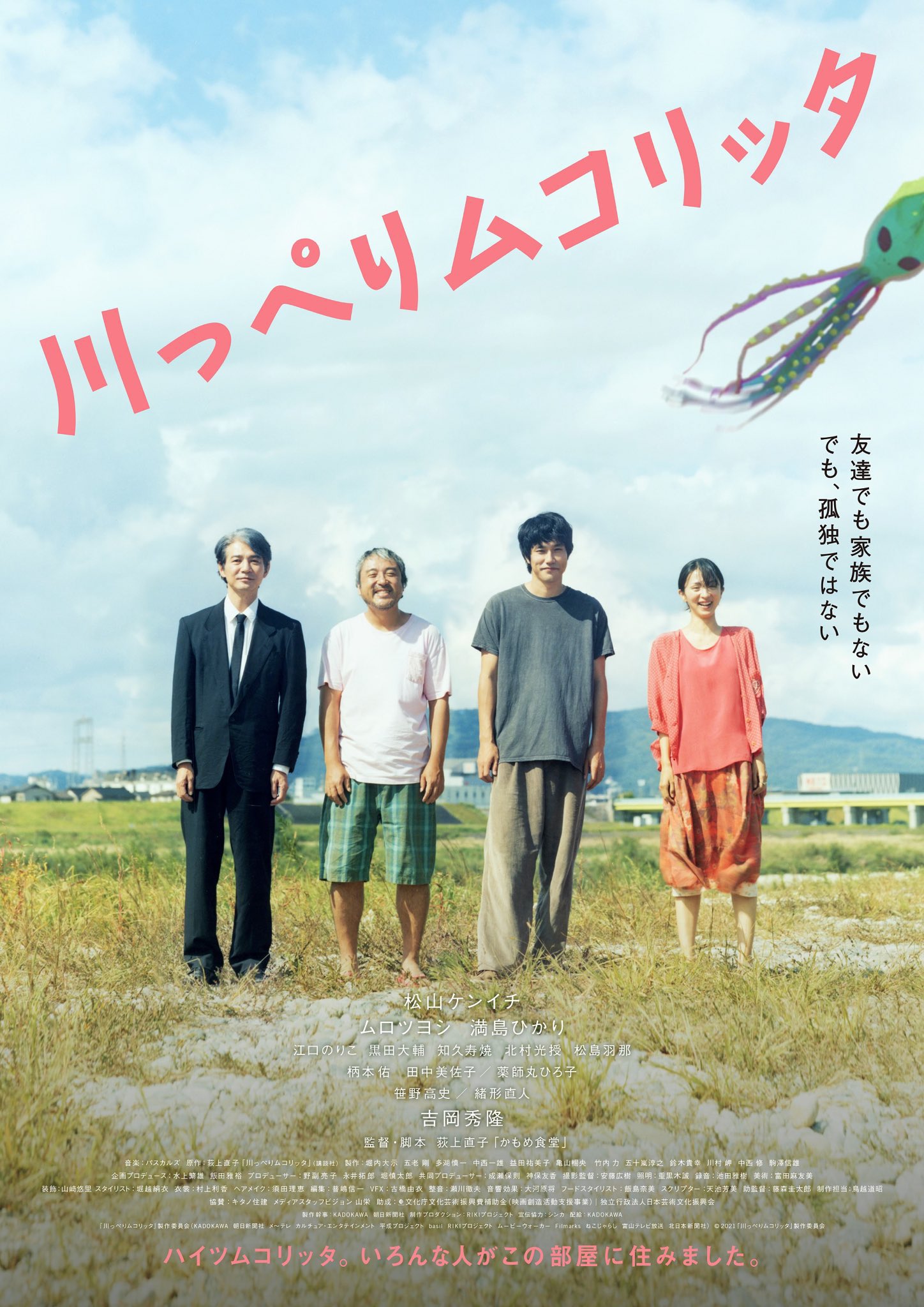
Riverside Mukolitta (川っぺりムコリッタ, Naoko Ogigami, 2021)

The spectre of death hangs over the protagonists of Naoko Ogigami’s adaptation of her own novel Riverside Mukolitta (川っぺりムコリッタ, Kawapperi Mukolitta) despite the sunniness and serenity of the riverside community where they live. They are each, in their own way, grieving and sometimes even for themselves in fear of a far off lonely death or else wondering what it’s all for and if this persistent suffering is really worth it, but eventually find a kind of solidarity in togetherness that can at least make the unbearable bearable. 

Recently released from prison, Yamada (Kenichi Matsuyama) has been sent to a remote rural village to start again with a job in a fermented squid factory and an apartment in a small row of houses by the river. His landlady Shiori (Hikari Mitsushima), an eccentric young woman with a little girl, assures him that though the building is 50 years old and many have passed through during that time no one has yet died in his unit. His neighbours Mizoguchi (Hidetaka Yoshioka) and his small besuited son Yoichi traipse the local area selling discounted tombstones reminding potential customers that no one lives forever and it might remove some of the burden of living to have your affairs in order for when you die. If all that weren’t enough, the last house in the row is thought to be haunted by an old lady whose ghost sometimes appears to water the flowers so they don’t turn to weed. Arriving home one day, Yamada discovers a letter from the local council letting him know that his estranged father has passed away in a lonely death and his remains are ready to collect at the town hall at his earliest convenience. 

Yamada is a man who keeps himself to himself, clearly ambivalent in trying to adjust to his new life wondering if he really deserves the opportunity to start again and if there’s any point in doing so. Seeing as his parents divorced when he was four and he had no further contact with his father, he is unsure if he wants the responsibility of his ashes which will of course contain additional expense for some kind of funeral. He meditates on the fates of “those who are not thought to exist”, such as the many homeless people who live by the river and are swept away by typhoons, and the elderly who die nameless and alone. When he ventures to the town hall, he discovers an entire room filled unclaimed remains some of which remain anonymous while the sympathetic civil servant (Tasuku Emoto) explains that in general they keep them for a year and then bury them together if no one comes forward to claim them. Aside from the staff members at the crematorium, the civil servant was the only person present at his father’s cremation which at any rate must be quite an emotional burden for him though he is familiar with the case and willing to talk Yamada through his father’s final days. 

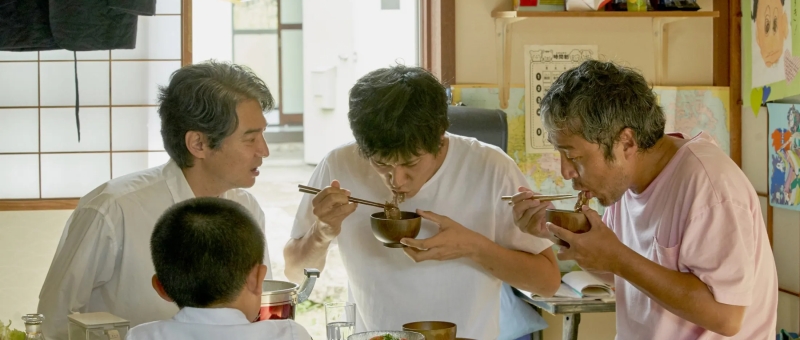
Meanwhile, he’s bamboozled into an awkward friendship with the strange man from next-door (Tsuyoshi Muro) who brands himself a “minimalist” and claims to be self-sufficient in the summer at least with the veg he grows in the garden behind their apartments but insists on using Yamada’s bath because his is broken and he doesn’t have the means to fix it. Giving in to Shimada’s rather aggressive attempts at connection, Yamada comes to feel the power of community in finding acceptance from the other residents in the small row of apartments along with the paternal influence of his boss at the factory and the kindness of an older woman who works there. Yoichi, the tombstone seller’s son, is fond of playing on a junk heap which is in its way a graveyard of forgotten and discarded things from rotary telephones to CRT TVs and broken air conditioners, while he and Shiori’s daughter Kayo try to contact aliens from a purgatorial space where the living and the dead almost co-exist. Taking place at the height of summer during the Bon festival when the mortal world and the other are at their closet, Ogigami’s laidback style gives way to a gentle profundity in the transient nature of existence but also in the small joys and accidental connections that give it meaning. 


Riverside Mukolitta screened as part of this year’s Camera Japan.

Original trailer (no subtitles)

Give Me Five (哥,你好, Zhang Luan, 2022)

A struggling 30-year-old begins to repair his relationship with the difficult father he believed never liked him after being unexpectedly thrown back to the past and almost erasing himself from history in Zhang Luan’s sci-fi-inflected tale of filiality, Give Me Five (哥,你好, gē nǐhǎo). What begins as a Chinese riff on Back to the Future eventually skews closer to recent hit Hi, Mom which the Chinese title subtly echoes as the hero comes to appreciate the power of maternal love and sacrifice through bonding with the younger versions of his parents. 

Now 30 years old, Xiaowu (Chang Yuan) explains that he was long estranged from his grumpy father Wu Hongqi (Wei Xiang) and rarely visited him but has since become his main carer now that he is living with Alzheimer’s. Xiaowu makes his living as an e-sports entrepreneur which is not something former engineer Hongqi can well understand and in truth Xioawu doesn’t seem to be that successful as he’s been putting off proposing to longterm girlfriend Huahua because of an anxiety about his finances. When Hongqi suddenly jumps off a bridge for no apparent reason and ends up in a coma, Xiaowu is at first oddly pleased and immediately begins raiding his office looking for his bankbooks only to find a mysterious ring and an old diary penned by his mother who died when he was a baby. Putting the ring on sends him back to 1986 where he manages to mess up his parents’ meet cute, endangering his own existence. In order to put things right he has to go back in time Marty McFly-style to ensure his mum and dad fall in love just like they were supposed to. 

Back to the Future is a film from the 1980s expressing nostalgia for an idealised 1950s small-town America. Give Me Five to a degree romanticises the China of the mid-1980s but does so from an entirely different angle than the recent trend in 80s nostalgia which has taken hold in the West in that, other than a brief romantic moment featuring Teresa Teng’s Tian Mi Mi along with a few other retro hits, it is largely uninterested in pop culture or revisiting childhood memories but is attempting to draw a comparison between China before economic reform and the ultra-capitalist society of today. In what some might see as a simpler time, Xiaowu’s mother Daliu (Ma Li) is, as she’s fond of saying, a “model worker” in a factory which is in danger of closure while the “Biff” character, Qiang (Jia Bing), is a former employee who was dismissed for stealing coal. Having become wealthy after almost certainly doing something dodgy in Hong Kong he’s returned with a prominent Cantonese accent to buy the factory as part of a public-private partnership. A feisty young woman, Daliu sends him packing insisting she won’t let anyone disadvantage her fellow workers. 

The comparison is further borne out by the melancholy figure of Qin (Huang Yuntong) who dated Hongqi after getting the meet cute that was supposed to go to Daliu but thew him over for the promise of riches with Qiang only to be left lonely in her old age having unwisely betrayed love for material gain. Meanwhile, there’s an interestingly progressive element to the relationship between Daliu and Hongqi in which Hongqi is somewhat feminised as the domestic partner cooking and shopping for his wife while Daliu is the uncompromising model worker as she proves during a high impact welding competition while eight months pregnant. The couple first fall in love talking over industrial plans with Daliu offering advice from the shop floor to help improve educated engineer Hongqi’s designs. While interacting with his parents before he was born, Xiaowu gains the familial experience he always felt he lacked in being able to share a family meal while touched by the love that existed between his mother and father and the knowledge that his parents were at least blissfuly happy with each other even if it was only for a short time. 

Xiaowu had been resentful of his father that he never really told him how his mother died. He decides to try saving his mother’s life too and through his various experiences comes to an appreciation of maternal love not least through somehow being able to time travel into the womb to forge a more direct connection with her. In part an advocation for a more traditional filiality in which Xiaowu develops an understanding of the interplay between love and sacrifice between parent and child while coming to understand his relationship with his father after learning his family history, the film also offers a subtle rebuke against the consumerist society in idolising Daliu and her model worker attitude insisting that everything was better when people worked together for the good of all rather than for personal gain. It might be a slightly disingenuous message, Daliu’s factory life is indeed somewhat idealised, but there is something touching in Xiaowu’s eventual conversion and belated bonding with his heartbroken father. 


Give Me Five is in cinemas across the UK, Australia and New Zealand courtesy of CMC and Well Go USA in the US and Canada.

International trailer (Simplified Chinese / English subtitles)

Mother’s Place (엄마의 자리, Ryu Hee-jung, 2022) 

Outdated patriarchal social codes conspire against the emotional bonds of family in Ryu Hee-jung’s touching family drama, Mother’s Place (엄마의 자리, eomma-ui jali). While adult siblings keep secrets from each other to avoid personal embarrassment and fail to resist the demands of otherwise estranged relatives, a teenage girl is forced to mourn the loss of her parents alone feeling as if her place in the family unit was never guaranteed and that she has been abandoned by those closest to her simply because her mother’s was a second marriage. 

High school girl Yuna is called to the hospital by her oldest sister, Jungsun, who is desperately trying to hold it together but receiving little support, to be told that her parents have been involved in a car accident and are in critical condition. Jungsun rings her other sister, Jungwon, to ask her to pick up her children while waiting for her husband to get off work but Jungwon is also busy with her job as a lawyer and ignores her first few calls. Meanwhile, the oldest brother, Junghan, rudely tells her he’s too busy to talk and makes no attempt to travel to the hospital which the other siblings partly understand because they believe him to be in Japan only as it turns out that is not quite the case. After the parents sadly pass away, Jungsun and her sister organise the funeral but are immediately overruled by a grumpy and extremely conservative uncle who happens to be a prominent politician and is outraged that they are holding a joint memorial considering it was a second marriage. Apparently from a somewhat prestigious family, the other relatives intend to bury the father in the family plot and think it would be improper to inter the mother alongside him because his first wife and the mother of the eldest three children already rests there. 

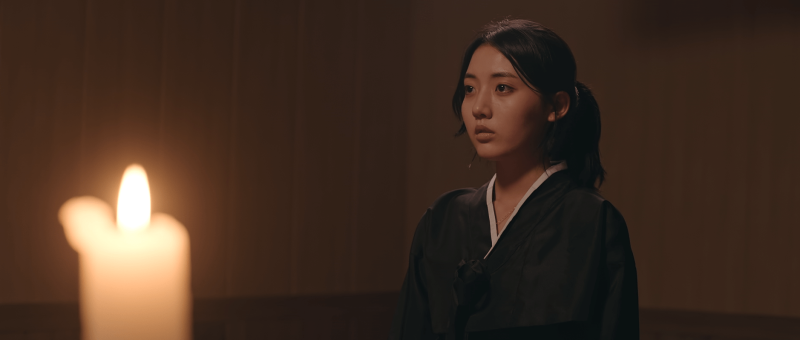
“Things won’t change even if you insist” Yuna is told by her siblings who are minded to simply go along with the uncle’s instructions even though they too were shocked and hurt by the suggestion that a joint funeral is improper, reminding the uncle that she may have been a stepmother but she was their mother too. Orphaned at such a young age, Yuna is then left to deal with her mother’s death all alone while simultaneously prevented from being able to attend her father’s funeral. Her outsider status is already signalled by her name, all of her siblings share the first syllable “Jung” while she obviously does not and while they always acted like a family now it’s like they’re disowning her while disrespecting her mother’s memory in suggesting there was something sordid about her relationship with her father that prevents her being buried next to him in her rightful place as his wife. 

She can’t understand why they would just go along with something so obviously wrong, totally unable to reject the uncle’s intrusion into what should be a matter for the immediate family. When he first arrives, the uncle immediately takes issue with the fact that Jungsun is acting as the chief mourner, insisting her husband (who might otherwise not be considered a member of her father’s family) take over until Junghan arrives because a woman occupying such a role is to him in his extremely conservative thinking inappropriate. A tearful Jungsun just lets it go if internally hurt and irritated given that she’s the one doing all the work of making these arrangements that have so casually been overturned. When Junghan finally shows up with a bruised face, the uncle immediately commandeers him and reveals that he’s invited some professors from a local university along with the intention of getting him a “proper” job though there can be few people who would otherwise think a funeral is an appropriate place for a job interview or professional networking. 

Junghan does however mimic his uncle’s conservative views in his constant digs at Jungwon for not yet being married at a comparatively late age. As will be discovered, Jungwon may have her reasons and they’re ones which she may not have felt comfortable sharing with her family members given the quality of the relationship that exists between them. They are all already holding secrets from each other because of the toxic performativity of their familial roles which leaves them embarrassed and fearful of failing to conform to a societal ideal as seen through the conservative eyes of their uncle and those like him. The older siblings only begin to realise their mistake on witnessing Yuna’s rebellion and fearing for her safety while reflecting on their own emotional bond with her mother and the various ways they are now being forced to deny their love and affection for her. 

Oddly, it’s the surprise appearance of the first wife’s ultra-glamorous sister that gives them permission to question the patriarchal norms expressed by the uncle and begin to re-establish the bonds they share as siblings brokered by an emotional connection and founded in shared memories rather than a simple blood relation. With truths aired and a little more emotional honesty in play, the family is free to remake itself along healthier lines of mutual support and compassion free of the constraints placed on them by outdated social codes. In searching for her mother’s place, Yuna begins to find her own outside of the cold and austere conservatism imposed by those like her uncle. 


Mother’s Place in Chicago on Sept. 24 as part of the 15th season of Asian Pop-Up Cinema.

Manchurian Tiger (东北虎, Geng Jun, 2021)

An adulterous bulldozer operator in north east China finds himself in conflict with a failed construction magnate when his wife insists he find a new home for their Alsatian before their baby arrives in Geng Jun’s dark comedy Manchurian Tiger (东北虎, dōngběihǔ). A Manchurian tiger does indeed appear at certain points of the film, a child at the zoo asking their grandfather why the rather morose beast does not roar only to receive the explanation that the tiger is all alone with no one to talk to. The child sadly reflects that it’s like the tiger is in prison, but the grandfather corrects them that it’s in there for its own good so that it can be protected, loved, and admired, but its plight still calls out to an emotionally wounded poet (Xu Gang) who is also no longer young and feels isolated and constrained by the world around him. 

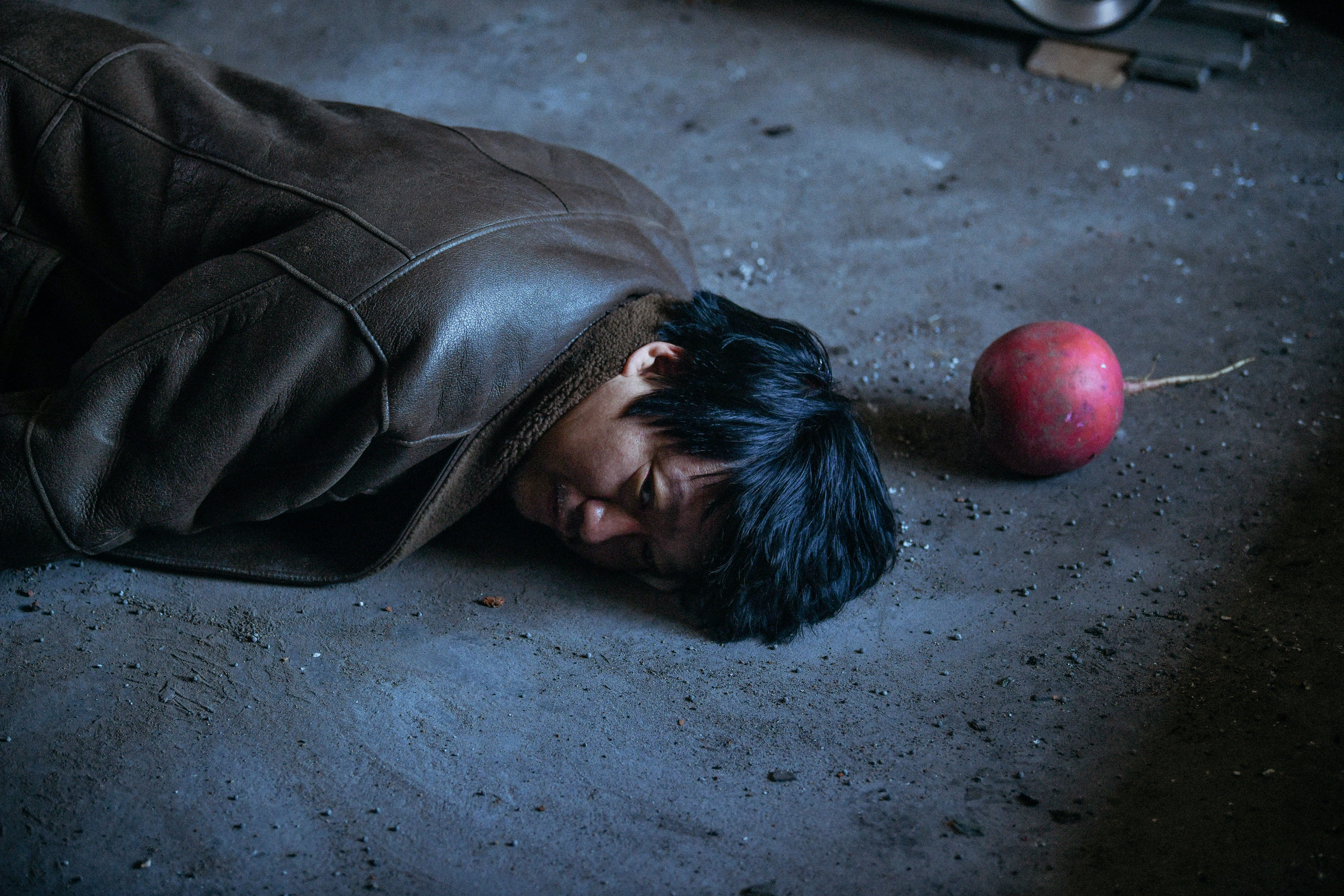
As for bulldozer operator Xu (Zhang Yu) who it seems may once have been a teacher, his problems seem to lie more in the inability to reconcile his conflicting emotions towards his family. His wife Meiling (Ma Li) tells him to get rid of the dog because it’ll be too much for them when the new baby arrives and he complies but is also sickened when he’s met with only prices by the pound on trying to find it a new home. He unwisely decides to leave the dog with a local businessman, Ma (Zhang Zhiyong), but Ma slaughters it to curry favour with a pair of “collection agents” he hires to help him get back money he invested into a construction project that’s clearly gone south and in truth sounds like it may have been a scam to begin with. When the heartbroken Xu discovers the truth he vows revenge only for a strange sort of solidarity to arise between them in shared victimhood both bested by the problems of the modern society in the formerly industrial north east. 

Ma could try to make the case that he’s a victim too and he is in a sense but he’s also a conman as Xu later brands him. Even so he does seem to feel some remorse if not for eating Xu’s dog then at least for plunging his friends and family into financial ruin after they sunk their lifesavings into his project because they believed in him. As he puts it they all, he included, fell for the fantasy of the modern China believing they could all get rich quick only to be undercut by the ironic flip side when cost cutting and subpar materials prevent the apartment block from being finished leaving Ma high and dry unable to recoup his costs until the apartments can be sold. The debt collection agents he unwisely hires are just thuggish loansharks who then ask him for a hefty deposit, smashing up his car to make a point when he tries to use it as collateral. 

In essence it seems as if all Xu wants is to Ma to apologise to the spirit of his dog but Ma apparently values his pride above money and complains the price is too high while Xu resents the attempt to place a monetary value on his friend or imply that perhaps his own flesh also has a price. He’s clearly in a space of mental despair, reminding his mistress that like the tiger he’s no longer young and has exhausted all other opportunities to improve his life so the only thing he has left is his marriage. As his wife Meiling starts starts visiting several women around the local area after noticing the scent of perfume along with stray hairs on Xu’s clothes, it becomes clear he has had several affairs already and is seemingly being punished for his sexual transgressions which are perhaps an attempt to escape his own sense of imprisonment, as caged as the tiger by his familial responsibilities and humiliated by the inability to meet them.

Yet none of these men, not Xu, nor Ma, nor the dejected poet are going to roar because they’ve long since accepted their captivity and believe themselves already too old to risk escape. A fight eventually breaks out among Ma’s creditors when one suggests that the money should first be given to the young because they will spend it, keeping the money moving through an uncertain economy, while the old will save having learned to be cautious amid the vicissitudes of life in a rapidly changing society. Darkly comic and tinged with the fatalism of Sino-noir along with its jazzy score, Manchurian Tiger seems to suggest that the cage is infinite and the only escape lies in accepting its myriad disappointments. 


Manchurian Tiger screened as part of this year’s New York Asian Film Festival where it was presented in partnership with CineCina.

Festival trailer (English subtitles)

Images: © Blackfin Production

Shari (シャリ, Nao Yoshigai, 2021) [Fantasia 2022]

From a distance, conflict and harmony can appear as the same thing or at least that’s how it was for the director of Shari (シャリ) seeing a mountain obscured by the weight of clouds seemingly in a constant battle of resistance with the wind. Later she comes to realise that what she was seeing wasn’t discord but two forces acting in concert with one another maintaining a kind of balance in the natural world. 

Balance may be something in danger of getting lost in the contemporary society as director Nao Yoshigai’s gentle voiceover explains. A documentary/fiction hybrid, Yoshigai wanders around Hokkaido in the winter talking to some of the residents of small-town Japan before shifting into a more environmental message as her interview subjects reflect on the effects of pollution and global warming. The seas are full of plastic while the absence of drift ice has led to a decline in fish populations. Bears have been observed coming down from the mountain but locals were less afraid than sorry hoping the bear would choose to return to its natural habitat and feeling just the littlest bit guilty on hearing it had been killed wondering if their presence is an incursion on its rightful home. Then again, two of the locals that Yoshigai talks to are newcomers from Tokyo who procured licenses to hunt deer and admit that essential life in this land of cold and snow is often difficult. Ironically enough, the woman suggests that they themselves have recovered a sense of being wild in their return to a more primitive way of life. 

In a way it’s that wildness, an ambivalence with an atavistic impulse that seems to captivate Yoshigai as a kind of spirit of the place. She recalls the first time she ate deer meat and that it caused her a sleepless night broken by strange dreams of being in a forest with bloodstained snow and encountering a little girl. Yet as the conclusion admits, we live taking heat from others as the woolly red creature often seen wandering through the town offers up its living blood. In another echo of the opening, two forces which ought to be at war turn out to be allies. The townspeople are fearful at the lack of falling snow explaining that in a roundabout way snow blankets the soil preventing it from freezing and preserving what lies below for the upcoming spring. 

It’s the weather that frightens some most in this age of sleepless bears who no longer have the urge to hibernate given the increasing temperatures. Yoshigai begins to feel responsible, as if her filmmaking has somehow confused the seasons, a feeling perhaps compounded when she returns to Tokyo in late January and finds it unseasonably warm while heavy snowfall is finally forecast for Shari. As another resident puts it, people in places like these had little choice but to learn to live with nature but nature is changing. Some had wanted to shift into hotels but others later won out arguing that nature was their greatest asset and must be protected though few seem to know how when the world is out of kilter and unlikely to stop its course towards self-destruction any time soon. 

In the end, however, Yoshigai’s prognosis is more hopeful recalling the battle between clouds and winds which was really a dance and certain that this perpetual motion has its own direction which can never be stopped. What we discover is nature red in tooth and claw as the Red Thing trudges through snow and smears its blood wherever it goes threatening in jest to consume the local children. Yet through her travels in Shari in summer sunshine and winter snow, Yoshigai comes to understand the pull of the place in its sheer elementality along with the sometimes eccentric residents such as former nomad who chose to settle down rearing sheep for wool and baking bread for sale, both things which are in their own way about warmth and comfort in a cold and unforgiving place. Sleepless bears are all we are, eyes strained by oncoming catastrophe stumbling around a world in the midst of melting until someone puts us out of our misery but continuing to hope for a blanketing of snow as a sign of possible salvation. 


Shari screened as part of this year’s Fantasia International Film Festival

Festival trailer (English subtitles)

Struggling Man (私はいったい、何と闘っているのか, Toshio Lee, 2021)

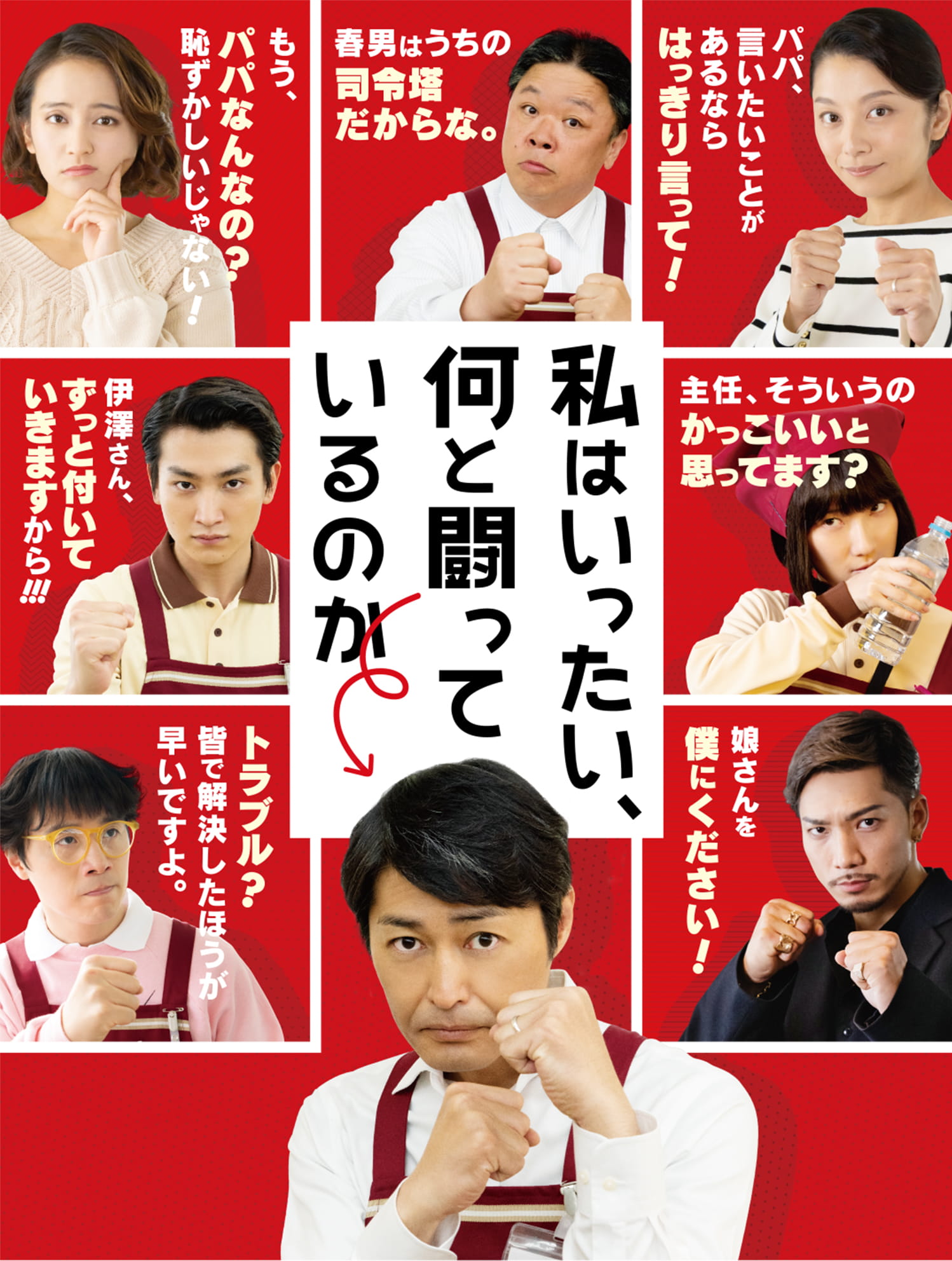
Life is a lonely battlefield for the middle-aged hero of Toshio Lee’s Struggling Man (私はいったい、何と闘っているのか, Watashi wa Ittai Nani to Tatakatteiru no ka). The film’s English-language title and supermarket setting may recall Juzo Itami’s Supermarket Woman, but Lee’s lighthearted dramedy soon takes an unexpected left turn as the hero battles a kind of mid-life crisis of fracturing masculinity as his professional and family lives come under simultaneous threat firstly by his failure to land a long overdue promotion and secondly by his eldest daughter’s impending marriage. 

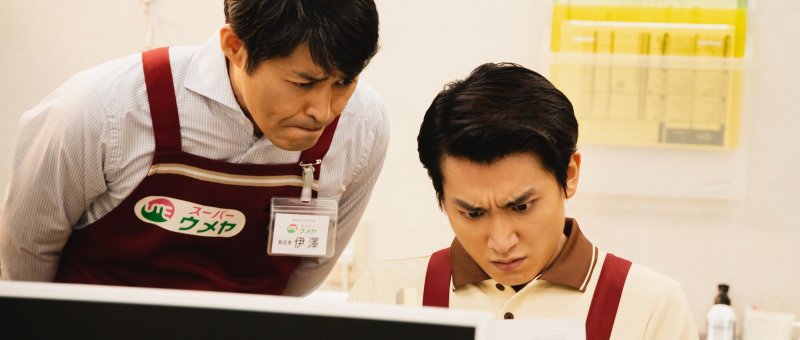
After 25 years working at the same small-town supermarket, Haruo Izawa (Ken Yasuda) is well respected by his colleagues and often depended on by his boss Mr. Ueda (Hikaru Ijuin) yet harbours an internalised inferiority complex that he has not yet made manager. When Mr. Ueda passes away suddenly, everyone, including Haruo himself, just assumes he’ll finally be getting promoted but head office soon parachute in an extremely strange man from accounts, Nishiguchi (Kentaro Tamura), who knows nothing at all about how to run a supermarket. Haruo ends up with an awkward horizontal promotion to deputy manager while Nishiguchi basically leaves everything up to him. 

Haruo is always being told that he’s too nice but as he later tells another employee, he too is really just thinking of himself as revealed by his ever running interior monologue in which he often imagines himself in situations which will show him in a good light only for things not to pan out as he’d hoped. It’s clear that what he’s experiencing is partly a middle-aged man’s masculinity crisis often comparing himself to others and embarrassed on a personal level in not having achieved his career goals while directly threatened by the presence of his daughter’s new boyfriend fearing that he will lose his patriarchal authority within his own household in which he is already somewhat mocked by an otherwise genuinely loving and supportive family. His anxiety is compounded by the fact that he is a stepfather to the two daughters while he and his perspicacious wife Ritsuko (Eiko Koike) have a son together. The discovery of plane tickets sent by the girls’ estranged birth father in Okinawa with the hope that they will visit unbalances him in his increasing fear of displacement.  

As in the Japanese title of the film, Haruo is always asking himself what it is he seems to be fighting with the obvious answers being an internalised inferiority complex and toxic masculinity while constantly told that he doesn’t help himself with his Mr. Nice Guy approach to life. When he discovers an employee may be defrauding the business, he stops his assistant from reporting it and after discovering the truth decides to help cover it up so they won’t lose their job but later loses out himself when his simple act of kindness and compassion is viewed in bad faith by a potential employer. He tries to make things work with Nishiguchi, but Nishiguchi is a defiantly strange person and so all of Haruo’s attempts to help him integrate into supermarket life backfire. As it turns out, he’s in a constant battle with himself against his better nature but always resolving to be kind and put others first while privately annoyed that the universe often seems to be unkind to him. 

Then again as an old lady running a curry house puts it, happiness is having a full belly and so long as Haruo has a healthy appetite things can’t really be that bad. His life is quite nice, which is something he comes to appreciate more fully while reclaiming his image of himself as a father and along with it a sense of security brokered by a truly selfless act of kindness informed by paternal empathy. Professional validation may be a little harder to win, but lies more in the gentle camaraderie with fellow employees than in ruthless workplace politics or rabid ambition. Life need not be a lonely battle as Haruo begins to learn setting aside his manly stoicism and trusting in his ace detective wife who has been engaging in a similar and apparently victorious battle herself reaffirming her love for the kind of sweets so unexciting no one remembers they’re there which may seem a little plain on the outside but have their own kind of wholesome sweetness. 


Struggling Man streams in the US Sept. 17 – 23 as part of the 15th season of Asian Pop-Up Cinema.

International trailer (English subtitles)

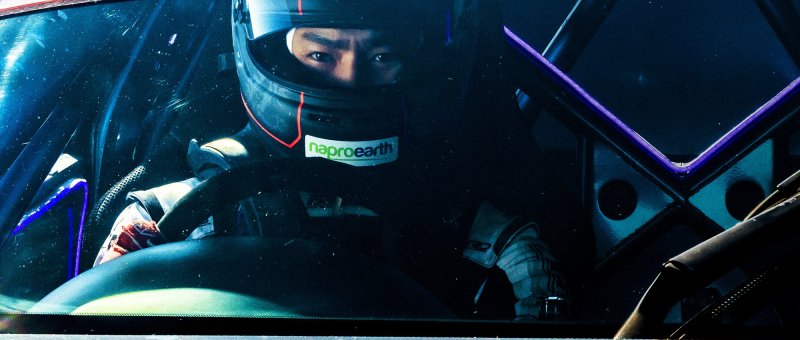
Alivehoon (アライブフーン, Ten Shimoyama, 2022)

How far can skills learned in simulation be transferred to the “real” world? Ten Shimoyama’s Alivehoon (アライブフーン) sees a top gamer take to the track for real to compete for drift racing glory while battling both his own lack of confidence and that of those around him. What he discovers is that there may not be so much difference as might be assumed, but offline racing is not a solo sport and succeeding means learning to trust in others as well as oneself. 

Koichi’s (Shuhei Nomura) immediate problem is that he doesn’t fit in at his job as a mechanic and is resented by the other employees for failing to pull his weight. All he wants to do is play games and after a lifetime of practice he’s become a champion in the world of e-sports drift racing but secretly harbours the desire to become a “real” race driver. He finally gets the chance to prove himself when his exasperated boss gets him an opportunity to try out for a real team in need of a rookie driver to ensure its survival. Diffident as he is, Koichi agrees and after brief moment of confusion on the track, proves he has what it takes to take his virtual skills to the real world as an aspiring drift racer. 

The main opposition Koichi faces is from those who dismiss him on the grounds that in-game experience is useless in the real world, which in some cases it may be but luckily Koichi does at least know how to drive and after a moment to play things through knows how to translate his skills from the online world to a real life track which of course has much more proximity to mortal danger than he has ever experienced before. That might be one reason that veteran driver Muto (Takanori Jinnai) who retired after a catastrophic crash in the opening sequence does not take him very seriously on witnessing him being physically sick after being driven round the course by a champion racer while his daughter Natsumi (Ai Yoshikawa) is very invested in the idea that it might be possible to turn an e-sports champ into a top rank driver and save the team in the process. 

Team Alive is positioned as the nice guy underdog, trying to win through hard work and fairness in contrast to arrogant hotshot Shibasaki (Shodai Fukuyama) who turns down the chance to join Alive to go with a more lucrative offer from a haughty middle-aged woman (Anna Tsuchiya) who plays only to win. Shibasaki drives dirty with the racing equivalent of kicking dust in Koichi’s eyes but eventually pays a heavy price for his lack of sportsmanship only to be humbled and come to see the merit in the honest and down to earth approach of team Alive. Koichi meanwhile fights an internal battle trying to rediscover a sense of confidence while beginning to find it in the mutual support of his teammates acknowledging that he may be in the driving seat but he’s not alone and the victory does not belong entirely to him. 

The film’s race scenes are supervised by “drift king” Keiichi Tsuchiya and feature real life drivers such as Naoki Nakamura, Daigo Saito and Masato Kawabata driving real courses for added authenticity all shot in camera without the use of CGI or special effects. The neon blue/red lighting and synth score contribute to the retro aesthetic but it has to be said that Koichi seems to take to real life drift racing a little too easily and experiences surprisingly few setbacks before making a fairly perplexing decision in the film’s final moments despite having discovered the value of teamwork along with a new family in team Alive who each value him for who he is as he brings the best in virtual racing to the real world game. Natsumi too earns the respect of her father as he comes to trust and believe in Koichi but is never quite given the chance to prove herself in her own right. In any case there is something heartwarming in the film’s conviction that there are no pointless skills and that working hard to become good at something is its own reward whether you become a champion or not.


Alivehoon screens in Chicago on Sept. 17 as part of the 15th season of Asian Pop-Up Cinema.

Original trailer (English subtitles)

The Fifth Thoracic Vertebra (다섯 번째 흉추, Park Sye-young, 2022) [Fantasia 2022]

A strange fungus growing on an old mattress slowly takes human form while feeding on loneliness and misery in Park Sye-young’s melancholy experimental feature, The Fifth Thoracic Vertebrae (다섯 번째 흉추, daseos beonjjae hyungchu). The Fifth Thoracic Vertebrae is near enough the one closest to the heart, and the one the growing creature is prone to rip out of its unsuspecting victims as it travels towards its uncertain evolution. Yet there is a strange sort of wistfulness that accompanies the mattress’ journey as if a new world were being born, one birthed in pain and anguish but with a yearning for love and connection even in the depths of its loneliness. 

The mattress is to begin with one purchased by a young couple about to move in together but soon becomes a symbol of their doomed love. While the mattress leans against a pillar outside an apartment building, a rude removal man swears at the young woman on the phone apparently unable to gain access. The boyfriend was supposed to let them in, but as we discover he’s fallen asleep and the girl must now abandon her plans to carry the mattress up the stairs herself and position it around his sleeping body. The film had explained to us that we are still some days away from the creature’s birth but we can soon see spores collecting on the mattress as a symbol of the relationship’s demise. When the couple finally break up, the boyfriend notices the mould but simply flips the mattress over as if that will solve all of his problems. 

Slowly but surely, the mattress travels all around the contemporary society in which many are it seems remarkably unfussy about the condition of a mattress they do not intend to sleep on themselves. It first ends up in a love hotel where it witness another breakup, resentment between the lovers soon giving way to sorrow and finally neediness as they consent to part. Now grown enough in strength the mattress creature rips out their vertebrae though it’s unclear whether it does so to relive them of their pain or merely to consume it. 

Abandoned again by the irritated landlord cross with his customers for being too stuck up for a mattress which he thinks is perfectly fine if you just flip it over and forget about the admittedly “disgusting” growths on the underside, the creature finds a new home with a terminally ill woman who seems to have some kind of rare disease which requires her isolation though seemingly because of some kind of stigma rather than for any medical cause. It’s distressing to think that anyone would give such a soiled, unsanitary thing to a dangerously ill woman though she seems to have become aware of the creature and views it almost as a friend reaching out in her own loneliness and charging it with a letter for her daughter she fears the nurses will otherwise burn with her body. It seems they do not burn the mattress, but seek to get rid of it while recommending it be purified through exorcism but of course the removal people are far too cheap for that. 

In any case, the mattress creature soon finds an affinity with the van driver who is celebrating his 37th birthday alone on the road with a sad slice of cake and a single candle while listening to teach yourself English tapes in search of meaningful connections. Perhaps it makes sense that along with sweat, dead skin, and other things we unknowingly shed, we leak sadness and pain into a space of comfort and safety feeding a creature of loneliness and desire with the physical remnants of our emotional selves. What survives of us is less love than its unanswered call, an undeliverable letter becoming a sort of holy text for a new form of life that may long survive us. Filmed with a dreamy poeticism and sudden shocks of eeriness in its ominous lighting and sci-fi score, Park’s oneiric drama nevertheless beats with a melancholy pulse of frustrated desire in which all connection is fleeting and love births only loneliness in a world in which a mattress knows us best of all. 


The Fifth Thoracic Vertebra screened as part of this year’s Fantasia International Film Festival

Trailer (English subtitles)