Procurer of Hell (地獄の饗宴, Kihachi Okamoto, 1961)

By 1961, the Japanese economy had largely recovered and the nation was emerging into an era of rising prosperity, but there were also those who were left behind or could progress into the new Japan. Shot with Okamaoto’s trademark irony, Procurer of Hell (地獄の饗宴, Jigoku no Kyoen) is a darkly comic tale of one such man who could have quit while he was ahead and started a new life if only he hadn’t been so greedy or perhaps so hung up on revenge. 

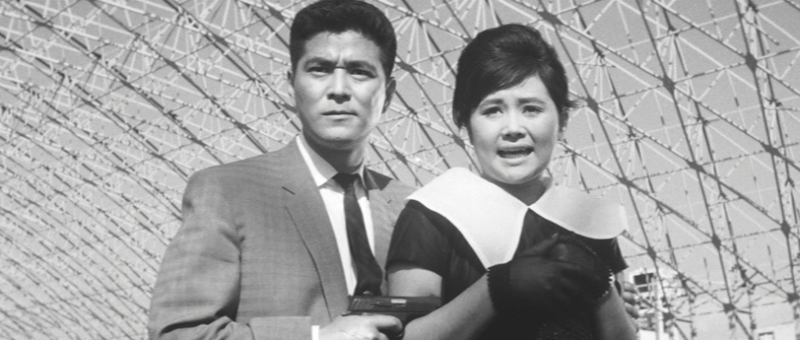
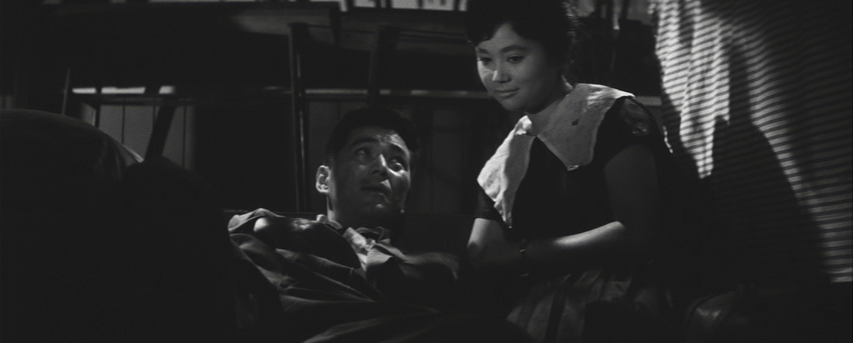
In a sign of the newly international society, Tobe (Tatsuya Mihashi) runs a shady business that claims to provide “English lessons” with blonde women are that are in reality appointments with sex workers. He also peddles pornographic images and dabbles in blackmail. When he finds a roll of film at the station, he gets it developed and discovers it contains photographs of his sergeant during the war, Itami (Jun Tazaki), who raped the Chinese woman he wanted to marry back in Manchuria. Tobe was unable to help her after getting his hand impaled on a tree branch from which he could not free himself. The scar he still bears on his hand is a mark of his corruption and a reminder of the moment which seems to have soured him on humanity and turned him into a cynical and amoral man. He decides to use the photographs to torment and blackmail Itami to get the money to help a widowed single mother he’s interested in secure a better future for herself by taking over a coffee shop from the owner who plans to retire.

As such, he does it for “good” reasons and Kazuko (Junko Ikeuchi) and her son Saburo represent for him a better future in the new Japan in which he would own a photo studio and live a law-abiding life. Saeko (Reiko Dan), Itami’s secretary with whom he was also having an extra-marital affair, is in other ways his opposite number and the representative of the dark side to which Tobe is drawn. Like him, she tries to play the situation to her advantage by playing the innocent before finally throwing her lot in with Tobe and suggesting he help her double-cross Itami so they can run off with the money he embezzled from his company before faking his own death in a convenient train crash. That Tobe extracts sexual favours from Saeko in return for giving her the photos and negatives interferes with the supposed nobility of his quest and apparently pure-hearted love for Kazuko and her little boy, while Saeko gradually shifts from exploited victim to calculating conspirator manipulating Tobe just as he believes himself to be manipulating her.

In any case, it remains true that he could have just settled for the money he needed for the cafe and walked away from this overly complicated situation involving Itami’s legal wife and associates who have actually embezzled the money and want the pictures back because they need Itami to be dead for their plan to work, but he doesn’t. He becomes fixated on getting his fair share of the ill-gotten gains much more than helping Kazuko or getting his revenge against Itami, which wasn’t really much of a revenge anyway considering what Itami had actually done during the war. But on the other hand, Itami seems to have become a rather powerless figure having married into his wife’s family to work in their business while she plots to have him confined to a psychiatric hospital to keep him out of her way. Saeko too is manipulating him. She has no real feelings for Itami and only wants the money, masterminding this whole scheme to get her hands on it with no intention of fleeing abroad with him. Similarly, she plays the victim with Tobe, telling him that Itami paid for her brother’s school fees and that she wants the photos back to avoid her brother or Mrs Itami finding out it about it and feeling hurt.

But while they’re fixating on the 150 million yen embezzled from the business, there are crowds of angry people turning up at the building society Itami runs complaining that their savings have disappeared and wanting to know if they’re going to get the houses they’ve been promised. Tobe walks through the May Day protests calling for better working conditions and higher wages, pointing to the ways this society is still veering off course in deliberately leaving some-people behind by rooting the new economic prosperity in exploitation. Tobe’s assistant wants to join the protest, but Tobe tells him they don’t really belong with the workers because of their nature of their business. The blackmail scam is his revenge not only on Itami but on everything that’s happened to him since the war and this ridiculous post-war society that he nevertheless hopes to join through these immoral means. The song of the canary he buys for Saburo begins to haunt him as a symbol of the wholesome life he might lead, but that life cannot really be won that way. He and Saeko are really two of a kind, she apparently brought low by her unexpectedly genuine feelings for him as even the police, picking him up for something else, leave them bleeding in the street surrounded only by emptiness and futility mere feet from the hospital in their own relentless pursuit of the “real” criminals.

Husband and Wife (夫婦, Mikio Naruse, 1953)

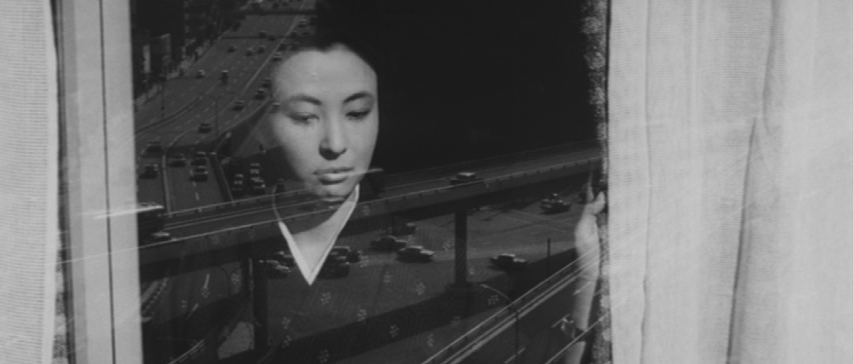
Kikuko (Yoko Sugi) climbs the stairs to the roof of a department store and pauses at the top looking down on her friends below, but they appear to be looking down on her. They’re disappointed. She looks so “provincial”, even though she has no children and therefore more time to spend on herself. They’re envious of her “freedom” to return home late while they have to get back to their husbands or in-laws, but Kikuno isn’t really free at all while trapped in a stifling marriage to the incredibly dull and petulant Isaku (Ken Uehara). 

One of a series of films about marriage and originally envisaged as a sequel to Repast until Setsuko Hara fell ill, Husband and Wife (夫婦, Fufu) paints a rather bleak picture of married life even by Naruse’s standards. The couple are quite literally but also spiritually “homeless” in that they cannot find a home to share, while the absence of a domestic space to call their own prevents them from solidifying their marriage. They’re pushed out of Kikuko’s parents’ home because her brother’s getting married and they need the space, but Isaku drags his feet over finding somewhere else and leaves much of the legwork to Kikuko alone. The main problem seems to be that Isaku can’t afford anything decent, which places a strain on his male pride, but in a repeated motif, rather than confront the situation, he ignores it completely and then crassly presses his recently widowed colleague to let them rent a room in his now much emptier house. 

It’s a mystery why Isaku has so many financial problems when he and Takemura (Rentaro Mikuni) work for the same company, save that Isaku had evidently spent some time working in the provinces, and his colleague had already bought a home with no apparent money worries, but it further sets the two men apart and fuels Isaku’s sense of inadequacy. Having returned from a leave of absence following his wife’s death, Takemura is grief-stricken and apparently uxorious. He complains that he’ll never find another woman like his late wife, all while Isaku won’t shut up about the house and others relentlessly encourage him to remarry. Nevertheless, after the couple move in with him, a natural connection arises between Kikuko and Takemura who is Isaku’s total opposite, both in his treatment of Kikuko and general personality. Where Isaku is sullen and resentful, Takemura is cheerful despite his grief and generous of spirit. Kikuko effectively becomes a wife to both men, taking care of each of them by cooking and cleaning, but while Takemura goes out of his way to thank her, all Isaku does is run her down and humiliate her in front of company.

Then again, having fallen in love with Kikuko precisely because she is a “proper wife,” Takemura then runs his own late wife down by complaining that she wasn’t very pretty and couldn’t cook. The only thing she had going for her was her health, and then she died. He says got a bum deal, and that Kikuko has shown him a different side of womanhood. When two colleagues come to the house and compliment Kikuko’s cooking but are surprised when she eats nothing herself (because they have no money), Isaku responds to their assertion that it’s difficult to be a housewife by replying that men work hard all day while women “only” have to look after the house. For her part, Kikuko says that she was happier when she was working. Men can fall in love several times, but once a woman’s married her romantic life is over. As her friend tells her, men soon get bored of their wives and hers has already taken a mistress at work. 

At several points and with the women in earshot, the men warn each other about the pitfalls of marriage. Irritated that Kikuko has returned to their home on New Year’s Eve after becoming fed up with Isaku, her father advises her brother that women show their true faces after six or seven years and it’s going to horrify him. Isaku tells him not to be too nice or obedient during the early days because his wife will get used to it, while Kikuko counters that men are overgrown children and as long as you make sure to cradle them like babies everything will be fine. Neither of them seem to have a very positive idea of what marriage should be and frame it almost in terms of a war in which they are continually at odds with each other. Isaku describes a husband and wife as a pair of scissors, intending it as a positive metaphor about how one half can’t cut alone, before reframing it as two knives coming together. He becomes unpleasant and chauvinistic, blaming Kikuko for everything by complaining that it’s her fault that he wears a torn up old coat that causes him some embarrassment in front of his boss and a tactless geisha, while criticising her for not having the bath ready when he comes home tired from working all day. Kikuko points out that men seem to assume they’re the only ones who get tired while her loved up brother swears he’ll be different and even if they’re in the honeymoon phase, they do seem much happier and more suited than the already resentful Kikuko and Isaku.

It’s the sister-in-law who throws them a lifeline by introducing them to a relative looking to rent a vacant room, allowing them a means to save their marriage by leaving Takemura’s house. Increasingly resentful of the growing attachment between Kikuko and Takemura, Isaku starts avoiding coming home and hanging out with a young woman at the office with, at least, the danger of a burgeoning affair for which he’s taken to task by Takemura. As Takemura says, it’s not much of a marriage if Isaku can’t trust his wife while Kikuko is eventually so sick of the cold shoulder and constant denigration that she considers leaving him. The new apartment finally gives them a domestic space they can call their own, but it comes with the caveat. The landlady doesn’t allow children because the tenant next door is an ikebana teacher who demands peace and quiet, but Kikuko is in fact already pregnant which might present another means of saving their marriage by becoming a family but Isaku immediately rejects it. He complains he doesn’t have any more money to move again and tells Kikuko to get an abortion, strong-arming her when she refuses. Kikuko can’t go through with it and the nicest thing Isaku says to her in the entire picture is that they can go home, he’s giving in and will raise the child even if it’s difficult. But even this bittersweet moment seems more like condemning them to marriage rather than repairing their relationship with Isaku only grudgingly accepting, most likely because he realises that his marriage is dead anyway if he forces Kikuko to give up their child against her wishes. Despite the changing season, the air between them remains frosty, and marriage is exposed for the prison that it is trapping each of them in loneliness and resentment rather than bringing them together in joy as they prepare to become a family rather than just husband and wife.


Husband and Wife  screened at Japan Society New York as part of Mikio Naruse: The World Betrays Us – Part I.

My Wonderful Yellow Car (吹けよ春風, Senkichi Taniguchi, 1953)

A kind-hearted taxi driver becomes our guide to the post-war society in a cheerful omnibus movie co-scripted by Akira Kurosawa and directed by Senkichi Taniguchi, My Wonderful Yellow Car (吹けよ春風, Fukeyo, Haru Kaze). Inspired by a Reader’s Digest column titled “human nature as seen in the rearview mirror”, the film follows cheerful cabbie Matsumura (Toshiro Mifune) as he drives around Tokyo in 1953 picking up various fares and sometimes adding commentary or trying to help with whatever kind of problem seems to be bothering them.

Then again, he stays well out of the first fare’s business as a young couple have obviously had some kind of falling out. Bursting into tears, the girl (Mariko Okada) announces that she wants to postpone the wedding and maybe even rethink this whole thing, while the boy reiterates with slight irritation that he’s said he’s sorry with the implication that that should be the end of it though we have no idea what (if anything) he’s actually done. In any case, they eventually patch things up over some canoodling in the back seat and ask to be dropped off so they can get something to eat. In some ways, the young couple represent a more hopeful vision of post-war youth who have no apparent worries besides their tiff and are financially comfortably enough not only to be getting married but can afford to travel by taxi and pay for a meal on the same occasion. 

Their situation is later contrasted with that of an older couple who’ve moved from Osaka to Tokyo in their old age and have bought a box of live lobsters to celebrate their silver wedding anniversary but as Matsumura notes though they appear to be quite well off they also seem somehow sad. That turns out to be because they lost their only son the previous summer and have moved into his old apartment. The old lady also cries in the back seat, but for a completely different reason. As they’ve only just moved here, they don’t have friends or anything to do and are completely lost in the wake of their son’s death. Matsumura’s kindness is demonstrated when he borrows three flowers from a bouquet delivered to a girl at the petrol station and presents them as an anniversary gift. The couple are so touched they invite him to enjoy their anniversary dinner with them and by the end of it have made the decision that they should go back to Osaka and restart their lives by re-opening their old business.

Throughout all this, Matsumura is very conscious of the meter. Every second he spent in the old couple’s apartment cost him money, but as he’s fond of saying you can’t always think of things like that. Even so, he reminds himself he has a wife and child so should be mindful of the clock but still turns down a fare to go back to the station and check on a young girl he’s pretty sure is trying to run away from home. A weird guy was sniffing around her and was in fact just about to lead her off when Matsumura gets back and announces he’s come to pick her up. Matsumura spends the rest of the ride trying to convince her to go home, repeatedly reminding her that most of the “panpans”, or streetwalking sex workers catering to US servicemen, were also once runaway girls. To more modern eyes we might wonder if sending her home is what’s best without knowing the reasons she wanted to leave. He goes so far as to buy her ramen which costs him more money on top of the lost fare which doesn’t collect from her either when he, a little less responsibly, abandons her when she refuses to tell him where she lives. Thankfully, it all seems to work out. The girl made a sensible decision to go home after all and is later seen happily doing her Christmas shopping with her mother who also thanks him for looking out for her.

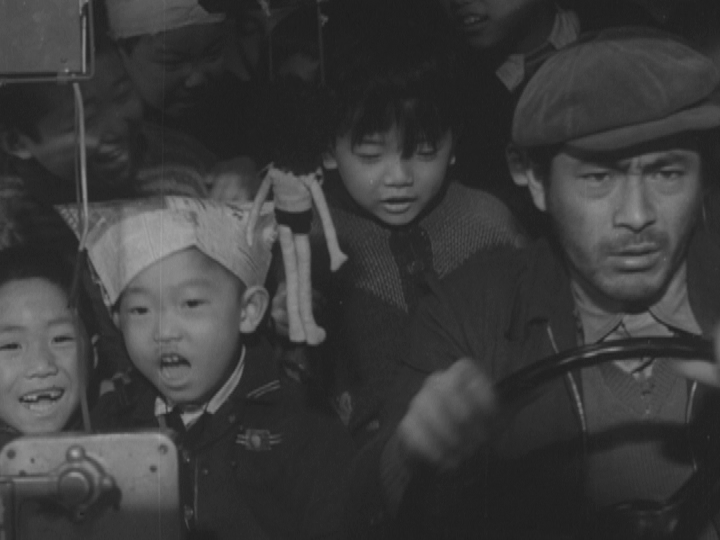
Perhaps these kinds of altruistic acts of kindness explain why Matsumura’s own clothes are quite ragged with a hole in his jumper and a tear to the shoulder of his jacket. He’s driving the cab in straw sandals which apart from anything else is probably quite cold in the winter. He spends another afternoon giving a free ride to some children, about 15 of them, who’ve crowdfunded 100 yen because they’ve never been in a car before and want to go as far it’ll take them having no idea that 100 yen is actually the initial charge so you can’t go anywhere on it all. Of course, Matsumura ends up taking them a bit further, and then realises he’ll have to take them back to where they were because they won’t have any other way of getting there or of knowing where they are now.

On the other hand, sometimes he ends up with nuisance fares such as two drunk guys who keep singing their university song. One of them even climbs out of the window and up onto the roof, causing Matsumura to assume he’s fallen off somewhere and he’ll have to go back and look for him to make sure he’s not hurt only to find him burbling in the footwell. He also ends up getting hijacked by a crook with a gun on his way back from Yokohama but getting a telling off from the police rather than a thank you for catching him after unwisely taking hold of the gun himself and messing up all the fingerprints. 

One might think the time he had a famous actress in the back of his cab who even sang along with the jingle he’d written for the cheerful yellow vehicle might make up for all that, but he says the story that best exemplifies why he loves driving a taxi is that of a middle-aged couple he picked up at the harbour shortly after a boat had docked repatriating people from China. Even in 1953, some had not yet returned after becoming trapped by the Chinese Civil War and eventual Communist victory. The man is dressed in military uniform and says he’s just been demobbed when Matsumura asks him, trying to lighten the mood while there’s obviously some degree of tension between the man and his wife. But as we gradually come to understand, it’s all just a ruse and he has in fact been in prison in Japan for the last seven years for an unspecified crime.

His wife asks Matsumura to drive around the city and attempts to show him how much things have recovered, suggesting that they can now put the past behind them and start over. But the man remains sullen and grumpy. He’s afraid to go home, afraid to face the neighbours worrying if they know what he did and that he’s been in prison. But most of all he’s afraid to face his children, the youngest of which he’s never met. The kids have been teaching themselves to say “Welcome home, Daddy,” in Mandarin believing he’s been in China all this time which the wife has to explain before they get there. The man tells his wife he understands if she doesn’t want him back, but she assures him that the children are excited as is she to start their new life together. Nevertheless, though they’ve been eagerly practicing, the older two children simply freeze when confronted by this anxious stranger who turns around to leave again feeling as if he doesn’t have the right to come back here after all only for the youngest one to suddenly pipe up with the phrase note perfect. It’s this kind of scene, getting people to where they need to be physically and emotionally, that seems to make Matsumura’s job worthwhile. In essence, he’s ferrying people towards the cheerful post-war future his cute yellow cab represents while driving round the rapidly changing city wondering who it is that’s going to end up in the rearview mirror today.


Title song (no subtitles)

Beast Alley (けものみち, Eizo Sugawa, 1965)

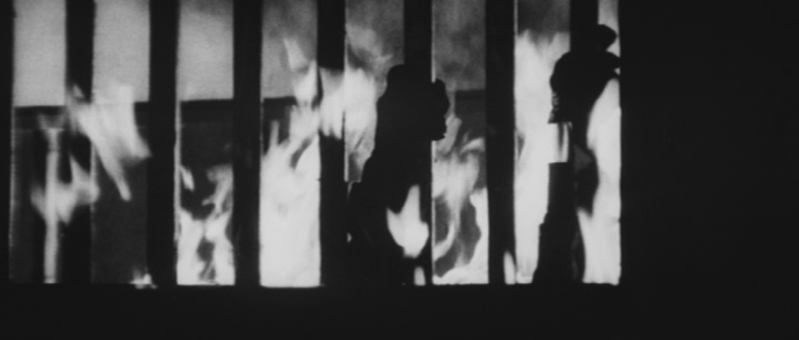
In the opening title sequence of Eizo Sugawa’s Beast Alley (けものみち, Kemonomichi), a thick blob of inky blackness gradually expands over an aerial view of the city until it obscures it entirely. The title card which then appears is written in plain white, but will reappear at the film’s conclusion this time ashen as if it too had been singed by the deeply ironic flames with which the film ends. Based on a novel Seicho Matsumoto and scripted by The Beast Shall Die’s Yoshio Shirasaka, the film similarly takes an incredibly cynical view of the modern post-war society in which it is revealed the militarists are still basically in charge and presiding over a deeply corrupt social order. 

The big bad, Kito (Eitaro Ozawa), says as much when he states the need for reforming the nation’s “rotten political system” by which he means post-war democracy. Kito made his made his money doing deeply dodgy things in Manchuria in addition to running an exploitative coal mine in Japan. Now mainly bedridden, he basically runs the country as a far-right political fixer working in tandem with big business and the yakuza who have traditionally been big supporters of conservative and nationalist forces. Early on we see one of his underlings negotiating with politicians to ensure that Taiyo Roads will be hired be hired for a large scale construction project planning to put highways all the way through Tokyo. As we later discover, he’s prepared to go to great lengths in order to achieve his goal, going so far as to have a sex worker murdered to implicate the uncooperative CEO of a rival construction film into resigning by threatening to frame him for the crime so they can install their stooge in his position. 

It’s into this world that everywoman Tamiko (Junko Ikeuchi) is drawn while working as a hotel maid at a traditional Japanese inn. Trapped in a bad marriage to a man who is also bedridden yet still attempts to rape her when she returns home to find him in bed with the housekeeper, Tamiko longs for escape and is therefore ripe for the picking when approached by Kotaki (Ryo Ikebe), the manager of an upscale Western hotel, to join him in an unspecified enterprise which will apparently make her very rich. The only catch is that she will have to “get rid” of her “dependent”, which she probably wanted to do anyway, by burning down her house with him inside it. Once she’s done this, there is no turning back for her even if she had not developed complicated feelings for Kotaki who is both her salvation and damnation. 

Tamiko’s husband had failed to give her the comfortable life that he had promised, something which she thinks Kotaki can deliver even if it requires her to become the plaything of Kito whom does she actually seem to like even if aware of the precarity of her position and still in thrall to Kotaki. Leaving the hotel so abruptly was however a strategic error as it arouses the suspicious of (originally) earnest cop Hisatsune (Keiju Kobayashi) who quickly realises that Tamiko set the fire to kill her husband. Though he seemed to be motivated by justice, Hisatsune too is soon corrupted explaining to Tamiko that he has become cynical and jaded. Years of police work have shown him that true criminals know how to break the law and get away with it so he can’t do anything about them, but “good” people, like he implies Tamiko, are pushed into crime by desperation and are easily caught. Tamiko wields her sexuality against him by agreeing to a tryst, though when it doesn’t go to plan he tries blackmail and then rape before she, ironically, manages to escape from his bungled crime. 

Hisatsune’s corruption is gradual and self serving. He starts with suspicion, tailing Tamiko in the interests of justice but also because he desires her, before stumbling on the conspiracy, putting the pieces together, attempting to use them for his own gain and trying to blow a whistle mostly out of resentment. Kito’s reach is all encompassing. Hisatsune is warned off investigating certain aspects of the crime by his senior officers and is then fired on Kito’s instructions for fiddling his expenses after harassing Tamiko. He tries to give his findings to his boss but it goes nowhere and then tries the press but is given the brush off, the editor his reporter friend refers him to gently implying he’s just a crank with an axe to grind. Of course, it turns out that the reporter is already in league with dodgy lawyer Hatano (Yunosuke Ito) who is Kito’s right-hand man. 

The connections between the three men, Kotaki who was once a communist, Hatano, and Kito go back to Manchuria and the corruptions of militarist era which it becomes clear has never really ended. Kito has only one rival and it’s another faction of the conservative ruling party who are probably just waiting for him die. Attempts are made on his life and they don’t go well for those who make them. Even if Hatano hoped to simply inherit an empire he, as he points out, put in much of the work to build he is sorely mistaken while Tamiko may intellectually understand that Kito’s death would place her in a precarious position but carries on regardless. “You never know who will betray you in this world” Kotaki laments, echoing Kito’s later claim that his Buddhist statues are the only ones will never betray him even as sleeps next to a statue of Aizen Myo whom he ironically claims protects mankind from their lust and desire. 

It could be said that desire is Tamiko’s undoing, but as Hisatsune had suggested perhaps you couldn’t blame her for longing to be free of the bedridden husband who had not delivered what he promised her. As she said, she was doing what could to survive even if you’d think she’d know putting on a ring taken from the finger of a murdered woman is akin sealing your own fate. Sugawa shoots with a noirish sense of dread, tracking Tamiko with her coat drawn up around her face as she tries to leave the scene of her crime, and makes the most of his fiery imagery before ending on a note of cynical laughter amid the inescapable hell the of post-war society. 


Original trailer (English subtitles)

Late Chrysanthemums (晩菊, Mikio Naruse, 1954)

The post-war economy was difficult for most, though by the mid-1950s the situation was perhaps improving. The four former geishas at the centre of Naruse’s Late Chrysanthemums (晩菊, Bangiku) , adapted once again from a series of stories by Fumiko Hayashi, are all in their way attempting to find a way through to the modern society but are nevertheless stuck in the past, unable to move forward as women more or less left behind by a changing idea of “modernity” which no longer has a place for them. 

The most successful of the women, Kin (Haruko Sugimura), has become a ruthless moneylender engaging in real estate speculation. As the film opens she’s waiting for the arrival of a business associate for a meeting about a house she’s trying to flip, clear that they’ll need to kick out the desperate widow who is currently living there. Kin has lent money to her old “friends” with whom she spent her youth as a geisha before the war. Otamae (Chikako Hosokawa) and Otomi (Yuko Mochizuki) are widows with unfilial children, Otamae now working as a maid in a love hotel while her son Kiyoshi (Hiroshi Koizumi) struggles to find a job, and Otomi a washerwoman selling blackmarket cigarettes as a sideline while her daughter Sachiko (Ineko Arima) is a forthright modern woman who refuses to enable her mother’s irresponsible vices. Nobu (Sadako Sawamura), meanwhile, married late to a man from outside of Japan and has opened a small bar where she hopes to start a family, brushing off Kin’s insensitive insistence that she is already too old to bear a child. 

Kin has prospered and become wealthy, but she’s done so largely at the sacrifice of maternity. She disparages the other women, telling them she’s grateful not to have had children because not even they can be depended upon, but is also embittered that she’s missed out on life and love, substituting material wealth for emotional fulfilment. Otomi and Otamae have problems with their children and regrets about their lives, but they both resent Kin for her heartless rationality. Kin is in a sense supporting them with her money, even if she wants it back with interest, and continues to see herself as doing a favour for women she considers friends, hurt that they often run or hide when they see her coming but insisting that she is only trying to survive while implying that the other women have failed to achieve the self-sufficiency she has achieved because they’ve lived irresponsibly by placing their trust in men and frittering their money away on the temporary pleasures of drink and gambling. 

Otomi’s thoroughly modern daughter Sachiko thinks something much the same. When Otomi approaches her for a loan, she says no, fearing that her mother has another lover she will end up subsidising or that she will spend it all on drink and pachinko. Sachiko does, however, offer to buy her mother dinner which at least ensures she will get a good meal. Sachiko’s shock news is that she plans to marry an older man, though he seems not to be particularly wealthy seeing as she later sarcastically asks Kin to buy her a house because they’ll be living with other tenants in a small flat. Otomi objects, not only because Sachiko hasn’t mentioned any of this to her before, but because she thinks Sachiko is being overly practical and gives her some surprisingly transgressive advice to the effect that she should have her fun with various men while she’s young so she’ll be able to figure out which is the best to spend a life with. Sachiko quite reasonably asks how that worked out for her, to which Otomi obviously has no answer and leaves the restaurant feeling dejected enough to ask Kin for the money she was after instead. 

Otamae’s problem is of the opposite order. Her son Kiyoshi cheerfully rolls home in the morning after staying out all night and tells her he’s become a kind of gigalo, dating a slightly older woman who is technically the kept mistress of another man. The situation is ironic in the extreme, but despite her own past as a geisha, Otamae doesn’t like it that her son is engaging in a compensated relationship, while he suggests that perhaps she messed him up by making him refer to her as his sister in public. Eventually Kiyoshi is offered a job in a mine in Hokkaido, salmoning the post-war migratory movement and leaving his mother (as well as the mistress) behind to fuel the economic recovery from the provinces. 

Otomi and Otamae have only each other to rely on, men and children have all proved undependable. Kin, the most fiercely independent, is literally haunted by the spectre of failed romance. Nobu, snaps that Kin made her money by swindling her clients, which might be why she takes the side of Seki (Bontaro Miake), a man who tried to commit double suicide with Kin but survived and was ruined. Kin sees it differently. Seki tried to kill her when she refused to die with him, so understandably she is not keen to reconnect. Nobu advises him to visit her and ask for money as “compensation”, which whichever way you look at it is crass and troubling, that Kin is expected to compensate a man for his ruined prospects caused by his obsessive romantic violence towards her which she claims has put her off men for life. Nevertheless, she continues to meditate on the memory of Tabe (Ken Uehara) whom she loved when he was a student, even visiting him in his Hiroshima barracks after he was drafted. She is thrilled to receive a letter from her first love, but declares herself disappointed minutes after he arrives for a visit. Tabe is just another failed salaryman who thinks women like her have it easy and harps on about how looking at his “old” wife makes him nostalgic for the women he loved in his youth. Like everyone else, he’s after her money. Kin burns the photo of him in uniform and gives up any lingering dream she might have had of romantic fulfilment. 

The women find themselves trapped by conflicting visions of “modernity” which are wildly different from those of their youth. They miss their “carefree” lives as geishas, now perhaps somewhat romanticised, along with the misplaced idealism of their time of Manchuria, while lamenting that as single older women they cannot be anything other than dependent. Only Kin is able to achieve self-sufficiency, but does so effectively as the film suggests at the cost of her “femininity”, becoming hard and cold, ruthlessly practical but not perhaps uncaring even as she continues to subsidise the only “friends” she has perhaps in the knowledge that they fiercely resent her. Yet their lives continue. Nobu runs her bar, Otomi and Otamae send their children off with grudging respect while vowing to follow their examples, and Kin, after a moment of crisis, ventures off towards new prospects. For good or ill they shift towards the modern world, more understanding of its rhythms and their place within it than before, but perhaps no more secure.


Throne of Blood (蜘蛛巣城, Akira Kurosawa, 1957)

In many ways, the underlying theme in Akira Kurosawa’s films of the 1950s is that we are incapable of knowing ourselves and are, as a forest spirit remarks in Throne of Blood (蜘蛛巣城, Kumonosu-jo), afraid to look into our own hearts and admit our darkest desires. In adapting Shakespeare’s Macbeth, Kurosawa is less interested in the pull of ambition than the insecurity that drives it along with the inability to transcend himself that precipitates the hero’s decline. 

Indeed, after Washizu (Toshiro Mifune) and his best friend Miki (Minoru Chiaki) ride into the misty forest domain of the witch-like seer who ominously turns her spinning while offering a moral lesson that neither of them heed, they sit on the ground and laugh about what they’ve heard. Yet as Washizu partly admits the old woman revealed something of himself to him in that she echoed a dream of which he was unwilling to speak. Miki asks what warrior would not want to be placed in charge of a castle, but for Washizu it’s almost a primal need to prove himself in surpassing other men. Miki, by contrast, is not so nakedly ambitious but he doesn’t really need to be because he has a son. Washizu has no heir, his line will end with him and so he has only this life to make something of his name. 

Having no heir also undermines his sense of masculinity, just as it undermines the femininity of his wife, Lady Asaji (Isuzu Yamada), who as a woman now likely too old to bear a child may fear for her position. Kurosawa styles Yamada’s face as a perfect noh mask while she delivers her lines with the intonation of noh theatre all of which lends her a fairly eerie presence which only deepens as she descends into the darkness and back out again hovering like a ghost. She is in a sense perhaps already dead if not otherwise possessed by some malignant spirit as she urges her husband on in their dark deeds like a demon on his shoulder even going so far as to present him with the spear he will use to murder his lord, the ultimate act of samurai transgression. 

Yet as Lady Asaji points out, the present lord killed the lord before him for the right to sit on the dais. When the lord comes to stay with them on a pretext of hunting while preparing to launch an attack on a potential rival, the couple are moved into a room previously inhabited by a retainer who’d tried to mount a rebellion but was defeated. He took his own life and the room is still stained with his blood which covers both walls and floor. Washizu ought to realise that this is his fate too, but deep down he wants the prophecy to be true, which it is if more in the letter than the spirit. Would he have done it if he had not met the forest spirit, or would he only idly have thought of it but never followed through? It’s not something that can be known, but his eventual failure is born more of his inability to accept this side of himself than it is the price of ambition in itself. “If you’re going to choose ambition choose it honestly with cruelty” the forest spirit later advises, and Washizu might have been more successful if had he done so earlier. 

Then again, the world he lives in is as Lady Asaji describes it a wicked one in which betrayal is an all but inevitable certainty. Washizu insists that Miki is his friend, and that making Miki’s son his heir satisfies the prophecy while binding him to him so that he cannot rebel even if he were minded to. But Lady Asaji assumes that Miki is ambitious too, suggesting that he may strike first or report his treachery in the hope of personal advancement. For the prophecy to come true, someone has to betray the lord though it need not have been either of them but there can be no trust or friendship in this world of fierce hierarchy and internecine violence. 

Both men should perhaps have realised that when they were trapped riding around the eerie lair of the forest spirit with its mists and cobwebs not to mention heaps of piled skeletons still in their armour all victims of ambition and the spirit’s false promises if also echoing the legacy of wartime folly. “Look upon the ruins of the castle of delusion” the noh chant that opens and closes the film intones, warning of illusionary riches and the price of deluding oneself along with the destruction wrought by those unable to break free of the spider’s web of human desire. 


Throne of Blood screens at the BFI Southbank, London on 21st February 2023 as part of the Kurosawa season.

Original trailer (no subtitles)

Yojimbo (用心棒, Akira Kurosawa, 1961)

“You’re not a bad guy after all” a previously hostile inn owner later concedes, finally seeing the method in the madness of a cynical wanderer who appears to take no side but his own but may in his own way be quietly fighting for justice in a lawless place. A samurai western set in an eerie ghost town beset by feuding gangsters whose presence has destroyed the local economy and lives of the frightened townspeople, Yojimbo (用心棒) subversively suggests that the world’s absurdity is best met with nihilistic amusement and healthy dose of irony. 

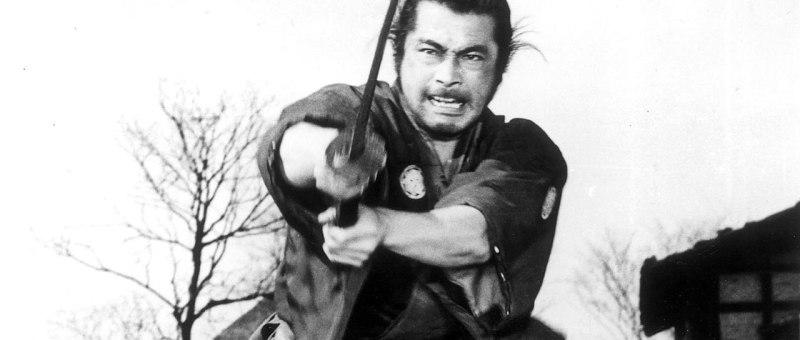
When the confused hero who later gives his name as Sanjuro (Toshiro Mifune) wanders into town, he is surprised to see a stray dog running past him with a human hand in its mouth. This is indeed a dog-eat-dog society in which a petty dispute between gang members has forced the townspeople to hide behind closed doors. The streets are empty and silent until the town’s only policeman darts out and requests a “commission” for recommending Sanjuro offer his services as a bodyguard to either of the two factions suggesting that brothel owner Seibei (Seizaburo Kawazu) is on the way out and upstart Ushitora (Kyu Sazanka) is the best bet. But Sanjuro does not particularly like the look of Ushitora’s gang which as is later revealed is largely staffed by desperate disreputables, convicts, and murderers. 

Sanjuro’s response is to laugh. He makes his money by killing and there are lots of people in this town the world would be better off without. He plays each side off against the other, knowing that they each need a man of his skill to break the stalemate but is rightfully mistrustful of both. First approaching Seibei, he overhears his cynical wife Orin (Isuzu Yamada) suggesting that they agree to his high fee but kill him afterwards so his services will effectively be free. Sanjuro’s plan is to antagonise both sides so they wipe each other out, freeing the town of their destructive influence. With violence so present on the streets, the townspeople are afraid to leave their homes and the only guy making any money is the undertaker. 

The trouble also means they can’t host the local silk fair which usually stimulates the town’s economy demonstrating the counter-productivity of the gangsters’ dispute in that no silk fair means no delegates and empty gambling rooms meaning the gangsters aren’t making any money either. Yet it’s also clear that it’s gambling that has corrupted the town and is disrupting the social order. A symptom of an economical shift, gambling offers a new path to social mobility amid the fiercely hierarchal feudal society in which the possibility of distinguishing oneself in warfare has also disappeared. Thus the young man Sanjuro encounters on the way into town argues with his father, rejecting the “long life of eating gruel” of a peasant farmer claiming he wants nice clothes and good food and has chosen to burn out brightly. Kohei (Yoshio Tsuchiya), a young father has also succumbed to the false hope offered by the gambling halls and lost everything, including his wife, to a greedy sake brewer turned silk merchant and local mayor thanks to his enthusiastic backing of Ushitora. 

“I hate guys like that” Sanjuro snarls, but it seems he also hates petty gangsters and everything they represent. “This town will be quiet now” he remarks before leaving, as if stating that his work here is done and the real purpose of it was clearing out the source of the corruption rather than taking advantage of the town’s plight for his own material gain. Yojimbo quite literally means bodyguard and is the service Sanjuro offers to each side interchangeably, but Sanjuro isn’t above betraying his clients or playing one off against the other. His final foe, Ushitora’s brooding brother Unosuke (Tatsuya Nakadai), wanders around with a pistol in his kimono as if to say the age of wandering swordsmen has come to an end but in the end is exposed as complacent in his superior technology, easily neutered by Sanjuro who even gives the gun back to him as if no longer caring whether he lives or dies merely amused to find out the answer much as he had been standing on a bell tower watching the factions pointlessly tussling below. Masaru Sato’s surprisingly cheerful score seems to echo his state of mind, seeing only humour in the absurdities of the feudal order and the futility of violence while Kurosawa’s camera roves around this windswept wasteland as Sajuro kicks the gates of hell shut and prepares to move on to the next crisis in a seemingly lawless society.


Yojimbo screens at the BFI Southbank, London on 18th & 23rd February 2023 as part of the Kurosawa season.

Original trailer (English subtitles)

I Live in Fear (生きものの記録, Akira Kurosawa, 1955)

Which of us is “crazy”, the man who lives in fear or the rest of us who live in its denial? By 1955, a decade had passed since the bombs fell on Hiroshima and Nagasaki, but even if the world seemed “peaceful” it was only superficial. The Korean War had “ended” in an uneasy truce only two years earlier and the world was already mired in a cold war which daily threatened to turn hot with both sides in possession of a nuclear deterrent. Akira Kurosawa’s I Live in Fear (生きものの記録, Ikimono no Kiroku) asks us if we can really say a man is “insane” if his life is ruled by a rational anxiety and if it is our refusal to accept the threat he sees which eventually drives him out of his mind. 

Our guide is gentle dentist Harada (Takashi Shimura) who has a sideline as a mediator at the family court. The case he has been called in on one particular afternoon is that of the Nakajima family which is attempting to have the ageing patriarch, Kiichi (a near unrecognisable Toshiro Mifune), declared legally incompetent on account of his increasing paranoia about nuclear attack and latent radioactivity. A wealthy self-made man and foundry owner, Kiichi has frittered away vast sums on harebrained schemes to keep himself and his family safe but after a plan to build a bunker in a remote area had to be abandoned, he’s set his heart on moving everyone to Brazil where he believes they will be safer. 

The problem is partly one of changing times as Kiichi, “despotic and selfish” as his son describes him, attempts to railroad his family into a safety they do not want or need. His two legitimate sons now operate the foundry and their lives are dependent on it, which is not to say that they are dependent on Kiichi, but if he goes through with selling the the foundry to finance his new life it will leave them all high and dry. It would be, to a certain way of thinking, the ultimate paternal betrayal but in Kiichi’s mind all he’s trying to do is “save” his family from an invisible threat. 

That family, meanwhile, is one he’s already undermined through patriarchal selfishness in fathering a series of illegitimate children he is also supporting financially but has never legally acknowledged. The parents of the illegitimate kids are worried that if the family succeeds in having Kiichi declared legally incompetent, his wife will get her hands on the purse strings and they’ll be left out in the cold. Kiichi, meanwhile, has an old-fashioned view of filial relations and never considers that the other kids might not want to come with him either even if it’s unexpectedly nice of him to include them, or that inviting your two mistresses to live in the same house as your legal wife might be awkward for all concerned. 

On the face of it, the case is open and shut. If a man causes his family to suffer through frittering money away on drink or pachinko, they would approve the motion to give another family member legal control over his finances. So why is it taking them so long to decide if Kiichi is a liability to his family or not? The problem is, his fear is entirely rational. It’s only its extent which is the problem. It’s perfectly understandable to be afraid of the ebola virus or brain-eating amoeba, but we can’t afford to spend every minute of every day consumed by fear and so they retreat into the background anxiety of our lives while we try to go on living. Yet, could it be that Kiichi has it right and we’re merely living in denial, sleepwalking into a preventable disaster while he alone has a plan for survival? 

“No place is safe” Kiichi’s son-in-law exasperatedly explains to him after he has taken drastic and somewhat ironic action, a kind of scorched earth policy designed to force his sons to follow him into a new world of safety. Pushed over the edge, Kiichi gets a rude awakening, realising that it was perhaps selfish of him only to think of salvation for his immediate family when his actions will essentially throw his workforce under the bus. Belatedly, he promises to find a way to take them to Brazil too, never realising that people have their own lives that aren’t so easily uprooted. He thinks Brazil is safer because the currents of the world seem to blow ill winds over Japan, but there are already more than enough nuclear bombs lying in warehouses to destroy the planet several times over. 

In any case, Kiichi has already destroyed his family through his various transgressions. They don’t want to go in part because they don’t particularly like him, are sick of his gruff authoritarianism, and resent his tendency to make unilateral decisions on their behalf. Strapped for cash he tries asking the illegitimate kids to return some of the money he gave them, but they too are insecure in their positions and cannot trust that they will continue to be provided for if Kiichi is deposed. Meanwhile, when Kiichi falls ill the legitimate children are only too quick to start discussing the inheritance in the absence of a will. Perhaps Kiichi isn’t much more to them than a walking wallet, all of which lends a rather poignant quality to his continual attempts to protect his family from the nuclear apocalypse in fulfilment of his fatherly duty even as he wagers their economic security to do so. 

If Kiichi is a Cassandra prophesying the end of the world, we won’t be here to be sorry we didn’t listen, but Harada and other more rational minds are shaken by the intensity of his vision. They cannot say that he is “mad” even if his anxiety has consumed his life, but nor can they allow him free rein to pursue his plans because they do not concern only himself but greatly affect the lives of others. They are forced to wonder if it isn’t we who are “insane”, quietly living our lives while all these preventable threats hover in the background, ignored. Kiichi’s mistake was perhaps that he wanted only to be “safe” in an unsafe world, not to cure it of its dangers. Few us are actively trying to eliminate ebola or brain-eating amoebas, just as few actively opposed an increasingly nuclear society, powerless as we are and were in the face of a greater threat. Perhaps Kiichi was the sanest one of all, retreating into a world of madness and infinite safety in a delusional bubble of survival in an otherwise crazy world.


I Live in Fear screens at the BFI Southbank, London on 6th & 13th February 2023 as part of the Kurosawa season.

Ikiru (生きる, Akira Kurosawa, 1952)

The Japanese economy may have embarked on a path towards recovery thanks to the stimulus of the Korean War, but in the early 1950s many might have thought it too soon to ask if survival in itself was enough yet this is exactly what disillusioned civil servant Kenji Watanabe finds himself asking after receiving the devastating news that he has advanced stomach cancer and year at most to live. “To live” is apt translation of Akira Kurosawa’s intensely moving existential melodrama, Ikiru (生きる), which tackles the compromises of the salaryman dream head on along with those of the contradictions of the sometimes dehumanising post-war society. 

As the opening voice over reveals to to us, Watanabe (Takashi Shimura) is man who died long ago or perhaps has never truly been alive. In some senses, he is nothing more than an embodiment of the seal he uses to stamp documents day in day out, a mere piston in an ever turning machine of relentless bureaucracy. A young woman, Miss Odagiri (Miki Odagiri), working in the Public Affairs department loudly reads out a joke someone has written about their boss, Watanabe, who has taken not a single day’s holiday in 30 years suggesting that it’s less that he fears city hall will grind to a halt without him than they’ll suddenly figure out city hall has no need of him at all. The irony is city hall does indeed grind to a halt in Watanabe’s absence as he, unthinkably, fails to turn up for work for days on end as the papers pile ever higher on his desk. “Nothing moves here without his seal” one of the workers admits, bewildered by this sudden break with protocol while salivating over its implications in the possibility that Watanabe’s chair may soon be empty. 

Yet Watanabe’s crisis is that he’s realised he’s wasted his life on a pointless bureaucratic career that’s done little more than keep a roof over his head. Even the roof is a fairly modest one and it’s clear that his grown up son Mitsuo (Nobuo Kaneko) considers him to be a stingy old miser, unable to understand why he’s never spent so much as a penny on himself and lives in a kind of self-imposed austerity. Perhaps to Watanabe this is what constitutes properness. He’s done everything he was supposed to do, got a steady job at city hall and eventually became the head of department, but now he feels foolish and lonely. Mitsuo and his wife seem to resent him and talk openly about their plans to use their inheritance, along with Watanabe’s retirement bonus, for a downpayment on a “modern” home the polar opposite of the pre-war townhouse where the family continue to live. 

Mitsuo and Kazue (Kyoko Seki) are perhaps emblems of the increasingly empty consumerism of the post-war era, emotionally disconnected from Watanabe and seeking only the flashy and new. Miss Odagiri, the young woman from work, immediately says that she’d love to live in a home like Watanabe’s rather than the crowded multiple occupancy flat she currently inhabits with her family. Cheerful and outgoing, Odagiri is on the other hand a symbol of a new generation that wants something more out of life than simple material comfort and might even be willing to trade it for a small amount of happiness. Having worked at city hall for all of 18 months, she decides that she just can’t take it anymore and is quitting to get a job in a factory making toy rabbits that she says allow her to feel as if she’s making friends with all the babies in Japan. 

To that extent, Watanabe is himself also a baby craving Odagiri’s company admitting that he envies her youth and vitality in realising he squandered his own and will never get it back. How uncomfortable it must be for her, their final meeting in a restaurant sandwiched between a loving couple and teenage girl’s birthday party as Watanabe, gaunt and shrunken, claws at the air and begs her to help him live. Yet even within the grotesquery the tone is ironic, the strains of “Happy Birthday” accompanying Watanabe down the stairs as a the high school climbs up to meet her friends signalling his (re)birth as a man with purpose and determination. Just as Odagiri had found meaning in the rabbit, Watanabe finds it deciding to get a playground built over a post-war swamp in the slums filled with raw sewage and mosquitos that left the local children ill. 

Yet children’s parks aren’t particularly profitable which is presumably why the petition to build one had been kicked all round city hall in the infernal wheel of bureaucracy in which Watanabe too is trapped. “You call this democracy?” one of the women bringing the petition asks, taking the clerk to task complaining that all they do is fob them off insisting it’s someone else’s responsibility to help while determined only to guard their own turf. “You’re not supposed to do anything at city hall” someone ironically adds, “the best way to protect your place in this world is to do nothing at all”. Watanabe did nothing at all for 30 years and it got him nowhere, his dedication to his job disrupting his relationship with his son though Watanabe is ironically one of the most emotional men and engaged fathers seen on screen in the post-war era. 

After his death, in the park he helped build for which the deputy mayor has taken credit, his colleagues put him on trial at the wake trying to work out why he did it and whether or not he even knew he was dying seeing as he told no one close him not even the son whom he felt he could no longer trust. They deny his role while both praising and condemning his passion as somehow improper, disrupting the dispassionate rhythms of the bureaucratic machine with human emotion. It was only coincidence, they say. The deputy mayor wanted an election and the yakuza wanted to turn the swamp into a red light district. “Did he think he could just build a park?” someone adds, bemused by his effrontery as a man from Public Affairs straying into the Parks Department’s territory. You have to protect your turf after all. Finally moved by Watanabe’s last ditch bid to make his life mean something, to feel alive and know he has lived, the the drunken salarymen, all but one who retreats to look at Watanabe’s photo above the altar, swear to follow his example. 

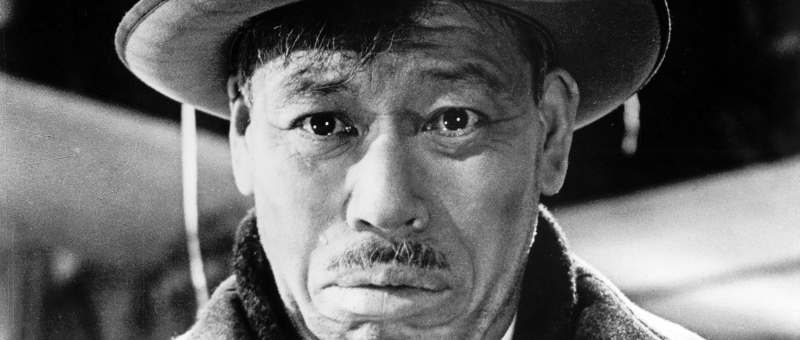
But of course the bureaucratic wheel keeps turning, another dangerous sewage problem diverted to another department continuing the literal pollution of the capitalistic post-war society. A kind of ghost story, Kurosawa lights Shimura from below, shadows cast across his gaunt face even by his “rakish” new hat while his huge eyes have a somehow haunted, grotesque quality filled with hungry desperation. Yet it’s to childhood that Watanabe eventually returns, “perfectly happy” sitting on a swing singing a song from his youth about the price age while surrounded by snow and at last painfully, absurdly alive. 


Ikiru screens at the BFI Southbank, London on 4th & 15th February 2023 as part of the Kurosawa season.

Original trailer (English subtitles)

Drunken Angel (酔いどれ天使, Akira Kurosawa, 1948)

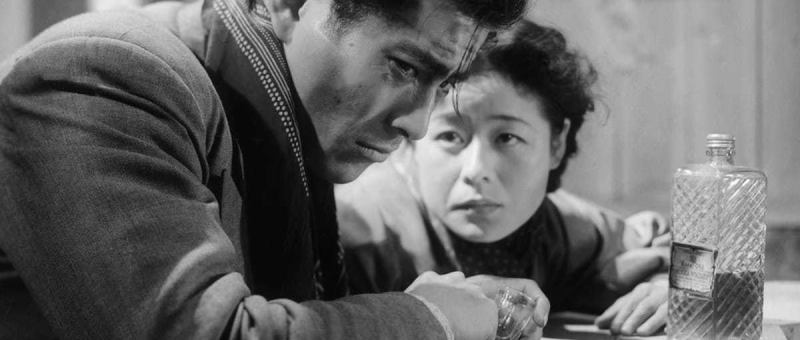
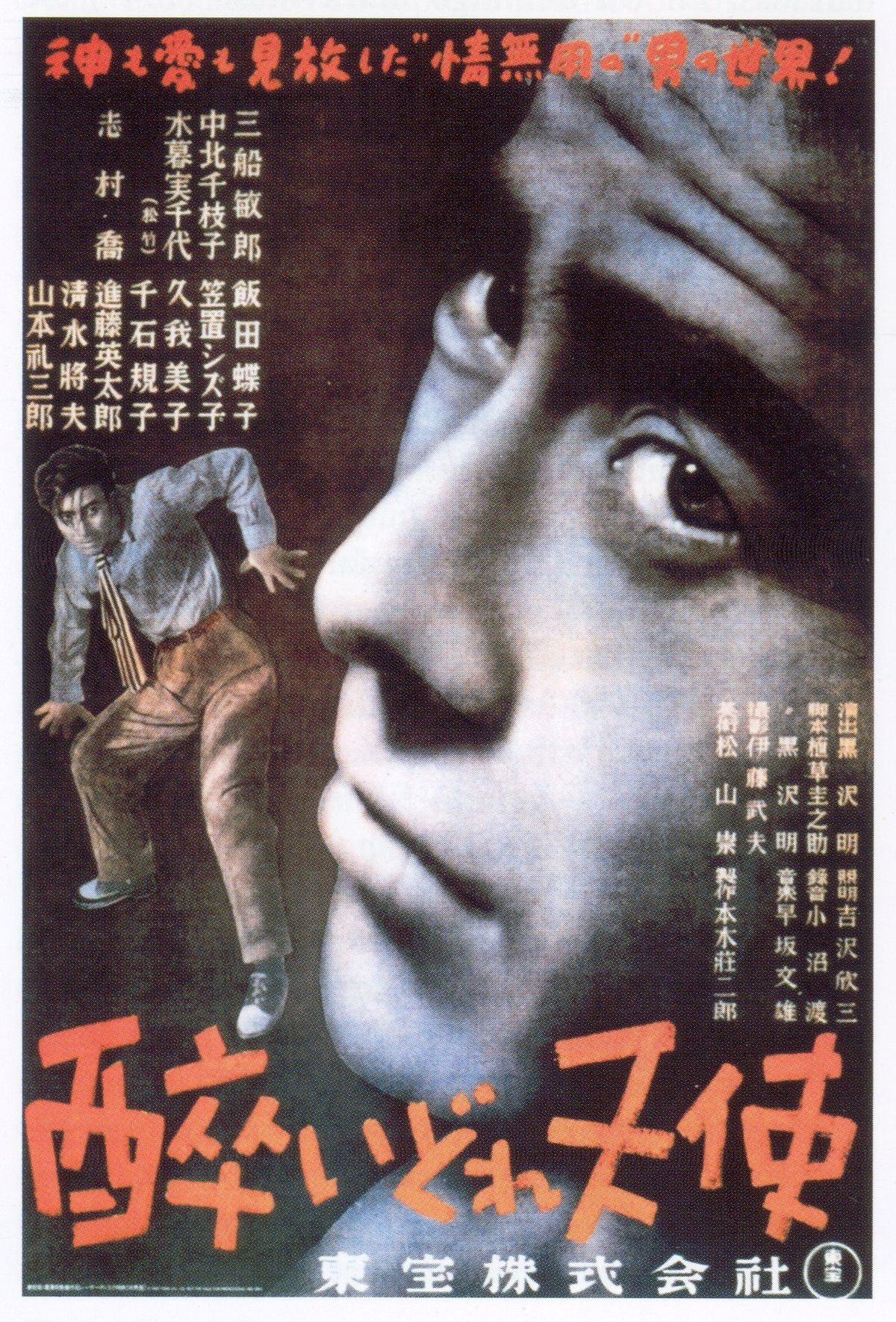
A gruff yet well intentioned doctor does his best to cure the ills of post-war Japan in a rundown slum on the edge of a fetid swamp in Akira Kurosawa’s noir tragedy, Drunken Angel (酔いどれ天使, Yoidore Tenshi). The doctor is most obviously the drunken angel of the title though it could equally apply to the unhappy yakuza he tries so hard to redeem whom most agree is not suited to that kind of life and trapped by the feudalistic thinking of the pre-war past.

Matsunaga (Toshiro Mifune) is the big man around town, but jaded physician Sanada (Takashi Shimura) sees straight through him. “He acts tough and swaggers around but I know in his heart he’s incredibly lonely,” Sanada tells his assistant, Miyo (Chieko Nakakita), a young woman he took in to help her escape the clutches of the violent yakuza ex who left her with syphilis. Miyo bemoans Sanada’s terrible bedside manner and tendency to bully his patients but praises his dedication and remarks that few doctors go as far for those under their care as he does especially ones like these who don’t often have the money to pay. This is a little ironic given Matsunaga’s original objection that he doesn’t trust doctors because it’s not in their best interests to cure you, something which Sanada jokingly acknowledges while expressing the futility he feels in the face of the mass sickness that confronts him. 

When Matsunaga first comes into his office, Sanada remarks that’s its not just his lungs that are sick, he’s sick to the core. But still he seems to think that Matsunaga can be saved, not just physically but spiritually redeemed if only he can coax him away from the yakuza underworld. Matsunaga is suffering from tuberculosis, a common disease of the post-war era and closely linked to the squalid conditions in which he lives which are themselves symbolised by the swamp in the centre of town onto which Sanada’s clinic backs. Sanada tries to warn the local children not to play in it because of the risk of typhus not to mention the mosquitos it attracts but the kids don’t really listen to him and shout back that he’s “just a drunk”. Yet the swamp represents a world upside-down, the neon sign for the No. 1 cabaret bar constantly reflected in its bubbling waters while as the film opens we see a trio of sex workers preparing to head into the red light district and a pair of petty thugs fighting while a young man plays Spanish guitar on the ruins of a bomb damaged building. 

It’s as if it were this world that is slowly consuming Matsunaga, an old-school yakuza who insists “we still believe in things like honour and loyalty” certain that the big boss will side with him against the returned upstart Okada (Reizaburo Yamamoto), Miyo’s yakuza ex, even as Sanada tells him it’s money that matters and Matsunaga no longer makes any. Everyone tells him that he already looks like a ghost, his appearance increasingly gaunt in his parallel decline as the illness takes hold and he begins to lose his status to Okada only to overhear his boss call him an “amateur” that he was only keeping around as a potential sacrifice. In the end, Matsunaga is too good for this world. Naively believing in things like honour and loyalty which no longer mean anything in the dog-eat-dog post-war society he is left with nothing other than a nihilistic bid for vengeance and a desire to repay Sanada’s faith in him if only in the most ironic of ways. 

Like Matsunaga, Sanada sometimes says the opposite of what he means claiming that he doesn’t care what happens to Matsunaga but is determined to wipe out the TB inside him to stop it spreading it to others. He’s on a mission to “sterilise this contaminated town” by eradicating the twin threats of disease and the yakuza, calling Matsunaga a coward for failing to face his fear and loneliness succumbing to the quick fixes of his hedonistic yakuza lifestyle. He’s not perfect either, a doctor who drinks his medical ethanol supplies and berates his patients when he them catches out them out drinking when he told them not to, but is also very at home with who he is and doing his best with it. His disappointment in Matsunaga is mainly in his swagger, the false bravado that masks his human frailty and unwillingness to face his fear of death which manifests itself in a hauntingly expressionistic dream sequence. Using silent cinema composition and canted angles Kurosawa conjures a world of constant uncertainty amid the vagaries of the post-war society in which the only sign of salvation is a drunken doctor and his “rational approach” to the sickness of the age.


Drunken Angel screens at the BFI Southbank, London on 2nd & 10th February 2023 as part of the Kurosawa season.