Sometimes people come into your life for a short time and then move on. Perhaps you won’t see them again, though the effect they have on you remains profound. Takaki is still hung up on a girl he met during his childhood and subsequently lost touch with to the extent that he has become isolated and emotionally distant. In remaking Makoto Shinkai’s anime 5 Centimeters per Second ( 秒速5センチメートル), Yoshiyuki Okuyama homes in on a sense of urban alienation and a longing for something greater that transcends ordinary life before arriving at an acceptance that sometimes there is no greater meaning beyond a pleasant memory.
Takaki (Yuzu Aoki) feels as if he’s looking for the feeling he’s lost while living in a soulless urban environment and doing a job that, as someone later says, isn’t all that much fun but not particularly taxing either. It’s clear that he wants something more out of life, but at the same time has become afraid to connect with people. As a child, he moved around a lot and so developed a habit of avoiding getting into relationships in order to avoid the pain of separation. As an adult, he never stays in one place for too long and is always moving on, quitting one job after another and moving to new parts of the city. He has a kind of girlfriend, but keeps her at arms’ length emotionally and is not seriously invested in the relationship.
The irony is that he and Akari (Mitsuki Takahata) bonded over the experience of being transfer students, but where Takaki has become a kind of nomad, Akari has begun to settle down with a regular job in a book shop. Though the film is told mostly from Takaki’s perspective, it seems that she has decided their youthful connection is something that belongs in the past as a comforting memory rather than a promise that will one day be fulfilled. She may think of Takaki from time to time, but also hopes that he has moved on and is living in the present rather than being hung up on the romantic ideal of their childhood connection.
TV news broadcasts discussing space probes that are destined to continue travelling in different directions echo the course of their relationship. Takaki assumes it’s an orbit and that their paths are destined to cross again eventually, when really their childhood friendship was a kind of launch point after which the distance between them would only grow. Their paths do indeed cross at times with several near misses at reconnection, but they remain liminal presences in each other’s lives.
The implication is that Takaki has retreated into a fantasy of idealised romance to avoid dealing the emotional difficulties of adult life, while for Akari the memory of her childhood friendship with Takaki has allowed her to move on into a more settled adulthood in which she is willing to accept the possibility of painful separations while putting down roots and forging relationships with those around her. Living through the illusionary “end of the world” affords Takaki a kind of rebirth in which he can learn to let go of the past and begin to move on by opening himself up to those around him.
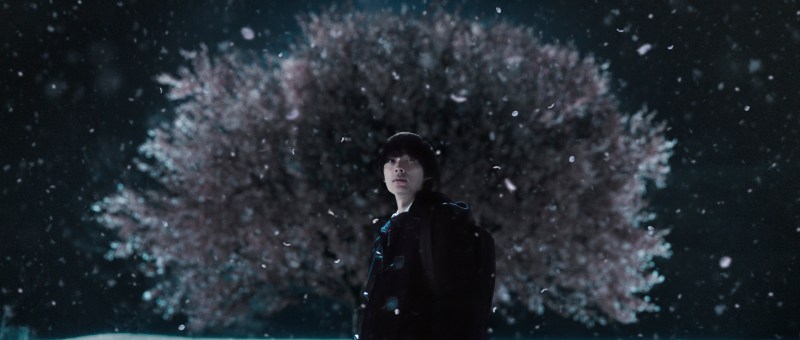
Okuyama captures Takaki’s sense of alienation while finding beauty in the world that surrounds him, from the spaces of urban loneliness to the crisp white snow and cherry blossom tree that Takaki believes is his salvation. The environment both reflects his anxieties and feelings of isolation, and is at times a barrier to his reconnection with Akari, but is also a source of hope for the future that the impending end of the world will not in fact come to be. Takaki’s 30th birthday is rather a kind of coming full circle and the launch point for adulthood in which he can finally move on from idealised first love and begin to open himself up to all the joy and pain that life has to offer.
5 Centimeters per Second screened as part of this year’s Nippon Connection
Consumed by rural ennui, three teenage girls set on a dramatic plan for escape in Takashi Koyama’s darkly comic youth drama, All Greens (万事快調〈オール・グリーンズ). The title turns out to be apt, not only in ironically referencing the drugs at the film’s centre, but also that the girls are all still fairly naive and just trying to figure out their place in the world. Whatever that may turn out to be, it’s clear that each of them is constrained by their circumstances from abusive fathers to absent parents and outdated patriarchal ideals.
The reduced horizons of their lives are evident in Hidemi’s (Sara Minami) description of the school as a place where everyone’s either given up on exams or is too poor to access better education. She and Mako (Mizuki Yoshida) seem to resent popular girl Milk (Natsuki Deguchi) and her seemingly perfect life, but are unaware that circumstances are similar to theirs or that she too is longing to escape this dead-end town. Hidemi is sick of her abusive father and submissive mother and finds release through rap music. Mako wants to be a manga artist, but is under pressure from her family who expect her to marry a man to take over their farm. And Milk has become a mother to her mother who appears to have had a mental breakdown following the death of her husband, a nuclear plant worker caught up in a radioactive incident.
The attitude of Mako’s family may seem excessively old-fashioned, but seems to reflect the traditional culture of the village. When the teacher warns their class about a flasher, he tells the girls to travel in groups and avoid going home alone while ensuring their skirts are not too short as if that had anything to do with the likelihood of being flashed. The three girls are briefly united when they witness a woman and her small child being dumped in the middle of an intersection by an abusive spouse. They hear later that the woman snapped, killed her abusive husband and burnt his house down before drowning herself and her daughter in the river. Each of them fear ending up like this woman, as if the village itself were an abusive spouse from whom they can’t escape. Hidemi’s dreams of rap stardom are even disrupted when she’s offered a promising opportunity with a “beat master” who first tells her he’s quitting the business because he’s getting married and needs a more stable line of work, and then matter-of-factly says that the job is conditional on sleeping with him. He even tried to drug her drink, but Hidemi has a healthy level of suspicion regarding men who offer help, so she switched their drinks which is how she finds out he has a safe full of marijuana seeds.
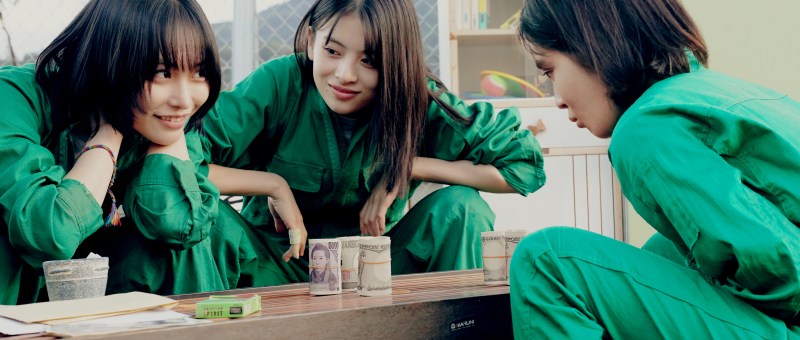
The drugs offer a more literal kind of escape in the prospect of a small business the three girls could operate illicitly together without really thinking about the consequences beyond the hope of making enough money to leave town. Later they bring in two fellow students who need money because they are gay and want to move in together to escape their oppressive families, though Hidemi’s assertion that karma isn’t real may seem hubristic while playing into her sense of the world as a lawless place in which there are no real consequences for anything because she’s used to seeing bad guys get away with their crimes. In trying their luck in the big city, however, the girls find themselves out of their depth as their small-town gangster dreams implode in the face of the realities of urban crime.
In the end, the only real answer may be to burn it all down, but the sense of solidarity between the girls has at least given them the courage to chase their dreams even if they may still prove elusive. As the fumes make their way through the school, it provokes a sense of liberation as the old codes of conformity begin to dissolve and people say what they really feel. It may be only temporary and perhaps lead nowhere at all, but for the moment at least the road ahead is wide open.
Black River is a good place to start this retrospective as, though it’s not his first film, it is the first time Nakadai played a prominent role on screen. His cinema career, however, began a little ignominiously with a small gig as an extra on Seven Samurai having been sent there by the acting school he was training at at the time. He had obviously never been involved with a period film before and Akira Kurosawa actually yelled at him that he “walked funny” and didn’t know how to move like a samurai. He was only in one scene all he needed to do was walk across the set, but Kurosawa kept making him redo it from 9am to 3pm before finally giving up.
Nakadai seems to have taken this quite badly and made a vow that he was going to become a great actor so he could turn down all of Kurosawa’s films, so he was quite reluctant to work with him again. He rebuffed all of Kurosawa’s attempts to do so and only accepted the role in Yojimbo when Kurosawa reached out to him personally, having apparently remembered him from Seven Samurai. Presumably, he’d either learned to walk like a samurai by that point, though he’d mainly done films set in the present day, or Kurosawa didn’t mind because his character in Yojimbo after all represents a kind of modernity.
In any case, Nakadai got his start in films proper after he was spotted playing Oswald in Ibsen’s Ghosts by actress Umeji Tsukioka who recommended him to her husband, the director Umetsugu Inoue, and he made his film debut in Pheonix in 1956 in which Tsukioka starred. He then played several small parts in other films before playing what’s really his first prominent role Masaki Kobayashi’s Black River, which is the film you’re about to see, after being recommended to the director by a friend of his who was an executive at Haiyuza theatre company where Nakadai had trained and continued to work.
Throughout his career, Nakadai was primarily a theatre actor. Though he was highly sought by each of the big five studios during Japan’s golden age, Shochiku, Toho, Nikkatsu, Toei, and Daei, he never signed an exclusive contract and preferred to remain freelance meaning that he was in the enviable position of having a lot of control over which projects he participated in. While the studio system was in place, the Big Five’s business model was largely based around a roster of exclusive stars that they slotted into whichever project they thought would suit them. If a director wanted to use an actor from another studio, they’d have to come to some sort of agreement which could be quite difficult to work out. But as Nakadai was freelance, he could work with any of the studios he wanted and was able to play a wide variety of roles rather than by literally type cast as a leading man or character actor or limited one particular genre.
That’s why you’ll see the Shochiku logo before Black River which was the home studio of director Masaki Kobayashi, while The Age of Assassins was made for Toho which was the home studio of Kihachi Okamoto. During the days of studio system, the Big Five would also train their own directors in house and there was no real other way to become a mainstream film director without joining a studio and working your way up from assistant director. That said, the interesting thing about Masaki Kobayashi is that he was a relative of the great star Kinuyo Tanaka who had also spent most of her career at Shochiku before breaking her exclusive contract following the backlash on her return from an American tour in 1949. She also went freelance in order to work with a wider variety of directors and later pursue a career as one herself.
The working relationship between Nakadai and Kobayashi was the most important in terms of their cinema work to the point that Nakadai really became a stand-in for Kobayashi on many of his films and especially his magnum opus The Human Condition. They were, however, from quite different generations. Kobayashi joined Shochiku as an assistant director after graduating from Waseda University in 1941 but was drafted not long after and left for the war though he regarded himself as a pacifist and resisted by refusing all promotions above the rank of private despite being considered a capable soldier. He spent about a year in a prisoner of war camp after the war ended and only returned to Japan 1946 to discover his father and older brother had died, while he was professionally disadvantaged as other directors who were exempt from the draft and had continued working throughout the war had leapfrogged ahead of him. He ended up serving as an assistant to Keisuke Kinoshita who was only a couple of years older than he was, though they got on really well and Kobayashi had a lot of admiration fro Kinoshita’s work who had, after all, been quite a close collaborator with Kinuyo Tanaka.
That might explain why his first couple of films were more regular Shochiku fare. The studio specialised in “shomingeki” or films that revolved around the lives of ordinary, lower-middle-class urbanites. It wasn’t until his third film, Thick-Walled Room that he began to address the themes that were more personal to him such as Japan’s wartime legacy and the struggle of the individual against a corrupt system. But The Thick-Walled Room which dealt with the still sensitive topic of wartime atrocities proved too controversial for Shochiku, which is not a studio that generally tolerates controversy. Consequently The Thick-Walled Room was shelved for a few years for fear of offending the Americans though the Occupation was already over and Kobayashi had to go back to making films that were much more typical of the studio’s style.
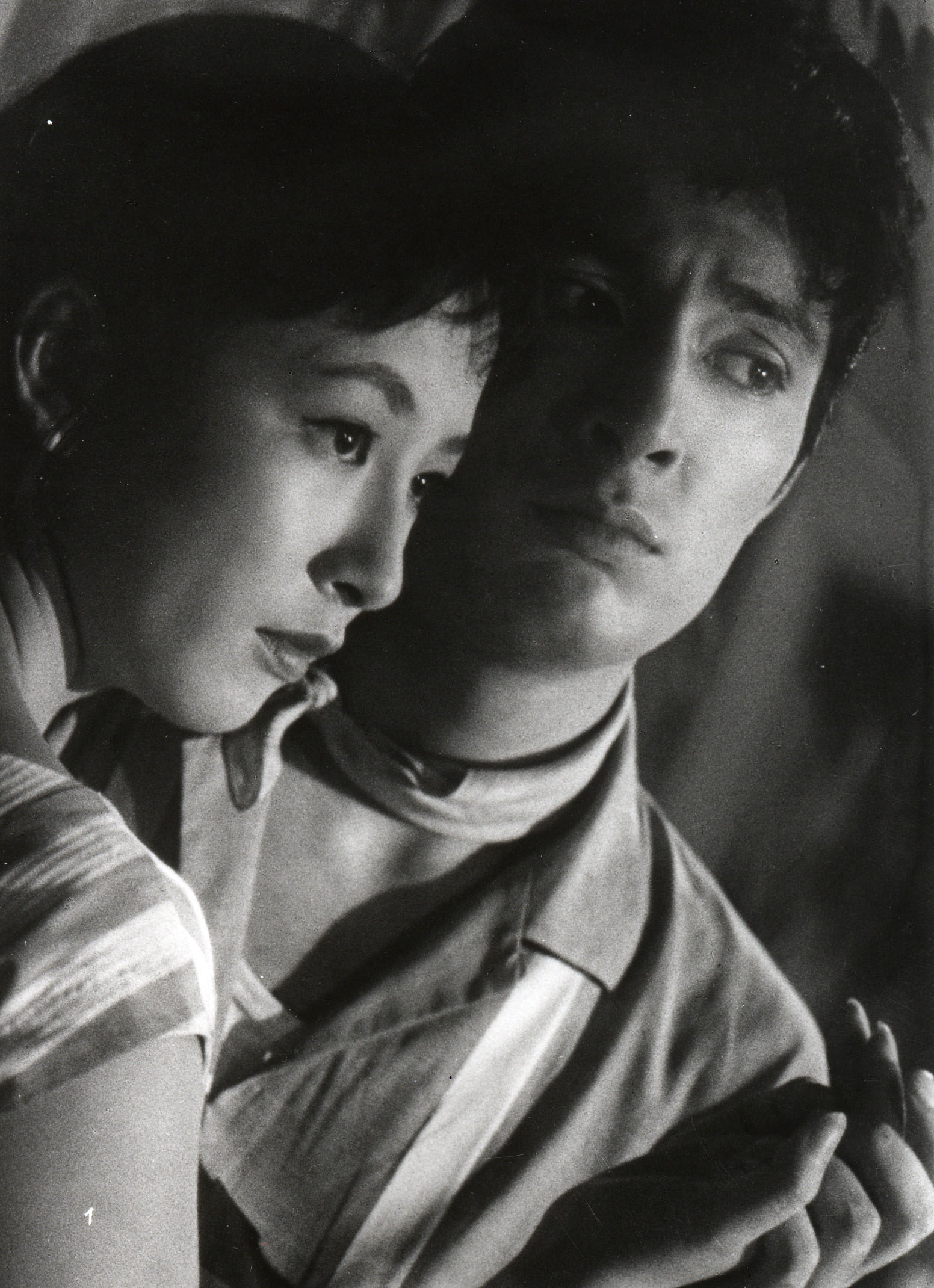
After testing the waters with cynical baseball drama I Will Buy You, Black River may be Kobayashi’s second attempt to work on material that directly interested him. Scripted by Zenzo Matsuyama, the film explores on the radiating corruption of US military bases in the post-Occupation society through the lives of those drawn into its nexus of violence and immortality. It opens with an American plane noisily zooming overhead above sleazy clubs with Western names catering American servicemen. Sex workers line the streets and it’s clear that the entire area is economically dependent on the base for its survival. Caught between those living in a rundown slum area and red-light district are recently arrived student Nishida and pure-hearted waitress Shizuko neither of whom feel they belong in this environment. Nishida is a student who’s chosen to live out here to save a few pennies, but at heart thinks he’s much better than the other residents at the tenement. Shizuko is attracted to him because he seems different and represents a link back to a more middle-class, respectable vision of Japan, but ends up being raped by local gangster Killer Joe who represents post-war moral decline in his wilful collaboration with the Americans. She’ll spend the rest of the film trying to retrieve the parasol that Joe took from her that represents innocence, while struggling with herself, unable to understand her attraction to the man who raped her despite her fear of him and his violence towards her.
Ineko Arima who plays Shizuko is another interesting case in that she actively fought for more control over the kind of roles she played even within the studio system. She started out playing male roles at Takarazuka Review and made her film debut in a Takarazuka Review film for Toho. Before moving to Shochiku she co-founded the independent production company Ninjin Club with fellow actresses Keiko Kishi and Yoshiko Kuga that aimed to circumvent the studio system and provide more creative freedom for actresses in particular. Ninjin Club is also one of the production companies listed for this film alongside Shochiku.
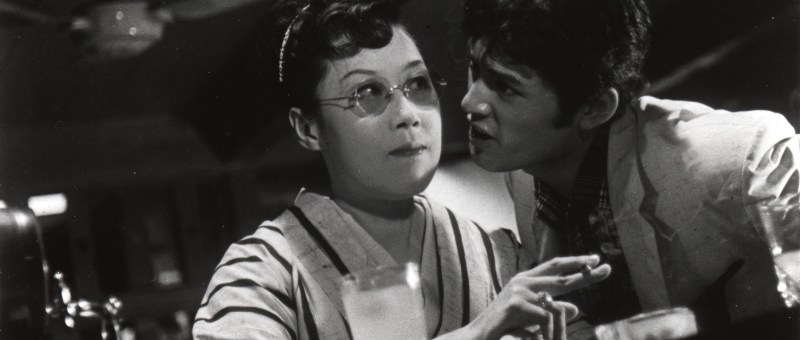
You actually might not recognise her to begin with because she’s wearing this amazing set of false teeth that give her a rather grotesque appearance, but the slum landlady is played by Isuzu Yamada, a star of the 1930s who mainly worked at Toho and often worked with Mizoguchi and Naruse. She had also gone freelance at this point having left Toho during the labour dispute that erupted in the mid-40s, so you could say that these are all very appropriate stars for a Masaki Kobayashi film in each having in some way rebelled against the corrupt studio system, even if Kobayashi himself was more or less complicit with it.
The landlady’s grotesquery provides an interesting counter to the amorality of Joe and his backer who are in cahoots with the Americans and want to knock the tenement down to build a love hotel. She is merely someone whose worst instincts have been indulged by the post-war moral decline as she gleefully teams up with Joe in the hope of many a bit more money from selling her apartment block, little caring that most of the residents have nowhere else to go and are only living here because they can’t afford anything better. The resistance, led by Korean communist Mr Kim, in the end proves ineffective and it seems there really is no solution other than violence to deal with a man like Joe, though in taking him out one would only damn oneself. Nevertheless, the film does not particularly blame the Americans so much as the Japanese for allowing themselves to be corrupted in this way and permitting this state of lawlessness to exist in which a man like Joe is free to behave as he does with no real consequences. I do hope you’ll enjoy it.
At 35 years old, Taiga (Takashi Kawaguchi) is beginning to tire of city life and thinking of settling down, but as a gay man in contemporary Japan, there are limits to how much that is possible for him. Inspired by real life stories from the LGBTQ+ community, Anshul Chauhan’s Tiger is more character study than issue drama, but explores the ways in which Taiga’s horizons are constrained by the way society receives his sexuality to the point that he finds himself considering entering a platonic marriage as the only real way to ensure a full domestic life with the possibility of raising children.
As someone from the “Friendship Marriage” organisation points out, even the recently introduced partnership system available in some areas of Japan is a long way from a legal marriage and is geared more towards housing provision and hospital visits. It doesn’t confer inheritance rights for those who own property, or even the right to attend a funeral if the other relatives object. Child adoption is relatively rare in Japan in any case and not generally available to same sex couples while even costly options such as IVF and surrogacy could be bureaucratically difficult given the way the family register system works.
Though the woman giving the presentation seems incredibly angry about the weakness of the partnership system legislation, labelling it “a disgrace”, it can’t be denied that Friendship Marriage is essentially complicit with the heteronormative views of mainstream society in which it is still socially and in some cases practically difficult not to be married. After signing up for the service, Taiga meets a woman who is half-Iranian and grew up in Tehran. It doesn’t occur to him that her decision to come to Japan was not made entirely freely and that she cannot safely return there without the threat of violence. Taiga may feel himself constrained, but he won’t be arrested or tortured solely for existing as a gay man. Nevertheless, he faces reduced options when it comes to employment and has never revealed his sexuality to his father fearing that he will reject or disown him.
Tensions come to a head, as they so often do, when the matter of inheritance is raised. Taiga’s sister Minami (Maho Nonami) is aware of his sexuality though does not seem altogether accepting and is resentful of his life in Tokyo which she assumes to be aimless and free of responsibility while she has had to shoulder the burden of caring for their ageing father alone. It’s obvious that she has been banking on inheriting the family home and is resentful on hearing their father has suggested leaving it to Taiga on the condition that he marries and has children, knowing that this is something that is not possible in contemporary Japan. The implication is that Taiga had no choice but to leave his home town in order to lead a more authentic life and essentially develops two opposing personas, that of “Tiger” the aspiring porn star and “Taiga” the would-be-family man.
Minami later wields this duality against him, asking him to baby-sit her daughter Kaede to whom he is especially close, while threatening to out him to their father if he doesn’t agree to give up his right to the domestic space represented by their family home. His former lover, Koji (Yuya Endo), has entered a conventional heterosexual marriage without disclosing his sexuality to his wife and is riddled with regrets over not leaving with Taiga and trying to start a domestic life in the city as a gay couple. The Friendship Marriage system removes the element of betrayal, but also elides authenticity in providing a mechanism for each partner to fulfil social and parental expectation while avoiding disclosing their sexuality, and equally prevents them from enjoying a full and loving domestic relationship with a same-sex partner.
The film never particularly suggests that there is anything wrong with the way Taiga is living in Tokyo nor with his desire to get into gay porn, but merely highlights the sense of emptiness he feels as someone denied the possibility a full domestic life. There is after all a kind of age cap involved in his life as a sex worker working at a men-only massage parlour which he may fast be approaching even aside from the clients who like to exorcise their own sense of powerless by paying money to abuse and humiliate him. In the end, all he’s left with is an uncertain liminal space living as a literal stand-in marooned on the sidelines with no place to call his own.
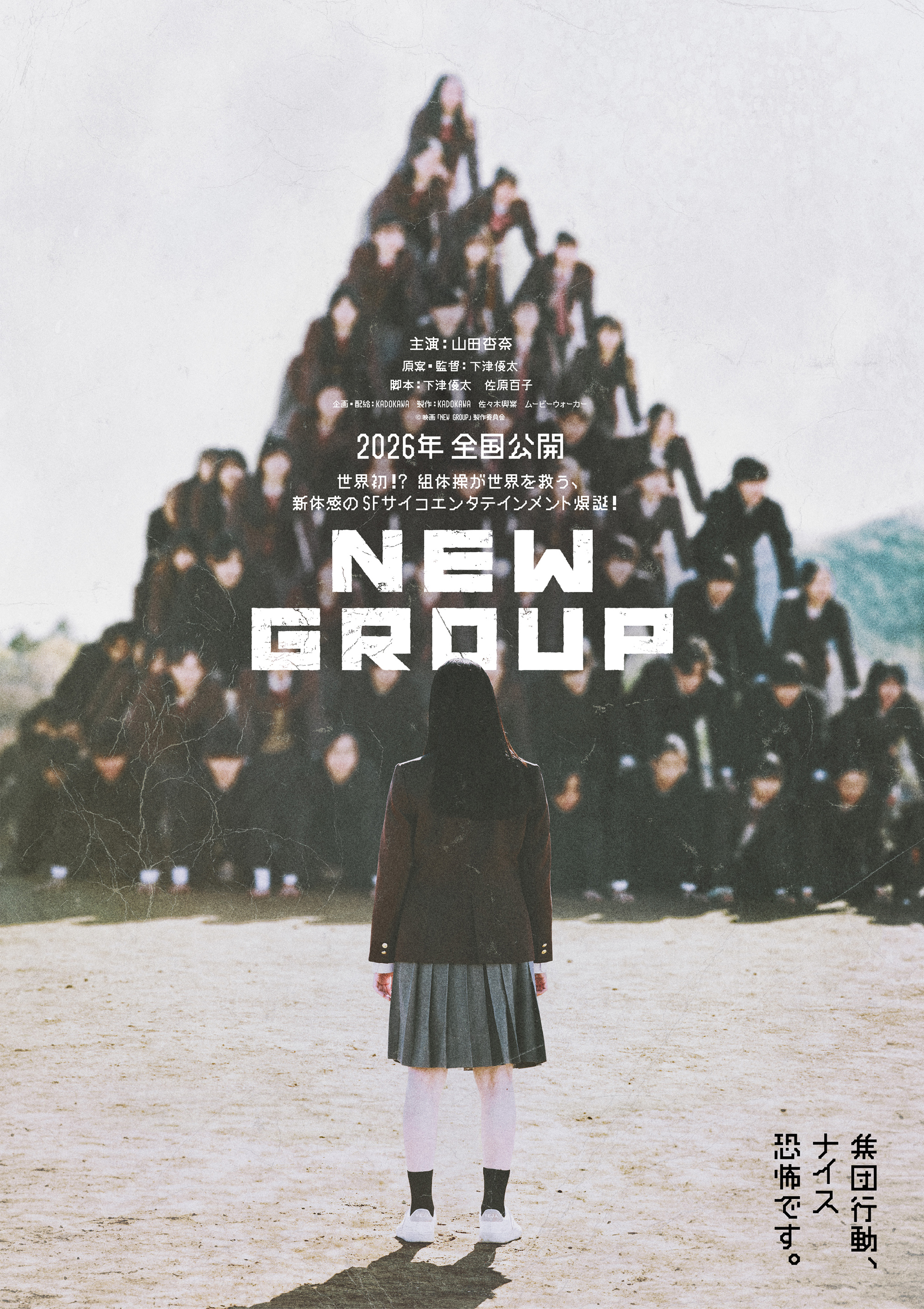
If all your friends went and formed a giant human pyramid, would you go and form a giant human pyramid too? Parents used to caution against such dangerous group think, but it has to be said that perhaps they only complained when the group activity didn’t suit them or required some additional expense they didn’t really want to pay. If the group activity was studying hard at school to get into a good university and become a successful member of society rather than buying the later must have fashion item to fit in at school, then they’d hardly complain about that.
Yuta Shimotsu’s absurdist satire New Group is in many ways about the deeply ingrained patterns of thought that exist within a society to the extent that they are rarely ever questioned. Ai (Anna Yamada) is coming to an age in which she is beginning to feel hemmed in by a conformist society but at the same time does not have the courage or confidence to challenge it. When she sees another girl being bullied, she wants to step in to defend her but all she manages to do is give the bullies a hard stare. Her friend Haru asks her what university she’s thinking of applying to to, but Ai only says she’ll apply to the same one as her and study the same thing. She can’t even answer when she’s put on the spot about what she wants to do for the school festival for fear of picking the wrong one and being ostracised from a particular faction, so she just goes along with the first person who asked for her vote.
As her teacher says, though there is a strong groupthink in play, everything comes to a binary. It’s always “uchi-soto”, us and them. But what does it mean to be a member of the main group? Ai isn’t convinced she wants to give up her autonomy just to fit in and increasingly feels herself to be an outsider. Her name is of course reminiscent of the English pronoun “I”, though it’s true meaning is “love”. She’s pulled out of inertia by a boy named “Yu” who nevertheless is later pulled into the pyramid and tells her that “ai” is here, meaning both that the group is love and Ai, the individual, belongs with in it. She replies that he’s wrong, that isn’t love, and it isn’t her. There is no room for the individual within the pyramidic structure of the group.
Yu has recently returned from abroad and is living alone free of parental authority which is why he doesn’t fit into the carefully controlled harmony of the school. He is out of step at marching practice and less afraid to voice his true opinions. He intervenes to save the other girl from the bullies and chastises Ai that just watching makes you complicit. Yu might as well be one of the space aliens they keep talking about on TV, a subversive force out to destabilise the harmonious society. Yet Ai’s doubts seem to have arisen because of a personal trauma. As a child, she chose the group over her younger sister who was then killed in an accident. She feared being excluded and essentially sacrificed her sister for approval while also denying her affiliation to the group that is her family.
The quest of Ai and Yu is then to maintain their selfhoods while operating in a society that demands conformity. Controlled by the maniacal headmaster, their schoolmates all immediately start marching to the beat of the PE teacher’s whistle and dutifully take their place in the pyramid in which all they do is uphold the structure of the group. As the pair are chased by the zombie-like figures, Ai has to confront the fact that it might just be easier to go with the flow, even if that too comes at a price. Even so, in her efforts to resist, is Ai not just creating another group of her own that can only exist because of its opposition to the first? If there is “I” there must also be “you” and never the twain shall meet. A TV commentator played by the director Takashi Shimizu tries to speak out about the nonsense groupthink being conveyed through the innocuous medium of daytime television but is dragged off air while shouting at everyone to wake up and think for themselves. It seems that few are brave enough to switch off and think for themselves while the only path to freedom lies in loneliness and exile even if in the end it is “love” that saves us after all.