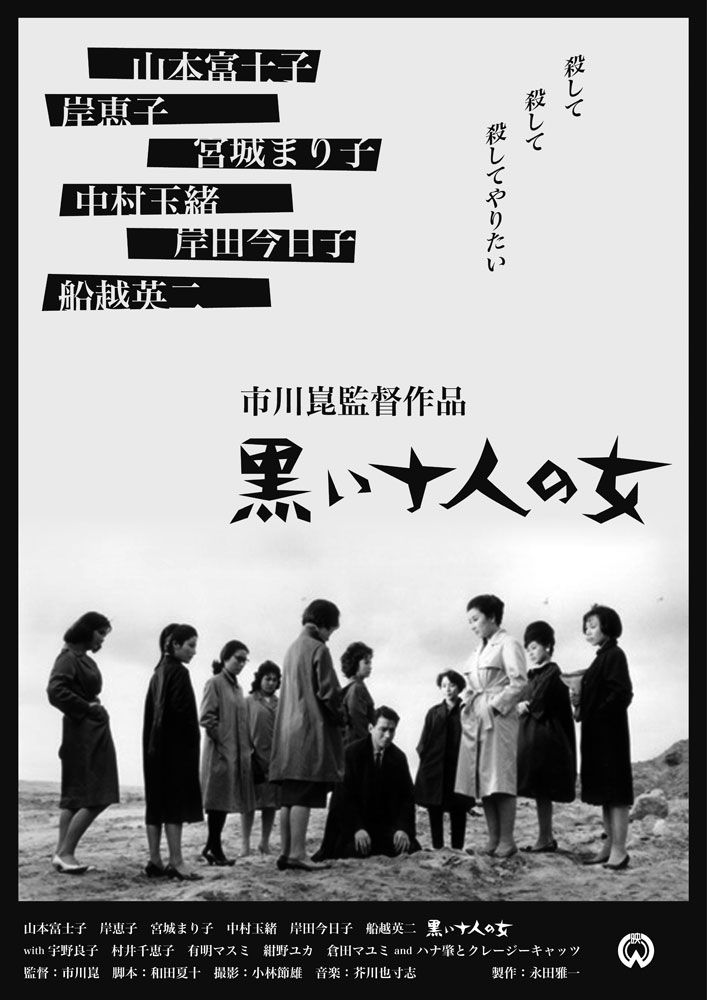
Ten Dark Women (黒い十人の女, Kon Ichikawa, 1961)

Ten Women in BlackKon Ichikawa, wry commenter of his times, turns his ironic eyes to the inherent sexism of the 1960s with a farcical tale of a philandering husband suddenly confronted with the betrayed disappointment of his many mistresses who’ve come together with one aim in mind – his death! Scripted by Natto Wada (Ichikawa’s wife and frequent screenwriter until her retirement in 1965), Ten Dark Women (黒い十人の女, Kuroi Junin no Onna) is an absurd noir-tinged comedy about 10 women who love one man so much that they all want him dead, or at any rate just not alive with one of the others.

Kaze (Eiji Funakoshi) is a TV producer by profession, though it might be better to think of him as a professional ladies’ man. He’s married to a woman who owns a bar, but is also carrying on affairs with nine (!) other women plus occasional one night stands with 30-50 others he meets through his work. His wife knows about his affairs and, while not happy about it, is putting up with things like decent wives are supposed to do. However, many of Kaze’s “mistresses” have inconveniently discovered each other’s existences and bonded in their mutual frustration with him. Strangely they all think he’s a great guy and remain very much in love with him but the situation being what it is the entirety of the betrayed wife and mistress support club eventually comes to the same conclusion – Kaze must die!

However, the women are all so devoted to Kaze, they don’t quite want him to disappear so much as for him to pick them and only them to live with happily ever after. One of the women foolishly warns Kaze about their plot as leverage for her marriage proposal but unfortunately for her he still turns her down and returns home to ask his wife what’s going on. She doesn’t deny her murderous intentions and in fact tells him in great detail how they intend to do him in. Kaze, to his credit, says he doesn’t mind very much and only worries about his wife’s future life as a murderess. Together they hatch a plan to fool the other women involving a pistol loaded with blanks and a tomato but nothing quite goes to plan.

An absurdist satire about the intense vanity of the womanising male, Ten Dark Women looks forward to Fellini’s similarly themed 8 1/2 or City of Women though here the idiotic husband at the centre becomes both prey and foil for the group of plotting women seeking revenge against his disloyal ways. Kaze, as he himself admits, is not particularly appealing to women though his position at the TV studio undoubtedly proves useful to some of them. He’s a curiously passive presence, not so much seeking out female company as acquiescing to it. It’s not quite clear if his concern for his wife should she decide to kill him is genuine or a means of manipulative self preservation but at any rate he takes the threat to his life extremely calmly.

Each of the women has their own claims on Kaze but the other thing they all have in common is being the prisoner of an extremely sexist society. Some of the women are with Kaze for careerist reasons, but it’s clear that there is a definite limit placed on a woman’s potential both inside and out of the creative industries. The commercial model makes a play for a more official relationship by bringing up the fact that Kaze’s wife has a job and therefore cannot devote herself entirely to Kaze’s wellbeing as proper wife should (as by implication would she after marrying and retiring from the modelling world). Kaze helped his wife set up her bar which she runs herself though constantly plays hostess to her husband’s industry friends. It appears what Kaze wants is less a devoted wife than an indifferent one who will permit his frequent “indiscretions” whilst also providing him with a conventional “home”.

Another of the women tries to get herself a promotion but her boss, though broadly sympathetic and dangling the idea of a raise, brings up the oft repeated notion that there’s no sense in giving her the job because a woman should leave at some point to marry and have children. When the woman criticises the behaviour of her male colleagues, her boss simply shrugs and admits men in TV aren’t “serious”, yet when she points out that she is serious and works hard she is told that women are better off at home. Women, he says, express themselves through their children whereas men make their mark through a career. The woman says that she believes everyone should try to reach their own potential in whatever way they can but her pleas fall on deaf ears. This notion is repeated later on when the women try to take revenge on Kaze by tricking him into resigning from his job – a man is his work, he claims. A man without a job is nothing at all and a man who is kept by a woman is less than nothing – Kaze is suddenly panicked, losing his occupation and social position is much more frightening to him than losing his life.

The women couldn’t kill the system or the TV, but they could kill Kaze so who can blame them for trying. Another of the women states that the imposed isolation of a man’s working life has cost him the ability to connect with other people on a human level and so his erasure is simply the end of a long process of social death. If some of the women triumph, others retreat as one does in suicide only to return as a ghost longing for the murder plot to succeed so that she and Kaze can be alone together at last. Kaze thinks he’s using each of them, but they have all been using him in one way or another and his only way out lies either in death or becoming a trophy for the most needy of his paramours.

Cynical in tone, Ten Dark Women is an amusingly absurd look at gender roles in early 1960s Japan as each of our women attempts to usurp male power for their own ends, some with more success than others. Ichikawa employs beautiful noir lighting in his elegantly composed black and white photography which, along with its jazzy score, gives the film a familiar feeling of crime laced modernity. An early instance of the feminist revenge film, Ten Dark Women is very much a comedy which avoids making its group of frustrated, resentful women mistreated by a buffoon of a TV exec the butt of its own joke, neatly highlighting the precarious nature of their existence which obliges them to rely on so hollow a support.


Original trailer (no subtitles)

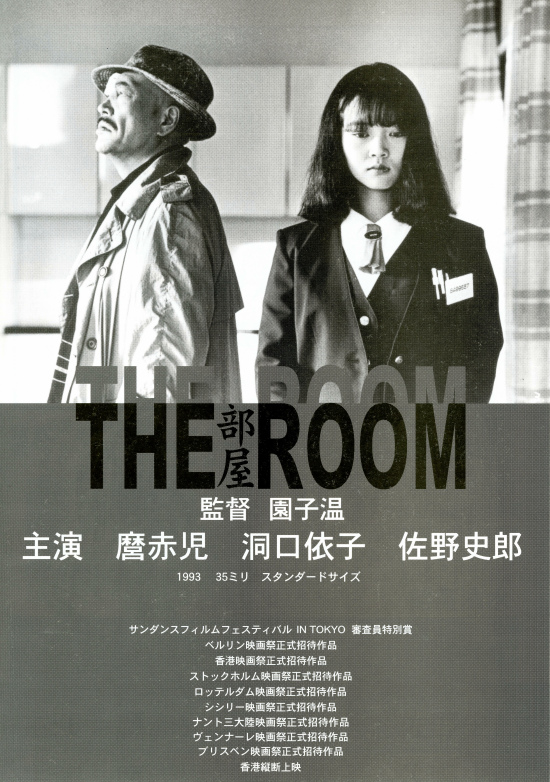
The Room (部屋, Sion Sono, 1993)

The roomThough the later work of Sion Sono is often noted for its cinematic excess, his earlier career saw him embracing the art of minimalism. The Room (部屋, Heya) finds him in the realms of existentialist noir as a grumpy hitman whiles away his remaining time in the search for the perfect apartment guided only by a detached estate agent.
Sono begins the film with an uncomfortably long static camera shot of a warehouse area where nothing moves until a man suddenly turns a corner and sits down on a bench. We then cut to a rear shot of the same man who’s now sitting facing a harbour filled with boats coming and going as the sun bounces of the rippling sea. We don’t know very much about him but he’s dressed in the crumpled mac and fedora familiar to every fan of hardboiled fiction and walks with the steady invisibility of the typical genre anti-hero.

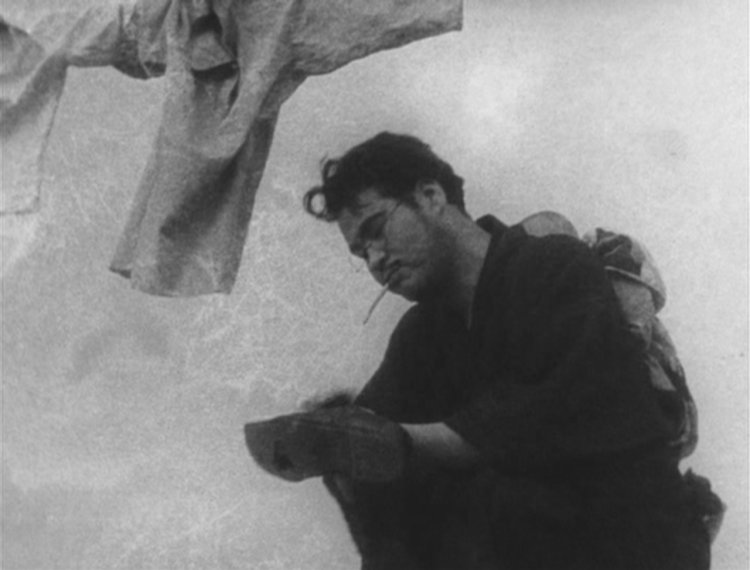
Before we head into the main “narrative” such as it is, Sono presents us with another uncomfortably long shot of the title card which takes the form of a street sign simply reading The Room, over which someone is whistling a traditional Japanese tune. Eventually we catch up with the hitman as he meets a young female estate agent identified only by the extremely long number she wears on the jacket of her official looking business suit. The hitman gruffly lists his poetical demands for his new home – must be quiet, have the gentle smell of spring flowers wafting through it, and above all it must have an open, unoverlooked view from a well lit window. The estate agent reacts with dispassionate efficiency, her gaze vacantly directed at the floor or around the rundown apartments which she recommends to her client. Together, the pair travel the city looking for the elusive “Room” though perhaps that isn’t quite what they’re seeking after all.

Sono shoots the entire film in grainy black and white and in academy ratio. He largely avoids dialogue in favour of visual storytelling though what dialogue there is is direct, if poetic, almost symbolic in terms of tone and delivery. The occasional intrusion of the jazzy score coupled with the deserted streets and stark black and white photography underlines the noir atmosphere though like the best hardboiled tales this is one filled emptiness led by a man seeking the end of the world, even if he doesn’t quite know it.

In fact, the relationship between our hitman and the passive figure of the estate agent can’t help but recall Lemmy Caution and the unemotional Natasha from Godard’s Alphaville – also set in an eerily cold city. If Sono is channelling Godard for much of the film, he also brings in a little of Tarkovsky as the hitman and estate agent make an oddly arduous train journey around the city looking for this magical space much like the explorers of the Zone in Stalker. Yet for all that there’s a touch of early Fassbinder too in Sono’s deliberately theatrical staging which attempts both to alienate and to engage at the same time.

The Room’s central conceit is its use of extremely long shots filled with minimal action or movement. In a 90 minute film, Sono has given us only 44 takes, lingering on empty streets and abandoned buildings long enough to test the patience of even the most forgiving viewer. Deliberately tedious, The Room won’t counter arguments of indulgence but its increasing minimalism eventually takes on a hypnotic quality, lending to its dreamlike, etherial atmosphere.

Here the city seems strange, a half formed place made up of half remembered images and crumbling buildings. Empty trains, scattered papers, and lonely bars are its mainstays yet it’s still somehow recognisable. Leaning more towards Sono’s poetic ambitions than the anarchism of his more aggressive work, The Room is a beautifully oblique exploration of the landscape of a tired mind as it prepares to meet the end of its journey.


Original trailer (no subtitles):

https://www.youtube.com/watch?v=aIUlIbFgiuk

Kochiyama Soshun (河内山宗俊, Sadao Yamanaka, 1936)

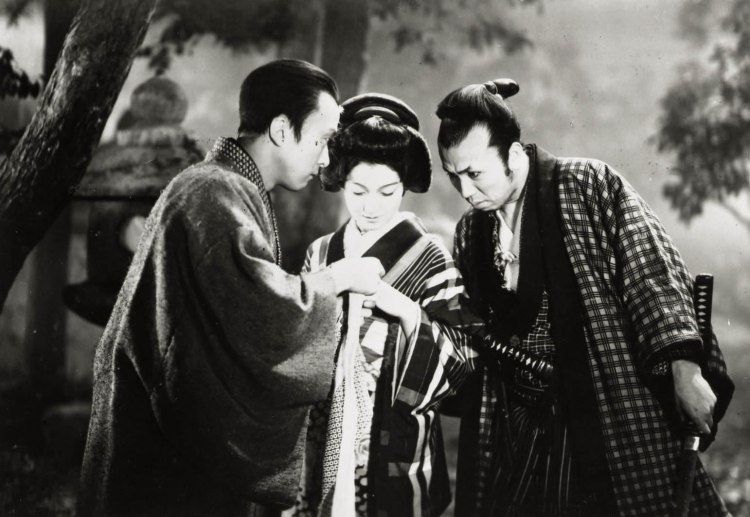
kochiyama soshunThe second of the only three extant films directed by Sadao Yamanaka in his intense yet brief career, Kochiyama Soshun (河内山宗俊, oddly retitled “Preist of Darkness” in its English language release) is not as obviously comic or as desperately bleak as the other two but falls somewhere in between with its meandering tale of a stolen (ceremonial) knife which precedes to carve a deep wound into the lives of everyone connected with it. Once again taking place within the realm of the jidaigeki, Kochiyama Soshun focuses more tightly on the lives of the dispossessed, downtrodden, and criminal who invoke their own downfall by attempting to repurpose and misuse the samurai’s symbol of his power, only to find it hollow and void of protection.
The primary players are the virtuous and innocent Onami (Setsuko Hara) who runs a small sweet sake stall and her errant young brother, Hiro, who spends all of his time in a local drinking establishment run by the wife of the titular Kochiyama Soshun. Despite his priestly get up, Kochiyama is a conman, swinder, gambler and petty gangster but for some reason he takes a liking to Hiro not knowing that he’s Onami’s brother because he’s been using the fake name of “Nao” to prevent his sister tracking him down and bringing him home again. There’s a bigger criminal outfit in town run by a guy named Morita but mostly everyone knows Kaneko who comes and collects his protection money. Kaneko also has something of a crush on Onami and generally lets her off the payments.

Everything starts to go very wrong when Hiro pinches the dagger of a careless samurai. It turns out that the sword and dagger set were a gift from his lord who received them from the shogun so this loss is particularly embarrassing and if he were asked to produce the dagger but couldn’t, he’d be duty bound to commit harakiri. Hiro gets himself into even more trouble when he spots a childhood friend working in the red light district and tries to run off with her. If things weren’t difficult enough, Onami is now firmly pulled into his web of trouble as Morita’s gang want the compensation money for the loss of their girl, a sum so vast there is no way Onami could ever be able to repay it leaving her with only one, unthinkable, option.

Everything here is pretence – the “priest” who cheats and gambles, the young man who uses a fake name, the samurai with no real power, and the dagger itself with its uncertain authenticity. Onami is the only true and honest thing in the entire film, unsullied by the meanness of the world which surrounds her, yet even she finds herself sucked in by the reckless actions of her brother. She too becomes a commodity to be bought, traded, and sold, placed as a bargaining chip between the competing forces of Kochiyama and Kaneko. Kaneko, though he works for the “bad guys” is not a bad man (more mirroring) and has a noble heart unwilling to carry out the service of his master when it conflicts with his own desire for justice.

Onami’s essential goodness has infected both of them as they now see that they have lived morally disappointing lives but have also been given a chance for a final bid at redemption, albeit in the service of an idiotic, self centred teenager whose selfish and reckless actions have destabilised the lives of everyone around him. The film ends on a note of uncertainty as one character is permitted to escape with the means to save another in hand, paid for by the sacrifice of others, but whether they will be in time or opt to selfishly run away is very much open for debate.

In a more serious mood here, Yamanaka is less playful than in the more obviously comic Tange Sazen: The Million Ryo Pot but nevertheless continues to push his art to the visible limit. Like Tange Sazen, Kochiyama Soshun is an ensemble led film but its plotting is far more intricate and involved. It’s possible that the film is incomplete, but events often seem hard to follow and we only learn of one extremely important incident during a throwaway conversation between two characters who clearly don’t know its import. Even so it’s no great hardship to piece things together as we go, and Yamanaka makes sure to draw his characters well enough that it doesn’t really matter. Even if the weaker of Yamanaka’s surviving films, Kochiyama Soshun is another characteristically innovative piece filled with wry humour but a fair degree of warmth too.


Unsubtitled clip:

https://www.youtube.com/watch?v=EHQTR9skR0w

Children of the Beehive (蜂の巣の子供たち, Hiroshi Shimizu, 1948)

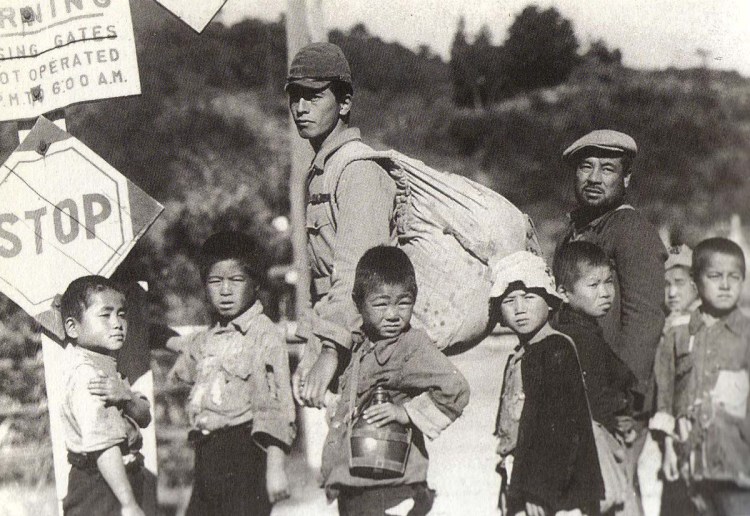
d0115515_1411145Hiroshi Shimizu is often remembered for his talent as a director of children, something which he brings to the fore with his melancholy meditation on the immediate post-war world in Children of the Beehive (蜂の巣の子供たち, Hachi no Su no Kodmotachi). This is a destroyed society, but one trying to make the best of things, surviving in any way possible. It’s fairly clear from Shimizu’s pre-war work that he did not entirely approve of the way his country was heading. Children of the Beehive seeks not to apportion blame, but merely to make plain that no one can get along alone here, in the post-war world there are only orphans and ruined cities but that itself is an opportunity to rebuild better and kinder than before.

The scene begins with a few street urchin kids plying their trade by pickpocketing at a railway station. A bewildered soldier lingers on the platform, uncertain of what to do next but decides not to board a train after all. Like these children, he himself is an orphan and has no real place to go back to, no family waiting to greet him. The children work for a Fagin-like street thief with one leg and no scruples who has them doing all sorts of not quite legit enterprises but after all he’s just trying to survive too. Outside, the gang run into another lady who’s been trying to get a telegram through to a distant friend but isn’t having much luck. Eventually the soldier decides to travel with the boys, leading them to the only place he has left to think of as “home”, an orphanage far out in the country.

Like many of Shimizu’s films, Children of the Beehive adopts a loose road trip format as he takes us along bumpy narrow roads and mountain passes. Occasionally we hit the cities though in a matter of fact way. Hiroshima crosses our eyes as a vista of devastation, a crater where a city used to be though this is just how it is there, no sadness or repudiation, just a resignation to the way the world now looks. The children rough and tumble their way through, quickly taking to the new “paternal” figure of the kindly soldier who, despite the obvious hardships he must have faced himself, is determined to teach them to be softer in a world which only wants to make them hard.

A poignant moment occurs when the children come across a school and one of them sits underneath an open window, wishing he could go to class like the other kids. The soldier doesn’t have much education himself but also laments that boys aren’t in school. At least one of them can read and write (to the level appropriate for his age) so presumably they received some kind of education during the war but have obviously not been receiving any tuition since being orphaned. The soldier does what he can but his lessons are generally more of the life variety as he teaches the children the importance of honest labour, working together and treating others with respect. When the children encounter another group of boys who run away from them, one boy gets upset and calls them “mean” but the soldier explains that it’s not their fault, they’re just afraid so the boys need to be extra nice to show them there’s no need to feel scared.

Similarly, when they meet other orphaned street kids who seem to be nervously hanging around, partly afraid but also wanting to make contact with a large group of other children, the soldier allows them to join the gang (so long as they’re prepared to earn their keep and work alongside everyone else). There is sadness here, and darkness lurking around the edges but Shimizu refuses to judge. The soldier accepts everyone as they are but tries to teach them by example. When the ragtag bag of displaced persons finally reaches its destination no one is left behind. Everyone is invited into this new family built out of the ruins of a defeated society.

Shimizu made good on his progressive ideals. The kids in the movie aren’t actors but actual war orphans whom Shimizu did indeed take in and educate later even going so far as to open an orphanage. Shimizu believes in the essential goodness of ordinary people and that small gestures of personal kindness elevate the world around them, provoking kindness in others and ultimately making the world a more bearable place even if they create no great social change. When the group finally arrives at the children’s home, the boys’ (and they do all seem to be boys, no word on what happens to female war orphans) voices throng like a swarm of busy bees, an apt metaphor because this is a place of intense industry where gentle flowers are pollinated with the simple power of love in the hope of growing a better, kinder society built on mutual support and acceptance.


Utae! Seishun Harikiri Musume (歌え!青春 はりきり娘, Toshio Sugie, 1955)

vlcsnap-2016-07-04-00h41m46s630Hibari Misora was one of the leading lights of the post-war entertainment world. Largely active as a chart topping ballad singer, she also made frequent forays into the movies notably starring with fellow musical stars Izumi Yukimura and Chiemi Eri in the Sannin Musume series. This solo effort from 1955 is directed by the Sannin Musume director Toshio Sugie and follows a similar approach with the 18 year old Hibari starring as a teenage girl who looks really like Hibari Misora (but unfortunately cannot sing).

Hibari is playing a teenager here but she’s left school and is working as a bus conductoress. Bright and cheerful in her work, she takes some ribbing from the other employees because of her resemblance to the singing star (she has a large beauty mark drawn on her right cheek to make sure we know she’s not the “real” Hibari) and is a little embarrassed when they ask her to sing something because unlike her doppelganger, she’s tone deaf. Hibari lives at home with her mother and younger brother who’s still in school but their father seems to have left the household and there’s a degree of discord between the couple. Hibari tries to get her parents back together so they can live as a family whilst also maintaining her bus job, beginning a tentative romance with a former passenger, and even getting a few singing lessons from the real Hibari Misora herself!

Unlike the Sannin Musume movies, Harikiri Musume is shot in regular black and white though has pretty good production values for the time with some location shooting and outdoor scenes. Hibari is only 18 here but she’s already working at the bus company which seems like a pretty good gig all things considered (though her money is going to pay for her brother’s school fees, such is life). Her biggest problems are her no good father and her singing star doppleganger which continues to cause her embarrassment.

Harikiri Musume is a pop star vehicle but oddly Hibari doesn’t get to perform that much. Early on she laments not being able to sing as she listens to one of her bus company colleagues singing the song Rendezvous (also featured in one of the Sannin Musume movies) which is then followed by a more operatic track from a male colleague (of course, these two end up becoming a couple, united in their musical talents). She watches “herself”  on TV and later mimes to a recording of the famous Hibari at home but the main subplot of the film takes hold once the two Hibaris meet in a neat cinematic doubling trick. Famous Hibari teaches ordinary Hibari how to sing properly using Misora’s famous song Ringo Oiwake. She then turns up in the finale at the wedding celebration of two employees with a new song just for the bus company as a special gift.

As well as Rendezvous, there are even a few callbacks to Jankenbon which also appears in So Young, So Bright which was released the same year. Hibari is mostly acting with herself here and it’s altogether a more modest affair than the Sannin Musume pictures with no real production numbers or complicated staging but somehow all the more charming for it. In keeping with other similarly themed movies, Hibari has the disrupted family subplot and a very slight romance which never really gets started until near the end but the film cleverly avoids any kind of heaviness in favour of a light and breezy youthful tone. First rate fluff, but nevertheless an interesting look at the “ordinary” people of movie land in the mid fifties and an entertaining musical comedy in its own right.


No trailer but here’s a clip of Hibari Misora singing Ringo no Oiwake almost 25 years later:

Street Without End (限りなき舗道, Mikio Naruse, 1934)

Street Witout EndNaruse’s final silent movie coincided with his last film made at Shochiku where his down to earth artistry failed to earn him the kind of acclaim that the big hitters like Ozu found with studio head Shiro Kido. Street Without End (限りなき舗道, Kagirinaki Hodo) was a project no one wanted. Adapted from a popular newspaper serial about the life of a modern tea girl in contemporary Tokyo, it smacked a little of low rent melodrama but after being given the firm promise that after churning out this populist piece he could have free reign on his next project, Naruse accepted the compromise. Unfortunately, the agreement was not honoured and Naruse hightailed it to Photo Chemical Laboratories (later Toho) where he spent the next thirty years.
Although Street Without End is a conventional melodrama in many senses, it’s also quite a complex one playing with multilayered dualities and symbolic devices. After beginning with some brief pillow shots of the real city streets, we meet the stars of the show, Sugiko and Kesako, who are both waitresses in a local tea room. Whilst walking together, Sugiko is presented with an offer from a movie studio currently looking for new talent but isn’t really convinced, though the money would come in handy for her younger brother’s college tuition. A little while later she gets another offer from her boyfriend, Harada, who wants to get married as his parents are trying to pressure him into an arranged marriage at home. Sugiko agrees but is knocked over by a car on her way to meet him with the result that Harada thinks she’s changed her mind and goes home alone. Slowly she grows closer to the man who knocked her over, Yamanouchi, and eventually marries him instead but quickly finds herself out of place in his upperclass world.

Kesako, by contrast, ends up picking up on Sugiko’s job offer and joining the studio herself. She takes her unsuccessful artist boyfriend with her though their relationship suffers as she falls in with the studio crowd. Both women get what they thought they wanted, only to discover it to be not what they wanted at all.

Sugiko’s story is the main thrust of the narrative as she marries up through misfortune after Yamanouchi carelessly runs her over. He himself plays the part of the sensitive nobleman who’s bullied by his more conservative mother and sister who’ve picked out a girl exactly like them for him to marry. In a gesture that’s probably born out of rebellion rather than love, Yamanouchi brings Sugiko home as his wife but then leaves her to the mercy of the people he most feared himself. An ordinary working class woman, Sugiko quickly angers her mother in law by treating the servants like actual people and not having the poise expected of a Yamanouchi wife. Yamanouchi is too soft to defend himself, let alone his choice of wife, and so Sugiko’s life eventually becomes untenable sending Yamanouchi off the rails with it. Naruse includes a less than subtle intertitle here which states “EVEN TODAY, FEUDAL NOTIONS OF FAMILY CRUSH THE PURE LOVE OF YOUNG PEOPLE IN JAPAN”, which makes his position plain but seems a little strong for the anti-romantic nature of the relationship between the rebound Sugiko and the “getting back at mother” Yamanouchi.

Both Yamanouchi and Harada were interested in Sugiko as shield against an unwanted arranged marriage. Sugiko was unconvinced by both offers but her decision to marry Yamanouchi is one which ultimately went against her unconventional nature (as borne out by her unconventional decision to leave it). Sugiko and Kesako appear as mirrors of each other as Kesako nabs Sugiko’s job offer and starts to climb the studio ladder. Just as Sugiko finds the life of an upperclass housewife is not all she thought it would be, so Kesako begins to find the acting profession, which she’d previously dreamed of, equally unfulfilling. By the time we loop round the end, we arrive at the beginning again with both ladies in pretty much the same space they were in before though perhaps a little clearer about what it is they want from life. The final scene is one more of acceptance and self realisation than it is about moving forward, but then there’s a curious reappearance of a familiar face on a passing bus. It remains to be seen if this is hope leaving town or merely circling.


Street Without End is the fifth and final film included in Criterion’s Eclipse Series 26: Silent Naruse box set.

Every-Night Dreams (夜ごとの夢, Mikio Naruse, 1933)

Every Night DreamsFollowing on from Apart From You, Naruse returns to his exploration of working class women struggling to get by in a male dominated world in Every-Night Dreams (夜ごとの夢, Yogoto no Yume) also released in 1933. This time we meet weary bar hostess Omitsu who has a young son she’s raising alone after her deadbeat husband ran out on them a few years previously.

Omitsu doesn’t particularly like working in the bar, but as her mama-san grudgingly admits, she is quite good at it. She’s a modern woman who can drink and smoke and flirt to keep the guys buying drinks and wanting more though she’s finding it increasingly difficult to deflect some of the more intense interest such as that from a sleazy boat captain that her boss is eager to keep happy. Whilst at work, her son is looked after by a kindly older couple in her building who urge her to find a nicer line of business or get married again to a more reliable man.

The gentle rhythms of her life are disrupted when her long absent husband finally reappears. After first rejecting him outright, Omitsu eventually relents and lets him back into her life. However, despite his seemingly sincere pledges to change, get a proper job, start being a proper husband and father, Mizuhara fails to achieve any of his aims and also becomes increasingly jealous about Omitsu’s job at the bar. When their son, Fumio, is injured in an accident and requires expensive medical treatment, events reach a tragic climax.

Naruse would return to women alone facing a difficult economic future in many of his films but Omitsu’s situation is only made worse by the ongoing depression. Realistically speaking, there are few lines of work available to a woman in Omitu’s position and the more well regarded of them probably wouldn’t pay enough to allow her to keep both herself and her son, even as it stands she tries to borrow money from the bar to “reward” the older couple who watch Fumio while she’s working (though of course they wouldn’t take it). Omitsu herself feels there’s something degrading about her work and when her friend advises her to remarry, she exclaims any man worth a damn would run from a woman like her. Unfortunately, she may, in some senses, be right.

The man she ended up with, Mizuhara, is most definitely not worth a damn. It’s not entirely his fault he can’t find work – he does look for it and appears to want to find a job but in this difficult economic environment there’s not much going. Applying at factory, he’s turned down almost on sight because he’s a weedy sort of guy and doesn’t look like he’s cut out for physical labour. His inability to get ahead and provide for his wife and child sends him into a kind of depression and self esteem crisis which has him thinking about leaving again, especially as his increasing jealousy threatens his wife’s bar job which is their only form of income (whether he likes it or not). Fumio’s accident forces his hand into a series of bad decisions taken for a good reason but which again only cause more trouble for his family.

Naruse is a little flashier here than in Apart From You using canted angles, faster editing and even more zooms to hint at the panic felt by Omitsu in the increasingly distressing situations she finds herself in. Like the train accident in Flunky, Work Hard, the news that Fumio has been hit by a car is delivered in an expressionistic style beginning with his father putting down the boy’s toy car as a troupe of kids arrive and the screen is stabbed with a series of rapidly edited, alternating angle shots of intertitles mingled with the shocked reaction of the parents and the other children. If Naruse felt compelled to provide an ending with some sort of hint of far off promise in previous films, here he abandons that altogether as Omitsu laments her sad fate and instructs her son to grow up strong, not like his father, but like the mother who is doing everything she can to ensure his life won’t always be like this.


Every-Night Dreams is the fourth of five films included in Criterion’s Eclipse Series 26: Silent Naruse box set.

Apart From You (君と別れて, Mikio Naruse, 1933)

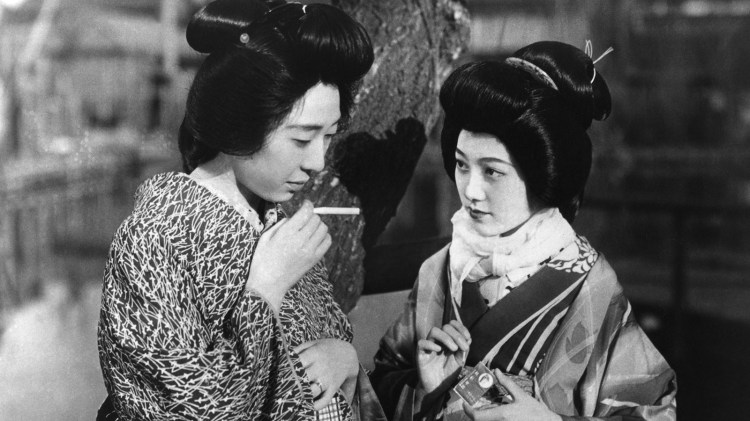
Apart From YouNaruse’s critical breakthrough came in 1933 with the intriguingly titled Apart From You (君と別れて, Kimi to Wakarete) which made it into the top ten list of the prestigious film magazine Kinema Junpo at the end of the year. The themes are undoubtedly familiar and would come dominate much of Naruse’s later output as he sets out to detail the lives of two ordinary geisha and their struggles with their often unpleasant line of work, society at large, and with their own families.
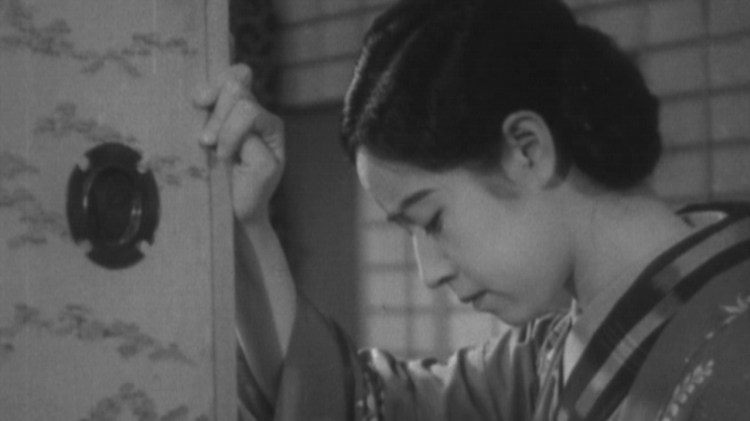
The older woman, Kikue, begins the film by asking her much younger friend and almost daughter figure, Terugiku, to pluck a grey hair from her head. Kikue also has a teenage son, Yoshio, who is becoming progressively rebellious, filled with anger and resentment over his mother’s line of work. Ignoring Kikue’s many sacrifices for him, Yoshio drinks, skips school and messes around with a gang of delinquents.

Feeling sorry for her mentor, Terugiku makes use of her good relationship with Yoshio to convince him that he should be more grateful for the kindness his mother shows him. Taking him on a trip to visit her impoverished family, Terugiku shows him the oppressive environment in which she grew up. Resenting having been sold to a geisha house to finance her drunken father’s violent outbursts, she is even more outraged that they now want to force her sister to undergo the same treatment. Terugiku is not prepared to allow this to happen and has decided to do whatever it takes to save her sister from suffering in the same way as she has had to.

Naruse highlights both the problems of the ageing geisha who sees her ability to support herself declining in conjunction with her looks, and the young one who only looks ahead to the same fate she knows will come to be her own. Both women are subjected to the humiliating treatment of their drunken clients who horse around and occasionally pull violent stunts with little to no regard for those who may even have been their wives, sisters, or daughters with a different twist of fate.

Kikue does at least have Yoshio, though their relationship is currently strained, but Terugiku has no one else to rely on. Her greatest fear is that her sister will also be sold off and have to endure the same kind of suffering as she has. In order to avoid this turn of events she agrees to undergo something far worse than even the unpleasantness of the geisha house to earn double the money in her sister’s place. She faces a future even bleaker than Kikue’s, yet in some sense it is a choice that she herself has made, actively, in sacrificing herself to save her sister.

Apart from You is much less formally experimental than either Flunky, Work Hard or No Blood Relation with its elegant, beautifully composed mise en scène. That said Naruse frames with a symbolist’s eye such as in a late scene where he shoots through the cast iron footboard of a sick bed to show the two women divided yet each imprisoned. This is a world filled with subtle violence, flashes of knives from clients and delinquents alike, raining blows from drunken fathers, and innocents wounded by misdirected arrows. Maternal love is both a force for salvation and of endless suffering but romantic love is always frustrated, ruined by practical concerns. Naruse rejects the kind of fairytale ending he succumbed to in No Blood Relation for something altogether more complex and ambiguous where there is both hope and no hope at the same time as a train departs in an atmosphere of permanent anxiety.


Apart From You is the third of five films included in Criterion’s Eclipse Series 26: Silent Naruse box set.

Clip featuring Terugiku’s visit to her family (with English subtitles)

No Blood Relation (生さぬ仲, Mikio Naruse, 1932)

No blood relationNaruse apparently directed six other films in-between Flunky, Work Hard and No Blood Relation (生さぬ仲, Nasanunaka) but we’ll likely never see any of them again. Adapting a “Shinpa” play (a new kind of Western style melodrama focusing on the real lives of everyday people), Naruse addresses a theme which later becomes central to his cinematic output – the trials and tribulations of women in contemporary society. This time we have two fully grown women tussling over the affections of a little girl who herself seems to have little input into the situation.
After a brief introductory sequence in which we witness the accidentally humorous escapades of a pair of petty crooks, we meet the sister of one of them who happens to be returning ex-pat and successful Hollywood actress, Tamae. It turns out that Tamae has come back to Japan after making her fortune in the movies hoping to reunite with the daughter she left behind six years ago.

However, her ex-husband, Atsumi, has remarried and the daughter, Shigeko, believes the second wife, Masako, is her real mother. Although the family are very happy together there is tension in the air as Atsumi’s company is running into trouble in this period of economic instability and he’s about to reveal he’s gone bankrupt. Atsumi’s mother does not take this well as she’s used to the upper middle class lifestyle and throws something of a hissy fit at being shamed in this way. Masako, by contrast, remains stoic and says she can bear the worst of what comes only she doesn’t want Atsumi to do anything illegal to try and solve their money problems and she doesn’t want to see Shigeko suffer. Her maternal feelings are further borne out when she is injured diving in front of an oncoming car which threatens to hit her daughter as she stops to pick up her doll in the middle of the road.

The problems continue pile up and Tamae uses her money as a lever to try and prise Shigeko away from her step-mother via the greedy grandma but the little girl was an infant when her birth mother left so she simply doesn’t remember Tamae and repeatedly asks to be allowed to go home to her “mother”. It’s understandable how much this would hurt Tamae who claims she’s only returned to Japan because she’s been unable to forget her daughter, yet her daughter never even knew her. If she was expecting some kind of cosmic connection it does not occur and if she truly wanted to rebuild a relationship with her child, what amounts to a virtual kidnapping was probably not the best way to go about it.

At heart it’s a tug of love between two women – the one who gave birth to a child and then abandoned it (perhaps harsh words, but no concrete reason other than a man and America are ever revealed), and the one who later raised it and came to love it as her own though shares no blood connection. Masako is the faithful Japanese wife, devoted to her family and just a very good, decent person which contrasts nicely with the ferocity of her rival – a modern woman, adulteress and movie star who thinks her money can enable her to take back what she previously gave up. For all that, it’s difficult to not to feel sorry for Tamae as her daughter continues to reject her. Even if the way she’s going about things is not sensible, her maternal emotions and the passion, desperation and even in part grief and regret are all too real.

Of course, what gets forgotten here is the plight of little Shigeko who never had any reason to believe Masako, who obviously loves her dearly, was not her real mother. Extremely confused and probably frightened, she just doesn’t understand why she’s being separated from her mum and being forced to hang out with this strange woman. Masako can’t get to see Shigeko after grandma has removed her from the house, but no one else stops to think about what sort of effect this is all having on a confused little girl who just wants to go home.

The depression is more of a backdrop here and even if Atsumi ultimately ends up feeling the brunt of it, money troubles are only a small part of the question at hand. Naruse doesn’t experiment as much as in Flunky, Work Hard but throws in a few impressive tracking sequences across open rooms and adds some rapid zooms as the two women have silent arguments over their relationships to Shigeko. Without giving too much away, the ending undercuts the degree of nuance Naruse had been trying add in ensuring that both women were drawn in a suitably complex manner, provoking sympathy and understanding for everyone caught up in this complicated situation (well, except perhaps for the bumbling crooks who are a little surplus to requirements).

The finale itself almost feels tacked on from an entirely different film with its sudden cheerfulness and abrupt closure as the original family is repaired thanks to a sudden monetary atonement and subsequent self-exile from the originally corrupting influence of the first wife. In many ways a standard melodrama of the time, No Blood Relation perhaps doesn’t have much more to recommend it than as an early example of Naruse’s development but does offer strong performances from its leading ladies and an interesting take on an age old question.


No Blood Relation is the second of five films included in Criterion’s Eclipse Series 26: Silent Naruse box set.

Flunky, Work Hard (腰弁頑張れ, Mikio Naruse, 1931)

flunky work hardMikio Naruse is often remembered for his female focussed stories of ordinary women trying to do they best they can in often difficult circumstances, but the earliest extant example of his work (actually his ninth film), Flunky, Work Hard (腰弁頑張れ, Koshiben Ganbare), is the sometimes comic but ultimately poignant tale of a lowly insurance salesman struggling to get ahead in depression era Japan.

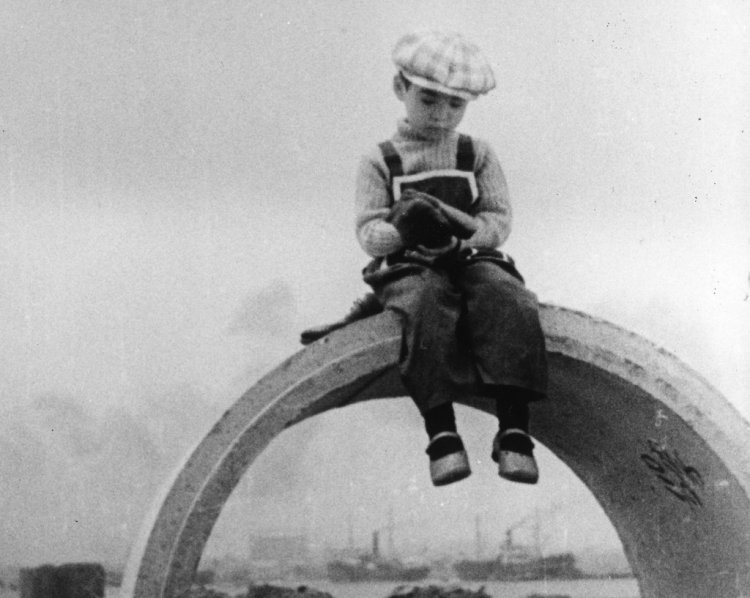
Okabe is the lowly insurance agent of the title. He works hard for his money, but there are slim pickings round here to begin with and a lot of competition from rival agents so Okabe struggles to provide for his wife and his little boy, Susumu, in the way that he would like. Okabe subjects himself any sort of humiliating behaviour on offer to try and get a contract including engaging in leap frog with a well to do lady’s children to try and seem more “friendly” than his rival broker.

Susumu, by contrast is a rebellious little boy and is aways getting into scraps with the neighbourhood kids who tease him because of his parents’ money problems. This wouldn’t usually be too much of a problem and Okabe even tells him it’s OK to defend himself when the other kids start in on him. Only this time Susumu has been fighting with the well to do lady’s sons which is going to make Okabe look bad and make it more difficult to convince her to take out a policy with his firm over another.

Okabe loses his temper and scolds the boy who runs off in anger and confusion only to get into a serious accident. His father, not knowing it’s his son that’s been injured, uses the news of a little boy getting hurt to try and convince the other mothers to take out insurance policies on their children. Later he feels bad about shouting at Susumu and decides to buy him a present, only he might already be too late…

Flunky, Work Hard starts out like the nonsense comedies Shochiku were known for at the time with a little of their common man approach thrown in, but quickly heads into melodrama territory as Susumu meets with his unfortunate destiny. This sequence is the most notable in the film as it’s far more experimental in nature than anything found in Naruse’s later work. Dipping into a montage of kaleidoscopic images, diagonal splits and the awful momentum of a train hurtling along a predetermined track only to meet with a horrifying, unexpected obstacle, this extremely complex sequence is the perfect cinematic expression of the blood draining from a father’s face as he contemplates the fact that he might have just lost his son through having lost his temper over something as trivial as a few shiny coins. Okabe is not a bad man, or even a bad father, but just another ordinary guy trying to make it through the depression. Even so, he may be about to pay a terrible price for failing to side with his son in favour of businesses prospects.

Like many silent films from this era, almost all of Naruse’s early work appears to be lost. Flunky, Work Hard is somewhat atypical when considered alongside his later career which had a strong female focus and leant more towards social commentary than the slapstick humour seen here. However, its tale of a father desperately trying to find a way to support his son in difficult economic circumstances only to find that his efforts may cost him the very thing that he was trying to protect all along is one which is instantly recognisable in any era.


Flunky, Work Hard is the first and earliest of the five films included in Criterion’s Eclipse Series 26: Silent Naruse box set.