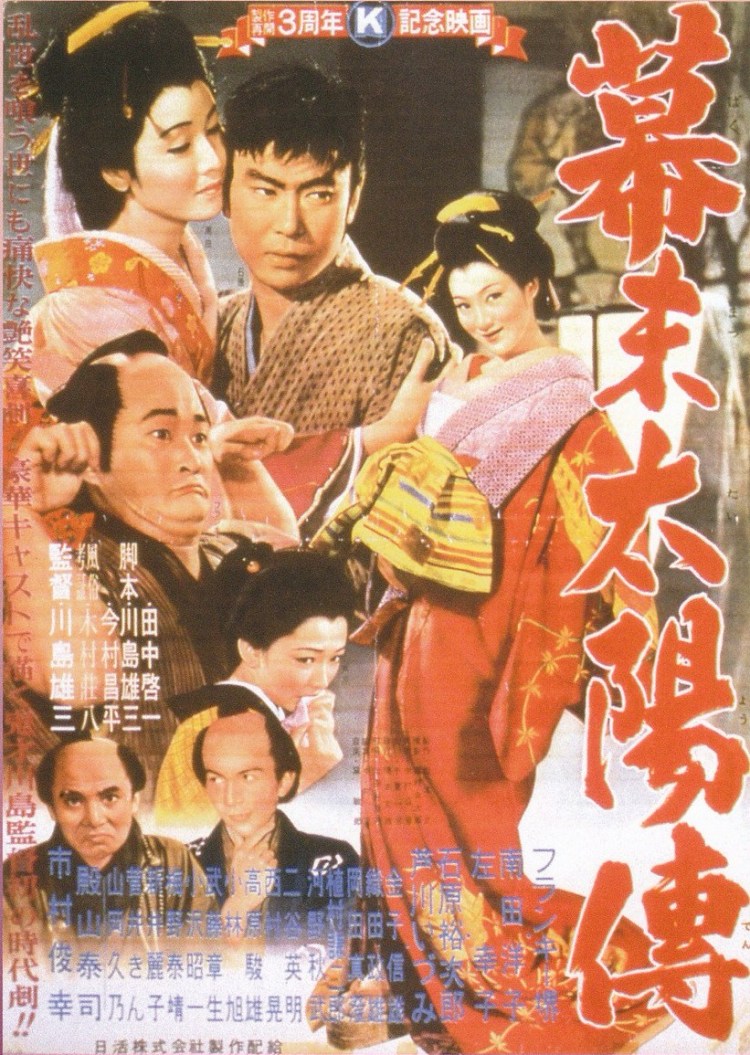
Bakumatsu Taiyoden (幕末太陽傳, Yuzo Kawashima, 1957)

bakumatsu taiyoden posterMany things were changing in the Japan of 1957. In terms of cinema, a short lived series of films known as the “Sun Tribe” movement had provoked widespread social panic about rowdy Westernised youth. Inspired by the novels of Shintaro Ishihara (later a right-leaning mayor of Tokyo), the movement proved so provocative that it had to be halted after three films such was the public outcry at the outrageous depictions of privileged young people indulging in promiscuous sex, drugs, alcohol, and above all total apathy – frivolous lives frittered away on self destructive pleasures. The Sun Tribe movies had perhaps gone too far becoming an easy source of parody, though the studio that engineered them, Nikkatsu, largely continued in a similar vein making stories of youth gone wild their stock in trade.

Yuzo Kawashima, a generation older than the Sun Tribe boys and girls, attempts to subvert the moral outrage by reframing the hysteria as a ribald rakugo story set in the last period of intense cultural crisis – the “Bakumatsu” era, which is to say the period between the great black ships which forcibly re-opened Japan to the outside world, and the fall of the Shogunate. The title, Bakumatsu Taiyoden (幕末太陽傳), literally means “legend of the sun (tribe) in the Bakumatsu era”, and, Kawashima seems to suggest, perhaps things now aren’t really so different from 100 years earlier. Kawashima deliberately casts Nikkatsu’s A-list matinee idols – in particular Yujiro Ishihara (the brother of Shintaro and the face of the movement), but also Akira Kobayashi and familiar supporting face Hideaki Nitani, all actors generally featured in contemporary dramas and rarely in kimono. Rather than the rather stately acting style of the period drama, Kawashima allows his youthful cast to act the way they usually would – post-war youth in the closing days of the shogunate.

They are, however, not quite the main draw. Well known comedian and rakugo performer Frankie Sakai anchors the tale as a genial chancer, a dishonest but kindly man whose roguish charm makes him an endearing (if sometimes infuriating) character. After a post-modern opening depicting contemporary Shinagawa – a faded red light district now on its way out following the introduction of anti-prostitution legislation enacted under the American occupation, Kawashima takes us back to the Shinagawa of 1862 when business was, if not exactly booming, at least ticking along.

Nicknamed “The Grifter”, Saiheiji (Frankie Sakai) has picked up a rare watch dropped by a samurai on his way to plot revolution and retired to a geisha house for a night of debauchery he has no intention of actually paying for. Though he keeps assuring the owners that he will pay “later” when other friends turn up with the money, he is eventually revealed to be a con-man and a charlatan but offers to work off his debt by doing odd jobs around the inn. Strangely enough Saiheiji is actually a cheerful little worker and busily gets on with the job, gradually endearing himself to all at the brothel with his ability for scheming which often gets them out of sticky situations ranging from fake ghosts to customers who won’t leave.

Saiheiji eventually gets himself involved with a shady group of samurai led by Shinshaku Takasugi (Yujiro Ishihara) – a real life figure of the Bakumatsu rebellion. Like their Sun Tribe equivalents these young men are angry about “the humiliating American treaty”, but their anger seems to be imbued with purpose albeit a destructive one as they commit to burning down the recently completed “Foreign Quarter” as an act of protest-cum-terrorism. The Bakumatsu rebels are torn over the best path for future – they’ve seen what happened in China, and they fear a weak Japan will soon be torn up and devoured by European empire builders. Some think rapid Westernisation is the answer – fight fire with fire, others think showing the foreigners who’s boss is a better option (or even just expelling them all so everything goes back to “normal”). America, just as in the contemporary world, is the existential threat to the Japanese notion of Japaneseness – these young samurai are opposed to cultural colonisation, but their great grandchildren have perhaps swung the other way, drunk on new freedoms and bopping away to rock n roll wearing denim and drinking Coca Cola. They too resent American imperialism (increasingly as history would prove), but their rebellions lack focus or intent, their anger without purpose or aim.

Kawashima’s opening crawl directly references the anti-prostitution law enacted by the American occupying forces – an imposition of Western notions of “morality” onto “traditional” Japanese culture. In a round about way, the film suggests that all of this youthful rebellion is perhaps provoked by the sexual frustration of young men now that the safe and legal sex trade is no longer available to them – echoing the often used defence of the sex trade that it keeps “decent” women, and society at large, safe. Then again, the sex trade of the Bakumatsu era is as unpleasant as it’s always been even if the familiar enough problems are played for laughs – the warring geisha, the prostitute driven in desperation to double suicide, the young woman about to be sold into prostitution against her will in payment of an irresponsible father’s debt, etc. One geisha has signed engagement promises with almost all her clients – it keeps the punters happy and most of them are meaningless anyway. As she says, deception is her business – whatever the men might say about it, it’s a game they are willingly playing, buying affection and then seeming hurt to realise that affection is necessarily false and conditional on payment of the bill.   

Playing it for laughs is, however, Kawashima’s main aim – asking small questions with a wry smile as Saiheiji goes about his shady schemes with a cleverness that’s more cheeky than malicious. He warns people they shouldn’t trust him, but in the end they always can because despite his shady surface his heart is in the right place. Warned he’ll go to hell if he keeps on lying his way though life, Saiheiji laughs, exclaims to hell with that – he’s his own life to live, and so he gleefully runs away from the Bakumatsu chaos into the unseen future.


Masters of Cinema release trailer (English subtitles)

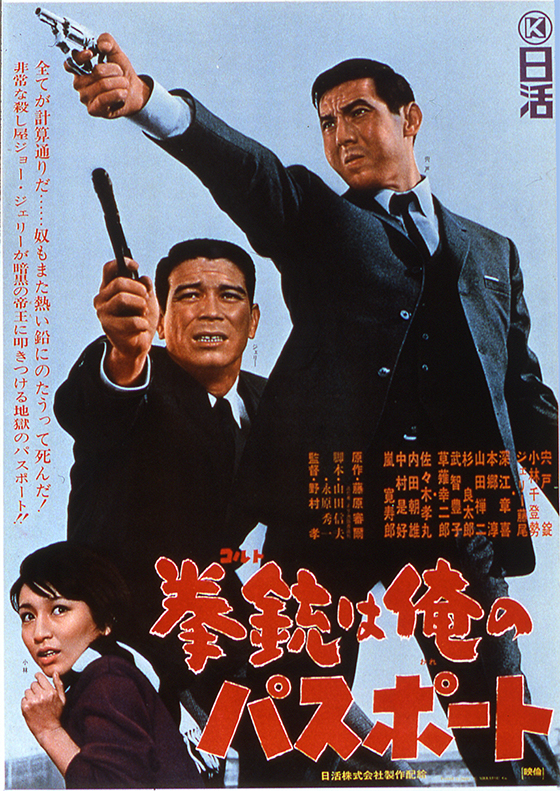
A Colt is My Passport (拳銃は俺のパスポート, Takashi Nomura, 1967)

colt is my passport posterJo Shishido played his fare share of icy hitmen, but they rarely made it through such seemingly inexorable events as the hero of Takashi Nomura’s A Colt is My Passport (拳銃は俺のパスポート, Colt wa Ore no Passport). The actor, known for his boyishly chubby face puffed up with the aid of cheek implants, floated around the lower end of Nikkatsu’s A-list but by 1967 his star was on the wane even if he still had his pick of cooler than cool tough guys in Nikkatsu’s trademark action B-movies. Mixing western and film noir, A Colt is My Passport makes a virtue of Japan’s fast moving development, heartily embracing the convenience of a society built around the idea of disposability whilst accepting the need to keep one step ahead of the rubbish truck else it swallow you whole.

Kamimura (Joe Shishido) and his buddy Shiozaki (Jerry Fujio) are on course to knock off a gang boss’ rival and then get the hell out of Japan. Kamimura, however, is a sarcastic wiseguy and so his strange sense of humour dictates that he off the guy while the mob boss he’s working for is sitting right next to him. This doesn’t go down well, and the guys’ planned airport escape is soon off the cards leaving them to take refuge in a yakuza safe house until the whole thing blows over. Blowing over, however, is something that seems unlikely and Kamimura is soon left with the responsibility of saving both his brother-in-arms Shiozaki, and the melancholy inn girl (Chitose Kobayashi) with a heart of gold who yearns for an escape from her dead end existence but finds only inertia and disappointment.

The young protege seems surprised when Kamimura tosses the expensive looking rifle he’s just used on a job into a suitcase which he then tosses into a car which is about to be tossed into a crusher, but Kamimura advises him that if you want to make it in this business, you’d best not become too fond of your tools. Kamimura is, however, a tool himself and only too aware how disposable he might be to the hands that have made use of him. He conducts his missions with the utmost efficiency, and when something goes wrong, he deals with that too.

Efficient as he is, there is one thing that is not disposable to Kamimura and that is Shiozaki. The younger man appears not to have much to do but Kamimura keeps him around anyway with Shiozaki trailing around after him respectfully. More liability than anything else, Kamimura frequently knocks Shiozaki out to keep him out of trouble – especially as he can see Shiozaki might be tempted to leap into the fray on his behalf. Kamimura has no time for feeling, no taste for factoring attachment into his carefully constructed plans, but where Shiozaki is concerned, sentimentality wins the day.

Mina, a melancholy maid at a dockside inn, marvels at the degree of Kamimura’s devotion, wishing that she too could have the kind of friendship these men have with each other. A runaway from the sea, Mina has been trapped on the docks all her adult life. Like many a Nikkatsu heroine, love was her path to escape but an encounter with a shady gangster who continues to haunt her life put paid to that. The boats come and go but Mina stays on shore. Kamimura might be her ticket out but he wastes no time disillusioning her about his lack of interest in becoming her saviour (even if he’s not ungrateful for her assistance and also realises she’s quite an asset in his quest to ensure the survival of his ally).

Pure hardboiled, A Colt is My Passport is a crime story which rejects the femme fatal in favour of the intense relationship between its two protagonists whose friendship transcends brotherhood but never disrupts the methodical poise of the always prepared Kamimura. The minor distraction of a fly in the mud perhaps reminds him of his mortality, his smallness, the fact that he is essentially “disposable” and will one day become a mere vessel for this tiny, quite irritating creature but if he has a moment of introspection it is short lived. The world may be crunching at his heels, but Kamimura keeps moving. He has his plan, audacious as it is. He will save his buddy, and perhaps he doesn’t care too much if he survives or not, but he will not go down easy and if the world wants a bite out of him, it will have to be fast or lucky.


Original trailer (no subtitles)

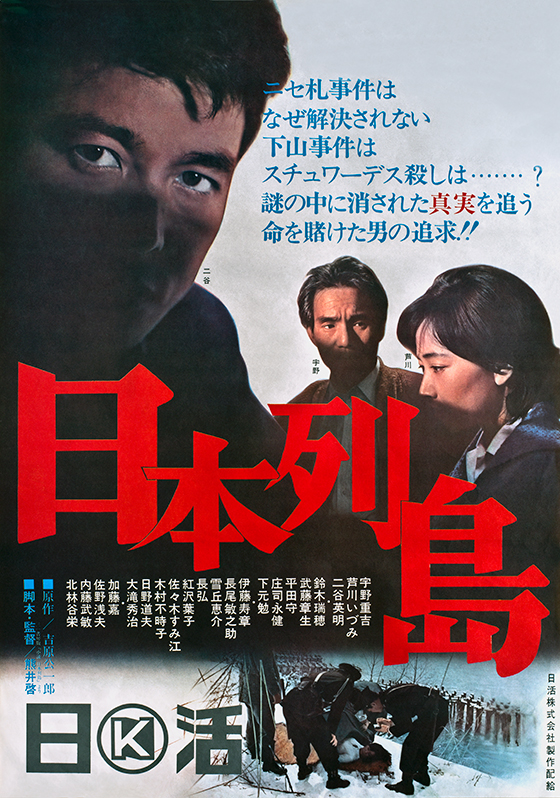
A Chain of Islands (日本列島, Kei Kumai, 1965)

nihon retto posterKei Kumai made just 19 films films in his 40 year career, but even since his earliest days he ranked among the most fearless of directors, ready to confront the most unpleasant or taboo aspects of contemporary Japan. His first film, The Long Death, interrogated wartime guilt through drawing inspiration from a real life 1948 mass poisoning case in which materials manufactured in a Manchurian lab may have led to the deaths of post-war civilians. Having begun in this possibly controversial vein, Kumai pressed on with 1965’s A Chain of Islands (日本列島, Nihon Retto, AKA The Japanese Archipelago) which he set in 1959 as Japanese youth protested the renewal of the ANPO treaty which placed Japan under the military protection of the American Armed forces in return for allowing the presence of those forces on Japanese soil.

Despite the contemporary setting Kumai opens with a explanatory voice over detailing the depth of the American military presence and the function of the CID which exists solely to investigate crimes committed by American servicemen. The CID is staffed by both Americans and Japanese nationals who, the voiceover explains, often feel conflicted in stepping onto American soil each morning as prolonged exposure gradually erodes their sense of difference and finally of “Japaneseness”. Akiyama (Jukichi Uno) is a translator/investigator at CID and he’s about to be handed an unusual request from his boss – reopen a cold case from the previous summer in which an American Sergeant was found floating in Tokyo bay. Akiyama’s new boss was a friend of the late soldier and would like to know what happened.

Akiyama’s investigations lead him down a dark path of corruption, murder, conspiracy, and governmental complicity. Beginning to investigate the case, Akiyama discovers that nothing is quite as it seems. A couple of policeman from the original investigation arrive to help him and echo their frustrations with the way the case was handled. Despite the police investigation, the American authorities did their best to interfere – commandeering the body and claiming jurisdiction in contravention of Japan’s standing as a sovereign nation. The Americans are no longer occupying forces but honoured guests who should obey international protocol in cases like these, but they rarely do. Despite the existence of the CID, crimes by American servicemen are generally covered up as the military insists the matter will be dealt with internally only for suspects to be suddenly “transferred” overseas.

Sgt. Limit was, however, one of the good ones and Akiyama’s investigation seems to point towards a murder and cover up instigated because Limit had got too close to the truth in investigating a sudden flood of counterfeit cash. The Americans, to the surprise of all, are only the middle man in the grand conspiracy which leads right back to the dark heart of Japan and the vast spy networks operated during the militarist era. As might be expected, these valuable networks are left wide open with the collapse of Japanese fascism but are perfectly primed to facilitate widespread crime spanning the Asian world and all with the tacit approval of the American and Japanese states.

Kumai also implicates the spy ring in a series of “mysterious” rail incidents, but makes sure to reserve some of his ire more the more usual injustices. Akiyama is caring for his young nephew whose father was killed in mining explosion which has claimed the lives of nearly every young man in the village leaving his sister unable to cope with her children alone. He is also battling a personal tragedy which is intensely connected to his decision to join CID which is currently inundated with cases of rape and murder in which American servicemen are implicated. The “foreign” becomes suspect but mostly for its hypocrisy as in the Catholic priest who becomes a major suspect in subverting the legitimate devotion of a Godly woman who only sought to live under the Christian teachings of love and kindness, while the American forces claim to stand for honour and justice but actively facilitate organised crime at an interstate level to further the progress of Capitalism whilst also facilitating civil unrest in volatile nations for financial and political gains.

That all of this happens immediately before the renewal of the ANPO treaty is no coincidence and Kumai even includes aerial footage of the mass protests filling the streets around the Diet building as the youth of Japan question why their nation has seen fit to make itself so complicit in the questionable foreign policy of another country. The outcome looks bleak for our protagonists who discover themselves to be mere pawns at the mercy of greater forces which cannot be circumvented or denied, but just as it all looks hopeless a new hope arises. Pledging to fight harder and continue the work which has been started, those left behind dedicate themselves to equipping the young with the tools to build a happier, fairer world in contrast to the one they seem primed to inherit from those who should know better. The final sequence shows us a young woman walking gloomily past the Diet building which seems to be looming over her as a veritable symbol of oppression but then her face brightens, her step quickens and she leaves the Diet far behind to walk forward towards the work which awaits her. 


A comprehensive overview of the 1960 ANPO protests.

Lost Chapter of Snow: Passion (雪の断章 情熱, Shinji Somai, 1985)

Lost-Chapter-of-Snow-Passion dvd coverShinji Somai’s work is most closely identified with depictions of contemporary young people who meet their approaching adulthood with an almost nostalgic melancholy but in Lost Chapter of Snow: Passion (雪の断章 情熱, Yuki no Dansho: Jonetsu), he takes things one step further as his orphaned heroine moves through dependence to independence and finally assumes her own identity. Based on a novel by Marumi Sasaki, Lost Chapter also fits neatly into the idol movie subgenre, starring the then popular singer and actress Yuki Saito who sings frequently throughout the film and provides the end titles theme Jonetsu (Passion).

As the film opens, seven year old orphan Iori (Mami Nakazato) has been adopted by the wealthy but cruel Naba family who regard her as a slave, to be beaten, humiliated and pressed into service. One day, an employee of Naba’s, Yuichi (Takaaki Enoki), visits and witnesses Iori’s cruel treatment at the hands of oldest sister Sachiko (Kyoko Fujimoto), immediately taking her home to live with him. The situation is difficult, especially as Iori’s past has led her to be wary of new connections, and her sudden arrival has also placed a strain on Yuichi’s engagement to a girl still living in Tokyo far away from snowy Sapporo. Ten years pass and Iori (Yuki Saito) has become a happy, healthy high school girl but the resurfacing of the Naba sisters in her life is to have profound consequences when one of them is murdered and Iori finds herself regarded as a prime suspect.

Embracing its almost Dickensian roots, Lost Chapter’s most obvious theme is the place, or displacement, of the orphaned within Japanese society which places the family above all else. Iori’s origins are never mentioned beyond her early life in an orphanage, but even when Yuichi brings her home the first words the housekeeper offers are that a discarded child like Iori maybe trouble, assuming that she is the result of a “loose woman’s” weakness and irresponsibility. The Nabas, who are a thoroughly unpleasant bunch ruled over by older sister Sachiko, have adopted her despite being an already large family but raising a lonely child in love was not their aim so much as getting a kitchen maid they wouldn’t have to pay. Iori is sent out on pointless errands through the snow and freezing air only to fear she will be beaten for having drunk the juice she was sent to buy on Sachiko’s behalf. This fate is not unique to Iori as she discovers when Daisuke (Kiminori Sera), a friend of Yuichi’s who has become like a second father to her, reveals his orphan past as a poor relation sheltered by family members but not quite embraced by them.

Iori’s poor treatment at the Naba’s is offered as a possible motive for the murder of Hiroko (Mai Okamoto) – younger sister to Sachiko and a student in the same class as Iori. Hiroko is fairly depressed and a flighty girl, still cruel and eager to show off in front of her former step-sister with a lengthy dance sequence offered in front of the hottest boys at school. When she dies suddenly, all evidence points to a cup of coffee Iori tried to take her in kindness but even if it wasn’t Iori who plotted to kill her, Hiroko’s death is still firmly linked to her family’s cruel superiority.

The strain of the investigation plays on Iori’s mind, forcing her into a deeper consideration of her place within Yuichi’s household especially as she’ll soon be approaching the crossroads of adulthood and will need to decide whether to go on to university or leave Yuichi’s house to be independent. In the housekeeper’s mind, staying at “home” is not an option once she could, theoretically, support herself but Yuichi and Daisuke may feel quite differently about this damaged little girl they once took in and are still in the process to turning into a fine young woman. Yuichi’s housekeeper has a choice metaphor regarding Yuichi’s intentions in rescuing Iori – pointing to a withered flower, she suggests that Iori was a thirsty seed that Yuichi has been patiently watering in order to see the flowers bloom, but this way of viewing the situation places a further wedge between Iori and Yuichi who is still seeing his fiancée in Tokyo while Iori’s feelings about the father figure who raised her but is also still a handsome, kind, and youngish man have begun to become confused.

Falling into shojo romance territory, Lost Chapter does indeed become a slightly uncomfortable romantic tale in which a young woman falls in love with her “father” and he with her though, as they aren’t blood related, it can still be depicted as sweet and innocent rather than a tale of long term grooming and inappropriate power structures. Yuichi, though obviously a kind and socially minded young man, is nevertheless as “irresponsible” as he’s branded in his neglect of his longterm fiancée (who later makes an embarrassing first visit in nine years to Yuichi’s home to ask Iori to back off and finally declare herself grown up so she and Yuichi can marry), and later positing of Iori as some kind of pet project in his determination to have her graduate university – a feather in his cap rather than a stepping stone to a middle-class life for his precious daughter.

Known for his long, roaming, handheld takes Somai opens with a 14 minute seemingly unbroken, dreamlike sequence recounting Iori’s life with the Nabas and her eventual rescue. Somai’s camera pans around a series of snow trenches, placing a phone call from Tokyo right inside the icy space alongside a hidden violin player scoring the action. Shot with the random, etherial quality of memory mixed with dream, this first sequence gives way to a more conventional main body even if Somai maintains his preference for long takes filled with surprising pans and unexpected entrances into the frame. There are great moments of tenderness and warmth in Iori’s story, brought to life by Somai’s noticeably expressionist techniques, but there’s pain and darkness too as death and suicide lurk in the background, ready to strike at any moment. A beautifully surreal, theatrical exploration of a standard coming of age tale Lost Chapter is both shojo romance at its most controversial and a fine showcase for a popular idol shining in a leading role.


Originally released as a double header with Nobuhiko Obayashi’s Four Sisters.

14 minute long take intro (no subtitles)

Yuki Saito singing Jonetsu on a Japanese TV show presumably around the time of the film’s release.

https://www.youtube.com/watch?v=gbR79Yax8R0

My Second Brother (にあんちゃん, Shohei Imamura, 1959)

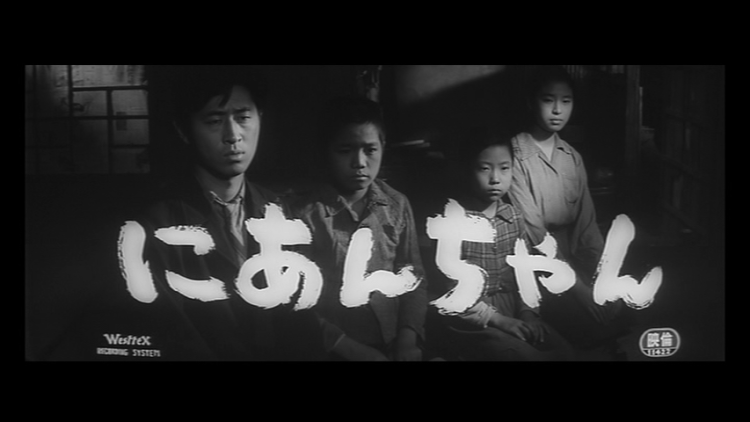
vlcsnap-2017-01-07-22h53m01s073Like most directors of his era, Shohei Imamura began his career in the studio system as a trainee with Shochiku where he also worked as an AD to Yasujiro Ozu on some of his most well known pictures. Ozu’s approach, however, could not be further from Imamura’s in its insistence on order and precision. Finding much more in common with another Shochiku director, Yuzo Kawashima, well known for working class satires, Imamura jumped ship to the newly reformed Nikkatsu where he continued his training until helming his first three pictures in 1958 (Stolen Desire, Nishiginza Station, and Endless Desire). My Second Brother (にあんちゃん, Nianchan), which he directed in 1959, was, like the previous three films, a studio assignment rather than a personal project but is nevertheless an interesting one as it united many of Imamura’s subsequent ongoing concerns.

Set in the early 1950s, the film focuses on four children who find themselves adrift when their father dies leaving them with no means of support. The father had worked at the local mine but the mining industry is itself in crisis. Many of the local mines have already closed, and even this one finds itself in financial straits. Despite the foreman’s promise that he will find a job for the oldest son, Kiichi (Hiroyuki Nagato), there is no work to be had as workers are being paid in food vouchers rather than money and strike action frustrates what little production there is. After receiving the unwelcome suggestion of work in a “restaurant” in another town, Yoshiko (Kayo Matsuo) manages to find a less degrading job caring for another family’s children (though she receives only room and board, no pay for doing so). With younger brother Koichi (Takeshi Okimura) and little sister Sueko (Akiko Maeda) still in school, it seems as if the four siblings’ days of being able to live together as a family may be over for good.

Based on a bestselling autobiographical novel by a ten year old girl, My Second Brother is one of the first films to broach the Zainichi (ethnic Koreans living in Japan) issue, even if it does so in a fairly subtle way. The four children have been raised in Japan, speak only Japanese and do not seem particularly engaged with their Korean culture but we are constantly reminded of their non-native status by the comments of other locals, mostly older women and housewives, who are apt to exclaim things along the lines of “Koreans are so shiftless” or other derogatory aphorisms. Though there are other Koreans in the area, including one friend who reassures Kiichi that “We’re Korean – lose one job, we find another”, the biggest effect of the children’s ethnicity is in their status as second generation migrants which leaves them without the traditional safety net of the extended family. Though they do have contact with an uncle, the children are unable to bond with him – his Japanese is bad, and the children are unused to spicy Korean food. They have to rely first on each other and then on the kindness of strangers, of which there is some, but precious little in these admittedly difficult times.

In this, which is Imamura’s primary concern, the children’s poverty is no different from that of the general population during this second depression at the beginning of the post-war period. The film does not seek to engage with the reasons why the Zainichi population may find itself disproportionately affected by the downturn but prefers to focus on the generalised economic desperation and the resilience of working people. The environment is, indeed, dire with the ancient problem of a single water source being used by everyone for everything at the same time with all the resultant health risks that poses. A young middle class woman is trying to get something done in terms of sanitation, but her presence is not altogether welcome in the town as the residents have become weary of city based do-gooders who rarely stay long enough to carry through their promises. The more pressing problem is the lack of real wages as salaries are increasingly substituted for vouchers. The labour movement is ever present in the background with the Red Flag drifting from the mass protests in which the workers voice their dissatisfaction with the company though the spectre of mine closure and large scale layoffs has others running scared.

One of the most moving sequences occurs as Koichi and another young boy ride a mine cart up the mountain and talk about their hopes for the future. They both want to get out of this one horse town – Koichi as a doctor and his friend as an engineer, but their hopes seem so far off and untouchable that it’s almost heartbreaking. Sueko skipped school for four days claiming she had a headache because her brother didn’t have the money for her school books – how could a boy like Koichi, no matter how bright he is, possibly come from here and get to medical school? Nevertheless, he is determined. His father couldn’t save the family from poverty, and neither could his brother but Koichi vows he will and as he leads his sister by the hand climbing the high mountain together, it almost seems like he might.