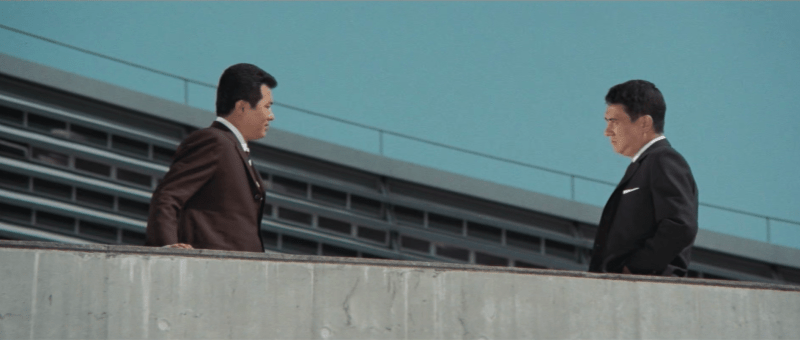
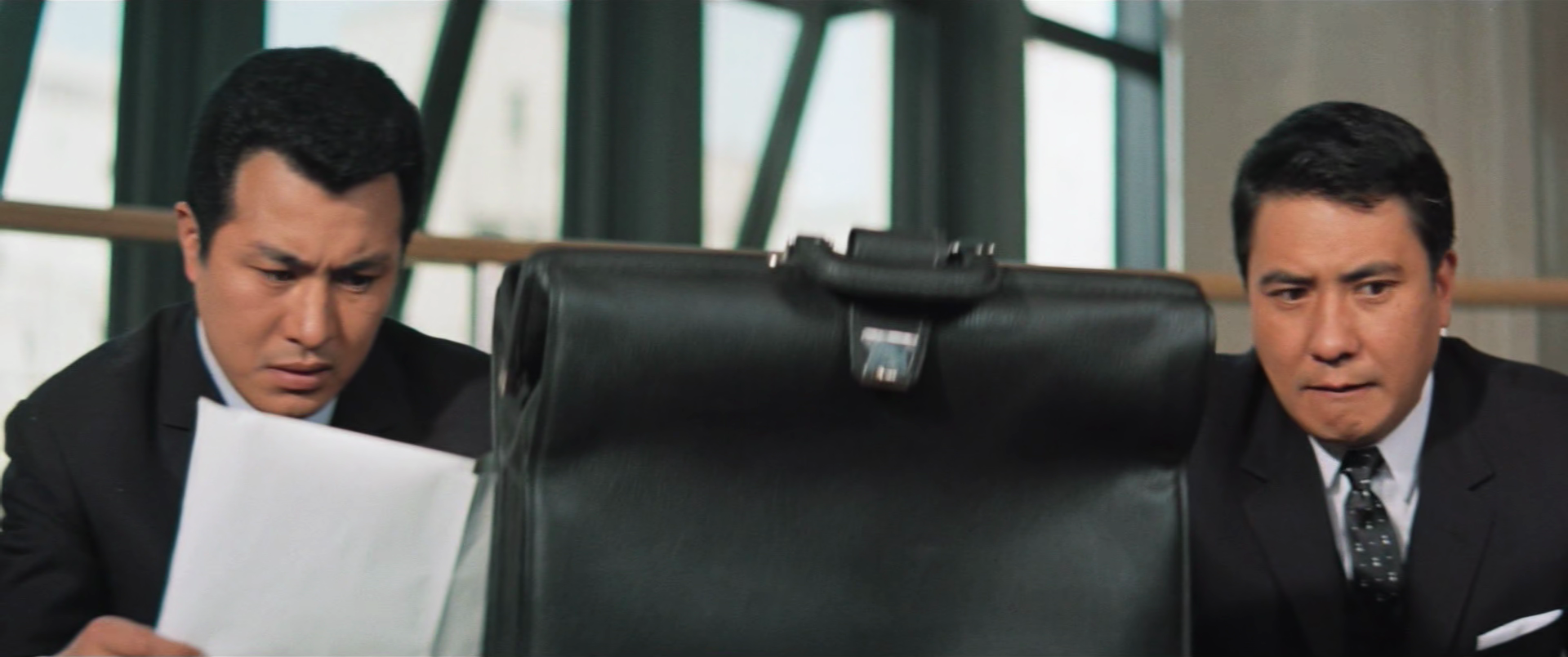
The Fort of Death (五人の賞金稼ぎ, Eiichi Kudo, 1969)

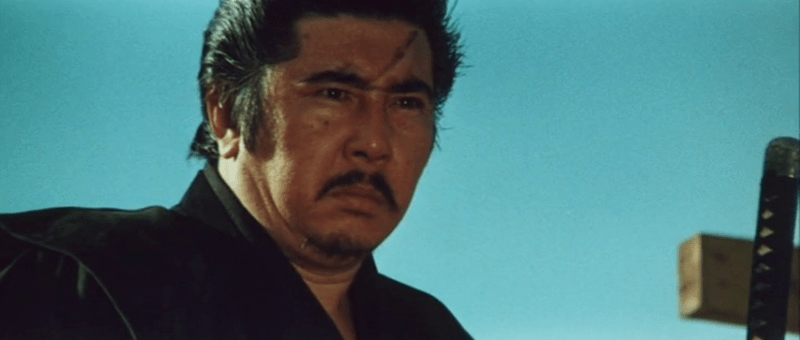
Shikoro Ichibei (Tomisaburo Wakayama) returns yet this time seemingly on the opposite side in the second in the Bounty Hunter series, The Fort of Death (五人の賞金稼ぎ, Gonin no Shokin Kasegi) this time directed by Eiichi Kudo. If the first film had been an Edo-era take on James Bond, the second is very much Spaghetti Western and feudal tragedy as Ichibei finds himself coming to, if not quite the rescue of the oppressed farmers, then at least moral support in taking stand against corrupt and self-interested lords.

This might be surprising in that in the first film Ichibei had been a shogunate spy and seemingly close friend of the man himself, yet this time around he’s working as a doctor while taking bounty hunter jobs to earn extra money to support the poor people who come to him for help. Like a true western hero, he has a small posse which includes the ninja lady, Kagero (Tomoko Mayama), from the first film only she’s being played by the actress who previously starred as his other love interest. In any case, he’s approached by a young man from a small village which is making a last-ditch appeal to the local lord to lower their tax burdens so they don’t all starve, though so far the lord’s response has been to add additional taxes and kill people for not paying them. 

On his arrival, Ichibei soon realises that the man who recommended him was actually the leader of the government forces during a previous peasant uprising at which Ichibei had also tried to help the farmers. In that case, Bessho (Shin Tokudaiji) had won, but it didn’t do him any good. His clan was dissolved and he became a wanderer, taken in by the village and now indebted to them, hoping Ichibei can help but fully aware of the brutality with which such challenges to the feudal order are put down. 

The lord later suggests it’s not really his fault. He has to curry favour with Edo to protect the domain, which is why he agreed to participate in a construction project that led him to confiscate all of his farmers’ rice and wheat. But then it’s also true that he is vain, and cruel. On realising the village has hired a man like Ichibei, some of the retainers suggest reopening negotiations but others complain that they must now crush the farmers or face ruin themselves while trying to ensure the strife in their domain does not come to the attention of the government in Edo. 

Part of their problem is that Ichibei simply has better technology in the form of gatling guns. Tying into the western themes, Ichibei is well versed in the use of firearms, while the samurai are mostly reliant on traditional weaponry such as arrows and swords. The lord later insists on using some canons, but is oblivious to the risk as the shogun has banned the use of gunpowder and using them may end up bringing him to his attention and thereby landing him in a lot of possible fatal trouble. 

In any case, it’s the villagers who suffer. Ichibei encounters a woman who has lost her mind, refusing to give up her baby who has died of malnutrition while her husband was executed for non payment of taxes. Meanwhile, some of the other ronin they hired attempt to rape a villager, and a young couple are prevented from marrying because the headman is worried that it would send the wrong message in a time so much strife. Then again, a woman basically attempts to rape Ichibei, descending on him while he’s still asleep which otherwise leads into a fairly comic sequence in which Ichibei must fight of a bunch of ninjas intent on stealing the gatling gun while dressed only his underwear.

Darkly comic it may be, but also surprisingly violent with a ninja at one point using a dead body as a Molotov cocktail not to mention the severed heads and limbs of the battle scenes. Ichibei is fully aware that the battle is a forlorn hope, but also that the villagers have no choice and perhaps this is better for them than simply accepting their fate and starving to death. Even so, he reserves his final words for the Edo inspector who arrives only when the battle is done to survey the scene, berating him that he ought to know what happened here from looking at the battlefield and deducing that this domain has not been run particularly well. It’s a tragedy of feudalism that provokes a tearful rage from the compassionate bounty hunter trying his best to heal the sickness in his society, though perhaps like the patient who visits him with a venereal complaint concluding the best solution is to cut it right off.


Eleven Samurai (十一人の侍, Eiichi Kudo, 1967)

“If no one denounces the absurdity of this world, then our descendants will keep suffering,” a soon-to-be ronin insists in Eiichi Kudo’s revengers tragedy, Eleven Samurai (十一人の侍, Juichinin no Samurai). It seems clear from the outset that their actions will have little effect no matter whether they succeed or fail because the enemy is feudalism which may be approaching the end of its life but is definitely not dead yet. They can at least attempt to avenge their clan even if they can’t save it while refusing to let an entitled, selfish lord get away doing whatever he likes just because he happens to be the son of the former shogun and brother of the current one.

The opening scenes see Nariatsu (Kantaro Suga) chasing a deer having declared himself a “real hunter”. He ignores the cries of his men to watch where he’s going and sails over the border into the territory of Oshi which amounts to an invasion seeing as he is armed and has no permission to be there. The deer gets away, but Nariatsu shoots an old woodcutter whom he felt to be in his way with his bow and arrow. The Lord of the Abe clan that rules Oshi immediately takes him to task and tells Noriatsu that his behaviour is unbecoming for the son of the former shogun. He’s committed a murder in their territory, but they’re prepared to let it go as long as he leaves as soon as possible. But Nariatsu doesn’t like being told what to do and simply shoots the lord in the eye, potentially sparking a diplomatic incident. 

The Abe clan try to lodge a complaint in Edo, but are shut down by courtier Mizuno (Kei Sato) who fears that to acknowledge an event such as this would damage the moral authority of the Tokugawa regime. He decides to cover the whole thing up by claiming it was the Abe clan who insulted Noriatsu. The Abe clan will then be dissolved, and Oshi essentially gets nationalised. All of which suits Nariatsu just fine because he wants to take control of Oshi and expand his territory anyway. Part of his petulance seems to stem from the fact that he feels hard done by with such a small inheritance when his brother became the Shogun and received multiple fiefdoms. The previous Shogun, Tokugawa Ieyoshi, had produced an unusual number of children which became quite a problem in that he had to find lands for them all and eventually hastened the demise of the shogunate because of the additional strain. 

But Nariatsu is also an overgrown child who has no idea how to do anything for himself and no concern for the feelings or fortunes of others. When instructed to do something he doesn’t want to, Nariatsu petulantly stamps his feet and complains, and when his actions are challenged he simply replies that he’ll be telling his father. In fact, he is so infuriating that it’s likely most of his men secretly want him dead too, including his chief adviser Gyobu (Ryutaro Otomo) who was once the General Inspector but is now expected to babysit this absolute buffoon. Even though Nariatsu knows the Abe clan will be trying to kill him, he still sneaks out to the red light district and gets blind drunk with geisha which in itself is conduct unbecoming for a high ranking samurai such as himself. 

As such, he represents almost everything that’s wrong with the feudal order while Mizuno represents the rest. It’s Mizuno that secretly plots against the plotters, manipulating them into giving up their assassination mission by claiming to have switched sides only to backtrack and reveal he’s actually still working for Nariatsu fearing a reputational loss for the Tokugawa. Chief revenger Hayato (Isao Natsuyagi) is also banking on this fear of reputational damage, certain that the Shogunate won’t be able to bear the humiliation of Nariastsu being killed by a ronin so will instead claim that he died from an illness. Vowing to avenge the clan, Hayato righteously gives up his position to become one so that the Abes won’t be linked to the crime and is joined by 10 more similarly annoyed samurai. Six of them are already “dead” having been asked to commit seppuku for recklessly attacking Nariatsu on their own and blowing the whole operation. 

Hayato at least believes this to be a suicide mission. He leaves his loving wife and home and allows people to think he’s run off with Nui (Eiko Okawa), the younger sister of one of their number who died before he could join them. They do this because they think it must be done, and also because if no one stands up to samurai oppression it will never end. Wandering peasant Daijuro (Ko Nishimura) agrees with them. He wants revenge on the samurai for raping his sister after which his father and brother took their own lives. Nariatsu is as good as anyone else and he does very much need to die. 

But despite Daijuro’s homemade cannons, nothing quite goes to plan. Kudo sets his final battle in an atmospheric, misty valley that is an obvious stand in for the underworld. Hayato may succeed in killing Nariatsu but it’s a pyrrhic victory. Though he vowed “to put an end to this ridiculous world,” a samurai cannot really win this battle. It’s Daijuro who eventually walks off with Nariatsu’s head, symbolically decapitating the shogunate which the closing titles confirm was mortally wounded by this incident. With his striking black and white cinematography, Kudo does indeed paint this samurai world as a hellish place ruled over by an infinitely corrupt and self-interested authority. The nihilistic futility of it all is emphasised by the figure of a grown man sitting like a small child and splashing his sword in a puddle while surrounded by dead bodies. There might be a way out of this, but not for the samurai, only for those who will come after and perhaps finally be free of this world’s absurdity.


Castle of Owls (忍者秘帖 梟の城, Eiichi Kudo, 1963)

A surviving member of the Iga clan swears vengeance on Toyotomi Hideyoshi only to slowly come to the realisation that the best revenge is living well in Eiichi Kudo’s ninja drama, Castle of Owls (忍者秘帖 梟の城, Ninja Hicho: Fukuro no Shiro). Adapted from the novel by Ryotaro Shiba, the film is somewhat unusual in its positivity in allowing its hero to first reject the codes by which he was raised and then those of the prevailing times in eventually choosing love and happiness over the internecine obligation to gain vengeance against a corrupt social order.

Hoping to solidify his grip on power, Oda Nobunaga has his right-hand man Toyotomi Hideyoshi massacre the Iga clan of ninjas who are then almost entirely wiped out. Juzo (Ryutaro Otomo) and his friend Gohei (Minoru Oki) both survive, but Juzo’s entire family is brutally murdered while his sister takes her own life after being gang raped by Hideyoshi’s soldiers, using her final breath to tell her brother to avenge her. Overwhelmed by grief, Juzo is chastised by veteran ninja Jiroza (Kensaku Hara) for his show of emotion. He reminds him that a ninja should be as unbreakable as stone and that he should abandon all human sentiment. Juzo, however, insists that he may be a ninja but is also human and refuses to apologise for his feelings. 

This is it seems the major conflict. Jiroza has already signalled his own heartlessness and practicality when he advised the surviving ninja to flee, for escape is less dishonourable than death. Those who refuse are welcome to surrender, and those who cannot run must be left behind to their fate. For Jiroza, all that matters is survival for both himself and his small daughter Kizaru (Chiyoko Honma) who is currently tied to his back (no mention is made of her mother, perhaps she had already passed away). Now that his family are dead, Juzo has a new mission and reason for survival insisting that what the living can do for the dead is vengeance, though in his case it is personal rather than principled for he mostly wanted revenge for his sister rather than the Iga clan as a whole or anything it represents which he otherwise seems to be at odds with. 

10 years later, Oda Nobunaga has already been bumped off in an act of betrayal by one of his own men leaving Toyotomi Hideyoshi in charge and now the target for Juzo’s revenge. Around this time, Hideyoshi is planning an invasion of Korea against the advice of most of his courtiers in order to legitimise his rule through imperial ambition and military dominance. Juzo has been trying to assassinate him, and has apparently failed five times already. A surprise visit from Jiroza and his now teenage daughter involves a job opportunity promising a monetary reward should he succeed, but Juzo is wary. The merchant who hires him says he wants Hideyoshi out of the way because a war in Korea will damage his business prospects, but as Juzo points out Hideyoshi’s death will leave a power vacuum resulting in another civil war. The merchant, however, giggles childishly and remarks that domestic wars are good for business, leading Juzo to suspect he’s here on behalf of Tokugawa Ieyasu, the most likely to assume power in the event of Hideyoshi’s death.

The irony is though Juzo very definitely wants Hideyoshi dead, when someone else suggests it he becomes conflicted because he knows it will lead to another period of chaos in which even more people will die. Meanwhile, a ninja’s allegiance should belong to his client, who is always the highest bidder, so this is both a win-win situation and a mild conflict of interest. Conversely, Gohei (Minoru Oki), who was betrothed to Kizaru, has apparently betrayed the clan and taken a position as a retainer for one of Hideyoshi’s lords. He agrees to betray the Iga, inform on the plan to assassinate Hideyoshi, and even bring in Juzo in return for a 300-koku stipend and a shot of advancement under the new regime.

Now, on one level this might be understandable. Japan has emerged from a couple of hundred years of constant warfare, there’s no place for ninja in a world of peace as former Iga man Mimi (Tokue Hanasawa) remarks revealing that he’s survived the last 10 years through begging. It’s also understandable given that a ninja is expected to be duplicitous and act in self-interest. Even Juzo applaud’s Jiroza’s ninjutsu on realising that he’s teamed up with Gohei to betray him in order to take out the leader of the Koga ninjas. In essence, he’s only really done what Juzo later does but also the opposite in choosing his individual happiness through betraying those around him to throw his lot in with the person who murdered his entire clan. 

Juzo meanwhile is shaken by his unexpected attraction to female ninja Kohagi (Hizuru Takachiho), a daughter of the Koga,  who like him finds herself conflicted in her mission because of her growing affection for Juzo. Kohagi asks him if they really have to live on hate when they could live happily together instead, but even while conflicted Juzo can’t bring himself to let go of the idea of vengeance and is haunted by images of his friends and family dying. Even so, having decided to give up on a happy future and risk his life to kill Hideyoshi he finds that it ceases to matter. Confronting him, his hatred melts away. He begins to recognise the futility of revenge and that it would be silly to cause a war and make a merchant rich to prove a point. Gohei, meanwhile, pays a heavy price for his choices when his lord disowns him. Even when Juzo comes to rescue him from jail, he laughs that he’s caught him at last. Having escaped from the Iga life to live in the sun, he finds himself in darkness once again. Juzo, however, rides off into the sunshine with Kohagi to live in peace that’s divorced from the wider world. They choose to exile themselves from this world of darkness and duplicity, to live freely in the sunlight rather than be consumed by the internecine codes by which they were raised. Kudo films his ninja battles in near total silence with an almost balletic intensity and paints this world as one of infinite mistrust and uncertainty but equally affirms that it is possible to simply walk away and choose happiness over duty or hate.


Fire Festival (火まつり, Mitsuo Yanagimachi, 1985)

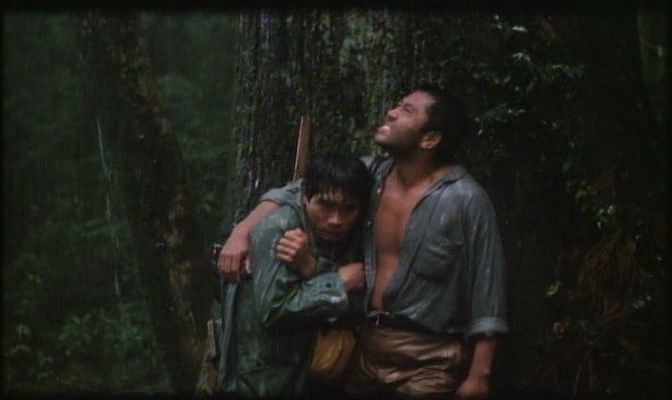
By 1985 the Japanese economy was approaching its zenith yet along with increasing economic prosperity had come social change of which small-town Japan was either casualty or sacrificial victim. “Nigishima will stay as it is” declares the last holdout of an increasingly obsolete way of life in Mitsuo Yanagimachi’s intense modernity drama, Fire Festival (火まつり, Himatsuri), a manly mountain man and animalistic force of nature by several metrics unsuited to life in the contemporary society into which he is ultimately unable to progress. 

There are many things which it seems have not changed in Nigishima for generations, one being the animosity between the cohorts of its bifurcated community, those who live by land and those who live by sea. Rural depopulation may have forced them to come closer but it has also increased their sense of mistrust while both industries continue to suffer in an economy which no longer prizes their humble rural output. Despite being catapulted into a promised modernity by the advent of the railway to great fanfare in 1959, it now seems that Nigishima cannot survive without a new road which could be paid for by the development of a marine park only mountain man Tatsuo (Kinya Kitaoji) owns the property right in the middle of the earmarked area and has hitherto refused to sell further increasing the tension between the two communities. 

Tatsuo is thought of, and thinks of himself, as a big man in the area quite literally it seems as part of the reason he enjoys this status is down to his being unusually well-endowed. He believes himself to have a special relationship with the mountain goddess, often joking to the other men about having a sexual relationship with her while sometimes describing her as his girlfriend. Several times he is mistaken for an animal, firstly by the boatman bringing his childhood sweetheart and sometime mistress Kimiko (Kiwako Taichi) back to the island who assumed he was a monkey crawling along the cliff edge thoughtlessly throwing rocks at them, while he often gambols through the forest whooping like some kind of Tarzan. Entirely unreconstructed, his worldview is patriarchal and misogynistic. All of his banter with the other men is sexual, constantly referring to his penis while greeting his friends with lewd hand gestures thrusting his fist into his pocket as if waving with an erection. The cure for offending the goddess he tells his young protege Ryota (Ryota Nakamoto) is to drop his trousers and display his manhood, Tatsuo strangely believing this would appease her for taking wood from a sacred tree or killing without permission. 

Smearing the blood of a sacrificial animal over his chest and forearms he dedicates the death to the goddess, a gesture he will repeat in the film’s violent and tragic conclusion yet there is also arrogance in his conduct as if he believes himself above natural law, protected as the goddess’ favourite even as he describes himself as “suffocated” by the women in his life from his mother and five older sisters all of whom indulge him to his wife, kids, and mistresses. He has trained his dogs to hunt wild boar without the use of guns in a method he admits even other hunters describe as “cruel” while breaking a local taboo shooting monkeys in the forest well aware of nature red in tooth and claw. As such, there is little nobility to be seen in his determination to preserve this already obsolete way of life. His virility maybe contrasted with that of the ageing land broker Yamakawa (Norihei Miki) and his failed attempts to bed sex worker Kimiko who tricks him into paying off her debts, but he at least knows the way the wind is blowing explaining to her that towns such as Nigishima survive only through things like marine parks or hotels or even nuclear power plants. Without the road, the town will die. 

Yet in 1959 they were told the railway would save them and it seems it did not. Tatsuo’s love making with Kimiko in a boat borrowed from a treacherous fisherman who later agrees to sail it transgressively into sacred waters is intercut with memories of the rail line’s opening ceremony, two teenagers who might have been them or at least of around the same age ride an elephant on the jetty while the townspeople arrange themselves into the formation of the character for “celebration” captured by the aerial photographer above. For Tatsuo as a boy, was this a rebirth of Nigishima or the beginning of its demise as the coming modernity began to eat away at its foundations? 

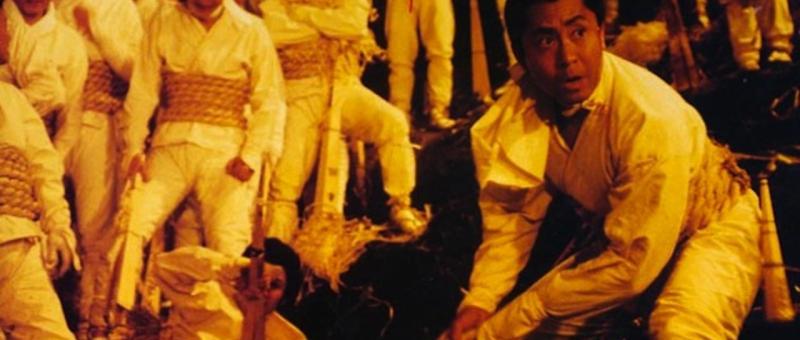
The fire festival is “for men”, according to Tatsuo, “to drive out evil spirits”, his manliness getting the better of him as he disrupts the proceedings to attack a man he accuses of having brought “false fire”. These are the lessons he teaches to surrogate son Ryota whose devotion to him borders on the homoerotic, Tatsuo cradling him during the climactic rain storm and he seeming to develop a fascination for Kimiko as a kind of indirect fixation. Ryota has learned Tatsuo’s chauvinism mimicking his lewd hand gestures and swaggering walk, his cruelty in sacrificing 1000 yen to trick Yamakawa into injuring his hand in a bear trap, and his arrogance ensuring that his problematic masculinity will survive into another generation presumably no more capable of halting the march of modernity than he has been. Tatsuo poisons the waters with fuel oil which as one of the greek chorus of fish wives points out does not catch fire, Tatsuo himself smouldering until an inevitable explosion. Receiving some kind of epiphany during a mystical congress with the goddess in the middle of a storm, he knows what he must do and accepts that he cannot progress into the modern society. Smoulderingly intense in its small-town animosity and primeval sensibilities, Yanagimachi’s poetic tragedy of futility and the broken promises of a badly distributed modernity may accept the the sacrifice but mourns it all the same. 


Fire Festival screens at the BFI on 20/27 December as part of BFI Japan.

Clip (English subtitles)

A Fishwife’s Tale (魚河岸の女石松, Eiichi Kudo, 1961)

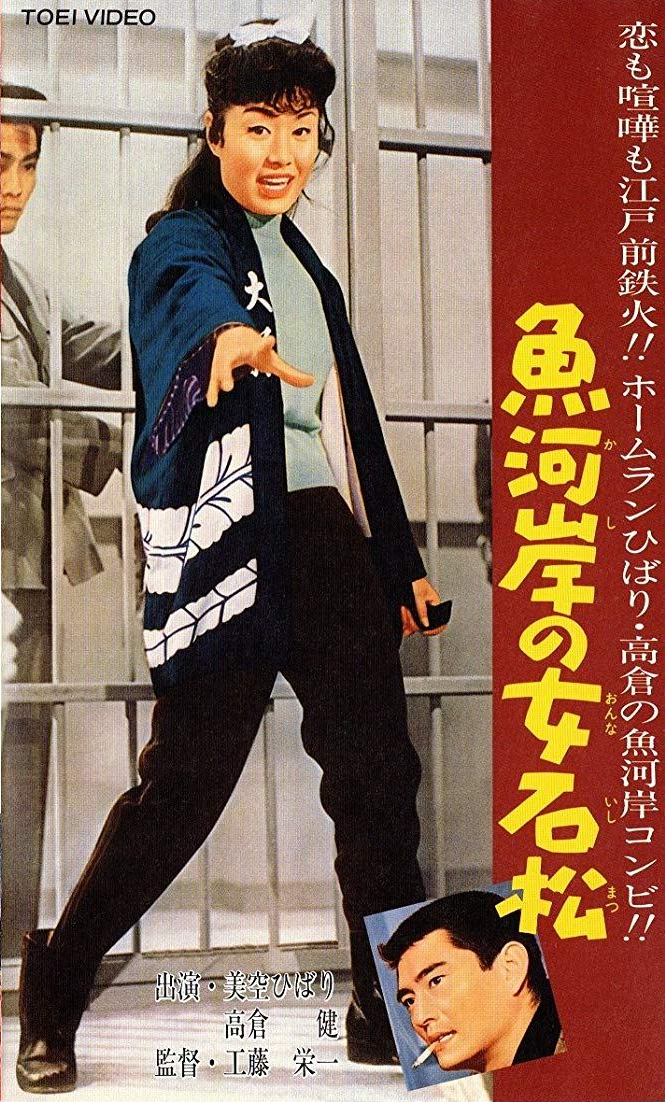
A Fishwife's Tale VHS coverWho better to take on post-war corruption and personal injustice than Hibari Misora? In another of her typically feisty roles, Hibari stands up for her friends, her community, and her family when they are threatened by the exploitative forces of the tabloid press, rubbish boyfriends, and evil corporations all while accidentally falling in love with Ken Takakura in an early role as cynical reporter with a heart of gold. Eiichi Kudo may be best remembered for a string of samurai movies in the ‘60s including 13 Assassins and The Great Killing, but like many of his generation he made a fair few programme pictures including several starring Hibari Misora of which A Fishwife’s Tale (魚河岸の女石松, Kashi no Onna Ishimatsu) is one.

Kudo opens with stock footage of a small fishing harbour which is all aflutter with the arrival of some unusual outsiders. A photographer from a “magazine” has arrived claiming that he wants to document the lives of ordinary working class people from the fishing industry. While some of the young women doll themselves up and plead with the photographer, “Lady Ishimatsu”, Keiko Kano (Hibari Misora), steals all the attention by defiantly rolling through in her truck ready for a day’s work. As predicted Keiko doesn’t want anything to do with this photography nonsense, and as it turns out she was right not to. The guys aren’t from the Sundays or National Geographic, they’re a scandal rag and they’ve bulked out their story with a lot of made up rubbish about the “sexy lives of fishwives” which paints them all as predatory nymphomaniacs. Matters come to a head when Keiko’s friend Yoko (Yukiko Nikaido) tries to kill herself in shame because of the paper’s implication that she’s a loose woman which causes her wealthy boyfriend to dump her (luckily, she’d mixed up tummy tablets with sleeping pills so thankfully survived even if feeling a little sick and silly).

The newspaper business has a second unforeseen consequence. When Keiko stands up to the achingly cool reporter, he realises she’s connected to another case he’s working on. Across town, a canned food magnate is facing ruin thanks to a standards scandal and is also earnestly searching for his long lost daughter, born to a geisha 20 years earlier and then adopted by another family. Dogged reporter Kitagawa (Ken Takakura), recognising the necklace around Keiko’s neck, wonders if she might be the girl Tachibana’s looking for. When it turns out that he’s right, Keiko’s world turns upside-down. Tachibana (Eijiro Yanagi), overjoyed to have found his daughter, goes about everything the wrong way and tries to take her back from her loving home with the promise of wealth and comfort, but Keiko loves her parents even if they aren’t hers by blood and resents the attempt to drag her away. 

Nevertheless, when the two cases turn out to be even more connected thanks to Yoko’s terrible boyfriend being the no good son of one of the conspirators, and Mr. Tachibana falling ill though the stress of his situation, the entire family reconsiders if they haven’t perhaps been selfish in resolutely rejecting a lonely old man trying to make up for a past mistake. Keiko becomes committed to standing up to the bullies. “We’re still young, as long we’re alive we’ll resist you” she tells her biological father’s arch enemy in what might as well be a rallying cry for post-war youth fed up with the corrupted older generation.

Then again perhaps things don’t change all that much. Rather than a salt scam or rice profiteering, this time it’s fiddling with the labels on tin cans but ordinary people are still having their food supply tampered with by those with enough money not to need to worry so much about food security – the amoral petty samurai of the Edo era have merely become amoral businessmen in the dog eat dog post-war world.

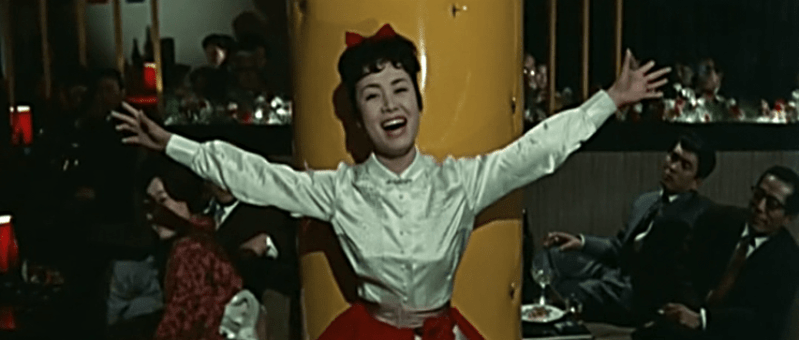
Comparatively light on song and dance – Hibari sings the title track as she drives in on her truck, hums a few tunes, and gets one dramatic musical number when she goes undercover as a nightclub singer to spy on the bad guys, Kudo ups the action quotient as Hibari makes herself the chief of the fishwives and takes on the photographers, sneaks around investigating, and then starts a full on brawl with goons in the final showdown. This time around the romance between frequent co-stars Hibari Misora and Ken Takakura is spiky and sparky, fuelled by Keiko’s strange positioning as a “tomboyish” bossy boots more at home in her truck and wellies than prancing around for the camera like the other girls. Oddly warm and filled with rebellious energy, A Fishwife’s Tale is, in its own quiet way, perhaps subversive in allowing a little political spirit of the age to creep in around the edges as Keiko steps forward to stay true to her roots, opposing injustice wherever she sees it and always acting on her own initiative.


Selection of scenes from the movie including Hibari’s big club number (no subtitles)

https://www.youtube.com/watch?v=o2C9SlTD278

Maintitles song – Hibari no Dodonpa

https://www.youtube.com/watch?v=LnATqXSHqbc

The Catch (魚影の群れ, Shinji Somai, 1983)

the-catch

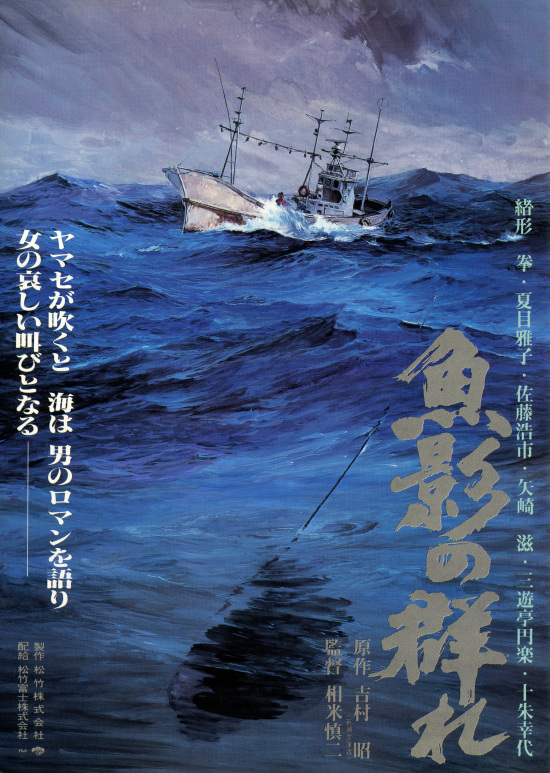
Some men become their work, the quest for success consumes them to the extent that there is barely anything left other than the chase. The Catch (魚影の群れ, Gyoei no Mure), Shinji Somai’s 1983 opus of fishermen at home on the waves and at sea on land is a complex examination of masculinity but also of fatherhood in a rapidly declining world filled with arcane ritual and ancient thought.

Fusajiro (Ken Ogata) is a middle aged man who looks old for his years. Man and boy he’s spent his life at sea, hunting down the elusive tuna fish which can be sold for vast amounts of money in the rare event that one is actually caught. This “first summer” as the title card refers to it, marks a change in his life as the daughter he’s been raising alone since his wife left him many years ago, Tokiko (Masako Natsume), has found a man she wants to marry. Her boyfriend, Shunichi (Koichi Sato), owns a coffee shop in town and Fusajiro has his doubts about a city boy marrying into a fisherman’s family. However, Shunichi isn’t just interested in Tokiko, he wants to set sail too. Though originally reluctant, Fusajiro eventually agrees to take Shunichi as a kind of apprentice but is dismayed when he gets seasick and seems to have no hint of a fisherman’s instinct.

Fusajiro is a legend among his peers – a big man of the sea, a true sailor and top hunter. He’s the one people turn to whenever anything goes wrong on the waves. However, he’s also a gruff man who speaks little and seems to prefer his own company.  In the rare event that he is speaking, it’s generally about tuna. When Shunichi first meets Fusajiro he remarks that he knew it must be him because he “smells of the sea”.

A later scene sees Fusajiro catch sight of a woman caught in the rain who immediately starts running away from him. Chasing her  just like one of his ever elusive tuna he eventually pins the woman down and takes her back to his boat to complete his conquest. The woman turns out to be his ex-wife, who left him precisely because of this violent behaviour. After momentarily considering returning to him, she realises that he hasn’t changed and accuses him of being unable to distinguish people from fish – he hooks them, reels them in, and if they don’t come willingly he hits them until they do so he can keep them with him. This overriding obsession with domination also costs Fusajiro his daughter when Shunichi is gravely injured on the boat and Fusajiro delays returning to port until he’s secured the tuna he was chasing at the time. Shunichi’s blood and the fish’s mingle together on the deck, one indistinguishable from the other, both victims of Fusajiro’s need to reign supreme over man and fish alike.

Fusajiro tried to warn Tokiko not to marry a fisherman, it would only make her miserable. Shunichi is warned that a fisherman’s life is a difficult one and the seas in this area less forgiving than most, but his mind is made up. Finally acquiring his own boat after selling his cafe, Shunichi, just like Fusajiro, starts to fall under the fisherman’s curse – endlessly chasing, living only for the catch. Unlike Fusajiro, however, Shunichi has little instinct for life at sea and fails to bring home his prey. Little by little, the mounting failures eat away at his self esteem as he feels belittled and humiliated in front of the other sailors culminating in an attempt to reinforce his manhood by raping his own wife. These men are little better than animals, consumed by conquest, permanently chasing at sea and on land. To be defeated, is to be destroyed.

Somai never shies away from the grimness and brutality of the work at hand. Ogata catches and spears these magnificent fish for real and the unfortunate creatures are then carved up right on the dockside before our very eyes. As we’re constantly reminded, physical strength is what matters for a fisherman and Fusajiro is a strong man, duelling with the tuna fish and straining to hold the line with all his might. Yet he’s getting old, his body is failing and like an aged toreador in the ring, his victory is no longer assured. The Japanese title of the film which translates as crowds of shadows of solitary fish expresses his nature more clearly, his fate and the tuna’s are the same – a lonely battle to the death. Unable to forge real human connections on land Fusajiro and his ilk are doomed to live out their days alone upon the sea wreaking only misery for those left behind on the shore.


Original trailer (No subtitles, graphic scenes of animal cruelty)