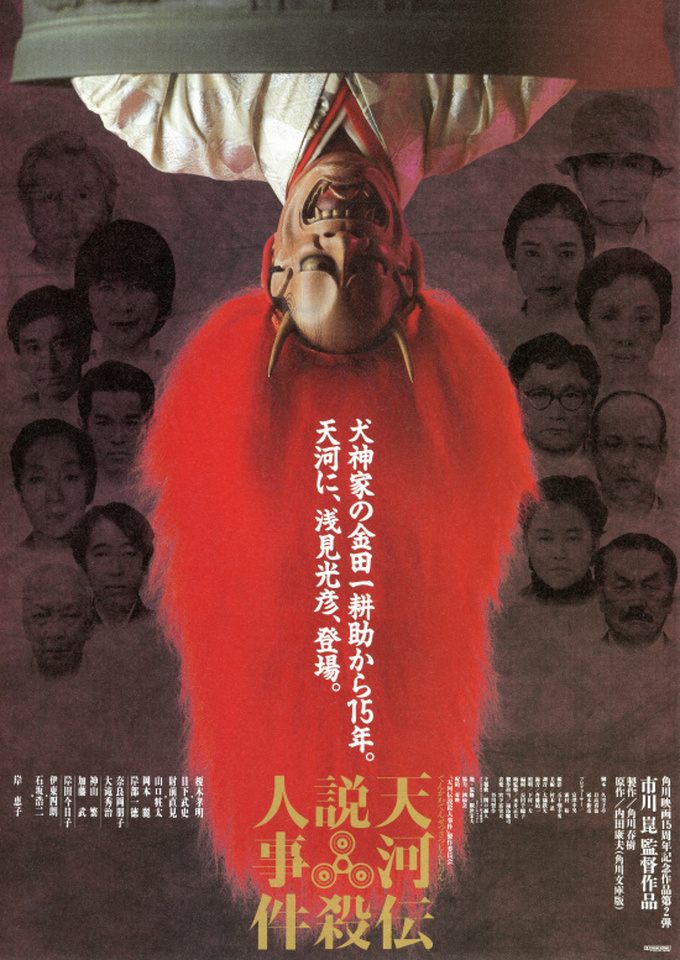
Noh Mask Murders (天河伝説殺人事件, Kon Ichikawa, 1991)

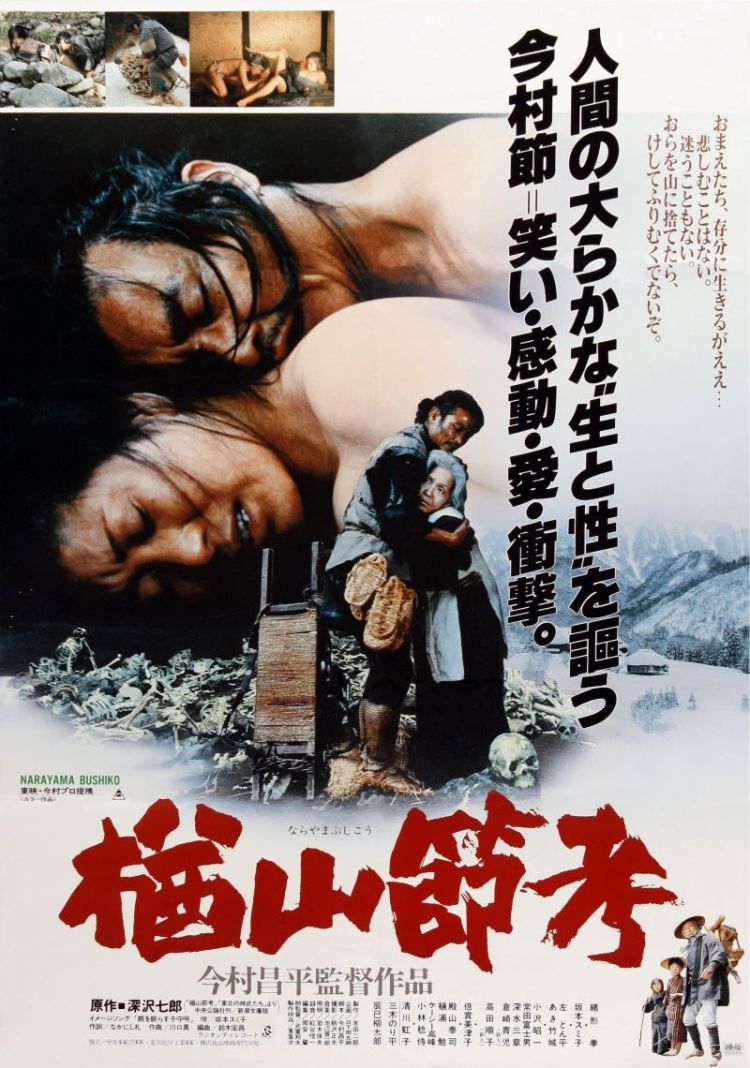
noh mask murders posterFor one reason or another, Japanese mystery novels have yet to achieve the impact recently afforded to their Scandinavian brethren. Japan does however have a long and distinguished history of detective fiction and a number of distinctive, eccentric sleuths echoing the European classics. Mitsuhiko Asami is just one among many of Japan’s not quite normal investigators, and though Noh Mask Murders (天河伝説殺人事件, Tenkawa Densetsu Satsujin Jiken) is technically the 23rd in the Asami series, Kon Ichikawa’s adaptation sets itself up as the very first Asami case file and as something close to an origin story.

Ichikawa, though he may be best remembered for his ‘60s arthouse masterpieces, was able to go on filmmaking where others perhaps were not precisely because of his forays into the populist with a series of mystery thrillers including several featuring top Japanese detective Kindaichi (who receives brief name check in Noh Mask Murders). Published by Kadokawa, Noh Mask Murders is produced by Haruki Kadokawa towards the end of his populist heyday and features many of the hallmarks of a “Kadokawa” film but Ichikawa also takes the opportunity for a little formal experimentation to supplement what is perhaps a weaker locked room mystery.

Asami (Takaaki Enoki) begins with a voice over as four plot strands occur at the same temporal moment at different spaces across the city. In Shinjuku, a salaryman drops dead on the street, while a young couple enjoy a secret tryst in a secluded forest, a troupe of actors rehearse a noh play, and Asami himself is arrested by an officious policeman who notices him walking around with a dead bird in his hand and accuses him of poaching. As he will later prove, all of these moments are connected either by fate or coincidence but setting in motion a series of events which will eventually claim a few more lives before its sorry conclusion.

To begin with Asami, he is a slightly strange and ethereal man from an elite background who has been content to drift aimlessly through life to the consternation of his conservative family which includes a police chief brother. He harbours no particular desire to become a detective and is originally irritated by a family friend’s attempts to foist a job on him but gives in when he learns he will have the opportunity to visit Tenkawa which is where, he’s been told, the mysterious woman who helped him out with the policeman in the opening sequence keeps an inn. Hoping to learn more about her, he agrees to write a book about the history of Noh and then becomes embroiled in a second murder which links back to the Mizugami Noh Family which is currently facing a succession crisis as the grandfather finds himself torn over choosing his heir – he wants to choose his granddaughter Hidemi (Naomi Zaizen) who is the better performer but the troupe has never had a female leader and there are other reasons which push him towards picking his grandson, Kazutaka (Shota Yamaguchi).

As with almost all Japanese mysteries, the solution depends on a secret and the possibilities of blackmail and/or potential scandal. The mechanics of murders themselves (save perhaps the first one) are not particularly difficult to figure out and the identity of the killer almost certainly obvious to those who count themselves mystery fans though there are a few red herrings thrown in including a very “obvious” suspect presented early on who turns out to be entirely incidental.

Ichikawa attempts to reinforce the everything is connected moral of the story through an innovative and deliberately disorientating cross cutting technique which begins in the prologue as Ichikawa allows the conversations between the grandchildren to bleed into those of Asami and his friend as if they were in direct dialogue with each other. He foregrounds a sad story of persistent female subjugation and undue reliance on superstition and tradition which is indirectly to blame for the events which come to pass. Everyone regrets the past, and after a little murder begins to see things more clearly in acknowledging the wickedness of their own actions as well as their own sense of guilt and complicity. Noh is, apparently, like a marriage, a matter of mutual responsibility, fostering understanding between people and so, apparently is murder, and one way or another Asami seems to have found his calling.


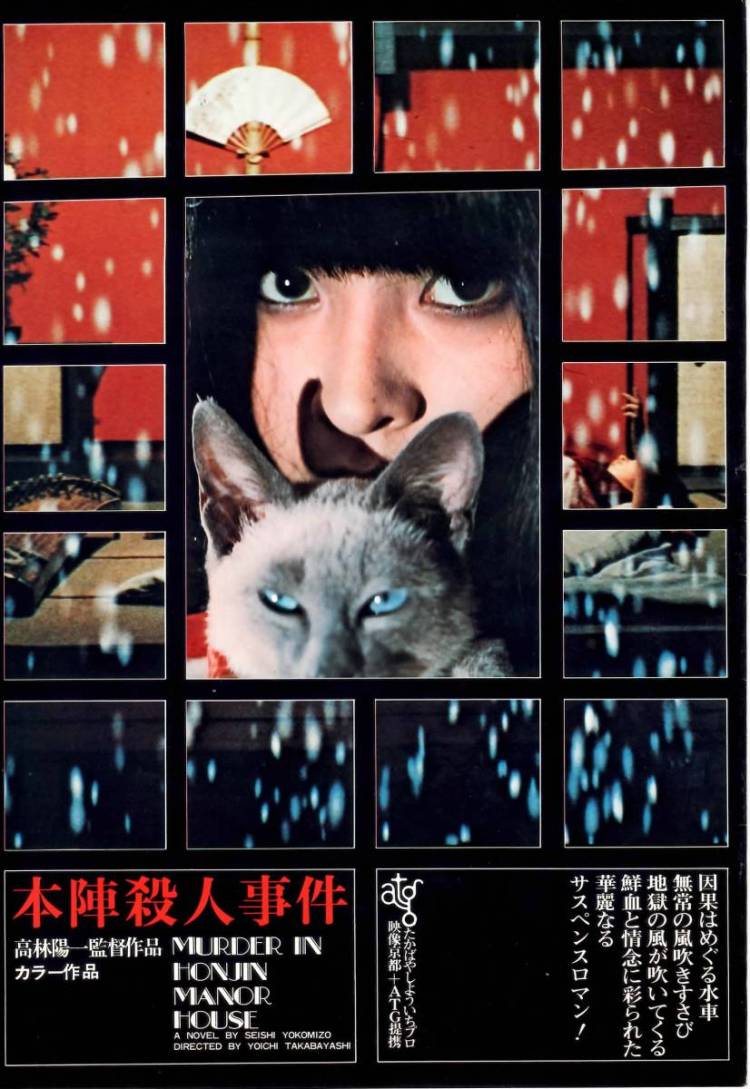
Death at an Old Mansion (本陣殺人事件, Yoichi Takabayashi, 1975)

death at an old mansion posterKousuke Kindaichi is one of the best known detectives of Japanese literature. There are 77 books in the Kindaichi series which has spawned numerous cinematic adaptations as well as a popular manga and anime spin-off starring the grandson of the original sleuth. Sadly only one of Seishi Yokomizo’s novels has been translated into English (The Inugami Clan which has the distinction of having been filmed not once but twice by Kon Ichikawa), but many Japanese mystery lovers have ranked his debut, The Murder in the Honjin, as one of the best locked room mysteries ever written. Starring Akira Nakao as the eccentric detective, Yoichi Takabayashi’s Death at an Old Mansion (本陣殺人事件, Honjin Satsujin Jiken) was the first of three films he’d make for The Art Theatre Guild of Japan and updates the 1937 setting of Yokomizu’s novel to the contemporary 1970s.

Beginning at the end, Kindaichi (Akira Nakao) arrives at a country mansion with a sense of foreboding which borne out when he realises that the young lady he’s come to see, Suzu (Junko Takazawa), has died and he’s arrived just in time to witness her funeral. It’s been a year since he first met her, though he did so under less than ideal circumstances. As it happened, Suzu’s older brother, Kenzo (Takahiro Tamura), was married to a young woman of his own choosing, Katsuko (Yuki Mizuhara), despite strong familial opposition. On the night of their wedding, the couple were brutally murdered inside a private annex to the main building. The doors were firmly locked from the inside and there was no murder weapon on site. The only clue was bloody three fingered handprint made by someone wearing the “tsume” or picks used for playing the koto. Kindaichi, already a well known private detective, was summoned to investigate because of a personal connection to Katsuko’s uncle, Ginzo (Kunio Kaga).

The original novel was published in 1946 and it has to be said, some of its themes make more sense in the pre-war 1937 setting than they do for the comparatively more liberal one of 1975 though such small minded attitudes are hardly uncommon even in the world today. The Ichiyanagi family live on a large family estate (apparently not the “Honjin” – a resting place for imperial retinues in the Edo era, of the title but the ancestral association remains) and enjoy a degree of social standing as well as the privilege of wealth in the small rural town. Katsuko, by contrast, is from a “lowly” family of well-to-do farmers – mere peasantry to the Ichiyanagis, many of whom believe Kenzo is making a huge and embarrassing mistake in his choice of wife. Kenzo, a middle-aged scholar, has shocked them all with his sudden determination to marry, not to mention his determination to break with family protocol and marry beneath him.

Japanese mysteries are much less concerned with motive than their Western counterparts, but class conflict is definitely offered as a possible reason for murder. Other clues have more menacing dimensions such as the repeated mentions of a scary looking three fingered man who apparently delivered a threatening letter to the mansion on the night of the murder, and Suzu’s constant questions about her recently deceased cat who liked to listen to her play the koto. Suzu is 17 but has some kind of learning difficulties and is arrested in a childlike state of innocence which leads her to utter simple yet profound words of wisdom whilst also believing that her recently deceased cat, Tama, is some kind of god. Suzu’s “innocence” is contrasted with her brother’s coldhearted rigidity in which he’s described as a sanctimonious snob who believes himself above regular folk and treats his servants with contempt. This same rigidity in fact aligns him with his sister as both share an “atypical” way of thought and behaviour. Kenzo’s unexpected romance turns out not to be middle-aged lust for domination but an innocent first love arriving at 40 with all the pain and complication of adolescence.

Kindaichi arrives to solve the crime and makes an instant partner of the police inspector in charge who’s glad to have such esteemed help on such a difficult case. Putting two and two together, Kindaichi soon comes up with a few ideas after rubbing up against a mystery novel obsessed suspect and numerous red herrings. Once again coincidence plays a huge role, but the business of the murder is certainly elaborate given the pettiness of the reasoning behind it. Takabayashi never plays down the typically generic elements of this classic mystery, but adds to them with eerie, occasionally psychedelic camera work, shifting to sepia for imagined reconstructions and making use of repeated motifs from the fire-like imagery of the water wheel to a shattered photo of Kenzo shot through the eye. Strangely framed in red and gold the murder takes on a theatrical association that’s perfectly in keeping with its well choreographed genesis, and all the more chilling because of it. A satisfying locked room mystery,  Death at an Old Mansion is also a tragedy of out dated ideals equated with a kind of innocence and purity, of those who couldn’t allow their dreams to be sullied or their name besmirched. Perhaps not so different from the world of 1937 after all.


Original trailer (no subtitles)

Cats in Park Avenue (公園通りの猫たち, Shinichi Nakada, 1989)

vlcsnap-2017-01-06-00h41m34s475Looking at the poster and its “A Most “Oshare” Movie” tagline, you’d assume Cats in Park Avenue (公園通りの猫たち, Koendori no Nekotachi) to be a very stylish story about some fashionable felines living on an uptown street comparable to the famous New York landmark but the title is entirely coincidental as it’s a literal translation of the Japanese and just means the cats live on a street near the park. These cats are full on alley cats, scrappy and free, roaming the rooftops of Shibuya and not giving a damn about whatever it is cats are supposed to do. Ostensibly a throw away young adult movie about a group of dance students and their obsession with a gang of local street cats, Cats in Park Avenue  takes on a surprisingly individualist message as the virtues of freedom and validity of life outside the mainstream are resolutely reinforced through cute animation and nonsensical musical sequences.
The plot, such as it is, focuses on a local dance troupe who are about to put on a musical show inspired by the life of the their local cats (no, they don’t seem to be aware it’s been done already). Each of the main girls is lined up with a corresponding alley cat with whom she shares a degree of affinity and, oddly enough, the cats themselves are allowed to take centre stage for large parts of the film as they play, fight, and make improbable leaps from building to building.

Aside from the show, the main narrative kicks off when a wealthy old lady one of the girls works as a baby sitter for starts to get paranoid that one of the alleycats is after her prized kitty Marilyn. When she thinks Marilyn has gone to the dark side, she immediately kicks her out as “dirty” and starts on a mass “purification” programme for the surrounding area to eliminate all of the stray cats, including our beloved heroes. The “Cat Busters” are called in as a kind of storm trooper-esque execution squad complete with a strange scanning machine which works out if a cat is nasty or nice and dumps the unwanted ones right into the furnace. The cats, however, are about ready to fight back and free their friends from certain doom.

In the end they’ll have to save themselves, aided by the villainess’ young son who wields the weight of his own privilege to help. The girls are aligned with the cats in ways which are intended to be positive – emphasising the freedom they would like to have, the strength and daring, but are contrasted with the more “conservative” attitude of the film’s villain who wants everything to be “clean”, with “cats” confined to the home in a kind of golden cage. It is interesting in that sense that the evil instigator is herself a woman, wealthy and successful with a young son but seemingly unmarried. Despite living outside of the mainstream, it is she who seeks to grade the cats according to their usefulness and destroy the ones which don’t meet her criteria. The girls however, perhaps talking for themselves, insist the cats need to be free and keeping them indoors as pets where they don’t want to be not only makes them miserable but deprives them of the right of being what they are.

Intended for a very specific audience, Cats in Park Avenue cuts between images of these quite odd looking cats doing what they do, to large scale dance sequences and infrequent animation. The human cast are not the focus of the film and the character arcs of the real life girls take a back seat to those of their feline counter parts but they do at least get the opportunity to show off their singing and dancing credentials. The final show does indeed bear a significant resemblance to that other well known musical, but is much more cheerfully silly despite the heavy, if surreal, events which have previously taken place. A strange odyssey back to bubble-era consumerist pop, Cats in Park Avenue is unlikely to find much of an audience among modern viewers but is an interesting time capsule of the lower end of populist movies in the late 1980s.


TV Commercial (part of a reel of ’80s adverts – starts at 1:44)

https://youtu.be/1LR2qhypECU

Actress (映画女優, Kon Ichikawa, 1987)

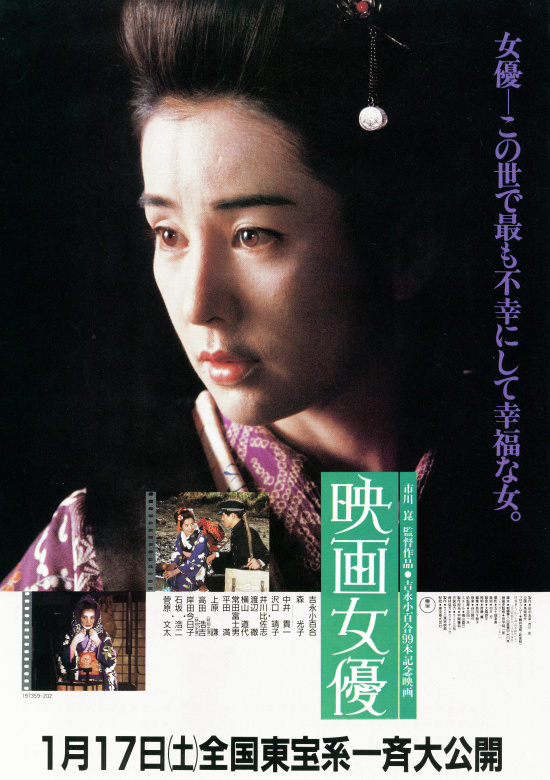
actressKon Ichikawa was born in 1915, just four years later than the subject of his 1989 film Actress (映画女優, Eiga Joyu) which uses the pre-directorial career of one of Japanese cinema’s most respected actresses, Kinuyo Tanaka, to explore the development of Japanese cinema itself. Tanaka was born in poverty in 1909 and worked as a jobbing film actress before being “discovered” by Hiroshi Shimizu and becoming one of Shochiku’s most bankable stars. The script is co-written by Kaneto Shindo who was fairly close to the action as an assistant under Kenji Mizoguchi at Shochiku in the ‘40s before being drafted into the war. A commemorative exercise marking the tenth anniversary of Tanaka’s death from a brain tumour in 1977, Ichikawa’s film never quite escapes from the biopic straightjacket and only gives a superficial picture of its star but seems content to revel in the nostalgia of a, by then, forgotten golden age.
The film begins with the young Tanaka awaiting a visit from her mentor, Hiroshi Shimizu (Toru Watanabe), whom her family are keen to thank for bringing them all to Tokyo away from their life of hardship. Although everyone is very happy for Tanaka’s success, there is shadow hanging over the party in the form of missing oldest brother Ryosuke who went on the run to avoid the draft and has not been heard of since.

Shimizu gives Tanaka (Sayuri Yoshinaga) her first roles at Shochiku where she becomes a contract player but is put out when another director, Heinosuke Gosho (Kiichi Nakai), wants to give her a leading role. Overruled by studio bosses, Shimizu becomes increasingly jealous of Tanaka’s career – a situation which is further complicated by the couple’s growing romantic entanglement which sees them living together in an unofficial marriage allowing Tanaka to continue acting. However, Shimizu continues to meddle in Tanaka’s professional life whilst also continuing his hard drinking, womanising playboy lifestyle. The couple eventually divorce but reunite from time to time on the film set.

Vowing never to marry again, the rest of Tanaka’s life is dedicated to acting and sees her working with some of the best directors of the age including Ozu (Shigemitsu Ogi) and later Mizoguchi (Bunta Sugawara). It is Tanaka’s professional and personal relationship with Mizoguchi which occupies the second half of the film. Judging by the first experience on the now lost Woman of Osaka in 1940, you wouldn’t think the two would ever wish to work together again though they eventually completed fifteen films together over the next fifteen years.

Mizoguchi’s process is completely different from any other Tanaka had worked with. Rather than meeting to rehearse and discuss the work, Mizoguchi abruptly sends her a lifetime’s supply of books about bunraku and changes the script that she has painstakingly committed to memory with on set rewrites communicated via a large blackboard he expects the actors to read from. Exasperated, Tanaka finally asks him for actual direction but he coldly states that she’s the actress and her acting is not part of his job description. Mizoguchi and Tanaka are very different people but each driven and ambitious so their frequent locking of horns produces a fiercely creative collaboration in which each was able to find worth even if it was frequently difficult.

The film ends around the time of Life of Oharu which would mark the final time the pair would work together. In terms of the film’s narrative, this unspoken development is foreshadowed by the idea that the two artists are heading in different directions but in the real world the reasons are a little less clear. Tanaka became the second woman to direct a feature film with Love Letters in 1953 which was even featured at Cannes, but for reasons unknown Mizoguchi attempted to block her access to the Director’s Guild of Japan, effectively ending both their friendship and any professional relationship. Ironically enough, Actress seems to imply that Tanaka’s desire to direct may have been inspired by Mizoguchi and his all powerful on set status prompting her to wonder how he does it, and, perhaps how she could do it too.

Ichikawa weaves the history of Japan through its cinema into the narrative to recount the changing tastes of the eras as naturalism came in and out of fashion and Japanese films began to experience international as well as domestic acclaim. Skipping huge portions of time to focus on the two directors – Shimizu and Mizoguchi, Ichikawa avoids mentioning Tanaka’s post-war visit to America which had a profound impact on her later career, not only in what she learned there but also in the extremely hostile reception she received on returning home. The main takeaway from his depiction of Tanaka is a woman ahead of her time, independent and headstrong, willing to work hard to achieve the things she wanted to achieve even if flying in the face of social convention though it makes no particular judgement on her character other than in her success as an actress.

Taking on the conceit of being a film about film, Ichikawa’s sets are theatrical, creating a deliberately artificial, half unreal world. This also extends into the scriptwriting which is extremely talky and more like a stage play than film, offering pointed, long stretches of monologuing which are already far away from the more naturalistic approach of early talking cinema. Characters have improbable, exposition filled conversations in which they each tell each other things they already know for the audience’s benefit – an effect which enhances the overall theatricality, but does draw attention to itself and eventually becomes wearing. Ichikawa’s picture of Tanaka is one of steely determination and of a woman ahead of her time, but even if Actress proves less than enlightening regarding its subject it does help to shed some light on both classic Japanese cinema and that of the late 1980s.


Original trailer (traditional Chinese subs only)

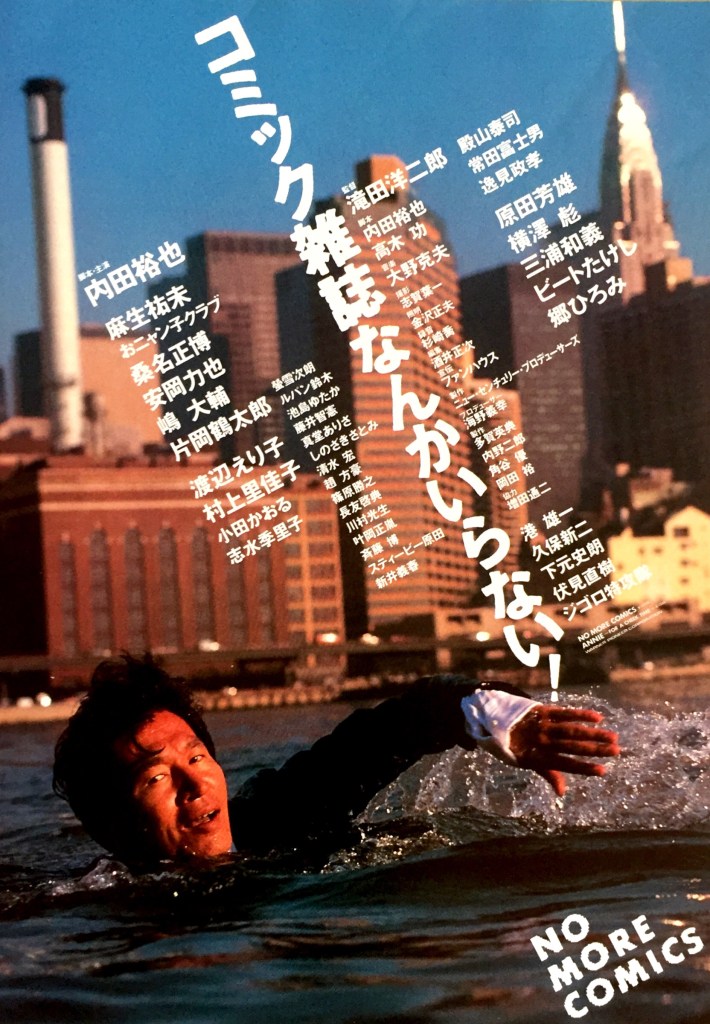
No More Comics! (コミック雑誌なんかいらない!, Yojiro Takita, 1986)

No More ComicsThe word “paparazzo” might have been born with La Dolce Vita but the gossip hungry newshound has been with us since long before the invention of the camera. Yojiro Takita’s 1986 film No More Comics! (コミック雑誌なんかいらない, Komikku zasshi nanka iranai AKA Comic Magazine) proves that the media’s obsession with celebrity and “first on the scene” coverage is not a new phenomenon nor one which is likely to change any time soon.

Kinameri (Yuya Uchida) is a hack reporter on a gossipy news magazine programme which reports on all the sordid personal details of the private lives of celebrities. In a bit of neat meta commentary, we first meet him when he’s doggedly following real life top actress of the time Kaori Momoi (making a brief self cameo) as she tries to board a plane at the airport. Kinameri keeps on asking his inappropriate questions about her alleged relationship with a screenwriter whilst Momoi successfully ignores him before finally reaching the relative sanctuary of the security cordon preventing Kinameri from actually boarding the plane with her. Of course, his interview attempt has failed but he plays the footage on the programme anyway justifying her silence as a lack of denial and that he has therefore “proved” that the rumours are true.

Kinameri is both respected and ridiculed by his colleagues who praise his probing journalistic techniques which see him doggedly refusing to give up on a story but also find his intensity amusing seeing as he’s mostly chasing cheating spouses rather than uncovering the next great political scandal like his heroes who exposed Watergate. Having graduated from a top Japanese university in political sciences, this is far from the line of work Kinameri would want to be doing and its vacuity coupled with his own failed ambitions push him further and further into a spiral of self loathing and depression.

It’s not only celebrities either. Even if you could make a case that those in the entertainment industry have entered into a pact with the media and are, therefore, fair game, civilians and particularly victims of crime should be off limits. Kinameri will literally stop at nothing to scratch a up a story including attending the funeral of a murdered 14 year old girl and quizzing her mother over the rumours that the girl had been engaging in prostitution to try and elicit some kind of social commentary about the youth of today. After his programming starts to decline in popularity he’s relegated to the late night slot which involves visiting various shady places such as strip clubs, snack bars that are actually yakuza hang outs, and even the set of a porn film where he gets a cameo feeling up the lead actress in the front of a convertible.

While all of this is going on, Kinameri is also receiving some bothersome cold calls offering to sell him gold as an investment proposal. His elderly neighbour is visited by a woman from the company and does actually buy some but Kinameri smells a rat and his journalistic instincts kick back in. His bosses at the network aren’t convinced though – dodgy gold dealers doesn’t sound like a ratings winner after all and even when Kinameri agrees to even shadier assignments so he can pursue his leads, they still aren’t really behind him. Eventually they catch up but it’s almost too late.

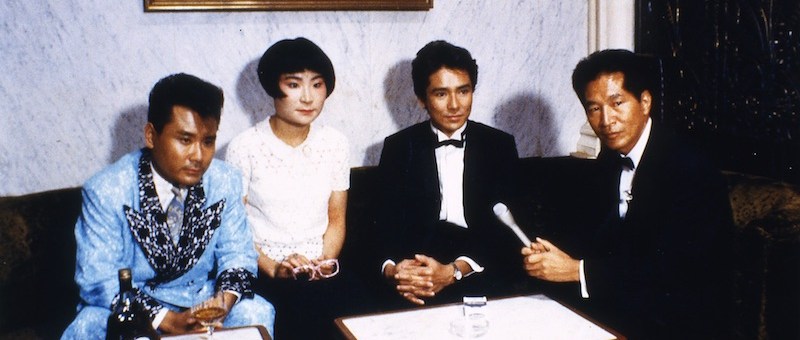
Kinameri keeps doing what he’s paid to do, even if he clearly despises everything about it. Asking trivial and ridiculous questions and being ignored anyway, conducting a vacuous meet and greet with a gang of up and coming idol stars, even posing as a gigolo – there are no lengths to which he will not sink in pursuit of his story. By the film’s finale he’s still the frontline reporter, looking on while a vicious yakuza (played by a young Takeshi Kitano) commits a brutal murder right in front of the cameras. No one is moving, no one is trying to stop this, everyone is manoeuvring to get the best coverage. Kinameri has had enough and, with a look of rage and contempt on his face, he launches himself through the widow in a last minute attempt to make a difference but once again, lands up flat on his face and, finally, excluded from the action.

Years ahead of its time, No More Comics! takes an ironic look at invasive media coverage of celebrity gossip which clogs the airwaves while the real story is wilfully ignored. Ironically, Kinameri even becomes something of a celebrity himself, well known for his dogged interviewing style. He receives countless answerphone messages from “fans” (somehow ringing his personal phone number) either praising his efforts or berating him for not pushing his targets harder. When a young aspiring journalist stops him in the street and asks for advice, Kinameri doesn’t even answer but just walks away with a look of contempt and sadness on his face. Finally, after his mad dash into a crime scene in the final reel, he becomes the news himself. All of his fellow reporters suddenly want to know “what happened”, “what was it like”, “did you go in to save him or for the story?” etc. Still stunned and probably in need of medical attention, Kinameri looks directly into the camera, puts his hand across the lens and states “I can’t speak fucking Japanese”.

Filled with rage and shame, No More Comics! is a Network-esque satire on the world of live broadcast reporting exposing the seedier sides of journalistic desperation. Ahead of its time and sadly still timely in the age of 24hr coverage which mainly consists of the same trivial stories repeated ad nauseum, its messages are needed more than ever.


Unsubtitled trailer: