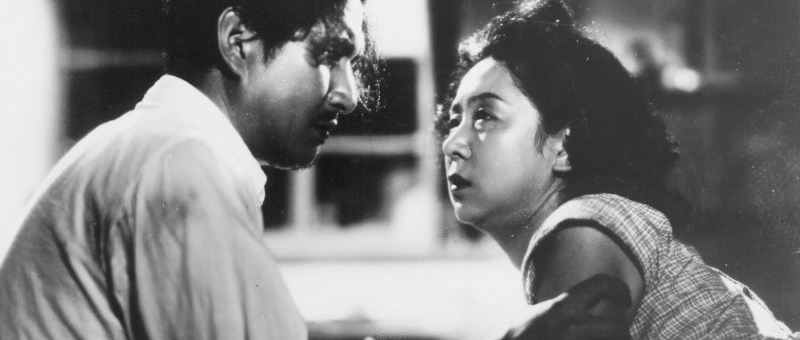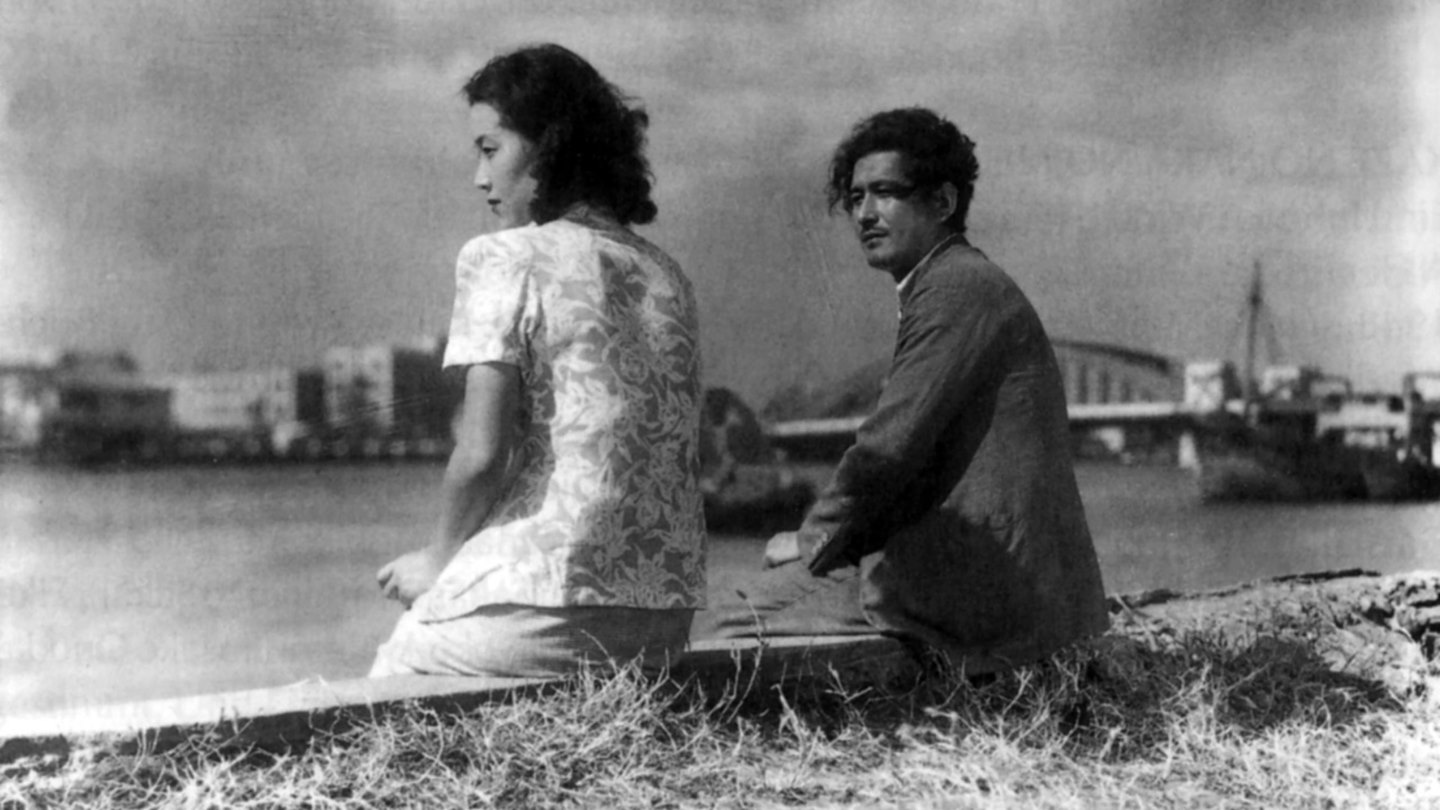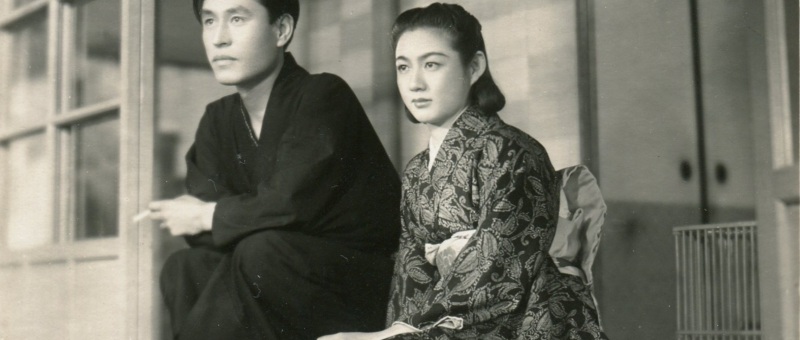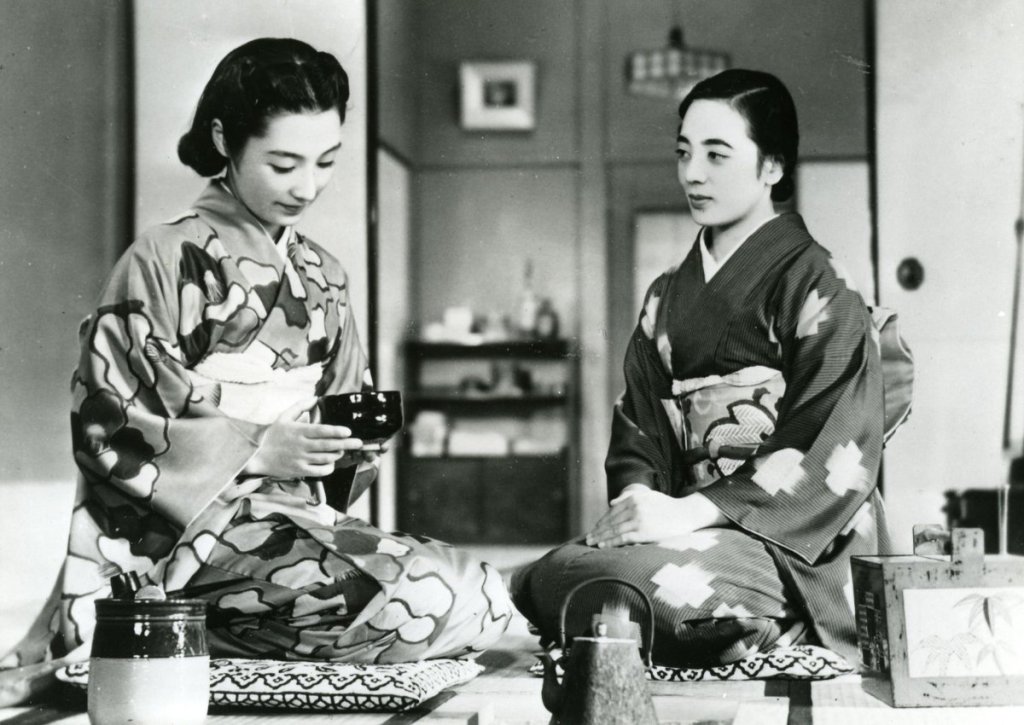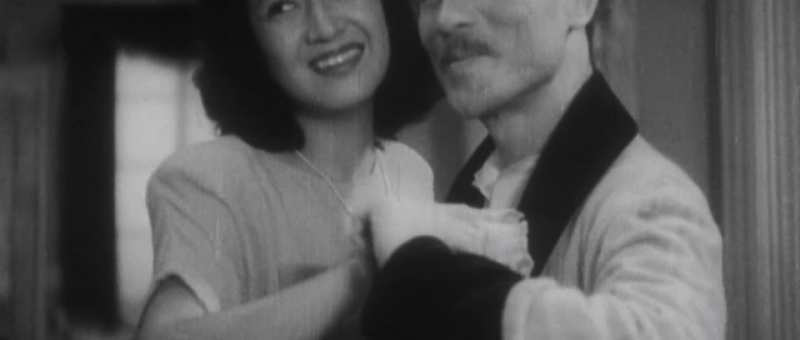
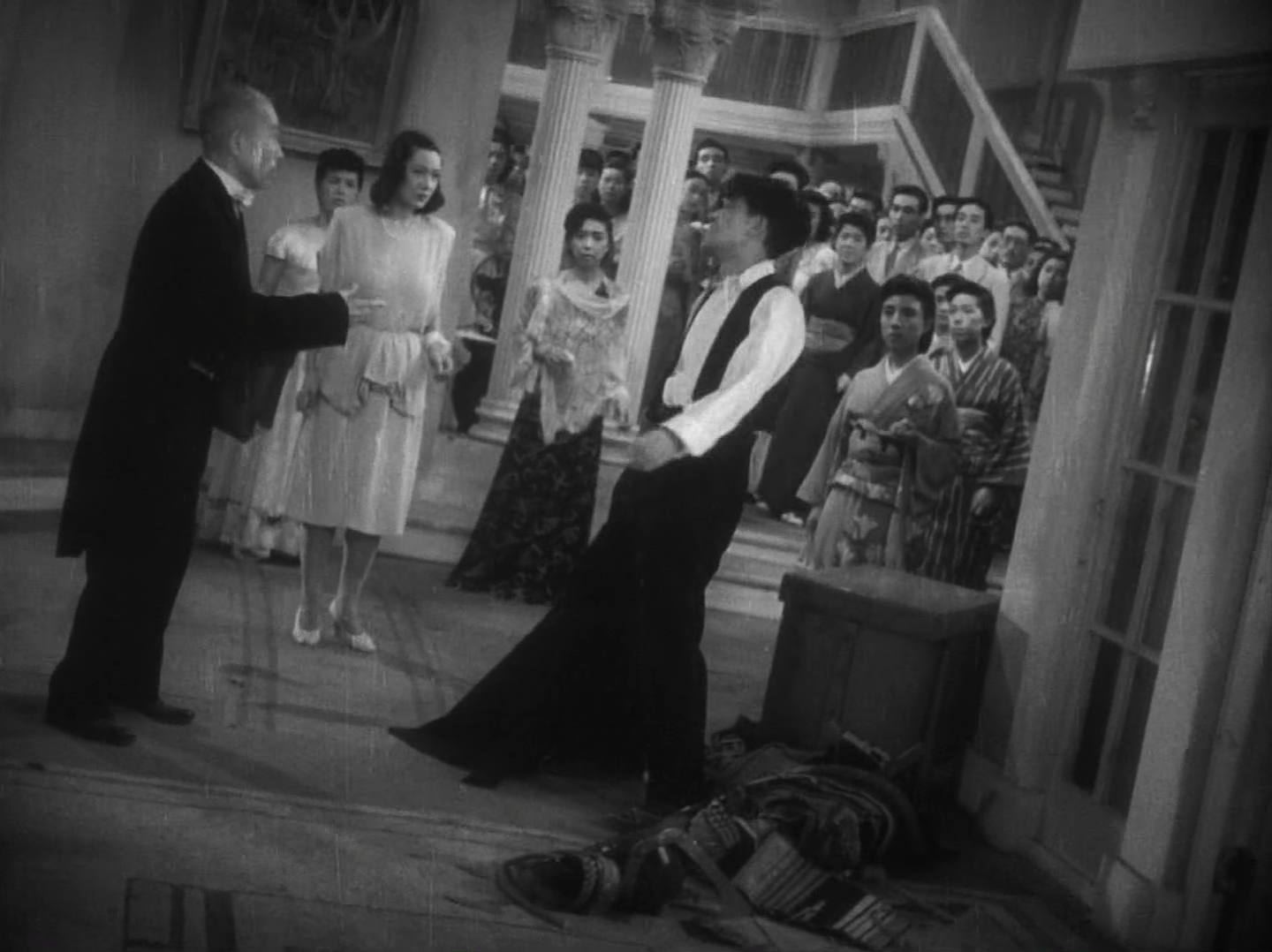
The Ball at the Anjo House (安城家の舞踏会, Kozaburo Yoshimura, 1947)

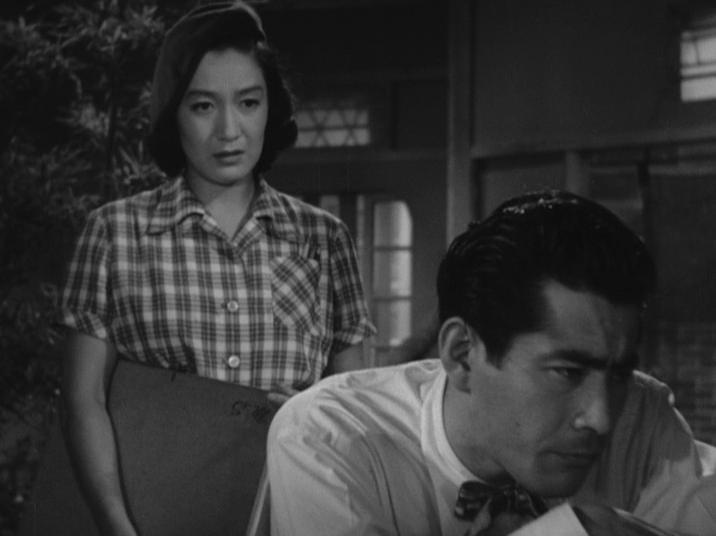
“Old things die out so new things can be born,” according to the ruined patriarch of a once noble house in Kozaburo Yoshimura’s Chekhovian drama Ball at the Anjo House (安城家の舞踏会, Anjo-ke no butokai), though he might as well be speaking to the post-war society. The Anjos are like the declining aristocracy of the earlier 20th century mourning the disappearance of their world of privilege and gaiety and reflecting that they too must now, as younger daughter Atsuko (Setsuko Hara) says, learn to serve others.

Atsuko is really the only one who accepts the age of the aristocracy has passed and that it is only right and proper that they should join this newly egalitarian, democratic society. Her sister Akiko (Yumeko Aizome) has recently returned home after 12 years having left her husband because of his adultery, but cannot now face it that she no longer has a place here. Approached by their former chauffeur Toyama (Takashi Kanda) who has long carried a torch for her, Akiko snaps that she will always be a noblewoman in heart, unable to let go of outdated customs of class and propriety. She seems to have feelings for the chauffeur too, but won’t let herself embrace them, calling him “dirty” and resenting herself for her attraction to a man who is not her social equal. 

But times are very different now and the aristocracy has been abolished which has in all other senses dissolved the class barrier between them. The tables have turned and Toyama is now a wealthy man having done well for himself in business through honest hard work. Akiko asks him for help as a kind of symbolic gesture as if she were making recompense by handing the house to its rightful owner in their former servant. He insensitively tells patriarch Tadahiko (Osamu Takizawa) that he can easily spare a few thousand to throw away on the house as a sentimental gesture, but does so largely without malice. Only after Akiko has turned him down at the ball and he begins to drink does he start to crow, if a little sadly, that now this base and ugly servant has bought the master’s house. On his way out, he knocks over the suit of armour that had stood in the hall as if literally bringing down the feudalistic military legacy of this once great family and sending it crashing to the floor. The camera suddenly tilts to emphasise that this world is now out of kilter and has been destabilised beyond repair. It’s only this action that frees Akiko from her self-imposed repression as she skips over the armour and chases Toyama out the door. Tumbling down a sand dune she literally descends to his level leaving her pearls and shoes behind. 

The class barrier has been fully dissolved, and Tadahiko too permits himself to marry his long-term mistress, the geisha Chiyo (Chieko Murata), who declares that she doesn’t care about his loss of status and invites him to live with her if he has to sell his house. But it seems as if Tadahiko can’t let go of his ancestral legacy nor his childhood home. In truth, this Western-style country house by the sea can only have been built after the Meiji Restoration which means it’s under a hundred years old and most likely built by Tadahiko’s father, the gentleman in European-style military dress in the portrait. As such, it was likely constructed to look forward to a new era as the samurai class rebranded itself into a European-style aristocracy. Tadahiko’s older sister, married to a lord who’s faring better in this new world, tells an enraptured collection of younger women of the time she danced with a prince a year after the Russo-Japanese war when she was only 19. But this will be the last ball at the Anjo House, in memory of a “beautiful way of life” that has been now been eclipsed.  

Tadahiko had faith that they would be saved essentially through the good chap system in his relationship with a nouveau riche upstart named Shinkawa (Masao Shimizu). Shinkawa holds the mortgage on the house, and there are all sorts of rumours about his shady business. He made most of his money on the black market. Shinkawa had arranged a marriage between his daughter Yoko (Keiko Tsushima) and Tadahiko’s son Masahiko, which gave him even more confidence. But as Atsuko says, Shinkawa was only friendly with him because of his aristocratic title and now it’s gone he has nothing to offer. In marrying Yoko to Masahiko (Masayuki Mori), Shinkawa would have gained the legitimacy of a connection with nobility while Tadahiko would have gained an injection of cash that would save his social status. But none of that matters any more now that the aristocracy has been abolished under the post-war reforms that have also seen Tadahiko’s lands confiscated and estate broken up. It seems that Tadahiko let Shinkawa use his name for a munitions factory during the war, which might not play so well now, just as Akiko’s decision to part with her adulterous husband may also have been influenced by the fact that he was a general who is presumably little in demand in the wake of defeat. Still, Tadahiko prefers Shinkawa to letting the house go to a former servant like Toyama who must himself be enamoured enough with that old world to want to become master of it rather than tear it down.

For Masahiko’s part, he has little interest in marrying Yoko but on learning the engagement has been unilaterally called off and Shinkawa is little more than crook decides to rape Yoko to get back at him. His cruelty is a symptom of post-war nihilism, and we soon discover he’s been sleeping with a maid, Kiku (Akemi Sora), to whom he made promises of marriage he had no intention of keeping. But Like Akiko it seems as if he does care for her after all, only he won’t let himself feel anything in the numbness of his loss of privilege preferring instead to laugh too loudly with his boorish friends. Only on seeing the class barrier dissolve when his father marries Chiyo and his sister Akiko takes off after Toyama does he allow himself to embrace Kiku and express genuine emotion.

Masahiko is played by a young Masayuki Mori who was the son of the novelist Takeo Arishima. Arishima was also a member of the aristocracy but one who became a socialist and dissolved his estate which was something of a fashion in the 1920s. The situation is however complicated by the fact that the Anjos’ servants remain loyal and don’t want to leave them. After all, this is as much their home too and they don’t have anywhere to go either because a world with no masters has no need for servants. We too are encouraged to mourn this world, but its end is also presented as a kind of liberation in which the family are finally permitted to embrace their own desires only after casting off the shackles of the aristocracy and preparing to forge new futures in a changing world leaving the feudal past behind and waltzing into a new and brighter future.
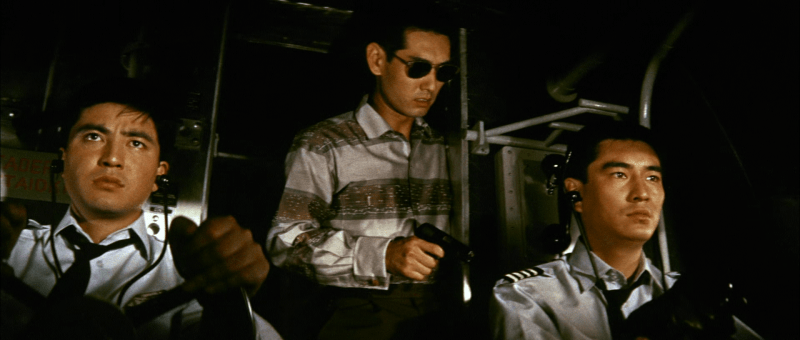
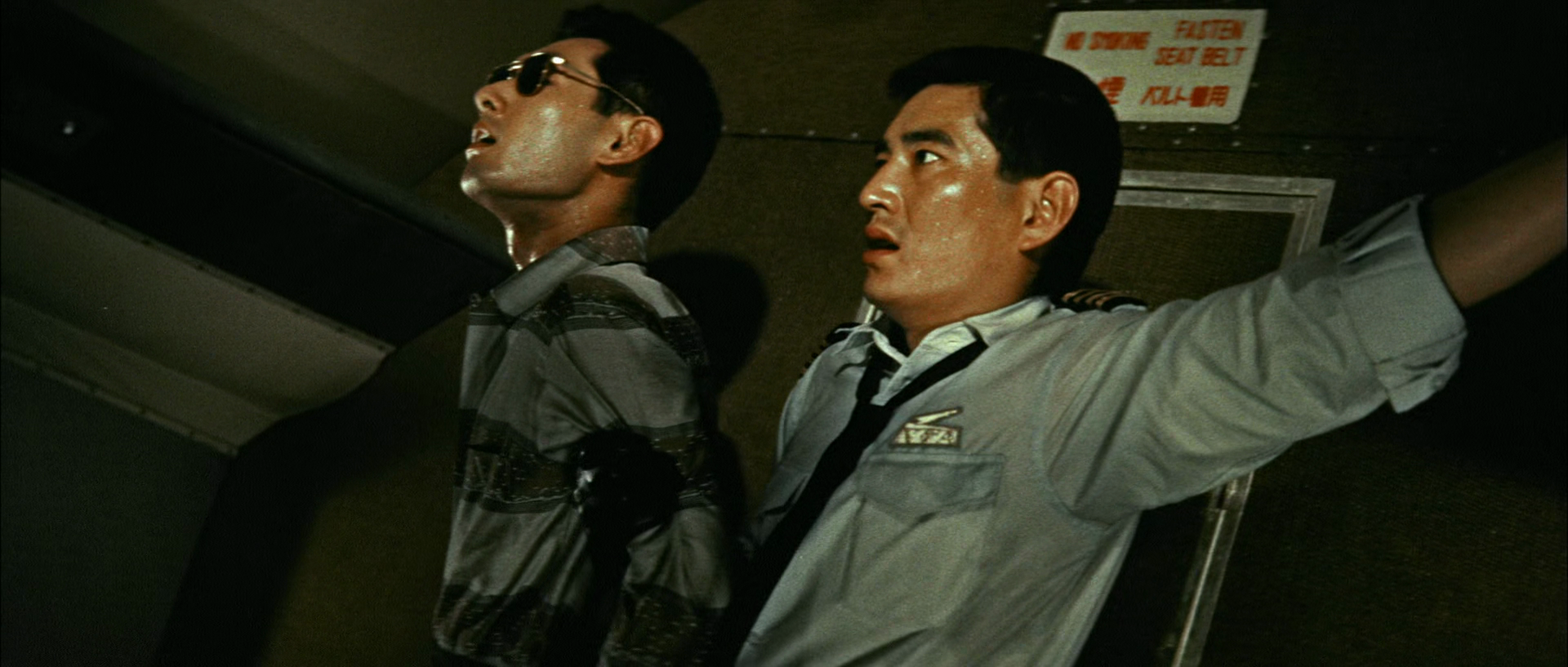
Four Hours of Terror (高度7000米 恐怖の四時間, Tsuneo Kobayashi, 1959)

It seems quite strange now to think of a time when air travel was both new and exciting and as easy as catching a bus. It’s this juxtaposition that Tsuneo Kobayashi’s hijacking thriller Four Hours of Terror (高度7000米 恐怖の四時間, Kodo Nanasen Metoru: Kyofu no Yojikan) plays with as an armed fugitive takes a passenger plane hostage in an attempt to escape after committing a murder while those on board struggle to accommodate themselves to this new form of transportation. 

This sense of exoticisation is obvious from the opening voiceover which sings the praises of Haneda airport as the gateway to a newly internationalised Japan though in actuality the flight in question is a domestic service travelling from Tokyo to Sapporo. The voiceover also introduces us to each of the passengers which come from differing strata of society and even includes a middle-aged American couple. There are in fact three generations of couples on board who seem to represent different stages of life from the newly wed students so wrapped up marital bliss that they barely notice anything else, to a long-married reporter and his wife on their first holiday together since their honeymoon, and an elderly couple returning from a trip to the capital who are mystified by this new age of mass media and air travel. The newlyweds apparently won this free trip on an aeroplane after agreeing to have their wedding broadcast on television in an early example of reality TV, reinforcing the sense of irony that they weren’t necessarily supposed to be on this doomed flight after all. 

Neither was car saleswoman Kazuko (Hitomi Nakahara) who has apparently been pulled away to Sapporo by a short notice business opportunity. She gets a standby ticket, as does her boyfriend/rival Fujio (Tatsuo Umemiya) who is also on track to the same opportunity. Weirdly, Kazuko is not overly sympathetic having randomly kicked a basket containing a little dog about to be smuggled on the plane by its doting owner, but does perhaps represent something of a more independent post-war womanhood even as she effortlessly deflects unwanted attentions from a client she may also have been exploiting in order to obtain his business. Having boarded the plane, she ends up sitting next to another man who requested a standby ticket and was using a surname that was the same as hers but evidently turns out to have been assumed. So lax is the security, you don’t necessarily have to travel under your legal name. In any case, she briefly flirts with him as an overture to a business relationship and also to annoy Fujio before overhearing a news report about the escaped fugitive on her portable radio.

Kida (Fumitake Omura), the fugitive, is dressed like a stereotypical yakuza which makes it odd that no one treats him with suspicion until they spot he’s carrying a gun which he had no trouble at all bringing on board. Though hijackings are not exactly unheard of, they aren’t particularly common either so no one would really suppose anyone had any reason to take a domestic flight to the provinces hostage, and really that was never Kida’s intention merely a last resort after being discovered. Later he gives a partial justification for his life of crime in that his mother beat him and then threw him off a cliff which is why he has a false leg. In any case, there’s a small moment of potential redemption towards the end when the kindly old lady tells him he can’t undo what he’s done, but could still resolve to change assuming they all survive this difficult situation with the plane which now has mechanical problems thanks to the gun going off. 

Even so, it’s the passengers who tie Kida up after the pilot ,Yamamoto (Ken Takakura), manages to disarm him by weaponising the plane. By flying to a high altitude, they knock him out with the air pressure, but are then faced with the mechanical failure of the landing gear which seems to be linked to with Yamamoto’s wartime trauma. A secondary drama revolves around his stoical character with one of the stewardesses apparently in love with him while simultaneously wary of his iciness given that he apparently showed no emotion after receiving the news his wife had passed away but simply flew the plane home as normal. Some see this as his devotion to the aircraft which is in a way a commitment to his duty over his human feelings, the factor that perhaps allows him to save the plane and get the passengers home safely. He is however saved by his love for his late wife with the cigarette case that contains her photo saving him from the worst effects of a bullet. 

The same may go for the co-pilot Hara (Kenji Imai) who is dragging his feet over his marriage to Yamamoto’s sister because he wants to achieve 3000 flight hours before getting married so he can call himself a real pilot. Though the film plants the seeds of these random plot threads and the social commentary that goes with them, it does not particularly engage while the hijacking itself remains fairly low key given that Kida is not a particularly “bad” bad guy. He just wants to go to a random place where the police won’t be waiting for him, but otherwise refrains from harassing the passengers save threatening a little boy travelling on his own to return to his parents after visiting his grandfather in Tokyo. In essence, there’s a kind of innocence and naivety in play which speaks to something of post-war hopefulness and a wonder in the frantic pace of progress in which the day is saved by keeping calm and carrying on even in the face of severe adversity.


Trailer (no subtitles)

Tokyo Sweetheart (東京の恋人, Yasuki Chiba, 1952)

It appears that even as early as 1952, some people were doing “very well, thank you” despite the suffering going on all around them. Then again, the heroes of Yasuki Chiba’s charming ensemble rom-com Tokyo Sweetheart (東京の恋人, Tokyo no Koibito) are relentlessly cheerful and likely wouldn’t use the word “suffering” to describe themselves, preferring instead to laugh at the foolishness of wealthy men and their petty squabbles while continuing to value what is honest and genuine above greed and insincerity.

At least, there’s a minor irony in the fact that Akazawa (Hisaya Morishige) makes his living selling pachinko balls, a a source of elusive hope that’s brought ruin to millions. His mistress, Konatsu (Murasaki Fujima), exclaims that when you’re doing well a ring or two is nothing, trying to manipulate Akazawa into buying a 500,000 yen diamond from the jewellers’ downstairs. Akazawa can afford to buy it, but he doesn’t really want to because he’s cheap and greedy. Later we’re introduced to a friend of portrait artist Yuki (Setsuko Hara) who does caricatures on the street corner below the office and hangs out with the three shoeshine boys opposite. Harumi (Yoko Sugi), a sex worker, has fallen ill presumably from tuberculosis. They only need 500 yen daily for her living expenses and medicine, but the only way they can hope to come up with it is by getting a large amount of people to part with a small amount of money which they are all willing to do as an act of solidarity. 

In rather farcical turn of events, the jeweller’s has commissioned a fake ring to display in the window for security purposes while they keep the real one in the safe. Konatsu suggests a complex plan to the jewellers of getting Akazawa to buy the diamond but giving him the fake which she will then return and pocket difference. Only Akazawa has the same idea, or rather he only wants to buy the fake one because Konatsu won’t know the difference and he doesn’t think she’s worth the expense of the real one. When he ends up with both rings, Akazawa’s wife, Tsuruko (Nijiko Kiyokawa), makes him give the fake one, which is actually real, to the tea girl, Tama, who wants to sell it, even if it is fake, to help Harumi not only with her illness but to escape sex work. The boys tell her she’s being selfish and naive. If Harumi had any way of escaping sex work she would have done so years ago, there’s no real hope for her now. “A shoe can be repaired,” one of the boys sighs, “but I’m not so sure about her.”

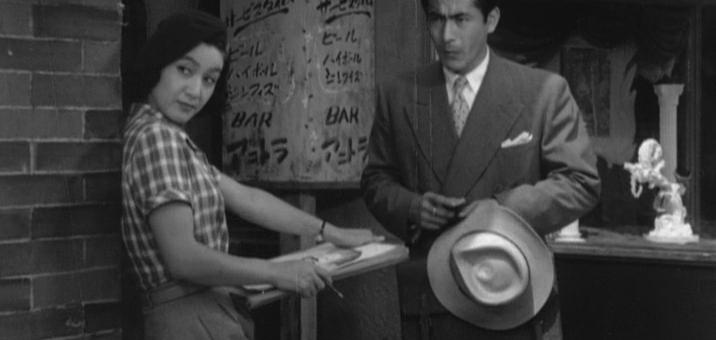
In some ways, it seems as if the genuineness of the ring is unimportant. The two are often mistaken for each other and few can tell the difference. After all, if you like it, what does its supposed authenticity matter and what does that really mean anyway? It does, however, seem to matter to Yuki who later says that she thought the film’s most genuine person, Kurokawa (Toshiro Mifune), was “gaudy and slick” when they first met because he was wearing a tacky tie pin and ring which stand out a mile to her as “fake”. Kurokawa in fact makes the replica jewellery displayed in front windows and dresses in that way as a kind lived brand though he does not necessarily approve of his own occupation. He exceeds expectations when he tracks the gang down in order to pay back some money Yuki had lent him when the conductor couldn’t give him change for his bus fare, as well as treating the shoeshine kids to ice creams and warning off the creepy yakuza type who keeps trying to bother Yuki for dates.

But the contradictions are brought to the fore when Harumi’s health declines and Yuki decides she ought to call the estranged mother to whom Harumi had written a comforting letter stating that she’d married and was living happily in Tokyo, enclosing a photo of herself and Kurokawa one of the shoeshine boys had taken on his toy camera. Yuki wants Kurokawa to pose as the husband so the mother won’t be so upset, only for him to point out that she now asks him adopt a fake persona after taking him to task for confusing people with his “fakes”. Again, this false comfort does seem to bring genuine relief to the mother even if as Kurokawa suspects she’s seen right through their ruse suggesting that authenticity of feeling is the only kind that matters.

Akazawa and his wife, meanwhile, bankrupt themselves trawling the river looking for the lost “genuine” ring sinking to all new depths of absurdity as even Tsuruko dons a diving suit and goes in to look herself. Unfortunately, all they find is a single pachinko ball. There is something quite abrupt about the sudden tonal shift from Harumi’s death bed to the gang laughing away at the foolishness of Akazawa and his wife, the boys convinced that Yuki and Kurokawa are now a couple though they never really enjoy much of a romantic resolution. Kurokawa lives a long way out of town and his home is surrounded by rubble and empty lots, signs of post-war devastation still not fully cleared away though Yuki and the boys, presumably war orphans, remain endlessly cheerful even as the extreme irony of Kurokawa’s rendition of Moon Over Ruined Castle washes over them. They do at least have each other and the strength of their community, living honest and genuine lives every day in contrast to men like Akazawa chasing pointless yet shiny trinkets and falling straight down the plughole themselves.


Song of the Flower Basket (花籠の歌, Heinosuke Gosho, 1937)

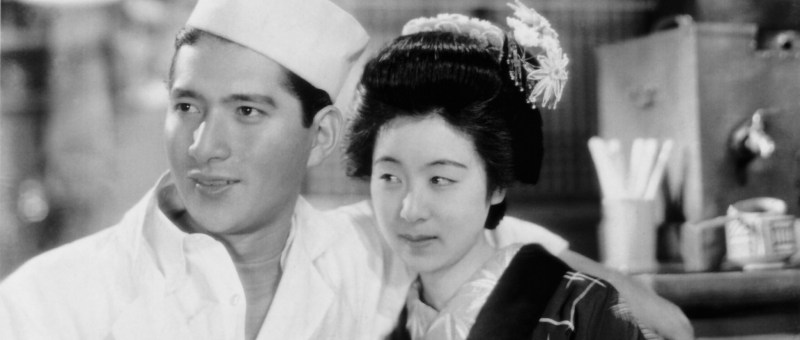
The daughter of a tonkatsu shop finds herself with an overabundance of suitors in Heinosuke Gosho’s generally cheerful yet occasionally dark melodrama Song of the Flower Basket (花籠の歌, Hanakago no Uta). Adapted from a novel by Fumitaka Iwasaki and scripted by Kogo Noda, the film finds its heroine caught at a moment of social change as she battles her snooty aunt for the right to decide her romantic future while her impoverished student boyfriend does something much the same in defying his family’s attempts to micromanage his life dreaming of the bright lights of Ginza. 

Yoko (Kinuyo Tanaka) is the “kanban musume” of her father Keizo’s (Reikichi Kawamura) pork cutlet restaurant, attracting customers with her charm and beauty while the Chinese chef her father brought back with him from Shanghai, Lee (Shin Tokudaiji), is the culinary star. Lee is secretly in love with Yoko whom he continues to refer to largely as “the young lady” and has long been writing an ode in her honour. Yoko meanwhile is in love with a penniless student, Ono (Shuji Sano), who at the beginning of the film has just returned home after visiting his family whom he has alienated by declaring that he doesn’t want to work in an office in the country while refusing an offer to marry into another family as an adopted son-in-law. The reason for this is less his pride than his desire to stay in Tokyo amid the bright lights of Ginza, sighing as he looks out into the neon-lit night gazing at adverts for Club Hamigaki toothpaste and Meiji Chocolate. The second reason may also be that he’s fallen for Yoko but given his precarious financial situation and lack of prospects does not quite dare to imagine a future with her. 

He must however be serious as we later learn he’s given up going to hostess bars with his friends, a bar girl greeting him in the restaurant evidently not having seen him in ages asking where he’s been much to Yoko’s embarrassment. The encounter places a seed of doubt in her mind in a minor role reversal as she begins to resent Ono’s past irrationally annoyed by the idea he has dated other women. Meanwhile, at the memorial event marking 11 years since her mother passed away while working as a steward on a boat in Singapore, Yoko’s snooty aunt tries to set her up with an arranged marriage to an Osakan doctor who may or may not marry depending on the “negotiations” but has also been promised his own clinic by his wealthy parents if the marriage is confirmed. Okamoto (Toshiaki Konoe) has visited the restaurant to get a better look at Yoko making him the third suitor to encircle her even though the chief concern of the family is that Yoko is almost 24 and therefore ageing out of top tier matches.  

To his credit, Yoko’s father is fully in her corner trying to stand up to the domineering aunt who is definitely overreaching in trying to micromanage the romantic lives of her nieces in the absence of her sister. He determines to find out if Yoko has her eye on someone already to get the aunt off their backs, but the situation develops in an unexpected direction when Lee mistakenly assumes that she likes him back. Too shy to say himself, he advises Keizo to ask frequent customer and best friend of Ono, Hotta (Chishu Ryu), who is on track to become a Buddhist priest and take over the family temple, only Hotta obviously tells him, correctly, that Yoko is in love with Ono having completely forgotten that Lee had once confessed his feelings to him. 

The film does its best to present a more positive vision an internationalist Japan even in 1937 despite the Aunt’s obvious disapproval of the family’s wandering past and is largely sympathetic of the lovelorn Lee yet implies that a romance between he and Yoko is so unthinkable that no one really considered the possibility that he may be in love with her himself even though it is incredibly obvious given his ongoing attempts to write a love song while he’s even torn out a picture of Yoko which appeared in a magazine and hung it on his wall. Yoko is oblivious to his feelings, believing that he is in love with their waitress, Oteru (Yaeko Izumo), who is indeed in love with him, and perhaps doesn’t appreciate the effect moving Ono in as a trainee chef will have on him both professionally and emotionally. The message that is emerges accidentally or otherwise is that Lee’s place at the cafe is insecure despite his skill being a large part of its success as he falls into a deep depression and eventually decides it’s too painful for him to stay. 

The revelations surrounding Lee further destabilise Yoko’s confidence in her choice of Ono whom she constantly doubts even suspecting he may have committed a violent crime when carted off by the police after newspaper reports stating the bar hostess he introduced her to earlier has been murdered in her apartment. Perhaps it’s normal enough to be uncertain if you’ve made the right choice in the early days of a marriage, but believing your spouse capable of murder is a significant stumbling block as is her final admission that she doesn’t really trust him and isn’t ready to accept his past with other women in a further reversal of their roles given he has now married into her family and taken her name. Nevertheless, the crisis seems to be repaired by her father’s simple act of ordering a round of beers making clear that he plans to celebrate and obviously still has confidence in Ono while preparing to adapt their restaurant to their new circumstances by branching out into sukiyaki. Expressing some of the anxieties of the 1930s from the precarious economy and uncertainty of the future to changing social mores as young people reject the traditional to craft their own romantic futures, Song of the Flower Basket nevertheless ends on a note of melancholy in the wandering Lee’s ode to loneliness and heartbreak under the neon lights of Ginza.


Scandal (醜聞, Akira Kurosawa, 1950)

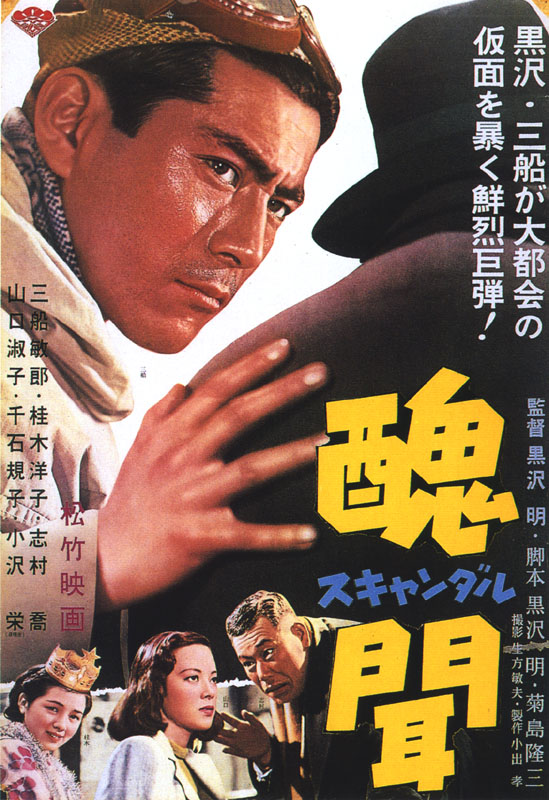
“Freedom of the press or harassment?” The more things change, the more they stay the same. Akira Kurosawa’s attack on the declining moral standards of the post-war society as reflected in the duplicity of the gutter press has unexpected resonance in the present day in which the media is simultaneously unwilling to challenge authority and in thrall to the populist allure of celebrity gossip with sometimes tragic results. The aptly named Scandal (醜聞) is essentially a morality tale which draws additional power from its seasonal setting and embodies the soul of the contemporary society in a conflicted lawyer consumed by internal struggle against despair and hopelessness. 

The more literal scandal however revolves around a well known singer, Miyako Saijo (Yoshiko (Shirley) Yamaguchi), and a motorcycle-riding artist, Ichiro Aoe (Toshiro Mifune), who meet by chance while staying at the same remote mountain inn. Having ironically headed to the mountains to escape the various “annoying things” that plague her in the city, Miyako has been pursued by two muckrakers from the tabloid press who take umbrage at her refusal to see them. They are then fairly delighted when they manage to snap a picture of Ichiro and Miyako standing on her balcony looking out at the mountains like a young couple in love. They deliver the photo to their seedy boss, Hori (Eitaro Ozawa), who is over the moon with excitement at his new business prospects. Suddenly Ichiro and Miyako are on posters all around the city with headlines such as “Love on a Motorcycle” and “Miyako Saijo’s secret love – revealed!”. 

Though Ichiro is a semi-public figure himself having been featured in magazine spreads as an artist on the rise, he is not a worldly man and is shocked by the idea that the press can make something up and print it with no consequences. He feels he must resist not just on a personal level angry to have been misrepresented but for the post-war future to ensure that the press is held to account and that it does not misuse its power to breach the privacy of ordinary citizens. To his mind, they only get away with it because most people just ignore them and wait for the scandal to pass, a sentiment born out by Hori who dismisses a concerned underling with the reminder that they’ve never yet been sued so they need have no fear saying whatever they like whether it’s true or not. “The kind of snobs we target think the law is beneath them” he adds, suggesting that most people prefer to think of the gutter press as something they can safely ignore and that it’s only themselves that they show up in their torrid obsession with the lives of others. 

But Hori also ironically defends his right to press freedom and quickly hits back that he’s being oppressed by those who wish to silence his right to free speech even when what he’s saying isn’t true. Lawyer Hiruta (Takashi Shimura) who offers to represent Ichiro in his lawsuit quickly identifies Hori as a duplicitous conman but also allows himself to be manipulated accidentally accepting a bribe after being led to believe that Hori has a top legal expert on retainer and the case is hopeless unless Miyako, who has so far maintained a dignified silence, can be persuaded to join as co-plaintiff. Ichiro had decided to accept Hiruta’s offer of representation largely on meeting his teenage daughter, Masako (Yoko Katsuragi), who has been bedridden with TB for the last five years. Masako is a pure soul whose isolation from the contemporary society has allowed her to maintain her innocence and humanity but it’s also true that it’s the society that made her ill in the first place.

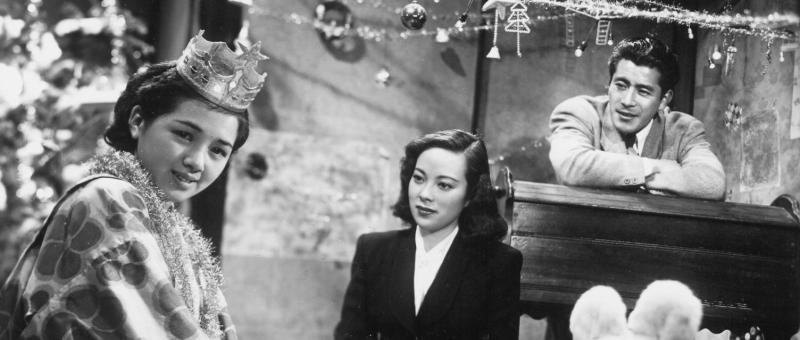
The morality play reaches a climax on Christmas Day as Ichiro delivers a tree on his motorbike while Miyako sings carols for a radiant Masako who is at least sitting up and looking much healthier than she’s ever been before. But the more Hiruta debases himself, caught between an accidental debt to Hori, his own lack of conviction, and the frustrated desire to do right, the sicker she gets as if poisoned by post-war duplicity. Even so, Ichiro continues to defend him insisting that Hiruta isn’t a bad person just a weak one and that in the end he won’t be able to go through with betraying him but will eventually come clean and tell the truth when it counts. Ichiro’s faith is as much in the institutions of the new democratic Japan as it is in Hiruta as he explains at the trial admitting that he may have been naive in placing too much trust in the legal system thinking that he couldn’t lose because he knows he’s in the right. As the opposition lawyer points out, that’s not a very good legal argument because his client thinks he’s in the right too only he doesn’t know that Hori is both a liar and an idiot who’s staked everything on the assumption that Hiruta won’t expose him for bribery, which would at least strongly imply he can’t back up his story, because it would mean destroying himself. 

In the end it’s Hiruta who puts himself on trial, baring his soul to the court which he acknowledges he has betrayed in his negligence and wilful obstruction of justice. It’s a victory for truth and decency and a turn away from the duplicitous, capitalistic mores of men like Hori who think they can do whatever they want and only laugh at those who value fairness and compassion. “In all my 50 years I’ve never seen a more confused age” Hiruta explains speaking of post-war chaos and the forced comprises of the intervening years of despair and desperation. As he coaxes the denizens of a small bar into an early rendition of Auld Lang Syne on Christmas Day, each vowing that this time next year things really will be better, many of them breakdown in frustrated longing drowning their sorrows as they continue to yearn for better times they do not really believe will come. But then like all the best Christmas films, this is also a redemption story of a man who decided that it wasn’t too late after all and that he might have to destroy himself in order make himself anew and be the man his daughter always knew he could be even if in the end he could not save her from the ravages of the post-war society.


Scandal screens at the BFI Southbank, London on 10th & 24th January 2023 as part of the Kurosawa season.

A Hen in the Wind (風の中の牝鶏, Yasujiro Ozu, 1948)

Sometimes melancholy as he might have been, the cinema of Yasujiro Ozu leans toward the wholesome. His families may experience crises, but they are good people who have generally learned how to be cheerful in the face of adversity. 1948’s A Hen in the Wind (風の中の牝鶏, Kaze no naka no Mendori), however, is unusually dark though perhaps not inappropriately so as it tries to make sense of a painful moment in time by re-envisaging it in terms of a marriage. 

Set very much in the immediacy of the contemporary era, the film opens ominously with an intimidating policeman taking a local census which introduces us to Tokiko (Kinuyo Tanaka) who lodges in the upstairs of a small, run-down building along with her young son Hiroshi while her husband Shuichi (Shuji Sano) has not yet returned from the war. Times are tough for everyone, and Tokiko is finding it increasingly difficult to make ends meet with her seamstressing job as prices rise everywhere. She’s down to her last kimonos which she asks an old friend, Akiko (Chieko Murata), to help her sell. Akiko turns to broker/madam Orie (Reiko Mizukami) who feigns exasperation to advise that a pretty woman like Tokiko, still comparatively young at 28, could make more money in her line of work. Akiko is offended on her friend’s behalf and the two laugh it off together, but when Hiroshi suddenly develops colitis and needs to be admitted to hospital Tokiko is left with no choice but throw herself on the mercy of Orie. 

Akiko scolds her friend, hurt that she didn’t come to her first and disappointed that she has chosen to degrade herself. Tokiko is sorry too, worried that if she had asked Akiko for the money she’d have found a way to get it even if she had none to spare and Tokiko would rather carry the burden herself. She wonders if she made the right choice. There was still furniture she might have been able to sell, but she wanted to keep it so that her husband would have a home to come home to. What else could a mother with a sick child do? This way at least she got the money quickly and Hiroshi recovered. It was a one time thing already in the past and no one needs to know. The friends agree to put it behind them as just another minor humiliation of life in the immediate post-war period. 

And then less than a month later Shuichi returns. The joyful reunion is disrupted when he idly asks about Hiroshi’s health and then becomes fixated on how Tokiko managed to pay the hospital bills. She doesn’t want to lie and would rather there be no secrets between them so she tells him the truth. Shuichi does not take it well. He tries to readjust to their married life but finds himself consumed with rage and unable to sleep. Intellectually, he knows his wife had no choice given the situation she was in and in one sense does not blame her but in the other he cannot accept it. 

Tokiko’s transgression undermines his fragile sense of masculinity in every possible way. He feels partly responisble. He wasn’t there to protect her because he was away at the war. If he’d returned a month earlier, she wouldn’t have needed to make such a sacrifice. Unlike many late returning soldiers, Shuichi walks straight back into his old job, easing the family’s financial hardship even as its harmony is strained by his ongoing resentment. Shuichi cannot help making this all about him. His wounded pride, his broken future, his romantic disappointment. He becomes obsessed with the idea of his wife defiled, insisting on tracking down the brothel where Orie brought her to ask if it really was just the one time while exploring the business for himself.

While schoolchildren sing cheerful folksongs in the playground behind, Shuichi talks to a 21-year-old who has only contempt for customers like him who ask too many hypocritical questions. She explains the she didn’t choose this sort of work, it’s the only way she can support her family, once again, ironically, because of a male failure in this case her father being unable to provide for them while her mother has passed away. Shuichi didn’t come for the full service, and so he eventually leaves, discarding money as he goes partly out of pity and partly in atonement. He runs into the girl again later and even shares her lunch during which he talks to her in a more fatherly fashion, encouraging her that she is not ruined and still has the right to strive for a brighter future. To further prove his point, he commits to finding her an “honest” job, asking with his friend at the company who is sympathetic and also wants to help. Only, his friend can’t understand. If Shuichi can sympathise so much with this young girl why can’t he forgive his wife who, to his mind, has done nothing wrong? 

Tokiko is perhaps a symbol of the pure Japan debased by the male violence that is militarism. Shuichi has come home from the war but carrying trauma of his own which he projects onto the loyal self-sacrificing wife who waited patiently for his return. Yet Tokiko blames herself, she begs him to beat her, hate her, only not to leave and not to be unhappy. Shuichi only comes round after accidentally pushing her down the stairs in a rare moment of shocking domestic violence totally unexpected in an Ozu movie (even if not quite unique). Suddenly overcome with post-war humanism, Shuichi forgives his wife essentially giving her the same speech he’d given to the girl only with greater emphasis. Life is long and their path is hard. They need to “be more accepting and love one another”, “conquer hardship through laughter and trust”, so that they might have a “true marriage”. Tokiko’s redemption, and perhaps that of her nation, is dependent on the former soldier Shuichi’s forgiveness, and of her acceptance of it, rather than a recognition of her blamelessness. In any case, a line has been drawn. The future starts now and it’s going to be a better one built on compassion and mutual forgiveness rather than selfishness and resentment.


A Hen in the Wind screens at BFI Southbank on 10th/14th September as part of Kinuyo Tanaka: A Life in Film

Brothers and Sisters of the Toda Family (戸田家の兄妹, Yasujiro Ozu, 1941)

Yasujiro Ozu made only two films during the height of the war. After being drafted for the second time in 1943, he famously sat out the main action from the relative safety of Singapore where he was able to indulge his love of Hollywood cinema to an extent impossible in Japan. Somewhat surprisingly, 1941’s Brothers and Sisters of the Toda Family (戸田家の兄妹, Toda-ke no Kyodai) does not seem to fit the censor’s ideal in that it contains little to no patriotic content and never mentions the war save for presenting the idea of “Manchuria” as a place to start again free of burdensome codes of social oppression but, crucially, embraces classic ideas of filial piety which is presumably how it came to be approved by the powers that be. 

Shortly after the Toda family gathers for the first time in quite a while to celebrate Mrs. Toda’s (Ayako Katsuragi) 61st birthday, Mr. Toda (Hideo Fujino) drops dead of a heart attack and it is discovered that the family firm is near bankruptcy. The large, Western-style mansion where the family photo so recently took place will have to be sold and Mrs. Toda and her unmarried daughter Setsuko (Mieko Takamine) will have to move in with one of the married children. 

Like the later Tokyo Story, Brothers and Sisters of the Toda Family concerns itself with the failure of filial piety in an increasingly corrupt society. Multigenerational homes might once have been a cultural norm, but perhaps it’s understandable that few people might be excited about the prospect of their mother suddenly moving in with them especially as the traditional Japanese house is not designed with personal space in mind. Power dynamics seem to be the problem at the first home where daughter-in-law Kazuko (Kuniko Miyake) makes no secret of the fact that the two women are in the way. She resents having to shift everything around and reorder her home to give them space upstairs, complains about their noisy pet bird, and is then put out when Setsuko and her mother fail to greet her guests even though she specifically asked them to absent themselves in order to avoid meeting them. 

At the next home, however, it’s more a question of maternal heirarchy. Daughter Chizuru (Mitsuko Yoshikawa) has two children and the oldest, her son Ryokichi (Masao Hayama), is very attached to his grandma, so much so that he confides in her about skipping school because he got into a fight and is worried about reprisals. Chizuru’s main objection to them moving in had been that it might distract Ryokichi from his studies, and it’s clear that she finds it difficult to assert her own maternity with her mother hovering in the background. She accuses Mrs. Toda of interfering by keeping her promise to Ryokichi and not telling her about skipping school, making it impossible for them to keep living in the same house. 

Rather than descend on the home of the last daughter, Ayako (Yoshiko Tsubouchi), who is hurt but perhaps relieved to hear they won’t be living with her, Mrs. Toda and Setsuko decide to move into a dilapidated summer house the family thought too worthless to sell. They are now thoroughly marginalised, living in a literal half-way home having lost their position in society. Setsuko, naive but earnest, is the keenest to adapt to her circumstances. Her best friend Tokiko (Michiko Kuwano) is from an “ordinary” family and tries to point out, as nicely as possible, that Setsuko is going to find it much more difficult than she thinks to move beyond her privilege. Aware of her precarious circumstances, she expresses the intention to work but is quickly shut down by Chizuru who finds the idea highly offensive and in fact embarrassing. She urges her to think about a socially advantageous marriage instead.  

Shojiro (Shin Saburi), the youngest and as yet unmarried son, urges her to do something much the same at the film’s conclusion but also offers his sister the freedom to fulfil herself outside the home by accompanying him to the land of the possible, Manchuria. Previously regarded as a feckless failure, Shojiro decided to take up the opportunity to make something of himself in Japan’s new colonial endevour. On his brief return to mark the first anniversary of his father’s passing, he appears in a China-style suit and fiercely takes his siblings to task for their disrespect of his mother. It has to be said, however, that he does not particularly take Mrs. Toda’s feelings into account and foregrounds his own duty of filial piety in insisting that she live with family rather than alone excluding the possibility that she too may prefer her freedom. In any case, it’s freedom he dangles before Setsuko in suggesting that in Manchuria you can do as you please without needing to worry about what others think. He offers her the possibility of marriage, but also of working and a kind of independence which is bound within the family. For herself, Setsuko wants to bring Tokiko too, positing a possible arranged match between her friend and her brother which other members of the family may find inappropriate in its transgressive breach of the class divide. 

The family is both dissolved and restored as the three Todas prepare to remove themselves from a corrupted Japan for, ironically, a new start in the home of old ideas, China, where there is both the promise of modernity and all the “good” aspects of the traditional, to whit filiality. Fulfilling the censors demands in subtly criticising the decadent, selfish, and hypocritical lifestyles of an impoverished nobility while presenting Manchuria as an opportunity remake a better, purer (and subversively progressive) Japan through imperialist pursuits, Brothers and Sisters of the Toda Family offers an ambivalent portrait of contemporary Japanese society in which the young save themselves but only by saving their parents first. 


Brothers and Sisters of the Toda Family is available on blu-ray in the UK as part of the BFI’s re-release of Tokyo Story in its recent 4K restoration which also includes an introduction to Tokyo Story from Tony Rayns, and Talking with Ozu: a tribute to the legendary director featuring filmmakers Lindsay Anderson, Claire Denis, Hou Hsiao-hsien, Aki Kaurismäki, Stanley Kwan, Paul Schrader and Wim Wenders. The first pressing also comes with a booklet featuring an essay by Professor Joan Mellen, archival writing by John Gillett and Lindsay Anderson, and a biography of Yasujiro Ozu by Tony Rayns.

It is also available to stream online via BFI Player as part of the BFI Japan Yasujiro Ozu collection.

Titles and opening (no subtitles)

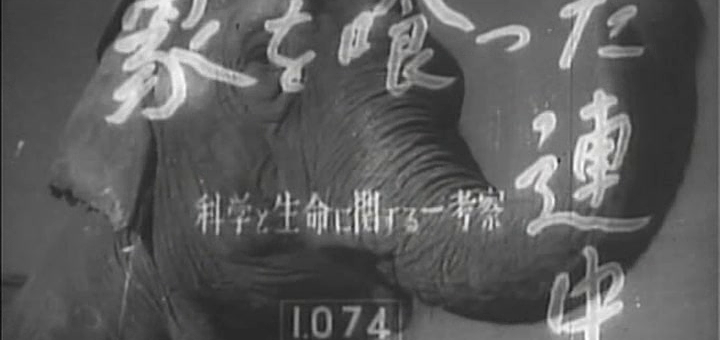
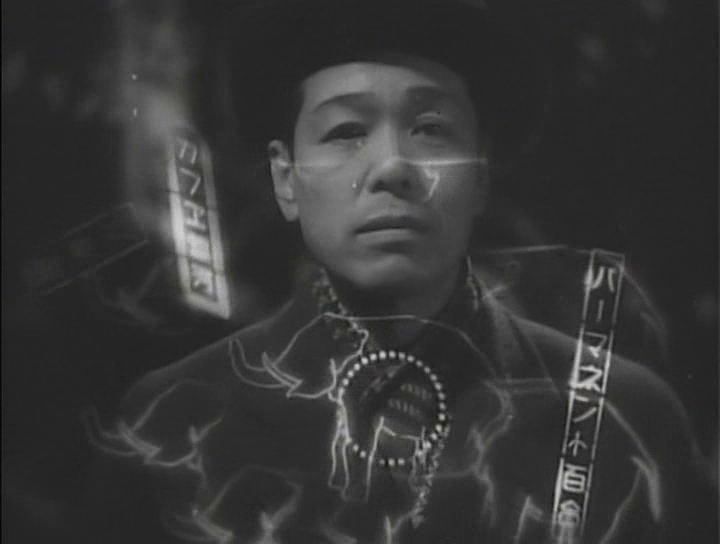
The Fellows Who Ate the Elephant (象を喰つた連中, Kozaburo Yoshimura, 1947)

The Japan of 1947 was one still very much caught up in post-war chaos. In the cities, most particularly, hunger was a major problem. The Fellows Who Ate the Elephant (象を喰つた連中, Zo wo Kutta Renchu) may have a title that strongly recalls the screwball comedies of the ’30s, but is less slapstick comedy than dark satire in its central premise that a bunch of idiot mad scientists might actually eat a deceased elephant in extreme dedication to “mottainai” waste not want not philosophy coupled with the justification that all is permissible in the name of science. 

The elephant is, apparently, the last in Japan and was the childhood friend of zookeeper Yamashita (Chishu Ryu) who brought him all the way over the mountains from Thailand after the war. “Shiro-chan” is very ill with some kind of elephant cold but for some reason the doctors the zoo uses aren’t vets specialising in large, exotic animals but virologists. While they stand around apparently mystified, Yamashita enquires after the professor he usually deals with but is told that, despite being over 60 years of age, he’s currently away on honeymoon after marrying a very young and extremely beautiful woman. Sadly, Shiro doesn’t make it. The professor is saddened to learn of the death from the paper and wonders if it might have been a virus similar to one which attacks hoofed animals like donkeys and horses but is not usually found in Japan (Shiro is Thai after all). 

This is relevant because the disease is fatal and contagious but does not usually pass to humans and is only a risk if you come into direct contact with it, like say if you eat meat from an infected animal. No one would eat an elephant though so there’s nothing to worry about. Enter extremely unpleasant mad scientist Wada (Shinichi Himori) who decides that science dictates they must find out if it’s sanitary to eat elephant meat. Though Wada ropes in fellow scientist Baba (Yasumi Hara) with his scientific justifications, he tricks the other two into eating some without telling them what it is. Unforgivably, he even gives some to Yamashita and seems to get a kick out of feeding him his own childhood friend when Yamashita had only come on instruction from his boss to apologise for being over emotional the day before. Yamashita leaves feeling sick after Wada tells him what he was eating for additional effect, but his wife (Chiyoko Fumiya) later remembers a story he told her about fellow elephant drivers in Thailand who ate some elephant meat from an infected animal and were dead within 30 hours. 

After hearing Yamashita’s concerns, the scientists begin investigating and indeed find cases of people dying after eating contaminated meat. The only cure is the serum they use to treat the horse infection the professor mentioned, but it seems nowhere has any in stock (the disease is rare in Japan after all). The idiot scientists come to the conclusion they will die in exactly 30 hours’ time and decide to put their affairs in order rather than consult an actual doctor who might be able to help them. This mostly involves trying to explain their foolishness to their wives. Watanabe (Takashi Kanda) is a father of three with another child on the way. He regrets that he hasn’t been present enough in his family life and has failed to adequately provide for his wife who he will shortly be leaving to raise four children alone. Nomura (Toru Abe) meanwhile is an uxorious newlywed constantly worried that his wife (Kyoko Asagiri), who already dislikes Wada for being a bad influence on her husband, will not be able to bear the anxiety of knowing he may soon die. Baba who has only his parents retreats back to his old country home to apologise for not being a better son. 

Wada, meanwhile, moans about everyone else’s understandable desires to comfort their wives and families. He criticises Yamashita for trying to excuse himself because he’d rather go home and have dinner with his wife, while mocking Nomura for being a henpecked husband. This might partly be because he has no wife or family of his own and is currently chasing after Tomie (Akemi Sora), a maid at his boarding house, who seems pretty indifferent or even hostile to his attentions, joking that she’d celebrate on hearing of his demise. She eventually agrees to go out with him, but only if he really dies. Other than the wives, no-one quite believes the guys’ bizarre story. Baba’s parents even try to stop him going back to Tokyo when a potential cure is located in case he goes “even more mad”. 

In these trying times, the idea that someone might try to eat a dead elephant is perhaps not quite as ridiculous as it might first seem. The act of trying it, however, also plays into the constant critiques of bad or irresponsible science which are a mainstay of films in the immediate post-war era. Wada knows that he can and so he doesn’t bother to think about if he should, spinning tales of Jenner and Koch as if they’re about to make some grand lifesaving discovery. His brush with death does at least begin to humble him as he finally accepts responsibility for the unexpected consequences of his cruel prank, realising that as a man with no wife or family it should perhaps be him if anyone is going to have to make a sacrifice. Finally someone manages to get through to the professor on the phone who tells them they’re all very stupid and haven’t thought of something perfectly obvious that makes all their panicking completely pointless, but at least the surreal 30-hour near death experience has brought out a warmer side of Wada and given a few irresponsible scientists a quick lesson in social responsibility. 


Dispersed Clouds (わかれ雲, Heinosuke Gosho, 1951)

Heinosuke Gosho made his name before the war as a master of “shomingeki” – often humorous but generally naturalistic portraits of lower middle class life. Becoming synonymous with a Chekhovian mix of laughter and tears later dubbed “Goshoism”, he continued into the post-war era as one of its most prominent humanists, less directly sentimental than Kinoshita but with no less faith in human goodness. Always ahead of the curve, he was among the first Japanese directors to break with the studio system, setting up his own production company (along with director Shiro Toyoda, cameraman Mitsuo Miura, and writers Jun Takami, Junji Kinoshita, and Sumie Tanaka), Studio Eight, after becoming embroiled in the industrial disputes which engulfed Toho in the late ‘40s. Gosho’s participation was apparently more out of a sense of loyalty to his mistreated colleagues than it was political conviction, but in any case he found himself unable to continue working in a system which prevented him from expressing himself to the fullest of his intentions.

1951’s Dispersed Clouds (わかれ雲, Wakaregumo) was the first film released by Studio Eight, distributed by Shin Toho (the “new Toho” set-up by those same colleagues Gosho had supported in the ‘40s). In a sense it addresses similar themes to other post-war films making use of the familiar “cloud” metaphor, but these clouds are dispersing in more positive directions in that they are wilfully floating away from the traumatic past towards a brighter, more compassionate future, as perhaps was Gosho as he embarked on a new phase of his career.

The heroine, Masako (Keiko Sawamura), is a woman caught between old worlds and new. Very much of the post-war era, she is a university student who intends to work after graduation and values her independence but nevertheless is also looking back towards a childhood she feels she was denied, gradually coming to understand that it was she who denied herself in her resentful mistreatment of her young step-mother in mourning of the birthmother she lost at only six years old. The cloud from which she originally disperses is a group of five fellow students with whom she has gone on a walking holiday exploring rural Japan – an increasingly common pastime in the post-war era but one perhaps still a little unusual for five young women travelling alone. Accompanying her friend into a local photography shop in search of an extra roll of film for her camera, Masako receives the unwanted attentions of the storeowner and makes a speedy escape only to fall ill outside the station and cause the gang to miss their train. Irritated, Masako tells the others to go on without her while she stays in a nearby inn convalescing from what is apparently light pneumonia but also, it has to be admitted, an intense bad mood. 

Masako’s friends are keen to help her, but also exasperated. “You never accept the kindness of others” they lament to her passive aggressive desire not to bother them on their trip, while later plotting how best they can help her seeing as she wouldn’t accept their money if they tried to give to her so she’ll be able to pay for the doctor after they’ve left. They never really consider waiting for Masako to recover, resolving to continue on with their holiday, but do check in on her from time to time from the road with the offer to join them later seemingly open. Meanwhile, they’re all swooning over the improbably handsome country doctor, Minami (Yoichi Numata), who swoops in to treat Masako with a no-nonsense yet caring bedside manner.

Only six years older than Masako, Minami is a certain young man who has found his forward path in life. He has his own small practice which is woefully ill-equipped to cater for the entire town (he can’t admit Masako because he is already overflowing with patients sleeping on the floor), but dreams of building another clinic in an even smaller village further up the mountain where they don’t even have electricity. Despite her friends’ giggling, Masako is in too much of a mood to notice Minami much from her sick bed but later takes a liking to him though mostly in flight when her hated step-mother Tamae (Taeko Fukuda) finally arrives to take her back to Tokyo.

While at the inn, Masako bonds with the kindly maid, Osen (Hiroko Kawasaki), who brought her to there in the first place after noticing her in distress at the station. The innkeeper, who has a flighty modern daughter of her own, is not best pleased that Osen has brought sickness into the house and even less so that it’s a young woman whom she is not convinced is the right kind of clientele (her attitude changes when Tamae arrives laden with expensive gifts). Osen, who lost a husband in the war and daughter in infancy, takes to the young woman with maternal warmth – something which Masako has been seeking ever since losing her birth mother. A woman without a child and a child without a mother easily slip into a familial relationship, but rather than jealous Osen is only sad when she sees how much Tamae is trying and failing in the same role while Masako resolutely rejects her out of nothing more than childish resentment.

Masako, self aware to a point, describes herself as “spoiled, nervous, and selfish” and seems to want to change without knowing how. She tells Minami that she dislikes people in general because they’re all liars and can’t be trusted. Nevertheless, she finds herself hanging around Minami’s clinic in order to avoid Tamae and half convinces herself she is in love with him. An ill-advised five mile hike to the next village to find the earnest young doctor provokes an awkward encounter between the two in which it becomes perfectly obvious that Minami is devoted to his practice, sees Masako only as a patient, and is not really interested in her newfound desire to pursue a deeper union. He tells her, politely, that she is too much trouble and would only be an inconvenience. He doubts that she, a middle-class woman from Tokyo, will be able to adjust to the privations of life in the mountains and is perhaps unconvinced that she has acquired the sufficient maturity to try after just one night of having fun “helping people”.

Masako is not wounded by his words but is enlightened by them on discovering that Minami has lost people too – his brother and friends in the war, but where her childhood loss has made her self-involved and resentful, his grief has made him generous and openhearted. Minami has dedicated himself to the wellbeing of all mankind, which might or might not mean that he has little time for deeper individualised connections, but in any case though she doesn’t realise it herself what Masako is seeking isn’t Minami or a romance but a path back into the world as someone less closed off and unforgiving. Thanks to Osen’s warmth and Minami’s generosity she is able to escape her sense of self-imposed inertia and let her mother go.

Because of this she gives to Osen the precious silver spoon she had treasured as a keepsake from her mother, remarking that she doesn’t need it anymore, while Osen then gives her the rather ironic gift of a spoon case she’d knitted as a present. Though the ending is positive with Masako preparing to leave the transitory space of the mountain town to return to Tokyo “healed”, it is also filled with a quiet anxiety for the older Osen who has, in a sense, been bereaved twice in losing another daughter and being left all alone, knowing that Minami will soon be off to his own bright future. Osen made her new start some time ago after reaching the forward-thinking conclusion that she wasn’t happy with the idea that women must have soft hands. She declares herself happy in a calm sort of way, but is also filled with regrets from the past in having chosen to marry the man chosen for her over the one she loved and finding only unhappiness. Her counselling of Masako not to make the same mistake is perhaps one of the things that sends her, mistakenly, off towards Minami, but unlike the younger woman Osen seems primed to remain in the liminal space of the mountain town unable to leave the past behind in order to move forward in a more positive direction. 

“This world is not so easy” Masako is repeatedly told, but in true Gosho style, it needn’t be so hard if only you learn to live generously with a forgiving heart. The rather mercenary relationship between the innkeeper and her flighty but shrewd daughter is directly contrasted with the innocent yet melancholy one between Osen and Masako, but perhaps neither is really more positive than the other only different. In any case, Osen and Masako, like any parent and child, must eventually part. Masako boards the train into the future smiling brightly, a cloud dispersing from the whole, unburdened by the traumatic past and floating defiantly forward on a path of her own choosing resolved to live for others rather than fixating on her personal pain.


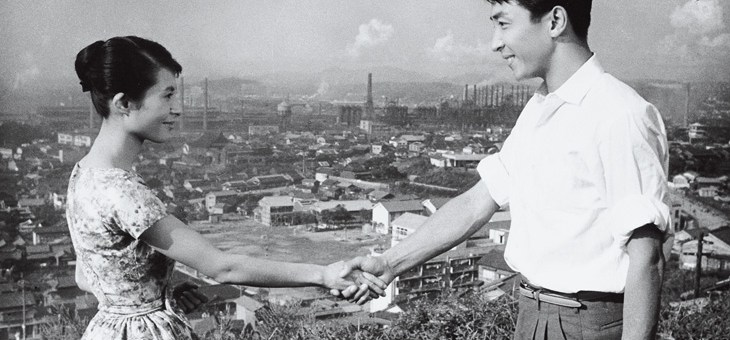
The Eternal Rainbow (この天の虹, Keisuke Kinoshita, 1958)

Eternal rainbow poster 1Famously, towards the end of the war, Keisuke Kinoshita got himself into trouble with a dialogue free scene of a mother’s distress as she sent away the son she’d so carefully raised “for the emperor” towards an uncertain future in the midst of hundred of other, identically dressed faceless boys. Army might have showcased the director’s propensity for resistance, but one could also argue that there was just as much propagandistic intent in the post-war films as their had been in the militarist era even if the messages they were selling were often more palatable. 1958’s The Eternal Rainbow (この天の虹, Kono Ten no Niji) is a case in point. A portrait so positive one wonders if it was sponsored by Yahata Steel, The Eternal Rainbow is nevertheless conflicted in its presentation of defeated post-war hope, exploitation, and growing social inequality even as it praises its factory city as a utopian vision of happy industry and fierce potential.

A lengthy opening sequence featuring voice over narration recounts the history of the Yahata Steel Works which began operations in 1901 in Northern Kyushu and now employs thousands of people, many of whom live nearby in the ever expanding company dorms the newer models of which feature bright and colourful modern designs in contrast to the depressing grey prefab of the traditional workers’ homes. Gradually we are introduced to our heroes – chief among them Mr. Suda (Yusuke Kawazu), a young man from the country who saw a factory job as his over the rainbow but is rapidly becoming disillusioned with its dubious gains. Rather than the company dorms, Suda rooms with the foreman, Kageyama (Chishu Ryu), and his wife Fumi (Kinuyo Tanaka) whose young son Minoru (Kazuya Kosaka) didn’t qualify for a factory job on account of his small frame and his been unable to stick at anything in the precarious post-war economy. Meanwhile, Suda has made friends with an older worker, Sagara (Teiji Takahashi), who has fallen for a secretary, Chie (Yoshiko Kuga), but her family are dead against her marrying a factory worker while she is also in a relationship with a college educated engineer, Machimura (Takahiro Tamura), but is beginning to doubt the seriousness of his intentions.

The drama begins when Sagara employs Kageyama to act as a go-between in a formal proposal of marriage to Chie’s parents, the Obitas. Kageyama didn’t really want to be a go-between because it’s gone badly for him before and he thinks this one is a non-starter too – women around here have their sights set on office workers, no one in the arranged marriage market is looking to marry someone on the shop floor. The Obitas feel much the same. Mrs. Obita is keen for Chie to marry up and is somewhat offended by the proposal, granting it only the customary consideration time to not seem rude in turning it down flat. Sagara is stoic about the matter, but the abruptness of the rejection greatly offends Suda who cannot stand for the Obitas snobbish put down of working people.

Herein lies the central conflict. Suda was a country boy who’d been sold an impossible dream. He believed that a job in the factory, for which he had to sit an exam and has been chosen out of thousands of other hopefuls, was his ticket out of rural poverty. Now that he’s working there he realises he is little more than a wage slave, working long hours for almost nothing with the only goal of his life being to earn enough to feed a family with a little (very little) left over for his old age. Minoru, the Kageyamas’ son, feels much the same and has already turned cynical and desperate. He can’t abide his father’s work ethic and wants more out of life than there perhaps is for it to give him. Suda repeatedly asks how people can learn to be happy in this sort of life, wondering if those that claim to be have simply given up their hopes and aspirations in resignation. When Minoru decides not to go to Tokyo it ought to be a victory, but then perhaps it is more that he has simply accepted that there is no hope there either.

Nevertheless, the depiction of Yahata as a place to work is ridiculously positive even as Kinoshita undercuts it with the disillusionment of both Suda and Sagara. A factory city, Yahata is characterised as a cornerstone of the burgeoning post-war economy, literally making the rails on which the new Japan will run. The works provides affordable accommodation for families, guaranteed employment, insurance, a “self service” supermarket right on site, social clubs, cultural activities, and festivals. They even get a large scale show from Tokyo every year.

Even so, an immense and seemingly unbridgeable gap exists between the steelworkers and the company men. Mrs. Obita might seem self serving and mercenary, but she’s had a hard life and perhaps it’s only natural that wants better for her daughter. Suda is angry to think a good man like Sagara who might be a bit old fashioned and unsophisticated but has taken the trouble to do things the “proper” way would be dismissed out of hand simply out of snobbery. His attitude is, however, somewhat problematic in that he begins bothering Chie to find out her reasons for declining the proposal, refusing to recognise that she doesn’t need to offer any reason besides her own will. Chie, meanwhile, is conflicted. A proposal of marriage from a man she doesn’t even really know is not something she was minded to consider in any case, but her feelings for Machimura are tested once she becomes aware that he is not quite in earnest and may have been messing around with his landlady while enjoying the attention he receives as an eligible bachelor around town.

Machimura, like Suda, Sagara, and Minoru, is somewhat listless and apathetic even if for the opposite reason in that his life is far too easy and he hasn’t had to make a lot of concrete decisions about his future. Chie doesn’t deny that his college education and urban sophistication are part of the reason she was attracted to him, but as she later tries to explain to Suda, she wasn’t simply angling to marry up – she just fell in love with someone who happened to be of a higher social class which isn’t the same as looking down on working people. She has a right to her feelings whatever political label an increasingly resentful Suda might like to put on them. Even so, if she had been trying to marry up who could really blame her for that? In a society in which women are still entirely dependent on a man, being largely prevented from pursuing a career in their own right, a marriage is effectively a job for life. Shouldn’t she pick the offer with the best benefits, just as Suda did when he chose to leave the country for a factory job?

Progressive factories are often presented as an ideal solution the problem of post-war poverty, but here Kinoshita does not seem so sure. Despite the emphatic tone of the infrequent voice over and the central messages that factory jobs are good jobs and looking down on manual work nothing more than snobbery, Suda and Sagara remain conflicted. This work is dangerous, pays little, and offers nothing more than false promise. If the vast cities like Yahata are the engines repowering the economic growth of a still straitened Japan, what will be the end result? Metropolis made flesh, the “eternal rainbow” is exposed as a self serving lie but what, Suda might ask, else is there for men like him in a society like this?


Original trailer (no subtitles)