An ama diver finds herself caught between tradition and modernity when a handsome young man arrives from the city in the debut narrative feature from Ishiro Honda, The Blue Pearl (青い眞珠, Aoi Shinju). Honda became fascinated by the lives of ama divers while filming a documentary about the Ise-Shima National Park and bought the rights to a novel by Katsuro Yamada in order to make use of the underwater filming techniques he’d developed to capture scenes of the women diving. In its way, the film also has an ethnographical component in incorporating elements of traditional village life such as the festival featuring Kagura dancing and puppetry along with ancient superstition.
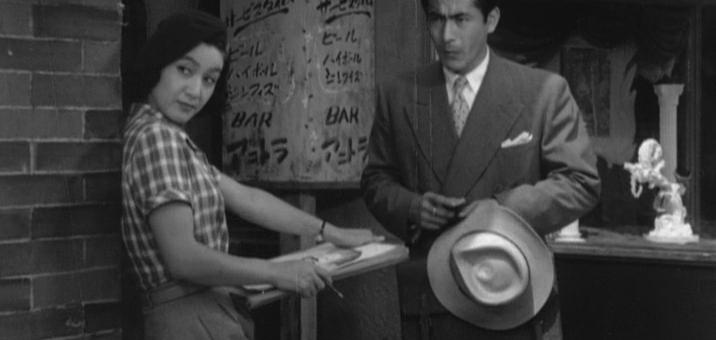
It’s clear from the opening scenes that Nishida (Ryo Ikebe) is going to be a corrupting force in this environment as he disrespects the sea immediately after disembarking from the boat by petulantly throwing his empty cigarette packet into it. This action may make it seem as if he’s not altogether happy to be here, though he seems to adapt well enough to island life serving double duty as an assistant lighthouse keeper and schoolmaster. Apparently arriving on the same boat is a woman who is returning to the village after having run away to Tokyo. Riu (Yuriko Hamada) represents another source of corruption and is not fully accepted by the other islanders having become to a degree “foreign” in her urbanisation. Unlike the other women, she wears Western clothes and puts on makeup while behaving in a brazen and flirtatious manner. Despite having trained as an ama diver since childhood, she is no longer able to dive with the same dexterity as the other women and constantly brings in poor hauls or rotten shellfish.
According to lighthouse keeper Fujiki (Takashi Shimura) who offers some ethnographical detail while explaining the ama diver tradition to Nishida, a woman’s worth before marriage is largely determined by her skill in diving. Married couples mostly work together with the man operating the boat and reeling the divers back in from their deep dives. As such, it requires a high degree of trust as the diver must be sure the person on the surface will reel them in if they get into difficultly. Noe is currently the top earner among the women, but this is also partially because she feels herself to be something of an outsider. Her father was not from the island and eventually left her mother for another woman to start a new life in Hokkaido, while her mother also left and has not been seen since. She worked hard to become a good diver so that she could support her mother should she return in her old age, but is also tiring of the ama life and fearful of the prospect that there is nothing beyond it. At present, she’s paired with a local man, Shintaro (Kan Yanagiya), whom the islanders expect her to marry though she appears not to want to.
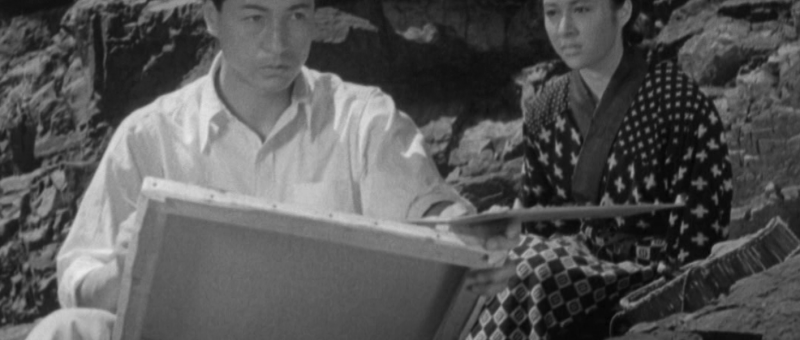
Her attraction to Nishida is then partly that for the outside world and an escape from the village. The local superstition against marrying outsiders seems to suggest that they can never really be fully accepted by the community and it is generally assumed that they will eventually leave rather than choose to live on the island. As Fujiki points out, diving makes up a significant proportion of the local economy, and so they do not want to risk losing a skilled diver who may choose to leave with a romantic partner from elsewhere. The superstition then serves a practical purpose in discouraging the ama from leaving, though it’s unclear to what degree they really believe in the retribution of the Dragon God. Despite Nishida’s prodding, Noe clearly believes in it to some degree as she eventually asks a shamaness for advice, but also disregards it when she’s told that she ought to give up on Nishida as nothing good will come from their relationship.
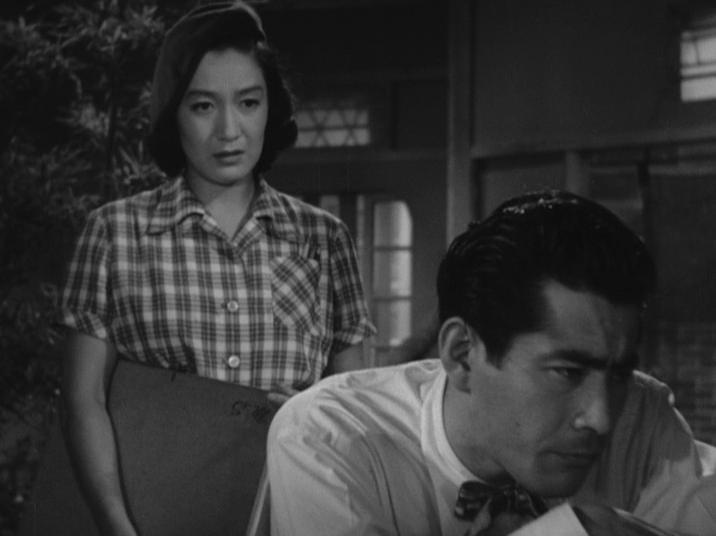
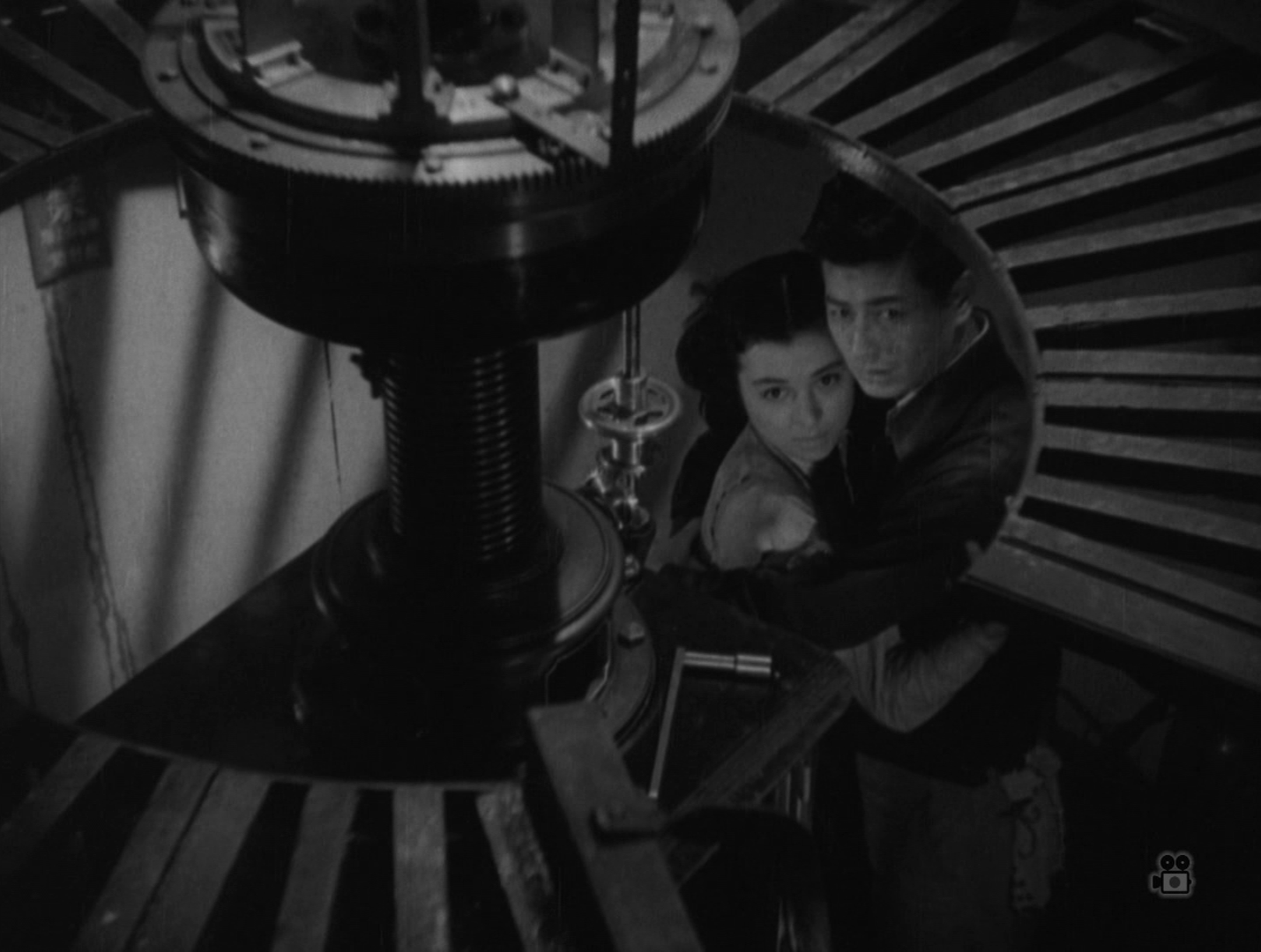
This superstition is perhaps why she comes to doubt Nishida when he unwisely agrees to dance with Riu after she walks into the lighthouse and puts on modern dance music to flirt with the other men. Riu does this originally out of jealously and resentment towards Noe who is regarded as the village’s golden girl but later claims to have developed feelings for Nishida, though her primary goal seems to be to ensure that Noe cannot have him. Noe, meanwhile, begins to lose her mind and starts diving recklessly claiming that she doesn’t care if she dies. The pair are positioned as diametrically opposed poles, the corrupted returnee from the city and pure-hearted island girl, yet in some senses Riu is also another possible future for Noe should she choose to leave the island alone. Both women are, in a sense, fighting for the different future that Nishida represents. He later suggests that he may leave to go to Hokkaido, the same destination as Noe’s father and in a certain way of thinking, still regarded as a new frontier society in contrast to the traditional life represented by the coastal village in the Ise peninsula.
But pitted against each other, the two women eventually fall victim to the superstition in becoming obsessed with retrieving the blue pearl from the Dragon God’s well which is said to grant romantic fulfilment. Riu dives out too far and reaches the pearl first, but is trapped by a falling rock, perhaps the Dragon God’s revenge for leaving the island and abandoning the sea. She calls out to Noe for help, but she either runs out of air before she is able to free her or wilfully chooses not to do so. Noe’s relationship with Nishida is then forever cursed, as she’s haunted by Riu’s frantic cries for help and her own sense of guilt while remaining uncertain if she could have saved Riu if she had really wanted to. In the end, the two women destroy each other because their desires cannot be reconciled nor is either one really complete without the other. Riu cannot to return to the world of the village nor live a settled married life with a man like Nishida, but neither can Noe reconcile her desire for a more interesting existence off the island with the island culture that lives inside her and the ingrained fear of the Dragon God. In the end, they must return to the sea. Honda makes full use of the expressionist possibilities of the landscape as raging waves seem to stand in for Noe’s tumultuous emotions culminating in a terrifying storm as she confronts Nishida in an attempt to ascertain his true feelings. Don’t mock the sea, Noe cautions Nishida on his arrival in town, though it’s equal parts the awesome power of nature and the inability to let go of ancient superstition that do for her in the end.