The Great Chase (華麗なる追跡, Norifumi Suzuki, 1975)

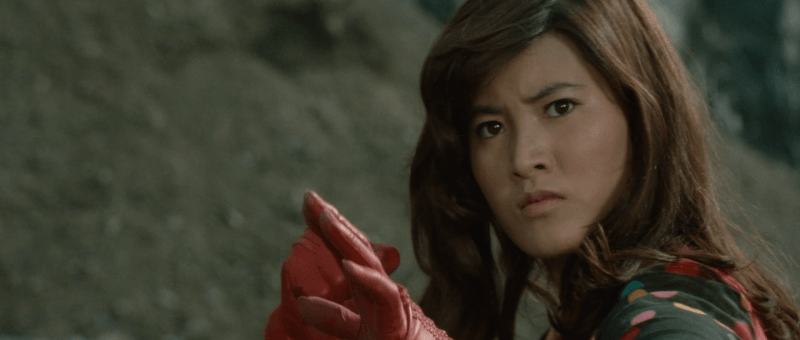
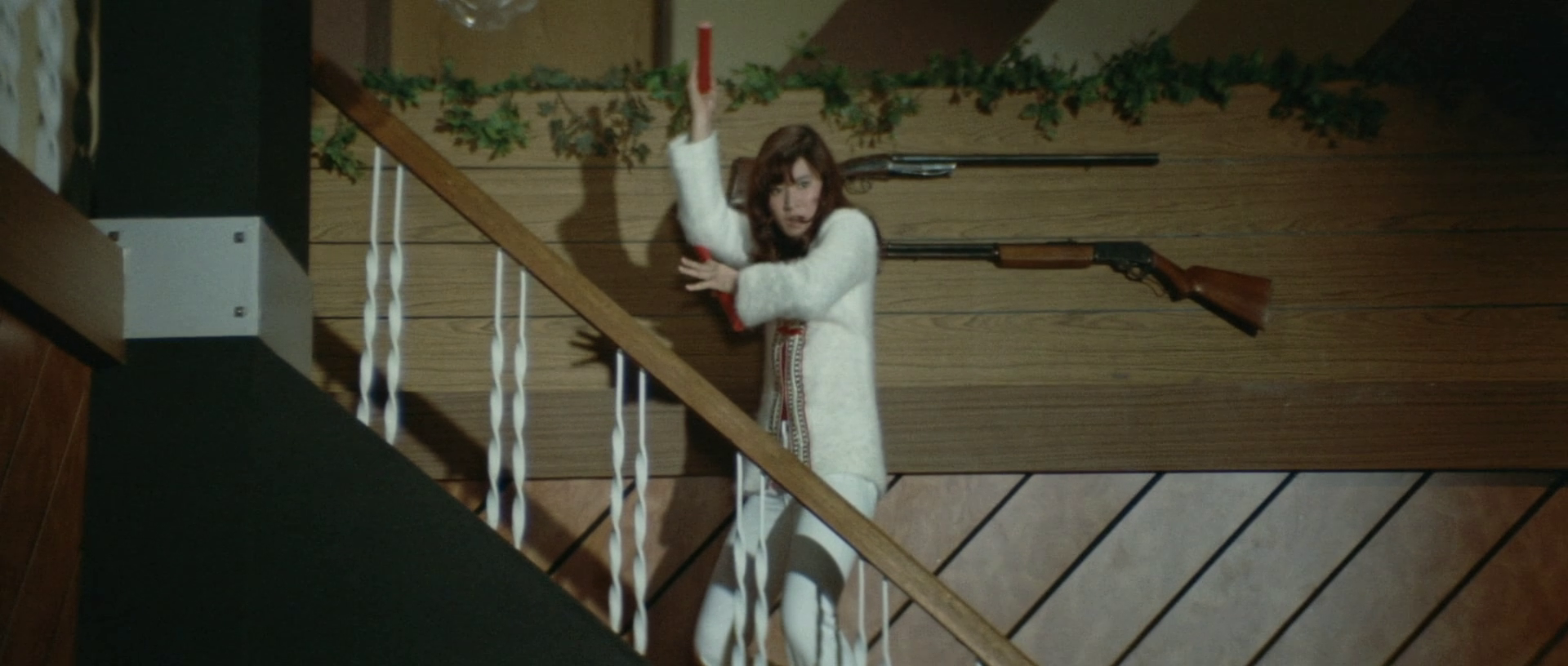
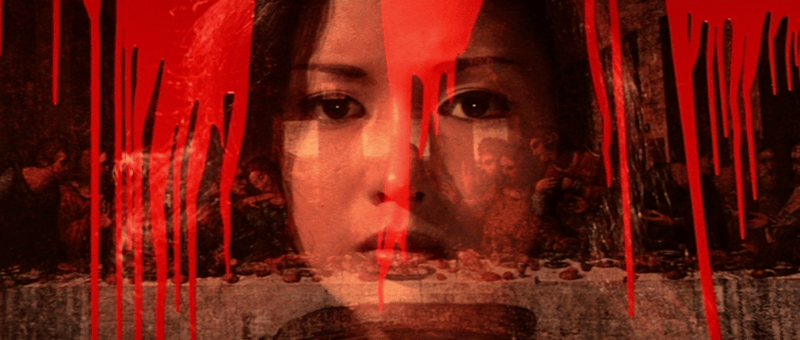
What about if you rebooted the Bannai Tarao series, but the hero was a female spy who is also a champion race driver and martial artist? Norifumi Suzuki did actually make a Bannai Tarao move in 1978 starring Akira Kobayashi, but the heroine of The Great Chase (華麗なる追跡, Karei-naru Tsuiseki) certainly loves a disguise or two and like the famous man of a thousand faces seems to have no trouble pulling them off as she infiltrates a gang of evil traffickers led by a furry which has come up with an ace new plan of packing heroin into coffins and having them shipped to nuns!

Oh, and the gang were also behind the death of her father who “committed suicide” in prison after being framed for drug smuggling. The Great Chase takes place in a world of pure pulp which somehow maintains its sense of cartoonish innocence even after Shinobu (Etsuko Shihomi) has infiltrated the heart of darkness and seen most of her associates killed by sadistic gang boss Inomata (Bin Amatsu). But at the same time, it delves into a deep sense of ‘70s paranoia as it becomes clear that the authority figures are all corrupt. Inomata has become a politician, while Shinobu’s father’s murder was orchestrated by the prison warden who was working with him in return for financial gain. The man who framed her father was a friend of his, implying that no one can really be trusted when there’s money to be made.

In a roundabout way,as this sense of anxiety is only reinforced by Shinobu’s role as some sort of secret agent working for the spy ring run by her uncle which is currently hot on the trail of the drug dealers even if they haven’t yet figured out who their boss is. Conversely, her home life is as wholesome as it could be with her two adopted siblings who run a florist’s along with Shinobu’s fan club. Her status as a kind of race car idol lends Shinobu a particular kind of ‘70s cool and turns her into some sort of superhuman figure capable of triumphing over any kind of adversity like a superhero worthy of any kid’s lunchbox. The siblings, Nagi (Fujika Omori) and Shinpei (Naoyuki Sugano), were taken in as orphans by her father which once again signals his goodness in contrast to the greed and selfishness of the gang that had him killed to cover up their crimes. 

That they peddle in drugs marks them out as a force of social disruption, but they’re also actively heretical in hiding behind the shield of the church. Suzuki frequently uses religious imagery in his films and here again echoes the romanticism of School of the Holy Beast with the use of red roses to decorate the coffin of the unfortunate young woman who has been turned into a vessel for smuggling drugs and has for some reason been laid out otherwise entirely naked. When it comes to retrieving the merchandise, we can see that many of the habits are being worn by men while Inomata himself masquerades as a priest. Then again, perhaps he is merely indulging his love of costume play seeing as he also has a hobby of wearing a furry bear suit to attack and rape women in his living room. 

Inomata’s claws then seem to represent something else, a rapacious, grasping sense of patriarchy in which he also uses drugs to bind women to him. Shinobu’s childhood friend Yukiko (Hisako Tanaka) has apparently fallen victim and laments that she is possessed by him body and soul to the point that the old Yukiko is dead which is why she hasn’t been able to step in and help Shinobu and is doing so now fearing that it may cost her her life. Suddenly, it’s all quite grim with the basement sex cult, whipping and torture, but Shinobu maintains her plucky spirit and is somehow able to lure Inomata towards a cable-car-based showdown. With a cameo from real life wrestler / singer Mach Fumiake, the film enters a kind of meta commentary on a real-life Shinobu (though she was not, as far as anyone knows, one of Japan’s top spies), but otherwise remains within the realms of pulp in which the heroine is able to pull off her difficult mission with the help of her talent for disguises before dramatically unmasking herself as the woman who’s going to take them all down. Camp to the max and incredibly surreal, the film never drops its sense of silliness even as the grim events enveloping Shinobu lead to tragic consequences that she barely has time to deal with before barrelling straight into the next duel with the forces of corruption.


*Norifumi Suzuki’s name is actually “Noribumi” but he has become known as “Norifumi” to English-speaking audiences.

Wicked Priest 5: Breaking The Commandments (極悪坊主 飲む打つ買う, Buichi Saito, 1971)

The Wicked Priest returns for his final adventure and once again finds himself tackling the corruptions of the mid-Meiji society. Titled in English “Breaking the Commandments” (極悪坊主 飲む打つ買う, Gokuaku Bozu – Nomu Utsu Kau), the Japanese title refers to something Shinkai (Tomisaburo Wakayama) admits part way through, that his ironically non-buddhistic life revolves around drinking, gambling, and women all vices he seems unable to give up even as he continues to fight justice for the oppressed little guy amid the burgeoning capitalist society of the new Japan.

Indeed the film opens with him in a brothel where he’s exhausting one woman after another and demanding she be replaced with a fresh model while simultaneously covering for petty crook Hideji (Teruo Ishiyama) who is hiding his sex worker girlfriend in the cupboard to save her from a local gangster. In the first few instalment, Shinkai is a lecherous yet lovable rogue who in his own way respects women but in these last two instalments is certainly less kind, treating these sex workers more or less as disposable while later threatening to rape a lady gambler who tried to trick him. In any case, after realising that even Hideji who he went out of his way to help is trying to deceive him, Shinkai ends up getting involved with a local dispute over transportation licences and a nefarious land-sharking plan run by thuggish gangsters with the collusion of the police chief.

The land sharks want to take over the abandoned mansion where Hideji and his family of crooks are currently living in the company of a former samurai lord who seems to be suffering with some kind of delusion that it’s still the Sengoku era. The police chief isn’t up for the idea at first but the gangsters falsely imply that those living in this area of town are merely “jobless people and criminals” that they don’t need to worry about. But their plan depends on bringing on board Wajima who holds the license for running freight carts but Wajima is an honest man who isn’t interested in bribes and has no respect for those who exploit others. He refuses to participate in the project.

Shinkai too refuses to let the gangsters get away with mowing over Hideji and the others and is once again saved by Ryotatsu (Bunta Sugawara) who agrees to put off their final fight until Shinkai is finished cleaning up this dirty little town. He largely does this by donning an elaborate disguise and teaming up with lady gambler Gin to trick conspirator Kawashima into giving back Wajima’s (Takashi Shimura) license after setting him up so he’d lose it. Meanwhile he also tries to repair another broken father-son relationship between Wajima and his errant boy Ryutaro (Kyosuke Machida) whom he’d kicked out some years previously after he became a yakuza and got into trouble with the law. 

What seems clear is that the chaos of Meiji has allowed the greedy to profit over the changing orders of the hierarchical society, no longer bound by traditional notions of good conduct or basic humanity. The police chief first objects to the plan, stating that many people living in the area the gangsters have earmarked for their docks are honest and hardworking and shouldn’t be lumped in with “criminals”, but is soon won over by a bribe and is also supporting a mistress in a separate household. Yet even so, Shinkai turns this same weapon back on Kawashima (Fumio Watanabe) in pretending to be a general from Tokyo who will soon be his father-in-law, leveraging his social advancement to bring him back into line in appealing to his greed and ambition while hinting at a militarist future in reminding him that Wajima’s carts were essential during the Satsuma Rebellion and may be so again should the occasion call.

After seeing off a series of bounty hunters, one sent in via a honey trap that suggests the gangsters really know their enemy, Shinkai has no option but to clear out the corruption himself at the point of a sword culminating in another bloody showdown which is also in its own way a means of protecting Ryutaro from a pointless revenge. “If I die the devil in hell will be in for a big surprise!” Shinkai cooly remarks as he marches off to fight for justice, but then there’s another battle waiting for him in the postponed grudge match with Ryotatsu as the two men tussle atop a sand dune ironically trapped in a co-dependent cycle of vengeance and salvation while Shinkai’s wandering most likely will never end.


Dissolution Rites (解散式, Kinji Fukasaku, 1967)

“We’re all legitimate businessmen now” as a former yakuza explains to a recently released foot soldier stepping out into a very different Japan in Kinji Fukasaku’s Dissolution Rites (解散式, Kaisan Shiki, AKA Ceremony of Disbanding). The funereal opening scenes feature the first in a series of dissolution rites as a man dressed in black reads from a scroll and explains that all the local yakuza clans will be disbanding because despite “working day and night for the benefit of the world and humanity in the spirit of democracy” times have changed and they find themselves unnecessary.

There at the beginning of that change, Sawaki (Koji Tsuruta) served eight years in prison for the murder of a rival gang boss to ensure his gang got hold of a local landfill site where they later built an oil complex. While he was inside, his boss died and his clan disbanded leaving him with nowhere to go but thankfully looked out for by an old friend, Shimamura, who has since become a construction magnate. On his arrival at Shimamura’s office, however, he’s ambushed in a suspected case of mistaken identity while the man driving him is killed. 

Shimamura (Fumio Watanabe) tells him he’s gone straight, but it soon becomes clear that even as yakuza forsake the streets for more organised crime they still behave like thugs using the same old tactics to get what they want. Shimamura is in cahoots with a corrupt local politician, Kawashima (Asao Uchida), and is determined to get access to another stretch of bombed out wasteland owned by an egalitarian doctor, Omachi, who refuses to sell because he’s set up a community there of marginalised people, including Sawaki’s former girlfriend Mie (Misako Watanabe), who work on his chicken farm. Meanwhile, Shimamura is targeted by rival “legitimate businessman”, Sakurada (Hosei Komatsu), who pulls a few dirty tricks of his own in an effort to cut Shimamura out of the picture.

Once again Tsuruta plays a man who is out of step with his times, partly because he’s been in prison but also in his fierce commitment to a now outdated code of gangsterdom. “The chivalry that we were taught was just a way for bosses to use their soldiers” Shimumura insists, “you’ll look foolish if you don’t get rid of it”, disingenuously casting his transformation into a legitimate businessman as a way of freeing himself from yakuza oppression. Sawaki turns down his offer to join the business because it seems a bit dodgy while intensely disappointed to discover another former colleague, Kubo (Kyosuke Machida), running a trafficking ring masquerading as a management studio for cabaret singers and strippers by tricking women with the offer of good jobs then getting the hooked on drugs and shipping to them to Okinawa to do sex work near the US bases.  

On his return, Sawaki is also stalked by the man whose arm he severed in killing the rival boss who turn out to be, like him, an old school gangster which is why he insists on his revenge only to find an unexpected kindred spirit as the two men find themselves each adrift in a world in which no one really cares about humanity and honour. Sakai (Tetsuro Tanba) chooses to walk a different path, conducting his disbandment ceremony in protest of yakuza corruption. Like many Tsuruta heroes, Sawaki also has the possibility of walking away and living a conventional family life as a husband and father having been forgiven by Mei but inevitably is pulled in a darker direction by the necessities of his code. The oil complex he helped to create is only a symbol of the duplicities of the post-war society allowing men like Shimamura to get rich while literally choking the life out of those like Mei whom they now want to kick out of her home to add insult to injury. 

There’s no one more tragic than a yakuza Sawaki admits, knowing there is no longer any place for him in an amoral gangster society while unable to simply leave it and enjoy a quiet life with the woman he loves. An indictment both of corporatised yakuza and the equally duplicitous practices of “legitimate” businesses and corrupt authorities, the film ends in another righteous assault filmed handheld with Fukasaku’s characteristically canted angles amid the chaos and confusion of a rapidly changing society. 

School of the Holy Beast (聖獣学園, Norifumi Suzuki, 1974)

“Why is sex wrong?” a rebel nun enquires, hinting at the hypocritical atmosphere of the convent which comes to stand in for the patriarchal superstructure of the contemporary society. That it does so might in a way be surprising given that Christianity has relatively little cultural relevance in Japan save its stance as a persecuted religion during the feudal era. Director Norifumi Suzuki jumps on the nunsploitation bandwagon but does so with a baroque romanticism mixed with punkish youthfulness as two young women find themselves rebels in the house of God.

They are both there for reasons largely unconnected to religion. 18-year-old Maya (Yumi Takigawa) is searching for the truth behind her birth and her mother’s death, while Sister Ishida (Emiko Yamauchi) claims she’s been sent there by a wicked stepmother. Ishida also kicks up a stink during a class by questioning the truth of immaculate conception which is quite odd for someone who wanted to become a nun, while otherwise punished for drinking whisky in the middle of the night. Punishment does seem to be the main thrust of their religious practice with the transgressions of “adultery”, which includes all impure thoughts, murder (!), and theft taken the most seriously. On her first night at the convent Maya is woken by the sound of another nun furiously whipping herself though in fairness there just isn’t much else to do. 

Suzuki rams home the erotisicm of ritual in the baptism Maya undergoes during her initiation as a nun in which she is totally nude and instructed to stand with her arms out as if on the cross in front of the altar. She must then bend to kiss the crucifix before receiving her veil as a bride of Christ. The nuns talk of lives of eternal virginity while burying themselves in asceticism in an effort to deny their natural desires but have to a degree sublimated their lust in violence. The most common form of punishment is whipping, while Maya is later tortured with thorns and artfully battered by roses. When one nun steals money in guilt for having abandoned her impoverished family to begin her spiritual journey to Christ, she confesses herself to a priest who offers her the same amount so that she can help her family and ease her conscience by returning it. But in reality the priest has tricked her. He resents that she feels as if her sin has been forgiven and she may forget her guilt, cruelly telling her that she will never hear the voice of God before going on to violate her. 

The act of betrayal, of himself breaking the code to which he should subscribe, is only a echo of an societal corruption which allows men to abuse their power often with the complicity of the women around them such as the abess who has long been in love with him. Kakinuma (Fumio Watanabe) is a man whose faith has been shaken. He bears the scars from exposure to the atomic bomb in Nagasaki which is centre of Christianity in Japan. After telling Hisako (Yayoi Watanabe) that God will not see her, he asks if anyone has actually seen him and why he does nothing when his people suffer. 

Both he and the abbess are trapped in a hell of their own making, though as the girls both say the convent is akin to a prison. When Hisako’s sister visits her they talk to each other through glass as if she were a prisoner, though in many ways she is oppressed by her own repressed desires while those of the other nuns have begun to drive them quietly out of their minds and into sadomasochistic fury. This peculiar madness is only deepened by the arrival of a new Mother Superior who returns from Europe insistent on rooting out “witches” in league with the devil. Suzuki signals the absurdity by playing a chorus of elation when a tortured nun wets herself over a tablet featuring a crucifix in the inversion of a bizarre Edo-era ritual designed to identify secret Christians who were at that point illegal. 

To break free of the covent and return to her liberated life in contemporary Japan as seen in the cheerful opening sequences of her date with Kenta (Hayato Tani), Maya must also free her mother’s ghost and the souls of her sisters by forcing Kakinuma to reckon with his crimes if in the most ironic of ways. Suzuki shoots with febrile romanticism, the pastel colours of the church lending it a hellish glow even before the resurrection of a ghost enacts karmic revenge in a feverish atmosphere of romantic jealously and masochistic repression.


Original trailer (no subtitles)

*Norifumi Suzuki’s name is actually “Noribumi” but he has become known as “Norifumi” to English-speaking audiences.

The Tattooed Hitman (山口組外伝 九州進攻作戦, Kosaku Yamashita, 1974)

The close brotherhood between two men is disrupted by changing times in a more contemporary gangster drama from Kosaku Yamashita, Tattooed Hitman (山口組外伝 九州進攻作戦, Yamaguchi-gumi gaiden: Kyushu shinko-sakusen). As many are fond of saying, times have changed and the yakuza must try to change with them or else meet a melancholy end. But as the hero admits, change is something he has no intention of doing even as his old school gangsterism leaves him increasingly at odds with the corporatising ways of the contemporary yakuza. 

The change in the times is obvious from the film’s opening sequence set in 1957 in which an attempt is made on the life of petty boss Ishino (Tatsuo Umemiya) by a gunman who shouts “die, for the good of the world” before firing a pistol and running away. Ishino has been targeted in a dispute over construction rights connected with the regeneration of hot springs resort, Beppu. The hit seems to have been ordered by rival gang, Sakaguchi (Eizo Kitamura), the leader of which is also a prominent local politician who is content to abuse his power for his own financial gain. So confident is he in his safety, that Sakaguchi even gets the police involved rather than deal with it himself. 

Ginji (Bunta Sugawara) has been Ishino’s sworn brother since their teenage delinquent days and determines to get revenge by raiding the Sakaguchi offices and killing one of their high ranking officers. Seeing as he’s already wanted by the police for a previous murder, Ishino sends Ginji to Osaka to lay low while working for an associate, Daito, mainly as a debt collector. It’s this act of separation which introduces a rift between the two men. While Ginji waits patiently to be recalled, Ishino climbs the ranks of corporatised gangsterism by learning to play by the new rules. 

To fill the void, Ginji takes on a new “brother” or perhaps surrogate son in the wayward Ken (Tsunehiko Watase) whom he first meets cheating at pachinko at a parlour where his pregnant wife Fusako (Mayumi Nagisa) is working. It’s Ken who first drags him into a brewing turf war as Korean gang Soryu threaten to disrupt the local equilibrium not least by selling drugs of which Ginji does not approve. Ginji “saves” Ken from joining Soryu by essentially making him his one of his guys though he doesn’t really have much of a position in Daito’s gang, offering him a sense of grown-up responsibility by handing him a pistol with the only the instruction to make sure he shoots with two hands. Unfortunately, Ken will follow his advice but otherwise ends up almost causing an incident with another gang by shooting a man who disrespected him in the street. Ginji marches straight down there to sort things out, but on arrival discovers an arrangement has already been made with his boss which further strains his sense of pride and confidence in his position as a yakuza.

Ginji feels something similar on being invited to a party to celebrate Ishino’s promotion only to be seated with the lowly footsoldiers and ignored by Ishino all night. Ishino rejects him still further in agreeing to plan to send him back to Kyushu out of the way hoping that his old school hotheadedness can finally be tempered. Others meanwhile voice concern that Ginji may have forged a relationship with rival Kobe gangs during the 18 months he abruptly disappeared from Osaka and has only come back to cause trouble. Ginji perhaps knows that he has no more future in the contemporary society, others remarking that seems like someone who is in a sense already dead for having accepted that he will die and most likely in Hakata, the town he had wanted to conquer with Ishino who had crushed his dreams in his newfound pragmatism by calmly explaining that they would never have the power to take it. 

Koji Takada’s screenplay positions Ginji’s gradual decline as an allegory for the yakuza himself while citing the new legislation that this particular series of incidents made necessary creating the new offence of assembly with dangerous weapons as a decisive moment in weakening the yakuza as an institution. Ginji remains a man displaced by his times unable to move forward into a new society in the way that Ishino has but stuck in a permanently post-war mentality despite the constant reminders that “times have changed”. Yamashita adopts the trappings of the jisturoku drama with frequent references to real life events and narrative voiceover but otherwise maintains his classicist formalism while ending on a note of ambivalence that tells us a certain kind of justice may have been served but the cycle of violence may not yet be completed.


Original trailer (no subtitles)

Volunteering for Villainy (悪人志願, Tsutomu Tamura, 1960)

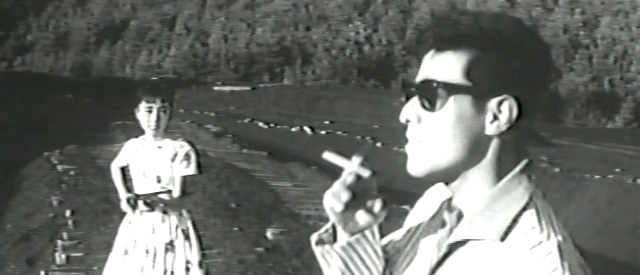
Tamotsu Tamura is best known as a screenwriter who worked closely with Nagisa Oshima, though he did actually direct a film himself at the beginning of his career. Having originally planned to become a reporter, Tamura was offered a job at Sankei Shimbun but his employment was postponed for medical reasons and he decided to retake the entrance exam for Shochiku joining the studio in 1955. Unfortunately Volunteering for Villainy (悪人志願, Akunin Shigan, AKA The Samurai Vagabonds) was not successful at the box office and Tamura soon left Shochiku along with Oshima and became a screenwriter at his independent production company. 

In any case, the film is very reminiscent of New Wave filmmaking both in terms of theme and aesthetic. It repurposes a moribund quarry town as an almost literal purgatorial space casting the protagonists into a deep hole from which they are eternally unable to escape. As the film opens, a collection of children are taunting a young woman, Hide (Kayoko Hono), calling her a murderer and castigating her for failing to die, though it later transpires that they’ve been hired by a henchmen of Tatsuo (Masahiko Tsugawa), the brother of the man she was involved in double suicide with who is determined to become some kind of local dictator.

But even he is in some ways rebelling against his powerlessness as the son of a local politician he brands as phoney and corrupt. Tatsuo claims he hates people who claim to be good but aren’t, in much the same way as Hide claims she can no longer trust anyone. Tatsuo seems to want revenge for the death of his brother for which he holds Hide responsible but insists he doesn’t want to settle it with money nor is he in favour when a shady local man makes vague allusions to having her bumped off.

When a new recruit, Yasuo (Fumio Watanabe), joins the quarry he becomes its latest kicking bag not least because it was Hide who escorted him into town. Yasuo has a stammer and incredibly meek manner that leans towards obsequiousness. “You’re as obedient as a dog,” people often remark with Tatsuo later astutely observing that he’s the sort of person who can’t do anything without someone telling him to do it. Yet it later seems as if his desire to obey, to be liked and accepted by those around him, has led him to commit a terrible crime claiming that he only did what everybody wanted done even if they were too afraid to say so.

Ashamed of himself and his corrupted masculinity Yasuo alternately rebels and overcompensates. He refuses to hit Hide when ordered to by Tatsuo, and to sleep with her when forced by the other men, but later hits and sleeps with her possibly not quite consensually when his masculinity is challenged. The irony is that Tatsuo who claimed he wouldn’t tolerate anyone defying him cannot control Hide’s free spirit and is therefore unable to overcome his powerlessness. He bullies and harasses her insisting that she leave town, but Hide refuses to go and is continually unbothered by the way she’s treated. Hide also eventually rejects Yasuo for his cowardice, severing her ties to him on realising that he informed on one of the other men who was fugitive from justice to curry favour with Tatsuo and take the heat off himself. She tells Tatsuo that though he’s always wanted things his own way, she’s always decided for herself, infuriating him with her free decision to leave having realised how petty and meaningless it was to stay in this petty and meaningless purgatory of broken and hopeless men. 

Tamura shoots with a roving and curious camera that takes on a life of its own swooping through the dorms but lends a degree of mythic eeriness to the final confrontation in the quarry as the workers begin to dot the skyline looking down at Hide below in a scene somehow reminiscent of L’Avventura. The town’s only bright spot is presented by Tatsuo’s younger sister Kiyoko (Chiaki Tsukioka) as the voice of reason even as she  brands everything boring and meaningless but thereby suggesting that it might not have to be this way. Her words, however, fall on largely deaf ears save those of Hide perhaps finally awake to her own agency only to have it immediately crushed by fragile masculinity.

The Insatiable (現代ポルノ伝 先天性淫婦, Norifumi Suzuki, 1971)

History repeats itself in Norifumi Suzuki’s erotic drama The Insatiable (現代ポルノ伝 先天性淫婦, Gendai Porno Den: Sentensei Inpu). The film’s Japanese title, Modern Porno Tale: Inherited Sex Mania, better hints at its true intentions in essentially repurposing a sense of class anxiety and moral conservatism as familiar from classic melodrama to fit Toei’s line of erotically charged movies but eventually offers little judgement of the heroine’s surrender to her fate (after gaining her revenge) in putting on her mother’s kimono to follow the path set down for her.

That was not, however, what Yuki’s (Reiko Ike) mother (Yoko Mihara) originally wanted. Hoping to save her from the life of a bar hostess with terrible taste in men, she sent her to a religious boarding school in Tokyo which has given her a toxic sense of shame in her sexuality. Sharing a bed with a classmate, she relates her fear and horror of sleeping with men which she assumes she is expected to do in time, though goes on to explore herself sexually with the other girl who feels much the same despite the warning from their lesson books that looking at another woman with desire is no different from adultery. 

Nevertheless, on returning to her mother’s home in Kyoto Yuki is later raped by her mother’s latest boyfriend who is for some reason a bowling enthusiast. His sensibility is emblematic of that of most men in the film who see Yuki merely as an object to be conquered. Following this violation, Yuki quits school and spends all her time in clubs in Shibuya unable to reconcile herself with her sexuality and living as good time girl if resenting herself when others see her as a sex worker. Sucked into the world of sleazy clubs, she becomes a kind of pass around for wealthy men while also cared for by a besotted yakuza who has been quite literally emasculated by his love for her, leaving Yuki unable to fully return his affections because he can no longer satisfy her sexually.

Eventually she meets handsome architect Yoichiro (Hiroshi Miyauchi) with whom she falls in a more wholesome love, but continues to believe that she cannot really be with him because of her sordid past. She then realises that not only does he have unfinished business with a French woman he met while studying abroad (Sandra Julien), but that his father, Matsumura (Tatsuo Endo), is the seedy loanshark who’s been trying to get his hands on her through middleman Akihito (Fumio Watanabe) who is connected with her mother’s new partner Tomoguchi, and also Yoichiro’s brother-in-law.

Akihito is really the villain of the piece, though mostly for his attempt to wage class warfare by taking over Matsumura’s business. His wife, Ayano (Miwako Onaya), has turned away from him knowing that her father brought him into the family for his ruthlessness while exclaiming that she hates self-made men. In much the same way that Yuki was attempting to escape her mother’s legacy, Akihito is also trying to overcome his impoverished background to catapult himself into the upper classes though Matsumura himself appears to have earned his wealth in dubious ways. In any case, he rejects Yoichiro’s decision to marry Yuki not only because he wants her himself but because he claims he wants to find a more appropriate wife for his son presumably as he found Ayano a husband who would benefit himself. 

In any case, Yuki is drugged and abused much like her mother turned into a plaything for men. Yuki resents her only momentarily for her role in her rape and sickening attempt to placate her boyfriend after having stood up for Yuki and confronted him about his betrayal. The two women later reconcile and find solidarity in their maternal relationship even if her mother can never escape the pattern of behaviour that keeps her dependent on bad men which is something Yuki may have overcome in the film’s closing moments as she in turn, wearing her mother’s kimono, opens a bar under her own name living as an independent woman. 

To get her revenge, she manipulated the men around her by using her sexuality against them only to be backed into a corner by Akihito’s chilling claim that she was now his slave. Her salvation at the hands of another man who damns himself in her defence and the defence of their love as something pure despite having cruelly rejected Yuki as a “whore” perhaps undercuts the message but also in the film’s eyes redeems her from her wandering life as an insatiable sex addict now free of her sense of shame and the lingering trauma of her rape. In this patriarchal and classist society, all men are animals driven only by destructive influences, while Yuki is even able to bond with Yoichiro’s French former lover with whom she also shares a sexual encounter. Suzuki films with characteristically romantic imagery and a wry sense of humour but nevertheless allows his heroine to find her way out of a world of beasts while refusing to shame her even as she embraces her mother’s legacy. 


*Norifumi Suzuki’s name is actually “Noribumi” but he has become known as “Norifumi” to English-speaking audiences.

Equinox Flower (彼岸花, Yasujiro Ozu, 1958)

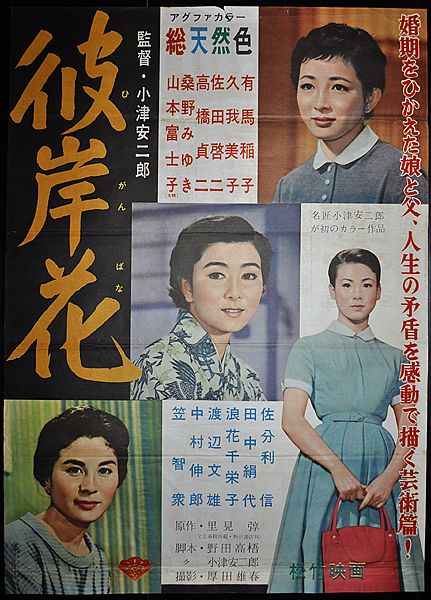
Japanese golden age cinema is famed for its centring of female stories, but while it’s true that many of Yasujiro Ozu’s family dramas revolve around a young woman’s feelings towards marriage, the perspective is often surprisingly male. Equinox Flower (彼岸花, Higanbana), his first film in colour, marks something of a change in direction in its spirited defence of the young, but at heart is still a story as much about impending old age, the responsibilities of fatherhood, and changing times as it is about contemporary family dynamics or female agency. 

The father in question, Hirayama (Shin Saburi), is a high ranking executive with two daughters. The older, Setsuko (Ineko Arima), is working at another company, and the younger, Hisako (Miyuki Kuwano), is still in school. Marriage is on his mind because he’s just attended the wedding of an old school friend’s daughter at which he gave a speech, with his wife Kiyoko (Kinuyo Tanaka) sitting awkwardly next to him, describing the arranged marriage he had with her as “pragmatic, routine” while he envies the young couple’s “fortunate opportunity” to indulge in romance. He and Kiyoko idly discuss the idea of Setsuko’s marriage, it seems as if there is a promising match on the horizon, with Hirayama conflicted while Kiyoko is very much in favour of doing things the traditional way. She’s already mentioned it to her daughter, but all she does is smile demurely which seems to provoke different interpretations from each of the parents. 

While thinking about all of that, Hirayama receives a visit from an old friend who was a notable absence at the wedding asking him to check up on his daughter Fumiko (Yoshiko Kuga) who ran away from home two months ago to live with a musician after he tried to veto her intention to marry without consulting him. Hirayama is sympathetic, perhaps thinking his friend has acted foolishly and pushed his daughter away. After visiting the bar where she works, he comes to the conclusion that as long as she’s happy with her choice then everyone else should be too. That all goes out the window, however, when a young man, Taniguchi (Keiji Sada), visits him unexpectedly at work and asks for permission to marry Setsuko. Hirayama quite rudely asks him to leave and then irritatedly talks the matter over with Setsuko before petulantly refusing his consent, not because he objects to Taniguchi, but because he is hurt on emotional level that she hadn’t talked to him about this first (not least so that they stop worrying about arranging a marriage) while resentful that she’s gone behind his back and undercut his patriarchal authority. 

In addition to the changing nature of family dynamics, Hirayama is perhaps conscious of his advancing age, feeling himself increasingly obsolescent and therefore additionally wounded by this assault on his authority as a father. The generation gap, however, is all too present. Both Setsuko and Fumiko feel as if they simply cannot talk to their parents because they wouldn’t listen and will never understand. Yukiko (Fujiko Yamamoto), the daughter of another friend, feels something similar in her exasperation with her well-meaning single mother who keeps hatching plans to set her up with various men she isn’t interested in. Intellectually, Hirayama sides with the young, envying them their freedoms and advising Yukiko firstly not to marry at all, and then encouraging her desire to resist arranged marriages despite trying to foist them on his own daughters. 

Even Kiyoko eventually describes her husband’s continuing petulance as “inconsistent”. It seems obvious that Kiyoko is siding with her daughter, immediately taking a liking to Taniguchi who politely brought her home after she stormed out following an argument with her father, but she continues to behave as a “good wife” should, politely minding her husband while gently hoping that he will eventually come round. Only once pushed does she try to explain to him, again politely, that he’s being selfish and unreasonable, but he continues on in resentment while causing his daughter emotional pain simply for trying to find her own happiness rather letting him decide for her. Kiyoko is afraid that if it carries on like this, then Setsuko will, like Fumiko, eventually leave and they’ll lose her completely, something which Hirayama either hasn’t fully considered or is actively encouraging through his petulance. 

In the end the conclusion he comes to is that the parents will eventually have to give way or risk losing their children entirely. He tells both Fumiko and Yukiko that all parents want is for their children to be happy and so nothing else matters, but struggles to put his advice into practice when it comes to his own daughter. Like pretty much everyone in an Ozu film, Hirayama is a good, kind person, even if one struggling against himself as he contemplates a loss of authority, a change in standing, and the difficulty of dealing with complex emotions as a man in a patriarchal society. Predictably, it’s women who essentially bully him into making better decisions, Yukiko “interfering” in the nicest of ways, while his wife makes it clear that though she thinks he’s wrong she will continue to stand by him if only in the hope he will eventually see the light. “Life is absurd, we’re not all perfect” he admits, only later realising how his stubborn foolishness may have caused unnecessary suffering to those he loves the most.


Currently streaming in the UK via BFI Player as part of Japan 2020. Also available to stream in the US via Criterion Channel.

Original trailer (no subtitles)

Street of Love and Hope (愛と希望の街, Nagisa Oshima, 1959)

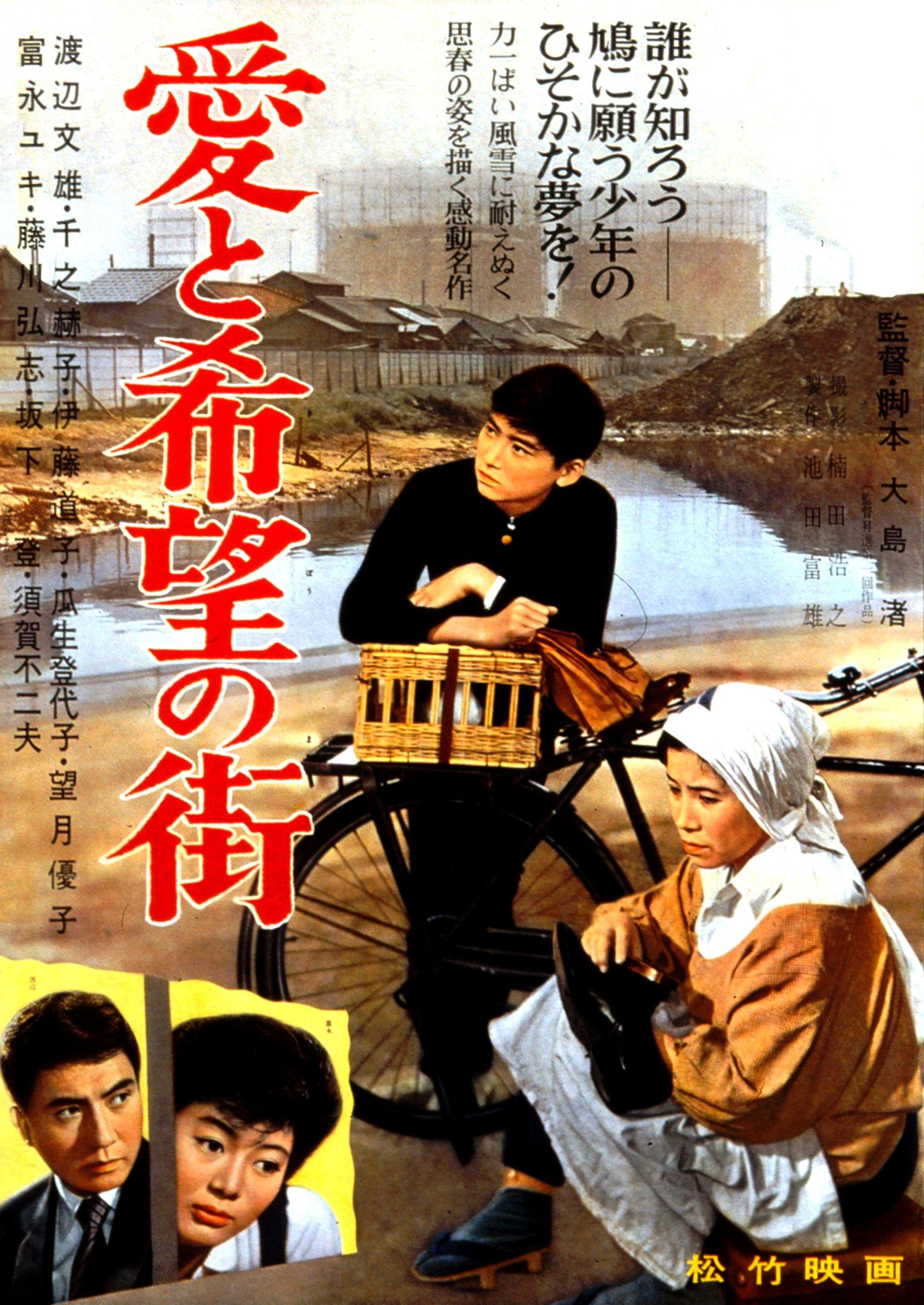
“You must sell your pigeons or you can’t survive in this world” a less progressive figure than he first seemed eventually admits in Nagisa Oshima’s ironically titled debut feature Street of Love and Hope (愛と希望の街, Ai to Kibo no Machi). As might be expected given the director’s later trajectory, there is precious little love or hope on offer and it seems his particular brand of grumpy pessimism ruffled studio feathers from the very beginning earning him a sixth month directing ban with a top executive complaining “this film is saying the rich and poor can never join hands”. The executive may have had a point in the increasing inequalities of the post-war society in which humanist hypocrisy offers only entrenched division and inevitable class conflict. 

As the film opens, the hero, Masao (Hiroshi Fujikawa), is selling his sister’s beloved pet pigeons because, as his social worker later explains, welfare payments are not enough to live on and his mother Kuniko (Yuko Mochizuki), who usually shines shoes for a living, has TB which leaves her unable to work. Kuniko is keen for Masao to stay in education and attend high school, but he acutely feels the burden on his mother and intends to work while attending evening classes. The trouble begins when Masao sells his pigeons to a wealthy young lady, Kyoko (Yuki Tominaga), who is the teenage daughter of an electronics factory boss. 

Well-meaning as she is, Kyoko tries to give Masao the change from her purchase after he explains he’s selling the birds because he needs money. Ironically she gives one of them to her sickly younger brother, but the problem is that Masao is effectively running a scam. The birds are homing pigeons. Assuming the new owners don’t cage them in properly, the birds will fly right back home and he can sell them again. He’s already done this a couple of times and is at least conflicted about it, especially as it upsets his sister Yasue (Michio Ito) so much, though what else really is he supposed to do?

This central question is the one that eventually comes between Masao’s progressive schoolteacher Miss Akiyama (Kakuko Chino) and Kyoko’s sympathetic older brother Yuji (Fumio Watanabe) who works in HR at his father’s factory. Another of Oshima’s mismatched, ideologically opposed frustrated couples, Miss Akiyama and Yuji find themselves on either side of a divide. It seems that the factory does not ordinarily employ city boys, preferring to recruit from the countryside and house employees in dorms because the boss is convinced rural youth is less corrupted by amoral urbanity. Hoping to help Masao, Kyoko and Miss Akiyama team up to convince him to change his mind and give Masao a chance, but they eventually fail him during the exam because it accidentally uncovers his pigeon scam and therefore proves the boss’ point. 

That isn’t all it exposes, however, as even the seemingly progressive Yuji expresses some extremely outdated, quite offensive prejudices even as he insists they didn’t fail Masao because he comes from a single-parent family. According to the boss, children of “broken families” become “twisted human beings” which is unfortunate because “corporations value stability”. Even while not disagreeing with his father’s logic, Yuji explains that he can’t employ Masao not because of his fatherless status but because he’s fundamentally dishonest as proved by his pigeon scam. Miss Akiyama who’d previously described him as the kind of boy who never lies, is shocked but later reflects on his circumstances and her own. In its own ways, her life is also hard and she can see how it might happen that she too may have to “sell her pigeons” (a handy piece of wordplay hingeing on the fact the Japanese for pigeon, “hato”, sounds similar to the English word “heart”) in order to survive. She can forgive Masao for doing the same in the knowledge he had no other choice, but believes Yuji wouldn’t nor would he forgive her if he discovered that she too had sold herself. She cannot be in a relationship with a man who is so “heartless” and unforgiving and it is this which creates the unbreachable gulf between them itself informed by their differing socioeconomic circumstances. 

These differences in standing are also brought out in the youthful idealism of Kyoko who wholeheartedly believes she can help Masao by giving him money and then trying to improve his circumstances by getting him a job in her father’s factory. Both her father and her brother dismiss her altruistic desire to help as childish, Yuji pointing out that there are millions of poor people not just one and you can’t help them all, while their cynicism is eventually validated in the exposure of Masao’s “fraud” which accidentally brands those living in difficult economic circumstances as duplicitous criminals even as it directly implies that it is an unfair society which turns honest boys like Masao who never lie and just want to take care of their mothers into “heartless” bird traffickers. You can see why Shochiku didn’t like it, the hope of the post-war era shot down by the gun of a conflicted industrialist. 


Late Autumn (秋日和, Yasujiro Ozu, 1960)

“It’s people who complicate life. Life itself is surprisingly simple” according to a puffed up old man having just hugely overcomplicated an admittedly delicate situation in Yasujiro Ozu’s Late Autumn (秋日和, Akibiyori). A reinterpretation of his classic Late Spring, Late Autumn once again stars Setsuko Hara but this time as a widowed mother far more enthusiastic about marrying off her only daughter while enduring the sometimes unwelcome assistance of a group of middle-aged men stepping into the decidedly female realm of matchmaking and of course concluding that they are doing a fantastic job. 

The action opens at the seventh memorial service for Akiko’s (Setsuko Hara) late husband, Miwa, attended by his three old high school friends, Taguchi (Nobuo Nakamura), Hirayama (Ryuji Kita), and Mamiya (Shin Saburi) who’s turned up fashionably late in the hope of skipping most of the sutras. At the refreshments afterwards, talk turns to the marriage of Miwa’s daughter Ayako (Yoko Tsukasa) who is now 24 which is actually edging towards the late side by the standards of the time. The three old men offer to help find prospective matches with Taguchi instantly proposing an acquaintance to which Ayako smiles demurely but is later relieved to discover is already taken. Mamiya too has a lead, a nice young man from his office, Goto (Keiji Sada) who graduated from a good university and is not bad looking either. Though Akiko is excited, she’s surprised to discover that her daughter wants to shut the offer down immediately before even exchanging photos. She feels she’s not ready for marriage and is happy the way things are. Of course, if she fell in love it might be a different matter, but to her mind there’s no rush to get married just for the sake of it. 

Generally speaking, it’s other women who mostly enforce these restrictive patriarchal social norms, after all a daughter’s marriage is ironically the one area of a woman’s life over which she usually has total control. In this case, however, Ayako’s marriage becomes a kind of hobby for three eccentric old men who each have problems of their own they don’t seem to be in a big hurry to deal with. They each have a latent crush on Akiko from their youth though it was obviously Miwa who later married her. Hirayama is widowed with a teenage son, but Mamiya and Taguchi have wives and daughters of their own, Taguchi’s already married but apparently experiencing frequent bouts of “frustration” with her husband, and Mamiya’s still in school, while their wives are fully aware of their lingering affections for Akiko but mostly content to laugh at their ridiculousness. They are all certain that Ayako “needs” to get married as soon as possible and that they are “helping” her towards “happiness” though what they’re mostly doing is a father knows best routine in which they resolutely ignore her repeated desire for things to go on as they are until she decides that they shouldn’t. 

Ayako isn’t interested in arranged marriage, but does become interested in Goto after accidentally meeting him at Mamiya’s company and then discovering they have a mutual friend, all of which makes their relationship both “arranged” and “not”, giving Mamiya cause to think he’s responsible when he’s really just incidental. Thinking things aren’t moving fast enough, the guys decide the problem is Akiko and if they can persuade her to remarry then Ayako will be less reluctant to leave home. Their behaviour is in fact quite manipulative, something they are later called out on by Ayako’s feisty friend Yuriko (Mariko Okada) who is also trying to help but determined to do it in a less problematic way. The gang’s suggestion to Ayako that her mother is considering remarriage when in fact she had no such intentions at all places a rift between the two women with Ayako left feeling hurt and betrayed, as if her mother has offended her father’s memory and done something improper behind her back. 

Ayako is not alone in her lingering prejudice against second marriage even if Yuriko tries to explain to her that she’s being unreasonable. Hirayama too originally objects to the gang’s plan to get him to marry Akiko on the grounds that it would be “immoral” to marry his old friend’s wife, but is brought round when he puts the idea to his son and finds him wildly enthusiastic if only in part because he’s already thought ahead to his own marriage and is worried his dad will want to live with them and that would inconvenient for everyone. When it comes to Akiko’s marriage, there seems to be more wiggle room. Everyone wants her to be “happy” and so there’s a greater freedom to explore various options while completely ignoring her preference to remain a widow. As we see from Akiko’s life, she is already financially independent and really has no “need” to remarry unless she happened to fall in love though she remains attached to her husband’s memory. As she later confesses to Ayako, she has no desire to “climb that mountain” again, and in fact will be happier living in freedom as an independent woman. 

As so often, however, while remarriage is optional marriage is not. Ayako has to marry, she never really has the option to remain single even that was what she wanted. She falls in love with Goto and indeed wants to marry him if perhaps worried about leaving her mother behind, making the three old men partially correct in their conviction that her reluctance was more anxiety than it was opposition. Unfortunately, their “success” emboldens them towards the next match and possibly more unhelpful meddling, complicating what should be simple with their increasingly outdated ideas fuelled by a desire to rebel against their sense of impending obsolescence. “In marriage you just give up” an exasperated wife admits, but wouldn’t it be something if you didn’t have to?


Late Autumn is currently streaming on BFI Player as part of the BFI’s Japan season.

Original trailer (no subtitles)