
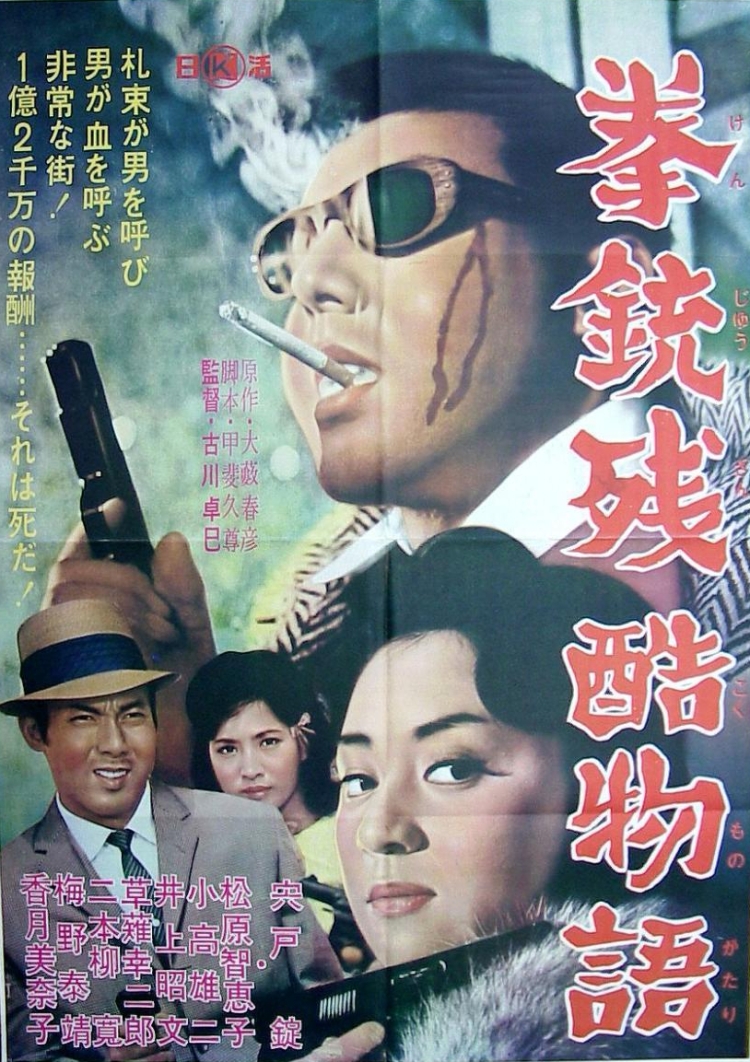
 In the history of Japanese noir, the name Haruhiko Oyabu looms large. Oyabu’s gritty, pulp infused tales of tough guy heroes found their clearest expression in the hardline ‘70s with Toru Murakawa’s unique brand of macho action as seen in Resurrection of the Golden Wolf or The Beast Must Die, but a decade earlier they were also finding fertile ground in Nikkatsu’s harder B-movie noir. Based on a novel by Oyabu, Cruel Gun Story (拳銃残酷物語, Kenju Zankoku Monogatari) seems to owe more than a little to Kubrick’s The Killing in its crime never pays tale of honest crooks undercut by their unscrupulous comrades but the central message is that the gun is a cruel master and those living under its control will pay a heavy price.
Togawa (Jo Shishido) has just been (unexpectedly) given early release from a prison sentence incurred when he took revenge on the truck driver who knocked down his little sister (Chieko Matsubara) and confined her to a wheelchair for the rest of her life. Middle rank gangster Ito – formerly a crooked lawyer with a pencil mustache a supercilious air, has a job for him the gang thinks only he can do. The payout is 120 million yen – not to be sniffed at, but Togawa has reasons to be suspicious. He takes some convincing but finally relents when he finds out an old and trusted friend, Shirai (Yuji Kodaka), has already agreed. The gang have another three guys lined up but Togawa rules the third one out when he tests him and confirms he’s an untrustworthy blabbermouth. The other two are a former boxer with mild brain damage whose girlfriend has just left him, and an unscrupulous but clever chancer named Teramoto (Kojiro Kusanagi).
Following the general pattern, Furukawa walks us through the heist as it’s supposed to go if everything goes to plan complete with a 3D diagram and plastic toy cars but, of course, not everything goes to plan. The job is to steal the ticket money from the Japan Derby (much like the race course robbery in The Killing). The gang will set up fake road signs and station a “policeman” to divert the armoured car onto a small country lane where they will kill the police motorcycle escort, get rid of the guards, and load the truck onto a bigger lorry that they will then take to a disused US airbase they’ll use as their lair.
Disused American airbase could easily apply to the entirety of the surrounding area. Jets fly ominously overhead while the world Togawa and his guys inhabit is one of noirish jazz bars filled with foreigners, grimy boxing clubs, signs in English and the relics of destruction everywhere. This is a place for those who’ve already fallen through the cracks, even the gangsters are only really small fry – not yakuza but hoodlums ripped straight from the Edward G. Robinson playbook. This giant heist is the most audacious in living memory, pulling it off would be the finest achievement any of them would ever make, taking them out of their dead end environments and catapulting them into the criminal high life.
Togawa knows there’s something not right about this – he almost turns it down because he wants to be around to take care of his sister, but he also wants the money to pay for an operation he hopes will restore her mobility to assuage his guilt over having sent her out on the fateful day she was injured. Rie now lives in the care of kindly nuns and is a goodhearted, religious woman hoping for her big brother’s reformation. Togawa and his sister are also victims of war having lost their parents during the evacuation from Manchuria and have been essentially on their own ever since. Rie has become a living symbol of Togawa’s failures – his inability to protect her, to keep them both safe and together, and to free them of the ruined post-war landscape within which they both remain trapped. Rie pins her hopes on God, but Togawa says to hell with that – where has He been so far?
Having pinned his hopes on the gun, Togawa intends this to be the heist to end all heists. After this, he’ll be free to give his sister the life she deserves away from crime and the rundown town strewn with mementos of a distant, dethroned occupying power. The gun, however, is a divisive weapon and engenders nothing but mistrust among men. Resentful of Togawa’s solid friendships, the other guys turn on him as do his shady employers sending Togawa even further along the dark path to moral ruination than he already was. All that’s waiting for Togawa is a hollow victory and the intense disappointment of those whose faith in him was ultimately misplaced.
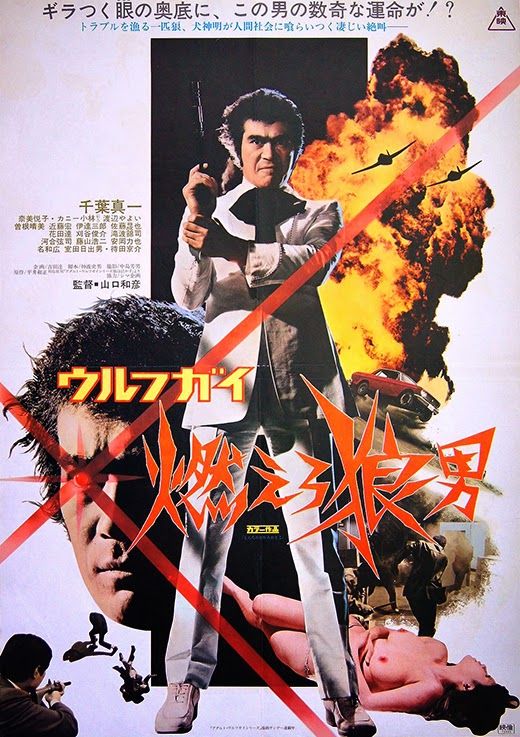 Universal’s Monster series might have a lot to answer for in creating a cinematic canon of ambiguous “heroes” who are by turns both worthy of pity and the embodiment of somehow unnatural evil. Despite the enduring popularity of Dracula, Frankenstein (dropping his “monster” monicker and acceding to his master’s name even if not quite his identity), and even The Mummy, the Wolf Man has, appropriately enough, remained a shadowy figure relegated to a substratum of second-rate classics. Kazuhiko Yamaguchi’s Wolf Guy (ウルフガイ 燃えよ狼男, Wolf Guy: Moero Okami Otoko, AKA Wolfguy: Enraged Lycanthrope) is no exception to this rule and in any case pays little more than lip service to werewolf lore. An adaptation of a popular manga, Wolf Guy is one among dozens of disposable B-movies starring action hero Sonny Chiba which have languished in obscurity save for the attentions of dedicated superfans, but sure as a full moon its time has come again.
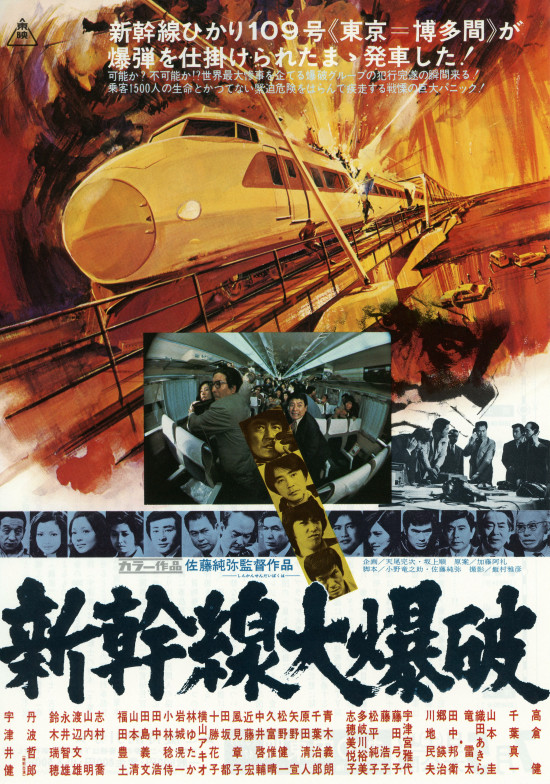 For one reason or another, the 1970s gave rise to a wave of disaster movies as Earthquakes devastated cities, high rise buildings caught fire, and ocean liners capsized. Japan wanted in on the action and so set about constructing its own culturally specific crisis movie. The central idea behind The Bullet Train (新幹線大爆破, Shinkansen Daibakuha) may well sound familiar as it was reappropriated for the 1994 smash hit and ongoing pop culture phenomenon Speed, but even if de Bont’s finely tuned rollercoaster was not exactly devoid of subversive political commentary The Bullet Train takes things one step further.
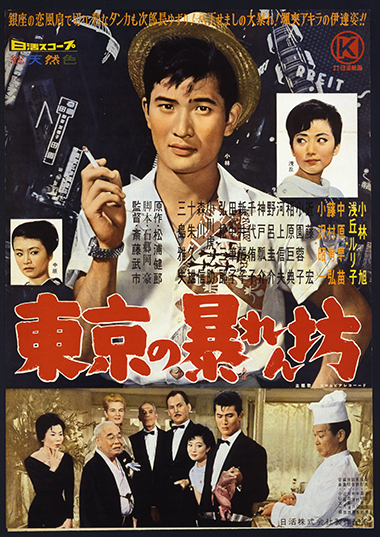 The bright and shining post-war world – it’s a grand place to be young and fancy free! Or so movies like Tokyo Mighty Guy (東京の暴れん坊, Tokyo no Abarembo) would have you believe. Casting one of Nikkatsu’s tentpole stars, Akira Kobayshi, in the lead, Buichi Saito’s Tokyo Mighty Guy is, like previous Kobayashi/Saito collaboration
 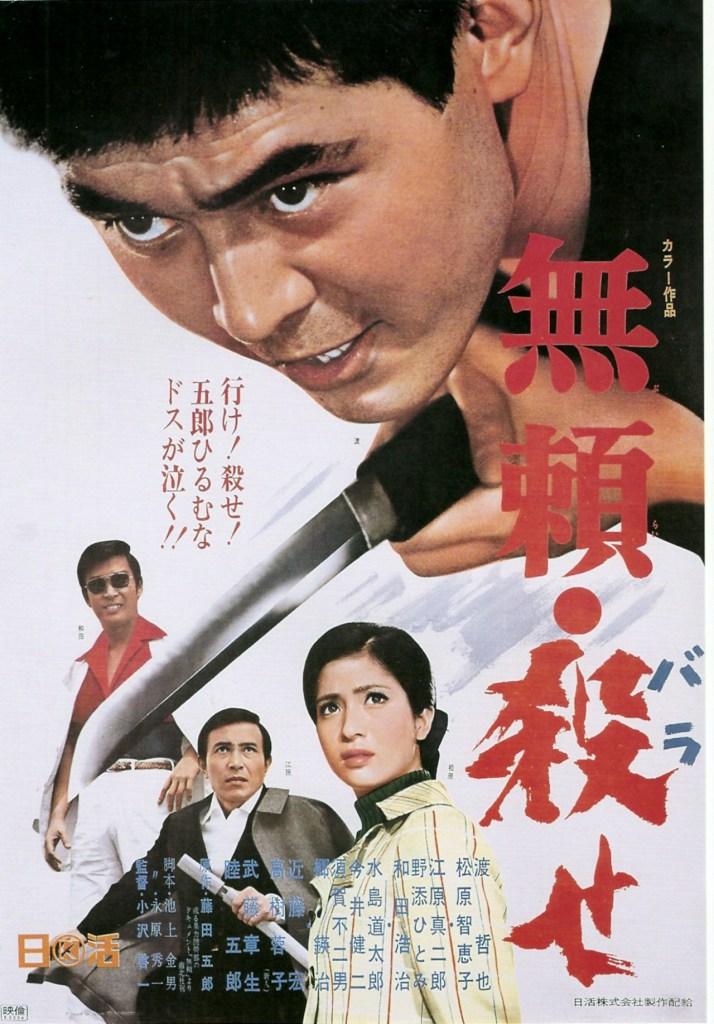 Goro, Goro, Goro – will you never learn? Maybe he will because this is the last film in the series! Appropriately titled Outlaw: Kill! (無頼 殺せ, Burai Barase), this sixth and final film in the Outlaw series sees Goro once again moving to a new town and trying to lead a more honest life but unfortunately he’s wandered in at just the wrong time because a local gang boss has just been sent to prison after defeating a group of assassins leaving a dangerous vacuum and leading, therefore, to the outbreak of a turf war.
 Windows on Worlds