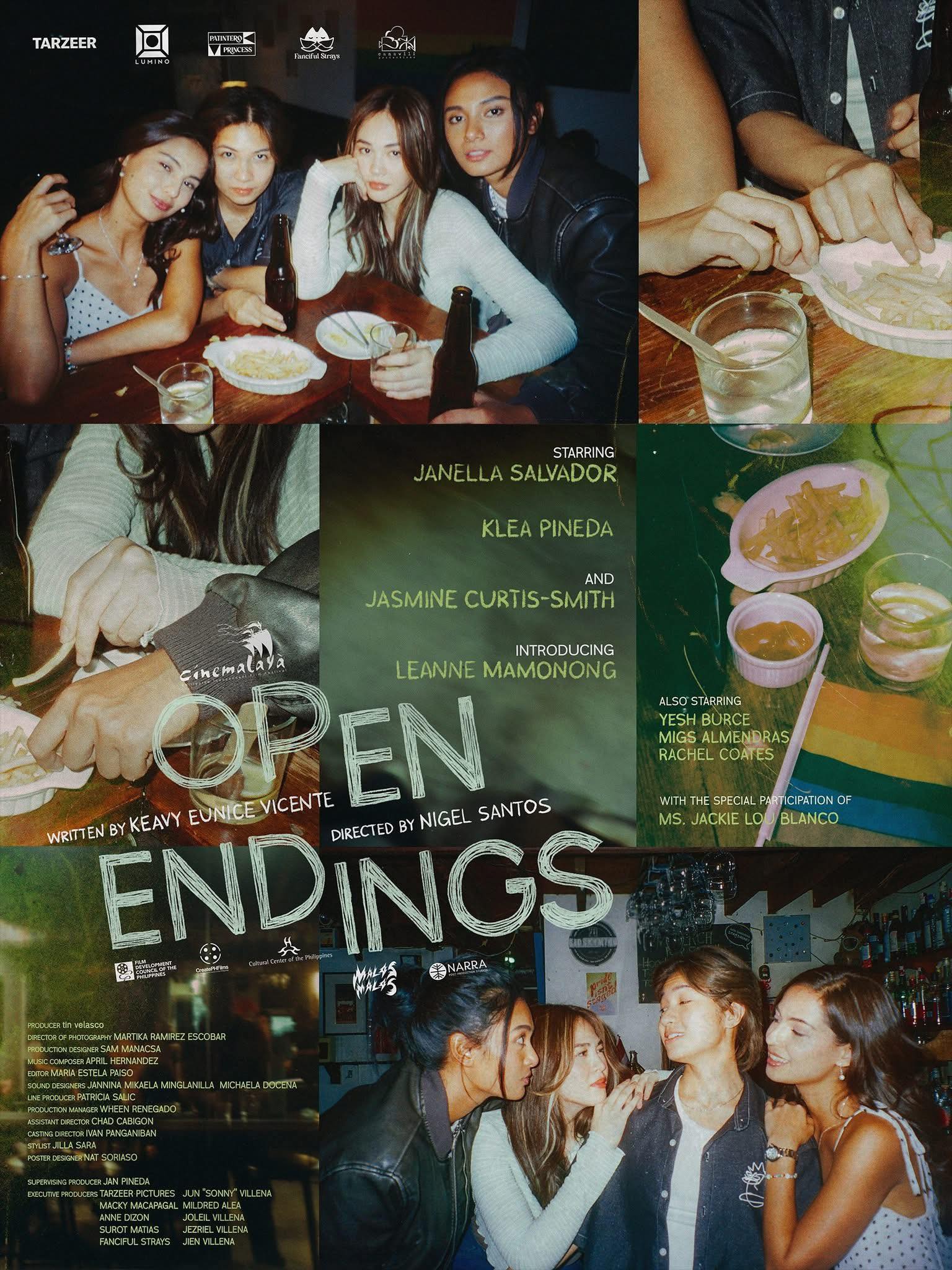
Open Endings (Nigel Santos, 2025)

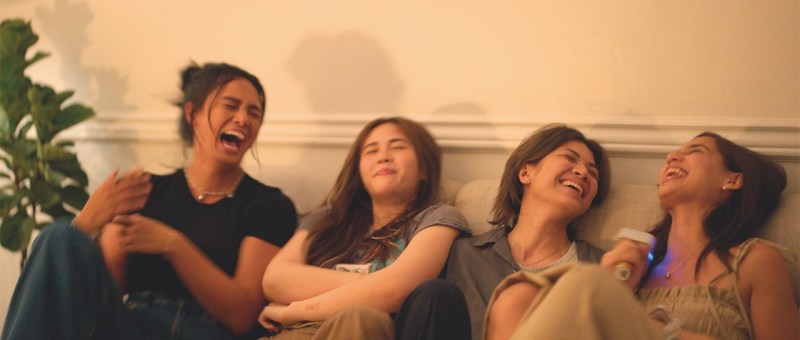
Is it acceptable to be friends with your exes? Charlie’s (Janella Salvador) bond with her friendship group made up of women who’ve all been romantically entangled at one point or another becomes a problem for her new relationship. Rafa (Rachel Coates) finds the situation altogether too weird, and even goes so far as to ask Charlie to cut her friends off. It might not be a good idea to date someone who tries to isolate you from friends and family, but Rafa claims these are just her boundaries and she can’t help feeling uneasy with Charlie spending so much time with women she’s previously slept with.

Then again, it’s not easy to be gay in the Philippines and this community is quite small. Can you really afford to cut people off just because of potential awkwardness? Each of the women is struggling in their own way, but tries to support her friends and is supported in return. The group only really formed as the exes banded together to look after Hannah when her partner passed away. Sundays have now become sacred to them as a time they can all come together and share their fears and worries no matter the various unresolved feelings that exist between them.

These relationships are often messy and ill-defined, but genuine and heartfelt. For Kit (Klea Pineda), friendship is most the beautiful of gifts and she fears acting on her feelings for Charlie because she doesn’t want to ruin what they have. Still closeted not wanting to upset her parents are religious and conservative, Kit is in an awkward non-relationship with a married woman who is also the mother of one of her pupils at the school where she teaches. Alexa (Yesh Anne Burce) is trapped with a heteronormative relationship she cannot escape because divorce is still not legal in the Philippines. Constrained by her own circumstances, she becomes possessive of Kit who is the only path back to her authentic self and the only person with whom she can be free. In other ways, however, perhaps the impossibility relationship suits Kit because she cannot be her authentic self either while unable to reveal her sexuality to her parents. 

The impossibility of divorce is also a factor when Hannah (Jasmine Curtis-Smith) suddenly drops the bombshell that she’s become engaged to a man. The group’s only bisexual, Hannah faces prejudice from her family who express relief that she’s finally got over her lesbian phase and rediscovered the right path, while the friends also see it as a kind of betrayal though perhaps only because she kept her new relationship secret from them for several months. Charlie is also subjected to homophobic violence when a man barges into the gay bar where she’s drinking and propositions her, insisting that she is “alone” because he’s only seen her with another woman. When he finally figures it out, he sees it as a challenge and quickly becomes violent. 

These kinds of petty aggressions remind the women of their precarious position within a hostile society that enforcers heteronormativity and traditional gender roles. Their friendship is a small bubble of resistance that gives each of the women additional confidence to continue being who they are. This atmosphere of hostility plays into Mihan’s insecurities, her far of commitment and inability to clearly declare her feelings. She resents Hannah for choosing to marry a man as if she were doing it because of social expectation rather than personal desire, while also forced to accept that this is all her fault. She had plenty of time to try and patch things up with Hannah, but never did. 

The open-ended nature of these relationships leaves Mihan with anxiety, but it also allows these women to continue being friends and supporting each other. The friendship doesn’t have to end just because the romance did. But at the same time, she has to accept that the risk of heartbreak is something that has to be actively embraced and her tendency to skip out on relationships the moment they become serious leaves her only with a lack of resolution. Painting a warm and funny portrait of contemporary queer life in the Philippines which nevertheless does not shy away from its difficulties, Open Endings celebrates most of all the joyousness and power of female friendship in the face of social hostility.


Open Endings screened as part of this year’s Queer East.

Trailer (English subtitles)
The Loved One (Irene Emma Villamor, 2026)

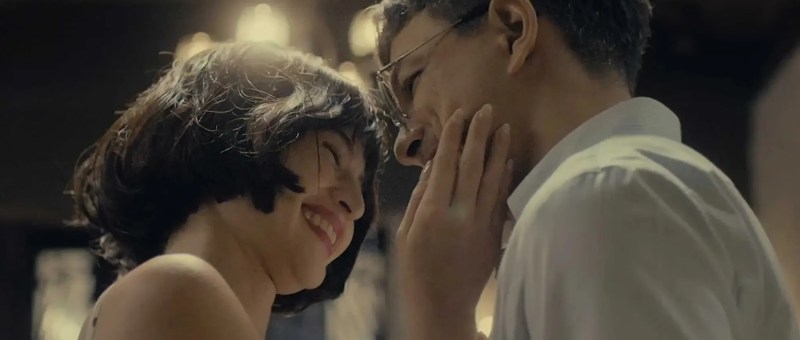
It may be true that within every relationship there is the lover and the one who is loved and that love is generally unequal. At least, Eric (Jericho Rosales) feels himself to have been the lover and is resentful that Ellie (Anne Curtis) did not seem to love him as much as he loved her, but the irony is that Ellie may feel the same. She kept trying to get through to Eric, but he never really seemed to listen to her nor did she feel him to be very interested in who she actually was as opposed to what he wanted her to be. 

In any case, it’s clear from the offset that Eric and Ellie are entirely unsuited. The qualities that once drew them to each other are exactly those which later drive them apart. Told mainly from Eric’s perspective, the film nevertheless paints him as an incredibly dull person, which wouldn’t really be a problem in itself if he didn’t resent other people’s desire to go places and do things quite as much as he does. He’s a bit of a fuddy-duddy and, as his mother puts it, “traditional” which is to say socially conservative with some fairly right-wing, authoritarian views which are in direct contrast to Ellie’s bohemian outlook. Eric’s attracted to her because she’s a free spirit, a dynamic and mysterious young woman who likes to have fun but also wants to make a difference in the world. 

But Eric’s also insecure in himself and at the end of the day wants Ellie to lead a more conventional life. Ellie comes from money, and Eric can’t escape the sense of inferiority he feels around her upper-class parents who disparage his occupation on their first meeting and make no secret of the fact they think he’s not good enough for their daughter only to come round to him later. In some ways, Ellie may be attracted to him because he reminds her of her father and aside from his working-class background is exactly the sort of man she’s told she’s supposed to want. Nevertheless, he becomes jealous and controlling. He pushes marriage with thinly veiled desperation, as if by putting a ring on her finger he’d have won her forever. Ellie, meanwhile, tells him she doesn’t want to be “trapped” by him and has no interest in getting married. All she wants is to live with him, though Eric isn’t all that keen on the business of living so much as the external validation of social success through ticking off milestones like marriage and children and career achievement. 

Ellie doesn’t care about any of that. When she tells Eric that she’s quit her office job because the corporate life isn’t for her, he looks on in total horror as if he can’t believe someone would do something so foolish as to quit their job with no plan for the future. He puts up with it when she starts doing humanitarian work, but thinks of it as a hobby or a passing fancy and never takes it seriously. It doesn’t occur to him that something that doesn’t make money or improve one’s social standing could be fulfilling, and worse than that, he resents what he sees as Ellie’s unseriousness thinking that it’s born of the confidence and security that comes with privilege. If he once thought of her as a free spirit, he comes to see her as flaky and fails to notice that she is always growing and changing as she pursues the person she’s supposed to be while he remains defiantly as he is, resenting that everything is changing all around him. 

Still, Ellie keeps trying even though this relationship is clearly not working for her. She begins smoking to deal with her anxiety which mainly seems to be bundled up with her relationship with Eric and breaks down in tears listening to a woman trapped in an abusive marriage tells her of her struggles to leave while working at a women’s association. Eric is often cruel and thoughtless, selfish and controlling, pissed off when she talks to other men but flirting with a woman at work with whom he almost starts an affair. He thinks that “almost” is his saving grace, but really it doesn’t matter. Eric has treated both women disrespectfully and already cheated on Ellie emotionally if only in his reluctance to go home knowing that she’s there. The generous conclusion that Ellie comes to that they were both too much for each other. At the wedding where they reconnected, Ellie asked Eric if he thought their friends’ relationship would last and love was enough to see them through. Eric thought so, though she wasn’t so sure. It worked out for their friends who might not have had such a tempestuous love story and settled into a much more conventional married life, but no matter how much they may have loved each other, Eric and Ellie’s romance was always doomed. “How did they survive each other?” Ellie asks as she and Eric look on at an older couple celebrating a birthday surrounded by children and grandchildren, while all they’re left with is the smouldering embers of a failed love.


Trailer (no subtitles)