
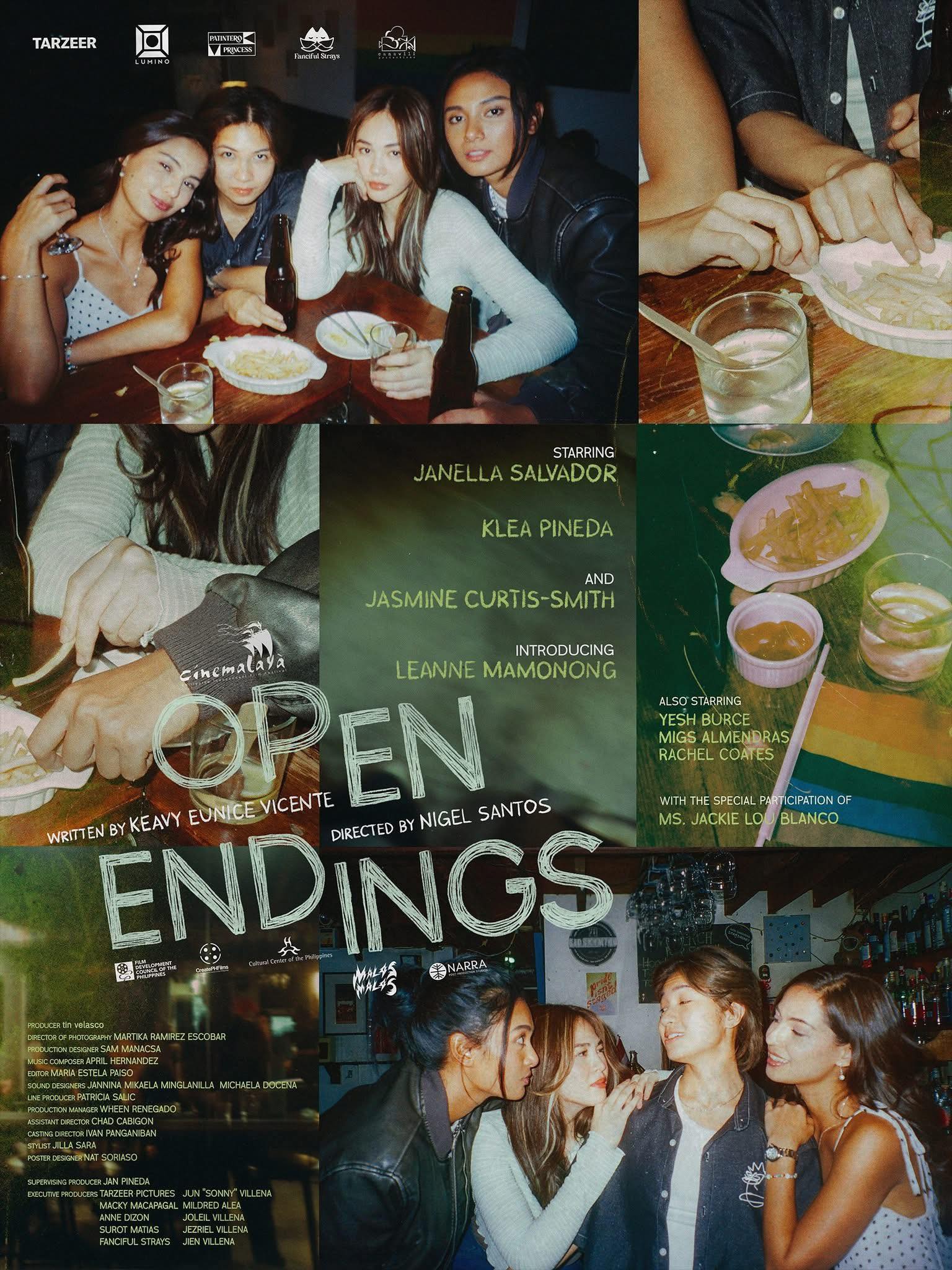
Open Endings (Nigel Santos, 2025)

Is it acceptable to be friends with your exes? Charlie’s (Janella Salvador) bond with her friendship group made up of women who’ve all been romantically entangled at one point or another becomes a problem for her new relationship. Rafa (Rachel Coates) finds the situation altogether too weird, and even goes so far as to ask Charlie to cut her friends off. It might not be a good idea to date someone who tries to isolate you from friends and family, but Rafa claims these are just her boundaries and she can’t help feeling uneasy with Charlie spending so much time with women she’s previously slept with.

Then again, it’s not easy to be gay in the Philippines and this community is quite small. Can you really afford to cut people off just because of potential awkwardness? Each of the women is struggling in their own way, but tries to support her friends and is supported in return. The group only really formed as the exes banded together to look after Hannah when her partner passed away. Sundays have now become sacred to them as a time they can all come together and share their fears and worries no matter the various unresolved feelings that exist between them.

These relationships are often messy and ill-defined, but genuine and heartfelt. For Kit (Klea Pineda), friendship is most the beautiful of gifts and she fears acting on her feelings for Charlie because she doesn’t want to ruin what they have. Still closeted not wanting to upset her parents are religious and conservative, Kit is in an awkward non-relationship with a married woman who is also the mother of one of her pupils at the school where she teaches. Alexa (Yesh Anne Burce) is trapped with a heteronormative relationship she cannot escape because divorce is still not legal in the Philippines. Constrained by her own circumstances, she becomes possessive of Kit who is the only path back to her authentic self and the only person with whom she can be free. In other ways, however, perhaps the impossibility relationship suits Kit because she cannot be her authentic self either while unable to reveal her sexuality to her parents. 

The impossibility of divorce is also a factor when Hannah (Jasmine Curtis-Smith) suddenly drops the bombshell that she’s become engaged to a man. The group’s only bisexual, Hannah faces prejudice from her family who express relief that she’s finally got over her lesbian phase and rediscovered the right path, while the friends also see it as a kind of betrayal though perhaps only because she kept her new relationship secret from them for several months. Charlie is also subjected to homophobic violence when a man barges into the gay bar where she’s drinking and propositions her, insisting that she is “alone” because he’s only seen her with another woman. When he finally figures it out, he sees it as a challenge and quickly becomes violent. 

These kinds of petty aggressions remind the women of their precarious position within a hostile society that enforcers heteronormativity and traditional gender roles. Their friendship is a small bubble of resistance that gives each of the women additional confidence to continue being who they are. This atmosphere of hostility plays into Mihan’s insecurities, her far of commitment and inability to clearly declare her feelings. She resents Hannah for choosing to marry a man as if she were doing it because of social expectation rather than personal desire, while also forced to accept that this is all her fault. She had plenty of time to try and patch things up with Hannah, but never did. 

The open-ended nature of these relationships leaves Mihan with anxiety, but it also allows these women to continue being friends and supporting each other. The friendship doesn’t have to end just because the romance did. But at the same time, she has to accept that the risk of heartbreak is something that has to be actively embraced and her tendency to skip out on relationships the moment they become serious leaves her only with a lack of resolution. Painting a warm and funny portrait of contemporary queer life in the Philippines which nevertheless does not shy away from its difficulties, Open Endings celebrates most of all the joyousness and power of female friendship in the face of social hostility.


Open Endings screened as part of this year’s Queer East.

Trailer (English subtitles)
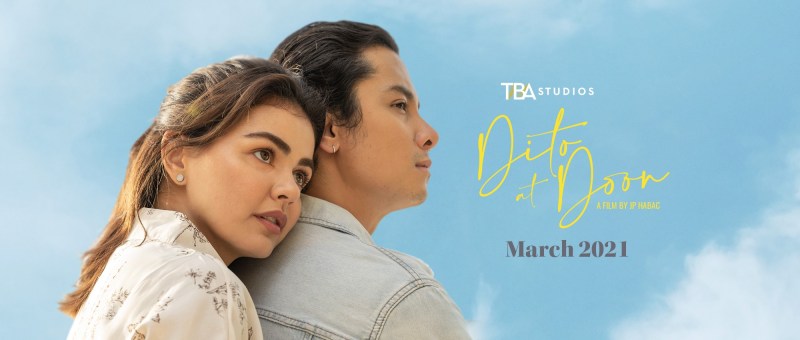
Here and There (Dito at Doon, JP Habac, 2021)

Love in the time of corona? Romantic fantasy can be a helpful diversion but it’s difficult enough to get to know someone fully at the best of times, when your interactions are mediated through the connective barrier of technology it may be impossible. A true corona movie, JP Habac’s zeitgeisty rom-com Here and There (Dito at Doon) finds two lonely people falling in love, perhaps, over FaceTime but discovering that their lockdown connection may not survive its liberation.

30-ish Len (Janine Gutierrez) is a graduate student whose financial and environmental circumstances have not changed very much despite the imposition of a lockdown. Happy, to an extent, with staying home alone she takes to “facenook” to voice her exasperation with those already fed up, reminding them it’s only been eight days and being asked to stay at home is not exactly difficult. Only she gets an equally exasperated, prickly reply tagged #youreboredwerehungry from a stranger flagging up her privilege and pointing out that it’s all very well for her, but what about people who are struggling with having lost their livelihoods? She agrees with him, but also thinks it’s a separate point from the one she was making and isn’t sure why he’s picking a fight with someone he doesn’t know, settling for a rather pithy reply. That would have been that, but after Zooming her two besties Len gets a bit of shock, irresponsible Mark (Victor Anastacio) has flouted the lockdown rules and got a friend over, Caloy (JC Santos), who turns out to be none other than her FN troll. Still, over Zoom, the pair kind of hit it off and Caloy even sends a grovelling apology. Len isn’t sure what’s going on here, but decides to go with it because after all what else is there to do? 

A perfect capture of a moment in time, Here and There is filled with early pandemic nostalgia from a fascination with Dalgona coffee and learning to cook to the ubiquity of masks and hand sanitiser as Len and her friends attempt to ease their anxiety through frequent Zoom sessions and online drinking parties. In a poignant staging device, Habac brings his cast together as if they were really all in the same room yet they are still divided, socially distanced and unable to touch either each other or common objects located as they are somewhere else. When there’s a “here” there must be a “there”, but the internet has the uncanny ability to imperfectly merge the two, closing the gap but perhaps painfully. One step on from an old-fashioned penpal romance, Len and Caloy bond over facenook messenger and occasional phone calls but the screens which connect them also divide, she’s still “here” and he’s still “there” in emotional as well as physical dimensions. 

As her friends testify and that first meet cute bear out, Len is stubborn and opinionated, a self-centered only child, while despite the reversal of their first meeting Caloy seems to be sensitive and caring yet also perhaps increasingly depressed and anxious worrying about his family back in rural Cebu which according to the news is turning into a coronavirus hot spot. Working as a frontline delivery driver, Caloy had accused Len of belittling the fears of those who have no choice but to go out when she is free to stay safe at home, but she does know about the plight of frontline workers because her mum (Lotlot de Leon, Gutierrez’ real life mother) is a nurse who insists on social distancing inside the house as well as the use of masks and copious disinfectant. At 55 she’s in an at risk group and Len is forever trying to convince her to retire or at least stop taking additional shifts but her mother feels she has a responsibility, leaving Len often entirely alone with only her plants to talk to. Perhaps for these reasons, he going out, she staying in, Len rarely thinks to ask how things are for Caloy until it’s perhaps too late, angrily snapping at him on the phone while he tries to cheer her up only realising that he might be hurting too after her own problems have been sorted. 

She can’t see it, but he always seems to be surrounded by cooling blues as in his lonely bedroom while her spacious multilevel home is a warming mix of golds and browns lit by comforting lamplight. Nevertheless, they slowly bond sharing their traumatic pasts and hopes for the future, hers Korean barbecue his to see her so he says, yet there are also ways in which they do not quite connect never quite understanding each other as they remain “here” and “there” respectively. “Everything has to end sometime” Len adds encouragingly, though in the “real” world we’re still waiting a year in, but she’s more right than she knows over optimistically contemplating her happy ever after while getting used to the new normal. A charming, witty romance boasting fantastically sophisticated dialogue, innovative production design, and witty composition, Here and There is the first great corona movie capturing the everyday of these strange times with touching levity even as its unexpected ending reminds us that they too will sometime end.


Here and There screened as part of the 2021 Osaka Asian Film Festival. Production company TBA Studios has also just launched its own streaming service TBAPlay available in the US and Europe (Italy, Germany, Portugal, Spain, and Switzerland) featuring last year’s Write About Love as one of its launch titles. Readers in the Philippines can also stream Here and There via Cinema 76@Home.

Original trailer (English subtitles)