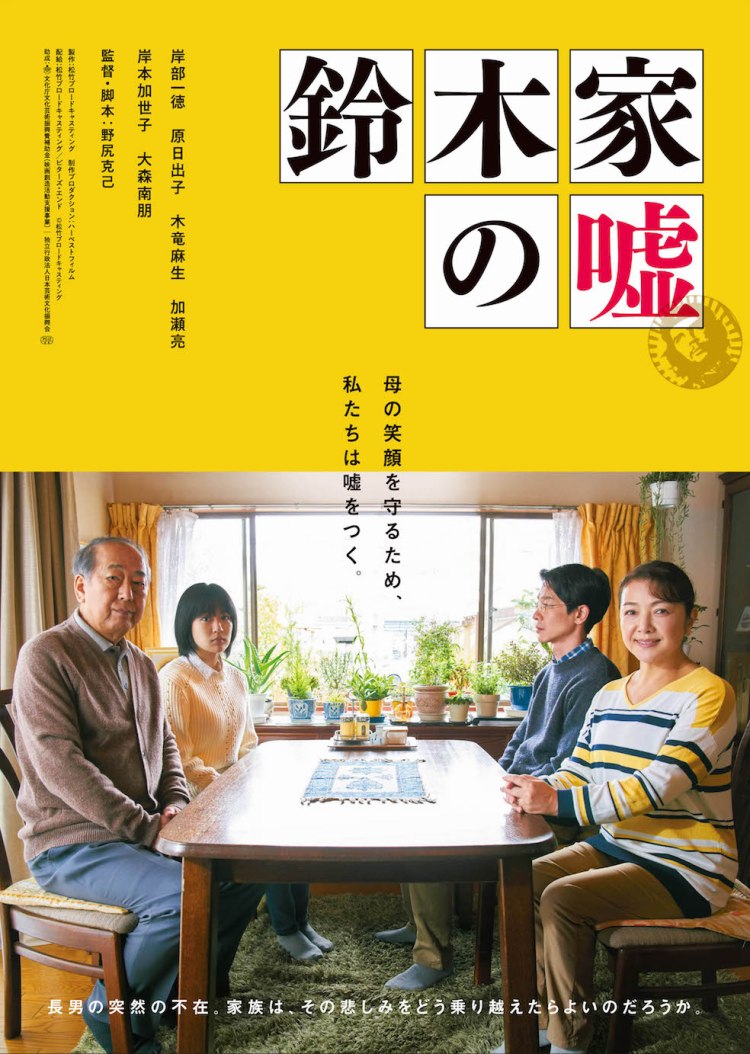
Shoplifters (万引き家族, Hirokazu Koreeda, 2018)

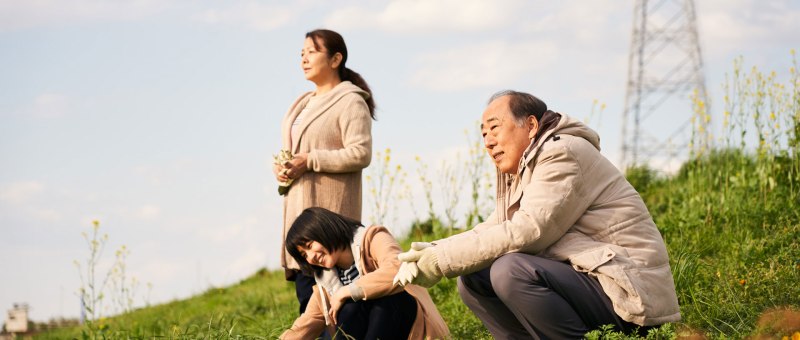
Shoplifters poster 2Tolstoy once said that all happy families are alike, but each unhappy family is unhappy in its own way. The family drama is the mainstay of Japanese cinema, though to be fair it rarely features families which are noticeably “unhappy” so much as struggling under the weight of social expectations. Nevertheless, since consumerism arrived in force, the concept of “the family” has come in for regular interrogation. That at the centre of Shoplifters (万引き家族, Manbiki Kazoku), Hirokazu Koreeda’s return to the genre with which he is most closely associated, are on one level among the happiest of families ever captured on film, but then again they are not quite like all the others.

The Shibatas live in a small Japanese-style house owned by “grandma” Hatsue (Kirin Kiki) whose pension (or, to be more precise, that of her late husband) makes up a significant portion of the family income. Patriarch Osamu (Lily Franky) has a casual job as a day labourer while his wife, Nobuyo (Sakura Ando), works in a laundry. Her “sister” Aki (Mayu Matsuoka) tells people she works as a kind of hostess but actually dresses up as a schoolgirl and performs sex services behind a two-way mirror in a sleazy club. Meanwhile, Osamu and Nobuyo’s “son”, Shota (Jyo Kairi), alternates his time between homeschooling himself and helping out with the family’s only other source of income – thievery. It’s after one partially successful foray to the local supermarket that Osamu and Shota come across a little girl, Yuri (Miyu Sasaki), stuck out on a balcony alone in the freezing cold and decide to take her home for something warm to eat.

Of course, this family itself is the very definition of makeshift. Osamu and Nobuyo may be a “real” couple, but no one else is actually related. The Family Game may have attempted to take the family apart and expose it as an artificial mechanism devoid of real feeling in which each is simply playing the role expected of them, but Shoplifters asks the opposite – if a found family can actually be more “real” that the real thing because it has been chosen, is wanted, and continues to function because of an organic bond between individuals which exists in the absence of blood.

In a sense, the family itself has been “shoplifted”. Later, under questioning, Nobuyo is accused of “throwing away” Hatsue but she corrects them – she didn’t and she wouldn’t. Someone else “threw away” Hatsue and she found her. Hatsue was abandoned by her husband who fathered a family with another woman, but seemingly not with her. Alone she longed for a family of her own and most of all to avoid the looming threat of a “lonely death”. Whatever else they might have gained from the “arrangement”, Osamu and Nobuyo are at least able to offer her the thing that would make her life complete as she prepares to meet its end. By the logic of the family drama, one family must be broken in order to forge another and it’s true enough to say that each member of the Shibata clan has been pilfered from somewhere else but in the end perhaps it’s better this way, free of the cold obligation of a blood or legal tie.

Then again, there are cracks in the foundation. Little Shota, growing fast into a young man, is increasingly conflicted about the way the family makes ends meet. Trapped in low paid, casual employment, Osamu and Nobuyo are working but poor, unable to support their family on their wages alone. Injured at work, Osamu is left without compensation because he’s only a day labourer and therefore not entitled to workplace protections while Nobuyo is eventually forced into a “workshare” arrangement and then to resign when her boss cruelly tells her and a friend that they can decide between themselves which of them gets to keep their job. They steal because they’re hungry, but also perhaps because they enjoy this small way of rebelling against the system. Osamu tells Shota that stealing from stores is OK because no one really “owns” anything while it’s still on the shelf, but Shota begins to doubt his logic. It’s not just “taking”, it’s taking “from” and Shota is increasingly worried about who it is their way of life may be harming. He worries that in taking in Yuri the family is corrupting her, indoctrinating her into their morally dubious universe.

Morally dubious it may be, but life with the Shibatas is warm and safe which is a lot more than can be said for Yuri’s life with her birth parents who don’t even bother to report her missing – social services eventually figure out she isn’t around two months later and come to the conclusion that the parents may have got rid of her in some unspecified way. Which sort of “corruption” is worse – an upbringing filled with abuse and neglect, or one filled with love and habitual criminality? Yet it’s an act of love that finally breaks the family apart and leaves them at the mercy of cold and official forces too obsessed with their own sense of narrative to bother listening to the “truth”. Shoplifters wants to ask if the “natural” laws of society still serve us when little girls fall through the cracks and our definition of “family” is so narrow and rigid that it denies us a way of saving them. Sometimes the found family is stronger than the inherited one, but society is primed to crush it all the same in its relentless and indifferent quest to preserve the social order.


Shoplifters opens in UK cinemas on 23rd November courtesy of Thunderbird Releasing.

International trailer (English subtitles)

Dangan Runner (弾丸ランナー, SABU, 1996)

Dangan Runner posterIt’s not difficult to see what might send three young men running like stray bullets from a random gun in the Japan of the mid-90s, but each of the various protagonists of SABU’s debut feature Dangan Runner (弾丸ランナー, AKA Non-Stop) is reaching for a different target. Like much of the director’s later work, Dangan Runner pivots on random circumstance which somehow conspires to bring our three runners together as if bound by cosmic thread while they too are chased by an oncoming storm in the form of vengeful yakuza and the bumbling cops hot on their trail.

Kickstarting the whole affair, lowly restaurant worker Yasuda (Tomorowo Taguchi), fed up with the petty humiliations of his life, decides to rob a bank. He has everything planned, even rehearsed and choreographed down to the second, but when the time comes he makes a mistake. Having left his mask at home, he decides to buy one from a local combini but panics and accidentally shoplifts instead, attracting the attentions of bullet two – Aizawa (Diamond Yukai), who is wounded in the arm by Yasuda’s nervous shot when his gun accidentally goes off. A drug addict and former rockstar, Aizawa, intent on revenge for the disrespect he’s just been paid, retrieves the gun dropped by Yasuda and chases him through the streets of Tokyo. Aizawa in turn continues the chain reaction when he bumps into a yakuza, Takeda (Shinichi Tsutsumi), who is “triggered” by a deep seated trauma into chasing off after Aizawa, knife in hand. Meanwhile, a rival yakuza clan is also after Takeda because of gangland politics while they too are being monitored by the police who have gotten wind of a gang war in the offing.

Though SABU’s film is not in the least political, it is like much of his work a mild satire even if its sympathy lies firmly with its three central heroes each desperately trying and failing to outrun themselves. Yasuda, a small man with a slight frame, is the lowest of the low. He has a terrible job as a kitchen assistant in a small restaurant where he is constantly bullied by the head chef and belittled by the other kitchen staff who are all much taller and stronger than he is. It’s not difficult to see why he might bristle so much when one calls him “good for nothing”, yet he’s not the type to offer more than an angry stare in return. To make matters worse, he runs into an old girlfriend who appears to have moved on and up. Walking arm in arm with a wealthy salaryman, she has apparently jettisoned the “common” name of “Midori” for the relatively more sophisticated one of “Yasuko”, presumably hoping to hook someone who is indeed the polar opposite of a “loser” like Yasuda.

Aizawa also has his share of woman troubles though his are of an opposing dimension. A failed musician with a drug problem, Aizawa alienated his loving girlfriend while hoping his addiction would save him from his unattainable dreams. Of course, it’s an entirely different “shot in the arm” that starts him running, but like Yasuda in the end all he can think of is the girl and how he did everything wrong. Takeda, by contrast, is a yakuza through and through. His regrets are bound up with homosocial bonding and male loyalty, mourning the death of the trusted superior he failed to save in dodging the blows of a random assassin. Yet as his superior tells him, all living beings run towards the same thing. A yakuza cannot control his death but he can control his life and the effect he has on others. He urges Takeda to run and find life in the process, but perhaps Takeda’s destination is the run itself rather than where it will eventually take him.

Indeed, Yasuda, accidentally landing up in the middle of the yakuza gang war, affirms that he never felt so alive as when he was running for his life. All three men, running fast from failure, finally achieve the freedom they’d dreamed of through the intense exertion of their flight which later literally becomes orgasmic as all three fantasise about a pretty woman seen on the side of the road. Like bullets fired from a gun powered by social impossibility, each is destined to explode on reaching its chosen target. Like many of SABU’s later protagonists, these are men brought low by life and circumstance, driven slowly mad by a conspiracy of cosmic coincidence, mere playthings of fate without power or agency. Angry young men are a powder keg waiting to ignite, but in SABU’s whimsically surreal universe they usually sort things out amongst themselves. For the Dangan Runners, they only need to look in the mirror to figure out where it is they need to go.


Dangan Runner is available on dual format DVD & blu-ray from Third Window Films. On disc extras include a video essay on the history of V Cinema from film scholar Tom Mes, and an expansive audio commentary by Jasper Sharp providing detailed background on SABU’s career and the Japanese cinema landscape of the mid-90s.

Original trailer (English subtitles)

Ten Years Japan (十年 Ten Years Japan, Chie Hayakawa, Yusuke Kinoshita, Megumi Tsuno, Akiyo Fujimura, Kei Ishikawa, 2018)

Ten Years Japan posterBack in 2015, five aspiring Hong Kong filmmakers came together to present a collection of shorts speculating on the fate of their nation in 10 years’ time. Coinciding with if not directly inspired by the Umbrella Movement, Ten Years was a deliberately political project which tapped into the nation’s unique preoccupations almost 20 years on from the end of British rule and a little more than 30 before One Country, Two Systems expires. The film proved an unexpected box office hit and has gone on to become an unconventional franchise with a host of other Asian nations creating their own omnibus movies musing on what may or may not have occurred in a decade’s time.

Unlike the original Hong Kong edition, Japan’s vision (十年 Ten Years Japan) is decidedly less political, perhaps reflecting a greater level of stability. Nevertheless, taken as a whole there are a number of recurrent themes running through each of the segments from the ageing population to the increasing power of the state and the dark possibilities of technology.

In Chie Hayakawa’s Plan 75, the first and darkest of the shorts, a conflicted salaryman (Satoru Kawaguchi) makes his living selling the titular “retirement” plans to those who have reached the age of 75 and decided enough is enough. Japan’s population is ageing faster than any other and caring for the elderly has placed a significant strain on the young. The old and infirm are therefore encouraged to think of themselves as burdensome, that they should do the decent thing and relieve the pressure on their loved ones by going gracefully at the right time. So far so Ballad of Narayama, but age isn’t quite the issue – the rich are excluded because they’re still spending their money and therefore economically useful. The government would rather roll out the invitations to the “unproductive”.

Ironically enough, a little girl who wants to be a vet in Yusuke Kinoshita’s Mischievous Alliance is advised to become a doctor instead and specialise in elder care which is in fact a growth industry. Unlike the elderly in Plan 75, the kids of Mischievous Alliance are not quite so willing to sit back and conform despite being fitted with invasive headsets connected to a monitoring program which “corrects” their bad behaviour whenever they try to break the rules. The hero rejects his oppressive schooling by self identifying with a stabled horse previously used for medical experimentation, longing to run free if only for a few moments.

If the “promise” system at the centre of Mischievous Alliance presented a vision of a future in which privacy and individual agency have all but disappeared, Data asks us if we have the right to reconstruct someone’s identity after they’ve gone by examining their digital footprint. A high school girl (Hana Sugisaki) tries to adjust to the idea of her widowed father’s (Tetsushi Tanaka) new girlfriend by opening up her mother’s “digital inheritance” but learns more than her mother might have wanted her to know. High school videos and pictures of old boyfriends jostle with beautiful flowers and private anxieties, but when it comes right down to it the organic memories are the only ones that count and the only things to make sense of the cluttered imagery in an uncurated personal museum of random digital moments.

Youth’s desire for knowledge and freedom is also at the heart of Akiyo Fujimura’s The Air We Can’t See which is the only one of the shorts to address nuclear anxiety in the post-Fukushima world. After some kind of event has made the surface uninhabitable, humanity has survived underground. A curious little girl, however, is fascinated by the idea of the outside. Longing to hear the birds and feel the rain, she imagines herself an exterior world but also comes to wonder if her home is a kind of prison born of fear and maybe it’s all alright up top if only you have the courage to look.

Meanwhile the apocalypse is still a little way off in Kei Ishikawa’s For Our Beautiful Country which hints obliquely at the growing threat of North Korea as missiles fly overhead with increasing frequency. The references, however, are older. A cynical ad man (Taiga) oversees a campaign promoting Japan’s remilitarisation but is later charged with letting the elderly, eccentric graphic designer (Hana Kino) know her poster is being “substituted” with something more “powerful”. After spending the day with her and coming to understand the subtle act of rebellion which has made her poster unusable for its propaganda purposes, the ad man gets a new a mission. It’s all up to the young now who have both an opportunity and a duty to ensure their country does not fall into the same kind of ugliness that sent young men off to die in the name of beauty.

Bookending the piece, Hayakawa and Ishikawa present the bleakest visions in which the descent into cruel authoritarianism may have already passed the point of no return. The children, however, seem to disagree and universally turn away from oppressive social codes, preferring to find their own truths and committed to exploring their own freedoms. Ten Years Japan may shed the overtly political overtones of its Hong Kong inspiration but finds brief rays of hope in the midst of despair in a child’s ability to break the programming and strive for a better, fairer world free of adult duplicity.


Screened as part of the 2018 London East Asia Film Festival.

Original trailer (no subtitles)

Ghost in the Well (怪談番町皿屋敷, Toshikazu Kono, 1957)

Ghost in the Well poster 2Love across the class divide threatens to overthrow the social order. Inspired by the classic folktale Bancho Sarayashiki, Ghost in the Well (怪談番町皿屋敷, Kaidan Bancho Sarayashiki) is indeed the story of a haunting though perhaps not altogether of the kind you might be expecting. This is a tale of romance, but also one of impossible love in which the only possible union is in death. The pure love of a servant girl is deemed incompatible with the oppressive world of samurai honour, and so she must die, but her lord cannot survive it. He cannot reconcile himself to having chosen to preserve his honour, his status, his lineage at the cost of her life and his love.

Rowdy samurai Harima (Chiyonosuke Azuma) loves making trouble in the streets. As the lord’s bannerman he knows he has a degree of status and likes to throw his weight around in the yoshiwara, much to the lord’s consternation. Harima has also taken a fancy to one of his maids, Okiku (Hibari Misora), who continues to reject his advances despite returning his affections because she knows the class difference makes a legitimate relationship between them impossible and a dalliance with her lord means losing the opportunity to marry anyone else. Harima tells her that there’s no such thing as status when it comes to love and that he doesn’t think of her as a passing infatuation. Eventually Okiku gives in and a kind of promise is made between them.

Nevertheless, it’s a promise which can’t be kept. The Aoyama family is in trouble and the obvious answer is to make a good match for Harima that will restore both status and wealth. When one of Harima’s friends is ordered to commit seppuku for the exact same petty punk antics Harima gets up to all the time matters come to a crunch. To keep him safe, Harima’s uncle arranges a marriage with an influential family. Harima tries to refuse but he too is more or less powerless even if he weren’t torn between the obligation to his samurai code and his illicit love for servant girl whom he would never be permitted to make his wife. To cement the match, Harima’s uncle has prepared 10 precious plates as a dowry, but Okiku, catching sight of Harima’s bride-to-be, drops one and breaks it in two. Her fate is sealed. Harima draws his sword on her and she backs away, eventually falling into the well and dying there.

The broken plate is, of course, a symbol of their broken covenant but also of Okiku’s shattered dreams as she watches a beautiful but haughty woman steal away her last hope of happiness solely through the accident of noble birth. As her friend tells her, a commoner cannot become the wife of a samurai and all Okiku can do is resign herself to her unhappy fate. Having broken the plate, however, all is lost. The men of the household admit their responsibility for entrusting the entirety of their future to a mere slip of a girl in the middle of intense heartbreak, but Okiku cannot go unpunished and Harima must claim his new life by destroying his past love.

Harima does what he’s supposed to do, if in passion and half by accident. Yet the marriage remains broken, the family in jeopardy, and Harima without hope of future. The ghost of Okiku, real or imagined, haunts him while he remains guilt ridden and filled with regrets. Despite his rowdiness and manly pride, he chose his samurai honour and condemned his one true love to a lonely death. Her love has, however, survived and resurrected her not as a demon of vengeance come to lead him to his doom but as a lovelorn woman keen to remind him of the promise he made and broke but which might be mended.

Harima pays for his transgressions, though more as a mischievous samurai who allowed his over inflated ego to convince him he had the right to oppress his fellow retainers than as a man who caused the death of an innocent woman, first by corrupting her and then by the same rigidity which has led to his present predicament. There can be no “love” in a such a society, let alone the love of a bannerman and a servant girl. Theirs is a blood wedding, uniting them in death, consumed by the impossibilities of the samurai era. At only 45 minutes, Ghost in the Well is perhaps a slight retelling of the tale and somewhat in imbalanced in its presentation of the fates of the two lovers but is nevertheless a refreshingly romantic take on an often dark story in which a scorned woman’s vengeance is reframed as a powerful condemnation of an oppressive society.


Horrors of Malformed Men (江戸川乱歩全集 恐怖奇形人間, Teruo Ishii, 1969)

Horrors of Malformed Men poster

The line between madness and sanity is often a thin one, entirely dependent on a series of social perceptions themselves dictated by a vague concept of time and morality. Horrors of Malformed Men (江戸川乱歩全集 恐怖奇形人間, Edogawa Rampo Zenshu: Kyofu Kikei Ningen), loosely inspired by an Edogawa Rampo short story The Strange Tale of Panorama Island as well as a series of similarly themed tales from East and West, is set in 1925 – the end of “Taisho” which is to say immediately before the problematic “Showa” era marked by its own kind of madness and defeat if also by a gradual rebirth. Nevertheless, madness reigns in here though it’s madness of a very particular kind as those excluded from a fiercely conformist society seek to remake the world in their own image and take a horrifyingly poetic revenge on the rest of humanity for their failure to embrace difference.

The tale begins with amnesiac medical student Hirosuke (Teruo Yoshida) who finds himself inside a cage at a mental institution surrounded by screaming, half naked women one of whom attacks him with a knife. Luckily, the knife turns out to be a stage prop with a retractible blade presumably given to the unfortunate woman wielding it as a kind of calming device. Eventually rescued by the warden who attacks the mad with whips as if they were mere cattle, Hirosuke retreats to his cell to ponder on his current circumstances, if he is really “mad” or the only sane man in an insane world. Meanwhile, he is plagued by the memories of a long forgotten lullaby and the vision of a woman’s face suddenly contorting, transformed into a horrifying monstrosity.

Managing to escape, Hirosuke gets a lead on the lullaby that takes him to a coastal village where he discovers that a man who looks eerily like himself has recently passed away. Hoping to solve a series of mysteries, he fakes his own death and manages to convince the other villagers that he is the recently deceased Genzaburo somehow resurrected and risen from the grave. Where all this takes him is to a mysterious island where Genzaburo’s father Jogoro (Tatsumi Hijikata) – a hideously deformed man with webbed fingers, has been trying to create his own bizarre society.

Horrors of Malformed Men was technically “banned”, or perhaps it’s better to say suppressed in an act of self censorship by a nervous studio, but not so much for its gleefully surreal grotesquery as for the “malformed” in the Japanese title which is in fact an extraordinarily offensive word. In any case it adopts a typically difficult position towards those it calls “malformed” as warped both in body and mind. Our mad scientist, Jogoro is a man driven insane by his society’s consistent rejection of him. When the beautiful wife he has somehow managed to win displays only disgust towards his twisted body and finally betrays him by sleeping with her handsome, sensitive cousin, Jogoro’s mental stability is forever fractured leading to his dark desire to take revenge on the “perfect” world by creating his own “malformed” creatures mirroring his own spiritual decline.

Jogoro’s island is a place of “madness” where spiritual corruption leads only to a kind of devolution in which animalistic desires exist only to be sated. Here there is no love or community, only a cold and individual progress towards oblivion. Hirosuke enters a nightmare of a waking sort in which he must confront himself, his family legacy, and a potential conflict between his own desires and the rules of society. Yet he is also haunted by the image of an as yet unseen future of where such ugliness may lead. Jogoro’s otherworldliness and deformities, his singleminded to desire to remake the world with himself on top and others all below, speak of a madness yet to come and the terrible retribution which would be exacted for it.

As if to reinforce his own message, Hirosuke declares himself not of this kind – he chooses to remove himself from a world with which his personal desires are incompatible, maintaining their purity in refusing to live on indulging in a practice most would regard as so taboo as to constitute a kind of “madness” all on its own rather than honouring civilisation by living on in denial. Something tells him, this is where he’s been heading all along. Deeply strange, surreal, and perhaps questionable in its final moment of capitulation which lays the blame for the entire sad and sorry escapade at the feet of a scornful woman rather than the society which both forced her to marry a man she didn’t like and encouraged her to reject him on the grounds of his “ugliness”, Horrors of Malformed Men is not a story about madmen and weird islands but of the evil that men do and the pain it leaves behind.


Horrors of Malformed Men is available on blu-ray from Arrow Films. The set includes two audio commentaries – one featuring film critic Mark Schilling ported from a previous release, and the other a new commentary by film scholar Tom Mes, as well as interviews with Shinya Tsukamoto and Minoru Kawasaki on Ishii’s career, and footage of Ishii visiting the Udine Far East Film Festival. The first pressing also comes with a booklet featuring a wide ranging essay by Jasper Sharp plus shorter essays by Tom Mes on Ishii’s career and Grady Hendrix on Edogawa Rampo.

Original trailer (English subtitles)

Mirai (未来のミライ, Mamoru Hosoda, 2018)

Mirai posterIn Mamoru Hosoda’s Wolf Children, a young woman experiences heartbreak when the love of her life is cruelly cut down, leaving her alone with two small children whose particular needs send her off in search of a new way of living. Hosoda’s filmography is filled with family drama, of how difficult and painful the relationships between parents and children can be. Wolf Children was the story of a mother’s tragedy in that she has to set her children free in order to see them grow. The Boy and the Beast was a young man’s struggle to make peace with his father. Mirai (未来のミライ, Mirai no Mirai) presents an altogether less “complicated” vision of family life, steeped in authentic detail and gentle warmth.

The hero of the tale is Kun (Moka Kamishiraishi) – a train obsessed four year old suddenly presented with a new baby sister later named “Mirai” (Haru Kuroki). Having been an only child used to receiving all of his parents’ attention, Kun is intensely resentful of the various ways his life has changed. Feeling pushed out, he begins to throw tantrums, become argumentative, even threaten to run away from home. Meanwhile the family dog, Yukko, looks on with thinly veiled contempt as Kun gets a little of his own medicine in no longer being the centre of attention.

Taking refuge in the front garden which is a major feature of the family home designed by his architect father, Kun begins to receive a series of visitations – firstly from an anthropomorphised Yukko and then by the teenage incarnation of his little sister on an urgent mission to the past to ensure her absent minded father packs the Hina Matsuri dolls away on time lest she end up an old maid, prevented from marrying her one true love because of ancient superstition (and her father’s forgetfulness). After interacting with the older Mirai, Kun travels off on further flights of fancy to observe his mother at his age and even his late great grandfather – a dashing, motorcycle riding hero who walked with a limp thanks to a lucky wartime escape.

Snatched from vague comments overheard from his parents and grandmother, Kun’s adventures teach him new and valuable ideas about the world. He learns that it’s alright not to understand everything right away because that’s what life is for. As someone later puts it, there’s a first time for everything and once you’ve learned one thing you’re halfway way to knowing everything else. Meeting his mother as a youngster shows him that she was once a messy toddler too and that all things come in time.

Kun still doesn’t quite understand, but comes to a new appreciation of his home and his family as a part of something far larger of which he is merely a mid-point on an ever expanding scale. Mirai shows him his “family tree” as manifested literally in the one in the family garden. Somewhat oddly for a girl from the future, Mirai likens it to a card index like the ones at the library (perhaps one of her old fashioned preoccupations like the Hina Matsuri superstitions) filled with personal stories in which no one is ever really forgotten. Having gotten himself into quite a fix and wound up at a very futuristic looking Tokyo train station, it’s family which eventually sets Kun on his way back home, having remembered who he is in relation to others.

Yet Kun’s family is also intensely modern and going through changes of its own. Kun’s mother will be going back to work soon after Mirai’s birth – something still somewhat unusual in traditional Japan while in an even more seismic leap towards equality Kun’s father, who will be working from home, has committed to sharing responsibility for the domestic realm in looking after the children during the day as well as taking care of the cooking and the cleaning while Kun’s mum works. Kun’s mother might bristle at her husband’s eagerness to accept praise for only doing his fair share while struggling with ordinary day to day tasks, but the couple have soon found a happy equilibrium in embracing the joys and anxieties of building a family. Another beautifully profound tale from Hosoda, Mirai is a lovingly rendered exploration of what it is to live a life among lives with all the rewards and responsibilities that entails.


Screened as part of the 2018 BFI London Film Festival.

International trailer (English subtitles)
Asako I & II (寝ても覚めても, Ryusuke Hamaguchi, 2018)

asako I & 2 posterDualities define the perpetually submerged worlds of Ryusuke Hamaguchi’s Happy Hour followup Asako I & II (寝ても覚めても, Netemo Sametemo). Waking and sleeping, fantasy and reality, past and present, presence and absence, love and sadness. Asako (Erika Karata), an ordinary young woman of the contemporary era, finds herself in a similar position to many of the heroines of contemporary Japanese literature in that she has no idea what she really wants out of life and is essentially torn between a series of idealised lives snatched from movies and magazines. Yet she is also haunted by a broken heart, arrested in a state of perpetual adolescence thanks to an early disappointment in love in which remains horribly unresolved.

As a university student in Osaka, Asako attends a photo exhibition dedicated to one of the few books put out by legendary Japanese photographer Shigeo Gocho titled “Self and Others”. Fascinated by an eerie picture of two little girls dressed identically, one slightly taller than the other, Asako’s attention is eventually caught by a striking young man. She leaves the exhibition and follows him until he eventually turns and faces her. Firecrackers some teenagers had been struggling to light suddenly explode around his feet. He strides over to her, asks for her name, and then leans in for a kiss – at least, that’s the way he later tells it to a disbelieving friend who points out that “no one meets like that”. An arty type in dungarees and shaggy hair, the young man’s name is “Baku” (Masahiro Higashide) – he uses the character for wheat (his dad was big into grains) but it’s also a homonym for explosion which a is key indication of the unpredictable excitement he comes to represent for Asako as her uni best friend Haruyo (Sairi Ito) attempts to warn her by insisting that Baku is the heartbreaking type and whatever she has with him is destined to end in tears.

Haruyo’s prediction comes to pass when Baku steps out one day to buy some shoes and never returns. A brokenhearted Asako makes her way to Tokyo and begins working a cafe but two and a bit years later, she is stunned to find “Baku” wearing a suit and working in an office. He doesn’t remember her and says his name’s Ryohei, but Asako can’t shake the association which is both attractive and repellent in equal measure. Ryohei is smitten, he felt the connection too, but Asako doesn’t quite know what to do with this unfortunate coincidence.

Events repeat themselves with only mild distortions – Asako and Ryohei attend another Gocho photo exhibition though this time with Asako’s Tokyo best friend, Maya (Rio Yamashita). Rather than a motorcycle accident, Ryohei and Asako find and comfort each other after the 2011 earthquake and eventually become a couple, move in together, and even get a cat. Asako begins to fall for Ryohei, but can’t be sure her love for him isn’t really love for Baku refracted through a different lens. Baku, a man with a wandering heart, once told her he would always return no matter how long it might take. There’s a part of Asako that’s always waiting, held back, afraid to move and unwilling to acknowledge the death of her younger self as immortalised in the image of herself with Baku.

When Haruyo runs into Asako and Ryohei unexpectedly in Tokyo, she gives us our first indication that Ryohei really does look like Baku and the association isn’t just a projection of Asako’s romantic anxieties. Haruyo’s first words to Asako are that she hasn’t changed – they’re intended as a compliment, but Asako bristles. She feels as if she’s moved forward, matured, is preparing to enter a comfortable middle age with Ryohei at her side but deep down she knows she hasn’t. She’s still the naive student pining for a lost love that never cared enough about her to resolve itself. She worries she’s been playacting and that her relationship with Ryohei isn’t “real” even if she cares about him enough to have her feeling guilty for this mild form of betrayal.

Later, offered another possibility, Asako feels as if her life with Ryohei has been like a dream, or perhaps the only waking moment of her life. When Ryohei introduces a work friend to Maya as an excuse to get close to Asako, they watch a video of her performing a scene from Chekhov’s Three Sisters – a play famously about self delusion in which the fierce belief in an impossible future becomes the only thing which makes life possible. The climactic earthquake hits just as Ryohei is preparing to watch Maya perform in Ibsen’s The Wild Duck – the play which lays bare the playwright’s key tenet, that if you take away a man’s life lie you take away his happiness. Ryohei’s friend Kushihashi (Koji Seto) might rip into Maya’s “narcissistic” acting, denigrating her for attention seeking rather than baring her soul on stage, but Asako admires her determination and absolute certainty in her chosen goal, things she herself lacks.

Talked down by the soothing tones of practiced de-escalator Ryohei, Kushihashi is prompted to confess that his outburst was mostly out of jealously, that having given up his dreams of the stage for a conventional salaryman life he resented seeing someone else embrace theirs. Asako can’t decide which “dream” she wants – a life of fireworks and unpredictability with Baku for all the heartbreak it might bring, or one of gentle happiness with the good and kind Ryohei. A series of crises prompt her into making a clear choice – seemingly her first, though it may be too late. Real love is messy, painful, and ugly, but it’s beautiful too once you learn to see through the miasma of self delusion and romantic fantasy.


Screened as part of the 2018 BFI London Film Festival.

Original trailer (no subtitles)

Cupola, Where the Furnaces Glow (キューポラのある街, Kirio Urayama, 1962)

(C) Nikkatsu 1962

cupola-poster-e1539038053246.jpgThe “shomin-geki” is generally associated with naturalistic depictions of the lives of “ordinary people”, but in reality most often focuses on the polite lower middle classes – white collar workers, shop keepers, small business holders etc, in short the sort of people who aren’t wealthy but aren’t starving either and generally live in moderate family homes rather than tenements or cramped apartment blocks. Blue collar lives are a less frequent sight on screen – something director Kirio Urayama seems to highlight in his mildly exoticised opening which introduces us to Kawaguchi, Saitama, a small town across long bridge not so far from Tokyo.

Unlike the bustling city still fighting its way back from post-war privation, Kawaguchi is a “town of fire and sweat” where the landscape is dominated by the “cupolas” of the title (Cupola, Where the Furnaces Glow , キューポラのある街, Cupola no aru Machi, AKA Foundry Town). Rather than the beautiful architectural domes the name might imply, these cupolas are the industrial kind – chimneys from the 500 foundries which are the area’s dominant economic force. There is, however, trouble in that the steel industry has been decline since the immediate post-war heyday and increasing automation is changing the face of working life.

Our heroine, Jun (Sayuri Yoshinaga), is a young woman with post-war ambitions trapped in the depressing blue collar world of Kawaguchi. She’s currently in her last year of middle school and is determined to carry on to high school and perhaps even beyond, but the family is poor and her father, Tatsugoro (Eijiro Tono), has just lost his job at the local steel works. The family’s neighbour, Katsumi (Mitsuo Hamada), is big into the labour movement and has been protesting the changes at the works which has been bought by a bigger concern who are intent on compulsory layoffs. Tatsugoro, however, likes to think of himself as a “craftsman” rather than a “worker” and refuses to join the union partly out of snobbery and partly out of an entrenched fear of “communism”. He refuses to fight his compulsory redundancy because he is still wedded to the old ideas about loyalty to one’s superiors whilst simultaneously viewing himself as “better” than the other workers because of his long experience and skilled craftsmanship.

Nevertheless, Tatsugoro continues to selfishly abnegate his responsibilities to his family, refusing to insist on his severance pay and drinking the little money he still has left. Tatsugoro has four children ranging from teenager Jun to an infant born just as he lost his job. Some way into the film, Jun and and her younger brother Takayuki (Yoshio Ichikawa) take their father to task for his continued selfishness but the confrontation ends only in defeat. Tatsugoro simply doesn’t care. Loudly exclaiming that he has no daughter and will send Takayuki to the boys’ home, Tatsugoro destroys their hopes by reminding them that their fate is the same his – leave school early, work in a factory, marriage, children, drink yourself into an early grave. The argument proves so disheartening that Jun gives up on a school trip she’d been given a special subsidy to attend to roam around the streets, sadly visiting the prefectural high school that she has now given up on attending and accidentally witnessing another reason to give up on life that she, naively, misunderstands.

Meanwhile, Jun and Takayuki have also made friends with a family from North Korea who will be returning (without their mother) under a preferential “repatriation” programme organised by North Korean officials in Japan with the backing of the US and the Japanese government which, uncomfortably enough, saw only advantage in reducing the ethnic minority population. Though the film adopts a mildly positive view of repatriation – after all, no one really knew what North Korea was like in 1961 and many saying goodbye to their friends fully expect to stay in touch and perhaps meet again one day, it does highlight the persistent layer of xenophobic prejudice that the children face. Sankichi (Hideki Morisaka), one of Takayuki’s best friends, is taunted from the audience whilst on stage in a children’s play by cries of “Korean Carrot” (he is wearing a funny wig at the time) while Jun’s mother makes no secret of her dislike of the children’s friendships, believing that the Koreans are “dangerous”. Others associate the North Korean (in particular) population with communism and possible insurrection, fearing that Japan might be pulled into another nuclear war in Asia by political troubles across the sea.

The repatriation program is attractive not only as a means of escaping a world of constant oppression, but because of the entrenched poverty of the Kawaguchi area and the relative impossibility of escaping it. In a poignant, resentful school essay Jun wonders why her future is dictated by a lack of money, why she alone will be prevented from going on to high school and pulling herself out of the lower orders solely because of her responsibility to her family and father’s fecklessness. Tatsugoro is eventually offered another job thanks to the kindness of the father of one of Jun’s wealthier school friends, but continues to view himself as a “craftsman” and resents being ordered around by youngsters. What’s more, the factory is much more advanced – doubtless, the father of Jun’s friend (so different from her own) thought it might be better for Tatsugoro whose health is poor because the work would be less physically strenuous, but Tatsugoro finds it impossible to adapt to automated working methods and soon quits, leaving the family cash strapped once again.

An inability to adapt is Tatsugoro’s tragedy though he later makes amends when he consents to join Katsumi’s union and takes a job in a new factory, confident that he can’t be summarily dismissed ever again. Jun, meanwhile, has discovered a third way. Longing to escape the burden of her family she resolves to step forward alone but also instep with her society. Having discovered the existence of a progressive factory which is run with friendliness and consideration and even provides education for employees, Jun realises she can have the best of both worlds. Though Jun’s decision is perhaps one of individualism and a bold assertion of her own agency, it’s also in keeping with the broadly socialist message of the film which insists that a problem shared is a problem halved and places its faith in ordinary people to look after each other. Optimistic, perhaps, but a perfect encapsulation of post-war humanism and growing hopes for the future for those who are prepared to work hard on behalf not only of themselves but also for the social good.


Original trailer (no subtitles)

Cupola, Where the Furnaces Glow was scripted by Shohei Imamura whose work often focusses on the working classes and rural poor. As such it shares some similarity with his early film My Second Brother which also touches on the lives of ethnic Koreans living in Japan though this time in a mining village where the labour movement is engaged in actively opposing the exploitative practices of the corporate mine owners.

Keiko (Claude Gagnon, 1979)

Keiko DVD coverThe Art Theatre Guild of Japan found itself in an awkward position in the late ‘70s. The kind of politically charged art cinema which had been its mainstay throughout the ‘60s was now out of fashion in the post-Asama Sanso world. The studio was then looking for new, young, dynamic voices who could potentially have something equally new and radical to offer to the the mid-’70s Japanese cinema scene which increasingly leaned towards the populist. That is perhaps how they came to work with émigré French Canadian filmmaker Claude Gagnon, distributing his independently produced debut feature Keiko. Gagnon’s film was nothing if not atypical of the time, dealing with the relatively taboo subject of female sexuality and the patriarchal society and doing it with a lens influenced more by European arthouse and New American cinema than by that of Japan or by the avant-garde movement which had forged ATG’s central ethos.

As the title implies, the tale revolves around the titular Keiko (Junko Wakashiba) – a 23-year-old office worker preoccupied with her lack of romantic success. Hoping to find a potential boyfriend, she spends her evenings in cafes, often staying until closing before going home alone. Embarrassed to still be a virgin at 23, she invites her old high school teacher (married with two children) out for a drink and they wind up in a love hotel but if Keiko thought losing her virginity would give her more confidence in dating she couldn’t be more wrong.

Soon enough she ends up in another “relationship” with a guy she meets in cafe but it’s obvious to everyone but Keiko that he is just using her for sex. Masaru (Takuma Ikeuchi), a photographer, constantly talks about himself and his work, refusing to go “out” on dates and preferring to simply arrive at Keiko’s flat and then leave again once he gets what he came for, claiming that his “mother” is waiting up for him at home. Eventually Keiko’s suspicions get the better of her and she finds out he is already married with children. The affair ends, leaving Keiko resentful and broken hearted. She drifts into a relationship with a colleague (Toshio Hashimoto) who is nice enough but Keiko isn’t really interested in him. Then something unexpected happens – a drunken experience with a female colleague leads to the most fulfilling and happiest period of her life but she is also plagued by calls from home about arranged marriages and “settling down”.

Told from Keiko’s perspective, Gagnon’s film paints a bleak picture of female existence in ‘70s Japan. Keiko’s office lady job is only really a stop gap ahead of a marriage and even at 23 she’s beginning to panic about finding a husband before her father finds one for her. She is shy and demure, modest and innocent as her society demands her to be, but she is also lonely. The camera finds her sitting alone at tables meant for four, the bars and cafes often completely empty save for her as they approach closing time. Keiko waits until the last minute, telling the girl behind the counter that she’s nothing much to do at home, but there’s nothing much to do in the bar either and she simply sits there all alone not talking to anyone, waiting for someone to take an interest only they rarely do.

Following the first few unsuccessful encounters with men, Keiko is initially confused by the unexpected interest from female colleague Kazuyo (Akiko Kitamura). Kazuyo, free spirited and independent, is perhaps portrayed more stereotypically with her short hair and tendency to dress in an overtly “masculine” fashion outside of work but few seem to have picked up on these seemingly “obvious” clues and she remains free to live her life in the way in which she chooses. Unlike Masaru who left in the middle of the night, Kazuyo is still around the next morning and not only that, she offers to cook breakfast and even takes a trip to the pharmacy to pick up some aspirin for Keiko’s sore head. Somewhat mystified by the whole affair and Kazuyo’s kindly consideration the morning after, Keiko tells her it might be better to forget about what happened the night before which Kazuyo again accepts without rancour.

Touched by all this maturity, Keiko begins to look at Kazuyo differently, and eventually decides to take a chance on something different. Before long they’ve taken an apartment together a little way out of town and begun building a life for themselves. Kazuyo is thinking about the future – she wants to start her own business and wants Keiko to help her, but the need for additional capital has her staying out evenings working in bars to earn extra money while Keiko is still getting letters from home about marriages.

Told entirely from Keiko’s perspective, Gagnon’s script veers away from its most interesting questions – why someone would willing abandon the greatest happiness they have ever felt and are certain they ever will feel to succumb to societal pressure to conform. Keiko’s oppression is almost taken as read, a constant background presence that never thinks to explain itself. Yet she is a grown woman (as she tries to point out to her father) who could simply have refused to take phone calls or answer letters. She has the power to say no to an arranged marriage, even if she perhaps does not have the power to live openly with Kazuyo as a married couple might. The film offers few explanations why she continues to placate a father she doesn’t like very much who lives a long way away save for leaving it at a need to be accounted “successful” in the eyes of society even if that conventional “success” is destined to make her very unhappy.

Gagnon’s approach is informed by European arthouse and to a lesser extent by contemporary New American cinema in attempting to create a kind of cinematic naturalism that exists in direct contrast to the expressive acting styles often found in more populist entertainment. He demonstrates the inertia of Keiko’s life by capturing her stillness, the scenes remain the same – only the outfits have changed. The camera pulls away from her as if it’s almost painful to do so, emphasising her loneliness and isolation as she remains trapped and alone in a society which abhors individualism but in reality cares little for individuals. The conformist society and its entrenched patriarchal social codes conspire to destroy happiness in order to maintain “stability”, condemning each to a particularly individual kind of misery from which it seems impossible to escape.


Original trailer (no subtitles)

Matsuchiyo – Life of a Geisha (松千代一代記, Ken Nishikawa, 2018)

Matsuchiyo PosterThe figure of the “geisha” looms large in Japanese cinema, but all too often international perceptions of what a geisha is or should be are rooted in old fashioned orientalist ideas of exotic Eastern women somehow both refined and alluring. Most assume geisha is synonymous with high class prostitute and that the life of a geisha is not much different from any other sex worker save for the trappings of elegance which are in fact its USP. These assumptions are, however, not entirely accurate.

In order to tell the story of the modern day geisha, Ken Nishikawa steps in front of the camera to tell that of his own mother which is also in many ways, the story of 20th century Japan. Later known as Matsuchiyo, Nishikawa’s mother spent the pre-war years in Manchuria returning to a land in ruins shortly after the wartime defeat. In order to support her ailing mother, she became a geisha which is, as we will discover, an extraordinarily skilled and arcane profession entailing the mastery of a number of traditional arts from dance to shamisen.

As Matsuchiyo later puts it, it’s difficult for a foolish girl to become a geisha, but for an intelligent one it may be impossible. A flippant remark to be sure, but it hints at the true purpose of a geisha’s training which amounts to a gentle erasure of individual personality in order to play the role of the perfect woman from the point of view of each particular client. Somewhere between bartender and therapist, a geisha must listen patiently to the complaints of each of her companions as they pour out their souls over sake, laying bare the fears and worries with which they could never burden a wife (assuming they might want to). Nodding sympathetically, she must remain cheerful and supportive, never voicing her true feelings but only those the client has paid to hear. The business of a geisha isn’t selling sex but fantasy, an image of unconditional love which is entirely conditional on payment of the bill.

As far as bills go, being a geisha is an expensive business and so each must be careful to hook a patron who will support her ongoing career – paying for training, equipment, elaborate outfits and hairdressing, in return for preferential treatment and loyalty. Matsuchiyo, as young woman, fell in love with a handsome young man but he was poor and her family still had debts. Though they urged her to do what she thought best, Matsuchiyo made a sacrifice and gave up on love to continue her geisha training and provide for her family. She became the mistress of a wealthy elderly man and later the “shadow wife” of a younger one from a wealthy family who fathered her three children but had two more with a legal wife. On his death she received nothing and the children were not even allowed to go to their father’s funeral, such was the taboo nature of their existence from the point of view of their father’s family.

The children were also instructed not to tell people that their mother was a geisha, leaving them with a lingering feeling of shame regarding her profession even if Matsuchiyo herself has absolutely none. Becoming a geisha is hard, it takes skill and application not to mention an investment in time. These days there are few women who want to be one, possibly because of its associations with the sex trade, but also simply because times have changed. Before the war when poverty was at its height, it was “normal” to sell a daughter to a geisha house so she might feed her family. Thankfully, this was no longer (officially at least) possible in the post-war world, but when Matsuchiyo became a geisha there were many young women like her who did so to escape the kind of extreme poverty which is happily absent in the modern Japan. The geisha houses enjoyed a post-war boom in the Showa era but have been in rapid decline ever since, becoming perhaps a rarefied cultural icon while the regular foot traffic trots off to the decidedly more casual world of hostess bars.

Nishikawa narrates much of his mother’s story in English with occasional on screen graphics to aid in explanation before allowing her to tell some of it herself in subtitled Japanese. Though others might have lamented Matsuchiyo’s “hard life” filled with loss and heartbreak, she herself regrets nothing and continues to dedicate herself to the geisha craft as the president of Atami’s geisha guild, fostering the latest generation of younger women keen to carry on the geisha legacy in an ever modernising world. A fascinating insight into the tightly controlled dichotomies of a geisha’s life, Nishikawa’s personal documentary is also voyage through the changing society of post-war Japan through the eyes of those trained to observe and most particularly an old woman who survived it all with a smile.


Matsuchiyo – Life of a Geisha (松千代一代記, Matsuchiyo Ichidaiki) was screened as part of the 2018 Raindance Film Festival.

Teaser trailer (English)