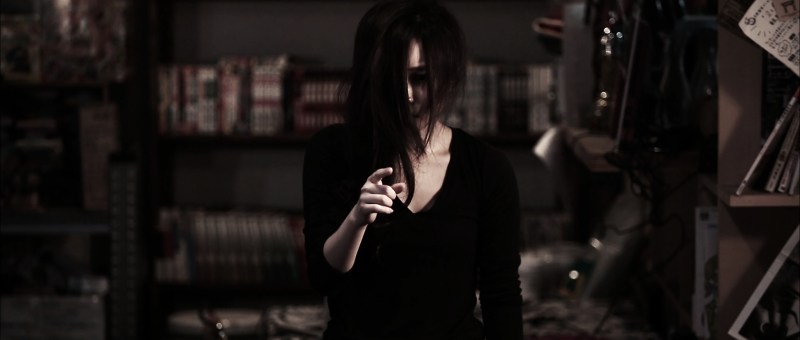
Wilderness (あゝ、荒野, Yoshiyuki Kishi, 2017)

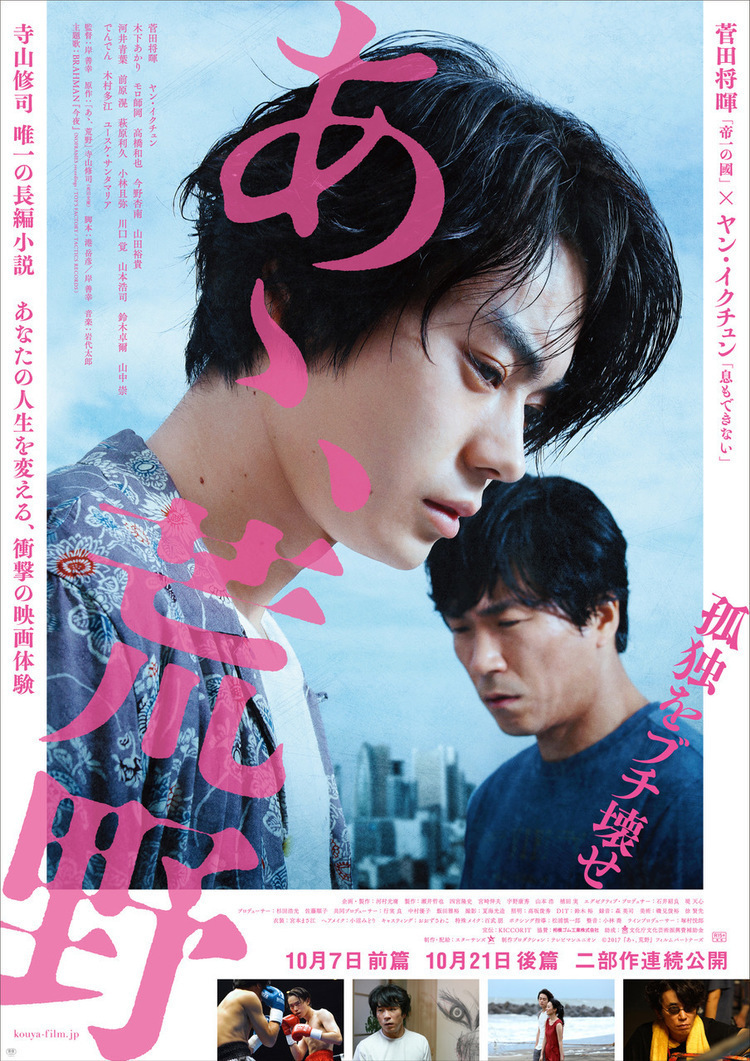
wilderness posterWhen Shuji Terayama published his only novel in 1966, Japan was riding high – the 1964 Olympics had put the nation back on the global map and post-war desperation was beginning shift towards economic prosperity. In adapting Terayama’s jazz-inspired avant-garde prose experiment for the screen, Yoshiyuki Kishi updates the action to 2021 and a slightly futuristic Tokyo once again feeling a mild sense of post-Olympic malaise. Terayama, like the twin heroes of Wilderness (あゝ、荒野, Ah, Koya), got his “education” on the streets of Shinjuku, claiming that more could be learned from boxing and horse races than any course of study. Both damaged young men, these lonely souls begin to find a place for themselves within the ring but discover only emptiness in place of the freedom they so desperately long for.

Shinji (Masaki Suda), abandoned to an orphanage by his mother after his father committed suicide, has just been released from juvie after being involved in a street fight which left one of his best friends paralysed. Discovering that his old gang won’t take him back he’s at a loss for what to do. Meanwhile, shy barber Kenji (Yang Ik-june) who stammers so badly that he barely speaks at all, is battling the possessive stranglehold his drunken, violent ex-military father weilds over him. Raised in Korea until his mother died and his father brought him back to Japan, Kenji has always struggled to feel a part of the world he inhabits. The two meet by chance when Shinji decides to confront the man who attacked his gang, Yuji (Yuki Yamada) – now an up and coming prize fighter. Shinji is badly injured by the professional boxer while Kenji comes to his rescue, bringing them to the attention of rival boxing manager Horiguchi (Yusuke Santamaria) who manages to recruit them both for his fledgling studio.

The Tokyo of 2021 is, perhaps like its 1966 counterpart, one of intense confusion and anxiety. Plagued by mysterious terrorist attacks, the nation is also facing an extension of very real social problems exacerbated by a tail off from the temporary Olympic economic bump. As the economy continues to decline with unemployment on the rise, crime and suicides increase while social attitudes harden. In an ageing society, love hotels are being turned into care homes and wedding halls into funeral parlours. The elder care industry is in crisis, necessitating a controversial law which promises certain benefits to those who commit to dedicating themselves either to the caring professions or to the self defence forces.

Yet nothing much of this matters to a man like Shinji who ignores the crowds fleeing in terror from the latest attack in favour of “free” ramen left behind by the man who recently vacated the seat next to him out of a prudent desire to make a speedy escape. Shinji takes up boxing as way of getting public revenge on Yuji but also finds that suits him, not just as an outlet for his youthful frustrations but in the discipline and rigour of the training hall as well as the camaraderie among the small team at the gym. Kenji, by contrast, is kind hearted and so shy he can barely look his opponent in the eye. He comes to boxing as a way of finally learning to stand up for himself against his bullying father, but eventually discovers that it might be a way for him achieve what he has always dreamed of – connection.

Asked why he thinks it is we’re born at all if all we do if suffer and long for death, Kenji replies that must be “to connect” though he has no answer when asked if he ever has. For Kenji boxing is a spiritual as well as physical “contact sport” through which he hopes to finally build the kind of bridges to others that Shinji perhaps builds in a more usual way. Shinji tells himself that the only way to win is to hate, that in boxing the man who hates the hardest becomes the champion but all Kenji wants from the violence of the ring is love and acceptance. Shinji’s friend, Ryuki (Katsuya Kobayashi), has forgiven the man who crippled him and moved on with his life while Shinji is consumed by rage, warped beyond recognition in his need to prove himself superior to the forces which have already defeated him – his father’s suicide, his mother’s abandonment, and his friend’s betrayal.

While Shinji blusters, shows off, and throws it all away, Kenji patiently hones his craft hoping to meet him again in the boxing ring and “connect” in the way they never could before. There’s something essentially sad in Kenji’s deep sense of loneliness, the sketches in his notebook and strange relationship with an equally sad-eyed gangster/promoter (Satoru Kawaguchi) suggesting a hankering for something more than brotherhood. Nevertheless what each of the men responds to is the positive familial environment they have never previously known, anchored by the paternalism of coach Horiguchi and cemented by unconditional brotherly love.

Caught at cross purposes, the two young men battle each other looking for the same thing – a sense of freedom and of being connected to the world, but emerge with little more than scars and broken hearts, finding release only in a final transcendent moment of poetic tragedy. Kishi’s vision of the immediate future is bleak in the extreme, a nihilistic society in which hope has become a poison and death its only antidote. A tragedy of those who want to live but don’t know how, Wilderness is a minor miracle which proves infinitely affecting even in the depths of its despair.


Screened at Nippon Connection 2018.

Original trailer (no subtitles)

Interview with director Yoshiyuki Kishi conducted at the Busan International Film Festival (Japanese with English subtitles)
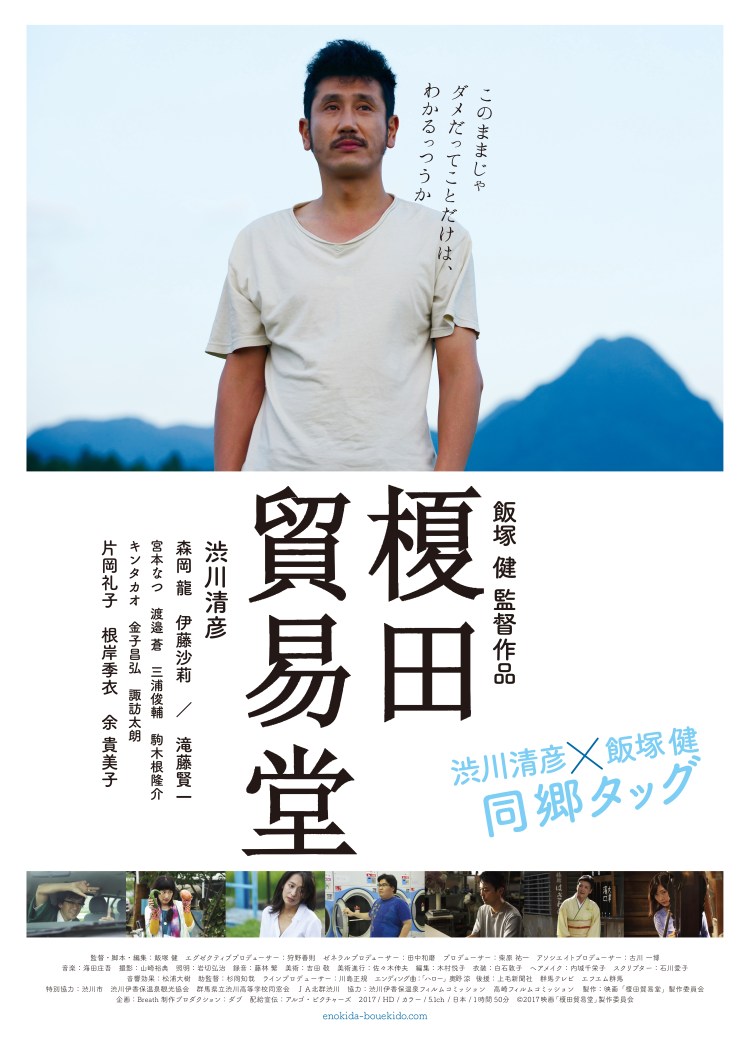
Enokida Trading Post (榎田貿易堂, Ken Iizuka, 2018)

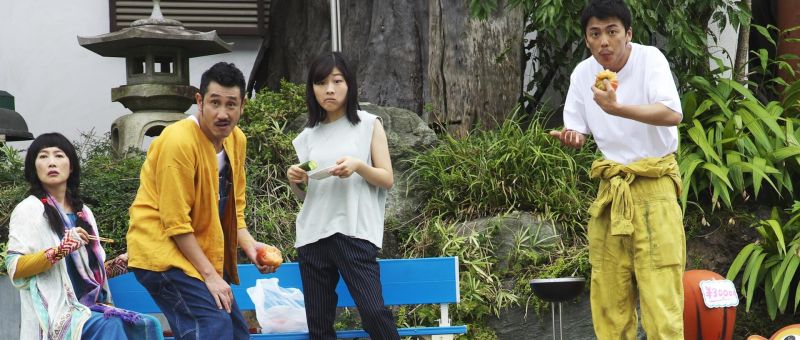
NC18_cinema_Enokida Trading Post_flyer_preview.jpegJapanese cinema is filled with tales of those who become disillusioned with city life and decide to go home to the country to start all over again. Almost always they start with failure and build to success as the hero or heroine gradually figures out what they want out of life and then how to make it happen. Enokida Trading Post (榎田貿易堂, Enokida Boekido), however, does things a little differently. Mr. Enokida (Kiyohiko Shibukawa) has been back in his home town for four years and has already built up a successful, if scrappy, business selling second hand goods. When the right hand side of the first character in Mr. Enokida’s name suddenly falls off the store’s sign one day without warning, Mr. Enokida knows something big, good or bad, is definitely on its way.

Both director Ken Iizuka and star Kiyohiko Shibukawa hail from the small country town, not coincidentally also called Shibukawa, in which the film is set. A tribute to rural life, Enokida Trading Post adopts the calming, laidback feel of many a Japanese tale of life in the village but that’s not to say it’s the sort of place where nothing much happens – quite the reverse in fact. When we first meet Mr. Enokida, he’s wandering into the local hair salon but he’s got more than just a quick trim on his mind. Aside from indulging in a little how’s your father with the middle-aged proprietress (Reiko Kataoka), he’s also picking up a few extra pennies from the curious little boy he’s allowed to watch from outside. The affair with hairdresser will eventually get him into a lot more trouble, but Mr. Enokida is the sort that finds trouble worth the prize so it’s mostly the people around him who will end up paying the price.

Enokida Trading Post has two other employees – Chiaki (Sairi Ito), a married woman experiencing some kind of problems at home, and Kiyohiko (Ryu Morioka) who seems to have an extreme aversion to answering the telephone. The gang are also joined by a hippyish older lady, Yoko (Kimiko Yo), who stops by to chat every now and then, and an old friend, Hagiwara (Kenichi Takito), also recently returned from Tokyo but apparently only for a few weeks while he finishes a screenplay.

Sex and gossip become the two main pastimes for the Enokida gang as Kiyohiko catches sight of Yoko in a compromising position with the old man who runs the local laundrette while Mr. Enokida has begun to worry that Chiaki may have become a victim of domestic violence. As it turns out Chiaki’s worries are of a quite different order which might explain why she keeps renting “racy” mainstream movies like Betty Blue and Eyes Wide Shut from the local DVD store and apparently watching them all alone.

In an attempt to solve some of their problems, the gang find themselves making a visit to “Chinpokan” which effectively means “willy museum” and is indeed filled with pieces of erotic art from classic shunga to a room full of wooden penises in various sizes. A visit to Chinpokan can it seems work wonders, but as soon as you solve one problem another arises and a surprising discovery is made regarding another local love story before a third suddenly spirals into violence, revenge, and murder! Even in peaceful Gunma, such things do indeed still happen – something which prompts Mr. Enokida into a another reassessment of his life choices as he ponders his role in events so far and tries to decide what his next move ought to be.

Mr. Enokida’s motto had always been that anything except for actual rubbish he could handle. Sadly, quite a lot of rubbish has just happened to him and he doesn’t know what to do about it. The revelations do however prompt each of his friends into opening up about their individual worries and finally finding the strength to face them head on to make some decisions of their own. Making the best use of the beautiful scenery and filled with the charms of small town life, Enokida Trading Post is another in the long line of relaxed rural adventures, effortlessly finding the strangeness of the everyday in the country while grounding its sense of absurd fun in the unique philosophy of Mr. Enokida and his variously troubled friends.


Screened at Nippon Connection 2018.

Original trailer (no subtitles)

Hanagatami (花筐/HANAGATAMI, Nobuhiko Obayashi, 2017)

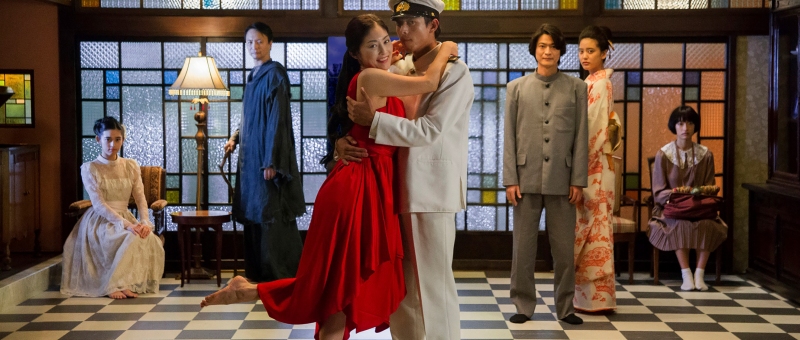
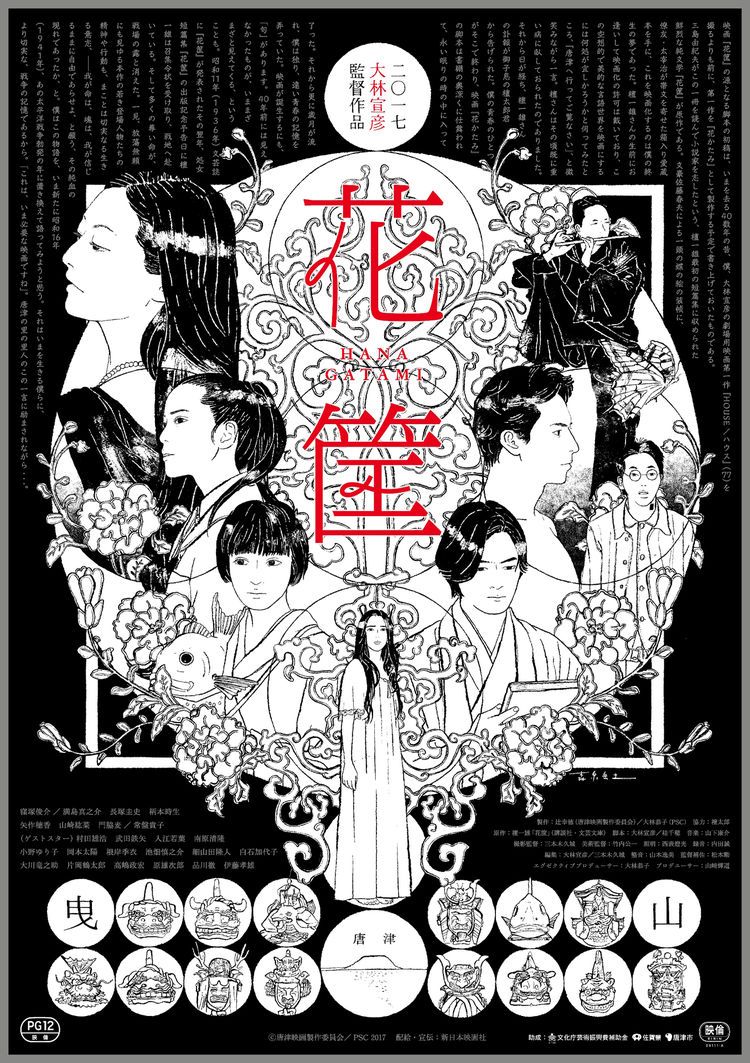
Hanagatami posterIn time the past becomes a dream. A world in and of itself, conjured from feeling and memory and painted in the imprecise strokes of one attempting to recreate a long forgotten scene. The melancholy heroes of Nobuhiko Obayashi’s long career were each trapped in a sense by nostalgia, a yearning for another time and place, or more precisely another, more innocent, version of themselves only with the benefit of hindsight and the confidence of age. Finally realising a long dreamt of project in dramatising Kazuo Dan’s classic wartime youth novel Hanagatami (花筐/HANAGATAMI), Obayashi reunites with another melancholy young man who as he puts it in the opening text wants to tell his story not out of a sense of nostalgia but out of longing for the things which were lost. Those like him who had the misfortune to be young before the war saw their whole world swept away by a kind of madness far beyond their control, losing not only a past but a future too.

When Toshihiko Sakakiyama (Shunsuke Kubozuka) returns home from Amsterdam where he had been living with his parents, Japan is already at war in China. Though the times are changing, Toshihiko’s life remains relatively untouched by conflict, insulated from the concerns of the day by the pleasant natural surroundings of his old-fashioned country town. Returning to the family estate presided over by his war-widow aunt, Keiko (Takako Tokiwa), Toshihiko strikes up a friendship with her sickly sister-in-law, Mina (Honoka Yahagi), whose proximity to death only seems to enhance her beauty. At school he finds himself caught between two polar opposites – the strong and silent Ukai (Shinnosuke Mitsushima) and the cynical nihilist Kira (Keishi Nagatsuka), while his two sets of social circles finally combine with the addition of Mina’s friends Akine (Hirona Yamazaki) and Chitose (Mugi Kadowaki) who also happens to be Kira’s cousin. The world is on the brink of ruin, but there are dances and picnics and festivals and everywhere everyone is desperate to live even in the midst of such foreboding.

Obayashi opens with a quote from one of Dan’s poems in which he mourns the flowers in full bloom shortly to be cut down in their prime. Hanagatami itself means “flower basket” but is also the title of a noh play about a woman driven mad by love for a man from whom she is separated by the arbitrary rules of her society. Japan itself has become a basket of flowers, offering up its youth on a senseless altar to political hubris while a generation attends its own funeral and becomes obsessed with the idea of permanence in a permanently uncertain world. Chitose carries about her camera, bitterly claiming that she will confer immortality on her subjects while privately longing for an end to her loneliness and suffering.

Like the heroine of the noh play, our protagonists too are driven mad by love as the madness of their times spurs them on and holds them back in equal measure. Mina, in all her etherial beauty, becomes the symbol of an age – innocence about die, drowned in its own blood. All in love with Mina, or perhaps with death itself, the men sink further into petty rivalries and conflicted friendships all the while staving off the inevitabilities of their times – that soon they too will be expected to sacrifice themselves for a cause they don’t believe in or risk being left behind alone.

Toshihiko finds himself torn between his two friends – the light and the dark, the robust Ukai and the gloomy Kira. While Toshihiko’s wide-eyed hero worship of Ukai and his idealised male physique takes on an inescapable homoerotic quality, his relationship with Kira leads him towards a darker path on which everything is “worthless” and all pleasures impossible in a world apparently so close to its end. Kira, having committed a truly heinous act, reminds his friends that they routinely kill and eat animals, and that one day they too will be gobbled up, swallowed whole by the cruelty of their times.

One by one the war takes them, if indirectly, leaving only Toshihiko behind. Describing his youth as like a game of hide and seek in which he suddenly realised it had gotten dark and all his friends had gone home, Toshihiko recasts his tale as a ghost story in which he remains haunted by the visions of his younger self and longs for his long absent friends, robbed of the futures promised to them by right of birth. Free floating through dreams and memory, Obayashi conjures an etherial world overshadowed by tragedy but coloured with wistful melancholy as pale-faced soldiers march off for the land of the dead while youth does its best to live all its tomorrows today in rejecting the senseless cruelty of its age.


Screened at Nippon Connection 2018.

Update July 2020: Hanagatami is released on UK blu-ray from Third Window Films on 6th July in a set which also includes a 20-minute making of and 35-minute interview with director Nobuhiko Obayashi.

Original trailer (no subtitles)

We Are (青の帰り道, Michihito Fujii, 2018)

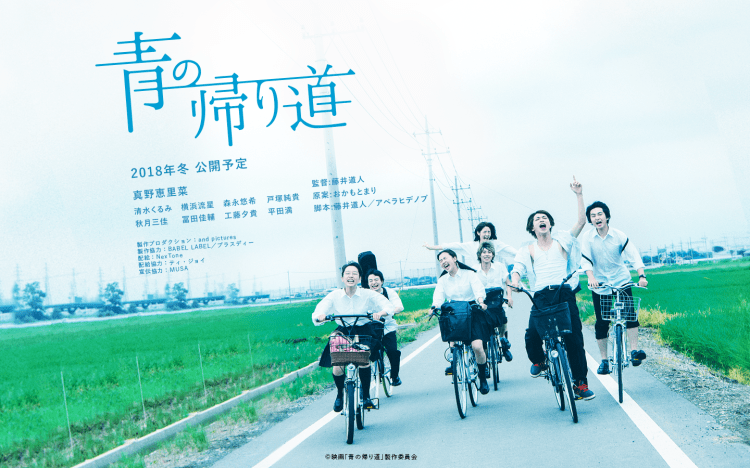
We Are horizontalThe youth movie perhaps hit its peak in the immediate post-war period, but poignant coming of age tales have always held a special place in Japanese cinema. We Are (青の帰り道, Ao no Kaerimichi) has a fairly troubled history of its own – the shoot was disrupted when one of its stars was arrested leading to the role being recast, requiring substantial reshoots which took place over a year later. Yet like its protagonists, We Are was finally able to rediscover itself and create something beautiful from admittedly difficult circumstances. Broken hearts, broken dreams, and broken futures conspire to scatter a once close group of high school friends as they each pursue individual dreams with individual success whilst looking alternately for a path both forward and back.

Spanning from 2008 to 2018, We Are follows seven ordinary small town teens from their high school graduation through to a more settled adulthood ten years later. In 2008, Kana (Erina Mano) and Tatsuo (Yuki Morinaga) have musical dreams which she is going to Tokyo to pursue while he is staying behind to study for medical school entrance exams in an attempt to fulfil his doctor father’s wishes. Kana’s best friend, Kiri (Kurumi Shimizu), is going with her, partly out of a want of anything else to do. She has dreams of becoming a photographer but her family are not supportive of her art and she has always struggled through feeling at odds with them. Loud mouth delinquent Ryo (Ryusei Yokohama) doesn’t really have a plan, save bumming around until something turns up and any plans Ko (Junki Tozuka) might have had would have been derailed seeing as he’s got his girlfriend (Mika Akizuki) pregnant and has decided on a shotgun wedding. Only Yuki (Keisuke Tomita) is following a more conventional path in going to Tokyo for university and then planning on finding a regular salaryman job.

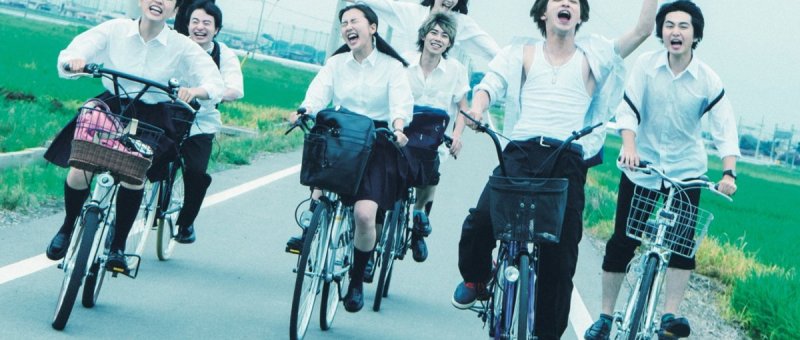
The film opens with a scene of joy and freedom as the kids ride their bikes along an otherwise empty stretch of road between the fields, swearing to make the most of the last summer vacation. The road itself becomes a recurrent motif, stretching out into the distance seemingly full of promise but also strangely empty. The kids do indeed make some memories, but for some of them the hope proves too much to bear, soon turning to despair as their lives begin to spiral out of control, their dreams warped and ruined by the muddiness of the adult world.

Kana’s musical career is quickly derailed by an amoral producer who doesn’t believe in the artistic merit of music, only in its commercial capability. Kiri, dropping out of college, gives up on her dreams of photography to make Kana’s a success through acting as her manager but the two naive country girls are no match for the canny executive and Kiri is soon working for the company learning how to market soulless pap to a public desperate only for empty cuteness. While Kana struggles with accidentally becoming the poster girl for a brand of vegetable juice, Kiri embarks on her first love affair but is ill equipped to recognise the potential warning signs in her new boyfriend owing to a lack of emotional awareness brought about by her dysfunctional upbringing.

While Kana and Kiri struggle in the city, Ko has married, settled down and begun building a home for himself back in the country. An ordinary dream, but an achievable one if you’re willing to make it work and Ko takes to fatherhood with natural ease. Sadly, his friends are not so lucky. As their dreams fade, alcoholism, domestic abuse, crime, and finally suicide conspire to ruin their hopes, leaving each with a profound sense of guilt and defeat in finally finding themselves on the road home with not much to show for their travels besides a few fresh scars. Yet somehow, despite the myriad unforgivable things and a shared sadness in a collective failure to save each other, friendship endures, forgiveness is possible and though the days of youth will never return, there is a “way back” for those who’ve learned that there’s nothing wrong in wanting to start over. You can never go “home” again, but some things don’t change even when you do and if you’re very lucky the most important of them will still be there waiting for you no matter how long you’ve stayed away.


Screened at Nippon Connection 2018.

Bamy (バーミー, Jun Tanaka, 2017)

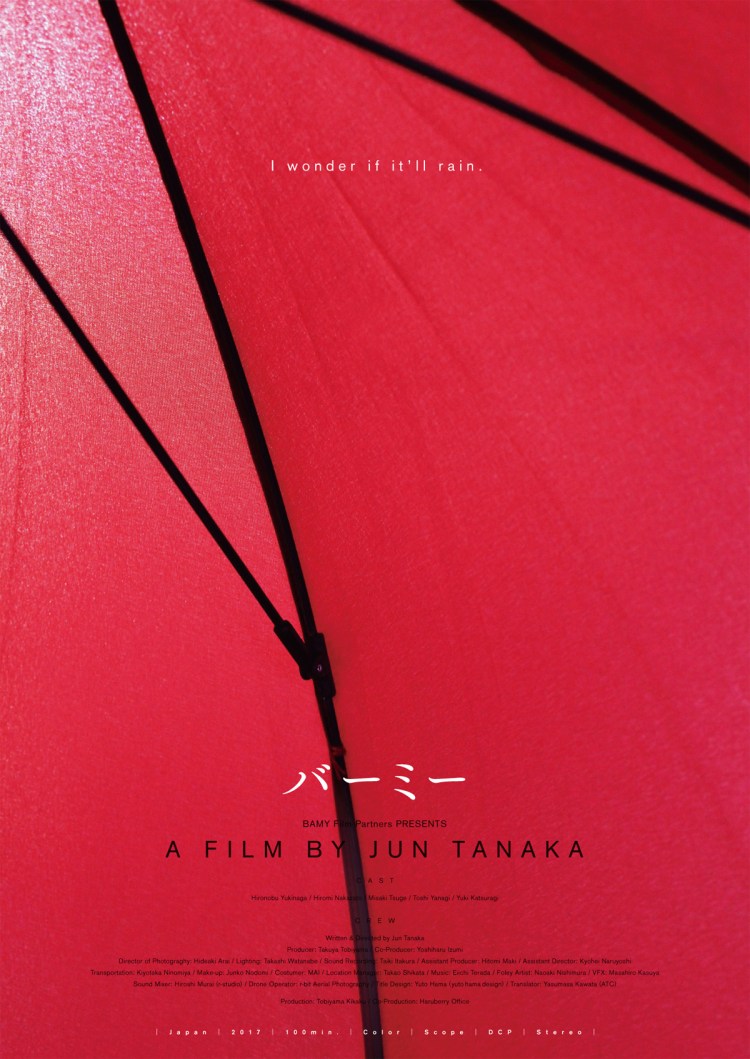
Bamy posterCan you be so haunted that you eventually become a ghost? The protagonist of Jun Tanaka’s Bamy (バーミー) sees lonely spirits everywhere but they don’t frighten him, in the expected sense at least, so much as act as supernatural jailers lurking just out of sight ready to remind you that there is no escape from their all seeing eyes. Which is to say, he begins to find them irritating especially as he feels himself pulled along by the unstoppable forces of “the expected” without being entirely sure “the expected” is what he really wants. Perhaps Ryota (Hironobu Yukinaga) is just another commitment-phobe getting cold feet before a wedding and looking for an excuse to find out if the grass is greener with someone else, but then again perhaps there are forces operating beyond our understanding, be they good or ill.

Our pair of lovers are brought together by the sudden and unexpected arrival of a bright red umbrella falling impossibly from on high. As their eyes meet across the incongruous sight, Fumiko (Hiromi Nakazato) recognises the man on the opposite side as Ryota – an old friend from her university days. Fast forward one year from this atypical meet cute and Fumiko and Ryota are moving in together with a wedding date already in place. The red umbrella hangs proudly on their balcony as a romantic tribute to their love but at odd times it seems to glow ominously, as if emanating a sense of inescapable unease. The couple’s happiness is ruptured when Ryota spots the first of his ghosts lurking in the bedroom. Before long he’s seeing them at work, in the streets, everywhere. He’s seen them all his life and though they do not frighten him, he is sick of their constant presence. Gradually the ghosts place a wedge between himself and Fumiko as he begins to neglect the wedding preparations before running into another woman, Sae (Misaki Tsuge), experiencing the same problem who might be better placed to understand what he’s going through.

The ability to see ghosts, it has to be said, is not an especially good excuse for neglecting one’s fiancée. Ryota, who seems to have forgotten there are many other words in the Japanese language besides the one which means “sorry”, does not appear to be a very good communicator and never thinks of confiding in Fumiko about what it is that is bothering him, nor does he ever try to communicate with the ghosts who perhaps are just looking for attention. In fact, Ryota never seems to take much of an active role in anything and almost “haunts” his own life, remaining isolated on the fringes, drifting along aimlessly like a man without a soul.

Existing to one side of the world around him, Ryota eventually makes ghosts of both his women. Sitting alone before a table on which lies a lovingly prepared meal, Ryota cannot see Fumiko as she lurks behind him, her form distorted and indistinct as filtered through the frosted glass which acts as divider to their living area. Later her face appears again through a frosted door as she grows ever more distant towards him, no longer “Fumiko” but a strange, unknowable being. Her hand on his face once grounded him, brought him back to the real but since the umbrella disappeared all that has changed. Meanwhile, Ryota wonders if the ghost seeing Sae is his real soulmate only to see her pale before him, her fingers dark and cold as she too becomes little more than something that will bind him to a fate he isn’t sure he wants.

The umbrellas at least seem to want Ryota to be with Fumiko, whatever he (or she) may think about it. An echo of the “red strings of fate”, the umbrellas bind the lovers on a cosmic level which can never be severed – Ryota’s “rebellion” is perhaps towards fate itself, towards having his life dictated to him (by an umbrella) with his personal agency all but removed. Then again, maybe “the umbrellas” know best and what they’ve given Ryota is a gift, only the pleasure of a gift begins to dissipate when it is made clear that it cannot be declined. The cosmos seems determined on railroading him and perhaps the only way to “escape” its harbingers is to accept its judgement and submit, turning a given fate into a chosen one through a conscious act of will. Echoing Kiyoshi Kurosawa in his conflicted romanticism and David Lynch in his eerie sense of the everyday surreal, Tanaka conjures an atmosphere of inescapable supernatural dread as his hero begins to realise his only source of salvation may lie in willing submission. 


Screened at Nippon Connection 2018.

TFF trailer (English subtitles)

Love and Wolbachia (恋とボルバキア, Sayaka Ono, 2017)

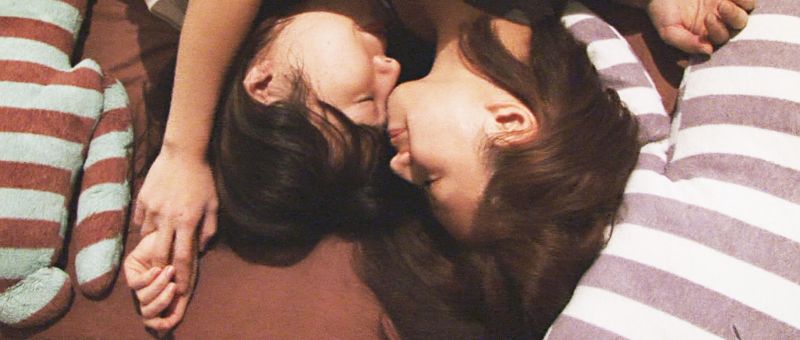
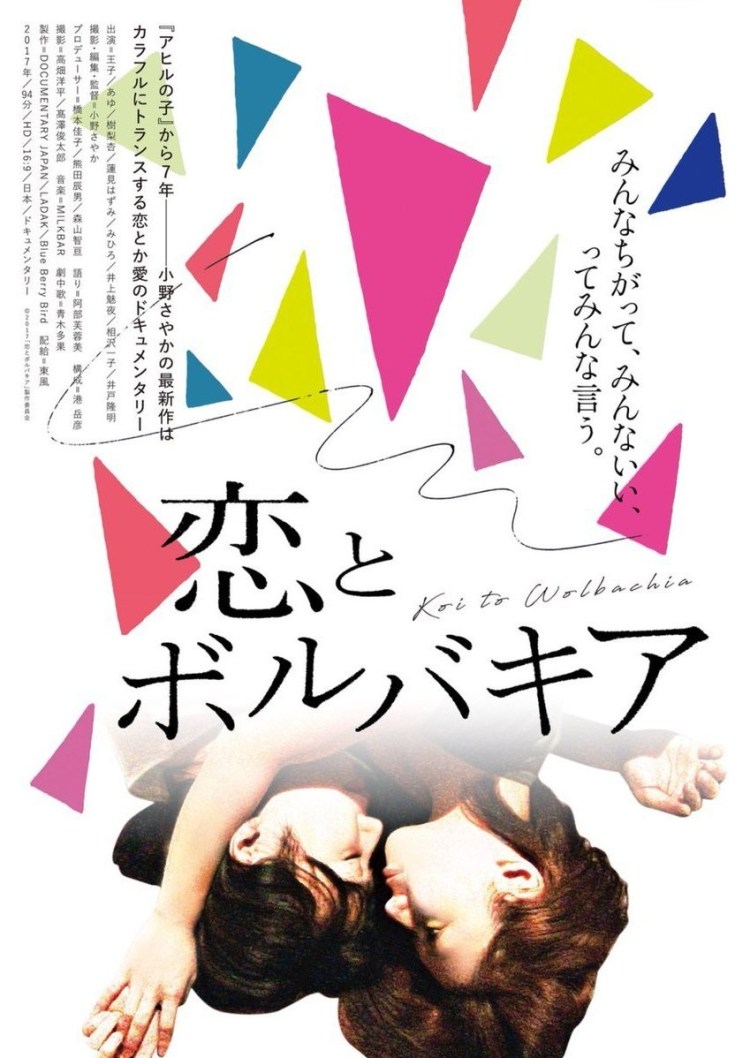
love-and-walbachia-poster-2-e1527641922439.jpgDocumentarian Sayaka Ono turned the camera on herself and her family seven years ago with her graduation project/debut feature The Duckling. Returning with her second feature after spending the intervening years in TV documentary, Ono tackles a subject perhaps more distant from her personal experience in exploring the lives of sexual minorities and particularly of transgender women in generally conformist Japan. Love and Wolbachia (恋とボルバキア, Koi to Wolbachia) takes its name from that of a parasitic bacteria which can cause its host to change sex. Love may very well be a kind of virus, but Ono seems more interested in answering the question of why someone might decide to live as a woman in a society so often hostile to them.

The first two protagonists Ono introduces us two were born intersex. Despite their personal feelings, each was encouraged to take hormones to conform more closely to their external appearance. Forced to make a perhaps false binary choice, or in essence being deprived of the right to make it for themselves, each has attempted to live in the way which bests suits their authentic selves though they often encounter discrimination and/or hostility from those around them.

The question of gender in and of itself appears more important to some than others. Another of our protagonists, Miya, refers to herself as a “makeup man” and runs a bar which acts as a kind of community space and refuge for other transgender and non-binary people who often have nowhere else to turn. Nevertheless, Miya struggles with her partner’s decision to undergo gender confirmation surgery and finds it difficult to understand why someone would be willing to put themselves through so much pain and suffering for something she sees as an external concern. For Miya the question of “gender” seems moot, not quite something requires only an individual identification but which scarcely requires one at all. It is she feels, in essence, something culturally defined which an individual is free to accept or reject in claiming their own personal identity as distinct from from social codes dictated by society.

Yet Miya also finds herself a victim of these social codes in a desire to provide protection to those who need it only to find herself ill equipped to cope with the intense responsibility of accidentally becoming a community leader if one without a particular political agenda save wanting to make other people’s lives easier. The question of gender roles becomes a more obvious problem in the relationship between lesbian Julian and her transgender partner Hazumi. Criticised by some of her friends for dating a transwoman, Julian also struggles with a perceived expectation to adopt a “masculine” role within the relationship, that Hazumi expects her to provide protection while also becoming the dominant partner which she seems to feel does not fit her personality. Conversely, Julian also longs for a conventional home and family as a married couple with children yet Hazumi wants to transition fully and, having left a marriage and a child to live a more authentic life, worries that starting another family with Julian may prevent her from achieving her dream.

A conventional family life also seems to have prevented 50-year-old Ichiko from pursuing her desire to live as a woman, having lived in a time when few knew such things were possible. A father with three children, most of her resources are given over to their care but she still finds time to enjoy a more authentic life and participate in the community. Like Ichiko, Mihiro began wearing women’s clothing after admiring her wife’s outfits only she later decided to leave her marriage and retains a male personality only for work. Having fallen in love with a man who himself feels uncomfortable with the culturally defined notions of “masculinity”, Mihiro is heartbroken to realise he already has a live-in girlfriend and worries his impression of their relationship may not match her own. This rings eerily true given a solo interview in which he jokingly laments Mihiro’s purehearted approach to romance which he believes leaves her open to male manipulation.

Ono does not particularly explore the lives of transmen, perhaps an anomaly seeing as Japan is one of few nations to have elected a transman to office (Japan also elected its first transgender female politician back in 2003), preferring to explore the place of trans and gay women in a society which can be deeply misogynistic and relentlessly conformist. Mihiro’s supportive mother, watching her carefully applying her makeup, remarks on how much time men must save in not needing to bother. Mihiro partially corrects her – wearing makeup is a choice which is open to women but not perhaps to men and choice, it seems, is the main thing or not so much “choice” but freedom to live in the way you choose rather than the way which is chosen for you by your society. 


Screened at Nippon Connection 2018.

Original trailer (no subtitles)

A Mummy’s Love (木乃伊の恋, Seijun Suzuki, 1973)

vlcsnap-2018-05-28-23h20m55s542After getting fired from Nikkatsu for making films which made no sense and no money, Seijun Suzuki cemented his place as a thorn in the side of the establishment by suing them for breach of contract. The “dispute” dragged on, eventually seeing him blacklisted by the other major studios and unable to make a feature film for ten years. This did not mean however that Suzuki was entirely idle between the releases of Branded to Kill and his 1977 “comeback” movie A Tale of Sorrow and Sadness. Like many other directors who found themselves adrift in the changing film industry, Suzuki busied himself with short projects for television, both commercials and stand alone episodes of anthology series including one for Eiji Tsuburaya’s Twilight Zone-esque Horror Theater Unbalance.

Horror Theater Unbalance, produced by Tsuburaya Pro, was in keeping with the studio’s other similarly themed horror and science fiction SFX series but took the form of 13 one off one hour dramas. Although production began in earnest in 1969, filming didn’t finish until 1972 and the series eventually aired in 1973. Many of the episodes were inspired by well known mystery stories and each also featured a framing sequence in which author/actor/TV personality (and later politician) Yukio Aoshima introduced and then wrapped up the tale à la Alfred Hitchcock, Rod Serling, or perhaps Cookie Monster whilst sitting in a creepy mansion filled with weird skeletal objet d’art. Tsuburaya Pro was able to mop up some prime Nikkatsu talent which was gradually seeping out of the studio as it crept towards its eventual rebirth as the producer of Nikkatsu Roman Porno. This included not only Suzuki but also Yasuharu Hasebe and Toshiya Fujita among others, as well as outlying figures from the independent world such as Kazuo Kuroki.

The first to be broadcast, Suzuki’s episode was adapted from a short story by Fumiko Enchi whose recurrent themes share much with those of the director in her frequent use of fantasy and eroticism. A Mummy’s Love (木乃伊の恋, Miira no Koi) is technically a triple tale as it contains an internal framing sequence in addition to the broader one common to the series. The lead is actually Shoko (Misako Watanabe) – a widowed middle-aged editor working with her now elderly professor on a new version of a classic tale from Japanese literature. Her memory is sparked when she catches sight of an oddly vacant-looking monk in the back of a car – eerily like the one in the story which revolves around the discovery of a monk who was buried alive as way of achieving enlightenment but has recently (or perhaps not) begun ringing his bell to alert those above to his conscious presence.

One of the villagers, Shoji, becomes fascinated with the idea of the unsleeping monk. When they dig up the corpse it’s a stiff, strangely robust skeleton which some of the villagers end up using for a game of punt the monk, but little by little his flesh returns. He is not, however, as enlightened as one might hope. To begin with he’s a gibbering wreck, and then finally something more like a crazed sex pest whose pent up amorous energy eventually wears out his new “wife” in a matter of days when she suddenly gives “birth” to a small army of mini dust buddhas. Shoji is sick of the monk and wants to get rid of him, but when he takes his own wife sometime later all he can hear is the sound of a little tinkling bell and suddenly he can’t bear to touch her.

The theme seems to be that unquenched desire will drive you insane with the ambiguous addition that desire itself is best overcome rather than satisfied. Having recounted to us the story of the monk, Shoko finds his tale echoing in her own life. A war widow she lost her husband young and has experienced near constant sexual harassment from her former professor, now bedridden and defeated. Unbeknownst to her, the professor has been keeping her engagement photo in his study for the last decade. He claims that it’s not impossible for an ordinary many to resurrect himself solely through the power of enduring sexual desire, rightly (but somewhat inappropriately) implying that Shoko too harbours lingering desires which have gone unsatisfied since her husband’s passing.

The story culminates with Shoko’s pleading hope for a resurrection as she unwittingly arrives at the place of her husband’s death where she encounters a strange man who might or might not be her late spouse. Making either real or hallucinatory love atop a grave with either a resurrected corpse, a ghost, a phantom of memory, out of body spirit, or just a random rough man talking shelter from the rain, Shoko is a prisoner of her desires but the source of her visitation remains difficult to discern.

Working within a TV budget, Suzuki reins himself in but lends his idiosyncratic sense of ironic fun to an otherwise gloomy, dread-laden tale as the villagers gleefully kick around the dried corpse of the old monk as if he were a long buried football and then seem to meet an unquiet knowingness in his ever hungry eyes. Peppered with surrealist touches, Suzuki’s contribution to Horror Theater Unbalance is a heady affair but one imbued with his characteristic twinned sense of irony and wistful melancholy in a tale of those undone by unresolved longing.


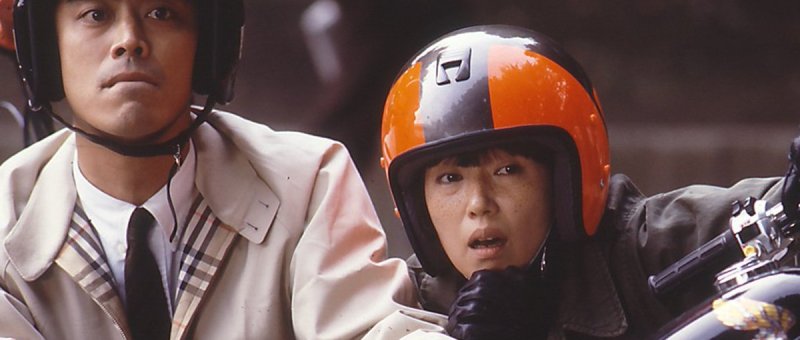
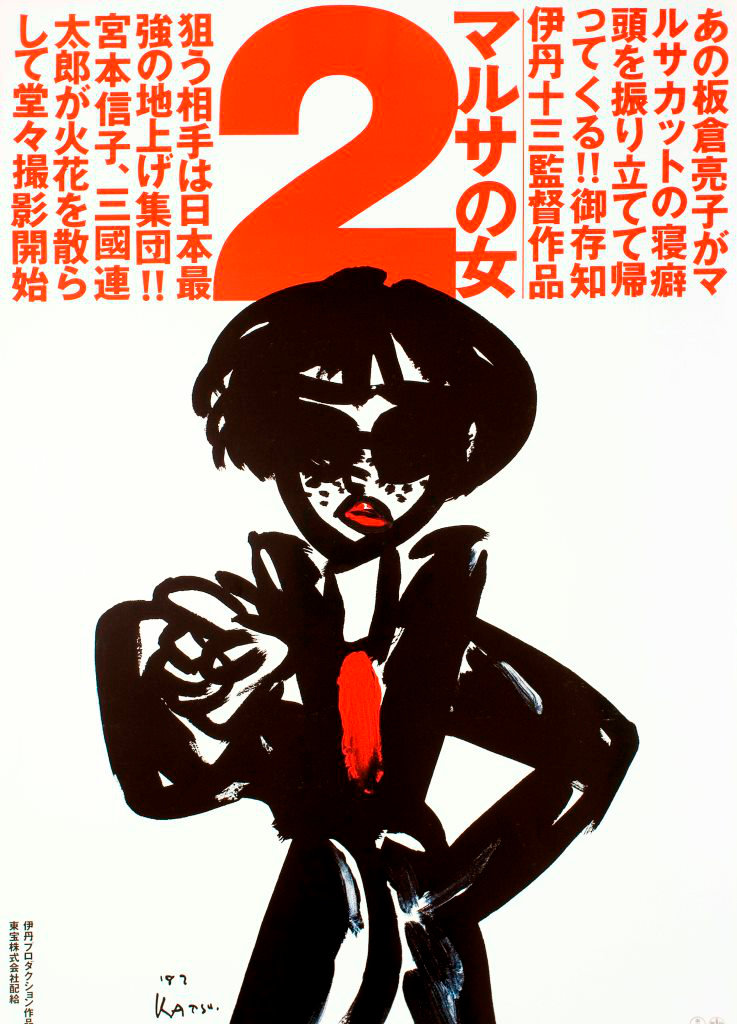
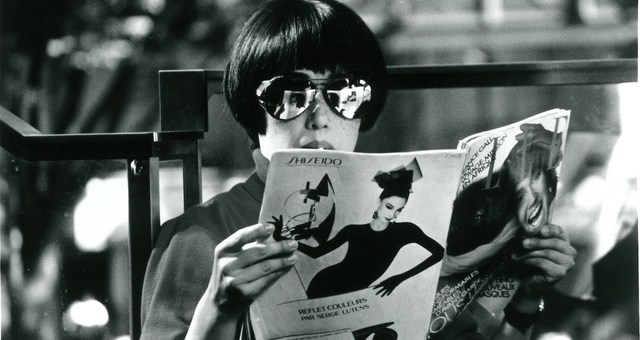
A Taxing Woman’s Return (マルサの女2, Juzo Itami, 1988)

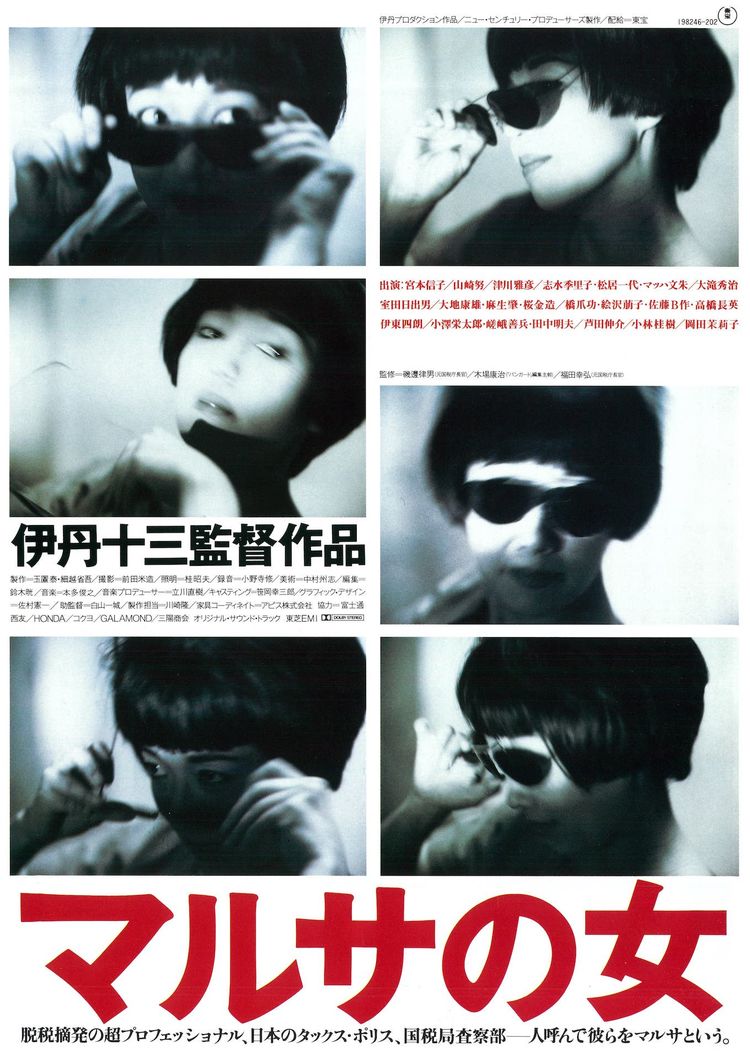
Taxing Woman 2 posterA Taxing Woman introduced us to Ryoko Itakura (Nobuko Miyamoto) – an oddball detective working as an insurance inspector who met her Irene Adler in a tax dodging corporate gangster with a limp. A year later she’s back, still the only woman working with the tax inspectorate and apparently still a dogged pursuer of those who would seek to defraud the Japanese government of its rightful earnings. Ryoko may have been a stickler for the rules who applied the same dog with a bone approach to a mom and pop store chowing down on its own supplies as to a dodgy yakuza led conspiracy, but she also believed in justice – something which stands her in good stead when she rubs up against a dodgy cult which, again, is a yakuza front but adds insult to injury by deliberately manipulating the vulnerable.

The action opens with some kids poking at the dead body of a “landshark” floating in a pond before flashing to a meeting of officials sucking crab meat from the shell and wondering what they’re going to do about this land they need cleared now their heavy is out of the picture. The corrupt politician from the first film, Urushibara (Takeya Nakamura), is apparently still involved in semi-legal land deals but palms the assignment off on a colleague. The big wigs need to empty a dated housing complex on some valuable land so they can build a vanity skyscraper – office space apparently being scarce in mid bubble Tokyo.

To do this they enlist the services of dodgy cult leader Onizawa (Rentaro Mikuni) and his troop of yakuza goons. Most of the tenants have already signed but they have three key holdouts – a diner owner clinging on to the family legacy, a stubborn paparazzo, and an intellectual professor who heads up the housing association. Unlike the yakuza of Taxing Woman, these guys have not reformed – they are the new/old style of lawless thugs who are perfectly prepared to threaten women and children to get their own way. Making it impossible for the tenants to stay through intimidation and noise torture, they stoop to blackmail to seal the deal.

Despite arriving only a year after A Taxing Woman, Taxing Woman’s Return (マルサの女2, Marusa no Onna 2) takes place in a much darker, though more obviously comedic, world. Whereas the earlier film adopted a noticeably ambivalent attitude to the tax inspectors and the enterprising gangsters, the villains of A Taxing Woman’s Return are so heinous and morally bankrupt as to be entirely indefensible even if the inspectorate takes a turn for the bumbling to compensate. The “cult” is, of course, merely a convenient money laundering front and tax dodge for the yakuza – religious organisations are exempt from taxation in the vast majority of cases which may be why the local tax office records hundreds of registered “religious bodies” in its jurisdiction alone. That doesn’t mean it doesn’t have its loyal followers, often vulnerable people looking for spiritual fulfilment but being bled dry by the money hungry cultists while the leader’s wife swans around in sables costing more than the average annual salary. A desperate devotee in need of a loan puts his own teenage daughter up as collateral only to see her raped by Onizawa, eventually becoming pregnant by him at only 16 years of age and thereafter becoming his devoted concubine in a bizarre instance of Stockholm Syndrome.

Yet for all the background darkness of weird cultists and nasty yakuza backed up by corrupt and venial politicians, Itami ups the cartoonish sense of the absurd with our hero Ryoko clambering over rooftops to listen in to the bad guys while her boss throws himself down flights of stairs and has to battle piercing sirens to get into the villains’ secret vault. It is however a dark humour as the opening makes plain with its troupe of little children staring at the strange shape floating in the water – a motif later repeated when a yakuza is gunned down in the street only for another group of children to pour over him as he expires, a single tear rolling down his cheek. The original spongy white body gives way to the businessmen sucking spongy white crab out its shell while insensitively discussing the late land shark, and the yakuza are unafraid to deploy a maggot infested severed hand (thankfully a fake picked up from a friend who makes horror movies) to convince the tenants they mean business.

At the end of A Taxing Woman, the gangster and the inspector reached something of a truce but one which came down, broadly, on the side of right. This time things aren’t quite so simple. The conspiracy is bigger and deeper, stretching all the way into the Diet and about more than just office space in still developing Tokyo. Onizawa, regarding himself as public servant, tries to say he did it all for his country, that if someone didn’t get their hands dirty Tokyo would be eclipsed by Hong Kong or Seoul. A post-war justification for a bubble era problem, but one that takes us straight back to the first film in Onizawa’s second proposition that only through money does he truly feel “immortal”. He may be a liar and a cheat, but he’s only a symptom of rapidly spreading infection, one which Ryoko and her team are powerless to cure, trapped on the wrong side of the fence while the bad guys build monuments to economic hubris, indulging in vanity in an era of bad faith which is about to be brought to a rather abrupt close.


Currently available to stream in the US/UK via FilmStruck.

Original trailer (no subtitles)

A Taxing Woman (マルサの女, Juzo Itami, 1987)

A Taxing Woman posterIn bubble era Japan where the champagne flows and the neon lights sparkle all night long, even the yakuza are incorporating. Having skewered complicated social mores in The Funeral and then poked fun at his nation’s obsession with food in Tampopo, Juzo Itami turns his attention to the twin concerns of money and collective responsibility in the taxation themed procedural A Taxing Woman (マルサの女, Marusa no Onna). Once again starring the director’s wife Nobuko Miyamoto, A Taxing Woman is an accidental chronicle of its age as Japanese society nears the end of a period of intense social change in which acquisition has divorced mergers, and individualism has replaced the post-war spirit of mutual cooperation.

Ryoko Itakura (Nobuko Miyamoto), a single mother and assistant in the tax office, has a keen eye for scammers. She demonstrates this on a stakeout with a younger female colleague in which she keeps a shrewd eye on the till at her local cafe and comes to the conclusion that they’ve been running a system where they don’t declare all of their cheques. Running her eyes over the accounts of a mom and pop grocery store, she notices some irregularities in the figures and figures out the elderly couple feed themselves from the supplies for the shop but don’t “pay” themselves for their own upkeep. That might seem “perfectly reasonable” to most people, but it’s technically a small form of “embezzlement” and Ryoko doesn’t like figures which don’t add up. Seeing as the couple probably didn’t realise what they were doing was “wrong” she lets them off, this time, as long as they go by the book in the future. A more complicated investigation of a pachinko parlour finds a more concrete form of misappropriation, but Ryoko is fooled by the owner’s sudden collapse into inconsolable grief after being caught out and leaves him in the capable hands of his confused accountant.

Nevertheless, Ryoko may have met her match in sleezy corporate yakuza Hideki Gondo (Tsutomu Yamazaki). Dressing in a series of sharp suits, Gondo walks with a pronounced limp that hints at a more violent past but as his rival from the Nakagawa gang points out, violence is a relic of a bygone era – these days gangsters go to jail for “tax evasion” as means of furthering their “business opportunities” and facilitating ongoing political corruption. Gondo’s business empire is wide ranging but mainly centres on hotels, which is how he arouses Ryoko’s interest. She looks at the numbers, does a few quick calculations, and realises either the business isn’t viable or the correct figures aren’t being reported. Ryoko doesn’t like it when the books don’t balance and so she sets her sights on the seedy Gondo, but quickly discovers she has quite a lot in common with her quarry.

Itami was apparently inspired to make A Taxing Woman after the success of Tampopo shoved him into a higher tax bracket. Given Japanese taxes (at the time) were extremely high, getting around them had become something of a national obsession even if, in contrast to the preceding 30 years or so, there was plenty of money around to begin with. More than the unexpected tendency towards civil disobedience the times seemed to cultivate, Itami homes in on the increasingly absurd desire for senseless acquisition the bubble era was engendering. Thus Gondo who owns a large family home well stocked with symbols of his rising social status, also occupies a bachelor pad where he keeps a mistress which reflects the gaudy excess of the age right down to its random stuffed hyena. Nevertheless when one of the tax clerks asks for some advice as to how to have it all, Gondo replies that that’s easy – to save money, you simply avoid spending it. Gondo lets his glass run over and delights in licking the edges. It’s all about delayed gratification, apparently, and having a secret room full of gold bars to gaze at in order to relieve some of that anxiety for the future.

Gondo, like many of his ilk, has “diversified” – yakuza are no longer thuggish gangsters but incorporated organisations operating “legitimate” businesses through “illegitimate” means. Thus we first find him using a nurse who allows herself to be molested by an elderly, terminally ill client whose identity they will steal to found a company they can quickly dissolve when he dies to shift their assets around and avoid the tax man. Later he pulls another real estate scam by pressing a desperate family but his real focus is the love hotels, whose slightly embarrassing existence ensures that not many come poking around. Ryoko, however, is unlikely to let such a large scam slide and delights as much in closing loopholes as Gondo does in finding them. Noticing a kindred spirit, Gondo quite openly asks his new tax inspector “friend” what she’d think if he married his mistress, gave her all his money, and divorced her – divorce proceeds are after all tax free. Sounds great, she tells him, as long as you trust your wife not to skip town with all the doe.

Ryoko, a modern woman of the bubble era, single and career driven, is a slightly odd figure with her officious approach to her job and unforgiving rigour. Unlike her colleague who dresses in the glamorous and gaudy fashions of the times, Ryoko wears dowdy suits and her mentor boss is always reminding her about her “bed hair”, meanwhile she stays late at the office and offers instructions to her five year old son over the phone as to how to microwave his dinner. Though there is another woman working with her at the tax office, when she’s finally promoted to full tax inspector status she finds herself in a room full of guys who apparently hardly ever go home. On her first job she’s only really brought along because she’s a woman and they want to threaten a mob boss’ mistress with a strip search to find a missing key for a safety deposit box. The mistress, however, tries to throw them off the sent by publicly stripping off and encouraging them to check her “cavity” if they’re so keen to find this key, only for Ryoko to find it under the sink while all the guys are busy being shocked. Ryoko’s methods are occasionally as underhanded as Gondo’s and, like his schemes, built on gaming the system but she’s certainly a force to be reckoned with for those considering defrauding the Japanese government.

Gondo’s schemes excel because they aren’t entirely illegal, only clever ways of manipulating the system, but they’re also a symptom of a large conspiracy which encompasses improprieties right up the chain as banks, corporations, and politicians are all part of the same dark economy managed by a corporatising yakuza. Gondo takes frequent calls from a local representative who often “helps him out”. Later the same representative tries to put pressure on the tax office to back off, but Ryoko’s boss points out that he doesn’t need to because the press are already on the story so he should probably get started on his damage control rather than bothering public servants. Gondo and Ryoko, perhaps as bad as each other, lock horns in a battle wills but discover a strange degree of respect arising between them in having discovered a worthy adversary. There’s something undeniably absurd in Ryoko’s firm determination to catch out struggling businesses and the confused elderly with the same tenacity as taking on a yakuza fronted conspiracy, and there’s something undeniably amusing in Gondo’s attempts to beat the man by playing him at his own game, but the overall winner is Itami who once again succeeds in skewering his nation’s often contradictory social codes with gentle humour and a dispassionate, forgiving eye.


Currently available to stream in the US/UK via FilmStruck.

Original trailer (no subtitles)

Heaven is Still Far Away (天国はまだ遠い, Ryusuke Hamaguchi, 2016)

Heaven is still far away still 1Ryusuke Hamaguchi returns to the theme of objects in motion with his haunting short Heaven is Still Far Away (天国はまだ遠い, Tengoku wa Mada Toi). When one thing ends, conventional wisdom insists that something else must begin but real life shows us that that isn’t always the case. For three people attempting to deal with the legacy of an unsolved serial murder case, forward motion has been impeded, or perhaps refracted, and not least for the victim herself who remains a still point in an otherwise turning world.

Mitsuki (Anne Ogawa) tells us that her mother explained to her when she was a child that when you die you go to “heaven”, which is a place beyond the clouds. For Mitsuki, however, heaven still seems so very far off – after all, there are still so many things to experience here on Earth. At present, Mitsuki lives with Yuzo (Nao Okabe) – a strange and blunt young man who has the rather skeevy job of adding mosaics to pornographic videos. One day Yuzo gets a phone call from another young woman, Satsuki (Hyunri), who wants to interview him for a documentary she is making as a graduation project which will focus on her older sister who was murdered 17 years previously. Yuzo didn’t really know Satsuki’s sister but something he did after she died has captured her imagination and Satsuki would like to explore why he did it.

What ensues is a series of odd, concentric conversations as Satsuki tries to articulate her artistic intentions to the grumpy Yuzo who is either a quite a tactless person or one who likes to appear so for various unexplained reasons. Satsuki’s main hope, it seems, is a kind of exercise in emotional excavation. Confused by the way some things can carry on when others end, she wants to wants to mark out the shape her sister cut into the world by finding out how her presence and absence has affected the lives of those around her. For reasons which aren’t immediately clear, she wants to start with Yuzo because, through an accident of fate, he finds himself at the exact intersection of both of these points.

Satsuki asks if Yuzo bears a grudge towards her seeing as his life too has been derailed thanks to his connection with her sister’s life and death. Yuzo replies that he doesn’t – he bears the responsibility for the way his life has turned out, even if it might have been impacted by external events. Satsuki wrestles with trajectories, accepting that her family may have fallen apart on its own but always wondering what might have happened if she had died in her sister’s place, why her sister had to die rather than someone else’s, why parts of her life have also stopped in the wake of her sister’s absence. If Satsuki has “lost” something, did Yuzo “gain” it or did he “lose” too in gaining an additional burden? The only truth is that Mitsuki has become a point of refraction in each of their lives, looking on from the periphery unseen but making her presence felt even in her absence.

Hamaguchi once again makes the everyday seem strange as the past continues to haunt our protagonists, in ways both literal and metaphorical. An eery sense of sadness pervades, yet endings are refused in favour of dualistic circularity. Objects in motion must remain in motion, even if they appear to have stalled. One life refracts another, and absence defines presence. Heaven may still be far away, but it’s there all the same and its presence is felt, even if unseen.


Available to stream worldwide via Le CiNéMa Club until 24th May.