 Sad stories of single mothers forced to work in the world of low entertainment are not exactly rare in pre-war Japanese cinema yet Hiroshi Shimizu’s 1937 entry, Forget Love For Now (Koi mo Wasurete) , puts his on own characteristic spin on things by looking at the situation through the eyes of the young son, Haru (Jun Yokoyama). Frustrated by both social and economic woes, little Haru’s life is blighted by loneliness and resentment culminating in tragedy for all.
Oyuki (Michiko Kuwano) is a single mother and bar hostess in a port town. Her young son Haru loves his mum even though he’s often on his own but after he makes the mistake of inviting some of the other boys back to his mother’s apartment and they end up getting doused in her rather pungent perfume, the other kids’ mothers figure out what Oyuki does for a living. Predictably they forbid their kids from associating with Haru because his mother is “a bad woman”. After repeatedly trying to keep hanging out with the other children, Haru starts skipping school to avoid the constant exclusion entirely. When Oyuki finds out about this she is very upset and has him moved to another school but the old group of kids and the new group of kids are not entirely unconnected and so Haru is unable to escape the prejudice his old group of friends hold for him.
The film never goes into how Oyuki ended up on her own with a young child or what might have happened to Haru’s father but Oyuki’s role as a single mother is not the reason the pair are excluded from the other families. Lacking other opportunities, Oyuki is forced to into work as a bar hostess even though she clearly hates it and bears it only for her son’s sake.
Her job is to entertain men in the bar to keep the drinks flowing, always smiling and flirting to keep dull men trapped in the false hope of real connection. She gets paid very little for this as we find out early on when she tries to spearhead a kind of union movement in the bar by questioning why their work costs them so much – they have to pay for their outfits, food and drink out of their own wages when the girls working at other establishments get a share of the alcohol profits which they have helped to generate but Oyuki and her friends get only their meagre salaries. Their pleas fall on hard ears with the tough as nails mama-san who isn’t going to permit any kind of mutinies in her establishment. This is made clear later on when one employee tries to quit her job at the bar and move to Kobe in search of more lucrative employment but is beaten black and blue by the bar’s goons.
Oyuki’s single ray of hope comes in the form a sinister figure lurking in the shadows outside her apartment. Eventually becoming friends with Oyuki and her son, the man represents a possible happy ending in which he beats the depression, finds a better job and takes them both away from this world of poverty of degradation. Needless to say this is not to be – the man’s attempts to find a solution to everyone’s problems take to long and he is simply too late. Not only that, his well meaning words of advice to Haru that he should make sure to win against the bullies next time have disastrous consequences.
In essence, Forget Love For Now is “hahamono” in which Oyuki bravely sacrifices everything of herself in her son’s name, committed to the idea that he will progress through his education to university and repay all of her efforts by becoming a fine man. Society, whilst praising the idea of the self sacrificing mother, does not approve of the things she has to do in that very sacrifice she’s making and refuses to allow her success in her mission. The true tragedy is that the little boy, Haru, is aware on some level of everything his mother is doing for him and loves her so much that he is willing to sacrifice himself for her – rendering her long years of suffering entirely pointless.
In the end, Oyuki has nothing. As the title of the film tells us, not even love is permitted to her as she loses both her son and the possibility of romance as her well meaning man makes a now equally pointless sacrifice of his own. Forget Love For Now is somewhat atypical in Shimizu’s output as it ends with no hope in sight, strongly condemning this rigid society which forces women to act in a way of which it disapproves and then refuses to support them when they do. Shooting mostly on stage sets rather than the naturalistic settings featured in much of his other work, Shimizu crafts an emotionally devastating tale of maternal sacrifice cruelly frustrated by a cold and unfeeling society.
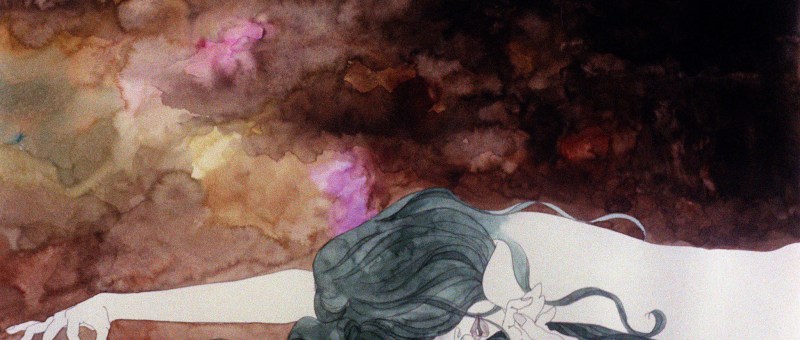
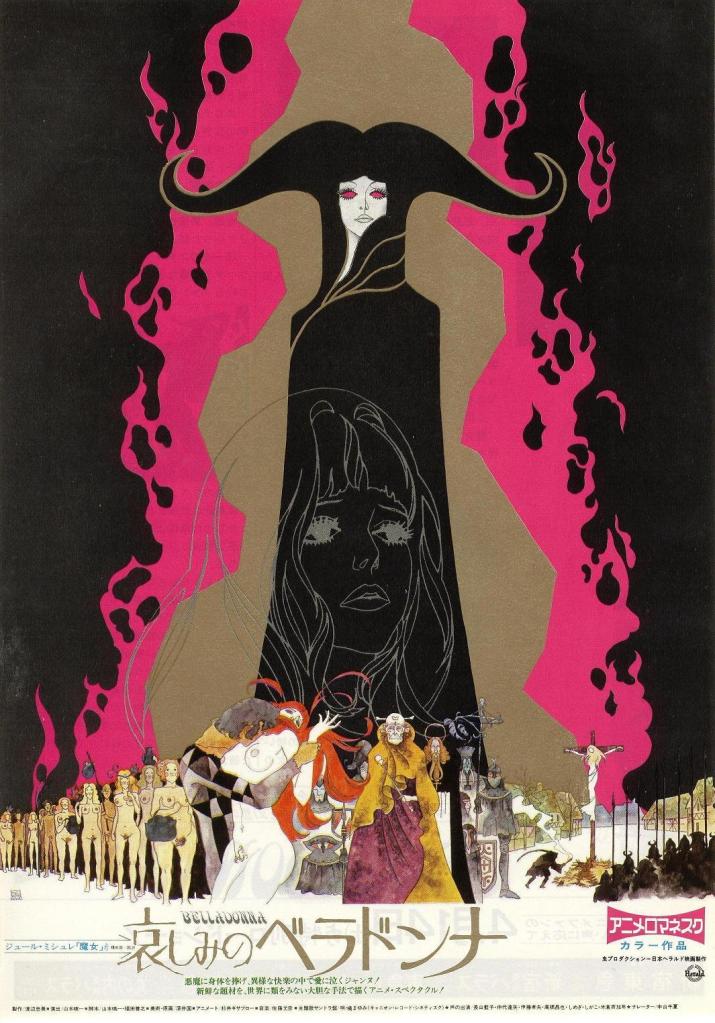 Loosely based on Jules Michelet’s La Sorcière (Satanism and Witchcraft) which reframed the idea of the witch as a revolutionary opposition to the oppression of the feudalistic system and the intense religiosity of the Catholic church, Belladonna of Sadness (哀しみのベラドンナ, Kanashimi no Belladonna) was, shall we say, under appreciated at the time of its original release even being credited with the eventual bankruptcy of its production studio. Begun as the third in the Animerama trilogy of adult orientated animations produced by legendary manga artist Osamu Tezuka’s Mushi Productions, Belladonna of Sadness is the only one of the three with which Tezuka was not directly involved owing to having left the company to return to manga. Consequently the animation sheds his characteristic character designs for something more akin to Art Nouveau elegance mixed with countercultural psychedelia and pink film compositions. Feminist rape revenge fairytale or an exploitative exploration of the “demonic” nature of female sexuality and empowerment, Belladonna of Sadness is not an easily forgettable experience.
 Those golden last few summers of high school have provided ample material for countless nostalgia filled Japanese comedies and 700 Days of Battle: Us vs. the Police (ぼくたちと駐在さんの700日戦争, Bokutachi to Chuzai-san no 700 Nichi Senso) is no exception. Set in a small rural town in 1979, this is an innocent story of bored teenagers letting off steam in an age before mass communications ruined everyone’s fun.
 Cities are often serendipitous places, prone to improbable coincidences no matter how large or densely populated they may be. Tokyo Serendipity (恋するマドリ, Koisuru Madori) takes this quality of its stereotypically “quirky” city to the limit as a young art student finds herself caught up in other people’s unfulfilled romance only to fall straight into the same trap herself. Its tale may be an unlikely one, but director Akiko Ohku neatly subverts genre norms whilst resolutely sticking to a mid-2000s indie movie blueprint.
 Below average student buckles down and makes it into a top university? You’ve heard this story before and Nobuhiro Doi’s Flying Colors (ビリギャル, Biri Gyaru) doesn’t offer a new spin on the idea or additional angles on educational policy but it does have heart. Heart, it argues is what you need to get ahead (if you’ll forgive the multilevel punning) as the highest barriers to academic success are the ones which are self imposed. Arguing for a more inclusive, tailor made approach to education which doesn’t instil false hope but does help young people develop self confidence alongside standardised skills, Flying Colors is the story of one popular girl’s journey from anti-intellectual teenage snobbery to the very top of the academic tree whilst healing her divided family in the process.
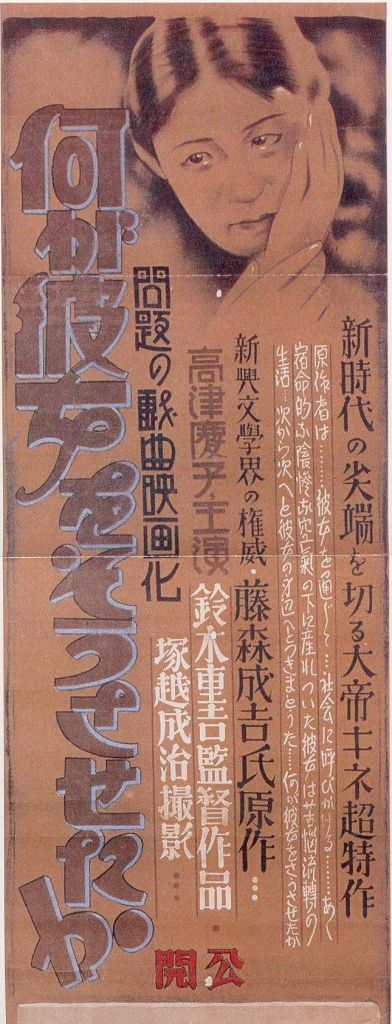 Like many other areas of the world in the first half of the 20th century, Japan also found itself at a dividing line of political thought with militarism on the rise from the late 1920s. Despite the onward march of right-wing ideology, the left was not necessarily silent. Ironically, the then voiceless cinema was able to speak for those who were its greatest consumers as an accidental genre was born detailing the everyday hardships faced by those at the bottom end of the ladder. These “proletarian films” or “tendency films” (keiko eiga) were increasingly suppressed as time went on yet, in contrast to the more politically overt cinema of the independent Proletarian Film League of Japan, continued to be produced by mainstream studios. Long thought lost, Shigeyoshi Suzuki’s What Made Her Do It? (何が彼女をそうさせたか, Nani ga Kanojo wo Sousaseta ka) was a major hit on its original release with some press reports even claiming the film provoked riots when audiences were passionately moved by the heroine’s tragic descent into madness and arson after suffering countless cruelties in an unfeeling world.
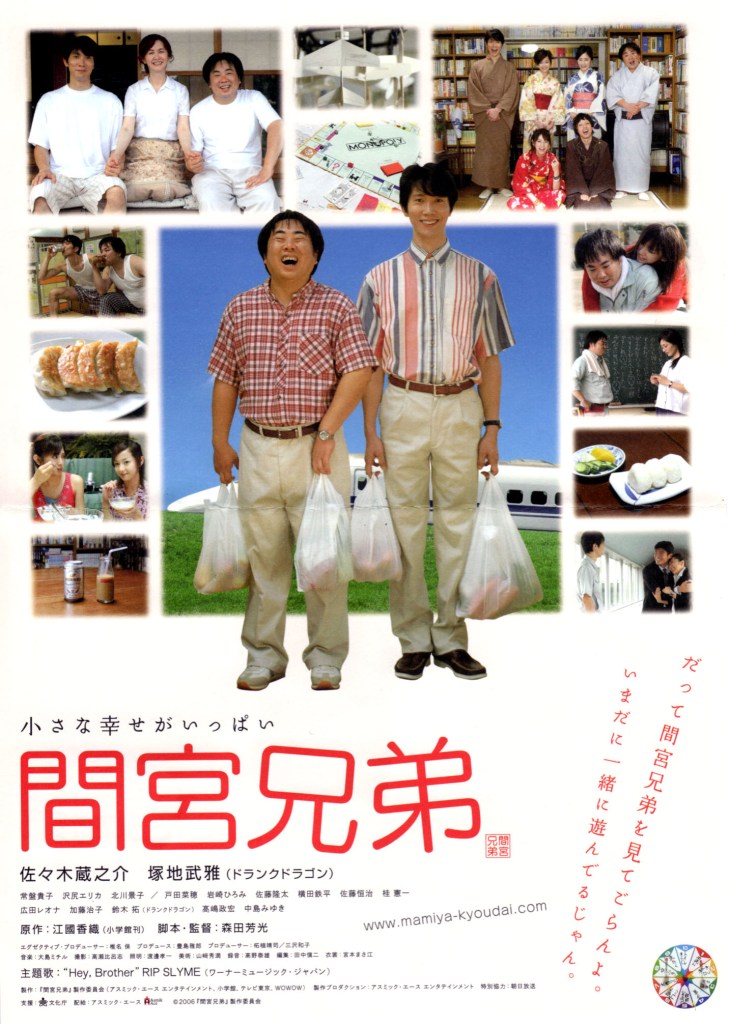 Ever the populist, Yoshitmitsu Morita returns to the world of quirky comedy during the genre’s heyday in the first decade of the 21st century. Adapting a novel by Kaori Ekuni, The Mamiya Brothers (間宮兄弟, Mamiya Kyodai) centres on the unchanging world of its arrested central duo who, whilst leading perfectly successful, independent adult lives outside the home, seem incapable of leaving their boyhood bond behind in order to create new families of their own.
 Review of Takeshi Kitano’s A Scene at the Sea – first published by
  The saga seemed complete with the end of
  At the end of
  Windows on Worlds