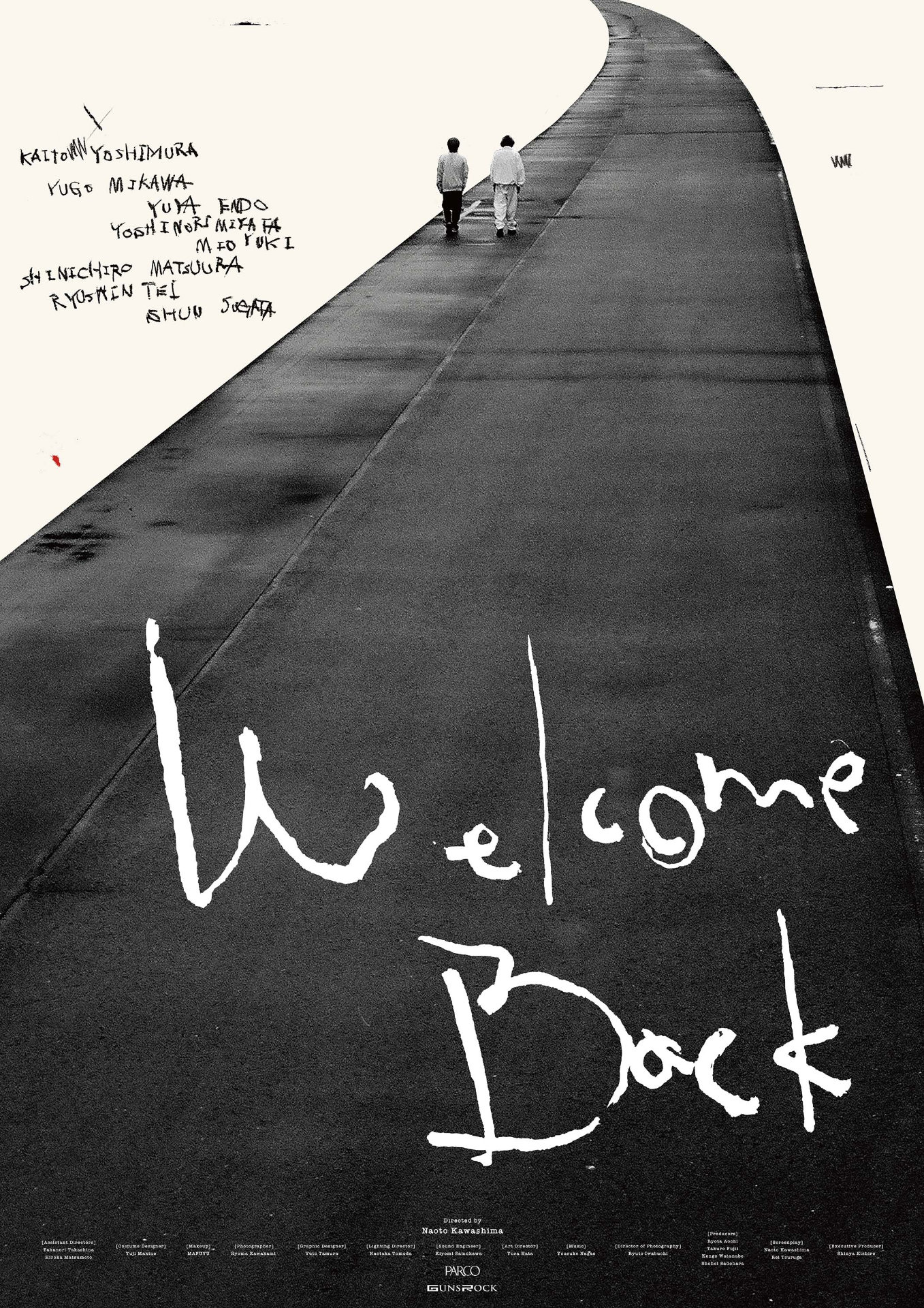
Welcome Back (Naoto Kawashima, 2024)

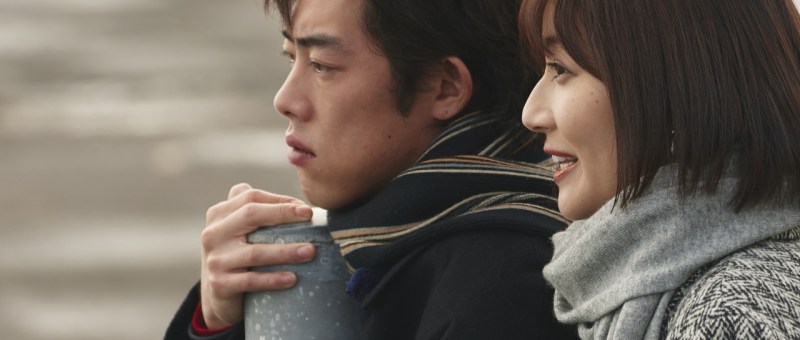
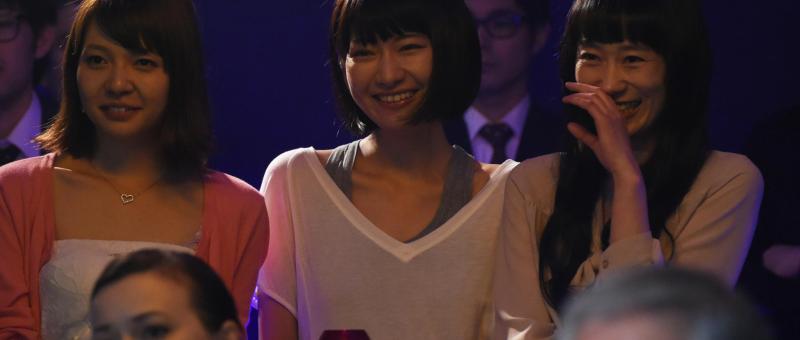
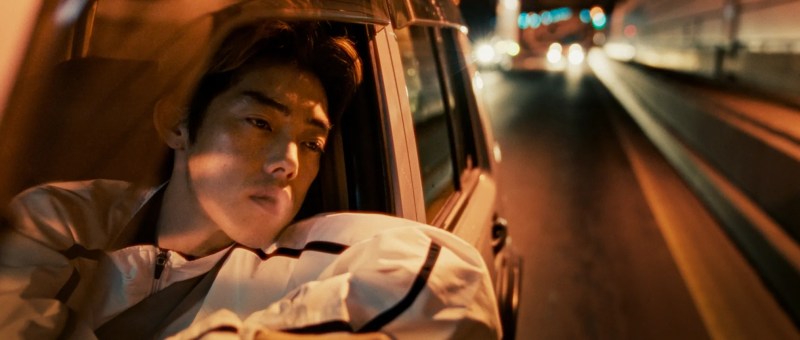
“Once you play the heel, you can’t go back,” according to up-and-coming boxer Teru’s (Kaito Yoshimura) coach, but it turns out to be truer than for most for the aspiring champion for whom getting up off the mat proves an act of impossibility. While he plays the hero for younger brother figure Ben (Yugo Mikawa) and talks a big game before stepping into the ring, in reality Teru is riddled with insecurity and using bluster to overcome the fear that he can’t live up to the image Ben has of him.

The terrible thing is, he might be right and Ben, a young man with learning difficulties who later gives his age as 10 though clearly in his 20s, may be beginning to see through him. “I lost because I looked at you,” he later says of a failed attempt to fight off their chief rival, but it might as well go for his life which he’s spent in Teru’s footsteps ever since his mother abandoned him with Teru’s family when they were just children on the same housing estate.

As such, Teru does genuinely care for Ben, but has also been hiding behind him in allowing him to become something like a mascot or cheerleader, someone over whom he feels superior but also looks up to him as the sort of person he wants to be but perhaps isn’t. In any case, his boxing career has been going well and he’s on track to become the Japanese champion, but at the same time he’s proud and arrogant. He thinks he knows better than his coach, and likes to make a big entrance trash talking his opponents in a larger-than-life manner that might be more suited to pro-wrestling than the comparatively more earnest world of boxing and earns him a degree of suspicion as a result. His opponent Kitazawa (Yoshinori Miyata) is his opposite number in that, as Teru points out, he’s deathly serious and certain in his abilities which is why he’s able to KO Teru mere seconds into their title match. No longer “undefeated”, Teru simply gives up and retires from boxing only to spiral downward while working as a supermarket mascot, eg. Ben’s old job from which he also gets him fired by messing it up for both of them because of his pride and temper.

But for Ben, the certain truth of his life has been that “Teru never loses”. Now that Teru lost, something’s very wrong with the universe and he has to put it right, which is why he decides to fight Kitazawa himself even if he has to walk to Osaka from Tokyo to do it because they’ve got no money for transport. What neither Teru nor Aoyama (Yuya Endo), a boxer Teru once defeated in another title fight but ends up helping him and Ben on their quest, is that after obsessively watching Teru all this time, Ben is actually quite a talented, if untrained, fighter. They were hoping they could get him to give up on his plan by finding someone weaker than Kitazawa to defeat him so he’d know he had no chance, but he basically fights his way all across Japan to prove that Teru really is the hero he always thought him to be. 

This turns out to be inconvenient for Teru because inside he feels himself to be a loser and since his single defeat has been running away from the fight. As he later begrudgingly realises, none of this would be happening if he’d knuckled down done the training so he’d be able to beat Kitazawa in the first place rather than being consumed by his pride and arrogance. He should be the one fighting Kitazawa, not Ben who is putting himself in danger because the world doesn’t make sense to him any more. Kitazawa, meanwhile, has his number and seems to look down on him for his lack of fighting spirit, correctly surmising he will walk away from the chance to fight him for real when he opts for a last resort of trying to bribe him to fake a sparring match so that Ben will see him win and be able to go on with his life. 

But nothing quite goes to plan, and it seems like Ben might be starting to see that Teru might actually be using him to bolster his own sense of low self-esteem which obviously means that he does and always has looked down on Ben. Having come to a realisation that he needed to play the role of the hero that Ben needed him to be, perhaps what he sees is that Ben has outgrown him and that despite his constant insistence that “Ben is a child” is capable of doing what he couldn’t in fighting back even when the odds seem impossible. Teru is defeated by life, but fighting back in his case might look like something a little less glamorous that starts with eating some humble pie and calling in a favour to get a shot at a regular job he’ll have to take a little more seriously. In one way or another, their accidental road trip clarifies the dynamics of their “brotherly” relationship, but at the same time leads them to a point of division in which moving forward might necessarily mean they’re going in different directions.


Welcome Back screened as part of this year’s Camera Japan.

Trailer (no subtitles)
God Seeks in Return (神は見返りを求める, Keisuke Yoshida, 2022)

It’s perfectly natural a lot of the time to feel as if you expect nothing in return for helping someone, after all it’s only what you should do as a fellow human being. But really we do expect something even if it’s just acknowledgement and it can be hurtful and upsetting if don’t feel we get it while the sensation that we’re being taken advantage of can leave us feeling silly for having offered in the first place. Keisuke Yoshida’s Good Seeks in Return (神は見返りを求める, Kami wa Mikaeri wo Motomeru) revels in these human paradoxes as a self-confessed nice guy is pushed to breaking point by the fallout from all his attempts to be neighbourly which seem to have backfired exponentially. 

Then again, Tamogami (Tsuyoshi Muro) almost certainly does at least hope for something in return when he agrees to help out struggling YouTuber Yuri (Yukino Kishii) with her moribund channel by enlivening it with his skills in video editing and design. He isn’t helping her in order to engineer a sexual relationship, and in fact turns Yuri down when she suddenly disrobes exclaiming that it’s the only way she can repay him for his kindness, but does appear interested and is additionally irritated when she begins hanging out with a bunch of vlogger cool kids he thinks are just exploiting her naivety. Yuri had already payed him back with homemade beef stew, an offer that was accepted in the interest of friendship, but her constant references to repayment of a favour expose her idea of relationships as essentially transactional which to be fair they well may be. Even so, she appears somewhat guileless, opportunist rather than calculating and desperate for attention.

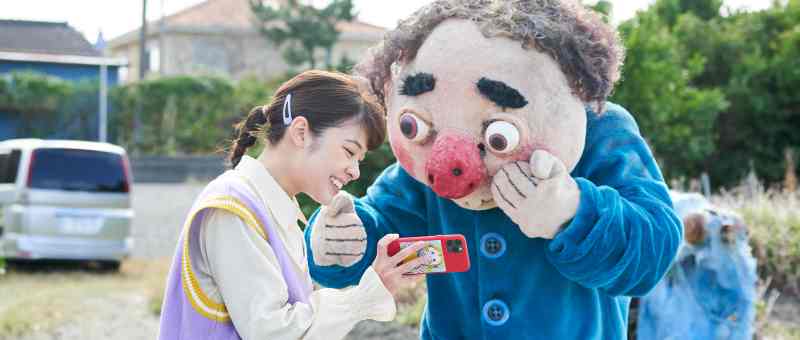
That might be why she can’t see that the reason she became unexpectedly popular after agreeing to a “body paint” stunt with a pair of more established YouTubers is that people wanted to see her naked which is why they’re always requesting more of the same. The first half of the film plays as quirky comedy, an offbeat romance between a nice middle-aged man and a dippy young woman who thinks she’s no good at anything and incapable of being alone. But things soon turn sour when one of Yuri’s stunts seems like it might have serious consequences for a local business owner and Tamogami has to muster all of his PR skills to put this particular fire out. The simple friendship between them that was brokered by a weird ogre-like mascot suit Yuri christens Jacob is disrupted by Yuri’s desire for fame as she undergoes a complete personality transformation after falling in with a group of more successful, media savvy YouTubers who have fancy design skills and marketing teams. She dismisses Tamogami as old-fashioned and joins in when the others make fun of him in rejection of the genuine friendship that had arisen between them.

When a friend he’d helped out financially and even stood guarantor on his debts takes his own life Tamogami is deep in the hole. Finally he wonder’s if he shouldn’t have something in return for all the unpaid labour he’s been doing for Yuri but she predictably brushes him off until he finally embarks on a weird vendetta trying to “expose” her YouTube channel for being founded on lies and exploitation. There may be something in her that’s regretful, wistfully looking at the sweater Tamogami had given her with cute illustrations of her and Jacob on it, while her new “god” Murakami openly mocks him leaving her conflicted about the dark side of their new internet endeavour effectively bullying a guy whose only crime was being nice and bit too dull and middle-aged for her new hipster friends sure to drop her like she’s hot as soon as something goes wrong.

Though not as extreme as some of Yoshida’s other films, God Seeks in Return suggests that nice guys never prosper but also that no one’s really as “nice” as they think they are. We wall want something in return even if it’s just a thank you and not to be belittled or taken advantage of. There can be something paradoxically selfish in niceness in which people do it more for their own gratification or to feel they are better than those they help and conversely the same in those who take advantage of others. In it’s way bleak and melancholy in its vision of human relationships, the film nevertheless holds out a faint hope in the reality of the genuine connection between its mismatched heroes no matter how dark and twisted it may eventually become.


God Seeks in Return screens 1st June as part of this year’s Nippon Connection

International trailer (English subtitles)

Far Away, Further Away (遠くへ,もっと遠くへ, Shinji Imaoka, 2022)

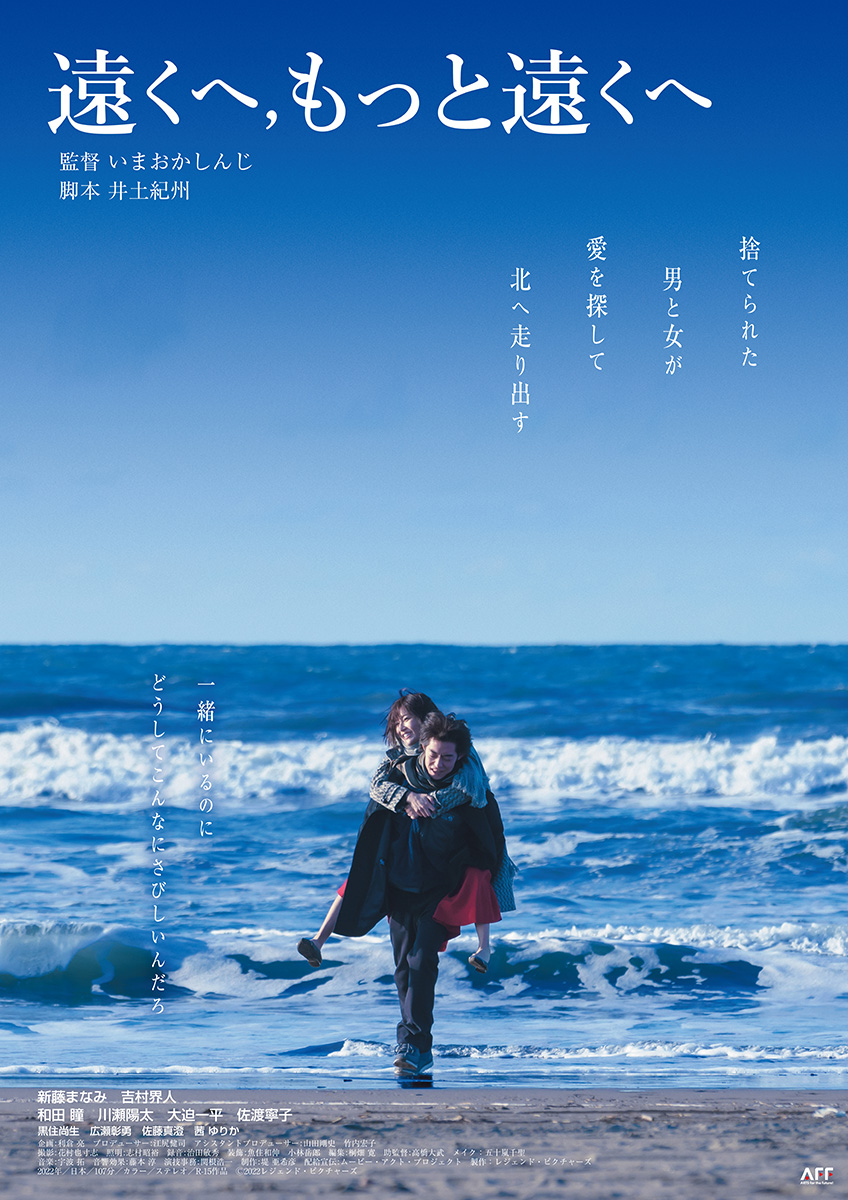
Is there an ideal way of coming to terms with the end of a marriage, or is better to take it as it comes? The heroine of Shinji Imaoka’s relationship drama Far Away, Further Away (遠くへ,もっと遠くへ, Tooku e, Motto Tooku e) thinks she has it all figured out and has started taking practical steps towards an efficient separation only to have the rug pulled from under her never having considered that her husband may also be unsatisfied and her attempts to mitigate his hurt feelings therefore less than relevant. Imaoka began his career in pink film and is probably best known outside of Japan for the erotic musical fantasy Underwater Love but has in recent years taken to more contemplative drama such as 2019 study in grief Reiko and the Dolphin, here continuing a key theme in the exploration of the difficulties in relationships between men and women. 

The main reason Sayoko (Manami Shindo) wants to leave her husband is that they’ve simply grown apart. Smiling gently at a sweet older couple looking at a two-seater sofa in the furniture store where she works, she reflects on their words that a marriage is weaker without common interests realising that she and Goro have none. A fishing obsessive, Goro usually retreats to his room after dinner to update his blog and fondle fishing equipment while her suggestion that she join him on his next trip is met with less than enthusiasm. Meanwhile, though she likes her job at the furniture store she’s beginning to feel as if she’s stuck in a rut and no closer to achieving her dreams of becoming an interior co-ordinator disappointed to discover a quote she’d written for younger couple who seemed happy enough in the shop screwed up in the park. One might assume they’ve obviously had an argument about it on the way home which probably isn’t anything to do with Sayoko but still she begins to wonder what the point is leading to Goro to advise her to quit her job laying bare the true source of his dissatisfaction in the marriage in that he was looking for a woman prepared to become a conventional housewife which in turn might explain why he’s not interested in the shared interests approach to marriage Sayoko suggests but prefers to maintain a separate lives model in which she takes care of the domestic while he has his work and individual hobbies to blow off steam. 

So distant from each other have they become that Sayoko hasn’t really realised she’s not the only one who wanted to end the marriage nor has he seemingly realised she’s in the process of leaving him. Her plan for a measured exit is nixed by her husband’s request for a divorce but through her quest to find a new apartment she gradually draws closer to lovelorn estate agent Yohei (Kaito Yoshimura) who is particularly interested in her story as his own wife, Mitsuko, left him seemingly out of the blue some years ago and he’s never really come to terms with it a part of him still assuming she’ll eventually come back. In a bid to find some closure Sayoko suggests they take off together to look for her so he can start to move on, heading north on a Hokkaido-bound road trip that takes her back to her own hometown where she reflects on her parents’ marriage after discovering her mother’s second life as a widow in which she has begun to fulfil herself as a singer no longer required to fulfil the role of the traditional housewife which Sayoko had rejected. 

Dealing with their respective baggage the pair grow closer and begin to move on together, further and further away until they reach the coast looking for a ferry to take them on to Sakhalin. The memories of old lovers retreat further and further away too, increasingly blurred and distant eclipsed by new ones even if a sense of loneliness remains. Contrasting the verdant natural vistas of rural Hokkaido with the greyness of Tokyo city life Imaoka adds a sense of childlike wonder as his heroine’s tendency to dance while repeating the same phrase with increasing intensity begins to rub off on her dejected love interest, making the case for striking out for a far off happiness rather than simply resigning oneself to an unsatisfying present. 


Far Away, Further Away screened as part of Osaka Asian Film Festival 2022

Original trailer (no subtitles)

Extraneous Matter – Complete Edition (異物-完全版-, Kenichi Ugana, 2021)

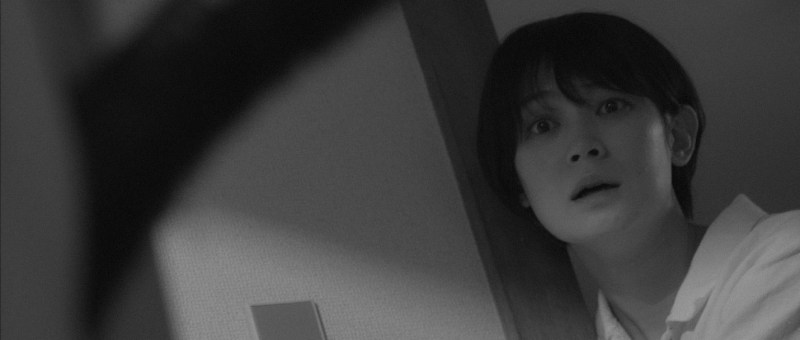
If you suddenly encountered a weird, decidedly alien, octopus-like creature living in your wardrobe what would you do? Would it frighten or intrigue you, would you want to get rid of it as quickly as possible or look after it for the rest of your life? The presence of these strange creatures provokes different responses from each of the heroes of Kenichi Ugana’s Extraneous Matter – Complete Edition (異物-完全版-, Ibutsu – Kanzenban-), an expansion of his earlier short of the same title. Drawing inspiration from the early work of Shinya Tsukamoto, Ugana’s crisp, academy ratio black and white photography makes use of an ironic score mimicking classic Hollywood melodrama lending a mythic quality to this lowkey tale of alien sex fiend invasion and human loneliness. 

For Kaoru (Kaoru Koide), heroine of the first segment, the creature seems to signify her sexual frustration and sense of existential inertia. For her, every day is the same. She wakes up alone, makes herself a cup of coffee and eats a pastry in front of the television which always seems to be carrying news of a celebrity sex scandal, and then starts work with her friends (for some reason working at her apartment) who gossip about their various sugar daddies. Her boyfriend (Shunsuke Tanaka) apparently lives with her, but immediately disappears right after dinner and actively avoids intimacy. Were it not for later events, we might wonder if the creature is somehow a transformation of the boyfriend, Kaoru herself unsure whether it was a dream, first violated but then apparently satisfied by the alien tentacles which later begin satisfying all of her friends. 

If the “extraneous matter” of Kaoru’s life was indeed her unfulfilled desire and internalised shame, then for the barmaid (Momoka Ishida) of the second sequence it’s perhaps a lack of excitement while for the young man (Kaito Yoshimura) who brings a creature zipped into a holdall to a pub to meet his ex-girlfriend (Makoto Tanaka) it’s more a desire for familial intimacy or a sense of commitment that may previously have frightened him. He appears to want to get back together with the young woman, apologising for his past behaviour while explaining that he found the creature in his wardrobe scary to begin with but later became fond of it and is convinced he could raise it with her help, ordering a parfait to feed it because he’s discovered it has a sweet tooth and particularly likes strawberries. He swats the errant tentacles away as if shushing a naughty baby as the woman too begins to coo over it, shovelling cream from the parfait into its mouth with a spoon. 

But then, the extraneous matter of the lives of others can also present a challenge to the social order. Some wish to eliminate the alien threat, a young man working at a factory (Shuto Miyazak) charged with disposing of alien bodies eventually conflicted on discovering one alive sure that he can hear the creature begging him for help. Together with a like-minded colleague (Duncan) he determines to save it and help it return to its people, culminating in an unexpected ET moment which perhaps realigns the “alien” threat with a social other as the two compassionate employees evade the authorities to get the creature to safety despite having been betrayed by their female colleague (Mizuki Takanashi). 

So, what is the “extraneous matter” of our lives, a kind of loneliness, a sense of “alienation”, or of emptiness in an “absurd” world of infinite mundanity? Perhaps all of the above, Kaoru returning to her lonely life apparently missing the strange and unidentified creature only to re-encounter it in an unexpected place and discover it has not forgotten her. Gently ironic, Ugana’s sci-fi-inflected aesthetic begins with grim body horror before progressing into something warmer, for good or ill becoming fond of its alien invaders as compassionate humans refuse to reject them embracing in a sense these “extraneous” sides of themselves they may have previously found disturbing in search of more fulfilling lives. Elegantly composed in its classic academy ratio frame with its ironic bonsai pillow shots and continuing sense of unease, Extraneous Matter nevertheless ends on a note of hope rather than threat even as the invaders apparently lurk among us but bringing with them comfort even in the reflection of our unmet desires. 


Extraneous Matter – Complete Edition streamed as part of this year’s Nippon Connection.

Original trailer (English subtitles)

BOLT (Kaizo Hayashi, 2019)

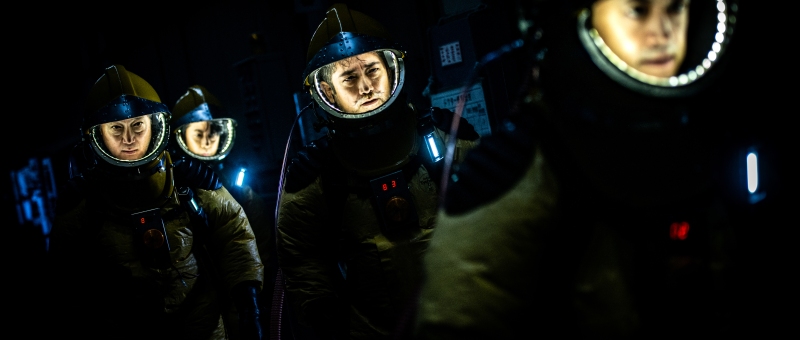
“We have to trust the bonds that tie us” intones a voice from the control room, “if you can’t tighten that bolt the water will pollute the future”. A series of post-Fukushima tales, Kaizo Hayashi’s tripartite portmanteau movie BOLT is less about the radiating effects of a nuclear disaster than their legacy, insisting that if you can’t pull together you can’t move forward but then in the end the bolt cannot be tightened or the deluge stemmed. It is perhaps too late, but still you have to live. 

Set in the immediate aftermath of the tsunami, the first of the three tales follows a series of selfless engineers sent in to tighten a bolt on a leaking tank. They are informed their suits will protect them but not completely, they have only half an hour of oxygen, and should work in pairs for no longer than a minute before changing over. The older men tell the younger to wait behind, hoping to spare them from harm while the young men bristle wanting to do their bit. In any case, one of the young men later freezes, his feet rooted to the spot as if under some kind of spell while his friend begins to go quietly mad when a second bolt works it way out seconds after he’s fixed the first. The unnamed chief (Masatoshi Nagase) refuses to return with his team, staying to ensure he’s done all that can be done but in the end they cannot stop what is already in motion. 

A few years later the chief has apparently moved on, now working as a house clearer in the exclusion zone. His job is to tidy up and sanitise the home of a man who refused the evacuation order and has since passed away alone. As he’s been told, he carefully saves important documents and personal items such as photo albums for the family only to be told there is no family to take them, they were all taken by the tsunami. His cynical partner asks him why he got into this kind of work. He doesn’t have much of an answer for him save that someone’s got to do it and can offer only the declaration that he has to go on living for further direction of his life. 

On Christmas Eve 2014 however he’s still alone, living in an auto garage making some kind of metal device while a pair of children outside set the scene for a ghost story claiming there’s a mermaid living in the tank inside. Like the deceased man, the chief also seems to have lost someone, a black and white photograph sitting on the desk behind him, while apparently attempting to return to his former life as a nuclear technician only to be told he’s taken too much radiation already though the plant is short staffed seeing as many prefer to work on the Olympics, forging the future while neglecting the past. His Christmas gets off to a strange start when a beautiful woman in a red convertible bedecked with festive lights literally crashes into his life. An echo of someone else her arrival and subsequent departure hint at the strange and ethereal impermanence of post-disaster life in the continuing impossibility of moving on from irresolvable trauma. 

Beginning in science fiction with the high concept opener and its cyber punk design, Hayashi posits the nuclear threat as a kind of supernatural curse which can perhaps never be undone. Crackles of electricity take on a spiritual air while the permanent pinking of the sky seems to hint at a world forever changed as if something has been unleashed and can never again be caged. Tormented by cosmological unease, the chief chooses action, trying to his best to live even when action fails. The bolt can’t be tightened, the water pollutes the future, and all he can do is continue to stem the tide, tightening the bolts wherever they fray. With occasional flashes of psychedelic surrealism, Hayashi’s three tales offer a bleak and melancholy vision of life in the shadow of an almost supernatural disaster, but find finally a determination to live no matter how futile it may turn out to be. 


BOLT streamed as part of this year’s Nippon Connection.

Original trailer (no subtitles)

Images: ©L’espace Vision, Dream Kid, Kaizo Production

Kamata Prelude (蒲田前奏曲, Ryutaro Nakagawa, Mayu Akiyama, Yuka Yasukawa, Hirobumi Watanabe, 2020)

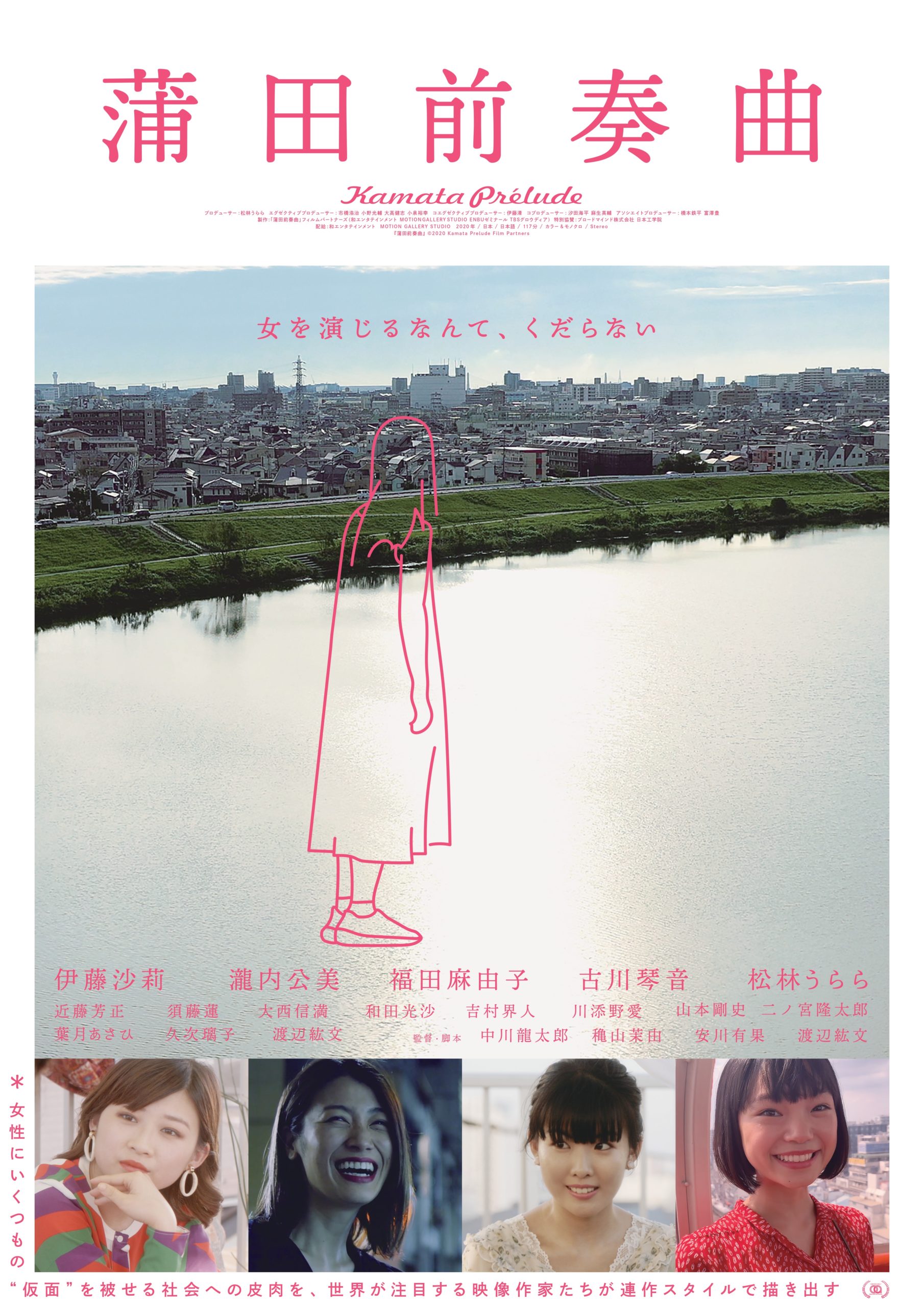
A quiet suburb of Tokyo, Kamata is in someways the birthplace of modern Japanese cinema home to Shochiku’s prewar studio where the “Kamata Style” which aimed to introduce a note of cheerful naturalism to an artform defined by shinpa gloominess was forged. Produced by actress Urara Matsubayashi who hails from the area and stars in three of the four segments, omnibus movie Kamata Prelude (蒲田前奏曲, Kamata Zensokyoku) asks some tough questions about what it means to be a woman and an actress today in the contemporary capital as the heroine, “Machiko Kamata”, contends with various demands from the economic to the emotional. 

Directed by Ryutaro Nakagawa, the first segment finds Machiko (Urara Matsubayashi) introducing herself as she takes part in a strange audition dressed in an inappropriately short cosplay-style nurse’s outfit. After the audition is over, her agent tells her to say “hi” to the director, a theme which will recur in the third chapter as Machiko finds herself feeling uncomfortable, forced to ingratiate herself in order to get ahead. Annoyed after the eccentric director asks her out for dinner, she can’t help asking him why she has to wear the suspiciously skimpy nurse’s outfit provoking him into a worryingly violent outburst. At home, meanwhile, her world is rocked by her younger brother’s revelation that he’s got a girlfriend who is, ironically, a nurse at local hospital. Jealous and resentful, Machiko can’t warm to Setsuko (Kotone Furukawa) who seems improbably sweet and innocent, almost as if she came from another time (the mid-August dating and ornaments for the Bon festival might clue us in as to why). Spending a day bonding with her, however, the two women generate a kind of sisterhood which pushes Machiko into a realisation of the emptiness she feels in her life of constant struggle as an aspiring actress supporting herself mainly with her part-time job at a ramen bar. 

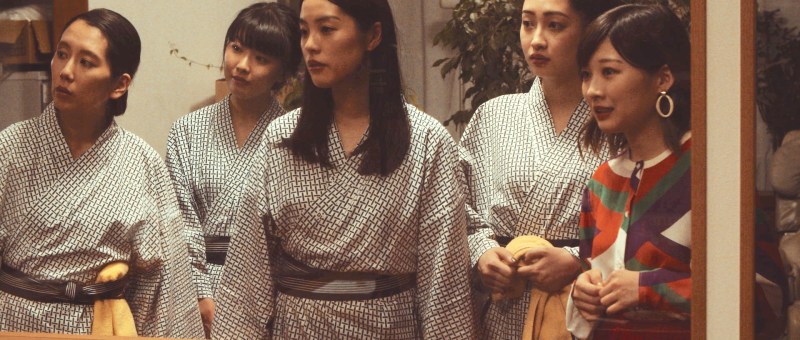
The themes of alienation and insecurity are only depend in the second segment, directed by Mayu Akiyama, in which Machiko reunites with a group of high school friends who are each less than honest about the state of their lives and their unfulfilled desires. Machiko gives the impression that she’s just been in a major movie with a big star, but it turns out she only played a corpse while the rest of the group are scandalised by the bombshell that their friend Marippe (Mayuko Fukuda) has got engaged to a guy from work she’s been seeing secretly for only six months. Besides being somewhat hurt not to have known she was seeing someone, the gang have different reactions to the news with hard-nosed career woman Hana (Sairi Ito) put out by Marippe’s traditional view of conventional gender roles in which she intends to let her career slide to concentrate on being a wife. A trip to a hot spring (the same hot spring seen advertised on Machiko’s T-shirt in part one) brings things to a head with a possibly cheating boyfriend eventually offering the excuse that he is merely a hot spring enthusiast sharing his hobby with a friend of the opposite sex rather than a two-bit louse indulging in the patriarchal double standard. 

Patriarchal double standards are out in force in part three, directed by Yuka Yasukawa, in which Machiko attends another odd audition where she and the other auditionees are asked to outline an episode of sexual harassment they have personally experienced. In fact, we have already seen her be inappropriately propositioned by a middle-aged producer who ran out on her in a coffee shop after she turned him down leaving her with the bill, but the episode she recounts is darker still. As she feared they might, the men in the room quickly figure out who she might have been talking about but proceed to put the blame on her implying that she sleeps around to get ahead and was only offended by the producer’s actions because he wasn’t powerful enough to be useful. It’s another woman however, Kurokawa (Kumi Takiuchi), who kicks things into gear by relating that she was assaulted by a man in a club whom she later reveals to have been the director himself only he doesn’t remember her. The director brings both women back and makes them re-enact Machiko’s tale of being inappropriately propositioned in a producer’s office, increasingly exasperated that the situation seems “too scary” as if he’s entirely missed the point of his own exercise or is actively getting off on the actress’ discomfort. The male cameraman (Ryutaro Ninomiya) is the one who eventually points out that the audition itself has descended into a protracted act of sexual harassment, seemingly conducted solely for the entertainment of the director and his assistant. 

Largely disconnected from the other three chapters, the fourth does not feature Urara Matsubayashi and is in fact set not in Kamata but in director Hirobumi Watanabe’s familiar Tochigi. The opening of his segment, characteristically filmed with static camera and in black and white, finds him once again playing a version of himself ranting about not knowing what to do with this unusual project he has taken on for the money even though he doesn’t generally make shorts, has never done an omnibus movie before, and remains suspicious of the concept. He relates all of this to his 10-year-old niece Riko (star of I’m Really Good), who says absolutely nothing while he continues to treat her as if she were the most famous actress in Japan. Somewhat poignantly, a photograph of Watanabe’s late grandmother sits on a stool off to the side, implying perhaps that little Riko has in some senses taken over her role as silent observer. The main thrust of the action follows Watanabe as he attempts to film a sci-fi movie about an alien invasion with local non-actors, but is finally linked back to the omnibus by Riko’s cheerful letter to Machiko in which she states that she wants to become an actress just like her. Ending on such an upbeat moment seems to imbue a sense of hope for the future that was perhaps previously absent, implying that the hopes and dreams of a little girl at least are worth fighting for if only to live up to her sense of expectation for the magic of the movies. 


Kamata Prelude streamed as part of this year’s Nippon Connection.

Original trailer (English subtitles)

Mori, The Artist’s Habitat (モリのいる場所, Shuichi Okita, 2018)

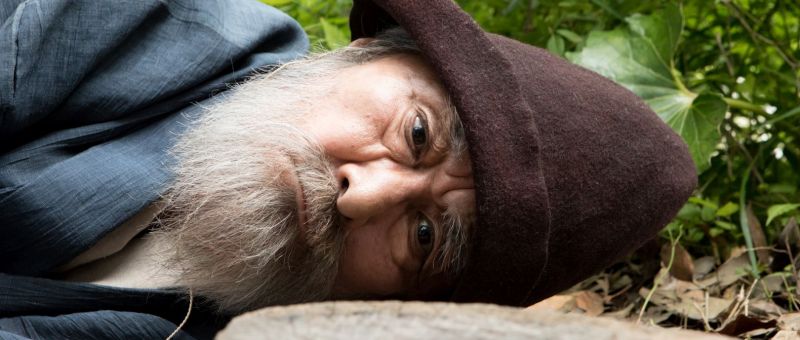
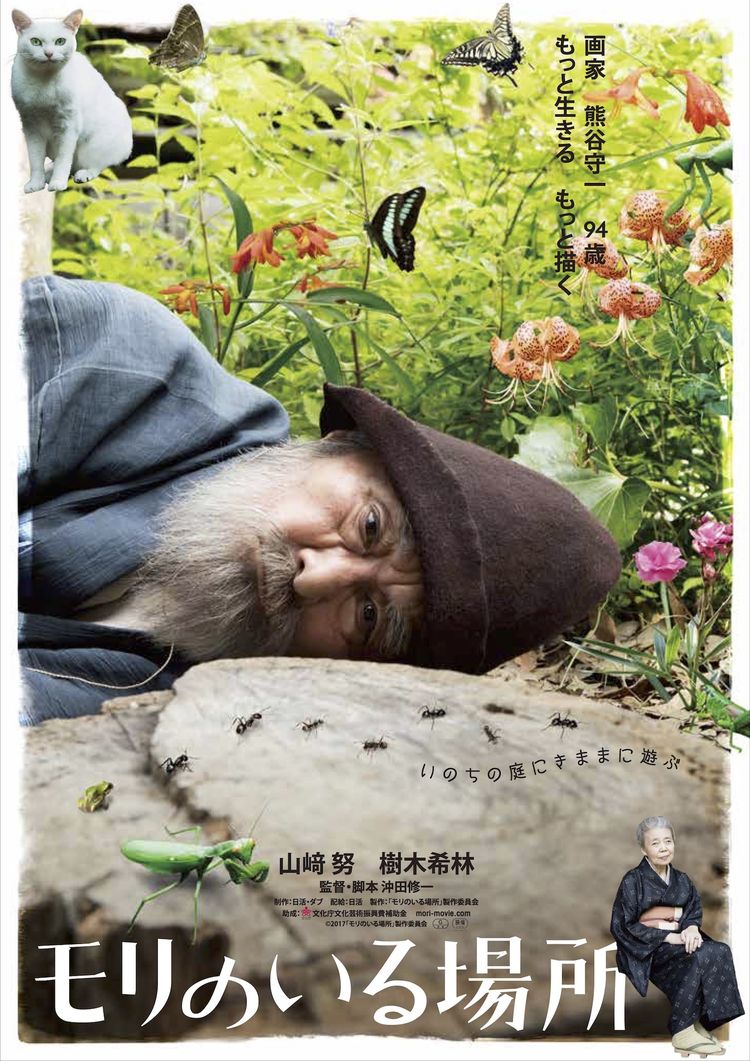
Mori an Artist's Habitat PosterThe world is vast and incomprehensible, but a lifetime’s study may begin to illuminate its hidden depths. At least it’s been that way for the hero of Shuichi Okita’s latest attempt at painting the joys and perils of a bubble existence. Mori, The Artist’s Habitat (モリのいる場所, Mori no Iru Basho) revolves around the real life figure of Morikazu Kumagai (Tsutomu Yamazaki), a well respected Japanese artist best known for his avant-garde depictions of the natural world, as well as for his eccentric personality. When we first meet him the early 1970s, Mori (a neat pun on his given name which uses the character for “protect” but also means “forest”), is 94 years old and has rarely left his beloved garden for the last 30 years. A man out of time, Mori’s world is however threatened by encroaching modernity – a gang of mobbed up property developers is after his land and is already in the process of constructing an apartment block that will rob Mori’s wonderful garden of its rightful sunlight.

Okita introduces us to Mori through an amusing scene which finds the Japanese emperor “admiring” one of his artworks only to turn around in confusion and ask how old the child was that made this painting. Spanning the Meiji and the Showa eras, Mori’s artwork is defined by its bold use of colour and minimalist aesthetic which outlines only the most essential elements of his subjects. As his wife of 52 years, Hideko (Kirin Kiki), explains to the various visitors who turn up at Mori’s studio/home hoping to commission him, Mori only paints what he feels like painting when he feels like painting it. Getting him to do anything else is a losing battle.

Painting mainly at night, Mori spends his days observing the natural world. Wandering around his garden he stops to sit in various places, gazing at the ants, and playing with the fish he put into a small pond dug way down into the earth over a period of 30 years. Despite his distaste for “visitors”, Mori has consented to be the subject of a documentary, followed around by a photojournalist (Ryo Kase) and his assistant (Kaito Yoshimura) keen to capture him in his “natural habitat”. The photographers, natural “shutterbugs”, gaze at Mori in the same way he gazes at his trees and insects. An irony which is not lost on the reticent artist.

Okita neatly symbolises Mori’s world as a place out of time by hovering over his desk on which lies a disassembled pocket watch. Eventually the watch will be repaired and time set back in motion but until now Mori’s garden has been a refuge of natural pleasures which itself contains the world entire. Receiving a surprise visitation from a supernatural being (Hiroshi Mikami), Mori is given an opportunity to explore the universe but turns it down. Firstly he doesn’t want to leave his wife on her own or see her “tired” by his absence, but secondly his garden has always been big enough for him and given thousands of years he fears he may never be able to explore it fully.

The garden, however, may not survive its owner. The 1970s, marked by early turmoil, later became a calm period of rising economic prosperity in which society began to move away from post-war privation towards economic prosperity. Hence our big bad is a property developer set on building apartment blocks – a symbol and symptom of the move away from large multi-generational homes to cramped nuclear family modernity. Unbeknownst to Mori, his garden has become a focal point for the environmental protest movement who have begun to set up signs and slogans around his home attacking the property developers for ruining a national landmark which has important cultural value in appreciating the work of one of Japan’s best known working artists.

Having lived through so much turmoil, Mori takes this in his stride. He knows his garden won’t last forever, and is resigned to the nature of the times. Mori may prefer to spend his days in quiet contemplation resenting the constant interruptions from all his “visitors” but makes time to talk seriously with those who seek his guidance such one of the developers (Munetaka Aoki) who’s brought along one of his son’s drawings, convinced that he must be a “genius”. Mori takes one look and tells him frankly that it’s awful, but adds that that’s a good thing – those with “talent” rarely do anything of note and even if it’s “bad” art is still art. Nevertheless there are those who try to profit from his work for less than altruistic purposes – the  hand-painted nameplate from outside the house is forever being stolen and he’s constantly petitioned to provide his services in service of someone else’s business.

Okita’s characterisation of the later life of a famous artist is another study of genial eccentricity as its hero commits himself fully to living in a way which pleases him, only bristling at those who describe his gnome-like garden presence as resembling a “Chinese Hermit Sage”. Mori himself is, of course, another living thing enjoying the natural world to its fullest and if it’s true that his time is ending there is something inescapably sad in looking up from the shadows of apartment blocks and finding nothing but lifeless concrete.


Screened at the 20th Udine Far East Film Festival. Mori, The Artist’s Habitat will also be screened as the opening gala of the 2018 Nippon Connection Japanese film festival, and will receive its North American premiere at Japan Cuts in July where Kirin Kiki will also receive the 2018 Cut Above Award.

Original trailer (no subtitles)

Sekigahara (関ヶ原, Masato Harada, 2017)

Sekigahara posterWhen considering a before and an after, you’d be hard pressed to find a moment as perfectly situated as the Battle of Sekigahara (関ヶ原). Taking place on 21st October 1600 (by the Western calendar), Sekigahara came at the end of a long and drawn out process of consolidation and finally ended the Sengoku (or “warring states”) era, paving the way for the modern concept of “Japan” as a distinct and unified nation. In actuality there were three unifiers of Japan – the first being Oda Nobunaga who brought much of Japan under his control before being betrayed by one of his own retainers. The second, Toyotomi Hideyoshi, continued Oda’s work and died a peaceful death leaving a son too young behind him which created a power vacuum and paved the way for our third and final creator of the modern Japanese state – Tokugawa Ieyasu whose dynasty would last 260 years encompassing the lengthy period of isolation that was finally ended by the tall black ships and some gunboat diplomacy.

Loosely, we begin our tale towards the end of the rule of Toyotomi Hideyoshi (Kenichi Takito) though, in a nod to the novel, director Masato Harada includes a temporal framing sequence in which our author depicts himself as a boy during another war sitting in these same halls and hearing stories of heroes past. As well he might given where he was sitting, the narrator reframes his tale – our hero is not the eventual victor, Tokugawa Ieyasu, but a noble hearted retainer of the Toyotomi, Mitsunari (Junichi Okada).

Riding into battle, Mitsunari reminds his men that this is a war of “justice and injustice” – they cannot lose. Yet lose they do. The narrator recounts Mitsunari’s improbable rise as an orphan taken in by Hideyoshi on a whim who nevertheless became one of the most powerful men in late 16th century Japan. Despite his loyalty to his master, Mitsunari cannot abide the cruelty of the samurai world or its various modes of oppression both in terms of social class and even in terms of gender. He resents the subversion of samurai ethics to facilitate “politics” and longs to restore honour, justice, and fairness to a world ruled by chaos. Rather than the bloody uncertainty and self-centred politicking that define his era, Mitsunari hopes to enshrine these values as the guiding principles of his nation.

On the other hand, his opponent, Tokugawa Ieyasu (Koji Yakusho) is famed for his intelligence and particularly for his political skill. Hoping to swoop into the spot vacated by Hideyoshi which his young son Hideyori is too weak to occupy, Ieyasu has been playing a long game of winning alliances and disrupting those other candidates had assumed they had secured. Unlike Mitsunari, Ieyasu is ruthless and prepared to sacrifice all to win his hand, caring little for honour or justice or true human feeling.

The framing sequence now seems a little more pointed. Sekigahara becomes a turning point not just of political but ideological consolidation in which Mitsunari’s ideas of just rule and compassionate fair mindedness creating order from chaos are relegated to the romantic past while self interest triumphs in the rule of soulless politickers which, it seems, travels on through the ages to find its zenith in the age of militarism. Mitsunari is the last good man, prepared to die for his ideals but equally prepared to live for them. His tragedy is romantic in the grander sense but also in the more obvious one in that his innate honour code will not let him act on the love he feels for a poor girl displaced from Iga whose ninja service becomes invaluable to his plan. With a wife and children to consider, he would not commit the “injustice” of creating a concubine but dreams of one day, after all this is over, resigning his name and position and travelling to foreign lands with the woman he loves at his side.

Working on a scale unseen since the age of Kurosawa, Harada patiently lays the groundwork before condensing the six hours of battle to forty minutes of fury. The contrast between the purity of the past and the muddied future is once again thrown into stark relief in the vastly different strategies of Ieyasu and Mitsunari with Ieyasu’s troops armed to the teeth with modernity – they fire muskets and shout cannon commands in Portuguese while Mitsunari’s veteran warriors attempt to face them with only their pikes and wooden shields. Unable to adapt to “modern” warfare and trusting too deeply in the loyalty of his comrades, Mitsunari’s final blow comes not by will but by chance as a young and inexperienced vassal vacillates until his men make his decision for him, betraying an alliance he may have wished (in his heart) to maintain. Goodness dies a bloody death, but there is peace at last even if it comes at a price. That price, for some at least, may have been too great.


Original trailer (no subtitles)

Dawn of the Felines (牝猫たち, Kazuya Shiraishi, 2017)

dawn of the felines poster largerTowards the end of the 60s and faced with the same problems as any other studio of the day – namely declining receipts as cinema audiences embraced television, Nikkatsu decided to spice up their already racy youth orientated output with a steady stream of sex and violence. The Roman Porno line took a loftier approach to the “pink film” – mainstream softcore pornography played in dedicated cinemas and created to a specific formula, by putting the resources of a bigger studio behind it with greater production values and acting talent. 40 years on Roman Porno is back. Kazuya Shiraishi’s Dawn of the Felines (牝猫たち, Mesunekotachi) takes inspiration from Night of the Felines by the Roman Porno master Noboru Tanaka but where Tanaka’s film is a raucous comedy following the humorous adventures of its three working girl protagonists, Shiraishi’s is a much less joyous affair as he casts his three lonely heroines adrift in Tokyo’s red light district.
Masako (Juri Ihata), Rie (Michie), and Yui (Satsuki Maue) are best friends, though they don’t even know each other’s real names. They each work for a shady escort agency in Tokyo’s red light district where they’re ordered and dispatched by their two-bit hustler of a manager Nonaka (Takuma Otoo) and driven around by the assistant who it turns out has been secretly filming them and posting the videos on YouTube as a kind of exposé on the sex trade.

Each of the women “has their tale to tell” as one puts it but none of them are particularly unhappy in their work, prostitution is simply their way of life and to that extent completely normalised. It does, however, interfere with their ability to form relationships, not just practically but emotionally. For unclear reasons possibly connected to debt collection Masako is technically homeless despite the large amounts of money she can earn, sleeping in cheap motels or all night manga cafes and carting all of her worldly possessions around with her in a tiny carry on size suitcase on wheels. One of her regulars, a millionaire shut in (Tomohiro Kaku), offers to let her stay with him but their relationship is strange and strained – somewhere between business and pleasure with the lines permanently unclear.

Rei, by contrast, is saddled with an elderly client who usually just wants to talk but eventually takes things in an extreme direction. Her path into prostitution is in a sense more positive even if it stems from a kind of vengeance in that the feeling of being needed and providing a valuable service gives her life meaning.

Yui looks for meaning through romance but rarely finds it thanks to the various potential mates she meets through her work. Yui’s young son Kenta has worrying bruises on his face, arms and torso, rarely speaks, and is frequently abandoned by his mother who pays a shady guy to look after him while she spends her time looking for love.

Working for a lenient agency the girls are more or less free agents rather than abused street walkers trapped by debt-bondage and could quit any time they wanted. Yui and Masako may be looking for an escape from this dead-end world – Yui at least is conscious of her age and the declining bookings, but neither names that as something that they are actively pursuing. Rei, by contrast, has made her escape already but has travelled in the opposite direction – from stifling bourgeois life to Belle du Jour liberation, but her eventual destination may be a much darker one than she’d anticipated.

This darkness hovers round the edges as the threat of violence is only ever indirectly expressed or fetishised as in a sequence led by Yui’s possible new partner and the bondage club he works at as one half of a warmup manzai act. Only towards the end does its reality finally surface, making plain how vulnerable and unprotected the women remain whilst on the job. Far from the liberated laughter of Night of the Felines, Shiraishi’s film traps its women with their own despairs as they wallow in an inescapable well of loneliness, satisfying the needs of others but unable to satisfy their own. Bleak but subtly ironic, Dawn of the Felines finds no joy in the sun rising, only the relief of the end of a working day as its three stray cats wander the streets looking for their place to belong.


Dawn of the Felines was screened at the 17th Nippon Connection Japanese Film Festival.

Original trailer (English subtitles)

Love and Other Cults (獣道, Eiji Uchida, 2017)

love and other cultsEiji Uchida’s career has been marked by the stories of self defined outsiders trying to decide if they want to move towards or further away from the centre, but in his latest film Love and Other Cults ( 獣道, Kemonomichi), he seems content to let them linger on the margins. The title, neatly suggesting that perhaps love itself is little more than a ritualised set of devotional acts, sets us up for a strange odyssey through teenage identity shifting but where it sends us is a little more obscure as a still young man revisits his youthful romance only to find it as wandering and ill-defined as many a first love story and like many such tales, one ultimately belonging to someone else.

Our lovelorn hero and narrator, Ryota (Kenta Suga), observes the heroine from afar as he tells us her story, which is also his story in a sense. Ai (Sairi Itoh), a neglected child, drifts aimlessly in an uncaring world forever seeking a place to belong but finding no safe space to drop anchor. Ai’s mother, as drifting and aimless as her daughter, attempts to find salvation through religion but her quest for self-fulfilment drags her from one spiritual fad to the next all the while pulling little Ai along with her. The pair finally end up in a cult commune where Ai is a favourite of the leader – a Westerner called Lavi (Matthew Chozick) who preaches free love but only for himself.

Eventually, the cult is raided by the police, Lavi flees, and Ai is “rescued” but the next stage in her odyssey is no less disruptive than the last as she finds herself adrift in the mainstream world. Dropped into a regular high school, Ai tries to play the regular high school girl but can’t shake the cult member inside her. Semi-adopted by an ordinary family, her life gains some normalcy but it is short-lived and before long Ai finds herself in another sort of commune altogether before ending up in teenage prostitution followed by the porn industry.

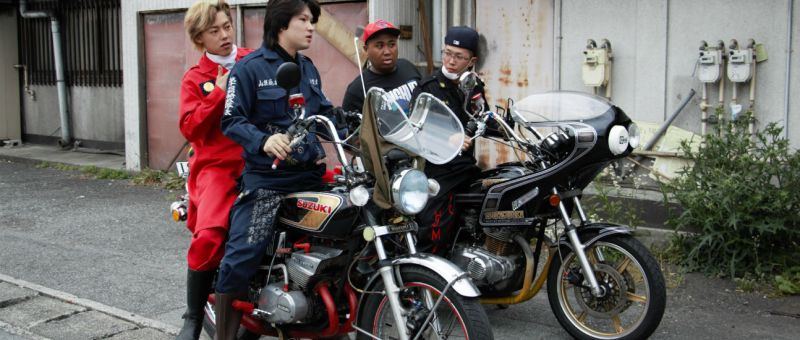
If girls like Ai end up in AV, boys like Ryota end up in gangs. So it is that Ryota gets mixed up with two equally lost wannabe gangsters in Kenta (Antony) – an outsider by virtue of non-Japanese heritage, and the blond-headed Yuji (Kaito Yoshimura) who’s watched too many movies. Kenta is the de facto head of a little band of petty delinquent kids but he’s getting bored with gangster stuff and yearns for something more real while Yuji trails around after the lollipop sucking local chieftain (Denden). Ryota looks on casually without striking out in either direction, pining for Ai but either unwilling or unable to install himself as a permanent part of her reality.

As Ryota puts it, they’re all just looking for a place to belong. They don’t care where or what that place is, but what they long for is a sense of belonging born of owning their own identities. What may be a typical teenage problem of figuring oneself out takes on a larger dimension given the general instability of the world these youngsters find themselves in. Another in the long line of recent films losing faith with the family, Love and Other Cults finds no room for a familial solution to social woes. Ai has been so definitively let down that her very idea of family is so hopelessly warped as to permanently remove the possibility from her future.

Neglected in favour of her mother’s ongoing and inconclusive search for meaning, Ai’s major attachment is to unclear spirituality but even this becomes horribly misused thanks to her involvement with a shady cult. Having become the favourite of cult leader Lavi, Ai is used to trading herself for affection and security and so when she finds herself semi-adopted by the kindly family of a friend she attempts to use these same familial mechanisms to secure her position only to end up ruining the whole thing. Re-encountering Lavi (now an AV producer) again as an adult, Ai is still unable to see the way that she has been used and misused, quickly resuming her childhood role but without the spiritual pretence.

Ryota and Ai meander aimlessly outside of each other’s orbit, neither finding the place they feel they ought to be. Tellingly, the only real story which obeys narrative rules is that of depressed thug, Kenta, who finds an unlikely soul mate in a chance encounter with a photography loving deep-sea diver, Reika (Hanae Kan). Kenta and Reika are kindred spirits whose place to belong presents itself randomly and without warning yet is found all the same. There is no cult in this love, only mutual salvation. Ai and Ryota, however, are each trapped in their respective quests for fulfilment, disconnected, visible to each other only in brief, fragmented episodes and set to drift eternally yet always in search of a place to call home.


Love and Other Cults was screened as part of the 19th Udine Far East Film Festival.

Original trailer (English subtitles)