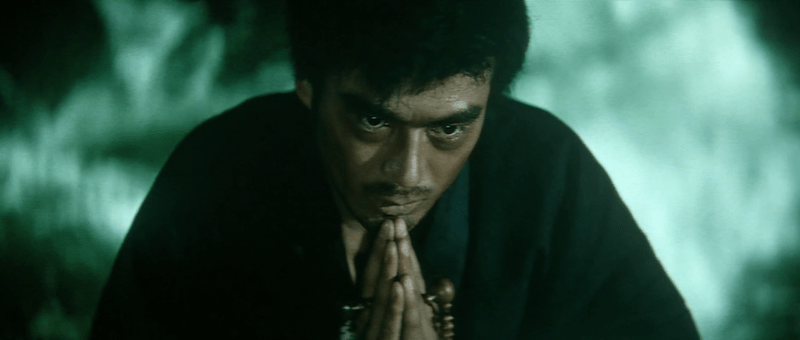
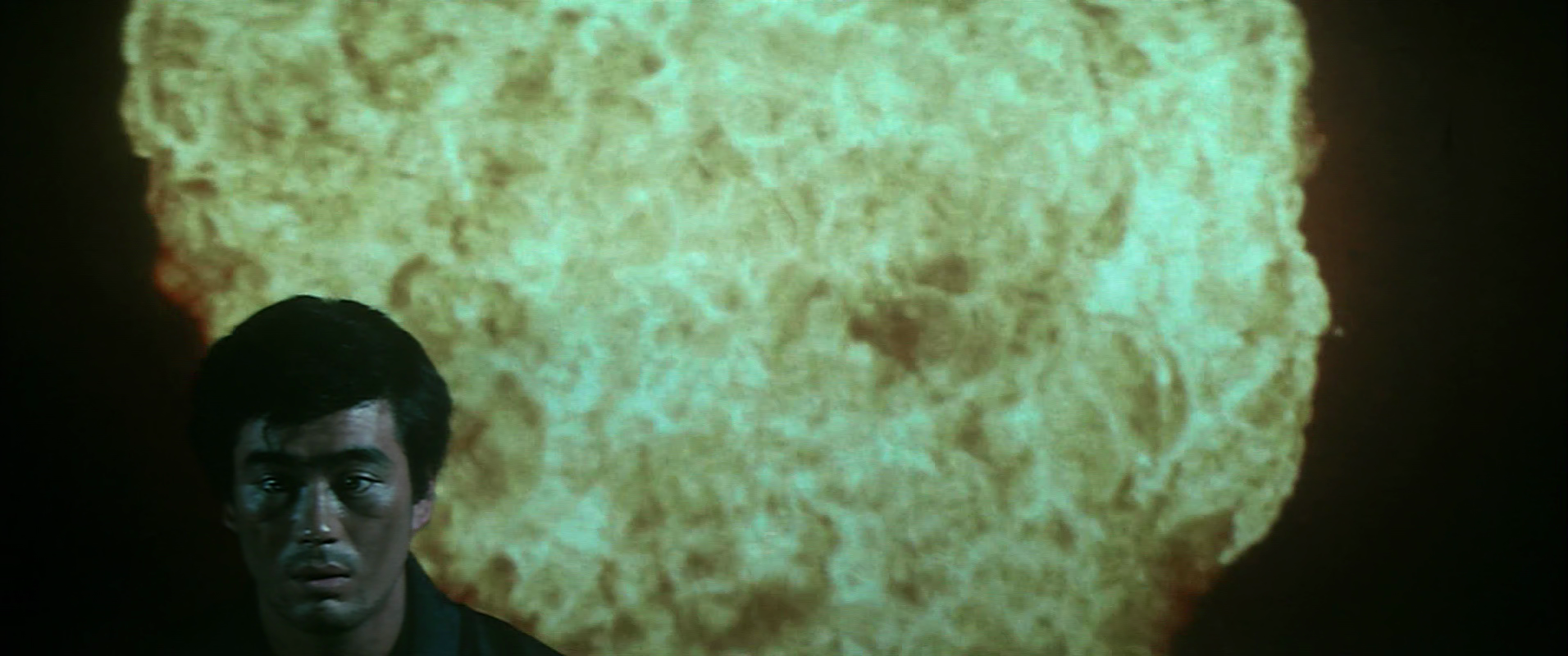
Memoir of Japanese Assassinations (日本暗殺秘録, Sadao Nakajima, 1969)

According to the narrator of Sadao Nakajima’s artistically daring Memoir of Japanese Assassins (日本暗殺秘録, Nihon ansatsu hiroku) the practice of assassination had got so out of hand in the early years of Meiji that the emperor was forced to institute a law banning it while accepting responsibility for the lawlessness his imperfect governance had produced. But by opening with the Sakurada Gate Indecent from 1860, the film seems to be asking what went wrong in Meiji and why the assassinations have still not stopped with the implication that more may be on their way in rather febrile political atmosphere of the late 1960s in the run up to the renewal of the Anpo security treaty with Asama Sanso still a few years away.

The answer to the question that it presents, is that oppression has still not ended in Japan and that most of these assassinations took place because people had enough of difficult social conditions those in power little did to address. However, the first few pre-20th century  assassinations which are presented in the form of short vignettes, are largely a product of the confusion of the bakumatsu era as reactionaries attempt to halt Japan’s increasing openness to the wider world and what they see as a loss of national identity and sovereignty. The implication is that this sense of ideological conflict is a direct cause of the nationalism that defined the first half of the 20th century. 

It’s not until we reach the early 1920s that the secondary cause of Japan’s dire economic situation rears its head as the right-wing nationalist leader of Righteousness Corps of the Divine Land (Bunta Sugawara), a society dedicated to workers’ rights, assassinates the head of a family-run conglomerate he accuses of feeding on the blood on the common man. From this incident we can see that it is not as easy to draw a line between left and right in terms of political ideology as it might be at other times or in other nations as otherwise nationalist forces share ideas that might lean more towards socialist ideals. Ikki Kita whose philosophy informed the February 26th Incident that ends the film described himself as socialist, but is also regarded by some as the architect of Japanese fascism. With the so-called “Showa Restoration”, he advocated for the elimination of private property and a doctrine of socialism from above in which the emperor would assist in the reorganisation of society. Which is to say, the clarification of the Meiji Restoration actually meant.

In any case, it’s easy to see the reasons that these ideas caught hold and that concepts such as “revolution” were a counter to the persistent hopelessness of the depression and the extreme poverty of Japanese society while the large conglomerates prospered through trading with the United States. The bulk of the film focuses on Onuma who assassinated Junnosuke Inoue in 1932 as part of an intended reign of terror known as the League of Blood instituted by the far right Nichizen Buddhism cult led by Nissho Inoue (Chiezo Kataoka),. Onuma was still alive at the time the film was made and apparently acted as a consultant. Played by a fresh-faced Shinichi Chiba, he’s depicted as an earnest young man who is driven into the ground by the increasingly capitalist mentality of the 1920s, a time of high unemployment and frequent labour disputes only exacerbated by the Great Depression. 

Though he had been a bright and attentive student, Onuma was forced to leave education because of his father’s early death and thereafter worked a series of causal jobs before leaving a position at a kimono dyers because of their callous treatment of another employee who was forced to embezzle money because his mother was ill and he was denied a loan by the boss who justifies his position by stating that he’s already given the man several advances on his salary. Onuma’s brother also resigned from his job to take responsibility for failing to spot someone else’s embezzlement, leading Onuma to conclude that being honest gets you nowhere in this morally corrupt society. This is rammed home for him at his next job at a cake baker’s where he becomes almost part of the family and draws closer to the maid, Takako (Junko Fuji). The boss intends to rapidly expand the business by building a bigger factory hoping to capitalise on the coronation of the new emperor. Staking everything on the factory, he takes out loans from loan sharks but fails to get a business permit from the police later remarking that he was naive thinking he could do business honestly not realising that the police expected a bribe.

Tuberculosis and the death of a girl who like him could not afford medical treatment further leave Onuma feeling resentful and hopeless leading to a suicide attempt after which he is born again in Nichiren Buddhism and becomes a servant to Nissho. It’s easy to see how Nichiren could offer an escape to young men like him who burn with rage and a desire to change society, though in essence it’s no different from the militarism that was growing in parallel being rooted in nationalist ideology and for the early part at least centred in the military. The May 15 Incident saw the military and members of the League of Blood assassinate the prime minister to enact the Showa Restoration and reorganise society. The revolution failed, but the 11 young officers who took part in received little punishment, furthering cause of the militarism, while directly contributing to the February 26th Incident which though it also achieved little further cemented the power of the military over the government. 

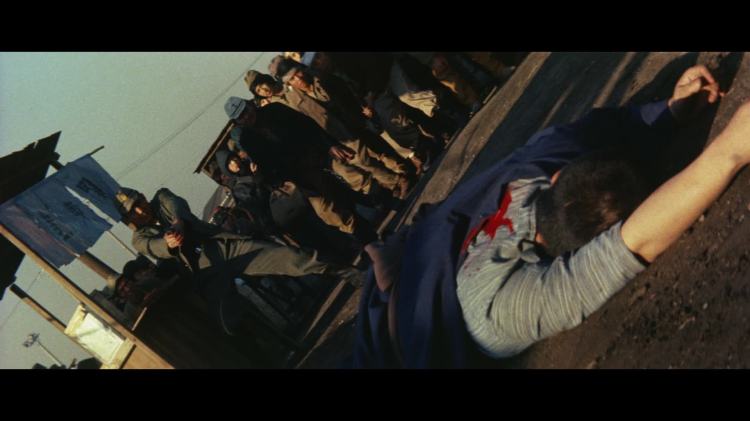
Though imperialism is subtly presented as another form of injustice as the nation spends money on warmongering while the people starve, the film straddles an awkward line in struggling to avoid glorifying the actions of the far right in painting Onuma and leader of the February 26th Incident Isobe (Koji Tsuruta) as dashing, idealistic heroes whose only wish was to save Japan and remake it in a way they believed to be better. This was pretty much the antithesis of what Nakajima intended, though it was picked up by some as a piece of right-wing propaganda. The film courted controversy both with Toei studio bosses and the government who ordered Nakajima to soften the excerpts from Isobe’s diary fearing they were too incendiary, though Nakajima had already shot the footage and was forced to find a compromise. Toei as a studio did rather lean towards the conservative and especially in its yakuza films which is perhaps unavoidable given that yakuza organisation did often have strongly nationalistic sensibilities. Accordingly, the film stars almost their entire roster of Toei’s yakuza and ninkyo eiga stars from Tomisaburo Wakayama to Ken Takakura and Koji Tsuruta along with Junko Fuji as as Onuma’s love interest who is eventually forced into sex work because of the economic conditions of the 1920s, and perhaps comes with some of that baggage. Its closing question, however, given the fact that all these assignations achieved almost nothing of what they were intended to, seems to be posited at the current society mired in the Anpo protests and the declining student movement to ask how else society might be changed and revolution enacted to create a fairer society for all through an ideology that could end this cycle of political violence.


Yakuza Graveyard (やくざの墓場 くちなしの花, Kinji Fukasaku, 1976)

“We don’t resort to violence. We observe the law.’ The hero of Kinji Fukasaku’s Yakuza Graveyard (やくざの墓場 くちなしの花, Yakuza no Hakaba: Kuchinashi no Hana) is berated by a superior officer for excessive use of force, but his criticism is in some senses ironic because it is the police force itself which becomes a symbol of the societal violence visited on those who can find no place to belong in the contemporary society. By this time the yakuza was already in decline and in the process of transforming itself into a corporatised entity while as a police chief explains increasing desperation has led to escalating gang tensions. 

Recently transferred maverick cop Kuroiwa (Tetsuya Watari) finds himself caught between two worlds in attempting to enforce the law through methods more familiar to yakuza. Soon after he’s had his gun taken away for exercising excessive force on a suspect he’d been independently tailing in the street on whom he’d found bullets designed to be used with a remodelled toy gun, Kuroiwa is pulled aside by another senior officer, Akama (Nobuo Kaneko) who takes him to a meeting with local yakuza boss Sugi (Takuya Fujioka). It seems obvious that Akama has cultivated a relationship with the Nishida gang which may not be strictly ethical for a law enforcement officer and hopes to bring Kuroiwa on board as a potential asset. They attempt to bribe him in return for information on the Yamashiro clan, the dominant organised crime association in the area, which has been hassling Nishida in an attempt to take over their territory. But Kuroiwa ironically tells them that they should “act like yakuza” and sort out their own problems rather than relying on the police before dramatically walking out much to to the consternation of everyone else present. 

Nevertheless, he eventually comes to sympathise with them as a symbol of the little guy increasingly crushed by corporate and authoritarian forces outside of their control. He finds out from a briefing that the police’s goal is the disbandment of the Nishida gang but when he asks why they aren’t going after the Yamashiro too he’s told to mind his own business and begins to realise that the police are in cahoots with organised crime. Whether they justify themselves that managing the Yamashiro to prevent a turf war is the best way to protect the public or are simply corrupt and in the pocket of big business, Kuroiwa can’t help but balk at the blatant hypocrisy of the law enforcement authorities. 

Later Kuroiwa reveals that he became a police officer after being bullied as a child in order to exert power over his life, or perhaps becoming an oppressor in order to avoid being oppressed. He was bullied because he had been born in Manchuria and even years later remains a displaced person at least on a psychological level. It’s this sense of displacement which allows him to bond with the Nishida gang’s accountant, Keiko (Meiko Kaji), whose father was Korean. Kuroiwa agrees to accompany Keiko to visit her husband (Kenji Imai) who is serving a lengthy prison term in order to tell him that the gang want to promote someone else to a position he viewed as his by right. The husband explodes in rage and uses a word some would regard as a slur to reference Keiko’s Korean heritage while she later attempts to walk into the sea feeling that there really is no place for her in the contemporary society. 

Just as she claims that she is neither Korean nor Japanese or much of anything at all, Kuroiwa is neither cop nor thug and similarly excluded from society at large. He ends up bonding with old school Nishida footsoldier Iwata (Tatsuo Umemiya), who is also ethnically Korean, for many of the same reasons and attempts to mount a doomed rebellion against their mutual oppression, but is hamstrung by his otherness which is only deepened when he’s taken prisoner by loan shark Teramitsu (Kei Sato) and given a mysterious truth drug developed by the nazis later becoming a user of heroin. Already marginalised, forced into crime by economic necessity and social prejudice, Iwata and Keiko like Kuroiwa himself struggle to escape their displacement while pushed still further out by systemic corruption and the amoral capitalism of an era of high prosperity. Shot with jitsuroku-esque realism and characteristically canted angles, Fukasaku injects a note of futility even within the hero’s tragic victory as he quite literally sticks two fingers up to the corrupted “brotherhood” that has already betrayed him.


Yakuza Graveyard is released on blu-ray on 16th May courtesy of Radiance Films. On disc extras include an in-depth appreciation of the film and the work of screenwriter Kazuo Kasahara from Blood of Wolves director Kazuya Shiraishi, and an informative video essay from Tom Mes on the collaborations of Meiko Kaji and Kinji Fukasaku. The limited edition also comes with a 32-page booklet featuring new writing by Miko Ko plus translations of a contemporary review and writing by Kasahara.

Original trailer (no subtitles)

Tokyo Bordello (吉原炎上, Hideo Gosha, 1987)

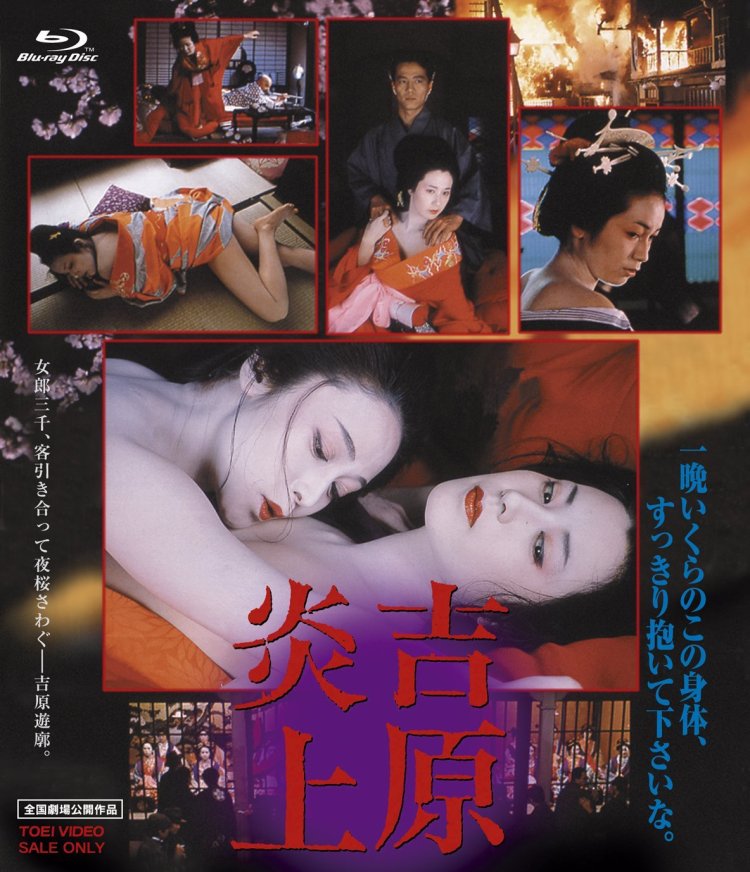
yoshiwara-enjoHideo Gosha maybe best known for the “manly way” movies of his early career in which angry young men fought for honour and justice, but mostly just to to survive. Late into his career, Gosha decided to change tack for a while with a series of female orientated films either remaining within the familiar gangster genre as in Yakuza Wives, or shifting into world of the red light district as in Tokyo Bordello (吉原炎上, Yoshiwara Enjo). Presumably an attempt to get past the unfamiliarity of the Yoshiwara name, the film’s English title is perhaps a little more obviously salacious than the original Japanese which translates as Yoshiwara Conflagration and directly relates to the real life fire of 1911 in which 300 people were killed and much of the area razed to the ground. Gosha himself grew up not far from the location of the Yoshiwara as it existed in the mid-20th century where it was still a largely lower class area filled with cardsharps, yakuza, and, yes, prostitution (legal in Japan until 1958, outlawed in during the US occupation). The Yoshiwara of the late Meiji era was not so different as the women imprisoned there suffered at the hands of men, exploited by a cruelly misogynistic social system and often driven mad by internalised rage at their continued lack of agency.
Opening with a voice over narration from Kyoko Kishida, the film introduces us to the heroine, 19 year old Hisano (Yuko Natori), as she is unwillingly sold to the red light district in payment for her father’s debts. After a strange orientation ceremony from the Yoshiwara police force where one “kindly” officer explains to her about the necessity of faking orgasms to save her stamina, Hisano is taken to the brothel which is now her home to begin her training. Some months later when Hisano is due to serve her first customer, she runs from him in sheer panic, leaping into a lake where a young Salvation Army campaigner, Furushima (Jinpachi Nezu), tries and fails to help her escape.

Taken back to the brothel and tied up in punishment, Hisano receives a lesson in pleasure from the current head geisha, Kiku (Rino Katase), after which she appears to settle into her work, getting promoted through various ranks until she too becomes one of the top geisha in the area. Sometime later, Furushima reappears as a wealthy young man. Regretting his inability to save her at the river and apparently having given up on his Salvation Army activities, Furushima becomes Hisano’s number one patron even though he refuses to sleep with her. Though they eventually fall in love, Hisano’s position as a geisha continues to present a barrier between the pair, forcing them apart for very different reasons.

Despite having spent a small fortune accurately recreating the main street of the Yoshiwara immediately prior to the 1911 fire, Gosha is not interested in romanticising the the pleasure quarters but depicts them as what they were – a hellish prison for enslaved women. As Hisano and Furushima later reflect, the Yoshiwara is indeed all built on lies – a place which claims to offer freedom, love, and pleasure but offers only the shadow of each of these things in an elaborate fake pageantry built on female suffering. Hisano, like many of the other women, was sold to pay a debt. Others found themselves sucked in by a continuous circle of abuse and exploitation, but none of them are free to leave until the debt, and any interest, is paid. Two of Hisako’s compatriots find other ways out of the Yoshiwara, one by her own hand, and another driven mad through illness is left alone to die like an animal coughing up blood surrounded by bright red futons in a storage cupboard.

As Kiku is quick to point out, the Yoshiwara is covered in cherry blossoms in spring but there is no place here for a tree which no longer flowers. The career of the courtesan is a short one and there are only two routes forward – become a madam or marry a wealthy client. Kiku’s plans don’t work out the way she originally envisioned, trapping her firmly within the Yoshiwara long after she had hoped to escape. Hisano is tempted by a marriage proposal from a man she truly loves but finds herself turning it down for complicated reasons. Worried that her lover does not see her as a woman, she is determined to take part in the upcoming geisha parade to force him to see her as everything she is, but her desires are never fully understood and she risks her future happiness in a futile gesture of defiance.

Defiance is the true theme of the film as each of the women fight with themselves and each other to reclaim their own freedom and individuality even whilst imprisoned and exploited by unassailable forces. Hisano, as Kiku constantly reminds her (in contrast to herself), never accepts that she is “just another whore” and therefore is able to first conquer and then escape the Yoshiwara even if it’s through a second choice compromise solution (albeit one which might bring her a degree of ordinary happiness in later life). Land of lies, the Yoshiwara promises the myth of unbridled pleasure to men who willingly make women suffer for just that purpose, further playing into Gosha’s ongoing themes of insecurity and self loathing lying at the heart of all physical or emotional violence. Though the ending voiceover is overly optimistic about the climactic fire ending centuries of female oppression as the Yoshiwara burns, Hisano, at least, may at last be free from its legacy of shame even whilst she watches the object of her desire destroyed by its very own flames.


Oiran parade scene (dialogue free)

The Yakuza Papers Vol. 2: Hiroshima Death Match (仁義なき戦い: 広島死闘篇, Kinji Fukasaku, 1973)

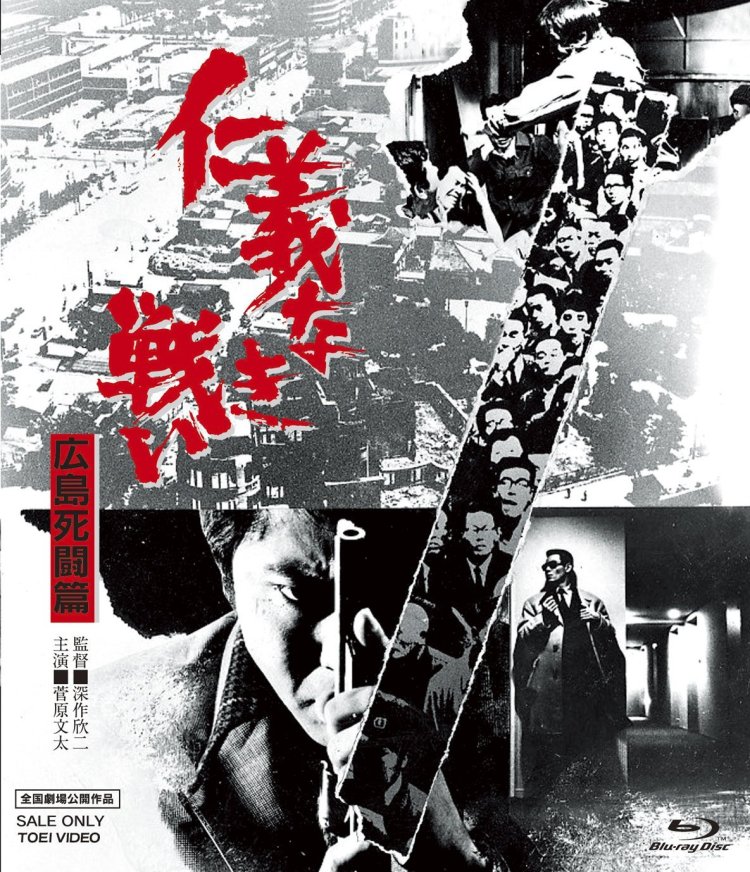
81ZkRgBFyyL._SL1378_If you thought the story was over when Hirono walked out on the funeral at the end of Battles Without Honour and Humanity think again – we’ve barely scraped the surface of the post-war Hiroshima criminal underworld chaos. The aptly named Hiroshima Death Match runs in parallel with the events of Battles Without Honour taking place in roughly the same time, 1950-1955, but features a new protagonist relegating Bunta Sugawara’s Hirono to the sidelines where he appears as a weary observer of the cruel yakuza world. This time our hero, Yamanaka, is younger – too young to have offered his life as a kamikaze in the war as he apparently wanted to, and is one of the thousands of young men who’ve found themselves alone and without futures thanks to both the after effects of World War II and the ongoing Korean War.
Hiroshima Death Match ties itself into Battles Without Honour and Humanity quite neatly when the protagonist, Shoji Yamanaka (Kinya Kitaoji), is sent to prison after taking a knife to a room full of guys who accused him of cheating in a gambling den. There he comes into contact with the first film’s hero, Hirono (Bunta Sugawara), who offers him some food whilst in solitary but then disappears for the vast bulk of the film. When he gets out, Shoji finds himself in trouble again when he can’t pay for his meal in a restaurant and offers to work off the bill. The waitress, Yasuko (Meiko Kaji), refuses and tells him to just forget about the money and leave when he’s done but Shoji is insulted by her “charity” and things kick off between him and a gang of yakuza also in the restaurant at the time. Yasuko turns out to be the widowed niece of a yakuza boss and after recovering in her care Shoji agrees to join the Muraoka gang to get revenge on the guys who beat him up.

Whereas Battles Without Honour and Humanity took as its protagonists the young men who’d returned from the war to a ruined and defeated country, Hiroshima Death Match focuses on the generation below who were too young to fight themselves but have still been marked by the after effects of the conflict. At the beginning of the film Shoji has nothing, he’s ashamed of cheating and gets upset when caught which only fuels his youthful and violent anger. He doesn’t seem to have any family to help him or honest work to go to and so, of course, he ends up a yakuza. Once again, the yakuza take the place of a traditional family offering both a place to belong and a degree of emotional and financial support – for a price.

When Shoji inevitably falls in love with Muraoka’s widowed niece, he discovers his surrogate father’s love is not quite unconditional. Yasuko has a young daughter and was married to a man who died a kamikaze war hero. Muraoka does not want her to remarry lest she shame her husband’s memory unless he keeps it in the family by marrying her off against her will to her huband’s brother. Shoji’s affair with Yasuko continues to cause a rift with Muraoka and he’s torn between a desire for a peaceful future with the woman he loves and loyalty to his gang boss to whom he owes so much. Muraoka’s own morals are shown to be far from the traditional yakuza ideals and he’s not above using Shoji’s strained loyalties to his own advantage eventually with tragic consequences.

Like Battles Without Honour and Humanity, Hiroshima Death Match is shot in the same quasi-documentary style with a weary sounding narrative voice over and frequent freeze frame captions identifying the characters along with their gangs and positions as well as their dates of demise at the appropriate time. The ruined Atomic Bomb Dome (now the Hiroshima Peace Memorial) continues to loom large over the proceedings as we’re reminded at the end that this isn’t the only blood that’s been shed here. Even more so than with Battles, Fukasaku rams home the senselessness and futility of violence. The film ends with Hirono attending another funeral (though this time in a black suit and melancholic air) where the bosses reap in consolation money and gamble at the wake. He gives his old bosses a sideways look as they laugh and joke while a young man who they all now account as some kind of legendary yakuza hero lies dead for no reason at all. What does this sort of life amount to in the end? The only reward for a life of violence is a lonely grave.


Hiroshima Death Match is available on blu-ray in the UK as part of Arrow Video’s Battles Without Honour and Humanity: The Complete Collection box set.


The Yakuza Papers Vol. 1: Battles Without Honour and Humanity (仁義なき戦い, Kinji Fukasaku, 1973)

Snapshot-2015-12-07 at 11_06_36 PM-930280086When it comes to the history of the yakuza movie, there are few titles as important or as influential both in Japan and the wider world than Kinji Fukasaku’s Battles Without Honour and Humanity (仁義なき戦い, Jingi Naki Tatakai). The first in what would become a series of similarly themed movies later known as The Yakuza Papers, Battles without Honour is a radical rebooting of the Japanese gangster movie. The English title is, infact, a literal translation of the Japanese which accounts for the slightly unnatural “and” rather than “or” where the “honour and humanity” are collected in a single Japanese word, “jingi”. Jingi is the ancient moral code by which old-style yakuza had abided and up to now the big studio gangster pictures had all depicted their yakuza as being honourable criminals. However, in Fukasaku’s reimagining of the gangster world this adherence to any kind of conventional morality was yet another casualty of Japan’s wartime defeat.

The story begins with a black and white image of a mushroom cloud with the film’s bright red title card and now famous theme playing over the top. This is Hiroshima in 1946. Things are pretty desperate, the black market is rife and there are US troops everywhere. Shozo Hirono (Bunta Sugawara) has just returned from the war (in fact he’s still in his uniform). He gets himself into trouble when he intervenes as an American soldier attempts to rape a Japanese woman in broad daylight in the middle of a crowded marketplace. He manages to cause enough of a commotion for the woman to escape but the Japanese cops just tell him not to mess with the GIs. Things don’t get much better as one of Hirono’s friends is assaulted by a yakuza. They get some rival yakuza to help them get revenge and in the commotion Hirono accidentally kills someone and is sent to prison for 12 years. In prison he meets another yakuza who wants to escape by pretending to commit harakiri and promises to get his yakuza buddies to bail Hirono out if he helps. From this point on Hirono has become embroiled in the new and dangerous world of the Hiroshima criminal underground.

Battles Without Honour and Humanity has a famously complicated plot entered around the various power shifts and machinations between different groups of yakuza immediately after the end of World War II. The film begins in 1946 and ends in 1956 though many of its cast of tough guys don’t last anywhere near as long. The picture Fukasaku paints of Japan immediately after the war is a bleak one. Even if some of these guys are happy to have survived and finally reached home, they’ve seen and done terrible things. Not only that, they’ve been defeated and now they’re surrounded by foreign troops everywhere who can pretty much do what they want when they want. They just don’t have a lot of options – if they don’t have connections to help them find work when there’s not enough to go around then it isn’t surprising if they eventually fall into to crime. Also, having spent time in the military, the yakuza brotherhood provides a similar kind of camaraderie and surrogate family that you might also find in an army corps.

It all gets ugly quite fast. Largely the yakuza are making their money profiting from the political instability, resenting the US occupation yet reaching deals with them to support their efforts in the Korean war and then selling new and untested drugs at home (with less than brilliant results). Betrayals, executions, assassinations in previously safe places like a bath house or the barbers – these are a long way from the supposedly honourable gangsters of old. One minute Hirono is offering to cut off his finger as a traditional sign of atonement (though no one knows exactly what you’re supposed to do in this situation and it all ends up seeming a little silly) and taking the rap for everyone else’s mistakes, but his friend faked harakiri to get out of jail and everyone is double crossing everyone else whichever way you look.

The whole thing is filmed in an almost documentary style with captions identifying the various characters and giving the exact time of their demise (if necessary) as well as a voice over giving background information about the historical period. The film is inspired by real life yakuza memoirs and there are parts which feel quite like a bunch of old guys sitting in a drinking establishment and recounting some of their exploits.

This new postwar world of heartless gangsters is a tough one and almost devoid of the old honour-bound nobility, however somehow Fukasaku has managed to make it all look very cool at the same time as being totally unappealing. You wouldn’t want to live this way and you definitely don’t want to get involved with any of these guys but somehow their self determined way of life becomes something to be admired. That said, there’s a sadness too – that even in the criminal underworld there used to be something noble that’s been obliterated by the intense trauma of the war. You can rebuild, you can move on from the destruction left by the war’s wake but there’s no going back to those days of “honour and humanity” – if they ever existed, they’re gone forever now.


Battles without Honour and Humanity is available in blu-ray in the UK as part of Arrow Video’s Battles Without Honour and Humanity: The Complete Collection box set.