My Wonderful Yellow Car (吹けよ春風, Senkichi Taniguchi, 1953)

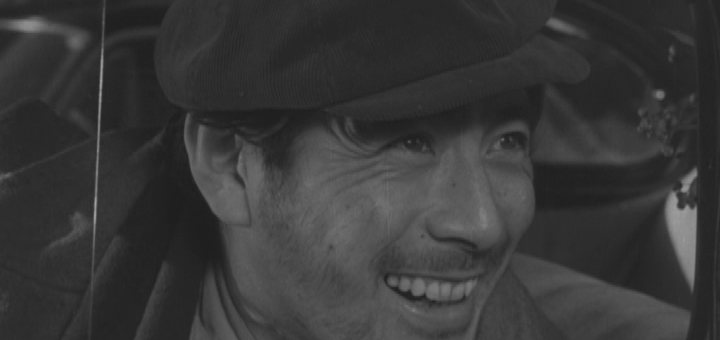
A kind-hearted taxi driver becomes our guide to the post-war society in a cheerful omnibus movie co-scripted by Akira Kurosawa and directed by Senkichi Taniguchi, My Wonderful Yellow Car (吹けよ春風, Fukeyo, Haru Kaze). Inspired by a Reader’s Digest column titled “human nature as seen in the rearview mirror”, the film follows cheerful cabbie Matsumura (Toshiro Mifune) as he drives around Tokyo in 1953 picking up various fares and sometimes adding commentary or trying to help with whatever kind of problem seems to be bothering them.

Then again, he stays well out of the first fare’s business as a young couple have obviously had some kind of falling out. Bursting into tears, the girl (Mariko Okada) announces that she wants to postpone the wedding and maybe even rethink this whole thing, while the boy reiterates with slight irritation that he’s said he’s sorry with the implication that that should be the end of it though we have no idea what (if anything) he’s actually done. In any case, they eventually patch things up over some canoodling in the back seat and ask to be dropped off so they can get something to eat. In some ways, the young couple represent a more hopeful vision of post-war youth who have no apparent worries besides their tiff and are financially comfortably enough not only to be getting married but can afford to travel by taxi and pay for a meal on the same occasion. 

Their situation is later contrasted with that of an older couple who’ve moved from Osaka to Tokyo in their old age and have bought a box of live lobsters to celebrate their silver wedding anniversary but as Matsumura notes though they appear to be quite well off they also seem somehow sad. That turns out to be because they lost their only son the previous summer and have moved into his old apartment. The old lady also cries in the back seat, but for a completely different reason. As they’ve only just moved here, they don’t have friends or anything to do and are completely lost in the wake of their son’s death. Matsumura’s kindness is demonstrated when he borrows three flowers from a bouquet delivered to a girl at the petrol station and presents them as an anniversary gift. The couple are so touched they invite him to enjoy their anniversary dinner with them and by the end of it have made the decision that they should go back to Osaka and restart their lives by re-opening their old business.

Throughout all this, Matsumura is very conscious of the meter. Every second he spent in the old couple’s apartment cost him money, but as he’s fond of saying you can’t always think of things like that. Even so, he reminds himself he has a wife and child so should be mindful of the clock but still turns down a fare to go back to the station and check on a young girl he’s pretty sure is trying to run away from home. A weird guy was sniffing around her and was in fact just about to lead her off when Matsumura gets back and announces he’s come to pick her up. Matsumura spends the rest of the ride trying to convince her to go home, repeatedly reminding her that most of the “panpans”, or streetwalking sex workers catering to US servicemen, were also once runaway girls. To more modern eyes we might wonder if sending her home is what’s best without knowing the reasons she wanted to leave. He goes so far as to buy her ramen which costs him more money on top of the lost fare which doesn’t collect from her either when he, a little less responsibly, abandons her when she refuses to tell him where she lives. Thankfully, it all seems to work out. The girl made a sensible decision to go home after all and is later seen happily doing her Christmas shopping with her mother who also thanks him for looking out for her.

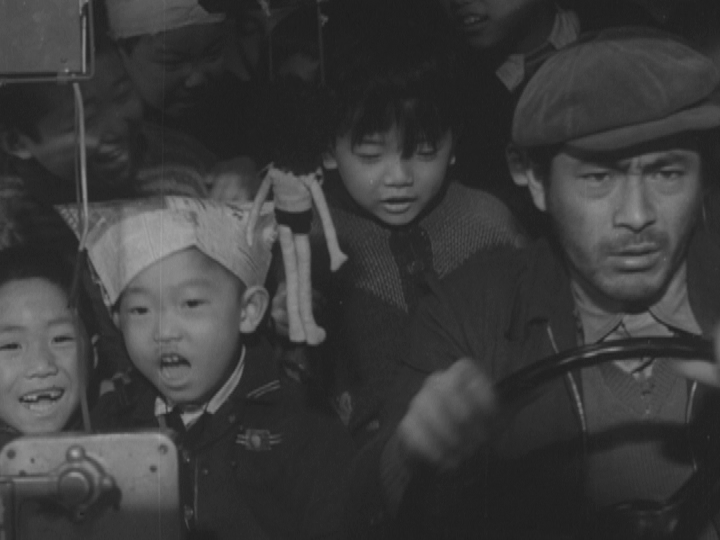
Perhaps these kinds of altruistic acts of kindness explain why Matsumura’s own clothes are quite ragged with a hole in his jumper and a tear to the shoulder of his jacket. He’s driving the cab in straw sandals which apart from anything else is probably quite cold in the winter. He spends another afternoon giving a free ride to some children, about 15 of them, who’ve crowdfunded 100 yen because they’ve never been in a car before and want to go as far it’ll take them having no idea that 100 yen is actually the initial charge so you can’t go anywhere on it all. Of course, Matsumura ends up taking them a bit further, and then realises he’ll have to take them back to where they were because they won’t have any other way of getting there or of knowing where they are now.

On the other hand, sometimes he ends up with nuisance fares such as two drunk guys who keep singing their university song. One of them even climbs out of the window and up onto the roof, causing Matsumura to assume he’s fallen off somewhere and he’ll have to go back and look for him to make sure he’s not hurt only to find him burbling in the footwell. He also ends up getting hijacked by a crook with a gun on his way back from Yokohama but getting a telling off from the police rather than a thank you for catching him after unwisely taking hold of the gun himself and messing up all the fingerprints. 

One might think the time he had a famous actress in the back of his cab who even sang along with the jingle he’d written for the cheerful yellow vehicle might make up for all that, but he says the story that best exemplifies why he loves driving a taxi is that of a middle-aged couple he picked up at the harbour shortly after a boat had docked repatriating people from China. Even in 1953, some had not yet returned after becoming trapped by the Chinese Civil War and eventual Communist victory. The man is dressed in military uniform and says he’s just been demobbed when Matsumura asks him, trying to lighten the mood while there’s obviously some degree of tension between the man and his wife. But as we gradually come to understand, it’s all just a ruse and he has in fact been in prison in Japan for the last seven years for an unspecified crime.

His wife asks Matsumura to drive around the city and attempts to show him how much things have recovered, suggesting that they can now put the past behind them and start over. But the man remains sullen and grumpy. He’s afraid to go home, afraid to face the neighbours worrying if they know what he did and that he’s been in prison. But most of all he’s afraid to face his children, the youngest of which he’s never met. The kids have been teaching themselves to say “Welcome home, Daddy,” in Mandarin believing he’s been in China all this time which the wife has to explain before they get there. The man tells his wife he understands if she doesn’t want him back, but she assures him that the children are excited as is she to start their new life together. Nevertheless, though they’ve been eagerly practicing, the older two children simply freeze when confronted by this anxious stranger who turns around to leave again feeling as if he doesn’t have the right to come back here after all only for the youngest one to suddenly pipe up with the phrase note perfect. It’s this kind of scene, getting people to where they need to be physically and emotionally, that seems to make Matsumura’s job worthwhile. In essence, he’s ferrying people towards the cheerful post-war future his cute yellow cab represents while driving round the rapidly changing city wondering who it is that’s going to end up in the rearview mirror today.


Title song (no subtitles)
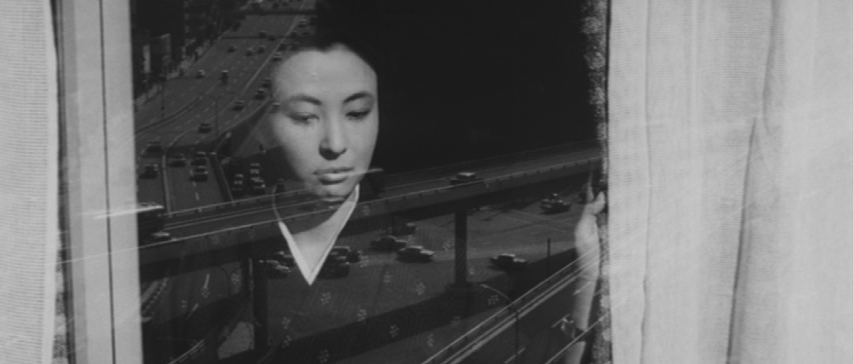
Beast Alley (けものみち, Eizo Sugawa, 1965)

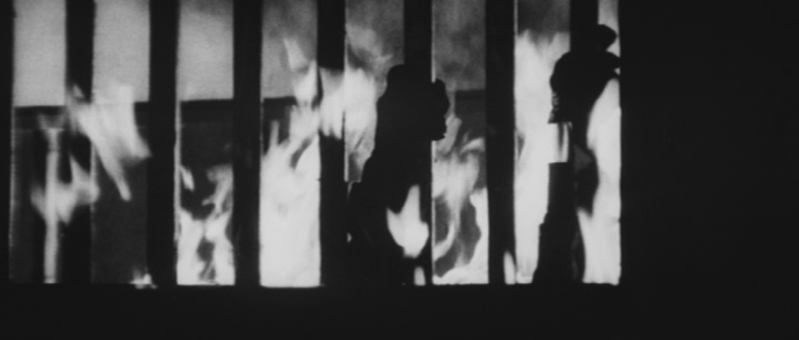
In the opening title sequence of Eizo Sugawa’s Beast Alley (けものみち, Kemonomichi), a thick blob of inky blackness gradually expands over an aerial view of the city until it obscures it entirely. The title card which then appears is written in plain white, but will reappear at the film’s conclusion this time ashen as if it too had been singed by the deeply ironic flames with which the film ends. Based on a novel Seicho Matsumoto and scripted by The Beast Shall Die’s Yoshio Shirasaka, the film similarly takes an incredibly cynical view of the modern post-war society in which it is revealed the militarists are still basically in charge and presiding over a deeply corrupt social order. 

The big bad, Kito (Eitaro Ozawa), says as much when he states the need for reforming the nation’s “rotten political system” by which he means post-war democracy. Kito made his made his money doing deeply dodgy things in Manchuria in addition to running an exploitative coal mine in Japan. Now mainly bedridden, he basically runs the country as a far-right political fixer working in tandem with big business and the yakuza who have traditionally been big supporters of conservative and nationalist forces. Early on we see one of his underlings negotiating with politicians to ensure that Taiyo Roads will be hired be hired for a large scale construction project planning to put highways all the way through Tokyo. As we later discover, he’s prepared to go to great lengths in order to achieve his goal, going so far as to have a sex worker murdered to implicate the uncooperative CEO of a rival construction film into resigning by threatening to frame him for the crime so they can install their stooge in his position. 

It’s into this world that everywoman Tamiko (Junko Ikeuchi) is drawn while working as a hotel maid at a traditional Japanese inn. Trapped in a bad marriage to a man who is also bedridden yet still attempts to rape her when she returns home to find him in bed with the housekeeper, Tamiko longs for escape and is therefore ripe for the picking when approached by Kotaki (Ryo Ikebe), the manager of an upscale Western hotel, to join him in an unspecified enterprise which will apparently make her very rich. The only catch is that she will have to “get rid” of her “dependent”, which she probably wanted to do anyway, by burning down her house with him inside it. Once she’s done this, there is no turning back for her even if she had not developed complicated feelings for Kotaki who is both her salvation and damnation. 

Tamiko’s husband had failed to give her the comfortable life that he had promised, something which she thinks Kotaki can deliver even if it requires her to become the plaything of Kito whom does she actually seem to like even if aware of the precarity of her position and still in thrall to Kotaki. Leaving the hotel so abruptly was however a strategic error as it arouses the suspicious of (originally) earnest cop Hisatsune (Keiju Kobayashi) who quickly realises that Tamiko set the fire to kill her husband. Though he seemed to be motivated by justice, Hisatsune too is soon corrupted explaining to Tamiko that he has become cynical and jaded. Years of police work have shown him that true criminals know how to break the law and get away with it so he can’t do anything about them, but “good” people, like he implies Tamiko, are pushed into crime by desperation and are easily caught. Tamiko wields her sexuality against him by agreeing to a tryst, though when it doesn’t go to plan he tries blackmail and then rape before she, ironically, manages to escape from his bungled crime. 

Hisatsune’s corruption is gradual and self serving. He starts with suspicion, tailing Tamiko in the interests of justice but also because he desires her, before stumbling on the conspiracy, putting the pieces together, attempting to use them for his own gain and trying to blow a whistle mostly out of resentment. Kito’s reach is all encompassing. Hisatsune is warned off investigating certain aspects of the crime by his senior officers and is then fired on Kito’s instructions for fiddling his expenses after harassing Tamiko. He tries to give his findings to his boss but it goes nowhere and then tries the press but is given the brush off, the editor his reporter friend refers him to gently implying he’s just a crank with an axe to grind. Of course, it turns out that the reporter is already in league with dodgy lawyer Hatano (Yunosuke Ito) who is Kito’s right-hand man. 

The connections between the three men, Kotaki who was once a communist, Hatano, and Kito go back to Manchuria and the corruptions of militarist era which it becomes clear has never really ended. Kito has only one rival and it’s another faction of the conservative ruling party who are probably just waiting for him die. Attempts are made on his life and they don’t go well for those who make them. Even if Hatano hoped to simply inherit an empire he, as he points out, put in much of the work to build he is sorely mistaken while Tamiko may intellectually understand that Kito’s death would place her in a precarious position but carries on regardless. “You never know who will betray you in this world” Kotaki laments, echoing Kito’s later claim that his Buddhist statues are the only ones will never betray him even as sleeps next to a statue of Aizen Myo whom he ironically claims protects mankind from their lust and desire. 

It could be said that desire is Tamiko’s undoing, but as Hisatsune had suggested perhaps you couldn’t blame her for longing to be free of the bedridden husband who had not delivered what he promised her. As she said, she was doing what could to survive even if you’d think she’d know putting on a ring taken from the finger of a murdered woman is akin sealing your own fate. Sugawa shoots with a noirish sense of dread, tracking Tamiko with her coat drawn up around her face as she tries to leave the scene of her crime, and makes the most of his fiery imagery before ending on a note of cynical laughter amid the inescapable hell the of post-war society. 


Original trailer (English subtitles)

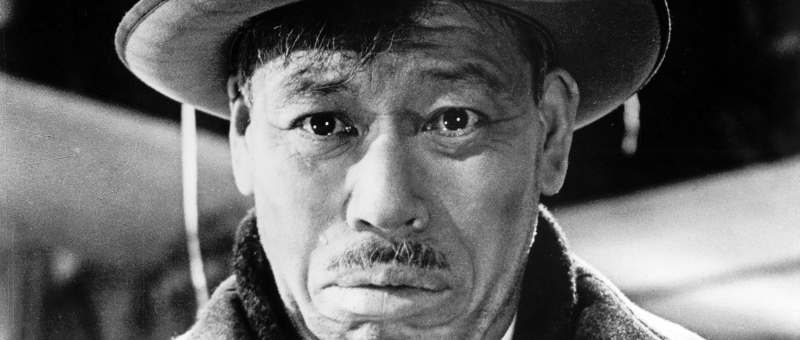
Ikiru (生きる, Akira Kurosawa, 1952)

The Japanese economy may have embarked on a path towards recovery thanks to the stimulus of the Korean War, but in the early 1950s many might have thought it too soon to ask if survival in itself was enough yet this is exactly what disillusioned civil servant Kenji Watanabe finds himself asking after receiving the devastating news that he has advanced stomach cancer and year at most to live. “To live” is apt translation of Akira Kurosawa’s intensely moving existential melodrama, Ikiru (生きる), which tackles the compromises of the salaryman dream head on along with those of the contradictions of the sometimes dehumanising post-war society. 

As the opening voice over reveals to to us, Watanabe (Takashi Shimura) is man who died long ago or perhaps has never truly been alive. In some senses, he is nothing more than an embodiment of the seal he uses to stamp documents day in day out, a mere piston in an ever turning machine of relentless bureaucracy. A young woman, Miss Odagiri (Miki Odagiri), working in the Public Affairs department loudly reads out a joke someone has written about their boss, Watanabe, who has taken not a single day’s holiday in 30 years suggesting that it’s less that he fears city hall will grind to a halt without him than they’ll suddenly figure out city hall has no need of him at all. The irony is city hall does indeed grind to a halt in Watanabe’s absence as he, unthinkably, fails to turn up for work for days on end as the papers pile ever higher on his desk. “Nothing moves here without his seal” one of the workers admits, bewildered by this sudden break with protocol while salivating over its implications in the possibility that Watanabe’s chair may soon be empty. 

Yet Watanabe’s crisis is that he’s realised he’s wasted his life on a pointless bureaucratic career that’s done little more than keep a roof over his head. Even the roof is a fairly modest one and it’s clear that his grown up son Mitsuo (Nobuo Kaneko) considers him to be a stingy old miser, unable to understand why he’s never spent so much as a penny on himself and lives in a kind of self-imposed austerity. Perhaps to Watanabe this is what constitutes properness. He’s done everything he was supposed to do, got a steady job at city hall and eventually became the head of department, but now he feels foolish and lonely. Mitsuo and his wife seem to resent him and talk openly about their plans to use their inheritance, along with Watanabe’s retirement bonus, for a downpayment on a “modern” home the polar opposite of the pre-war townhouse where the family continue to live. 

Mitsuo and Kazue (Kyoko Seki) are perhaps emblems of the increasingly empty consumerism of the post-war era, emotionally disconnected from Watanabe and seeking only the flashy and new. Miss Odagiri, the young woman from work, immediately says that she’d love to live in a home like Watanabe’s rather than the crowded multiple occupancy flat she currently inhabits with her family. Cheerful and outgoing, Odagiri is on the other hand a symbol of a new generation that wants something more out of life than simple material comfort and might even be willing to trade it for a small amount of happiness. Having worked at city hall for all of 18 months, she decides that she just can’t take it anymore and is quitting to get a job in a factory making toy rabbits that she says allow her to feel as if she’s making friends with all the babies in Japan. 

To that extent, Watanabe is himself also a baby craving Odagiri’s company admitting that he envies her youth and vitality in realising he squandered his own and will never get it back. How uncomfortable it must be for her, their final meeting in a restaurant sandwiched between a loving couple and teenage girl’s birthday party as Watanabe, gaunt and shrunken, claws at the air and begs her to help him live. Yet even within the grotesquery the tone is ironic, the strains of “Happy Birthday” accompanying Watanabe down the stairs as a the high school climbs up to meet her friends signalling his (re)birth as a man with purpose and determination. Just as Odagiri had found meaning in the rabbit, Watanabe finds it deciding to get a playground built over a post-war swamp in the slums filled with raw sewage and mosquitos that left the local children ill. 

Yet children’s parks aren’t particularly profitable which is presumably why the petition to build one had been kicked all round city hall in the infernal wheel of bureaucracy in which Watanabe too is trapped. “You call this democracy?” one of the women bringing the petition asks, taking the clerk to task complaining that all they do is fob them off insisting it’s someone else’s responsibility to help while determined only to guard their own turf. “You’re not supposed to do anything at city hall” someone ironically adds, “the best way to protect your place in this world is to do nothing at all”. Watanabe did nothing at all for 30 years and it got him nowhere, his dedication to his job disrupting his relationship with his son though Watanabe is ironically one of the most emotional men and engaged fathers seen on screen in the post-war era. 

After his death, in the park he helped build for which the deputy mayor has taken credit, his colleagues put him on trial at the wake trying to work out why he did it and whether or not he even knew he was dying seeing as he told no one close him not even the son whom he felt he could no longer trust. They deny his role while both praising and condemning his passion as somehow improper, disrupting the dispassionate rhythms of the bureaucratic machine with human emotion. It was only coincidence, they say. The deputy mayor wanted an election and the yakuza wanted to turn the swamp into a red light district. “Did he think he could just build a park?” someone adds, bemused by his effrontery as a man from Public Affairs straying into the Parks Department’s territory. You have to protect your turf after all. Finally moved by Watanabe’s last ditch bid to make his life mean something, to feel alive and know he has lived, the the drunken salarymen, all but one who retreats to look at Watanabe’s photo above the altar, swear to follow his example. 

But of course the bureaucratic wheel keeps turning, another dangerous sewage problem diverted to another department continuing the literal pollution of the capitalistic post-war society. A kind of ghost story, Kurosawa lights Shimura from below, shadows cast across his gaunt face even by his “rakish” new hat while his huge eyes have a somehow haunted, grotesque quality filled with hungry desperation. Yet it’s to childhood that Watanabe eventually returns, “perfectly happy” sitting on a swing singing a song from his youth about the price age while surrounded by snow and at last painfully, absurdly alive. 


Ikiru screens at the BFI Southbank, London on 4th & 15th February 2023 as part of the Kurosawa season.

Original trailer (English subtitles)

Until We Meet Again (また逢う日まで, Tadashi Imai, 1950)

Til we meet again poster 1Despite later becoming a member of the Communist Party, Tadashi Imai had spent the war years making propaganda pictures for the militarist regime. He later described his role in the propagation of Japanese imperialism as “the worst mistake of my life”, and thereafter committed himself to socially conscious filmmaking. Imai was later identified most closely with a style that was the anthesis of many his contemporaries branded “realism without tears”. Nevertheless, in 1950 he found himself making a full on romantic melodrama with anti-war themes. Until We Meet Again (また逢う日まで, Mata Au Hi Made) was, unofficially, an adaptation of Romain Rolland’s 1920 novel Pierre et Luce in which war conspires against the pure hearted love between two innocent young people.

Relocated to the Tokyo of 1943, Until We Meet Again begins at its conclusion with anxious student Saburo (Eiji Okada) pacing the floor, prevented from meeting his one true love, Keiko (Yoshiko Kuga), because his sister-in-law has fallen dangerously ill. Having just received notice that his draft date has been moved up and he’s expected to report for duty that very night, he fears he may never see her again whereupon he flashes back to their early courtship, all adolescent innocence and filled with the pure joy of falling in love for the first time.

Yet, as much as the war is the destructive force which will always stand between them, it’s also the one which brings them together. Saburo makes nervous eye contact with a pretty girl sheltering in a subway during an air raid. They are both afraid, and he chivalrously comforts and shields her with his body. Most particularly in the Japan of 1943, such bodily contact with a stranger of the opposite sex would be considered extremely inappropriate. There would be no other opportunity to enter this mild kind of physical intimacy save for the external pressures of life in war. Saburo doesn’t yet know the name of the woman in the subway, but can seemingly think of little else, seeing her everywhere he goes and looking for her in every face he sees. When they finally “meet”, they both agree that they are already acquainted and the intimacy between them quickly deepens through unexpected and perhaps transgressive physicality – a hand taken and placed inside a jacket to fight the cold, an embrace taken to guard against one explosion but leading to another. This innocent diffidence eventually leads to the film’s most famous scene in which Saburo, lamenting he must leave Keiko’s home, returns briefly to look at her in the icy window through which they share a chaste kiss.

Saburo, a wealthy young man too sensitive for the times in which lives, is ill-equipped to understand the difficulties of Keiko’s life. A closeup on her ragged shoes and her hard-nosed practicality make plain her penury and her determination to escape it. If he allowed himself to dream seriously of a life with her after the war, he might have to consider the words of his hardline brother, once sensitive like him but now fully committed to the militarist cause, who reminds him that an idle romance may be irresponsible considering that it will only cause them both, and more particularly her, pain when he must leave perhaps never to return. Saburo knows his brother might be right, wrestling with his love for Keiko while she professes that she would rather be with him no matter what pain might come.

Saburo’s friends tell him that “love is taboo”, and his brother something similar when he berates him for wasting his time hanging around with girls rather than preparing for the military. The enemy is less “the war” than it is the persistent austerity of militarism which crushes individuality and emotion to make love itself an act of treason. Yet it’s the very presence of the looming threat of war that makes their race towards romance possible. Saburo will be shipping out. Everything is fraught and desperate. There may not be another time and so the only time is now. It’s no coincidence that each incremental step in the couple’s relationship is preceded by an explosion, or that alarms are constantly ringing, while clocks tick ominously counting down their time.

Having been seriously injured in a freak accident despite wielding his privilege to serve in Japan and not on the front line, Saburo’s brother reconsiders and tells him that he is leaving his share of life’s happiness to him and so he has a duty to be doubly happy. Keiko too just wants her little “slice of happiness”, but it’s something this world has seen fit to deny them. The couple daydream about furnishing a house filled with children, but it’s a fantasy that will never materialise because theirs are the unrealised hopes of the youth of Japan cruelly denied their rightful futures because of a foolish war waged by their fathers and their grandfathers. The poignant final scenes suggest the older generation too will collapse under the weight of the tragedy they provoked, but sympathy remains with men like Saburo who went to war unwillingly because they had no other choice, unable to protect the things they loved from the chaos they left behind.


Invisible Man (透明人間, Motoyoshi Oda, 1954)

invisible man 1954 posterThe Invisible Man is a frightening presence precisely because he isn’t there. The living manifestation of the fear of the unknown, he stalks and spies, lurking in our imaginations instilling terror of evil deeds we are powerless to stop. Daiei made Japan’s first Invisible Man movie back in 1949 – a fun crime romp with the underlying message that scientific research is important but not as important as ensuring knowledge is placed in the right hands. Toho brought Eiji Tsuburaya back for another go at the same material in 1954 as part of their burgeoning tokusaku industry fathered by Godzilla. The 1954 Invisible Man (透明人間, Toumei Ningen), directed by Motoyoshi Oda, is once again a criticism of Japan’s wartime past but also perhaps of its future. This Invisible Man is an invisible hero but one whose heroism is only recognised once the mask is removed.
Opening in grand style, the film gets off to a mysterious start when a speeding car hits “something” in the road. The “something” turns out to be a previously invisible man whose appearance is returned to him as blood leaks out from under the now stopped car. In his pocket, the man has a suicide note explaining that living life invisible is just too depressing and he can’t go on. Seeing as the note is addressed to a “friend” who is also apparently an Invisible Man that means there are more out there. Despite there being no real threat involved in any of this, the newscasters are alarmed and the public frightened.

This is quite useful for some – a shady gang quickly starts putting on Invisible Man suits including wrapping their heads in bandages just like in the movies, and robbing banks. Admittedly this makes no practical sense but adds to the ongoing fear of an “invisible” threat. An intrepid reporter, Komatsu (Yoshio Tsuchiya), links the crimes to a nightclub where the head of the gang is also trying to pressure the headline star, Michiyo (Miki Sanjo), into a career as a drug mule. Besides violence, their leverage is the little girl who lives across from Michiyo and is blind – the money they would be paying her could also be used to pay for the girl’s eye surgery. Mariko is waiting patiently for her grandfather to make the money, unaware that he has also fallen under the spell of the criminal gang.

The real “Invisible Man” is doing a good job of hiding in plain sight by proudly standing out in a traditional clown outfit complete with makeup and a fluffy nose. Nanjo (Seizaburo Kawazu) works as a promoter for the club and is also good friends with little Mariko who is unable to see him either with or without his clown suit. Unlike other Invisible Men, Nanjo is good and kind – the curse of his condition has not ruined soul.

He is, however, afraid of being exposed. Aside from social ostracism (perhaps someone who wears a clown suit 24/7 isn’t particularly bothered about that), Nanjo fears what his government would do to him if they discovered he was still alive. Like his friend who later committed suicide, Nanjo was a member of an experimental army squad recruited towards the end of the war as Japan sought to create the ultimate warriors to turn the tide in the battle against the Americans. The Invisible Men were born but the war lost, and it was assumed that they had all fallen. Nanjo, surviving, has been abandoned by the land that he fought for. His existence is a secret, an embarrassing relic of Japan’s attempt at scientific warfare, and something which no one wants to deal with. Nando’s friend could no longer cope with his non-existence. Unable to return home, unable to work, unable to marry, there was no “visible” future which presented itself to him.

In this sense, Nanjo represents a point of view many might have identified with in 1954. These men fought and risked their lives for a god they now say is only a man, to come home to a land ruled by the “enemy” in which they can neither criticise the occupation or the former authorities. These men may well feel “invisible” in the new post-war order in which the younger generation are beginning to break free while they suffer the continuing effects of their wartime service even if not quite as literally as Nanjo.

Yet there’s a kind of internalised resentment within Nanjo who describes himself as a “monster created by militarism”. Disguising himself as a clown he attempts to live a “normal” life though one segregated from mainstream society. A half-hearted romance with club girl Michiyo and a well meaning paternalism for the orphaned little blind girl point to Nanjo’s altruistic heroism but also to a reluctance to fully engage with either of them due to a lingering sense of guilt and shame.

The Invisible Man is the hero here while the bad guys subvert and misuse his name to do their evil deeds, terrorising women and threatening to burn the city down rather than surrender to authority. Even more than others in Toho’s expanding universe of tokusatsu heroes, Invisible Man is a defence of the other as not only valid but morally good even in the face of extreme prejudice and violence. It is, however, also one of their less well considered efforts and Tsuburaya’s effects remain few and far between, rarely moving beyond his work on Daiei’s Invisible Man five years previously. Bulked out with musical numbers and dance sequences, Toho’s Invisible Man is a less satisfying affair than Daei’s puply sci-fi adventure but is nevertheless interesting in its defence of the sad clown who all alone has decided to shoulder the burdens of his world.


The H-Man (美女と液体人間, Ishiro Honda, 1958)

H-man
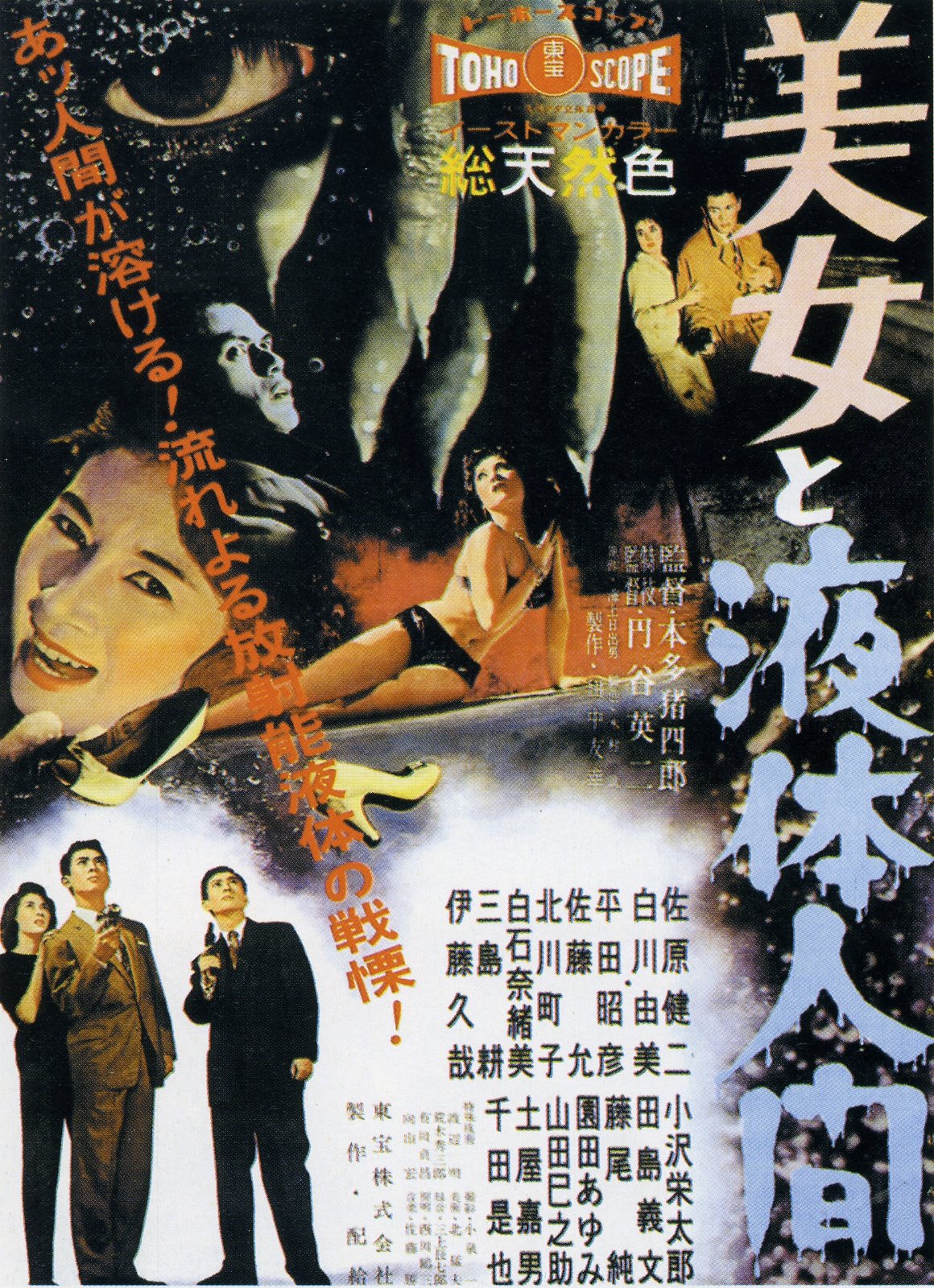
Toho produced a steady stream of science fiction movies in the ‘50s, each with some harsh words directed at irresponsible scientists whose discoveries place the whole world in peril. The H-man (美女と液体人間, Bijo to Ekitainingen), arriving in 1958, finds the genre at something of an interesting juncture but once again casts nuclear technology as the great evil, corrupting and eroding humanity with a barely understood power. Science may have conjured up the child which will one day destroy us, robbing mankind of its place as the dominant species. Still, we’ve never particularly needed science to destroy ourselves and so this particularly creepy mystery takes on a procedural bent infused with classic noir tropes and filled with the seedier elements of city life from gangsters and the drugs trade to put upon show girls with lousy boyfriends who land them in unexpected trouble.

Misaki (Hisaya Itou) is not a man who would likely have been remembered. A petty gangster on the fringes of the criminal underworld, just trying to get by in the gradually improving post-war economy, he’s one of many who might have found himself on the wrong side of a gangland battle and wound up just another name in a file. However, Misaki gets himself noticed by disappearing in the middle of a drugs heist leaving all of his clothes behind. The police immediatetely start hassling his cabaret singer girlfriend, Chikako (Yumi Shirakawa), who knows absolutely nothing but is deeply worried about what may have happened to her no good boyfriend. The police are still working on the assumption Misaki has skipped town, but a rogue professor, Masada (Kenji Sahara), thinks the disappearance may be linked to a strange nuclear incident…..

Perhaps lacking in hard science, the H-Man posits that radiation poisoning can fundamentally change the molecular structure of a living being, rendering it a kind of sentient sludge. This particular hypothesis is effectively demonstrated by doing some very unpleasant looking things to a frog but it seems humans too can be broken down into their component parts to become an all powerful liquid being. The original outbreak is thought to have occurred on a boat out at sea and the scientists still haven’t figured out why the creature has come back to Tokyo though their worst fear is that the H-man, as they’re calling him, retains some of his original memories and has tried to return “home” for whatever reason.

The sludge monster seeps and crawls, working its way in where it isn’t wanted but finally rematerialises in humanoid form to do its deadly business. Once again handled by Eiji Tsuburaya, the effects work is extraordinary as the genuinely creepy slime makes its slow motion assault before fire breaks out on water in an attempt to eradicate the flickering figures of the newly reformed H-men. The scientists think they’ve come up with a way to stop the monstrous threat, but they can’t guarantee there will never be another – think what might happen in a world covered in radioactivity! The H-man may just be another stop in human evolution.

Despite the scientists’ passionate attempts to convince them, the police remain reluctant to consider such an outlandish solution, preferring to work the gangland angle in the hopes of taking out the local drug dealers. The drug lord subplot is just that, but Misaki most definitely inhabited the seamier side of the post-war world with its seedy bars and petty crooks lurking in the shadows, pistols at the ready under their mud splattered macs. Chikako never quite becomes the generic “woman in peril” despite being directly referenced in the Japanese title, though she is eventually kidnapped by very human villains, finding herself at the mercy of violent criminality rather than rogue science. Science wants to save her, Masada has fallen in love, but their relationship is a subtle and mostly one sided one as Chikako remains preoccupied over the fate of the still missing Misaki.

Even amidst the fear and chaos, Honda finds room for a little song and dance with Chikako allowed to sing a few numbers at the bar while the other girls dance around in risqué outfits. The H-man may be another post-war anti-nuke picture from the studio which brought you Godzilla but its target is wider. Nuclear technology is not only dangerous and unpredictable, it has already changed us, corrupting body and soul. The H-men may very well be that which comes after us, but if that is the case it is we ourselves who have sown the seeds of our destruction in allowing our fiery children to break free of our control.


Original trailer (no subtitles)