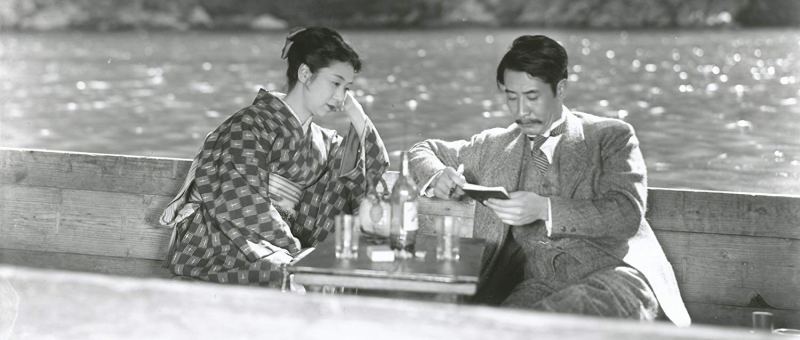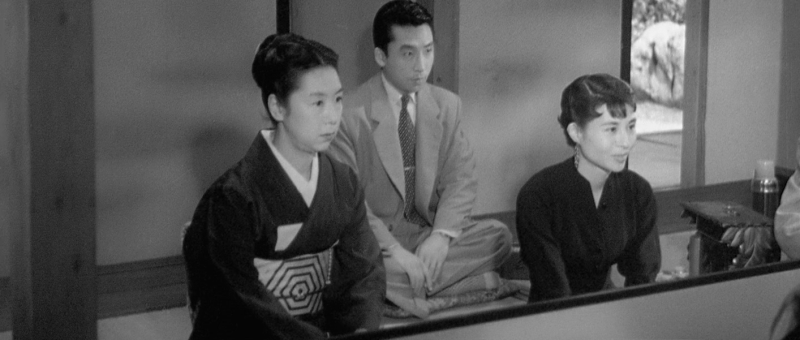
The Woman in the Rumour (噂の女, Kenji Mizoguchi, 1954)

A mother and daughter find themselves deceived by the same man, each hemmed in by realities which cannot be altered but eventually coming to a place of mutual understanding that allows them to restore their relationship not only as parent and child but as women in Kenji Mizoguchi’s 1954 melodrama, The Woman in the Rumour (噂の女, Uwasa no Onna). The first question we might ask ourselves is to which of the women the title refers, or indeed to which rumour, though in a sense rumours matter little for either of them when the problem is the constraints which each of them feel as women in the contemporary society. 

Even so, the sense of shame is evident when Yukiko (Yoshiko Kuga) is brought back to the geisha house run by her mother Hatsuko (Kinuyo Tanaka) after having attempted to take her own life in Tokyo. As we learn, the reason for her despair is in part heartbreak. She had been engaged but her fiancé’s family convinced him to end their relationship when they discovered that her mother ran a geisha house. Thus the suicide attempt is also a reflection of her sense of futility. She will always be the daughter of a woman who earned her living in the sex trade. This is a fact that cannot be changed and may lead her to think that her situation is hopeless because the same thing is likely to happen again leaving her unable to marry in a society in which there are few options for a single woman to make a life for herself not to mention the loneliness of living without romantic love. 

Hatsuko, meanwhile, is uncertain how seriously she should take the situation in part believing that it’s a product of youthful naivety in her daughter’s first romantic heartbreak. When a young doctor with whom she is close, Matoba (Tomoemon Otani), explains to her that Yukiko is depressed because she feels deep shame, self-loathing, and hopelessness due to her mother’s occupation, Hatsuko struggles to understand it and does not fully believe him. Nevertheless, she took care to bring her daughter up largely outside of the geisha world, sending Yukiko to Tokyo to study music implying that she herself to some degree sees her work as improper. The other girls view Yukiko with a degree of disdain, realising that her refinement was bought with their exploitation and noticing her animosity towards them. 

Hatsuko is mother both to Yukiko and the young women under her care who are always quick to point out that this is one of the better geisha houses because they are well looked after. When one of the women, Usugumo (Kimiko Tachibana), is taken ill, Hatusko calls in the doctor and allows her time off to rest which likely would not be granted at another house. She is reluctant to send her to hospital, but would if the situation called for it. In a sense it’s this solicitation that eventually allows Yukiko to find accommodation with her mother’s profession as she grows closer to the other women while nursing Usugumo herself and comes to understand their particular circumstances that have left them no choice but to live as geisha. Usugumo is reluctant to go to hospital because she is worried about the money she’d usually send to her sister Chiyoko (Sachiko Mine) who works the family farm and cares for their sickly father, but when she dies Chiyoko herself is left with little option other than to petition the geisha house to take her sister’s place. 

On seeing Chiyoko sitting on the step and pleading to be taken on, another of the women laments as she’s leaving that she wonders when there will be no more need for women like them. The geisha world is perhaps an unchangeable reality, just like Yukiko’s birth and her mother’s age. The rumours that surround Hatsuko are to do with her closeness with Matoba with whom she has clearly been in an intimate relationship, dreaming of becoming his wife and even considering selling the geisha house to buy a large property where they could live together as a couple while he runs a private clinic. Matoba predictably decides he prefers the younger Yukiko, Hatsuko increasingly desperate after overhearing their conversation about leaving her behind to move to Tokyo together where Matoba ponders finishing his education. The play they’ve gone to see almost feels like a personal attack as an actor intones that feelings of love at 20 are fine but at 60 it’s merely shameful. “Even carp know better than to fall in love at this age”, he adds, the old woman a figure of ridicule in her romantic delusion leaving Hatsuko feeling both humiliated and resentful.

When Hatsuko finally confronts Matoba, she does it as a scorned woman rather than as a mother, while Yukiko in turn first turns on her rather than Matoba even as she begins to realise the reality of the situation that the man who seduced her had been using her mother for his own gain in total disregard of her feelings. In short, even if Hatsuko were not her mother which certainly makes this a very complicated situation, he is not the sort of man she’d want to make a life with. Acutely aware of her own experiences of heartbreak, she fears for her mother’s wellbeing and comes to an understanding of her as a woman while accepting that “men are all alike” and in that at least perhaps her mother’s profession is the most honest of all. Mutually betrayed, mother and daughter are able to repair their familial bonds while Yukiko finds herself taking refuge in the geisha house as a space of female solidarity and bulwark against a cruel and patriarchal society. 

An Osaka Story (大阪物語, Kozaburo Yoshimura, 1957)

A man who tries to escape his poverty ends up imprisoning himself in Kozaburo Yoshimura’s tragicomedy An Osaka Story (大阪物語, Osaka Monogatari). Inspired by the work of Saikaku Ihara, Kenji Mizoguchi had intended to direct but sadly passed away before shooting started with Yoshimura appointed to take over. The broadly comic overtones may be at odds with Mizoguchi’s signature style but ultimately lend weight to the film’s ironic conclusion in which the hero finds himself essentially oppressed by his own wealth in being entirely unable to relate to other people or see the world in ways undefined by money. 

It may be possible to understand Omiya’s (Ganjiro Nakamura) mania as a reflection of his intense fear of poverty, that he is so terrified of possible destitution that he can never really have enough or allow himself to enjoy what he has in case there is no more to come in the future. Even as so his daughter later says, wealth changes him. As the film opens, Omiya is a peasant farmer with a bad harvest who can’t pay the onerous taxes demanded by his exploitative lord. He decides to flee to Osaka with his family but is soon rebuffed by the man he’s gone to see who has just become a samurai and wants nothing to do with him. Wandering around the city, the kids eventually discover a thin layer of discarded rice at a storage area they manage to sweep up giving Omiya a new idea of how to save their family. 

In some ways, his fate is foreshadowed when he alone is unable to slip through the fence while his wife and children mop up grains from the floor. The image of him on one side of the bars is repeated in the closing scene, while his loyalty to the family he tried so hard to save is weakened by the influence of money. Yoshimura shows us a world founded on exploitation. “Those who worked so hard to grow it won’t see a single grain,” Omiya bitterly laments watching workmen unload vast quantities of rice while the peasants starve. When the rest of the family have finished sweeping up what others so casually discarded, Omiya does not use the rice to feed them but sells it to a broker and gives them millet instead. His life is then ruled by the doctrine of good enough, living in painful, penny-pinching austerity even after becoming wealthy as a dodgy tea merchant/loan shark. 

Omiya is one of those people who know the price of everything but the value of nothing. Back at their farm, he’d firmly rejected his wife’s offer to sell herself into sex work to save the family, asking “How could I carry on happily knowing you were suffering for it?”, but this is exactly what he proceeds to do. Omiya no longer cares about his family’s feelings and thinks only abut money but simultaneously refuses to spend any of it. One has to wonder what the point of the money is when he’s living a life not all that different from a peasant farmer save being free of the anxiety of immediate starvation. The only person he has any kind of respect for is a widow much like himself who is equally obsessed with penny-pinching and maximising profits. 

The pair bond in their parsimonious natures, but the mutual desire to get a good deal necessarily comes between them especially when Omiya decides to marry off his daughter (Kyoko Kagawa) to Mrs. Abumiya’s foppish playboy son Ichinosuke (Shintaro Katsu) who has been secretly spending money in the red light district without her knowledge. He too is being exploited, in his case by a geisha who manipulates him into getting the money to buy out her contract by threatening suicide. Meanwhile, Omiya’s meanness means he’s never actually taught his son much about handling money. His invitation to the pleasure quarters by Innosuke eventually provokes his rebellion as he starts to question his father’s philosophy and what money is for if you still can’t live a comfortable life. 

HIs daughter Onatsu asks him something similar, pleading with him to learn to understand other people’s feelings before leaving the shop to be with a kindhearted clerk, Chunzaburo (Raizo Ichikawa), with whom she has fallen in love. So little does he care for people that Omiya doesn’t even bother to live up to the image of a wealthy man. The man who turned him away after becoming a samurai eventually racks up large debts and loses his title allowing Omiya to buy his house as an act of revenge despite his wife and daughter’s protestations that they already have “enough” and did not need more. He refuses contracts the previous owners had set up, throws out a hairdresser who comes to give the ladies a more class-appropriate haircut, and refuses a loan to the daimyo in incredibly rude fashion not to mention embarrassing just about everyone by refusing to serve any food at a wake. 

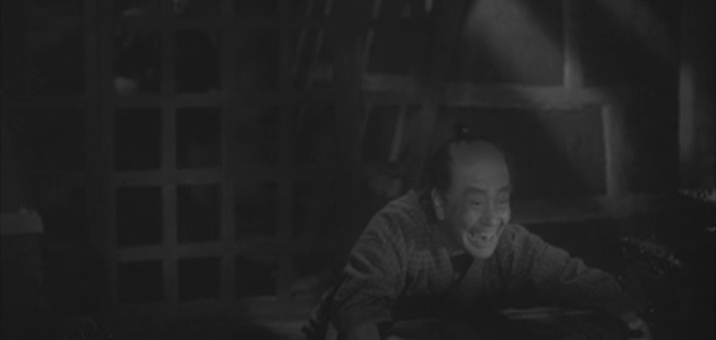
After ruining all of his personal relationships (except that with Mrs. Abumiya), Omiya experiences a kind of mental breakdown throwing himself over the chests of money in his vault and locking himself inside raving that everyone’s out to get their hands on his wealth. He’s just as much of a prisoner of this system as he was as a peasant farmer and has now imprisoned himself within a destructive delusion of capitalistic wealth. “Do what you have to do for a comfortable life,” Omiya’s son Kichitaro (Narutoshi Hayashi) had advised his sister, but this is what Omiya was trying to do too only for it massively backfire no matter what your personal definition of a “comfortable life” may be. Mrs. Abumiya tearfully wonders who’s going to inherit her money if not for her feckless son, but all Omiya can do is cackle wildly one like one possessed insisting that the money is his and his alone and not even death shall part him from it. In part a humorous take down of the contemporary society’s economic obsessions in a bid for ceaseless acquisition, the film is also a tragic tale of a man laid low by his addiction to money and the illusionary sense of comfort it provides him. 


Miss Oyu (お遊さま, Kenji Mizoguchi, 1951)

“I never realised how heavy this kimono was” a young woman exclaims towards the conclusion of Kenji Mizoguchi’s Miss Oyu (お遊さま, Oyu-sama), adapted from the Junichiro Tanizaki short story The Reed Cutter, finally collapsing under its weight having committed what amounts to an act of spiritual suicide in an internalised betrayal. Mizoguchi’s highly selective adaptation excises much of Tanizaki’s trademark perversity and targets instead the repressive social codes of the era which proceed to ruin three lives in frustrated affection, shame, and self-harming guilt. 

The trouble begins when Shinnosuke (Yuji Hori), a young man in search of a wife, mistakes his prospective bride for her sister and is forever smitten. Oyu (Kinuyo Tanaka), a widow with a young son, is only accompanying her younger sister, Oshizu (Nobuko Otowa), but is perhaps herself taken with the handsome suitor whom she repeatedly brands a “fine gentleman”. Having objected to all of Oshizu’s previous matches, she encourages her sister to marry this one not least because of his physical proximity that would allow the pair to visit each other regularly. The pain on Oshizu’s face is however readily apparent as Oyu relates the amusing incident to their brother, the younger sister clearly consumed with an inferiority complex in the shadow of the beautiful and elegant Oyu. 

It’s never quite clear to what extent Oyu is aware of her sister’s feelings, if she says these things thoughtlessly or with an intent to wound though she obviously cares deeply for Oshizu. Similarly the extent of her feelings for Shinnosuke remains oblique. As a woman well aware of her beauty and its power, perhaps she simply enjoys being desired or is so accustomed to male attention as to barely notice that Shinnosuke has fallen in love with her. Then again perhaps she knows all too well and for the sake of politeness pretends not to though in that case the decision to encourage her sister to marry him would seem perverse or suggest that she is attempting to deny her own feelings which she may not even understand by rendering Shinnosuke a “brother” in an attempt to remove him from the pool of potential romantic suitors. 

Even so there is an underlying quality of incestuous desire of Oshizu for her sister to whom she remains devotedly besotted, willing to sacrifice her own happiness in the hope of ensuring Oyu’s. After agreeing to marry Shinnosuke, she explains to him that she intends their marriage to be purely symbolic. She refuses to consummate their union on the grounds that it would be a betrayal of Oyu whom she knows to be in love with Shinnosuke while realising that he has married her only to be connected with her sister. When the trio take a trip together the strangeness of the ménage à trois is brought home by the confusion of the hotel maid who assumes that Oyu and Shinnosuke are the married couple, commiserating with Oshizu for being a third wheel. While Oyu childishly makes light of it, Oshizu is hurt and confused, jealous in two directions but pleading with Shinnosuke to be only his sister rather than a wife. 

Yet the wrongness of the arrangement is signalled on Oyu’s return home when she discovers not only that her son, Hajime, has fallen mortally ill in her absence but that rumours have begun to circulate about her unusual relationship with her brother-in-law. It is impossible to avoid the implication that Oyu is being punished firstly for betraying her maternity in having gone on holiday without her son to experience freedom as a woman, secondly for feeling sexual desire, and thirdly for feeling it for a married man who is now technically a brother in being her sister’s husband though as we know no one’s sexual desires are currently being fulfilled in this incredibly complicated and destructive arrangement. 

Though Tanizaki might have been more interested in exploring the darker aspects of human sexuality, Mizoguchi pulls back from the author’s trademark perversity to take aim at the repressive social codes of a patriarchal society which brought such a fraught situation into being. Oyu is unable to marry Shinnosuke because she is bound to her late husband’s family and by the responsibility to her son whom she would have to leave behind even if she were given permission to take another husband. Once her son dies, her ties to marital family are severed and they, disapproving of the rumours surrounding her unconventional relationship with her sister and brother-in-law, send her back to her brother who is also reluctant to accept her. On learning of the reality of her sister’s marriage, she decides to accept a proposal from a sake merchant in another town but the separation breeds only more destruction. Oshizu and and Shinnosuke move to Tokyo and three years later are living in poverty, Shinnosuke now dishevelled and dressing in Western suits with a modern haircut and a scraggly, half-hearted moustache. Oshizu’s eventual pregnancy which confirms that theirs is now a “full” union while Oyu’s is “symbolic” only the slows implosion of the trio’s repressed desires. 

Mizoguchi stops short of arguing for a transgressively new arrangement that would have allowed the trio to live together as a family but nevertheless attacks the repressive social codes that prevent them from speaking honestly about their feelings and force them into self-sacrificing acts of subterfuge which create only more suffering. He dramatises the claustrophobia of their lives through the obvious artificially of the stage sets which stand in such stark contrast to the expansive beauty of nature albeit sometimes unruly but always free, while lending their tragic tale a hint of the parabolic in its mists and rugged gardens as Shinnosuke finds himself alone under the cold light of the moon on a distant shore, a romantic exile from a repressive society. 


The Water Magician (瀧の白糸, Kenji Mizoguchi, 1933)

“As long as I breathe, I’ll remember my debt to you” avows a young man to his unexpected benefactor becoming one of many claiming they will never forget her kindness though in his case he actually means it. Kenji Mizoguchi would later become known for tragic tales of female suffering, but his central themes were established early on and very much in evidence in 1933 silent The Water Magician (瀧の白糸, Taki no Shiraito) in which a truly good woman tries to use her independent success to improve the lives of those around her but finds herself cruelly betrayed by a greedy and self-interested patriarchal society. 

Tomo Mizushima (Takako Irie) goes by the stage name Taki no Shiraito, which means something like white threads of the waterfall, particularly apt seeing as she is a “water magician” with a troupe of itinerant players. A beautiful woman who can make the water dance, she has her share of followers and is financially independent if subject to the vagaries of the show business existence. Her life changes one day when she is travelling in a horse-drawn coach that is embarrassingly overtaken by a fast running rickshaw man. The passengers are irate, wondering what they’re paying for, while the driver ignores their pleas not to spare the horses. Tomo decides to use her feminine appeal and then her financial power to convince him to speed up, but he ignores her too until he eventually decides to gallop forward recklessly while the passengers shake inside until the coach’s axle finally snaps and leaves them stranded. A gallant young man, the driver grabs Tomo and throws her on his horse to get her to the next town. She faints on the journey and only comes round after the coachman has left but discovers herself in possession of a complicated law book she assumes is his.  

Tomo cannot stop thinking about the dashing young man, only identified as “Kin” (Tokihiko Okada). She is surprised to reencounter him asleep on a bridge though he seems not to remember her. After finding out that he is an unluckily orphaned former samurai who was fired from the coach for breaking the axle and endangering the passengers, she resolves to use her financial power to help him achieve his dreams of studying law in Tokyo. Tomo does this because she is in love and asks for nothing in return except a future promise of romantic union to which the young man does not exactly agree but does take her money and vows to live up to the faith she has shown in him. 

Alone once again Tomo tries to contend with the world around her while dreaming of Kinya, sending him her savings for his upkeep while the troupe continues to suffer especially during the traditional dry spells of the heavy winter. The troupe’s leader makes the decision to get involved with dangerous loanshark Iwabushi (Ichiro Sugai), a huge hulking man with a mean look and lecherous temperament. While Tomo dreams of Kinya, two romances mirror each other in the failed relationship of the cruel knife thrower Minami (Koju Murata) and his terrorised wife Gin (Kumeko Urabe), and the innocent young love of the beautiful Nadeshiko (Suzuko Taki) and the barker Shinzo (Bontaro Miake). Gin also borrows money from Tomo which she was reluctant to surrender because she saved it for Kinya, claiming she needs it to visit her sick mother in Tokyo and vowing once again never to forget Tomo’s kindness but later skipping out with a stagehand to escape Minami’s control. Nadeshiko and Shinzo, however, are forced to flee on learning that Minami plans to sell her to Iwabushi to settle his private debts. The couple regret leaving Tomo who has always supported them in the lurch, but she helps them escape, ushering them out the back towards a waiting boat and handing them still more money asking only that they be happy and stay together always. 

That’s not perhaps a power that’s in their keep, but the youngsters keep it as best they can and eventually attempt to protect her in the way she has protected them. The world, however, is cruel. With work thin on the ground Tomo finds herself unable to go on funding Kinya as she’d promised, and is only shamed by his well-meaning letter explaining that he’ll try to find a way of supporting himself until his studies are finished so she needn’t worry. She cuts a deal with Iwabushi and sells her body on Kinya’s behalf, but he is in league with Minami who sets his goons on her to retrieve the money seconds after she’s obtained it. 

Her hopes are at least repaid on discovering that her love is true to his word, has never forgotten her, and is well on the way to achieving his dreams as person of note. “Chance and fate, that’s all there is” Kinya had lamented on their second meeting, but he couldn’t know how right he’d be. Tomo’s dreams are fulfilled only their negation. Kinya must do his duty even if it does her harm, yet he too feels responsible and wants to share her burden though that, ironically, would only destroy everything for which she has sacrificed so much. “The river flows on as it always has and always will” the Benshi adds in solemn contemplation of this romantic tragedy, somehow inevitable in its cruelty. Tomo finds herself at the mercy of her times in which money is all, goodness is a weakness, and love too fragile to survive. The woman who made the water dance floats away on a river of tears, a victim of a cruel and unforgiving society.


Poppy (虞美人草, Kenji Mizoguchi, 1935)

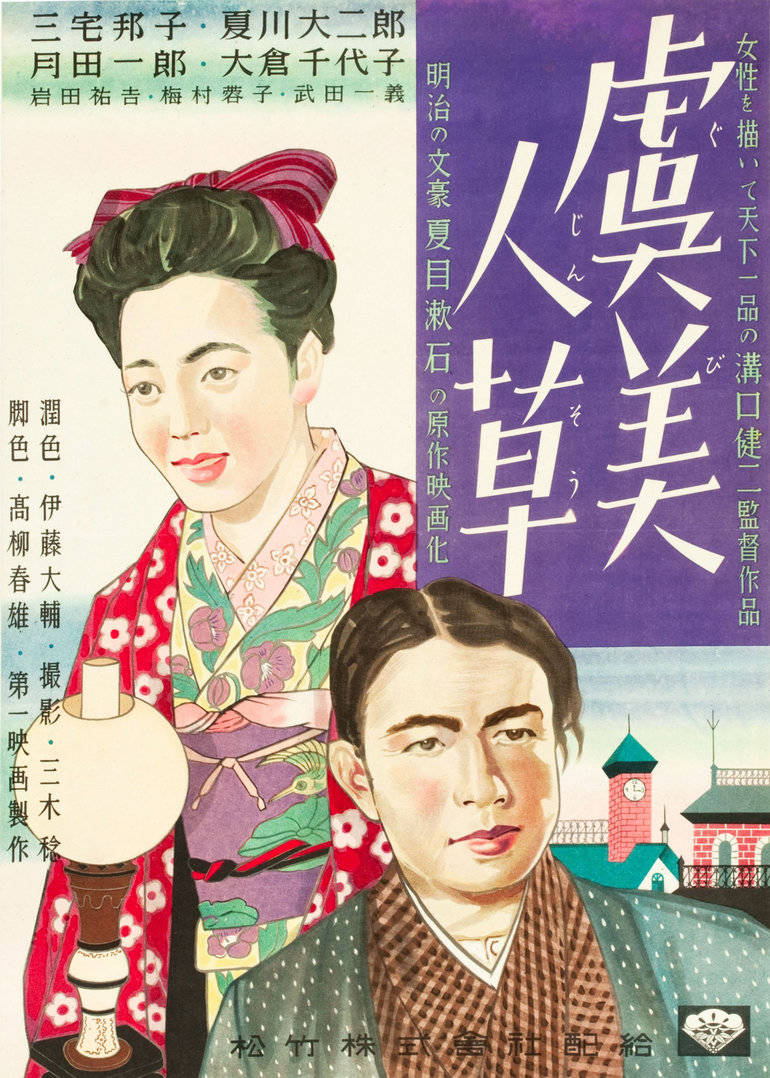
Most closely associated with tales of female suffering in a patriarchal society, Kenji Mizoguchi’s signature themes are already apparent in the films which survive from the pre-war era. Even so, 1935’s Poppy (虞美人草, Gubijinso), adapted from a novel by Natsume Soseki, largely sidesteps the parallel powerlessness of its twin heroines in placing the central dilemma firmly on the shoulders of its conflicted hero, a young man who owes everything to a benevolent patron whose daughter he is expected to marry but is captivated by a young and capricious heiress and consequently torn between duty and passion.

In late Meiji, an old man, Inoue (Yukichi Iwata), washes graffiti off his front wall apparently scrawled by a man desperate to marry his daughter Sayoko (Chiyoko Okura) whose beauty he claims puts other to shame (Inoue looks on approvingly at the last part, and decides to leave it). Inoue intends his daughter to marry Ono (Ichiro Tsukida), a young man he took in as a starving orphan and raised to adulthood. Ono is currently in Tokyo preparing to complete his doctoral thesis and the pair are very much looking forward to moving there to live with him. While Ono has not forgotten them, he has embarked on a life of his own as a Tokyo student, falling in love with the flighty Fujio (Kuniko Miyake) while working as a part-time English tutor. She too is keen to marry him, despite the fact she is technically still engaged to someone else, Hajime (Daijiro Natsukawa), in a match which was orchestrated by her father many years ago. Fujio’s mother is acutely concerned with her marriage for a number of reasons, the first being that Kingo (Kazuyoshi Takeda), her step-son and the family’s heir, refuses to marry and rejects his inheritance but if Fujio remains single then the fortune reverts to him. Secondly, she dislikes the idea of Hajime as a son-in-law because he has repeatedly failed to secure a position in the diplomatic corps and is currently unemployed.

The problem rests with Ono, whose conflicting desires are characterised not so much in terms of love versus obligation but as ambition versus constancy. Instead of explaining in person to Mr. Inoue that he is grateful to him and has no intention of rejecting their family but thinks of Sayoko as a sister and therefore would like to politely decline the idea of marriage, he sends a friend, Asai (Toichiro Negishi), to explain that he’s too busy to think about weddings and wants to defer the conversation until after his thesis is completed. Of course, Mr. Inoue sees through this thin excuse right away and is offended on his daughter’s behalf. The friend warns him that Ono is “worthless”. “He’s interested in what’s fashionable. He’s stupid” Asai goes on, implying that he is not exactly choosing to marry the woman he loves rather than honour a vague suggestion from the past, but is opportunistically seizing the chance to marry up into the high society of late Meiji Japan (a feat near impossible for a man who was once a starving orphan).

Love is not so much a part of the equation as one would expect and neither are the feelings of either woman held in very high regard. Nevertheless, Kingo eventually tries to warn Hajime away from his sister, explaining that “women who seek pleasure are dangerous”. “When I fall in love, I won’t just sit quietly waiting for my lover. I’ll make passionate love to him” Fujio flirtatiously tells Ono, dangling a precious watch from her father which serves as an indication of betrothal and membership of the family. Fujio and her mother are actively using the only means at their disposal to control their own futures by making a match they believe more beneficial which will ensure they keep themselves within the family succession, suggesting that Fujio, like Ono, is acting less out of “love” than self-interest, something which is later reinforced by her offering of the watch to Hajime who casts it to the waves in insistence that he was never interested in what it represents. 

While Asai recounts his meeting with Inoue, he tells Ono that he’s making the right decision and that his best option from all angles is to marry Fujio, but Hajime overhears him and chimes in with contrary advice that he should think carefully and be true to himself. In essence, all Hajime is telling him is to own his decision and make sure he is willing to live with it or else be consumed by self loathing and misery. By this point, we perhaps expect that modernity will win, that all will accept that it is unreasonable to expect anyone to sublimate their own desires to honour an old obligation and most particularly that the women be expected to submit themselves to dynastic marriages arranged by their fathers, but the resolution is quite the reverse. The modernist Fujio is twice rejected, while Sayoko and her father leave the modern capital for the ancient Kyoto. Ono is forced into a reconsideration of his spiritual debt to the Inoues who he would be betraying in marrying Fujio for social gain which is to say that feudalistic, patriarchal values are subtly reinforced while Western individualism is disparaged with only Hajime standing up for emotional integrity which neither philosophy particularly respects. In the end, nobody is happy but everyone is resigned to their particular misery as their burden to carry in knowledge that they have acted properly which is perhaps as close to a condemnation of a still oppressive society as you could get in 1935. 


The Straits of Love and Hate (愛怨峡, Kenji Mizoguchi, 1937)

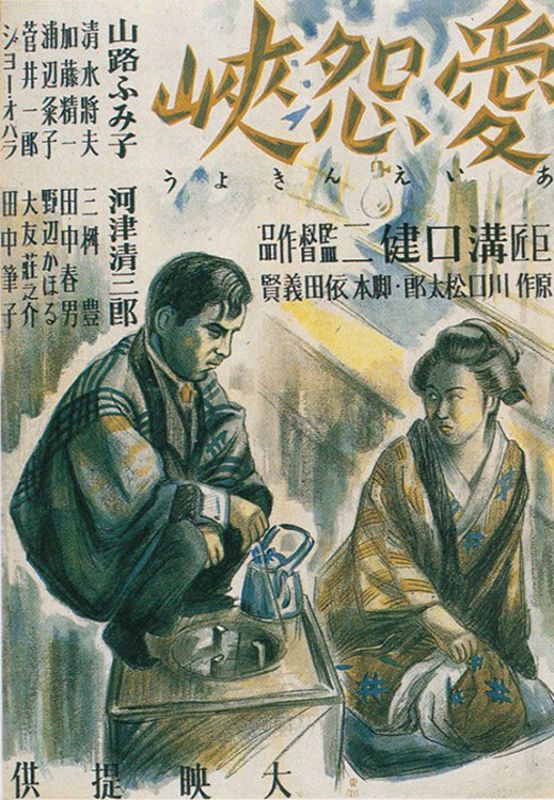
straits of love and hate poster“Tokyo is a dangerous city that traps innocent people like you” the heroine of Kenji Mizoguchi’s 1937 melodrama The Straits of Love and Hate (愛怨峡, Aien kyo) is told, but it’s not so much the darkness of the city streets as the world’s cruelty which threatens to consume her soul. Loosely inspired by Tolstoy’s Resurrection, then particularly popular in Japan and a frequent source for adaptation in the silent era, Straits of Love and Hate is a familiar tale of an innocent maid seduced and betrayed by the weak willed son of her social superiors, but rather than see her beaten by a broken heart Mizoguchi allows to her to find new strength in the determination to move forward in a direction of her choosing.

Kitchen maid Ofumi (Fumiko Yamaji) is in love with Kenkichi (Masao Shimizu ), the son of local hotel owners. Now that he’s finished his studies, his parents were expecting him to take over the inn so they’re not exactly pleased when he tells them he plans to go to Tokyo to become a teacher, nor would they be very happy about the idea of him marrying a lowly maid. After arguing with his father, Kenkichi more or less gives up on the idea of leaving, deciding to postpone until his parents come round or perhaps going on his own and sending for Ofumi when he’s financially stable. Twin pressures, however, force him to accept that it’s now or never. Ofumi is a few months pregnant and will soon be showing so his hand is in a sense forced. Meanwhile, Ofumi is keen to leave as soon as possible because her uncle, Murakami (Seiichi Kato), has turned up extremely drunk and is talking to her employers about taking her away to join his troupe of travelling players which she is desperate to avoid because she remembers her mother telling her he was no good and would sell her to a brothel as soon as look at her.

Kenkichi relents and the pair elope to Tokyo, but once there his general fecklessness resurfaces. The couple have begun to outstay their welcome at the apartment of a friend whose wife is becoming thoroughly fed up with Kenkichi who lounges about all day not looking for work, while an increasingly pregnant Ofumi is out job-hunting alone in the unforgiving city. A naive bumpkin, she’s nearly scammed by a street pimp who claims to be saving her from someone in fact just like him, but is rescued by Yoshi (Seizaburo Kawazu) – a wandering accordion player regarded by all as a petty thug. Kindhearted by nature, Yoshi takes pity on her and sets Ofumi up with a job in a cafe but is soon arrested for stabbing the pimp who was bothering her. Meanwhile, the irritated wife of Kenkichi’s friend has wired his dad who promptly arrives to retrieve his son. Spineless, Kenkichi walks out on his pregnant girlfriend leaving her only with a note that says “sorry, good luck with the rest of your life”, and an insultingly small amount of compensation money.

It’s easy enough to think that Kenkichi wasn’t really invested in his romance, got cold feet, or simply rejected adult responsibility, but the truth is more that he’s just as trapped by patriarchal social codes as Ofumi is and no more free even with his comparatively comfortable class background. He lacks the will to defy his father, and is simply too lazy to consider living an ordinary life in the city with a regular job where no one calls him “young master”. Ofumi, by contrast, fights for love. She breaks the class barrier, naively believes that Kenkichi’s parents will accept her because they cannot reject their grandchild, and forgives Kenkichi’s fecklessness because she truly believes in him. One word from his father, and he crumbles. Left alone Ofumi is forced to send her son out to foster parents and has no other choice than to become a bar hostess.

Unlike Kenkichi, Yoshi is patient and kind. He truly means to protect Ofumi and her son, but also has a self-destructive violent streak as manifested in his over the top attack on the pimp and later altercation with a remorseful Kenkichi. Ironically enough, Uncle Murakami whom she so feared becomes an unlikely source of salvation, inviting Ofumi and Yoshi to join the company as a standup double act. Witnessing Ofumi reenact her romantic tragedy on stage as part of a routine forces Kenkichi to confront his moral cowardice. While the intervening years have seen Ofumi become cynical and bitter, still angry and resentful, Kenkichi has become weary and resigned. His parents have moved to the country, and he now runs the hotel, but he’s still not free. Hoping to convince Ofumi to come back, he invites his dad to meet their son but it becomes clear to her that Kenkichi will never change. He lacks the strength to reject his father’s authority, and as he’s abandoned her before he will likely do so again.

Kenkichi, perhaps meaning well, offers to take the child, pointing out that growing up among travelling players is an inauspicious start in life whereas he can bring the boy up with all the advantages of middle-class comfort. Ofumi is guilty in her immediate refusal, acknowledging that she may be denying her son a “better life” than she can give him, perhaps selfish in her reluctance to be parted from her child, but equally certain that she doesn’t want her son to grow up like Kenkichi, a spineless product of a patriarchal social order unable to stand up to his father or seize his own agency. She tells Kenkichi that she’s fallen in love with Yoshi because theirs is a partnership of equals, they understand and support each other, moving forward as one. He won’t abandon her by choice, but he isn’t perfect either and his foolish self-destructive impulses and selfless nobility threaten his new hope for the future as he embarks on a high risk strategy to prompt Ofumi to accept the “better life” that Kenkichi can offer her. Nevertheless, the point is that the choice is finally hers – no man is going to make it for her, not even her son. What she chooses is a kind of independence, stepping boldly forward into a future that’s entirely of her own making.


My Love Has Been Burning (わが恋は燃えぬ, Kenji Mizoguchi, 1949)

My love has been burning posterAmong the many parallels that could be drawn between the Meiji Restoration and the immediate post-war period, the most obvious is that each provided a clear opportunity for social change along with a moment of frozen introspection and internal debate about what the new promised future ought to look like. Following Victory of Women and The Love of the Actress Sumako, Kenji Mizoguchi completed a loose trilogy of films dealing with the theme of female emancipation with My Love Has Been Burning (わが恋は燃えぬ, Waga Koi wa Moenu), returning once again to the broken promises of Meiji as its heroine discovers that old ideas don’t change so quickly and even those who claim to be better will often disappoint.

The film opens in the early 1880s as a teenage Eiko Hirayama (Kinuyo Tanaka) attends a rally to celebrate the arrival of noted feminist Toshiko Kishida (Kuniko Miyake). Eiko, a committed social liberal from a conservative middle-class family, went to see her idol in the company of a childhood friend, Hayase (Eitaro Ozawa), who is shortly going to Tokyo to study and join the democratic revolution. He halfheartedly asks Eiko to come with him, but knows that she won’t because her parents will refuse permission and she will not disobey them. Soon after, Eiko’s loyalty to her family is weakened when the family’s maid, Chiyo (Mitsuko Mito), is sold to a brothel by her father. Devastated, Eiko asks her parents for the money to buy her back but they refuse, regarding Chiyo’s sacrifice as noble and in line with filial tradition. If Chiyo had refused (not that she had the right or power to refuse), her parents would starve. Eiko rushes back to the docks, but she is too late, Chiyo and Hayase have both departed for the capital and extremely different fates.

After her family situation declines still further and Eiko decides it is impossible for her to remain under her father’s roof, she makes her own way to the city but finds it not quite so welcoming as she’d assumed it to be. Hayase is not overjoyed to see her. He merely asks if she has finally decided to marry him and becomes petulant when she reaffirms her intention to study even if she implies that she intends to marry him at a later date. During his time apart from her, Hayase has been working for the fledgling Liberal Party agitating for wider democratic rights and the expansion of the franchise, though he is irritated still further when his mentor, Omoi (Ichiro Sugai) – the leader of the socialists, is supportive of Eiko’s ambitions and agrees to find a job for her working on the party paper.

Eiko’s early disappointment in Hayase is frequently mirrored in all of her subsequent dealings with men. Hayase put on a performance of believing in her cause of women’s liberation and more widely the equality of all peoples ending centuries of feudal oppression, but really just wanted to possess her body and is unwilling to accept her decision to reject him or to choose someone else. Later visiting her after she has been imprisoned on a somewhat trumped up charge, Hayase tells her that a woman is only a woman when loved by a man, and that a woman’s fulfilment is achieved through home, family, and motherhood. He tells her that he admires her for her education and talent, but that she has “forgotten” that she is a woman. He will help her remember by getting her out of prison if only she consent to marry him even though he has previously attempted to rape her and is now working for the rightwing government having betrayed the socialist cause.

Meanwhile, Omoi looks an awful lot better. He is, ostensibly, entirely committed to socialist aims, energetically engaged in promoting the Liberal Party, and trying to ensure true democracy takes root in the new Japan, lifting the common man above his subjugated position in the still prevalent feudal hierarchy. Nevertheless, he too eventually falls in love with Eiko and like Hayase is ultimately more interested in her body than their shared cause for liberal freedom. He appears to support her desire for women’s rights as an integral part of his desire to end feudal oppressions but his belief in female equality is later exposed as superficial. Eiko, reuniting with Chiyo in prison, takes her into the household she now shares with Omoi (though they are obviously not legally married) as her maid which is perhaps not entirely egalitarian but still a well intentioned attempt to free her from the life her father condemned her to.

Omoi disappoints, bedding Chiyo while Eiko is working hard at the campaign office. Confronted, he rolls his eyes and offers a boys will be boys justification before affirming that it was just a matter of sexual satisfaction and that his feelings for her haven’t changed, mildly reproving Eiko for allowing her emotional jealously to cloud her judgement in restricting his sexual freedom. If it were indeed a matter of free love, perhaps Eiko could have understood, but Omoi damns himself when looks askance at Chiyo and remarks that it doesn’t really matter because she is nothing but a servant and a concubine. All at once, Eiko sees – despite his fine talk, Omoi may have abandoned feudal ways of thinking when it comes to working men but still sees women in terms of things. If he thinks female “servants” are not worthy of respect or agency, then what is it that he has been fighting for in his supposed mission to end oppression in Japan?

Attempting to comfort a distraught Chiyo who has been so thoroughly brainwashed that she never quite expected anything “better” than being a concubine and has truly fallen for all Omoi’s pretty words about wanting to make her happy, Eiko reminds her that as long as men continue to think as Omoi does women will never be free. Freedom and equality are what will enable female happiness, and long as men refuse to recognise women not as domestic tools but as fellow human beings there can be no freedom in Japan. Mizoguchi reinforces the idea that while one is oppressed none of us is free, neatly celebrating the success of the disappointing Omoi while lamenting that his intentions for reform will not go far enough. Eiko cannot free the women of Japan on her own, but her solution is warm and committed – she will teach them to free themselves by starting a school, educating the next generation to be better than the last. Chiyo, notably, whom she never blames or rejects, will become her first pupil neatly subverting Hayase’s cruel words when she asks Eiko to teach her how to be a woman.

Unusually brutal, My Love Has Been Burning does not shy away from the violence, often sexual violence, which both women suffer both at the hands of men and of the state as they attempt to do nothing more than live freely as full human beings. It also makes plain that even those with supposedly high ideals can disappoint as they nevertheless motion towards real social good without fully committing to its entireties. A committed pro-democratic, intensely feminist statement, Mizoguchi’s lasting message lies in an affirmation of female solidarity as, unlike the self-serving Omoi, Eiko lifts her pupil up onto her own level and draws her shawl around them both committed to proceeding forward together into a fairer future.


The Love of the Actress Sumako (女優須磨子の恋, Kenji Mizoguchi, 1947)

vlcsnap-2019-03-27-01h39m45s435The Taisho era was, like that of the post-war, a time both of confusion and possibility in which the young, in particular, looked for new paths and new freedoms as the world got wider and ideas flowed in from every corner of the globe. In The Love of the Actress Sumako (女優須磨子の恋, Joyu Sumako no koi), the second of a loose trilogy films about female emancipation, Kenji Mizoguchi took the real life story of a pioneering actress of Western theatre and used it to explore the progress of lack there of in terms of social freedoms not only for women but for artists and for society as a whole.

We begin in late Meiji as theatre director Shimamura (So Yamamura) fights to establish a foothold of Western-style “art theatre”, moving away from the theatricality of kabuki for something more immediate and naturalistic. He has, however, a problem in that as women were not allowed to take to the kabuki stage all of his students are male and casting a man to play a woman’s role would run counter to his desires to create a truly representative theatre. It is therefore lucky that he runs into Sumako Matsui (Kinuyo Tanaka) – a feisty, determined young woman who had divorced her first husband for infidelity and then left the second when he complained about her desire to pursue a career on the stage. In Sumako, Shimamura finds a muse and the ideal woman to portray the extremely controversial figure of Nora in his dream production of Ibsen’s incendiary A Doll’s House.

Shimamura casts Sumako because he sees in her some of Nora’s defiance and eventual desire to be free from illusionary social constraints, but it is in fact he who ends up embodying her spirit in real life. Somewhat feminised, Shimamura is in a difficult position in having married into his wife’s family, leaving him without real agency inside his own home as evidenced by his mild opposition to his daughter’s arranged marriage. While he wishes that his daughter be happy and if possible marry for love, Shimamura’s wife is very much of the old school and wants to make the best possible match in terms of financial gain and social status, viewing emotional compatibility as a low priority (the daughter herself as relatively little say). Unwisely falling in love with Sumako, it is he who eventually decides to follow Nora’s example by walking out not only on his family but also on the theatre company. He does this not quite because the scales have been lifted from his eyes – he was never under any illusion that his arranged marriage was “real” and there is of course an accepted degree of performance involved in all such unions, but because he finally sees possibility enough in his love for Sumako and the viability of emotionally honest Western art to allow him to break free of outdated feudal ideas of familial obligation.

Nevertheless, making a career as an artist is a difficult prospect in any age and Shimamura’s emotional freedom quickly becomes tied up with that of his art. Sumako’s Nora proves a hit (in the last year of Meiji), but he is ahead of his times both in terms of his liberal, left-wing philosophy and his determination to embrace modern drama in a still traditional society. The roles we see Sumako perform, including that in Tolstoy’s Resurrection which was another of those that helped to make her name, are all from proto-feminist plays which revolve around women who, like herself, had chosen to challenge the patriarchal status quo in pursuit of their own freedom and agency. Shimamura’s wife makes no secret of her outrage to her husband’s desire to stage A Doll’s House, viewing Nora’s decision as “selfish” and perhaps of a subversion of every notion she associates with idealised femininity. Though not so far apart in age, Sumako is a woman of Taisho who left not one but two unfulfilling marriages and is determined to forge her own path even if that path eventually leads her to subsume her own desires within those of her lover as the pair attempt to put their social revolution on the stage.

The revolution, however, does not quite take off. Despite good early notices, Shimamura’s Art Theatre company quickly runs into trouble. Faced with financial ruin, he does what any sensible theatre producer would do – he begins to prioritise bums on seats and acknowledges that if he’s to keep his company afloat and facilitate his dream of making Western theatre a success in Japan he’ll have to compromise his artistic aims  by putting on some populist plays. Of course, this sudden concession to commercial demands does not go down well with all and some of his hardline actors begin to leave in protest not just of his selling out but of his twinned desire to make Sumako his star.

Tellingly, the pair are eventually forced out of Japan entirely to tour the beginnings of empire from Korea to China and on to Taiwan. Their ideas are too radical and their society not quite ready for their messages even if not initially as hostile as it would later become. Shimamura works himself to the bone trying to keep his dream alive, eventually damaging his health. Sumako remains somewhat petulant about being forced into an itinerant lifestyle while her onstage personas come increasingly to influence her offstage life until it is said of her that her performance is “no longer an interpretation but an extension of reality”. In this, Sumako has, in a sense, achieved Shimamura’s dreams of a truly naturalistic theatre, but it comes at a cost, as perhaps all art does, and, Mizoguchi seems to suggest, becomes a kind of sacrifice laid down to a society still too rigid and unforgiving to appreciate its sincerity. Nevertheless, their boldness, as fruitless as it was, has started a flame which others intend to keep burning, eventually becoming a beacon for another new world looking to rebuild itself better and freer than before.


Short clip featuring Sumako’s performance as Carmen.

Victory of Women (女性の勝利, Kenji Mizoguchi, 1946)

Victory of Women cap 1Female suffering in an oppressive society had always been at the forefront of Mizoguchi’s filmmaking even if he, like many of his contemporaries, found his aims frustrated by the increasingly censorious militarist regime. In some senses, the early days of occupation may not have been much better as one form of propaganda was essentially substituted for another if one that most would find more palatable. The first of his “women’s liberation trilogy”, Victory of Women (女性の勝利, Josei no Shori) was released in 1946 and expressly embraced the democratic philosophy espoused by the American authorities which necessarily included a motion towards female emancipation.
Played by Mizoguchi’s muse Kinuyo Tanaka, our heroine is Hiroko – a young woman working as a lawyer defending women against the cold and hard face of the law. Her family situation is, however, complicated. Her father having passed away, Hiroko’s sister Michiko (Michiko Kuwano who sadly passed away during shooting after collapsing on set) married the prosecutor Kono (Kappei Matsumoto) who financially supported Hiroko so that she might become the lawyer she is today. Meanwhile, Kono is also responsible for the arrest and incarceration of Hiroko’s fiancé Yamaoka (Shin Tokudaiji), a liberal intellectual. The political situation having changed, Yamaoka is to be released from prison after five years but is now in extremely poor health. Hiroko intends to return to him, resume their former relationship and marry once his health recovers. This is anathema to Kono who still objects to his liberalist views and views himself as having a hold over Hiroko’s future as the head of her family and in having supported her financially.

Financial support is a cornerstone if not the full foundation of Kono’s position of entitled superiority over Hiroko and her family. Despite the melodramatic underpinning of the case at hand, the real questions are the ones defining the direction of the post-war world in pitting the feudal values of “duty” and “womanliness” against a modernising liberality that prizes freedom and equality above hierarchy and obligation.

Kono, perhaps to his credit, does not appear object to the idea of female lawyers and has indeed facilitated Hiroko’s rise to just such as position but otherwise affirms that “a woman’s duty is easy. All that is required of her is self-sacrifice”. The idea of “self-sacrifice” is one which is brought up in the closing speeches of the trial in which Hiroko makes an impassioned plea in the case of a mother, Moto (Mitsuko Miura), who, mad with grief, held her baby too closely and may have suffocated it. Kono’s argument is that Moto’s transgression is against nature and the social order, that she has “failed” as a woman in rejecting her maternity by murdering her child. He rejects the “extenuating circumstances” of her grief and desperation by painting her “crime” as a selfish one in choosing to save her own life rather than sacrifice herself on her child’s behalf. Insisting that she has “disgraced the morals of women”, Kono requests she be punished severely as an example to the others.

In refuting Kono’s argument, Hiroko not only restates the extenuating circumstances of the intense strain on Moto’s mental health but attacks his entire way of thinking in positioning “motherhood” as the primary female “duty”. She does not deny that there have been many wonderful stories of women who valiantly sacrificed their own lives for their families, but reminds the court that these stories have often been misused as a kind of propaganda in service of female oppression, that under the feudal system which militarists prized so highly women were little more than slaves to men with no rights or agency. Further more, she points to the corruption of the hierarchical society which has left Moto in such a difficult position following her husband’s early death as a result of an accident at the factory for which the factory paid but only until the end of the war at which time he was cruelly cast away like so many of his generation who had perhaps been similarly exploited to serve a similar idea of “duty” only this time to the state. Kono blames Moto, insisting that her “crime” occurred because her character is “weak”. Hiroko does not blame Moto at all but the society which placed her in such an impossible position and has all but broken her spirit.

The argument is between a fair and just society in which the law exists for the protection of the people, and an austere and cruel one in which the law exists to oppress and tyrannise. Kono, an arch and unreconstructed militarist, believes in the primacy of the law. He is rigid and uncompromising, branding Hiroko’s summation as “sentimental” and “romantic”, dismissing an “irrational” woman’s logic from his elevated position on the podium. As others point out to him, his way of thinking is outdated and his tendency towards an entitled assumption that it will eventually prevail through being the proper order of things is extremely misguided yet he clings fiercely to feudalistic values which have ensured power remains in the hands of people like him since time immemorial, uncompromising to the last.

Rather than focus on Moto and her trial, Mizoguchi and his scriptwriters Kogo Noda and Kaneto Shindo, return to the realms of melodrama in shifting into the domestic as Hiroko’s older sister Michiko struggles between the feudal duty to her husband (however much she appears to dislike him) and her love for her sister whose modern liberal way of thinking still strikes her as immoral. Michiko, it seems, was forced to sacrifice herself for her family in marrying Kono for financial support. The sisters’ mother, now committed to Hiroko’s way of thinking, willingly married her daughter off telling her never to return believing it to be the proper way of things. Having suffered so long in service of an ideal no longer current, Michiko gradually comes to the realisation that she now has a choice – she does not have to stay with a husband who she does not love and does not love her, she is free to leave him and live as a full and independent woman if that is her individual will.

Nevertheless, the slightly awkward framing perhaps casts the choices of Hiroko and her sister as being defined by their respective men – Hiroko swept along by Yamaoka’s socialist politics and Michiko by her husband’s conservatism. Both men are in different senses problematic – Yamaoka vindictive and unsympathetic to Michiko’s attempts to make peace, no more forgiving than Kono while also patronising in his last impassioned speech which places such great responsibility in Hiroko’s “tiny hands”. Nevertheless, Hiroko’s clearsighted fight not only for her own freedom but for a fairer, more compassionate society founded on the idea of a literal social justice in which the law exists in service of its people rather than to oppress them is remarkably forward thinking, moving beyond “propaganda” for the new regime to the better world so often envisaged by the post-war humanists.


Women of the Night (夜の女たち, Kenji Mizoguchi, 1948)

Women of the Night still 1Cinema of the immediate post-war period generally leaned towards upbeat positivity, insisting that, yes, the situation is painful and difficult but it wouldn’t always be this way, at least as long as ordinary people kept their chins up and worked hard to build a better future. Mizoguchi’s Women of the Night (夜の女たち, Yoru no Onnatachi) is very much not interested in this rosy vision of future success being sold by a new morale boosting propaganda machine, but in laying bare the harsh and unforgiving nature of a society that was fast preparing to leave a significant part of its population far behind. Women suffer in war, but they suffer after war too – particularly in a society as stratified as Japan’s had been in which those left without familial support found themselves entirely excluded from the mainstream world.

Fusako (Kinuyo Tanaka), a noble, naive woman still hasn’t heard from her presumably demobbed husband and is living with her in-laws. Her young son has tuberculosis and she is desperately short of money. Selling one of her kimonos, Fusako is excited to to hear of an “interesting proposition” but is repulsed when she realises the saleswoman is inciting her to an act of prostitution. After all, she says, everybody is doing it.

After undergoing a series of tragedies, Fusako thinks things are beginning to go right for her when she manages to get a secretarial job through the kindness of a connection, but it turns out that Mr. Kuriyama (Mitsuo Nagata) is not all he seems and his business may not be as legitimate as Fusako believed it to be. Another small miracle occurs on a street corner as Fusako runs into her long lost sister, Natsuko (Sanae Takasugi), formerly living in Korea and now repatriated to Japan, but a return to normal family life seems impossible in the still smouldering ruins of Osaka filled with black marketeering, desperation, and hopelessness.

Inspired by the Italian Neo Realist movement, Mizoguchi makes brief use of location shooting to emphasise the current state of the city, still strewn with rubble and the aftermath of destruction. Osaka, like Natsuko and Fusako, finds itself at a cross roads of modernity, paralysed by indecision in looking for a way forward. Fusako, the kinder, more innocent sister dresses in kimono, does not smoke, and is committed to working hard to build a new life for herself. Natsuko, by contrast, dresses exclusively in Western clothing, smokes, drinks, and works as a hostess at a dancehall with the implication that she is already involved in casual forms of prostitution.

Natsuko’s way of life, and later that of Fusako’s much younger sister-in-law Kumiko (Tomie Tsunoda), is painted as a direct consequence of an act of sexual violence. Having been raped during the evacuation from Korea, Natsuko feels herself to have been somehow defiled and rendered unfit for a “normal” life, relegated to the underground world of the sex trade as an already damaged woman. Fusako disapproves of her sister’s choices and is alarmed by the unfamiliar world of bars and dance halls but eventually ends up in the world of prostitution herself as a result of emotional violence in the form of cruel yet incidental betrayal. Fusako’s “descent” into prostitution is less survival than an act both of revenge and of intense self-harm as she vows to avenge herself on the world of men through spreading venereal disease.

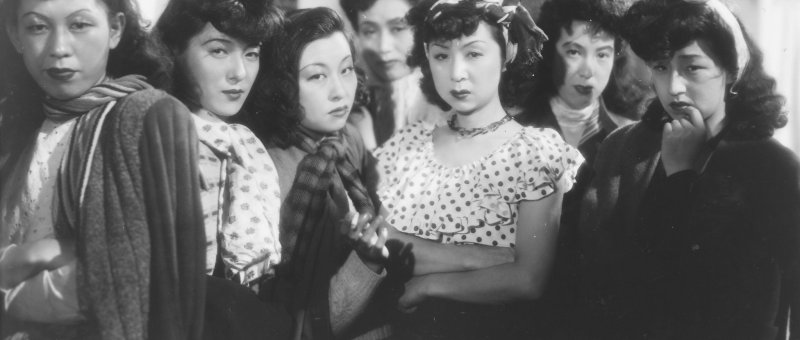
Mizoguchi’s attitudes towards sex work were always complex – despite displaying sympathy for women who found themselves trapped within red light district as his own sister had been, he was also a man who spent much of his life in the company of geishas. Nevertheless Women of the Night veers between empathy and disdain for the hosts of post-war “pan pans” existing in codependent female gangs in which violence and hierarchy were as much an essential part as mutual support. The film opens with a sign which instructs women that they should not be seen out after dark lest they will be taken for prostitutes, respectable women should make a point of being home at the proper hour. Later, when Fusako is picked up by a police raid, she comes across a woman from the “purity board” who wants to hand out some pamphlets to help women “reform” from their “impure” ways and temper their presumably insatiable sexual desire. Fusako quite rightly tells the woman where to go while the others echo her in confirming no one has volunteered to live this way because they like it. Starving to death with a pure heart is one thing, but what are any of these women supposed to do in a world that refuses them regular work when they have already lost friends and family and are entirely alone with no hope of survival?

A third option exists in the form of a home for women which has been set up for the express purpose of “reforming” former prostitutes so that they can lead “normal” lives. The home provides ample meals, medical treatment and work though its attitude can be slightly patronising even in its well meaning attempt to re-educate. Again the home is working towards an ideal which is not evident in reality – there are no jobs for these women to go to, and no husbands waiting to support them. Incurring yet another tragedy, Fusako receives a well meaning lecture from a male employee at the home to the effect that it’s time for women to work together to build a better world for all womankind but Fusako has seen enough of the sisterhood realise that won’t save her either and leaves the man to his platitudes trailing a dense cloud of contempt behind her.

Yet Fusako does change her mind, finally reunited with the missing Kumiko who has also fallen into prostitution after running away from home and being tricked by a boy who pretended to be nice but only ever planned to rob and rape her. In a furious scene of maternal rage, Fusako rails against her plight, enraged by Kumiko’s degradation which ultimately forces her to see her own. Brutally beaten by the other women for the mere suggestion of leaving the gang, Fusako is held, Christ-like, while she pleads for an end to this existence, that there should be no more women like these. The storm breaks and the other women gradually come over to Fusako’s side, depressed and demoralised, left with no clear direction to turn for salvation. Mizoguchi ends on a bleak note of eternal suffering and continuing impossibility but he pauses briefly to pan up to an unbroken stained glass window featuring the Madonna and child. Fusako emerges unbroken, taking Kumiko under her maternal wing, but the future they walk out into is anything but certain and their journey far from over.   


Screened at BFI as part of the Women in Japanese Melodrama season. Screening again on 21st October, 17.10.