Drawing Closer (余命一年の僕が、余命半年の君と出会った話。, Takahiro Miki, 2024)

Takahiro Miki has made a name for himself as a purveyor of sad romances. Often his protagonists are divided by conflicting timelines, social taboos, or some other fantastical circumstance, though Drawing Closer (余命一年の僕が、余命半年の君と出会った話。, Yomei Ichinen no Boku ga, Yomei Hantoshi no Kimi to Deatta Hanashi) quite clearly harks back to the jun-ai or “pure love” boom in its focus on young love and terminal illness. Based on the novel by Ao Morita, the film nevertheless succumbs to some of genres most problematic tendencies as the heroine essentially becomes little more than a means for the hero’s path towards finding purpose in life.

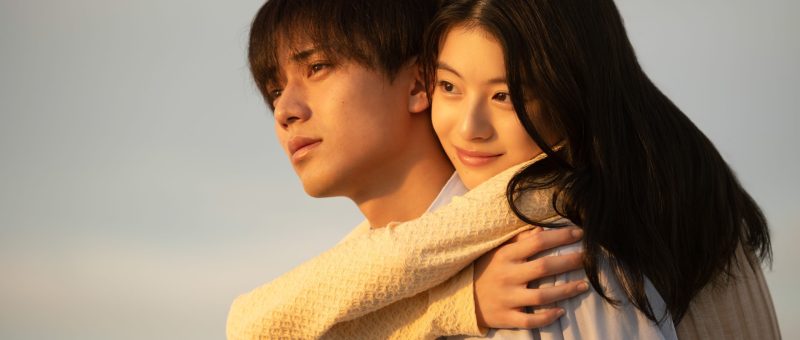
17-year-old Akito (Ren Nagase) is told that he has a tumour on his heart and only a year at most to live. Though he begins to feel as if his life is pointless, he finds new strength after running into Haruna (Natsuki Deguchi) who has only six months yet to him seems full of life. Later, Haruna says he was actually wrong and she felt completely hopeless too so actually she really wanted to die right away rather than pointlessly hang round for another six months with nothing to do and no one to talk to. But in any case, Akito decides that he’s going to make his remaining life’s purpose making Haruna happy which admittedly he does actually do by visiting her every day and bringing flowers once a week.

But outside of that, we never really hear that much from Haruna other than when she’s telling Akito something inspirational and he seems to more or less fill in the blanks on his own. Thus he makes what could have been a fairly rash and disastrous decision to bring a former friend, Ayaka (Mayuu Yokota), with whom Haruna had fallen out after the middle-school graduation ceremony that she was unable to go to because of her illness. Luckily he had correctly deduced that Haruna pushed her friend away because she thought their friendship was holding her back and Ayaka should be free to embrace her high school life making new friends who can do all the regular teenage things like going to karaoke or hanging out at the mall. Akito is doing something similar by not telling his other friends that he’s ill while also keeping it from Haruna in the hope that they can just be normal teens without the baggage of their illnesses. 

The film never shies away from the isolating qualities of what it’s like to live with a serious health condition. Both teens just want to be treated normally while others often pull away from them or are overly solicitous after finding out that they’re ill but at the same time, it’s all life lessons for Akito rather a genuine expression of Haruna’s feelings. We only experience them as he experiences them and so really she’s denied any opportunity to express herself authentically. Rather tritely, it’s she who teaches Akito how to live again in urging him that he should hang in there and continue to pursue his artistic dreams on behalf of them both. Meanwhile, she encourages him to pursue a romantic relationship with Ayaka, in that way ensuring that neither of them will be lonely when she’s gone and pushing them towards enjoying life to its fullest.

Nevertheless, due to its unbalanced quality and general earnestness the film never really achieves the kind of emotional impact that it’s aiming for nor the sense of poignancy familiar from Miki’s other work. Perhaps taking its cues from similarly themed television drama, the production values are on the lower side and Miki’s visual flair is largely absent though this perhaps helps to express a sense of hopelessness only broken by beautiful colours of Haruna’s artwork. Haruna had used drawing as means of escaping from the reality of her condition, but in the end even this becomes about Akito with her mother declaring that in the end she drew for him rather than for herself. Even so, there is something uplifting in Akito’s rediscovery of art as a purpose for life that convinces him that his remaining time isn’t meaningless while also allowing him to discover the desire to live even if his time is running out.


Trailer (English subtitles)

Moonlight Whispers (月光の囁き, Akihiko Shiota, 1999)

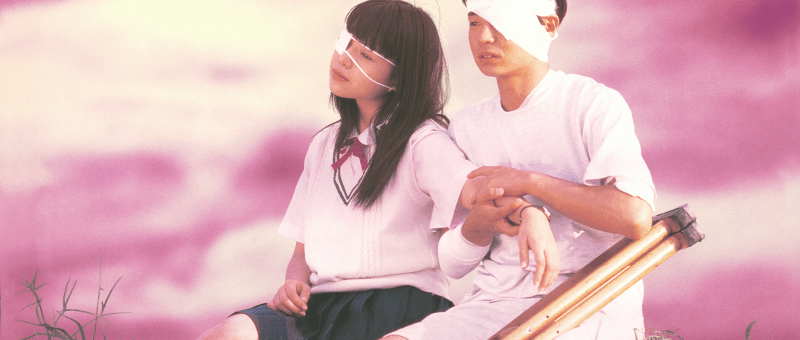
Well established in Japanese cinema, the teenage romance comes with its own series of genre tropes, the barriers standing between the young lovers usually leaning towards the constraints of a conformist society, class differences, or familial disapproval if not introducing a note of inevitable tragedy in serious illness or physical threat. What the youngsters typically do not do or are actively at times prevented from doing is to begin to accept themselves for all they know that to do so may in a sense result in their exile from mainstream society. Yet this is exactly the conclusion with which Akihito Shiota’s debut feature Moonlight Whispers (月光の囁き, Gekko no Sasayaki), adapted from the manga by Masahiko Kikuni, eventually presents us as the teens come to embrace their unconventional relationship while accepting that others may never truly understand. 

Beginning in conventionality, Shiota opens with the sweet and innocent friendship between kendo enthusiasts Takuya (Kenji Mizuhashi) and Satsuki (Tsugumi). Many seem to think they are a couple, but Takuya is quick to correct his friend telling him that they are merely “sparring partners” even going so far as to hand over a love letter, which he knows to be exactly the same as the letter his friend writes to all the other girls, on his behalf. As expected, Satsuki finds his behaviour insensitive, suspecting that Takuya himself has a crush on her but finally confessing her own feelings while he wheedles that he never said anything because of his sense of inadequacy explaining that just to be near her was always enough for him. Following this brief moment of connection, the couple embark on a “normal” teen romance, Satsuki taking the initiative with Takuya in bed with a cold to consummate their relationship. It does not go particularly well, in part because Takuya has a secret. He’s been secretly stalking Satsuki for ages, likes to break into her locker to smell her gym kit, and has a collection of keepsakes he’s stolen from her in addition to a series of illicit photographs and a tape of her using his family bathroom. The tape proves the last straw for Satsuki who then storms out calling him a freak and starts dating her handsome kendo club senior Uematsu (Kota Kusano) instead. 

What Satsuki hasn’t figured out is that Takuya quite likes it when she’s mean to him, which is why he continues stalking her even after she starts dating the very “normal” Uematsu. Unexpectedly, she begins to discover that she quite likes, if not quite the process of hurting him, then watching him suffer which is why she makes him sit silently in a tiny cupboard while she has “normal” sex with Uematsu on a sofa directly opposite. The relationship between them is one of push and pull, Takuya initially embarrassed and ashamed of his masochistic desires explaining that “god made me wrong” while ironically driving Satsuki towards an awareness of her sadism. On the other hand, the relationship had always been unconventional in its reversal of gender roles, Satsuki quite literally leading while Takuya trails behind. She is the first to openly state her feelings and the first to initiate sex, while Takuya is somewhat feminised in his deference and timidity.

Nevertheless, Satsuki struggles to accept her capacity for sadism refusing to tell Uematsu why she broke up with Takuya but explaining that she wants a “normal” relationship in with someone with whom she would be able to discuss anything and everything honestly the irony being that she might have had that with Takuya but cannot with Uematsu because she is filled with internalised shame about the “perverted” pleasure she gains on witnessing Takuya wilfully degrade himself on her behalf. They are already in an accidental sado-masochistic relationship though they of course do not quite have the words to describe how they feel or what it is that exists between them. Their love inevitably heads to quite a dark place but even so leads to a kind of rebirth in which each fully accepts themselves for who they are along with their designated role within the relationship even if also knowing that others may not be quite so understanding. 

For all of its provocative qualities, there is an underlying sweetness in Shiota’s unconventional romance even as he carefully inverts accepted genre norms the conventional indie background score perhaps ironically undercutting any sense that the relationship is actually as “perverse” as the teens sometimes feel it is even as they each struggle with their respective feelings and desires. Nevertheless he ends on a note of anxious ambivalence as the physically and emotionally wounded lovers remove themselves from mainstream society in order to embrace their authentic selves.


Original trailer (English subtitles)

Godzilla Minus One (ゴジラ-1.0, Takashi Yamazaki, 2023)

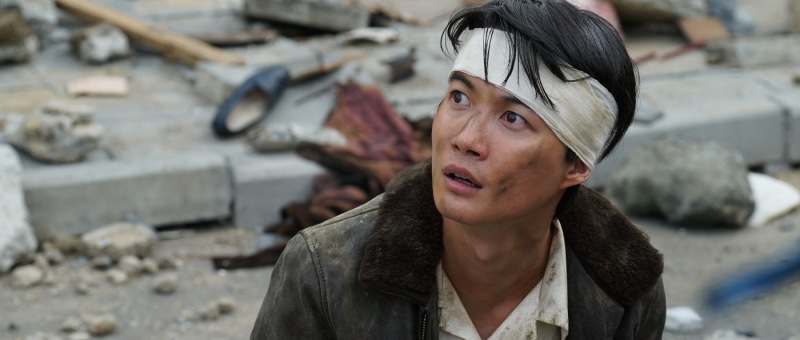
When Godzilla emerges from the waves in Takashi Yamazaki’s entry into the classic tokusatsu series Godzilla Minus One (ゴジラ-1.0), he does so as an embodiment of wartime trauma most particularly that of the hero, Koichi (Ryunosuke Kamiki), a kamikaze pilot who failed die. Some might call his actions cowardice, returning to base siting engine trouble rather than doing what others regard as his duty, though the film implies it’s simply a consequence of his natural desire to live, a desire which the tenets of militarism which in essence a death cult insisted he must suppress. 

But for Koichi as he’s fond of saying the war never ends. He’s trapped in a purgatorial cycle of survivor’s guilt and internalised shame, feeling as if he has no right to a future because of the future that was robbed from other men like him because of his refusal to sacrifice his life. When he first encounters Godzilla on a small island outpost, he is ordered back into his plane to fire its guns at him but freezes while the rest of the men, bar one, are killed. Tachibana (Munetaka Aoki), a mechanic who had already branded Koichi a treacherous coward, gives him a packet of photographs belonging to the dead men each featuring the families they were denied the opportunity to return to. Photographs on an altar become a motif for him, though he has none for his parents who were killed when their house was destroyed by the aerial bombing of Tokyo. A surviving neighbour similarly blames him, directly aligning Koichi’s act of selfish cowardice with the razing of the city.

The return of Godzilla is literal manifestation of his war trauma which he must finally confront in order to move into the new post-war future that’s built on peace and solidarity rather than acrimony and resentment for the wartime past. But then again, the film situates itself in a fantasy post-war Tokyo in which the Occupation is barely felt and the government, which mainly consisted of former militarists, is also absent. Both the US and the Japanese authorities refuse to do anything about Godzilla because of various geopolitical implications making this a problem that the people must face themselves, though they largely do so through attempting to repurpose rather than reject the militarist past. Noda (Hidetaka Yoshioka), a scientist who worked on weapons production during the war, gives a rousing speech in which he explains that this time they will not pointlessly sacrifice their lives but instead fight to live in a better world which is all very well but perhaps mere sophistry when the end result is the same. 

Called back by their old commander, many men say they will not risk their lives or abandon their families once again because they have learned their lessons but others are convinced by the message that they must face Godzilla if they’re ever to be free of their wartime past. Koichi wants vengeance against Godzilla but also to avenge himself by doing what he could not do before. The film seems to suggest that this time it’s different because he has a choice. No one has ordered him to die, and he is free to choose whether to do so or not which is also the choice of being consumed by his war trauma or overcoming it to begin a new life in the post-war Tokyo that Godzilla has just destroyed. 

Despite the desperation and acrimony he returns to, Koichi maintains his humanity bonding with a young woman, Noriko (Minami Hamabe), who agreed to take care of another woman’s child. Even the neighbour, Sumiko (Sakura Ando), who first rejected Koichi and is suspicious of Noriko, willingly gives up her own rice supply for the baby proving that in the end people are good and will help each other even if that seems somewhat naive amid the realities of life in the post-war city ridden with starvation and disease. In any case, it’s this solidarity that eventually saves them, Godzilla challenged less by a pair of large boats than a flotilla of small ones united by the desire to finally end this war. Like Yamazaki’s previous wartime dramas The Eternal Zero and The Great War of Archimedes, the film espouses a lowkey nationalism mired in a nostalgia for a mythologised Japan but as usual excels in terms of production design and visual spectacle as the iconic monster looms large over a city trapped between the wartime past and a post-war future that can only be claimed by a direct confrontation with the lingering trauma of militarist folly.


Godzilla Minus One opens in UK cinemas 15th December courtesy of All the Anime.

International trailer (English subtitles)

Funky Forest: The First Contact (ナイスの森 The First Contact, Katsuhito Ishii & Hajime Ishimine & Shunichiro Miki, 2005)

“Is that normal?” someone asks watching a previously mild-mannered doctor having a right old go at a tiny man baby currently attached to a high school girl’s armpit after being pulled free of its aquatic carapace, “don’t be rude” his companion shushes him. Katsuhito Ishii, Hajime Ishimine, and Shunichiro Miki’s Funky Forest: The First Contact (ナイスの森 The First Contact, Nice Mori: The First Contact) became the best known example of the short-lived trend in surreal comedy which came to dominate a certain kind of Japanese cinema from the late ’90s to early 2000s while perhaps surviving into the present day in a more arthouse friendly form in the deadpan absurdist cinema of filmmakers such as Akira Ikeda (Ambitious Places, The Blue Danube) or Isamu Hirabayashi (Shell and Joint).  

Even so, Funky Forest is wilfully anarchic skipping between a series of interconnected skits that eventually coalesce as something like a unique universe loosely revolving around three “unpopular with women” brothers and a “delusional” high school teacher in a non-relationship with a former student who thinks he’s seen a UFO and is engaged in a battle to save the aliens from the planet Piko-Riko. Two and a half hours long, which is admittedly pushing it for a non-linear sketch comedy, the film is split into two parts, Side A and Side B, joined by a short intermission after which the surrealism intensifies, the design of the title cards changes, and the action shifts in focus from a quiet onsen to an ordinary high school where the teacher and the two adult brothers each work. 

The action begins however with a pair of manzai comedians seemingly performing on some kind of space ship and to an audience consisting of identical military personnel each like the comedians dressed in white and silver while the show is broadcast to a man sitting in a tiny pod-like dream ship. The “Mole Brothers” recur throughout, their set routinely dividing one skit from another while one, Kazushi, also turns up on his own in a couple of other sketches as part of the great connected universe, and though their act being kind of a dud is part of the joke their variety-style humour is an otherwise key indicator of the kind of comedy which is being employed and subverted even as the action becomes ever more surreal. As it happens, each of the major plot strands seems to lead us towards a dance sequence such as that which closes the first half in Takefumi’s (Ryo Kase) strange fever dream which culminates in a Mandarin-language group routine and the first appearance of the weird, shrimp-like creatures which dominate Side B. 

Side B is indeed somewhat through the looking glass as we find the high school kids literally playing these alien creatures like musical instruments some of which need to be plugged in to the human body in one way or another such as the strangely cute rat/shrimplike beings which attach directly to the tongue. Sitting right in front of the high school class which is taught by lovelorn brother Katsuichi (Susumu Terajima) is none other than the film director and Neon Genesis Evangelion creator Hideaki Anno who later turns up again to discuss contemporary anime with guitar bother Masaru (Tadanobu Asano) in one of his many part-time jobs, though the class also includes the young primary school student who featured in the first skit in which she lamented having so much homework and escaped to the dreamscape in order to fight giant orbs with her mind. 

In an odd way perhaps that’s what our three directors are doing too, away on flights of fancy which make little literal sense but seem to have their own internal logic even though the directorial force the film presents is an adorable little scottie dog whose thoughts are translated by someone wearing a giant papier-mâché head. “Thinking is too scary, so I’ll forget about it”, someone explains which may be good advice in deciding to just accept the crazy randomness and play along. Often interrupting the action by cutting to black to mimic old-fashioned channel hopping the directors also throw in a random 20s intermission in the middle of a scene, animation of various styles, and surreal body-horror-adjacent practical effects, before winding up at the funky forest itself, a weird dreamscape somewhere in Hokkaido ruled by a dream-hopping girlband.  “What a strange dream” one character exclaims though in the great scheme of things perhaps it’s easier to make sense of a dream than a defiantly surreal reality.  


Funky Forest: The First Contact is released on blu-ray in the UK on 21st March courtesy of Third Window Films alongside quasi-sequel Warped Forest in a set which includes a feature length commentary from all three directors and a series of deleted scenes.

Original trailer (English subtitles)

The Taste of Tea (茶の味, Katsuhito Ishii, 2004)

Katsuhito Ishii is among a small coterie of directors who developed a cult following in the early 2000s but have since fallen by the wayside. In Ishii’s case, that may partly be because he chose to shuttle between live action and animation, continuing to work on short films and TV projects with the consequence that he’s directed only five (solo) features since his 1998 debut Shark Skin Man and Peach Hip Girl, the last of which, grisly manga adaptation Smuggler, was released back in 2011. Smuggler had perhaps taken him back to the “Tarantino-esque” (Ishii also worked on the animated sequence for Kill Bill), as they were sold at the time, absurdist gangster dramas of his earlier career, but all these years later it is something altogether softer if no less strange that has stood the test of time. 

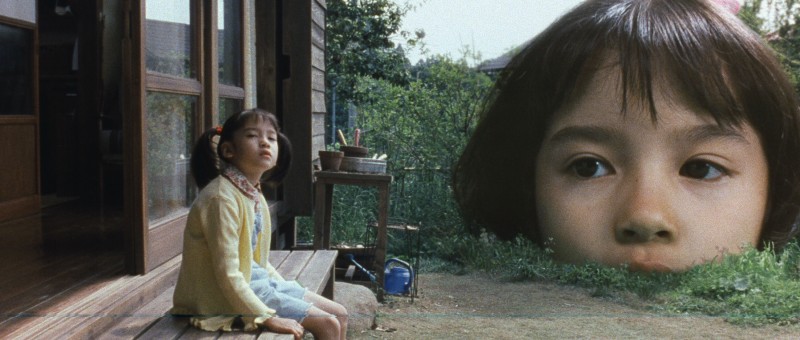
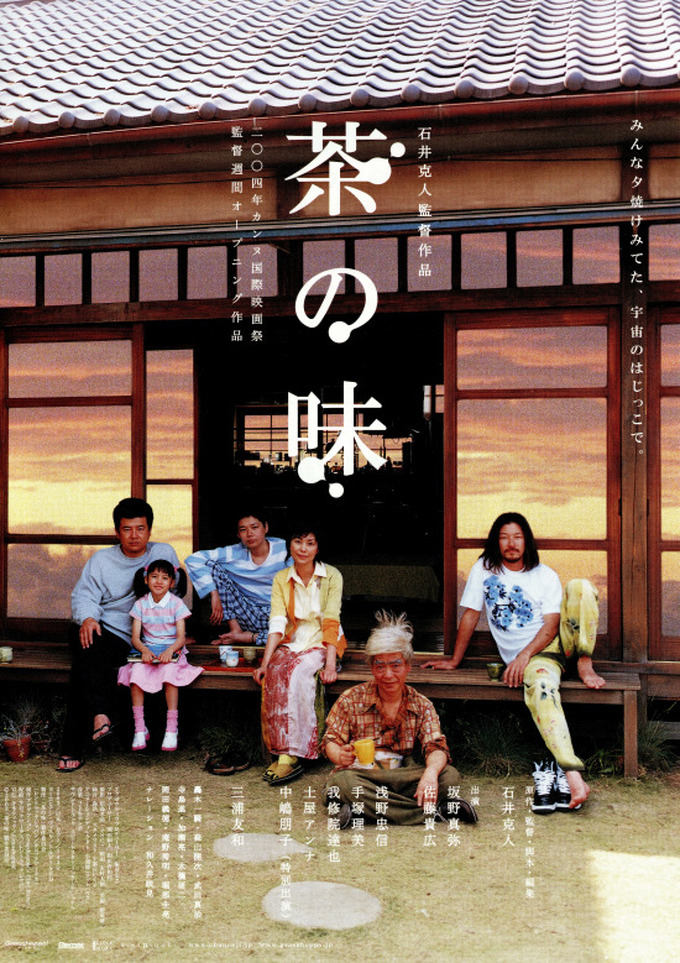
2004’s The Taste of Tea (茶の味, Cha no Aji) with its Ozu-esque title, rural setting, and preference for meditative long takes, is a “conventional” family drama. A collection of surreal episodes in the life of an ordinary family living in the countryside in the contemporary era, there are no real crises though each member is perhaps heading into an individual point of transition which, in the main, they cope with alone. Son Hajime (Takahiro Sato), whose flat-out running opens the film, is in the midst of adolescent romantic confusion while his younger sister Sachiko (Maya Banno) is quite literally plagued by self-consciousness, haunted by a giant version of herself continually staring at her. Mum Yoshiko (Satomi Tezuka) is making an indie animation at her kitchen table in an attempt to assert herself outside of her role as wife and mother, while dad Nobuo (Tomokazu Miura), a hypnotherapist, is a barely visible presence. And then there’s grandad Akira (Tatsuya Gashuin), a playful figure tormenting the children while helping Yoshiko figure out the bizarre poses needed for her project. 

Ishii signals his commitment to the surreal during the opening sequence which begins in darkness with only the sound of Hajime’s panting as he chases the train which will take his love away from him. Sadly he is too late, she is already gone and he can’t even console himself that he did his best because he knows deep down that even if he saw her he would have not have had the courage to say what he wanted to say which in any case he could have said at any other time but never did. As he’s thinking, a bulge develops in his forehead from which emerges a small train, carrying her out of his present and into a nebulous other space of memory. Nevertheless, it’s not long before Hajime finds a new love, a blissed out expression permanently on his face as he dreams of go-playing transfer student Aoi (Anna Tsuchiya). 

For all the idyllic countryside, however, there is darkness even here as the children each discover, Hajime and his dad witnessing a yakuza altercation outside the station, and Sachiko given the fright of her life by a “mud man” in a patch of ground technically out of bounds but central to her quest to be free of her other self. Uncle Ayano (Tadanobu Asano), an aimless young man working as a sound mixer undergoing a wistful moment of his own in insincerely congratulating his high school girlfriend on her marriage, tells his niece and nephew of his own strange haunting incident involving a ghostly gangster (Susumu Terajima) from which he thinks he was able to escape after learning how to do a backflip on the monkey bars. As it happens, that wasn’t it at all, but even small achievements have value as Sachiko discovers on realising that someone else was watching her struggle from a distance and evidently envisaged for her a happy resolution, a giant sunflower eventually engulfing all with a wave of love that also marks a point of transition, washing away its anxiety.  

A timeless portrait of rural family life, Ishii’s vision is surreal but also very ordinary and filled with the details of small-town living with all of its various eccentricities from two nerdy guys working on their robot cosplay to baseball playing gangsters and avant-garde dancers performing for no one on the shore. “It’s more cool than weird, and it stays in your head” Yoshiko says of a song composed by eccentric third brother Todoroki (Ikki Todoroki) in praise of mountains. The Taste of Tea has a strange and enduring flavour, savouring the surreal in the everyday, but finding always a sense of joy and serenity in the small moments of triumph and happiness that constitute a life. 


The Taste of Tea is released on blu-ray in the UK on 5th October courtesy of Third Window Films in a set which also includes a 90-minute making of feature and the “Super Big” animation.

Original trailer (English subtitles)

Pulse (回路, Kiyoshi Kurosawa, 2001)

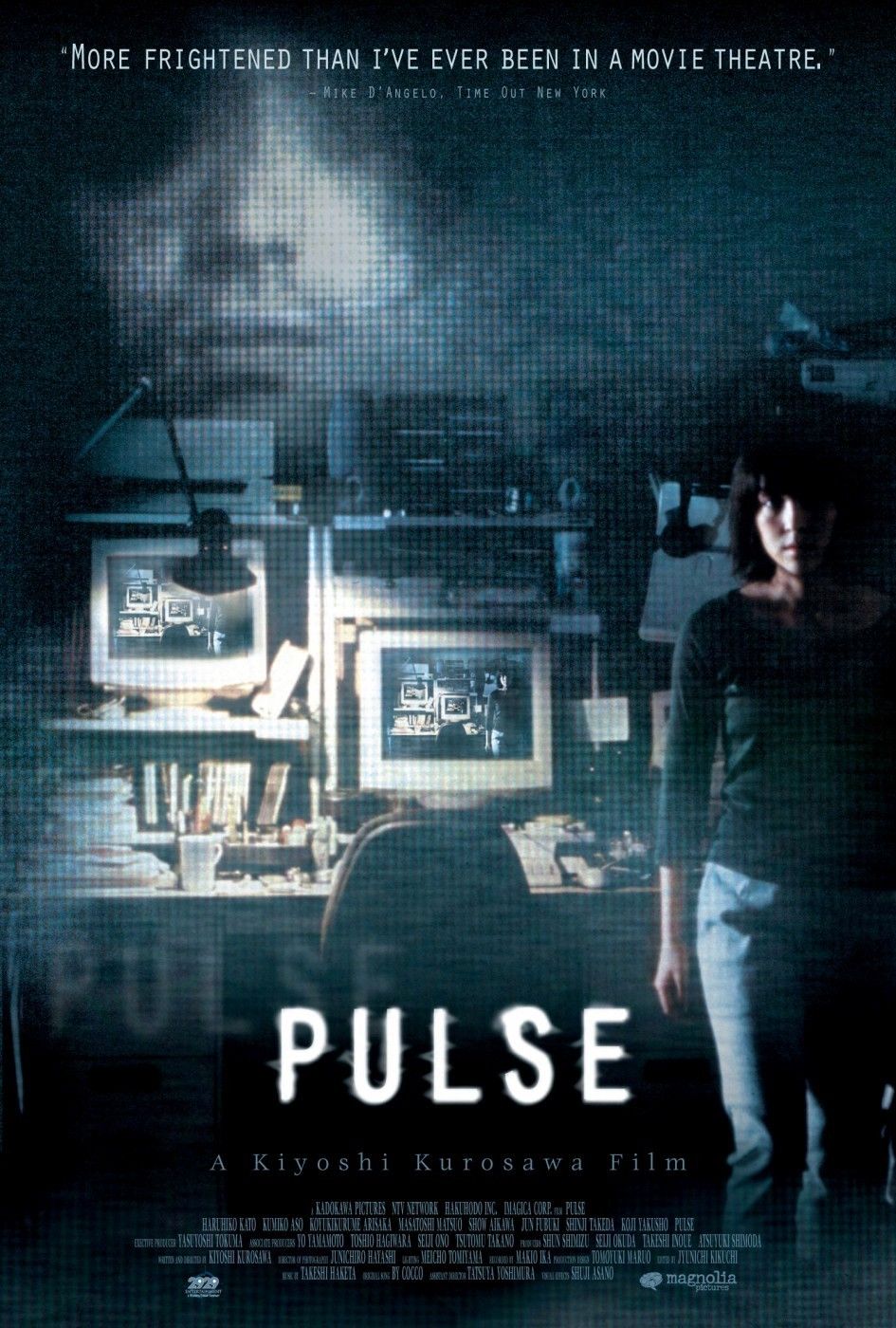
pulse US posterTimes change and then they don’t. 2001 was a strange year, once a byword for the future it soon became the past but rather than ushering us into a new era of space exploration and a utopia born of technological advance, it brought us only new anxieties forged by ongoing political instabilities, changes in the world order, and a discomfort in those same advances we were assured would make us free. Japanese cinema, by this time, had become synonymous with horror defined by dripping wet, longhaired ghosts wreaking vengeance against an uncaring world. The genre was almost played out by the time Kiyoshi Kurosawa’s Pulse (回路, Kairo) rolled around, but rather than submitting himself to the inevitability of its demise, Kurosawa took the moribund form and pushed it as far as it could possibility go. Much like the film’s protagonists, Kurosawa determines to go as far as he can in the knowledge that standing still or turning back is consenting to your own obsolescence.

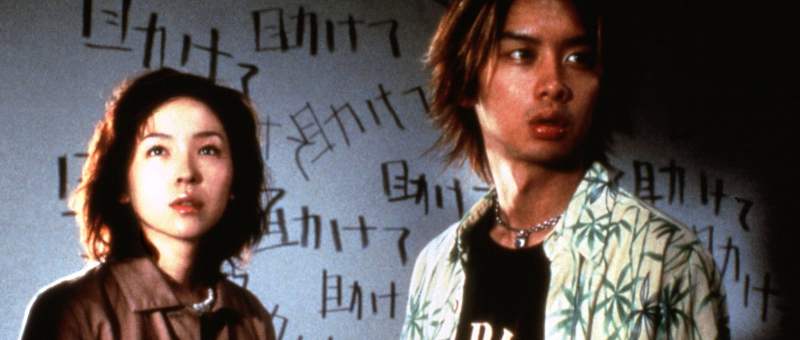
The end of the world starts with a young man staring at his computer screen and the strange images it conjures of the only half alive. Michi (Kumiko Aso), a young woman working at a rooftop plant centre, is dispatched to find out what’s happened to a colleague, Taguchi (Kenji Mizuhashi), who has some essential information stored on a floppy disk. Arriving at his flat she finds him distracted, informing her that the disk is somewhere in a pile scattered on the desk before disappearing off somewhere else. Having found what she came for, Michi looks for Taguchi to say goodbye but finds him hanged in an adjacent room. Barely reacting, Michi deals with the police before meeting up with her colleagues to relate the news, leaving each of them stunned. Another colleague, Yabe (Masatoshi Matsuo), then receives a strange phone call as a distorted voice repeatedly utters the words “help me”.

Meanwhile, economics student Kawashima (Haruhiko Kato) is attempting to set up this new fangled internet thing in his dorm but failing miserably. When he finally gets online and is greeted with the message “would you like to meet a real ghost?” he thinks he’s done something very wrong and hurriedly shuts his computer down. Seeking advice in the uni computer club he gets to know IT professor Harue (Koyuki) who tries to help him but may be beyond help herself.

The Japanese title, “Kairo”, literally means “circuit”, a fixed path of connectedness along which something flows continuously. A “pulse” is itself a circuit, or more accurately an observation of a fixed point in motion along it which maybe continuous or finite. Pulse, in its most immediate meaning is the life force by which we live, the thing which defines the states of life and death, but the “circuit” here is bigger than that which exists in one body alone, extending across the great confluence of humanity, or at least of that still regarded as “living”.

When Harue attempts to fix Kawashima’s internet she prompts him about why he wanted it in the first place (it was hardly necessary back in the still largely analogue world of 2001). He seems confused and replies he doesn’t quite know, it’s just that everyone seemed to be into it. Harue thinks she has his number – he thought he could use it to connect with people, but, she says, that is hopeless, people don’t truly connect, we all live in our separate bubbles. Harue is the most classically “disconnected” of our protagonists. Never having felt at home in the world, she talks of a lifelong fascination with the idea of death as a portal to another one in which it might be possible to live happily with others, only to realise as a teenager that it might also be a gateway to a land of perpetual nothingness and isolation. Terrified of being alone yet unwilling to submit herself to the inherent risks of connection, Harue exists in a permanent state of embittered longing and anxiety in which the cold embrace of death may prove the the only companion she will ever allow.

Harue may be an extreme case but she’s not the only example of disconnected youth. Michi, is also aloof and isolated – a child of divorced parents who has a close if imperfect relationship with her mother (Jun Fubuki) and an absent father she has already rejected. She says she’s OK in the city because she has her friends prompting her mother to warn her that she’s too trusting, too blind to the dangers of city life. Michi’s connections may turn out to be shallow, but unlike Harue she remains broadly open, seeking physical connections rather than digital ones. She visits her friend’s apartment, and makes a point of chasing after Yabe even after her boss warns her that friendly words can wound and that wounding a friend is also an act of self harm. Compelled to travel onwards, she resolves to keep on living, continue seeking connections until there are no more left to seek.

Kurosawa’s world is one of essential interconnectedness which finds itself frustrated by a mysterious forces leaking in. Yet the ghosts are not all on the other side, these are people who are spiritually dead while physically alive – isolated, defined by routine and expectation, and endlessly unfilled. “Trapped inside their own loneliness” as one character puts it, the disappeared gain a kind of immortality but it’s one filled with eternal longing and isolation. These “broken connections” are continually in search of vulnerable ports, flooding a system which has already begun to fail, and threatening to destroy that which they seek. The “ghosts” have destroyed the machine, but Kurosawa’s apocalyptic conclusion, melancholy as it seems to be, offers as much a hope for rebirth as it does a condemnation to existential loneliness.


Now available on blu-ray from Arrow Films!

Arrow release EPK

Rock’n’Roll Mishin (ロックンロールミシン, Isao Yukisada, 2002)

rock'n'roll misshinYou know how it is, you’ve left college and got yourself a pretty good job (that you don’t like very much but it pays the bills) and even a steady girlfriend too (not sure if you like her that much either) but somehow everything starts to feel vaguely dissatisfying. This is where we find Kenji (Ryo Kase) at the beginning of Isao Yukisada’s sewing bee of a movie, Rock ’n’ Roll Mishin (ロックンロールミシン). However, this is not exactly the story of a salaryman risking all and becoming a great artist so much as a man taking a brief bohemian holiday from a humdrum everyday existence.

Kenji’s life probably would have continued down a path of corporate serfdom uninterrupted if he had not run into old schoolfriend Ryoichi (Hiroyuki Ikeuchi) who, he learns, is setting up an indie fashion label with some of his friends. Ryoichi has to leave pretty quickly but he pastes a note on the outside of the restaurant window with his contact details so Kenji can find him again.

At work the next day Kenji “enjoys” some “banter” with an extremely unpleasant corporate stooge colleague who seems to be under the mistaken impression that he and Kenji are friends. After making some misogynistic comments about how Kenji is too much of a pushover and should “knock some sense” (literally) into his girlfriend, his colleague sets in on some typical salaryman careerist chat which is exactly the kind of thing Kenji is becoming disillusioned with.

Having failed to meet her at the restaurant, Kenji returns home one evening to find his girlfriend waiting outside his flat. She comes in and immediately takes off her clothes and gets into bed all without saying anything at all. When her T-shirt accidentally blows off the washing line and gets caught on some cabling below, Kenji remembers about his friend’s fashion company and decides to pay them a visit. Kenji is taken in by the sense of freedom and individual enterprise he finds in the workshop in contrast to his corporate drone office job. Eventually Kenji quits and joins the fashion gang full-time though he quickly finds that making a dream come true is surprisingly uphill work.

Unlike other films of this nature, there’s very little inspirational content to be found in Rock ’n’ Roll Mishin. The “mishin” of the title means a sewing machine and early on Ryoichi teases Kenji by telling him that his is a “rock and roll” machine because it beats out 8 stitches a second and if you really step on it it goes up to 16. Ryoichi’s teacher and mentor, Megumi (Ryo) lets Kenji in on the joke by explaining that it’s really called a “lock” machine because it holds the fabric in place for you. The other member of the team is a fashionista, Katsuo (Kenji Mizuhashi), who wants to create fashion that makes a sun of your heart so that you shine forth with an inner light. Needless to say, though the original three all have fashion skills from Ryoichi who’s the designer to Megumi who is a fashion teacher and Katsuo who studied fashion in London, nobody has any kind of business sense or a real business plan for this fledgling business.

In another film this might be where Kenji’s salaryman experience plays in, completing a missing element of the group which will enable them to triumph over adversity. However, Kenji’s experience is also fairly limited but the sensible economic advice he has to offer largely falls on deaf ears with his more creatively orientated teammates. They may understand the business on some level – at least enough to know what they can realistically expect to charge for their wares but are completely clueless about how they can go about managing their costs and maximising their profits. They also don’t really seem to know how to promote their business in anything other than a grungy, underground way which might be cool but is unlikely to take off without a serious amount of cynical marketing gimmickry which Ryoichi isn’t prepared to go for.

What Rock ’n’ Roll Mishin has to say about the youth of today isn’t very encouraging. It paints them as a group of unrealistic dreamers unwilling to put the work in to achieve anything. They might start to go for it in the beginning, but as soon as things start to look up they get scared and childishly run away rather than following through. Ryoichi is very much the tortured artist type, so fixated on maintaining his own image of artistic integrity that he’s completely unable to commercialise to work in any effective kind of way. Kenji is sucked in by the atmosphere of creative freedom but ultimately he has very little to offer and even if he is the one most affected by this new, bohemian lifestyle he’s also the best placed to recognise that you can’t live on dreams alone.

It’s tempting to read Rock ’n’ Roll Mishin as an ultra conservative, stick to the path message movie. It almost wants to say that it’s just not worth trying anything new because you’ll never see it through and you’ll be heading back to your old life with your tail between your legs quicker than you can say haute couture. However, even if the typical underdog triumphs against the odds narrative doesn’t materialise, Kenji at least comes to view his time in the fashion business in a broadly positive light. What he values is the time spent with friends, and, even if it didn’t work out quite the way they would have liked they still created something that was a success on its own terms and was ultimately appreciated by fellow travellers along the same path which, in the end, is what it’s all about.


Not exactly a trailer but this music video for one of the songs used in the film, Rock ‘n’ Roll Missing by Scudelia Electro, contains some footage from the film (lyrics in English)