The Fort of Death (五人の賞金稼ぎ, Eiichi Kudo, 1969)

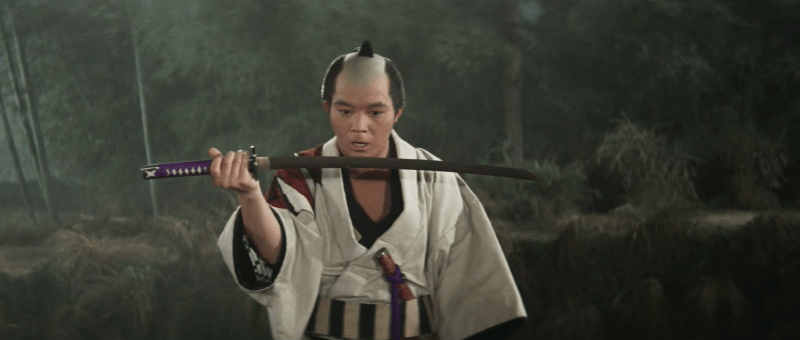
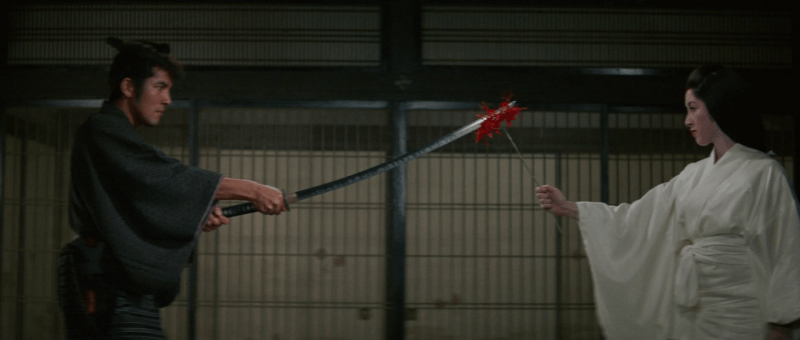
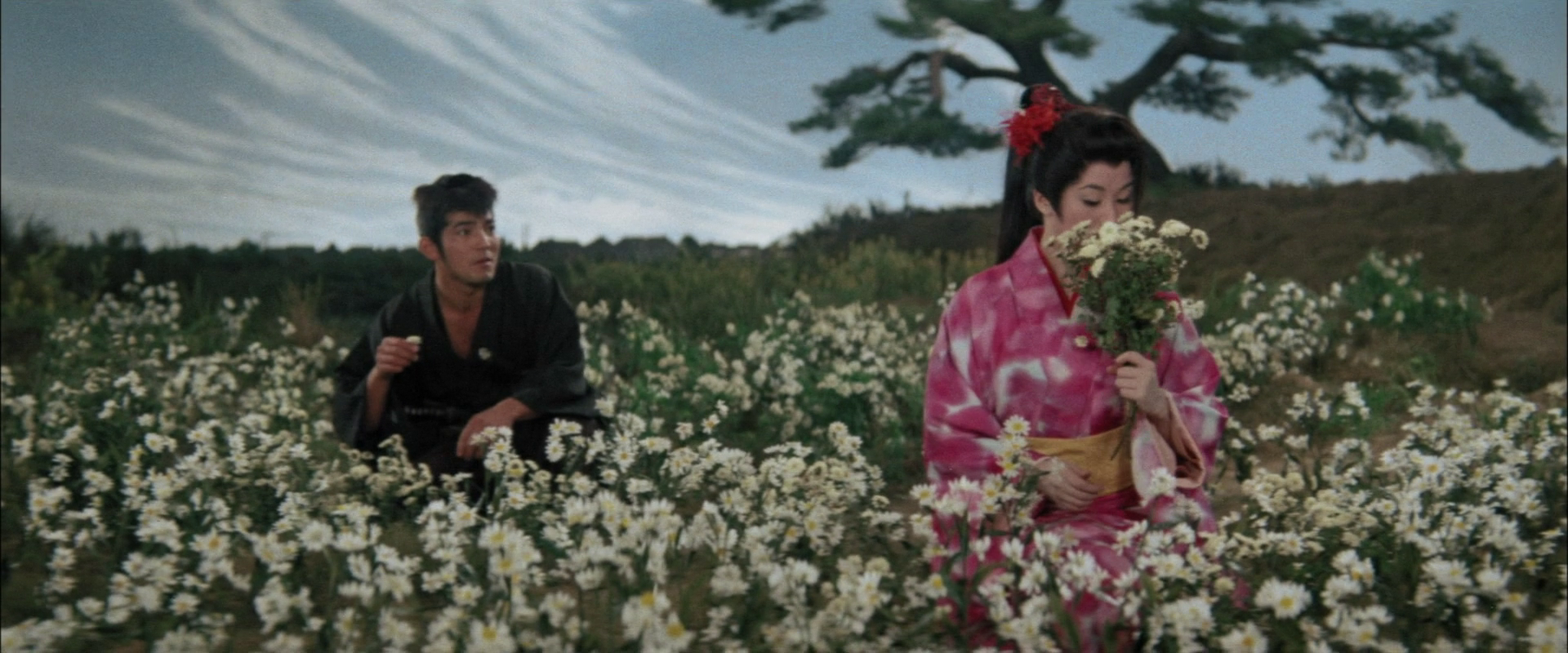
Shikoro Ichibei (Tomisaburo Wakayama) returns yet this time seemingly on the opposite side in the second in the Bounty Hunter series, The Fort of Death (五人の賞金稼ぎ, Gonin no Shokin Kasegi) this time directed by Eiichi Kudo. If the first film had been an Edo-era take on James Bond, the second is very much Spaghetti Western and feudal tragedy as Ichibei finds himself coming to, if not quite the rescue of the oppressed farmers, then at least moral support in taking stand against corrupt and self-interested lords.

This might be surprising in that in the first film Ichibei had been a shogunate spy and seemingly close friend of the man himself, yet this time around he’s working as a doctor while taking bounty hunter jobs to earn extra money to support the poor people who come to him for help. Like a true western hero, he has a small posse which includes the ninja lady, Kagero (Tomoko Mayama), from the first film only she’s being played by the actress who previously starred as his other love interest. In any case, he’s approached by a young man from a small village which is making a last-ditch appeal to the local lord to lower their tax burdens so they don’t all starve, though so far the lord’s response has been to add additional taxes and kill people for not paying them. 

On his arrival, Ichibei soon realises that the man who recommended him was actually the leader of the government forces during a previous peasant uprising at which Ichibei had also tried to help the farmers. In that case, Bessho (Shin Tokudaiji) had won, but it didn’t do him any good. His clan was dissolved and he became a wanderer, taken in by the village and now indebted to them, hoping Ichibei can help but fully aware of the brutality with which such challenges to the feudal order are put down. 

The lord later suggests it’s not really his fault. He has to curry favour with Edo to protect the domain, which is why he agreed to participate in a construction project that led him to confiscate all of his farmers’ rice and wheat. But then it’s also true that he is vain, and cruel. On realising the village has hired a man like Ichibei, some of the retainers suggest reopening negotiations but others complain that they must now crush the farmers or face ruin themselves while trying to ensure the strife in their domain does not come to the attention of the government in Edo. 

Part of their problem is that Ichibei simply has better technology in the form of gatling guns. Tying into the western themes, Ichibei is well versed in the use of firearms, while the samurai are mostly reliant on traditional weaponry such as arrows and swords. The lord later insists on using some canons, but is oblivious to the risk as the shogun has banned the use of gunpowder and using them may end up bringing him to his attention and thereby landing him in a lot of possible fatal trouble. 

In any case, it’s the villagers who suffer. Ichibei encounters a woman who has lost her mind, refusing to give up her baby who has died of malnutrition while her husband was executed for non payment of taxes. Meanwhile, some of the other ronin they hired attempt to rape a villager, and a young couple are prevented from marrying because the headman is worried that it would send the wrong message in a time so much strife. Then again, a woman basically attempts to rape Ichibei, descending on him while he’s still asleep which otherwise leads into a fairly comic sequence in which Ichibei must fight of a bunch of ninjas intent on stealing the gatling gun while dressed only his underwear.

Darkly comic it may be, but also surprisingly violent with a ninja at one point using a dead body as a Molotov cocktail not to mention the severed heads and limbs of the battle scenes. Ichibei is fully aware that the battle is a forlorn hope, but also that the villagers have no choice and perhaps this is better for them than simply accepting their fate and starving to death. Even so, he reserves his final words for the Edo inspector who arrives only when the battle is done to survey the scene, berating him that he ought to know what happened here from looking at the battlefield and deducing that this domain has not been run particularly well. It’s a tragedy of feudalism that provokes a tearful rage from the compassionate bounty hunter trying his best to heal the sickness in his society, though perhaps like the patient who visits him with a venereal complaint concluding the best solution is to cut it right off.


Roaring Fire (吼えろ鉄拳, Norifumi Suzuki, 1981)

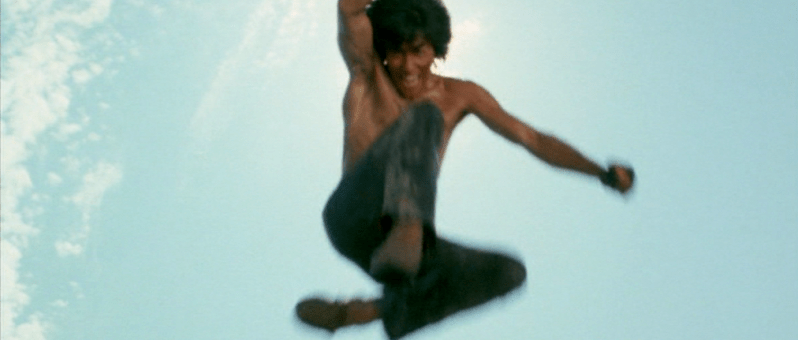
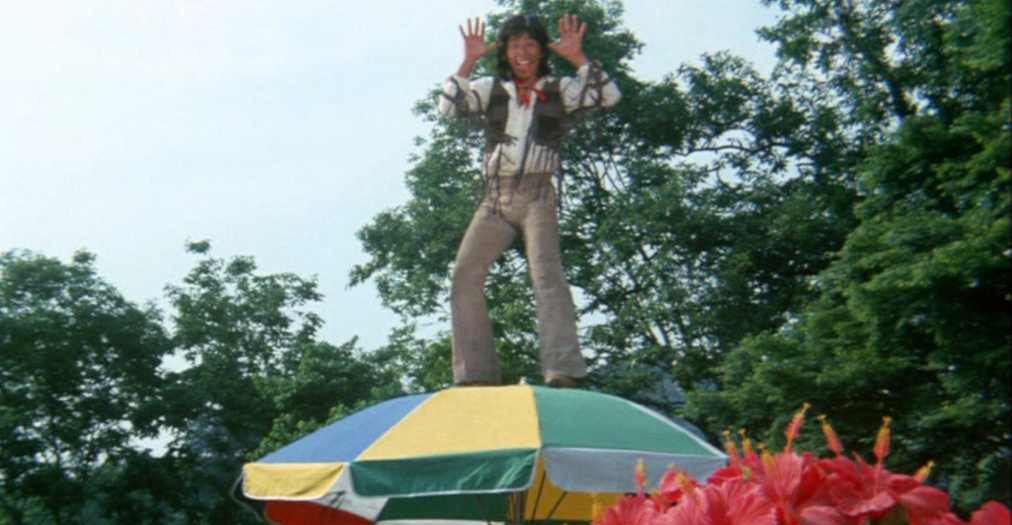
If Chiba’s karate films and the Sister Streetfighter series had been influenced by Shaw Brother’s kung fu films, Roaring Fire (吼えろ鉄拳, Hoero Tekken) is an homage to contemporary action and in some senses anticipates Jackie Chan and heroic bloodshed though in other ways harking back to the classic serial with its diamond-themed MacGuffin. A vehicle for rising action star Hiroyuki Sanada, the film reflects a new internationalist Japan but also confronts the toxic legacy of the feudal past in the fall of a once noble house.

Joji (Hiroyuki Sanada) has spent his entire life on a ranch in Texas only to discover from a deathbed confession by the man that he thought was his father that he had been kidnapped as an infant and is actually the son of the wealthy Hinohara family. But on travelling there, he immediately finds himself in the middle of a conspiracy. His twin brother Toru has gone missing after going to London to study ophthalmology in order to cure his sister Chihiro’s (Etsuko Shihomi) eye condition. Though his uncle, Ikki (Mikio Narita), welcomes him with open arms, a weird ventriloquist act by a man called Mr. Magic (Shinichi Chiba) that he’s taken to see suggests that the plane crash his parents died in may not have been an accident and his uncle killed them to take over the family business. 

Ikki is mixed up in the drugs trade with Hong Kong Triads and in keeping with Suzuki’s other films, we once again have a new solution to smuggling in hiding drugs in underripe banana skins. Lured to Ikki’s underground lair which has a large photo of Hitler on the wall and other Nazi memorabilia scattered around, Joji is given the “join us or die” speech, but ultimately manages to escape with some help from Abdullah the Butcher who is working as some kind of bodyguard but apparently takes a liking to Joji and declares they will be the best of friends forever after their initial fight. In any case, we soon realise that Ikki’s purpose in life is feudal revenge in that his mother was a geisha who died young because of her poverty and the nature of her work while staring at the Hinohiras’ giant mansion though his father apparently took no responsibility for him until after his mother died. His only goal in life is to take over the estate and otherwise destroy the rest of the family that never fully accepted him. 

Of course, Joji is in his way, but Joji doesn’t really want this legacy either and only wants to save his sister who turns out to be a kung fu ace despite her blindness but is otherwise unable to escape. In his final confrontation with Ikki, he reclaims the name of the man who raised him, Hibiki, and rejects that of Hinohara as if symbolically refusing his feudal inheritance. Mr Magic, really an Interpol agent, makes an executive decision to let him go which is also a representative authority figure setting him, and the younger generation, free from the feudal legacy to live a more international life. 

Nevertheless, Suzuki fills the film with a series of high-impact action sequences and extreme stunt work such as a crazy bus chase through Hong Kong which predates that in Police Story by a few years. The shuttles back and forth between Hong Kong and Japan, but it’s clear here that Ikki and his weird Nazi cohorts are the villains rather than the Hong Kong gangsters who really just exist and otherwise only factor into the story because of their desire for Queen of Sheba diamond that Joji’s birth father hid before he died so Ikki wouldn’t get his hands on it. A possibly poor taste allusion to the holocaust aside, Suzuki sticks to the plucky teen adventure format in which Joji gets into fights with the local guys and is quickly befriended by Chihiro’s teenage friends who all hang out at the mansion, rather than opt for a gloomy sense of paranoia and conspiracy even as Joji finds himself at the centre of a Hamlet-esque plot in which his uncle has usurped the throne and he must return to set it right. Yet rather than restoring the existing order, Joji effectively resets it by ending the family’s influence and then moving on into a freer existence shorn of filial responsibilities. 


Trailer (no subtitles)
Big Time Gambling Boss (博奕打ち 総長賭博, Kosaku Yamashita, 1968)

A Shakespearean tragedy of blood and honour, Kosaku Yamashita’s Big Time Gambling Boss (博奕打ち 総長賭博, Bakuchiuci: Socho Tobaku) discovers only fatalism and futility in the nobility of the yakuza code. The tragedy is that at any moment anyone could make a free choice to walk away, to abandon these arbitrary notions that convince them they must kill their friends and let their enemies go free, but they don’t because spiritually they cannot. Abandoning the yakuza code would in its own way a kind of death and mentally unsurvivable. 

There is however a greater tragedy in play. The film opens in the spring of 1934 with a villain remarking that it’s absurd to restrict oneself to one’s home terrified while a sword and the Japanese flag appear behind him. The catalyst for all this drama is Japan’s imperialist expansion. Yakuza fixer Senba (Nobuo Kaneko) and the shady Kawashima have hatched a plan to get all the yakuza clans to unite in a “patriotic” mission to traffic drugs to the frontlines looting as they go. Noble boss of the Tenryu Awakawa refuses, reminding them he’s just a simple gambling man and has no desire to get involved with politics before collapsing with a stroke. With Awakara alive but bedridden and no longer able to communicate effectively, the Tenryu decide to nominate a successor. The ideal candidate, Nakai (Koji Tsuruta), declines the offer on the grounds that he is a transplant from another gang in Osaka and thinks it would be inappropriate for an outsider to lead the clan. He proposes that his sworn brother, Matsuda (Tomisaburo Wakayama), should be appointed, though he is currently surviving a prison sentence so a caretaker should serve in his stead until his release. Most think this sensible though the proposed caretaker, Ishido (Hiroshi Nawa), also declines given the rules of seniority despite the fact that he is Awakawa’s son-in-law and so dynastic succession would also seem permissible. 

It’s during all of this finagling that Senba begins manipulating events to his advantage, gently manoeuvring the other lieutenants towards accepting Ishido as the new boss while he has no idea he’s being used as a pawn in Senba’s nefarious nationalist plotting. When Matsuda is released early, the entire situation kicks into overdrive in his outrage that the codes of rank have not been respected and that a man who is his inferior now sits at the head of the clan in a place he think’s rightfully Nakai’s but in light of his honourable refusal no one’s but his own. Even Matsuda later recognises his hot-headed recklessness in directly challenging Ishido over his decision to accept, insisting that the proper thing to do in his position would have been to persuade Nakai to take the job. Meanwhile, his own righthand man who’d been slumming it as a mere labourer in his absence, is dragged into intrigue in foolishly defending his honour by recklessly attacking Ishido’s men incorrectly believing they had provoked another gang’s attack on Matsuda little knowing it was all part of Senba’s plot. 

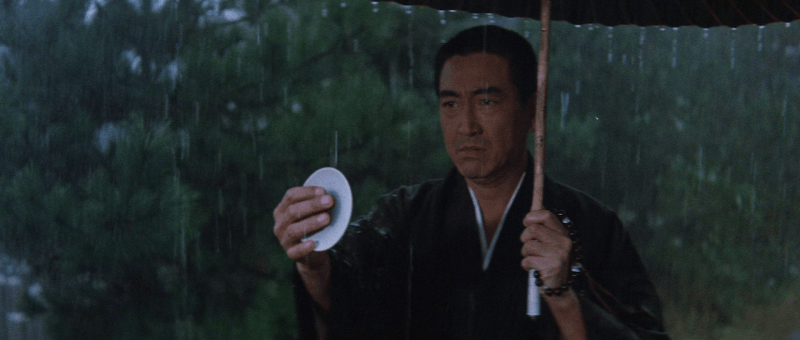
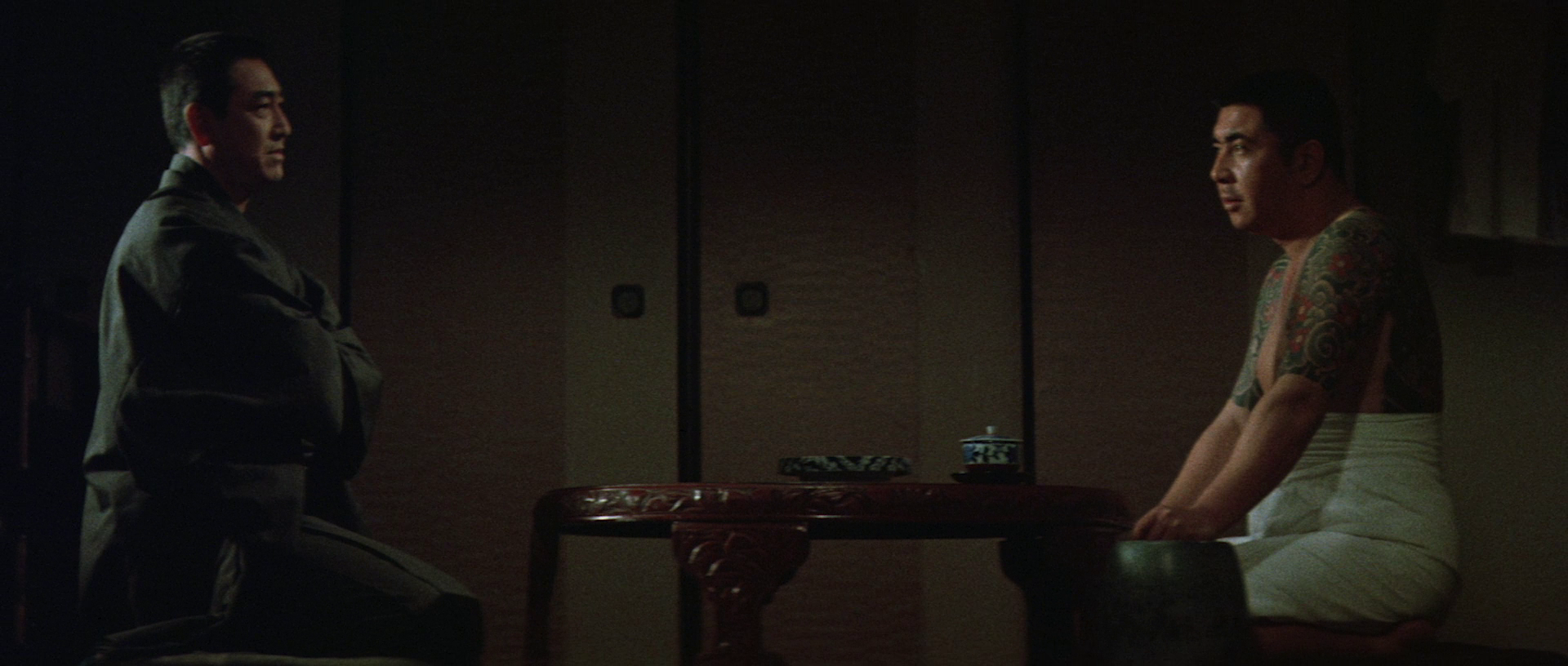
Nationalist trappings aside, Senba’s villainy is obvious from the moment he tells Nakai he thinks Matsuda was foolish for going to prison on the clan’s behalf and that he should have just found a scapegoat and put the blame on them, signalling himself a member of the new amoral yakuza who does not believe in giri and has no ninjo. Nakai rather is the opposite, as his old boss confirms in praising him for his correct decision to turn down the succession as it would not be right for him to accept as one who did not originate in their gang. Matsuda meanwhile pays too much attention to the letter of the code and not its spirit, obsessed with Ishido’s transgression and unable to let the matter drop to live a quiet life even as Nakai tries to convince him that the decision has been ratified by the lieutenants and the boss and so he must obey it. In a poignant moment, Nakai brings out the cup they used to seal their friendship and tells him that he will choose the clan, breaking the cup if Matsuda does not agree to accept a minimal degree of humiliation in returning with the intention of lying low and subtly reminding him that if he does not Matsuda will be placing a heavy burden on him that he may be forced to inflict lethal violence on his best friend and in fact brother-in-law. Realising the gravity of the situation, Matsuda immediately backs down, but events are now in motion that neither of them are capable of stopping. 

Of course, they could walk away but they don’t. Nakai offers the opportunity to Matsuda’s remorseful foot soldier Oto, telling him to leave the clan and take the woman he loves far away to live a peaceful life but of course he can’t because of his debt of loyalty to Matsuda. They are all trapped by the code which they follow and the villains ignore, laughing at them all the way. Then again, that’s what men like Nakai are for, born to set things right even if it comes at great personal cost. Even he finally snarls that he’s merely a murderer, rejecting any sense of honour in his actions while throwing a sword at the symbol of the system which has defined his life and submitting himself to the automatic operation of law of the state as a kind of martyr for system in which he may no longer believe. 


Trailer (English subtitles)

Ninja’s Mark (忍びの卍, Norifumi Suzuki, 1968)

Many have tried to end the Tokugawa line. Few have done so by covering a courtesan’s legs in fish scales to put the Shogun off his stride. Based on a book by Futaro Yamada, Norifumi Suzuki’s Ninja’s Mark (忍びの卍, Shinobi no Manji) is at heart a romantic tale in which love is “part of the game” but also apparently the one trick a ninja can’t escape. Perhaps that’s why Shogun Iemitsu at the comparatively late age of 30 has failed to produce an heir with any of the beautiful yet emotionally distant courtesans of the inner palace many of whom also seem to be ninjas, therefore provoking a constitutional crisis.

Aside from that, it seems the ninja plot is a kind of revenge against the Tokugawa carried out by the last remnants of a house that was dissolved by the Toyotomi. There are in fact three ninja clans all clustering around the palace, Iga, Koga, and Negoro, each of whom have different kinds of skills. Technically, some of them are in the employ of the Shogun’s disinherited younger brother Tadanaga (Shingo Yamashiro), but others of them are working strictly for themselves and their revenge. In any case, their plan is to prevent Iemitsu from fathering an heir by putting him off sex essentially by making it freaky (in a bad way). Thus one of the ninjas uses his ability to transform objects so that the courtesan’s legs are covered in fish scales. Another plan sees a ninja body swap with one of the women so that Iemitsu’s sperm ends up inside him where it obviously has nowhere to go. Meanwhile others hatch a plan to steal some of Tadanaga’s seed to use on the women in the inner palace to cover up Iemitsu’s potential infertility seeing as it is after just as good being of the Tokugawa line. 

This particular ruse is suggested by Toma (Isao Natsuyagi), the disenfranchised former member of the Yagyu school turned ninja ronin they bring in to solve the problem. He quickly homes in on Kageroi (Hiroko Sakuramachi), a female ninja, as the villainess whose special power is poisoning men with love and desire by means of the spider lily plant. But as Toma points out to her, she is also a prisoner of her skill in that if she were to fall in love she would inevitably kill her lover. Of course, he survives her first attempt to kill him, leading her to fall in love with Toma and become conflicted in her mission while he plays on her emotions to escape but eventually realises they may be more genuine than he first realised. 

In this, Suzuki brings some of his trademark romanticism particularly in the colourful art nouveau aesthetics and frequent use of rose imagery. Though the film is clearly designed to lean into the erotic with frequent use of nudity and salacious scenes including a brief moment of lesbian seduction, it eventually heads towards romantic tragedy in which the debauched and nihilistic Toma and the wronged Kageroi discover a love made impossible by their ninja code and the times in which they live. Having been ordered to kill her, Toma declares that he will marry Kageroi in the next life and returns to her the Buddhist Manji that is the “ninja mark” of the title. 

Nevertheless, the dialogue is often suggestive as in Kageroi’s curse that Toma’s “sword” will rot, while it’s also Toma’s “sword” that alerts him to the danger she presents. Toma too claims to derive his ninja powers from his “sword” having apparently concentrated them by repressing his sexual desire and swearing off women. He says that he seals all his “distracting” thoughts into a virgin, closing off all her senses and placing her into a coma until he breaks the spell. Even so, he admits that without his “sword” he is just a man, and as a man claims to love Kageroi, but as long as he has his “sword”, and she her “lily”, their love is impossible. 

But this repressed love seems to pose less threat to the social order than the lack of it in Iemitsu who is bored with his courtesans and cannot conceive an heir. Constitutional crisis is averted only through a little ninja trickery and a convenient ruse to overcome Iemitsu’s infertility so that in time he produces five sons and a daughter, which honestly seems like it might just present another set of problems in about 30 years’ time. Like similarly themed ninja pictures, Suzuki makes good use of surrealist imagery and colour play alongside the kind of onscreen text later used in jitsuroku yakuza films to name each of the ninja’s key skills and which clan they belong to. What he always returns to, however, is the sense of romantic tragedy in a world seemingly poisoned by ambition in which love itself is rendered an impossibility. 


*Norifumi Suzuki’s name is actually “Noribumi” but he has become known as “Norifumi” to English-speaking audiences.

Eleven Samurai (十一人の侍, Eiichi Kudo, 1967)

“If no one denounces the absurdity of this world, then our descendants will keep suffering,” a soon-to-be ronin insists in Eiichi Kudo’s revengers tragedy, Eleven Samurai (十一人の侍, Juichinin no Samurai). It seems clear from the outset that their actions will have little effect no matter whether they succeed or fail because the enemy is feudalism which may be approaching the end of its life but is definitely not dead yet. They can at least attempt to avenge their clan even if they can’t save it while refusing to let an entitled, selfish lord get away doing whatever he likes just because he happens to be the son of the former shogun and brother of the current one.

The opening scenes see Nariatsu (Kantaro Suga) chasing a deer having declared himself a “real hunter”. He ignores the cries of his men to watch where he’s going and sails over the border into the territory of Oshi which amounts to an invasion seeing as he is armed and has no permission to be there. The deer gets away, but Nariatsu shoots an old woodcutter whom he felt to be in his way with his bow and arrow. The Lord of the Abe clan that rules Oshi immediately takes him to task and tells Noriatsu that his behaviour is unbecoming for the son of the former shogun. He’s committed a murder in their territory, but they’re prepared to let it go as long as he leaves as soon as possible. But Nariatsu doesn’t like being told what to do and simply shoots the lord in the eye, potentially sparking a diplomatic incident. 

The Abe clan try to lodge a complaint in Edo, but are shut down by courtier Mizuno (Kei Sato) who fears that to acknowledge an event such as this would damage the moral authority of the Tokugawa regime. He decides to cover the whole thing up by claiming it was the Abe clan who insulted Noriatsu. The Abe clan will then be dissolved, and Oshi essentially gets nationalised. All of which suits Nariatsu just fine because he wants to take control of Oshi and expand his territory anyway. Part of his petulance seems to stem from the fact that he feels hard done by with such a small inheritance when his brother became the Shogun and received multiple fiefdoms. The previous Shogun, Tokugawa Ieyoshi, had produced an unusual number of children which became quite a problem in that he had to find lands for them all and eventually hastened the demise of the shogunate because of the additional strain. 

But Nariatsu is also an overgrown child who has no idea how to do anything for himself and no concern for the feelings or fortunes of others. When instructed to do something he doesn’t want to, Nariatsu petulantly stamps his feet and complains, and when his actions are challenged he simply replies that he’ll be telling his father. In fact, he is so infuriating that it’s likely most of his men secretly want him dead too, including his chief adviser Gyobu (Ryutaro Otomo) who was once the General Inspector but is now expected to babysit this absolute buffoon. Even though Nariatsu knows the Abe clan will be trying to kill him, he still sneaks out to the red light district and gets blind drunk with geisha which in itself is conduct unbecoming for a high ranking samurai such as himself. 

As such, he represents almost everything that’s wrong with the feudal order while Mizuno represents the rest. It’s Mizuno that secretly plots against the plotters, manipulating them into giving up their assassination mission by claiming to have switched sides only to backtrack and reveal he’s actually still working for Nariatsu fearing a reputational loss for the Tokugawa. Chief revenger Hayato (Isao Natsuyagi) is also banking on this fear of reputational damage, certain that the Shogunate won’t be able to bear the humiliation of Nariastsu being killed by a ronin so will instead claim that he died from an illness. Vowing to avenge the clan, Hayato righteously gives up his position to become one so that the Abes won’t be linked to the crime and is joined by 10 more similarly annoyed samurai. Six of them are already “dead” having been asked to commit seppuku for recklessly attacking Nariatsu on their own and blowing the whole operation. 

Hayato at least believes this to be a suicide mission. He leaves his loving wife and home and allows people to think he’s run off with Nui (Eiko Okawa), the younger sister of one of their number who died before he could join them. They do this because they think it must be done, and also because if no one stands up to samurai oppression it will never end. Wandering peasant Daijuro (Ko Nishimura) agrees with them. He wants revenge on the samurai for raping his sister after which his father and brother took their own lives. Nariatsu is as good as anyone else and he does very much need to die. 

But despite Daijuro’s homemade cannons, nothing quite goes to plan. Kudo sets his final battle in an atmospheric, misty valley that is an obvious stand in for the underworld. Hayato may succeed in killing Nariatsu but it’s a pyrrhic victory. Though he vowed “to put an end to this ridiculous world,” a samurai cannot really win this battle. It’s Daijuro who eventually walks off with Nariatsu’s head, symbolically decapitating the shogunate which the closing titles confirm was mortally wounded by this incident. With his striking black and white cinematography, Kudo does indeed paint this samurai world as a hellish place ruled over by an infinitely corrupt and self-interested authority. The nihilistic futility of it all is emphasised by the figure of a grown man sitting like a small child and splashing his sword in a puddle while surrounded by dead bodies. There might be a way out of this, but not for the samurai, only for those who will come after and perhaps finally be free of this world’s absurdity.


Wicked Priest 4: The Killer Priest Comes Back (極悪坊主 念仏三段斬り, Takashi Harada, 1970)

At the heart of the Wicked Priest series is an idea of rootlessness, the wandering monk Shinkai (Tomisaburo Wakayama), an orphan, often finding himself dragged into familial disputes between fathers and sons for one reason or another often estranged from each other. The aptly named Wicked Priest 4: The Killer Priest Comes Back (極悪坊主 念仏三段斬り, Gokuaku Bozu: Nenbutsu Sandangiri) finds Shinkai returning to his hometown after reencountering a childhood friend who’s found himself on the wrong side of a historical divide.

When Shinkai and Takegoro (Ichiro Nakatani) left their childhood village, they swore to become the best priest and mountain owner in Japan respectively but that obviously hasn’t worked too well for either of them. Takegoro evidently joined the wrong side during Bakumatsu chaos, a fact rammed home when his attempt to use currency issued by a feudal lord is rebuffed in a gambling den whose owner reminds him that it is now worthless. Only official currency issued by the central government is considered legal tender. On top of all that, it seems Takegoro might also have been cheating which signals just how far he has fallen. Running into him by chance, Shinkai ends up saving the day while accidentally humiliating a chastened Takegoro who is given a further dressing down by the old school lady yakuza boss Kuroda (Chieko Naniwa), also known as “the Thunder Woman”, who appears to be in charge, shooting off his little finger as an attempt to save face. 

In any case, the encounter has Shinkai feeling nostalgic and he decides to return to his hometown to hold a proper memorial service for his late mother. Only once there he ends up being drawn into another cycle of local corruption on discovering that the river workers are being exploited by rival yakuza groups who are working them to exhaustion and paying almost nothing. The leader of the Gondawara is quite obviously up to no good as he wears a western suit and has a handlebar moustache, quite clearly an amoral capitalist while his rival Ryuo (Eizo Kitamura) is a violent thug in ominous sunshades. In actuality, however, they are both branches of the yakuza syndicate led by Kuroda who is of the old school and doesn’t approve of their exploitative mindset. Just as she had Takegoro, she gives both men a good telling off reminding them that the river workers are essential for providing a steady supply of coal without which the new industrial economy will flounder. 

It’s also true that this same industry is fuelling militarisation and an eventual eye towards expanding imperialism, but Kuroda does seem to be mainly mindful of the workers welfare immediately insisting they should be paid a fair wage which is five times more than they’re currently getting. Ryuo and Godawara superficially agree but intend on simply exploiting their workers differently by demanding five times as much work for five times as much pay in a fifth of the time. Shinkai does his best to defend the rights of the local people, but is faced with a dilemma on realising that Takegoro is member of Godawara and hellbent on killing him having become cynical and desperate, willing to sell out a childhood friend for a few pennies. 

Part of Shinkai’s mission is winning Takegoro back over the side of right while reuniting him with his mother whom he’d been too ashamed to visit. On the other hand, this is perhaps the first time Shinkai shows a darker side to himself on threatening to rape a lascivious nun who tricked him into a martial arts contest while rebuffing his amorous intentions. He’s also still being pursued by Ryotatsu (Bunta Sugawara) and ironically ends up temporarily losing his sight himself but just as always Ryotatsu decides to come to his rescue mostly because it would be very annoying if someone else killed him first before he’s got his revenge. He also agrees to wait for Shinkai to finish his mother’s memorial service before scheduling their death match, the most patient revenger in jidaigeki history. In any case, it all ends with another massive showdown as a wounded Shinkai purifies the town of corrupt yakuza and liberates the river workers while finally getting to honour his late mother’s memory leaving Ryotatsu to make his exit deciding that vengeance can wait until the mourning’s over.


Sex and Fury (不良姐御伝 猪の鹿お蝶, Norifumi Suzuki,1973)

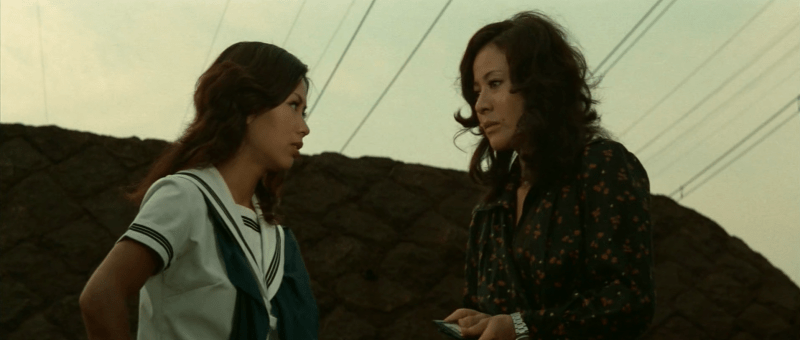
An orphaned daughter takes revenge against the corruptions of the late Meiji society in Norifumi Suzuki’s pinky violence classic Sex and Fury (不良姐御伝 猪の鹿お蝶, Furyo anego den: Inoshika Ocho). As the opening voiceover explains, the Japan of the early 1900s is already stoking imperial ambitions closely linked with the ideas of “modernisation” and “civility” it is seeking though in reality it is very much a gangster society as the three villains the heroine searches for have come to dominate the new Japan. 

This moment of schism is depicted in the opening sequence set in 1886 in which the little girl who will later take the name Ocho witnesses the murder of her policeman father by three unseen assassins who steal from him evidence of a scandal they then use for their own gain. The murder takes place in a shrine, the young Ocho rolling her paper ball onto a discarded charm that reads “misfortune”, while the film then jumps on to 1905 through a series of historical images prominently featuring the emperor Meiji along with a host of patriotic symbols that seem to signal the wrong path that is being taken. 

As for Ocho (Reiko Ike), she has survived by living on her wits as an excellent pickpocket and gambler but is otherwise uncorrupted continuing to dress in kimono and giving off an air of refined elegance that belies her toughness. In the course of her revenge, she is met by her opposite number, Shunosuke (Masataka Naruse), whose father was also killed by the same three duplicitous yakuza and is dragged into geopolitical intrigue by means of plot by the British to turn Japan into the site of the second opium wars using a spy disguised as a dancer played by Swedish starlet Christina Lindberg who is really in Japan for Shunosuke with whom she fell in love abroad only to be cruelly abandoned. 

Somewhat contradictorily, it’s these Western intrusions that are being resisted with Ocho the representative of an older Japan, and the gangsters that of a newer, largely amoral society of burgeoning militarism. Arch villain Kurokawa (Seizaburo Kawazu) lives in a huge Western-style mansion and is preparing to transition into national politics in the post-feudal society insisting that he and his organisation will soon control “everything”. His underling Iwakura (Hiroshi Nawa), who travels by motorcar, will also be handling the construction of Tokyo Harbour. When the girls from Ocho’s adopted family are kidnapped, they are taken to dance hall Panorama which is bedecked both with Christmassy tinsel and signs celebrating the victory in the Russo-Japanese conflict, while in an anachronistic touch scenes of the war are projected inside. Just to ram the point home, the man who throws a knife at Ocho is wearing stereotypical Chinese dress, while Kurokawa is later seen to have at his disposal a secret attack squad of nuns armed with switchblades and has Ocho whipped, by British spy Christina, in front of a large mural of Christ in some kind of underground chapel. 

In taking her revenge, Ocho is also in a sense attempting to right a historical wrong in removing these usurping men and their accomplice from power while fighting their perversion with her sexuality over which only she is master going so far as to kill one with poison rubbed on her own skin. In accidentally having exposed the equally duplicitous practices in a gambling hall, she is attacked while in the bath but instantly leaps into action entirely in the nude in a strangely beautiful sequence of elegant violence and poetic bloodletting that echoes the film’s conclusion in finally moving out into the snow. Eventually captured, she is bound tightly with rope and tortured but manages to cut herself free using only one of her trademark hanafuda cards which also symbolise her skill as a gambler even if her climactic game with Christina is played with Western cards for casino chips over a dining table. 

Suzuki signals the chaotic nature of this early 20th century world in his riotous use of colour and frequent anachronisms along with canted angles and a spinning top shot that seems to echo the world spinning out of control as Iwakura breaks a sacred promise between gamblers and rapes a young woman he had agreed to spare if Ocho was victorious in her bout with Christina. He saves his most expressionistic technique for the film’s closing moments in which Ocho singlehandedly puts a stop to Kurokawa’s corruption, another picture of Emperor Meiji looking down at her as she launches her final attack, and then stops to purify herself in the snow before wandering off into a storm of hanafuda cards with only darkness ahead of her.


Original trailer (English subtitles)

*Norifumi Suzuki’s name is actually “Noribumi” but he has become known as “Norifumi” to English-speaking audiences.

Sword of Destiny (孤剣は折れず 月影一刀流, Yasushi Sasaki, 1960)

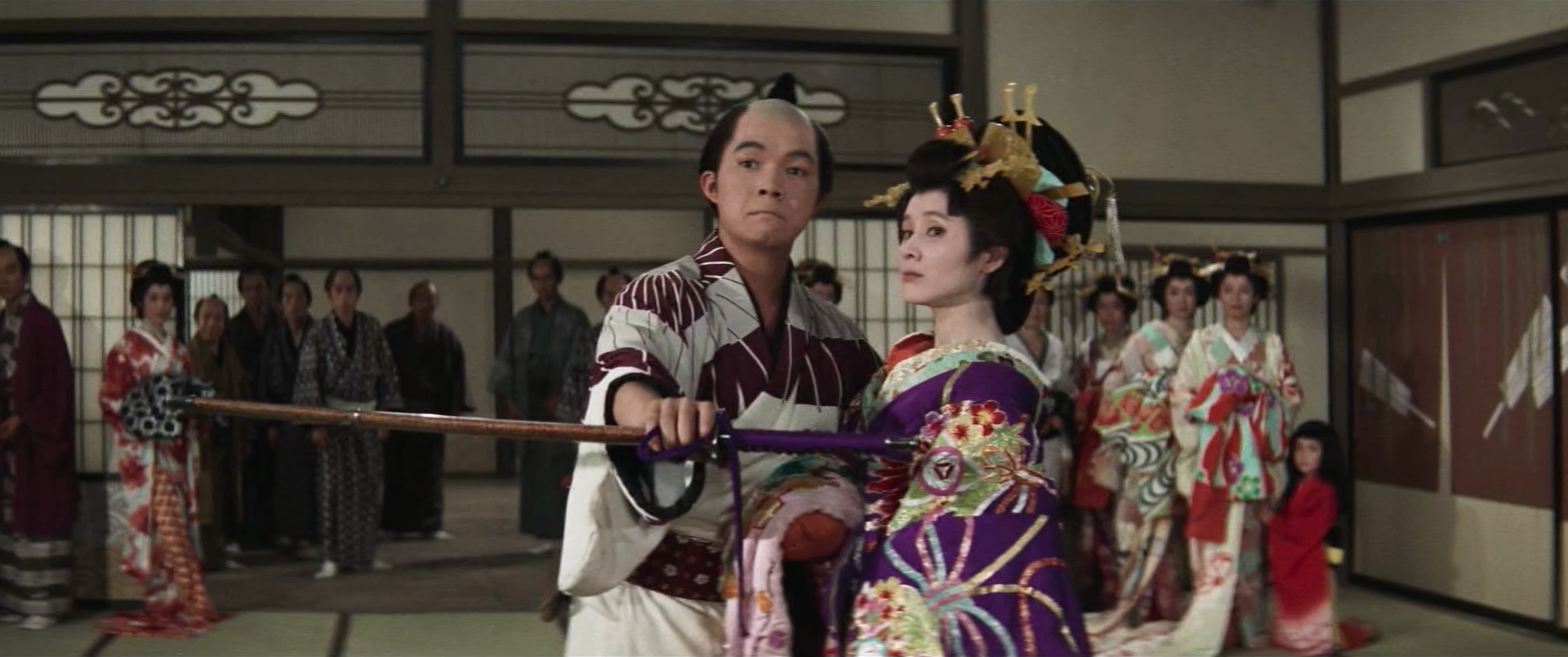
A wandering swordsman winds up in intrigue on returning to his fencing school to find his old master murdered in Yasushi Sasaki’s Sword of Destiny (孤剣は折れず 月影一刀流, Koken wa Arezu: Tsukage Ittoryu). A classic jidaigeki adventure, it nevertheless has to be said that this one is a little more sexist than most in actively pushing its series of female warriors into the background as the hero by turns sends them all back to typically feminine roles while declaring that he will be the one to claim vengeance and clear up corruption in the court itself caused by a woman’s apparent forgetting of her place. 

At least, this is what Mikogami Genshiro (Koji Tsuruta) is told by an old friend, Izu, after an altercation with the fiery princess Kazu (Hibari Misora). The Shogun’s nurse, Lady Kasuga, has apparently taken an interest in politics and has most of the inner palace in her grasp enriching herself in the process. Izu believes that she may also be behind the assassination of Geshiro’s former mentor Ono while working in league with the Yagyu who coveted the position of fencing master to the Shogun. He asks Genshiro to kill her which he’s only too happy to do while seeking vengeance for Ono, but later gains a second reason after meeting the two orphaned daughters of a former retainer forced to take his own life thanks to Lady Kasuga’s machinations. 

Itoya (Yoshiko Fujita) wanders round with a gun and disrupts Genshiro’s first assassination attempt. He later tells her to leave the killing business to him and live “the life of a woman” insisting that one girl has no power to kill Lady Kasuga anyway. Meanwhile, he also makes an enemy of the Shogun’s sister Princess Kazu after challenging her in the street on seeing her callous disregard for a peasant her horse had run over. Princess Kazu falls in love with him after he defeats her in a duel, temporarily rebelling in insisting she will resist a dynastic marriage and take no other husband though he eventually rejects her partly on the grounds of their class difference and partly because he is a wandering sword who lives in the moment and may know no tomorrow. 

Nevertheless, she is later seen capitulating to her proper role as a princess who exists largely to continue the family line, marrying a man chosen by the Shogun and his advisors with no real power to chose anything other than her obedience. In much the same way he does with Itoya, Genshiro pushes her back towards the typically feminine while falling for Itoya’s meek, sickly sister Mine (Hiroko Sakuramachi) who is otherwise an idealised image of femininity in her softness and naivety while like every other woman in the picture falling for Genshiro because of his robust manliness and ability to protect her by gaining the sisters’ vengeance on their behalf. 

Meanwhile, Genshiro also facing off against the rival Yagyu school whom he suspects of having killed Ono to usurp his place as the shogunate fencing master with the assistance of underling Takagaki who has now taken over leading to a mass exit of students fed up with his authoritarian teaching methods. Interestingly enough, Genshiro is temporarily imprisoned by the Yagyu alongside a dissident Christian whose death they’d faked while keeping him alive in order to torture the names of other Christians out of him. On fulfilling his request to take his cross to his daughter who has become a sex worker, Genshiro succeeds only in endangering her while she also falls in love with him. 

All in all, he’s not much of a responsible hero also reckless with the life of his former burglar sidekick Kurobei (Shin Tokudaiji) who uses his ninja tricks to get him out of prison. As expected, it all ends with in a battle against a treacherous swordsman and the spineless Takagaki with the final revelation that Lady Kasuga (who just dies of old age) had not much to do with anything anyway despite having been a “meddling” old woman who forgot her proper place. Even Mine is forced to admit that she can’t come between Genshiro and his sword so she plans to become a nun while Kazu sends him an elaborate katana to remember her by certain that he will not accept a place in the Shogun’s household but will return to the road to continuing his training. In any case, a kind of justice is done and order restored even if that order is in itself fairly unideal. 


The Geisha (陽暉楼, Hideo Gosha, 1983)

The coming of the railroad spells doom for one of the most prestigious geisha houses in Japan in Hideo Gosha’s adaptation of the Tomiko Miyao novel, The Geisha (陽暉楼, Yokiro). Miyao’s novels had often provided the inspiration for Gosha’s films and she had herself been the daughter of a “flesh broker” in pre-war Kochi though later escaping to another town to be a substitute teacher. Though the English title may focus more on plight of the the individual geisha at its centre, the Japanese hints more at the destructive cycle of the Yokiro itself in the persistent legacy of exploitation.

Then again as he later points out, if you’re looking for a villain in this story then the responsibility lies largely with Daikatsu (Ken Ogata) himself. In a prologue set in 1913, Daikatsu has eloped with geisha Otsuru but the pair are discovered by gangsters sent after them by the Yokiro. Daikatsu kills all of their assailants and assures Otsuru that they are finally “free” but it appears to be too late. Holding their baby daughter in one arm, Otsuru collapses into his other and presumably dies either then or shortly after while Daikatsu is later sent to prison for 10 years. 20 years later in 1933, the daughter, Fusako (Kimiko Ikegami), has become the number one geisha at the Yokiro under the name Momowaka though her career flounders because she is regarded as too emotionally distant to keep a patron. 

Daikatsu is also himself in Kochi at this point and working as a procurer brokering the sale of young women to the Yokiro and other geisha houses and brothels. When a school teacher comes to him to sell his wife, he taps her teeth to check for malnutrition much as one would examine a horse before running a hand underneath her kimono to check everything is at is should be before offering a valuation. Her husband only looks at him anxiously enquiring if a body such as hers which has as he later reveals born three children will fetch a good price. Daikatsu lets them go so the woman, Masae, can spend a final night with her family explaining that he cannot force someone to work if they do not want to do so and is well aware they will likely take his money and never be seen again which is what almost what happens. As it turns out the husband is killed in a fight and the woman ends up becoming a geisha anyway, only in the pay of prominent Osaka yakuza led by Inaso. 

Inaso (Mikio Narita) and buddies want in on the construction of the railroad that will shortly be coming to Kochi, but need to take over the town first which means getting around the mistress of the Yokiro, Osode (Mitsuko Baisho), who is apparently running every game town. The entire local economy is underpinned by female exploitation and facilitated by a woman, a former geisha, seizing the only power that is available to her. Isano later uses Masae as a kind of spy, getting her to initiate a relationship with Osode’s weak willed husband in an attempt to humiliate her which largely backfires as Osode boldly reclaims her man through a violent brawl in a hot spring though it does not appear that she is especially fond of him so much as he serves a particular purpose.

The brawl emphases the way in which women are pitted against each other by the nature of a patriarchal society along with the ways in which they are forced to mediate their power through men. Fusako also gets into an intense physical fight with Tamako (Atsuko Asano), a surrogate daughter of Daikatsu’s and emblem of a coming modernity, who insists on becoming a sex worker at the area’s most prominent brothel. In a strange moment of confrontation, both the geishas of the Yokiro dressed in their traditional regalia, and the sex workers of Tamamizu, arrive at a modern club where the heir to a banking empire courted by the Yokiro, Saganoi, dances the Charleston he learned while studying abroad in America. The geisha who dances with him struggles to pick up the moves, Saganoi lamenting that the dance is just not suited to a woman wearing a heavy kimono, elaborate wig, and clumsy geta. Tamako immediately gets up from her table and kicks off her shoes, gathering the hem of her own kimono to free her legs for the high level kicks of the modern dance. 

Fusako reclaims her authority by interrupting the dance immediately before its conclusion and insisting on retrieving their guest. Tamako appears to resent Fusako, perhaps frustrated in her relationship with Daisuke who does not appear to have had much contact with the daughter he sold at 12 years old. They too end up in an elaborate brawl in which Tamako rips off Fusako’s wig and splits her lip, symbolically freeing her to transcend the constraints of her “geisha” persona. Meeting Saganoi at Western-style bar, she boldly dances on the counter and sleeps with him of her own volition. But in doing so she conceives a child and leaves herself in a difficult position. She has betrayed her patron, and though she could simply have kept the fact from him and allowed him to think the baby was his, Fusako does not want to bring her child up in lies while simultaneously hanging on to a naive dream that Saganoi will one day return to her despite being made aware he has left for Europe. 

“All men are enemies of women,” she writhes in childbirth while swearing that no one will take her child from her, but she is still an indentured woman and her daughter is by rights the property of Osode. Her illness, presumably consumption, began long before her pregnancy and seems to an echo of the suffering she has been forced to endure as a geisha. As her health weakens, so the Yokiro declines. First it is ravaged by a literal storm, but also under threat from the Osaka gangsters desperate to take over Kochi to gain access to the lucrative construction contracts extending in its direction. Even so, as Daikatsu admits much of the fault lies with him. He chose to elope with Otsuru and was unable to protect either her or their daughter whom he allowed meet the same fate by entering the geisha world. He continued to earn his money by selling women into what is essentially slavery, and cannot escape his part in their continued exploitation while his entanglement with gangsters later disrupts the more settled life Tamako has begun to build for herself. 

“Wait all you want, the train’s not coming,” Tamako is later told, as if signalling that there really is no way out of this destructive and disappointing existence. Truly epic in scope, Gosha’s pre-war drama draws together patriarchal exploitation and societal corruption to critique a burgeoning modernity, but ends exactly as it started among the vibrant cherry blossoms only this time undercutting the melancholy of the oft repeated song with a more cheerful scene hinting at least symbolically at a long-awaited reunion. 


Original trailer (English subtitles)

Father of the Kamikaze (ゝ決戦航空隊, Kosaku Yamashita, 1974)

By the mid-1970s, Japanese cinema at least had become much more comfortable with critiquing the wartime past, considering it from a greater distance than the often raw depictions of war in the films from the previous two decades. 1974’s Father of the Kamikaze (ゝ決戦航空隊, A Kessen Kokutai), however, is among the few to skew towards the nationalist rather than the ambivalence or simple anti-war messages of other similarly themed films of its era. 

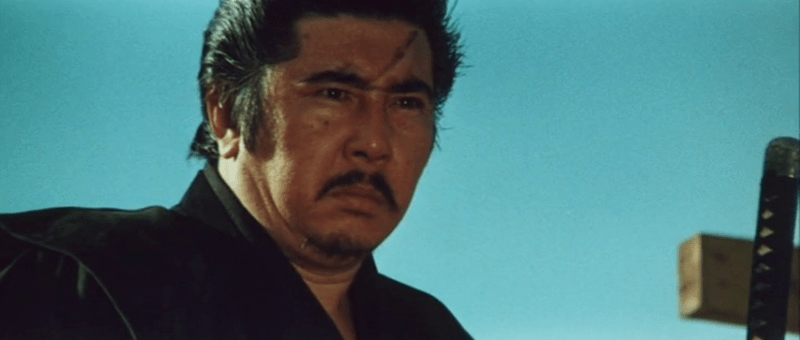
Starring ninkyo icon Koji Tsuruta who served in the air force himself, the film is a kind of biopic dedicated to Admiral Onishi who oversaw the kamikaze operations at the end of the war. As is pointed out, Onishi had been against the war in general terms even before its inception and is originally against the philosophy behind the kamikaze squadrons but as Japan’s fortunes continue to decline he becomes its biggest advocate citing a kind of sunk cost fallacy that it would be in someway unfair to the men that have already died to surrender while insisting that suicide missions are the only feasible way to turn the tide because one kamikaze could take out a hundred men by destroying battleships singlehandedly. 

The film in part attributes this extreme solution to the prevailing with your shield or on it philosophy of the contemporary society which placed extreme shame on the act of being taken prisoner. In the prologue that opens the film, a squadron of downed pilots whose heroic deaths have already been recorded is discovered alive in an American prisoner of war camp but as being a prisoner of war is so shameful and would reflect badly on the military, the decision is taken to fix the books by sending the men on a mission from which they are not intended to return. Onishi is opposed to the plan, he asks why they can’t find a way for the men to live, but the decision is already made. In any case, he describes the action of a suicide mission as a “beautiful ideal” even when insisting that a war cannot be fought in that way not least for purely practical reasons in that they do not have the resources to be wilfully sacrificing skilled pilots and their planes. 

Having come round to the idea, however, Onishi is a crazed zealot who cannot accept the idea of surrender and even goes so far as to barge into a cabinet meeting to urge ministers against a truce even though the war is clearly lost. To his mind, the only way to honour the sacrifices of those who’ve died is to fight to the last man. Kozono (Bunta Sugawara), another officer opposed to the kamikaze, eventually meets a similar fate in refusing to obey the order to lay down his arms and ending up in a psychiatric hospital. His objection had partly been that it’s wrong to turn men into ammunition, but also that the kamikaze project is itself defeatist and self-defeating when there are men such as himself who are committed to fighting on.  

In this the film leans into the image of militarism as a death cult in which dying for the emperor is the only noble goal of the whole imperial expansion. In its eventual lionising of Onishi’s image, his bloody suicide atop a white cloth resembling the flag of Japan while his parting words scroll across the screen in text, it does not shy away from his more problematic aspects in which he fails to object to a request from a junior officer that soldiers should be allowed to test their swords on American prisoners of war, roundly telling a subordinate who breaks protocol to insist that such a thing is not only morally wrong but will ruin their international reputation that he has no need to think of consequences because Japan will win this war. He claims to want to find a way of defeat that will satisfy the living and the dead, but in reality cannot accept it not least in that it would entail admitting that he sent 2600 young men to their deaths for nothing. 

Tsuruta brings the same level of pathos to his performance as he did in playing conflicted yakuza stoically committed to a destructive code, but there’s no getting away from the fact that the film focuses mainly on Onishi’s personal suffering as a man who sent other men to die for a mistaken ideal and then could not admit his mistake offering an apology only in his death in which he urged the young people of Japan to work to rebuild the nation in the name of peace. In switching to the present day and showing us Onishi’s dilapidated former residence and in fact the room in which he died with its tattered shoji and peeling paintwork, he veers towards the nationalistic in uncomfortably reinforcing the nobility of his death rather than the folly of war or absurdist tragedy of the kamikaze programme. Adopting a quasi-jitsuroku approach with frequent use of onscreen text, a narratorial voiceover, and stock footage of kamikaze in action Yamashita may portray war as madness in Onishi’s crazed devotion but cannot help depicting it as a “beautiful ideal” even in the undignified violence of Onishi’s ritual suicide.