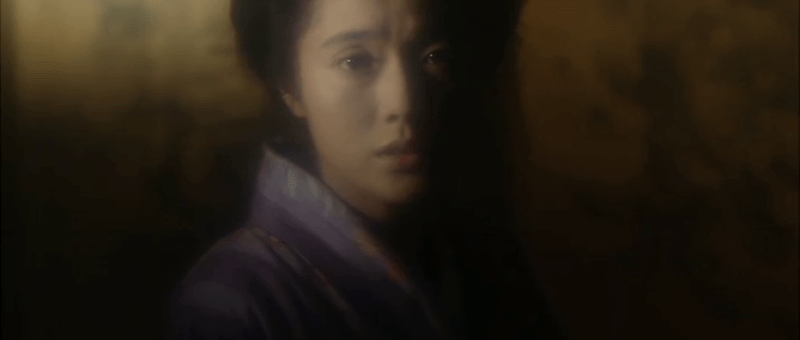
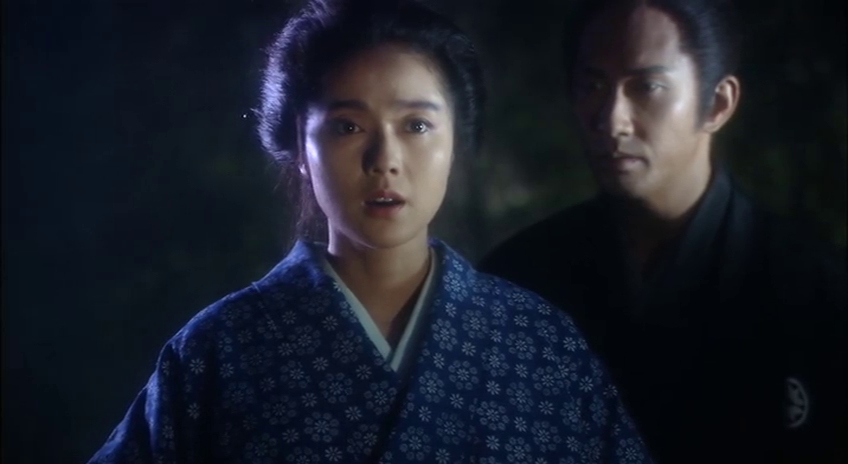
Kon Ichikawa’s Fusa (その木戸を通って, Sono Kido wo Totte) opens on a note of artifice. Misty rain and the verdant green of the forest give way to total darkness in which leaves appear, followed by the hero, Seishiro (Kiichi Nakai) tending a bonsai tree. As light brightens the scene, we see that he is seated beyond the veranda of his home which has taken on the appearance of a proscenium arch framed by the open shoji. It’s almost as if this space, in which Seishiro will enter his own reverie, is one of unreality as distinct from the interior which is busy with the preparations for the marriage of Seishiro’s only daughter, Yuka.
17 years previously, however, it was his own marriage he was preoccupied with when a mysterious woman arrived at his home claiming to have lost her memory and knowing only his name while he was away doing the annual audit. This is a little ironic, because “Seishiro Hiramatsu” hadn’t been his name for very long and, in fact, he struggled to remember it or answer when called. The second son of an Edo lord, Seishiro had been adopted into the Hiramatsu clan and has made an advantageous match with the daughter of a lord, Tomoe. The presence of the mysterious woman threatens Seishiro’s position and path to advancement when Tomoe happens to catch sight of her, assuming she’s an old flame from Edo trying to rekindle things with Seishiro.
He, meanwhile, assumes the woman’s arrival is part of a plot to discredit him and ruin his engagement, presumably perpetrated by a jealous rival. For those reasons, he instructs his retainer Yoshizuka to have the girl sent away, but he and his wife (Kyoko Kishida) feel sorry for her and wish to take her into the household. Seishiro comes up with the ingenious plan of throwing her out and following her to see if she meets up with whoever sent her, but becomes protective when she is nearly assaulted by a pair of local louts. Despite himself, he becomes absorbed in the mystery, but at the same time both he and the woman, whom they name “Fusa” (Yuko Asano), become worried that if she did in fact regain her memory, she would have to leave.
Fusa sometimes enters a kind of trance state, staring at the mystical forest behind the house in way that gives her a supernatural air. That she arrives so suddenly aligns her with a tradition of ghost story and folklore, suggesting that she may be some kind of forest spirit that like the Snow Woman would have to leave once the spell was broken. She describes herself as feeling as if he had been possessed or were trapped within a dream. As Seishiro learns later, she may not have known his name at all, but only taken it from one of his servants, while her past remains opaque. Nevertheless, they are blissfully happy and conceive a daughter together before Fusa suddenly disappears with the same suddenness as she arrived. She had often had visions of a bamboo path and a wooden door beyond which seem to lurk the secrets of her past, but it may not be possible to return after passing through.
Seishiro continues to believe she will one day remember them and return, but at the same time knows to treasure the small bubble of happiness they once had no matter how long it lasted. The truth is only that she was here and then gone, which isn’t so much of an unusual story and requires little explanation, though Seishiro never really solves the mystery as he had vowed to do. Perhaps like Fusa, he didn’t really want to risk breaking the spell. Based on a story by Shugoro Yamamoto, the film was produced by Fuji TV as a test feature for NHK’s “Hi-Vision” high-definition television channel with the consequence that it was shot on hi-def video tape and later transferred to 35mm for international festival screenings. For those reasons, it’s not a particularly handsome film and obviously low budget, but even so Ichikawa makes the most of the medium, leaning into its soft focus to create an ethereal and mysterious atmosphere. Playing with colour and light, he often frames Fusa as the only one in colour in an otherwise monochrome scene as if perhaps suggesting that it’s Seishiro’s world that lacks reality rather than hers. An ominous violet light seems to emanate from the misty forest, but in truth perhaps all here are ghosts looking for a way to go beyond the wooden door but, at the same time, hoping they won’t find it.

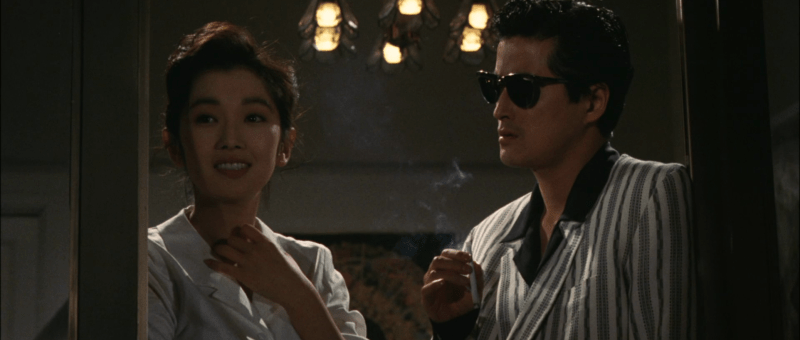

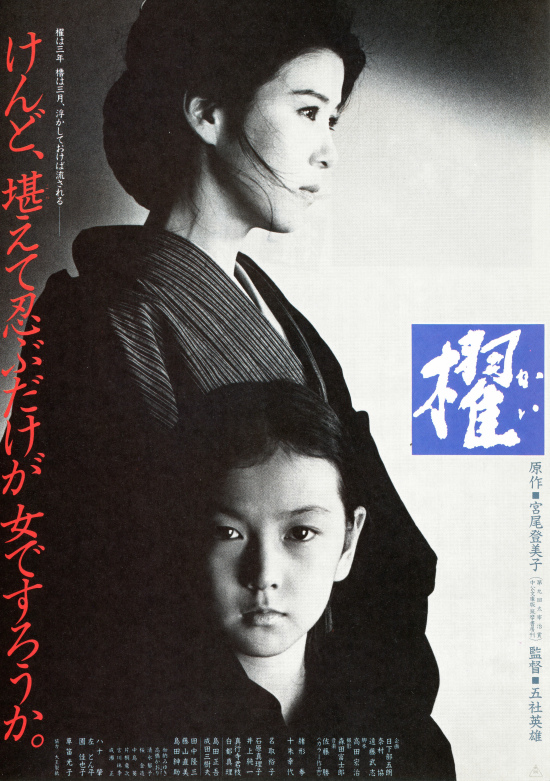 Until the later part of his career, Hideo Gosha had mostly been known for his violent action films centring on self destructive men who bore their sadnesses with macho restraint. During the 1980s, however, he began to explore a new side to his filmmaking with a string of female centred dramas focussing on the suffering of women which is largely caused by men walking the “manly way” of his earlier movies. Partly a response to his regular troupe of action stars ageing, Gosha’s new focus was also inspired by his failed marriage and difficult relationship with his daughter which convinced him that women can be just as devious and calculating as men. 1985’s Oar (櫂, Kai) is adapted from the novel by Tomiko Miyao – a writer Gosha particularly liked and identified with whose books also inspired
  Some people love ramen so much that the idea of a “bad” bowl hardly occurs to them – all ramen is, at least, ramen. Then again, some love ramen so much that it’s almost a religious experience, bound up with ritual and the need to do things properly. A brief vignette at the beginning of Juzo Itami’s Tampopo (タンポポ) introduces us to one such ramen expert who runs through the proper way of enjoying a bowl of noodle soup which involves a lot of talking to your food whilst caressing it gently before finally consuming it with the utmost respect. Ramen is serious business, but for widowed mother Tampopo it’s a case of the watched pot never boiling. Thanks to a cowboy loner and a few other waifs and strays who eventually become friends and allies, Tampopo is about to get some schooling in the quest for the perfect noodle whilst the world goes on around her. Food becomes something used and misused but remains, ultimately, the source of all life and the thing which unites all living things.
 When AnimEigo decided to release Hideo Gosha’s Taisho/Showa era yakuza epic Onimasa (鬼龍院花子の生涯, Kiryuin Hanako no Shogai), they opted to give it a marketable but ill advised tagline – A Japanese Godfather. Misleading and problematic as this is, the Japanese title Kiryuin Hanako no Shogai also has its own mysterious quality in that it means “The Life of Hanako Kiryuin” even though this, admittedly hugely important, character barely appears in the film. We follow instead her adopted older sister, Matsue (Masako Natsume), and her complicated relationship with our title character, Onimasa, a gang boss who doesn’t see himself as a yakuza but as a chivalrous man whose heart and duty often become incompatible. Reteaming with frequent star Tatsuya Nakadai, director Hideo Gosha gives up the fight a little, showing us how sad the “manly way” can be on one who finds himself outplayed by his times. Here, anticipating Gosha’s subsequent direction, it’s the women who survive – in large part because they have to, by virtue of being the only ones to see where they’re headed and act accordingly.
 Windows on Worlds