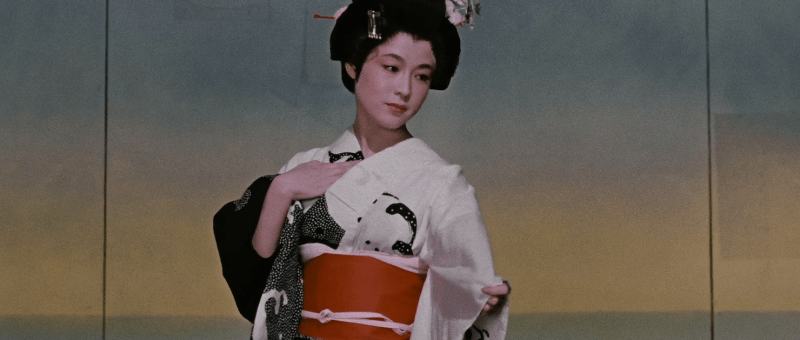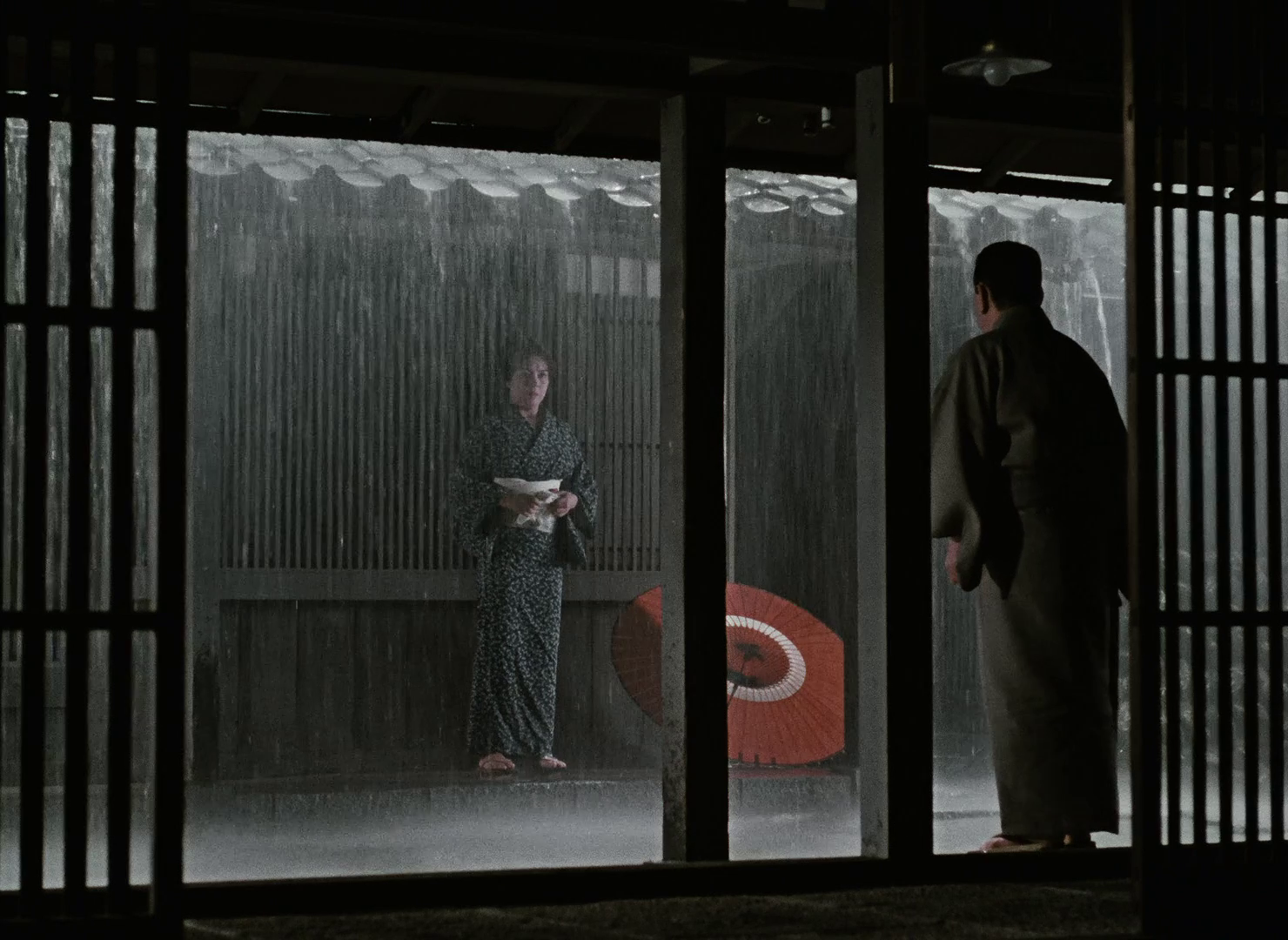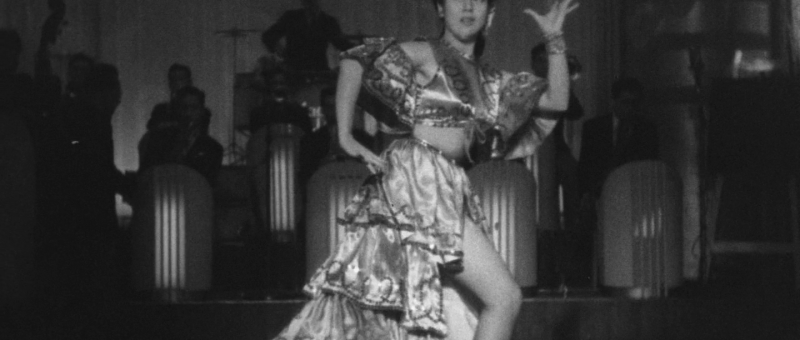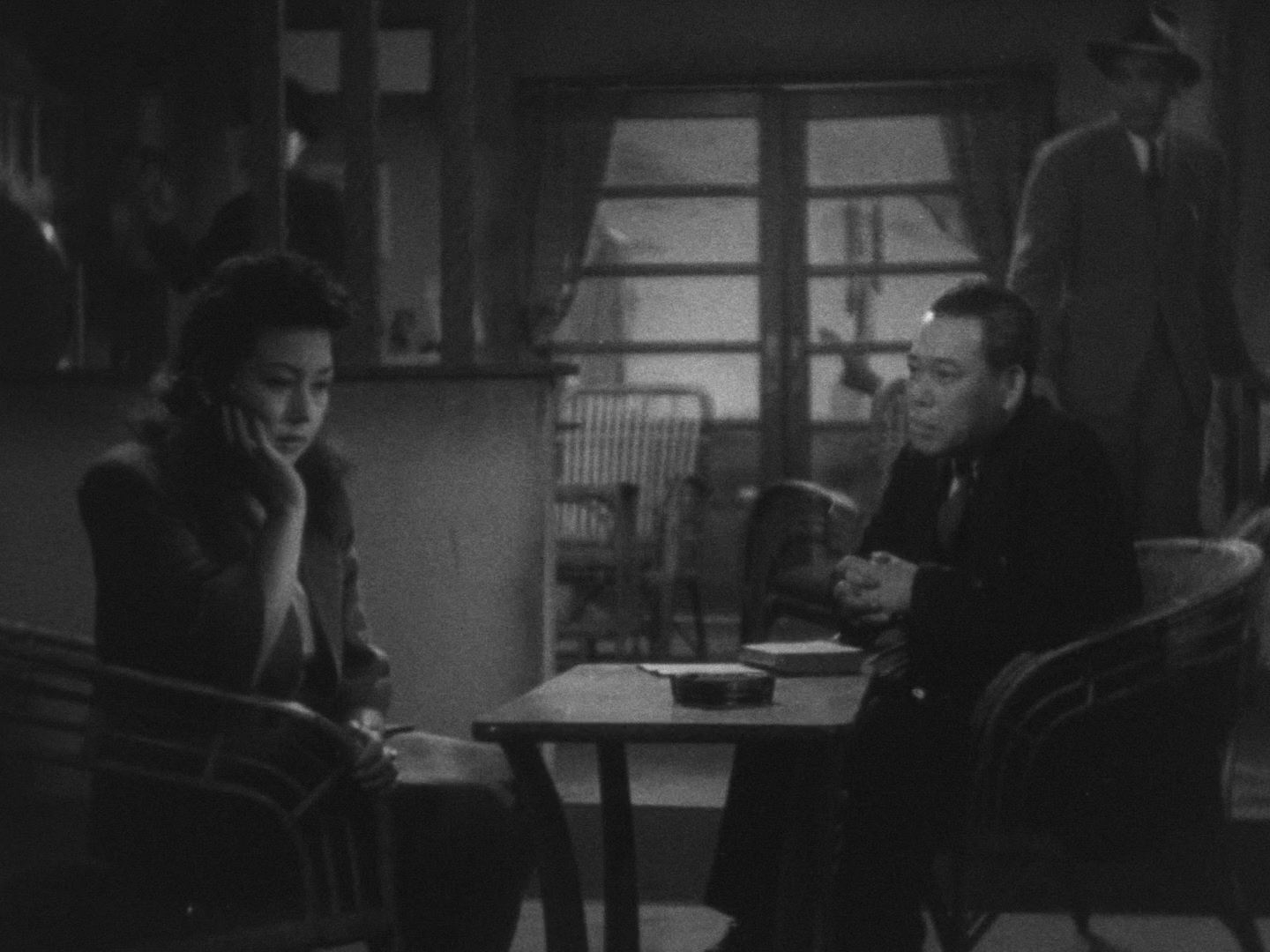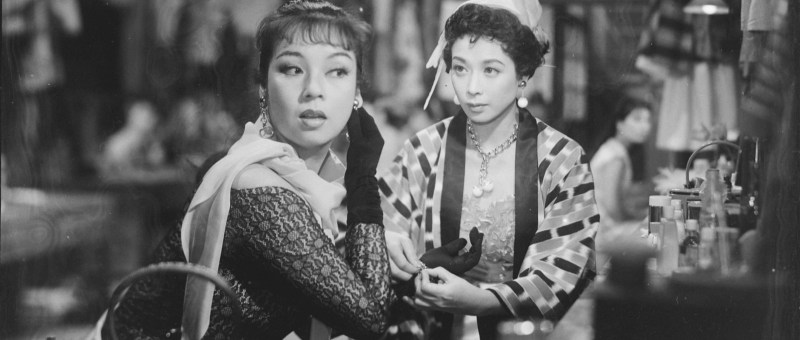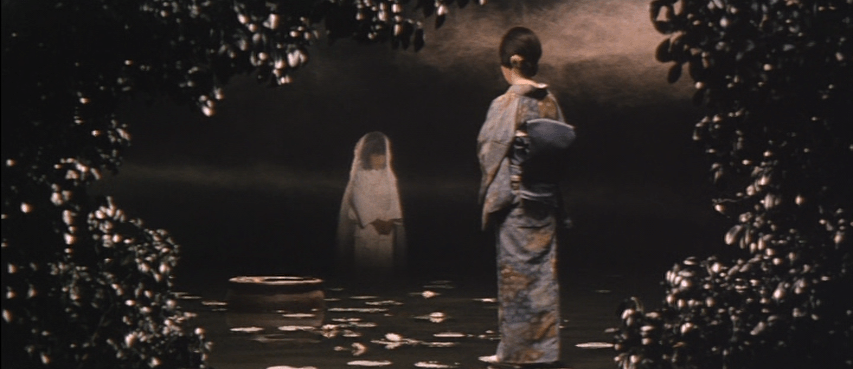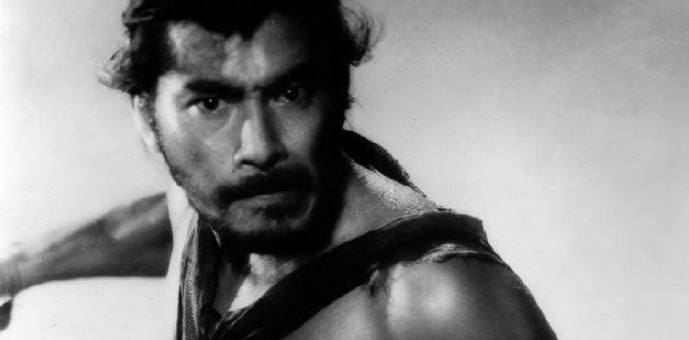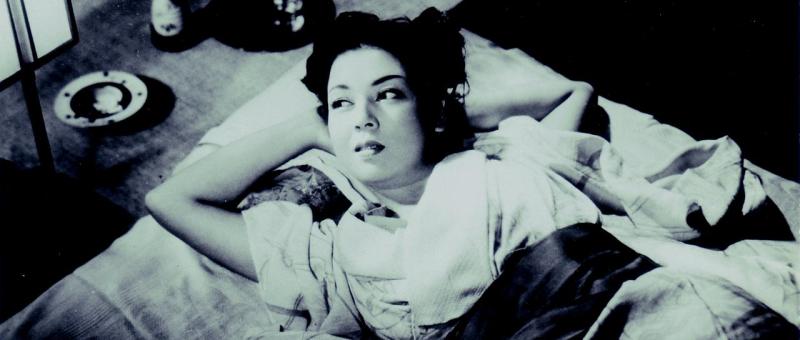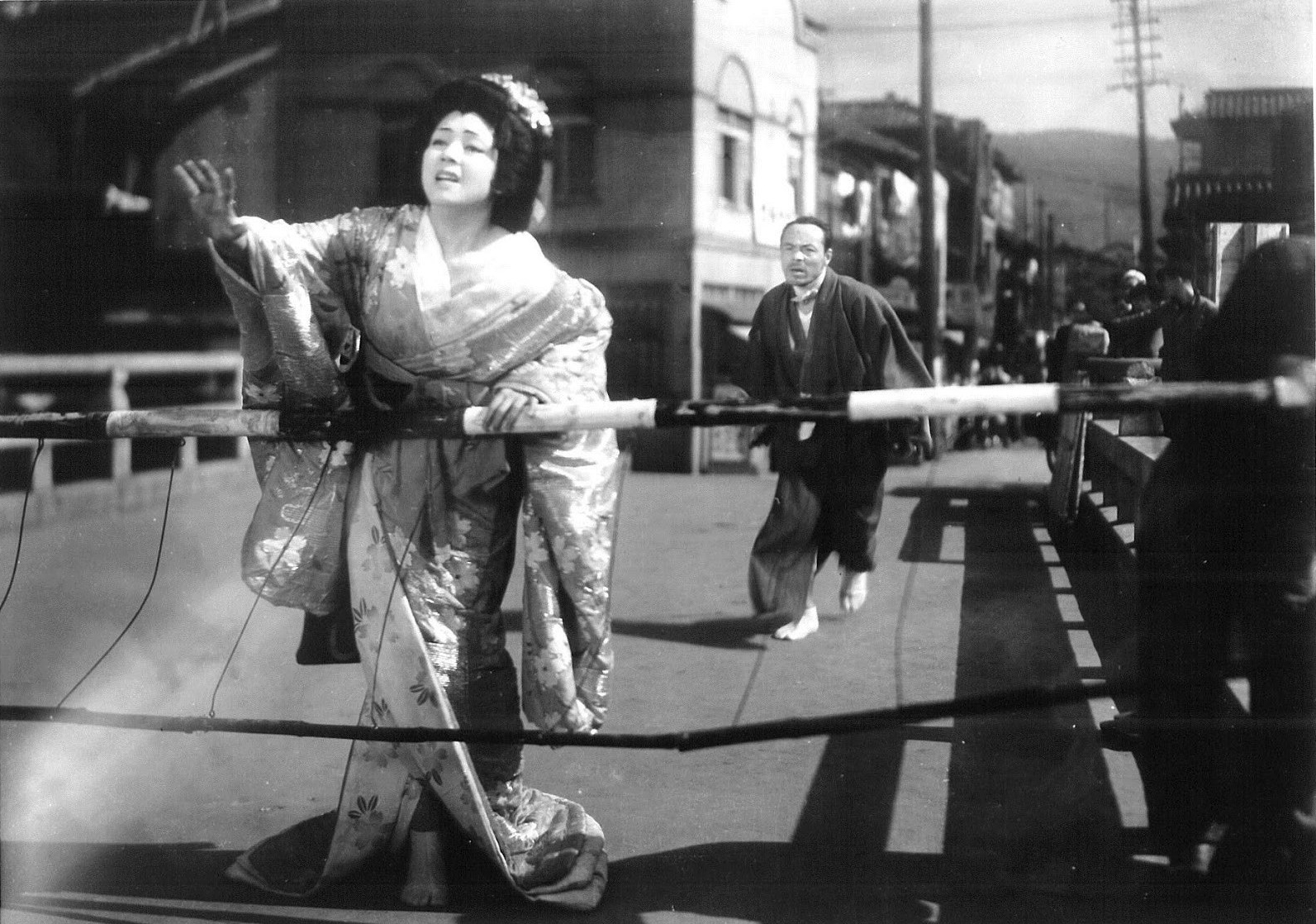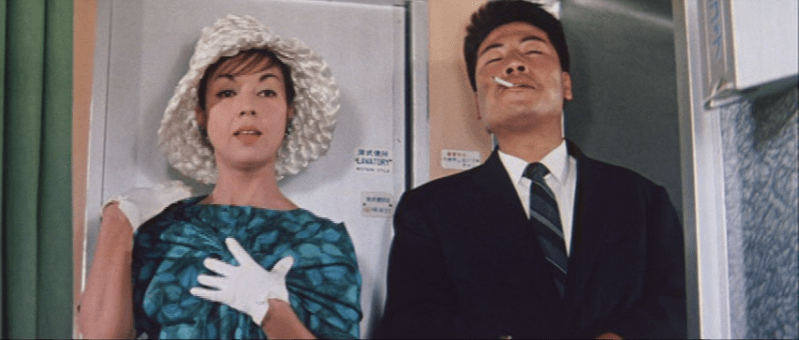
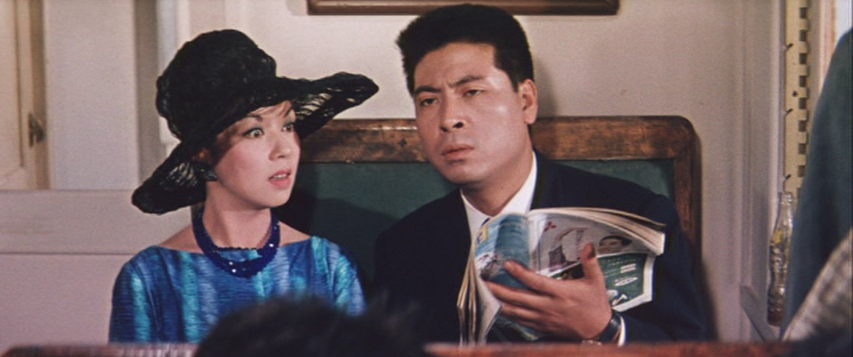
Floating Weeds (浮草, Yasujiro Ozu, 1959)

An oft-repeated criticism of the work of Yasujiro Ozu is that it is all the same. The similarity of the English-language titles with their ubiquitous seasonality doesn’t help, but you have to admit there is some truth in it. On closer inspection, however, it becomes clear that Ozu was not so interested in uniformity or repetition as he was in dialogue with himself. Thus Late Spring becomes Late Autumn and the abandoned father a conflicted mother, the two boys of I Was Born But… who rejected their father’s descent into corporate lackydom become arch consumerists seceding from society until their parents give them a TV set in Good Morning. Ozu refrained from remarking on the repurposing of old plots for new dramas, but did expressly regard his 1959 Floating Weeds as a “remake” of the 1934 A Story of Floating Weeds updated to the present day and filmed in the, by then, classic Ozu style. 

As in the 1934 version, the action centres on the arrival of a theatrical troupe to a small town which they have not visited in some years, in this case 12. This time around, the troupe is a little more exulted, performing kabuki-style narrative theatre rather than rustic entertainment, but is subject to many of the same problems. Kihachi is now Komajuro (Ganjiro Nakamura), a much older man though cheerful and energetic. He has chosen this town because it is home to an old flame, Oyoshi (Haruko Sugimura), who is the mother of his adolescent son, Kiyoshi (Hiroshi Kawaguchi). Kiyoshi thinks that Komajuro is his mother’s brother and that his father is long dead. He recognises Komajuro right away and is pleased to see him, though they evidently have not met in many years. 

The 1934 version had revolved around Kihachi’s corrupted paternity in his shame regarding the stigma of being a travelling player. By 1959 that is simply no longer so much of an issue, but whereas the financial difficulties Kihachi’s troupe faced were partly a symptom of the depression and partly of their misfortunes, those of Komajuro take on a more melancholy quality because it is obvious that this is a way of life which is coming to an end. When Kihachi says he’s going to start over, it seems futile but he is still young enough to have a credible chance. Komajuro is already “old” and it’s clear that he will struggle to support himself as a travelling actor simply because it is no longer a viable occupation. 

Thus Komajuro’s story is less one of frustrated fatherhood than of melancholy resignation to the vagaries of a lifetime. “Life is an unknown course”, he tells Oyoshi, “the only constant is change”. Like Kihachi he doesn’t want his son to see the show, though perhaps more out of embarrassment. Kiyoshi complains that the character in his play is “unrealistic” because he doesn’t relate to the modern world. Komajuro objects but explains that he is “a character from another era”, making it plain that he is talking as much about himself. Komajuro is a man left behind by time and incapable of understanding the world in which he now lives which may be one reason he seems to hang on to an intense desire to save Kiyoshi from being affected by the stigma of being the son of a travelling actor even though that is no longer something he would need saving from. 

This slight disconnect, along with Gajiro Nakamura’s cheekily comical performance, adds to the genial comedy which characterised the majority of Ozu’s colour films though this one is admittedly slightly less colourful owing to being produced by Daiei as one of a handful of films made outside Ozu’s home studio of Shochiku. Komajuro becomes a tragicomic rather than purely tragic figure, a man suddenly realising he has become old and facing the decline of his patriarchal authority. Like Kihachi he turns violence on both his mistress, Sumiko (Machiko Kyo), and the young actress Kayo (Ayako Wakao) who has fallen for his son, but it’s futile and born of desperation. A more sympathetic figure than 1934’s Otaka, Sumiko seems to genuinely like Komajuro and is hurt as well as jealous and threatened by the existence of his “secret” family. Her petty revenge is taken in response to Komajuro’s bitter claim that his son “belongs to a higher race” moments after bringing up her past as a sex worker. Rather than a simple desire for chaos and upset, she intends to pull Kiyoshi down to her level through getting him to sleep with Kayo, but Kayo falls for him for real only to worry she is perhaps ruining his bright future. 

“One can’t suddenly show up out of nowhere and assert one’s parental authority,” Komajuro eventually realises. His hopes are dashed by Kiyoshi’s relationship with Kayo not because of her proximity to the world of the travelling actor, but because he fears it means that Kiyoshi is just like him, an irresponsible womaniser. He wanted to save Kiyoshi as a means of saving himself, pushing his son into a more respectable world he had been unable to enter. Kiyoshi, however, rejects his sacrifice, describing his parents as “selfish” for keeping the secret all this time only to drop a bombshell now. He complains he’s been fine these 20 years and does not want or need a father beyond the one he already thought to be dead. Rather than the nobility Komajuro’s of paternal sacrifice, the focus is pulled back towards the son and his filial responsibility to live up to it by becoming a fine and upstanding young man while Komajuro is once again exiled back to the moribund world of the travelling actor. 

Of course, the world of 1959 was very different to that of 1934. The economy was at last improving and consumerist pleasures were very much on the horizon, meaning that for many life was comfortable at last. Japan was at peace if not completely free of political strife which removes the constant anxiety felt by those trying to survive the mid-1930s. But Ozu himself was also 25 years older and had perhaps reached that sense of resignation with the world that allowed him to sigh and laugh where before he may have trembled with fear or rage. Komajuro is as he always was, a floating weed, a man without a home, but now perhaps one of many rootless wanderers off the post-war landscape.


A Bullet Hole Underground (地下街の弾痕, Kazuo Mori, 1949)

Produced by Daiei Kyoto under the guidance of the Osaka Police, Bullet Hole Underground (地下街の弾痕, Chikagai no Dankon) is keen on selling a vision of order in a new Japan in which the police force employs all the latest technology to solve crimes calmly and methodically. We see them approach the crime scene forensically and conduct a series of scientific tests with microscopes and gadgets such as lie detector machines and code breaking equipment as they proceed towards the truth while earnest policeman Minagawa (Hiroshi Nihonyanagi) battles the ghosts of his past on realising that the dead man’s wife is his own lost love.

In any case, the film opens with a noirish scene at Umeda Station, Osaka, which then turns strangely comic. A man stumbles toward the exit and we assume that he is probably drunk but another man soon comes up behind him and pushes a pistol into his back. The second man pulls the trigger, then again to make sure, before calmly walking up the steps and leaving the station. A little while later, another drunk man arrives and has a little banter with the body before covering it with a signboard which is one reason it isn’t spotted until the shoeshine boys turn up in the morning. 

This sudden influx of children at rush hour is another symbol of the destabilisation of the post-war society in which the war orphans try to support themselves amid the still difficult economic environment. The lack of economic opportunities is also posited as a reason that the deceased, later identified as Kaneko, may have turned to crime by getting involved with a criminal gang smuggling drugs and money to destabilise the society even further. Yet the rot may have set in a little earlier than that. Before the war, Minagawa had wanted to marry Michiko (Machiko Kyo), the sister of his friend Sekiguchi (Toshiaki Konoe), but she later threw him over to marry the wealthy son of a family running a pharmacy. She admits she married him for the money, but after the war he lost everything. Unable to find work, Kaneko became a wastrel while Michiko gained employment at a cabaret bar as a dancer. He told her that he’d found a job at a company, but this turned out to be a lie and chief investigator Fujimoto (Takashi Shimura) assumes he must have been working for the gang. 

Still, to begin with it seems like it may have been a case of mistaken identity. Kaneko’s clothes turned out to belong to other people, a fact easily explained by Michiko that they were second hand, but also suggesting that someone may have set him up to take their fall. The gang needed the skills he learned in the navy but maybe they didn’t need him anymore. The root of the evil is located, ironically enough, in a jewellery store presenting a front of affluence and elegance but in reality founded on crime and misery when so many are still struggling to rebuild their lives. Michiko too seems to have turned cynical. She snarls and pushes Minagawa away, but privately cries and appears to regret her youthful decision to reject love for material comfort.

Perhaps because of its genesis as a film designed to promote the local police force, it has a much more upbeat conclusion and particularly for Michiko who is, unusually, allowed to redeem herself and gain a second chance to make a better decision by reuniting with Minagawa who does not and never has held her past against her. The pair of them look out over the fracturing city and remark at how it just carries on as if nothing had happened which feels like advice intended for the post-war society that it should do the same and try to leave the past behind to start a new life in this new era. Meanwhile, huge numbers of policemen swarm the harbour to crack down on the smuggling gang sending the not altogether comforting message that this city is well protected against all kinds of crime and the police force is a well-trained, modern institution that has the latest technology at its disposal along with astute and compassionate officers. There may be sleazy clubs, duplicitous men and heartless gangsters, black markets and smuggled dangers, but there are, the closing scenes with their wide-open vistas in which scorched trees stand behind the burgeoning city imply, better days to come.


Dancing Girl (踊子, Hiroshi Shimizu, 1957)

The sudden arrival of a younger sister throws the despair and disappointment of an ageing chorus dancer into stark relief in Hiroshi Shimizu’s Dancing Girl (踊子, Odoriko). Chiyo (Machiko Kyo) is indeed a dancing girl, waltzing her way through post-war Japan with seemingly little thought for others or the consequences of her actions aware only of her ability to dazzle and what it might win her if used in the right way while her sister quietly yearns for a more comfortable, conventional kind of life.

Hanae (Chikage Awashima) apologises for Chiyo’s childishness when she suddenly gets up to marvel at the snow during in an important meeting with choreographer Tamura (Haruo Tanaka) who has offered to take her on as a trainee dancer but he simply replies that it’s what makes her special in the way Hanae herself perhaps is not. In that sense there’s something a little uncomfortable in Tamura’s first word on meeting Chiyo being simply “sexy” uttered as if he were already salivating over her when the key to her appeal seems to lie in the awkward juxtaposition of her naivety and curvaceous figure. In many ways, it’s childishness that is Chiyo’s defining characteristic. She follows her impulses and is incapable of thinking beyond them. In a repeated motif we see her eat heartily as if she had not for eaten days or else to be snacking on something or other at a time when food is scarce. We later discover that she’s some kind of kleptomaniac, stealing at every opportunity even when she has no need to, simply taking something she wants without considering why it might not be right to do so as if all the world belonged to her. Meanwhile she embraces her sexuality without shame, sleeping with whomever she chooses but also doing so in a calculated effort to advance her own cause. 

The irony is that her rise coincides with her sister’s fall. Hanae has passed the age at which she might have become a star and is beginning to age out of her career as a chorus dancer. She tells her husband, Yamano (Eiji Funakoshi), that what she wants is a comfortable life and to become a mother though the couple have been married for five years and not yet conceived a child leading her wonder if there’s medical issue in play though Yamano confesses in what turns out to be an ironic comment that he doesn’t really want children anyway. In any case, they are each becoming tired of life in Asakusa and their mutually unsatisfying careers. Crushingly they each fear they have disappointed the other, Hanae sorry that she never made it as a dancer and wondering if Yamano would have been better off marrying someone from a less stigmatised profession, while he feels guilty that he could not give her a better standard of life and has failed to progress in his own career as a violinist. Chiyo’s arrival reinvigates them both in different ways. Hanae shifts into a maternal mode otherwise denied her in looking after Chiyo as she begins her career as a dancer, while Yamano begins with her a sexual affair that rekindles his masculine drive. 

But Chiyo also remains flighty and elusive. Essentially lazy, she soon tires of dancing and decides to become a geisha because it requires less rehearsal, then to give that up too to become someone’s second mistress. She rejects the conventional, settled life Hanae has come to long for and describes that in the countryside as “boring” when she suggests moving there having selflessly offered to adopt the baby Chiyo has also rejected which maybe Yamano’s or perhaps Tamura’s or someone else’s entirely not that it necessarily matters. The closing moments of the film perhaps imply a moralising rebuke of the new post-war vision of liberated sexuality, a despondent Chiyo once again making a surprise appearance and wanting to see her child but being afraid to do so unable to match up to the unsullied maternity of Hanae. Shimizu lends her passage a kind of transient quality in his restless camera which is in constant motion sliding laterally from one scene to another often coming to rest on emptiness even amid the bustling streets of a neon-lit Asakusa and the false promises of its illusionary glow.


Dancing Girl screens at Japan Society New York on May 18 as part of Hiroshi Shimizu Part 2: The Postwar and Independent Years.

The Possessed (妖婆, Tadashi Imai, 1976)

Shinto priests, black magic, and demonic possession. As the opening voiceover of Tadashi Imai’s The Possessed (妖婆, Yoba) remarks, you can hardly believe that such things could happen in the modern world alongside cars, trains, and telephones yet the tale we’re about to be told begins in 1919. Based on a story by Akutagawa, the film is however less a contemplation of ancient superstition amid rising modernity than the destructive patterns of class and patriarchy which conspire against the lives of two women who had once been good friends. 

In 1919, Shima (Machiko Kyo) marries Shinzo (Shinjiro Ehara) who has taken her name and become the presumptive heir of her family. Everyone at the wedding remarks on what a good catch he is, adding almost as an after thought that Shima seems happy about it too. The problem is that Shinzo is repeatedly unable to consummate the marriage. Part of this seems to be down to his wounded masculinity in having married into the family. He resents being under the thumb of his father-in-law along with the rumours that he only married Shima for her money even though this appears to be exactly what he has done. Perhaps further humiliated by his inability to perform, Shinzo tells Shima that it’s her fault because there is something wrong with her body that prevents him from becoming sufficiently aroused. Being a sheltered woman of the Taisho era, Shima wonders if her husband has a point and visits a doctor to find out but as expected he tells her there’s nothing at all wrong with her and it’s most likely Shinzo’s performance anxiety that is to blame. 

However, when her cousin Sawa’s (Kazuko Ineno) comb is found inside Shinzo’s kimono sleeve, the family begin to realise that the problem is he prefers her. He later admits as much and reveals that he’s planning to move closer to the family’s goldmine in Hokkaido and install Sawa in a house there as his common law wife with Shima left behind as a spouse of symbolic value. Shima has already felt herself haunted, but it’s at this point that the family brings in a Shinto priest who explains that Shinzo is possessed by an evil spirit though also giving the more rational advice that she should probably divorce him. Shima is forced to endure a strange ritual including purification by waterfall, but is also sexually assaulted by the randy priest though it it’s not completely clear that she fully realises what has happened to her. 

The implication is that the family treated Sawa as a kind of poor relation they trotted out to keep Shima company because she was an only child. Having grown resentful of Shima’s class privilege, Sawa’s jealousy manifested as covetousness that made her intent on taking whatever Shima had. She too later resorts to shamanistic black magic, fearful that Shima bears her a grudge for ruining her life and hoping to neuter any dark energy that she might be emanating in order to protect her teenage daughter Toshi (Miki Jinbo) who, ironically, has been betrothed to the son of a kimono shop named Shinzo (Taro Shigaki). 

Sawa never married and bore her child out of wedlock. She implies that she depended on men for financial support but never elaborates further. Shima, meanwhile, has been able to build an independent life for herself as a well-respected tailor. “It’s not normal for someone to suffer this much” a shamanically-inclined midwife later tells her when she too becomes pregnant out of wedlock but loses both the child and the man. The boot is perhaps on the other foot, Shima envies the life Sawa has with the one thing that will always be denied her, a child of her own. The midwife had once again told her that she was possessed, this time by the vengeful spirit of her lover’s daughter with his legal wife she fears may have been drowned deliberately by her mother out of jealousy. 

Shima is given a talisman of beads from the goddess of mercy, Kanon, and told that she can have what she wants if she prays hard enough, but Sawa is told the same thing and ends up going too far with the help of a shamaness praying to Basara Okami who later affirms that Sawa’s request comes with a price for the god wants Shima as a human sacrifice which is not really what Sawa had in mind. There is perhaps something symbolic in Shima’s gradual wasting away, becoming old before her time in her loneliness and sorrow (she is only supposed to be 33 at the film’s conclusion, actress Machiko Kyo was 52 at the time) even if she were not having the life force sucked out of her by a supernatural entity, though both women eventually pay a heavy price for their jealousy set against each other by a fiercely patriarchal and classist society which forces them to compete for husbands and standing. 

Imai’s photography is noticeably eerie if occasionally surreal as in the frequent and increasing sight of frogs, usually sign of good fortune or fertility but here ominous harbingers of supernatural dread in league with dark shamanistic forces. As the voiceover admits, it’s difficult to believe that these primitive ideas can exist side by side with the motor car but then again jealousy is as old as time itself and unlikely to disappear from the human psyche anytime soon even if in this case it could have been avoided if only the world were a little more equal. The film’s conclusion suggests it may now be, in a way, with a love match in the younger generation bringing the cycle of envy and resentment to a close even if the vengeful ghost of Shima may still be lurking somewhere in the shadows. 


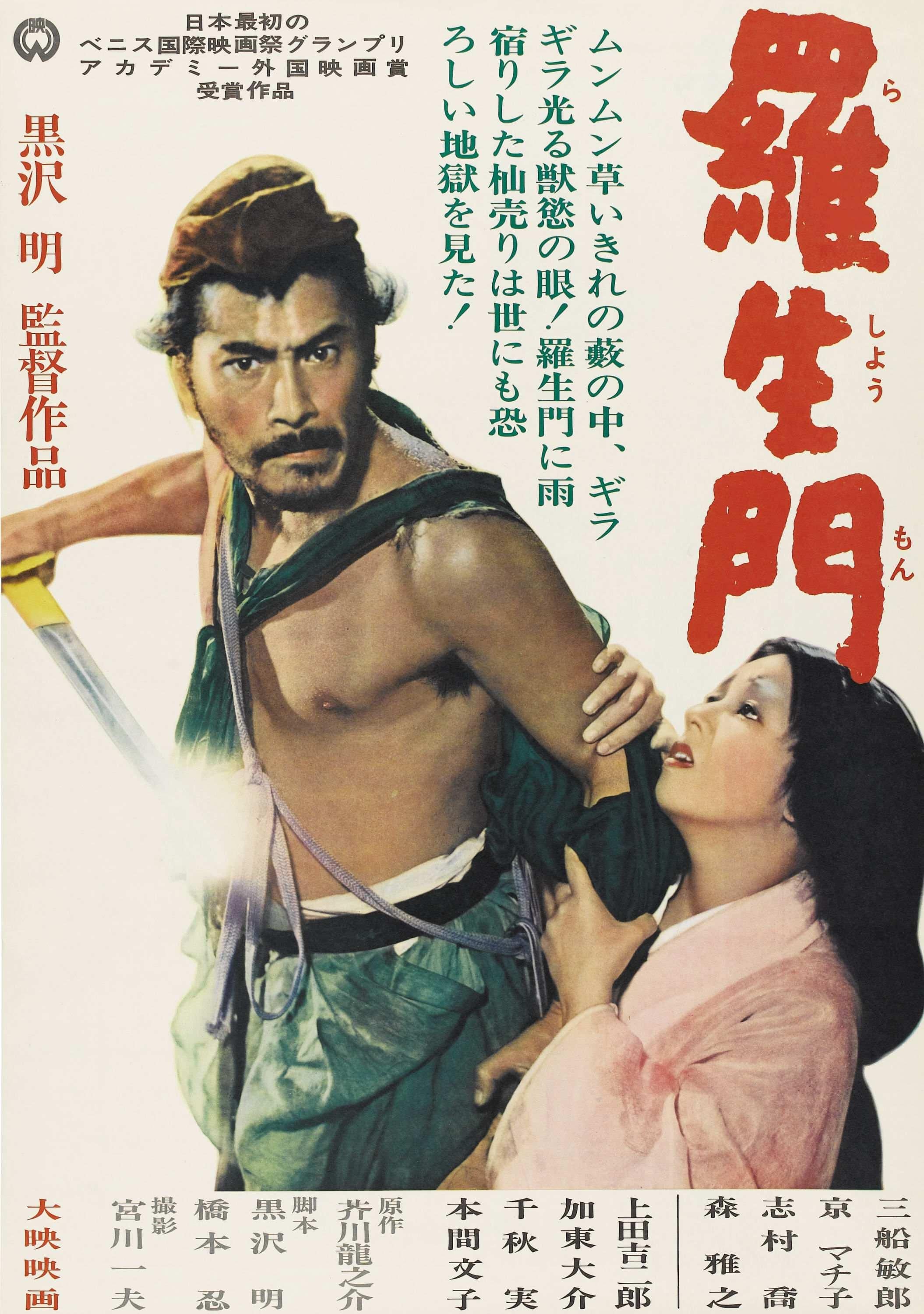
Rashomon (羅生門, Akira Kurosawa, 1950)

Is there such a thing as objective truth, or only an agreed upon “reality”? Like many of his early films, Akira Kurosawa’s adaptation of a pair of short stories by Ryunosuke Akutagawa is concerned with the idea of authenticity, or the difference between the truth and a lie, but is also acutely aware that the lines between the two aren’t as clear as we’d like them to be largely because we lie to ourselves and come to believe our own perceptions as “truth” assuming that it is others who are mistaken or duplicitous. 

After all, the film opens with the words “I don’t understand”, as the woodsman (Takashi Shimura), who later tells us unprompted that he does not lie, tries to reconcile the conflicting testimonies of a series of witnesses at the trial of the bandit Tajomaru (Toshiro Mifune) who is accused of raping a noble woman (Machiko Kyo) in the forest and killing her husband (Masayuki Mori). At the end of the film it becomes clear that most of his confusion is born of the fact that he witnessed more than he claimed, later presenting a more objective version of the events while justifying his decision not reveal it earlier by saying he didn’t want to get involved. Not wanting to get involved might be understandable, he has six children and presumably won’t be paid for his time nor will he want to risk being accused of something himself. Then again as the cynical peasant (Kichijiro Ueda) sheltering with him at the already ruined Rashomon Gate seems to have figured out, it might equally be that he took the precious dagger repeatedly mentioned in the trial before running off to find the police. He has six children to feed after all. 

The woodsman is simply confused if also guilty, but the Buddhist monk (Minoru Chiaki) who saw the couple on the road some days previously has been thrown into existential despair and is on the brink of losing his faith in humanity. He can’t bear to live in a world in which everyone is selfish and dishonest. Yet “dishonest” is not quite the right word to describe the testimony, for there’s reason to believe that the witnesses may believe what they say when saying it or have at least deluded themselves into believing a subjective version of the truth that shows them in a better light than the “objective” might have. At least, none of the suspects are lying in order to escape justice as each confesses to the crime though for varying reasons. 

The bandit flatters himself by assuming dominance over the situation, baldly stating that he killed the samurai to rape the wife only she took a liking to him and he killed the husband in a fair fight even remarking on his skill as a swordsman. As we later see Kurosawa frames these fights in a more naturalistic fashion than your average chambara. They are often clumsy and desperate, won more by chance than by skill. Tajomaru also describes the wife as “fierce” in an unwomanly fashion though she is meek and cheerful on the stand and later states that she fainted after her husband rejected her for her “faithlessness” and woke up to find her dagger in his chest, while his beyond the grave testimony delivered via spirit medium claims that he killed himself unable to bear the humiliation of his wife’s betrayal in agreeing to leave with Tajomaru. 

As the peasant points out, Tajomaru lies because he is insecure and so tells a story that makes him seem more “heroic” than he actually is, while the wife lies to overcome her shame, and the samurai to reclaim agency over his death and escape the twin humiliations of having been unable to protect his wife and being murdered by a petty bandit. As the three men sheltering under the Rashomon Gate concede, we don’t know our own souls and often resort to narrative to tell ourselves who we are. As usual, the truth is a little of everything, all the tales are partly true and less “lies” than wilful self-delusion to help the witness accept an unpalatable “reality”. Kurosawa perhaps hints at this in his use of extreme closeup while otherwise forcing the viewer into the roles alternately of witness and judge as if we were like the woodman watching from the bushes or hearing testimony from the dais while the action proceeds to the maddening rhythms of a bolero. Despite the hopeless of the situation, the reality that everyone lies and the world is a duplicitous place, the monk’s faith is eventually restored in the acknowledgment that there are truths other than the literal as he witnesses the woodsman’s compassion and humanity, the skies ahead of them beginning to clear as they leave the shelter of the ruined gate for a world which seems no less uncertain but perhaps not so cynical as it had before.


Rashomon is re-released in UK cinemas on 6th January courtesy of BFI.

Re-release trailer (English subtitles)

Gate of Hell (地獄門, Teinosuke Kinugasa, 1953)

Which is the greater challenge to the social order, love or ambition, or are they in the end facets of the same destabilising forces? Teinosuke Kinugasa’s Gate of Hell (地獄門, Jigokumon) is, from one angle, the story of a man driven mad by “love”, reduced to the depravity of a crazed stalker betraying his samurai honour in order to affirm his status, but it also paints his need as a response to the chaos of his age along with its many repressions while the heroine is, once again, convinced that the only freedom she possesses lies in death. Yet in the midst of all that, Kinugasa ends with a triumph of nobility as the compassionate samurai restores order by rejecting the heat of raw emotion for an internalised contemplation of the greater good. 

Set in the 12th century, the film opens in revolt as two ambitious lords combine forces to attack the Sanjo Palace in what would become known as the Heiji Rebellion. The lords have attacked knowing that Taira no Kiyomori (Koreya Senda) is not in residence, having departed on a pilgrimage. Fearful for the safety of his sister and father, retainers order decoys to be sent out to distract the rebels. Kesa (Machiko Kyo), a court lady in service to the emperor’s sister, agrees to be her decoy and Morito (Kazuo Hasegawa), a minor retainer, is ordered to protect her. He manages to escort her back to his family compound where he assumes she will be safe, transgressively giving her a kiss of life, pouring water into her mouth with his own, after she has fainted during the journey. Unfortunately, Morito has miscalculated. His brother has sided with the rebels and they are not safe here. During the chaos they go their separate ways, and as soon as Kiyomori returns he puts an end to the rebellion restoring the status quo.  

Shocked at his brother’s betrayal, Morito tells him that only a coward betrays a man to whom he has sworn an oath of loyalty but he explains that he is acting not out of cowardice but self interest. He has made an individualist choice to advance his status in direct opposition to the samurai code. Morito doesn’t yet know it but he is about to do something much the same. He has fallen in love with Kesa and after meeting her again at the Gate of Hell where they are each paying their respects to the fallen, his brother among them, is determined to marry her, so much so that he asks Kiyomori directly during a public ceremony rewarding loyal retainers for their service. The other men giggle at such an inappropriate, unmanly show of emotion but the joke soon fades once another retainer anxiously points out that Kesa is already married to one of the lord’s favoured retainers. Kiyomori apologises and tries to laugh it off, but Morito doubles down, requesting that Kiyomori give him another man’s wife. 

This series of challenges to the accepted order is compounded by a necessity for politeness. Morito is mocked and derided, told that his conduct is inappropriate and embarrassing, but never definitively ordered to stop. Making mischief or hoping to defuse the situation, Kiyomori engineers a meeting between Morito and Kesa, cautioning him that the matter rests with her and should she refuse him he should take it like a man and bow out gracefully. Kesa, for her part, has only ever been polite to Morito and is extremely confused, not to mention distressed, by this unexpected turn of events. She is quite happily married to Wataru (Isao Yamagata) who is the soul of samurai honour, kind, honest, and always acting with the utmost propriety. That might be why he too treats Morito with politeness, never directly telling him to back off but refusing to engage with his inappropriate conduct. That sense of being ignored, however, merely fuels Morito’s resentment. He accuses Kesa of not leaving her husband because Wataru is of a higher rank, as if she rejects him out of snobbishness, rather than accept the fact she does not like him. 

Morito continues in destructive fashion. We see him repeatedly, break, smash, and snap things out of a sense of violent frustration with the oppressions of his age until finally forced to realise that he has “destroyed a beautiful soul” in his attempt to conquer it. “One cannot change a person’s feelings by force” Wataru advises, but is that not the aim of every rebellion, convincing others they must follow one man and not another because he is in someway stronger? The priest whose head was cut off and displayed at the Gate of Hell was killed in part because he reaped what he had sown in beheading the defeated soldiers of a previous failed revolution. Morito kills a traitor and he falls seemingly into rolling waves which transition to an unrolling scroll reminding us that rebellions ebb and flow through time and all of this is of course transient. Only Wataru, perhaps ironically, as the unambiguously good samurai is able to end the cycle, refusing his revenge in the knowledge it would do no real good. Morito is forced to live on in the knowledge of the destruction his misplaced passion has wrought, standing at his own Gate of Hell as a man now exiled from his code and renouncing the world as one unfit to live in it. 


Gate of Hell is currently streaming on BFI Player as part of the BFI’s Japan season.

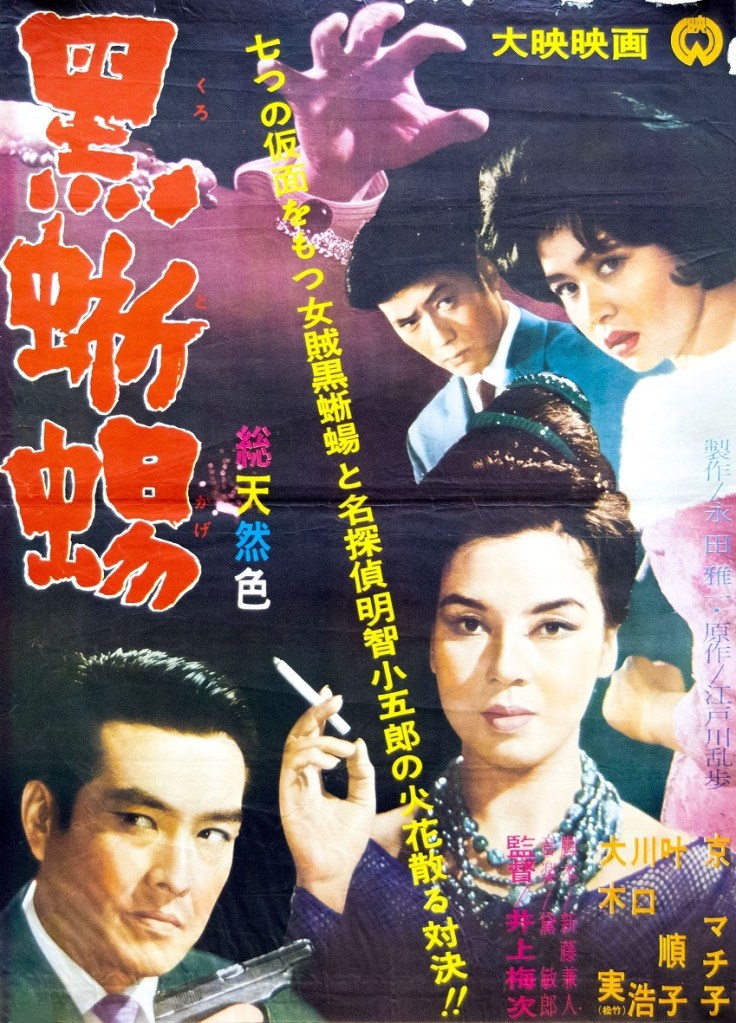
Black Lizard (黒蜥蝪, Umetsugu Inoue, 1962)

“I want to live in a world where things kiss spontaneously, money divides society like it does you and me” says the Black Lizard (黒蜥蝪, Kurotokage) to her mark, affecting the role of an elegant older woman but failing to conceal herself within the disguise. Though the later 1968 version by Kinji Fukasaku may be better known, Umetsugu Inoue’s adaptation of Edogawa Rampo’s 1934 short story, filtered through Yukio Mishima’s stage play and scripted by Kaneto Shindo, is a camp classic in its own right. Making full use of Inoue’s talent for musicals and the dance background of marquee star Machiko Kyo, Black Lizard is a full hearted crime melodrama in which the villain’s defeat is a perverse tragedy leaving the truly treacherous to ponder what it is they may have destroyed. 

Another outing for Edogawa Rampo’s master detective Akechi (Minoru Oki), the picture opens with “Japan’s best detective” offering a monologue to camera in which he explains that the world is a brutal place but crime too can be an art, it is after all a man-made creation. If only we had more artful crimes, he claims, the world might be a better place. That is perhaps why he seems to have fallen for the crafty Black Lizard, his Irene Adler talented at elaborate heists involving disguise and subterfuge. 

His present case, however, finds him on a retainer to boorish jewellery merchant Iwase (Masao Mishima) who has been receiving threatening letters claiming that someone “very evil” is planning to kidnap his 19-year-old daughter Sanae (Junko Kano) whom he is currently trying to marry off. The reason they’ve made this trip to Osaka (without her mother) is so that Sanae can meet another prospective husband. She doesn’t seem very happy about the idea, but is going along with it and it seems Iwase doesn’t intend to pressure her into a marriage she doesn’t want. In any case, she’s something of a sheltered young woman which might be why she doesn’t suspect anything of the over friendly Mrs. Midorikawa other than she seems to have designs on her father. Knowing that no young girl relishes the prospect of arranged marriage, “Mrs. Midorikawa” makes a point of introducing her to a “friend” of hers, Amamiya (Hiroshi Kawaguchi), whom she thinks might be more to her liking. Of course, Midorikawa is really Black Lizard and Amamiya is her henchman. They’ve come to kidnap Sanae in the hope of ransoming her for the precious jewel “Egyptian Star” that Iwase can’t stop boasting about. 

The thing about Black Lizard is that she’s not driven by monetary gain but by a lust for beauty. She loves everything that sparkles, but more than that the aesthetic pleasure of the human form. Black Lizard tells Sanae that she dreams of a world with no borders, in which people are free into wander into the homes of others, and the subway hangers will be made of diamonds and platinum – literally a sparkling world of peace and freedom where everything is beautiful and nothing hurts. In a slightly transgressive moment, she casts her eyes over Sanae’s youthful body, admiring her “perfectly shaped breasts” before turning melancholy in admitting that she feels sad whenever she sees someone beautiful in knowing they will soon grow old. Later, we realise we should have taken her at her word, her objection to transience apparently having turned murderous. 

Even so, Sanae in rejecting the idea of arranged marraige, foolishly admits she’d rather be stolen than bought. In her eyes, a desire to be swept off her feet by a romantic hero saving her from a bourgeois existence, but she is indeed about to be “stolen” if only to be redeemed when her father agrees to give up the Egyptian Star to save her. Iwase, however, like the Black Lizard herself, was seduced by the allure of precious jewels after striking it lucky as a working class young man labouring in a quarry. He loves his daughter, but cannot bring himself to surrender this the most precious of all his jewels even to save her life. Akechi assures him that he has a plan which will save both Sanae and the diamond, but is left with only contempt for the way that Iwase has been corrupted not quite by greed but by a kind of misdirected lust for illusionary lustre. 

Black Lizard, for her part, is smitten by Akechi’s acumen, taken both by his handsome form and by his ability to challenge her. They chase each other while wondering who it is that is really being pursued and what they intend to do if ever they manage to catch their quarry, but vowing to emerge victorious all the same. Black Lizard guards her heart jealously, like the most precious jewel of all, while Akechi is continually captivated by the perfection of her criminal escapades. “What I hate most in this world is fakes” Black Lizard exclaims, confronted by Akechi’s complicated doubles game where no one is quite whom they first seemed to be, but it’s her own authenticity which eventually blinds her in realising she might have made a damning confession to the man who has “stolen” her heart. Grotesque as it eventually is, and it ends in a bizarre museum of human taxidermy crafted into “beautiful” tableaux, Akechi cannot help but admire the “beauty” in Black Lizard’s artistry, lamenting the loss of something precious while those like Iwase will continue to sell their glittering emptiness to an increasingly “brutal” world. 


Black Lizard dancing away from the scene of the crime (no subtitles)

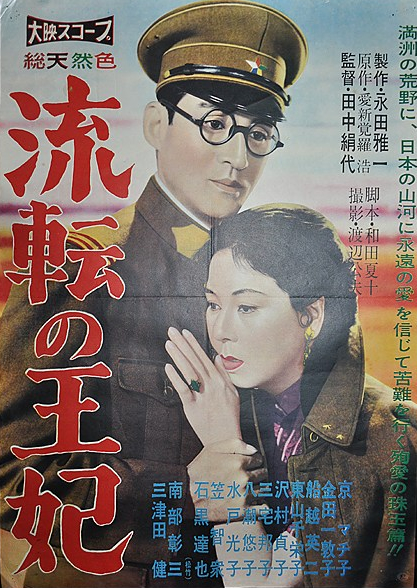
The Wandering Princess (流転の王妃, Kinuyo Tanaka, 1960)

Wandering Princess posterAs in her third film, The Eternal Breasts, Kinuyo Tanaka’s fourth directorial feature, The Wandering Princess (流転の王妃, Ruten no Ouhi), finds her working with extremely recent material – in this case the memoirs of Japanese noblewoman Hiro Saga which had become a bestseller immediately after publication in 1959. Tanaka’s filmic adaptation arrived mere months later in January 1960 which was, in an ironic twist, a year before the real life tale would meet something like the conventional romantic ending familiar from classic melodrama. Nevertheless, working with Daiei’s top talent including Kon Ichikawa’s regular screenwriter (and wife) Natto Wada, Tanaka attempts to reframe the darkness of the preceding 20 years as the defeat of compassionate idealism at the hands of rigid austerity and unstoppable oppression.

Tanaka opens with a scene taking place in 1957 which in fact depicts a somewhat notorious incident already known to the contemporary audience and otherwise unexplained on-screen in which the older Ryuko (Machiko Kyo) tenderly bends over the body of lifeless schoolgirl. The camera then pulls back to find another girl in school uniform, Ryuko, twenty years earlier. A young woman with innocent dreams, Ryuko’s life encounters the usual kind of unwelcome disruption in the unexpected arrival of a marriage proposal but this is no ordinary wedding. Ryuko, as the oldest daughter of a prominent noble family, has been selected as a possible bride for the younger brother of the former Qing emperor now installed as the symbolic leader of the Japanese puppet state of Manchuria. Against the odds, Ryuko and her new husband Futetsu (Eiji Funakoshi) are well matched and endeavour to build a happy home together just as they intend to commit themselves to the creation of a new nation born from the twin legacies of the fallen Chinese empire and the resurgent Japan.

Foregrounding Ryuko’s experience, the film does its best to set “politics” aside but the inescapable truth is that each of our protagonists is a prisoner of the times in which they live. The second scene finds Ryuko in 1937 as an innocent schoolgirl gazing at the young men in uniform as they march past her. She remains out of step with them, walking idly and at her own uneven rhythm while they keep rigorous and seemingly unstoppable time. The family are understandably wary of the implications of the marriage proposal, especially as it comes with a military escort, with Ryuko’s beloved grandmother the only one brave enough to ask to see whoever’s in charge of this outrage only to be told that their fates are in the hands of the nebulous concept known as “army” which knows no individual will.

Assured by her family that the decision rests with her, Ryuko consents – not only to becoming a stranger’s wife (which would have been her fate in any case) but to being a kind of ambassador, the presentable face of imperial ambition. On her marriage she’s presented with a deep red cheongsam and continues to dress in Chinese fashion for remainder of her life in Manchuria where she learns to speak Mandarin and devotes herself to becoming as Chinese as it’s possible to be. Meanwhile, her husband Futetsu busies himself with a complementary desire to become Japanese, intensely worried that the sometimes degrading treatment he and his family receive is exclusively caused by his problematic nationality. When their daughter, Eisei, is born, the couple determine to raise her as the child of a new world, the embodiment of idealised cultural integration.

The world, however, is not so kind and the blunt force of militarism continues to present a barrier to familial harmony. Futetsu is prevented from seeing his brother by the officious forces of the military police while the lonely, paranoid “emperor” suspects that Ryuko is nothing more than a Japanese spy sent to undermine his rule. Ryuko was sent to Manchuria to be the bridge between two cultures. Her, in a sense, feminine energy which attempts to build connection through compassion and understanding is consistently contrasted with the prevailing male energy of the age which prizes only destruction and dominance. Filled with the naivety of idealism, she truly believes in the goodness of the Manchurian project and is entirely blind to the less altruistic actions of her countrymen engaged in the same endeavour.

Confronted by some children in a park while pushing the infant Eisei in a pram, Ryuko is identified as a Japanese woman by her accent while conversing in Mandarin. She assures the children that Eisei is Manchurian like them, and that seeing as she married a Manchurian she is now too despite her Japanese birth. The kids are satisfied, so much so that they warn her that some Manchurians were killed recently in this park by Japanese soldiers, adding a mild complaint that it upsets their parents when Japanese people come to their restaurant and leave without paying. Mortified, Ryuko decides to use some of her (meagre) resources to buy all of the kids and everyone else in the park some sweets from a nearby stand, fulfilling her role as a Japanese ambassador even while insisting that she is a proud citizen of the newly born state of Manchuria.

Nevertheless the Manchurian project is doomed to fail, the kind of idealism fought for by Ryuko and Futetsu crushed under the boot of militarism. Despite everything, Ryuko still wants to be the bridge if only to prevent a catastrophe of this kind happening again (while perhaps refusing to engage with some of the reasons it happened in the first place) but in Eisei’s eventual death, foreshadowed in the melancholy opening, a deeply uncomfortable implication is made that the kind of cross-cultural harmony that Ryuko dreams of may not be viable. In contrast to the salaciously reported real life events (somewhat alluded to by presence of a schoolboy’s cap next to the body) which hinted at a suicide pact or murder, Ryuko attributes Eisei’s decision to end her life to an inability to reconcile her twin heritage coupled with the heavy burden of being the last descendent of the Qing Dynasty. Despite this minor misstep of tying the fate of Eisei to the failure of the Manchurian dream and the loss of its misplaced idealism, Ryuko ends her account on a hopeful note in admiring the flowers she planted finally in bloom and looking forward to a more hopeful age governed by warmth and compassion rather than violence and austerity.


The Wandering Princess was presented by Japan Foundation London as part of a series of events marking the publication of Tanaka Kinuyo: Nation, Stardom and Female Subjectivity.

Clothes of Deception (偽れる盛装, Kozaburo Yoshimura, 1951)

「偽れる盛装」(C)KADOKAWA1951

「偽れる盛装」(C)KADOKAWA1951Japan at a crossroads. East/West, past/future becomes a conflict between Kyoto and Tokyo in Yoshimura’s exploration of two women pulled in surprisingly contradictory directions in the new post-war world, Clothes of Deception (偽れる盛装, Itsuwareru Seiso). Working from a script by Kaneto Shindo, Yoshimura frames his tale as one of progress and resistance but the divisions are not as simple as they first seem. Machiko Kyo turns in another wonderfully nuanced performance as a Kyoto geisha trapped by the unchanging nature of her city yet yearning for an end to its slavish devotion to tradition.

Kumicho (Machiko Kyo) is the daughter of a longstanding geisha house currently operated by her mother. Though working as a geisha, Kumicho is not universally popular with the older generation thanks to her money first attitude which sees her prioritise earnings potential through having an unlimited number of clients rather than relying on a single patron. Kumicho is tough where geishas are generally soft and accommodating. She doesn’t take orders or nonsense from anyone, not least her push over of a mother.

Kumicho’s sister, Taeko (Yasuko Fujita), is not involved in the geisha trade and has a regular office job in the local tourist office. Unlike Kumicho, Taeko is mild mannered and reserved, dressing in regular Western fashions and travelling everywhere by bicycle. Taeko is engaged to a colleague, Koji (Keiju Kobayashi), who just happens to be the adopted son of another geisha house run by a woman with a long standing grudge against her mother.

Kyoto, a former capital, is famous for its historical qualities – a living museum to old-time Japan, but as a friend visiting from Tokyo points out perhaps that’s not altogether a good thing. Unlike Tokyo, Kyoto escaped much of the wartime destruction allowing it to be seen as a symbol of cultural resilience but lack of destruction also robs of it the chance for rebirth. History has survived, but so have lots of “tired old ideas”, according to Taeko’s friend Yukiko who urges her to forget the stagnant city and head for pastures new in Tokyo where the exciting post-war future is already underway.

Those old fashioned ideas are embodied within the rigid codes of the geisha world which Kumicho, on the surface the more traditional of the sisters but in actuality less so, has been breaking. Kumicho cares about money and she cares about survival which has made her unsentimental. Despite being involved in the “traditional” Kyoto occupation with all of its elegance and complicated ritual, Kumicho is a modernist who secretly hates the trade and holds each of her customers in deep contempt. Thus she thinks her mother, Kiku (Hisako Takihana), is a soft touch for continuing to bankroll the feckless son of her former lover, but is as heartbroken as anyone when one of the geishas becomes gravely ill. Kumicho’s manner maybe brash and brassy but her heart is as warm as her mother’s who continues to visit the widow of her former patron and makes sure the sickly geisha is cared for properly without resenting either the costs involved or the loss of earnings.

Taeko’s engagement to Koji opens up old wounds and exposes the less genial side of geishadom in the grudge bearing rivalry of Kiku and Koji’s mother Chiyo (Chieko Murata). Chiyo tries to put the kibosh on Taeko’s marriage as a way of getting back at Kiku, claiming that Taeko simply isn’t good enough for her son, but her authority is also dependent on those tired old ideas of hierarchy and filial piety. Koji, an adopted child, feels himself beholden to his mother’s needs in having been raised exclusively to fulfil them and vacillates in indecision regarding his marriage. Spineless and cowardly, Koji cannot find the strength to tell his mother no but also refuses to definitively break things off with Taeko.

Younger than Kumicho and a part of the “modern” world thanks to her regular office job in the tourist office, Taeko is comparatively more socially conservative reacting with horror when the increasingly strained Koji makes desperate, aggressive advances towards her whilst refusing to confirm his intention to marry against his mother’s wishes. Taeko and Koji have imprisoned themselves within Kyoto’s oppressive system of social codes in refusing to seize their chance of individual happiness and stride forward into the bright future being offered everywhere else except in the unchanging city.

Kumicho’s machinations eventually land her in hot water when an obsessed client ruins himself and then turns violent, demonstrating the less publicised dangerous side of life in the geisha trade. Kyoto, with all of its elegant refinement, can still be a place of rancour and regret where decades old grudges and more recent resentments threaten to disturb the peace. Kumicho’s innovations have shown up the geisha trade for what it is through her thoroughly unsentimental seduce and discard philosophy but she is, if nothing else, essentially truthful in her “modern” desire to call a spade a spade. The old ways are changing, though perhaps not fast enough. Kyoto, with its rigidity and stagnation is eventually rejected as Kumicho, unable to extricate herself, makes sure that her sister is first in line for all the opportunities the new world has to offer – by sending her to Tokyo, the capital of the future.


Screened at BFI as part of the Women in Japanese Melodrama season.

The Little Runaway (小さい逃亡者, Eduard Bocharov & Teinosuke Kinugasa, 1966)

The little runawayTeinosuke Kinugasa maybe best known for his avant-garde masterpiece The page of Madness even if his subsequent work leant towards a more commercial direction. His final film is just as unusual, though perhaps for different reason. In 1966, Kinugasa co-directed The Little Runaway (小さい逃亡者, Chiisai Tobosha) with Russian director Eduard Bocharov in the first of such collaborations ever created. Truth be told, aside from the geographical proximity, the Japan of 1966 could not be more different from its Soviet counterpart as the Eastern block remained mired in the “cold war” while Japan raced ahead towards its very own, capitalist, economic miracle. Perhaps looking at both sides with kind eyes, The Little Runaway has its heart in the right place with its messages of the universality of human goodness and endurance but broadly makes a success of them if failing to disguise the obvious propaganda gloss.

Little Ken (Chiharu Inayoshi) is ten years old and lives with his violinist uncle, Nobuyuki (Jukichi Uno). Ken has obvious talent at the violin and, like most kids in this rundown area, his drunken uncle has roped him into helping out for a few extra pennies. One fateful night, Nobuyuki has tied one on and lets slip that Ken’s dad might not be dead, but stuck in a hospital in Moscow. Soon enough a Russian circus comes to town and Ken strikes up a strange friendship with the kindly clown, eventually stowing away to the Soviet Union to look for his long lost father.

From one point of view, The Little Runaway conforms to a certain type of family drama which centres on the disconnect between a father and a son. Ken feels abandoned (no reference is ever made to his mother), though he loves and respects the uncle who takes care of him even if recognising his standard of care often leaves a lot to be desired. His desire to find his father is not so much motivated by unhappiness (his life is difficult but it’s the only one he’s ever known), but by the desire for answers as regards his own ancestry and the emotional need to reconnect with the biological father he no longer remembers clearly.

From another point of view, The Little Runaway conforms to the genre of children’s cinema in its close following of Ken’s quest. With no word of warning, Ken takes off for Russia as if he were simply going to check out a neighbouring town. Unaware of the political context and hoping to use his friendship with the circus troupe to his advantage Ken stows away on a boat headed for the USSR, but his clowning friends aren’t on it and he doesn’t speak any Russian.

The central tenet of the story is that there are kind people everywhere willing to help a determined little boy with melancholy eyes. Ken manages to get to Russia but then escapes his “escort”, hoping to travel to the capital faster. Wandering through the empty landscape, he chances into a house and makes friends with a peasant boy who introduces him to his wider family and a man with many daughters who could use a son just like Ken. Ken also tries to support himself by taking casual work as a labourer, having learnt the Russian word for such a job and repeatedly emphasising it, trying to assure them that he’s stronger than his appearance suggests.

Despite not speaking the language Ken manages to make himself understood through sand paintings, though the Russians he meets are all eager to share their food and shelter with him without much by way of explanation. As might be expected, the Russia depicted may not be particularly realistic, the officials are kind and jovial, the streets are clean, the people healthy and happy, and you can even buy Moscow cigarettes from woman running a stand in the square. The Japan Ken knows, by contrast, is one down at heels in which children are being pressed into shady forms of employment from Ken’s violin playing to little girls selling flowers on the street.

Depicting events from an innocent, child’s eye view, The Little Runaway finds only goodness rather than political anxiety but it is quick to emphasis the importance of helping those in need as the clown later avows. More or less straightforward in shooting style, Little Runaway is more intent on seeing the virtues of the cooperation between the Soviet block and the burgeoning Japanese economy than resolving its central mystery but nevertheless provides another welcome addition to the plucky child adventure genre while urging a kind of universal kindness probably not much in evidence in the real life Tokyo or Moscow of 1966.


Original Japanese trailer (no subtitles)