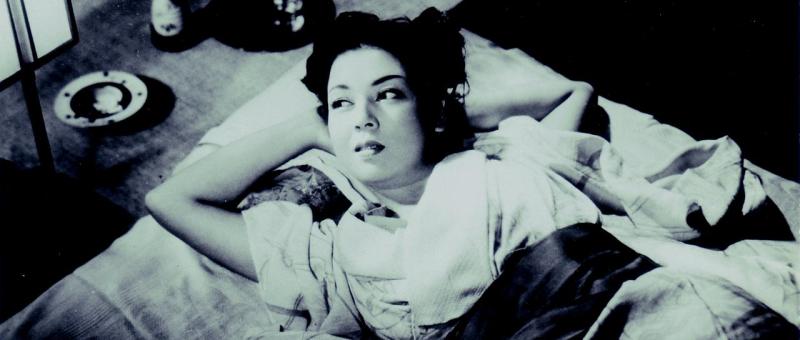
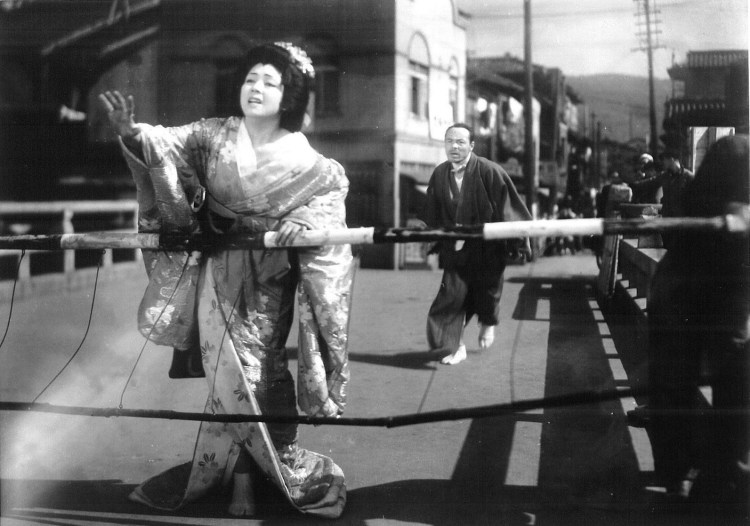
 Japan at a crossroads. East/West, past/future becomes a conflict between Kyoto and Tokyo in Yoshimura’s exploration of two women pulled in surprisingly contradictory directions in the new post-war world, Clothes of Deception (偽れる盛装, Itsuwareru Seiso). Working from a script by Kaneto Shindo, Yoshimura frames his tale as one of progress and resistance but the divisions are not as simple as they first seem. Machiko Kyo turns in another wonderfully nuanced performance as a Kyoto geisha trapped by the unchanging nature of her city yet yearning for an end to its slavish devotion to tradition.
Kumicho (Machiko Kyo) is the daughter of a longstanding geisha house currently operated by her mother. Though working as a geisha, Kumicho is not universally popular with the older generation thanks to her money first attitude which sees her prioritise earnings potential through having an unlimited number of clients rather than relying on a single patron. Kumicho is tough where geishas are generally soft and accommodating. She doesn’t take orders or nonsense from anyone, not least her push over of a mother.
Kumicho’s sister, Taeko (Yasuko Fujita), is not involved in the geisha trade and has a regular office job in the local tourist office. Unlike Kumicho, Taeko is mild mannered and reserved, dressing in regular Western fashions and travelling everywhere by bicycle. Taeko is engaged to a colleague, Koji (Keiju Kobayashi), who just happens to be the adopted son of another geisha house run by a woman with a long standing grudge against her mother.
Kyoto, a former capital, is famous for its historical qualities – a living museum to old-time Japan, but as a friend visiting from Tokyo points out perhaps that’s not altogether a good thing. Unlike Tokyo, Kyoto escaped much of the wartime destruction allowing it to be seen as a symbol of cultural resilience but lack of destruction also robs of it the chance for rebirth. History has survived, but so have lots of “tired old ideas”, according to Taeko’s friend Yukiko who urges her to forget the stagnant city and head for pastures new in Tokyo where the exciting post-war future is already underway.
Those old fashioned ideas are embodied within the rigid codes of the geisha world which Kumicho, on the surface the more traditional of the sisters but in actuality less so, has been breaking. Kumicho cares about money and she cares about survival which has made her unsentimental. Despite being involved in the “traditional” Kyoto occupation with all of its elegance and complicated ritual, Kumicho is a modernist who secretly hates the trade and holds each of her customers in deep contempt. Thus she thinks her mother, Kiku (Hisako Takihana), is a soft touch for continuing to bankroll the feckless son of her former lover, but is as heartbroken as anyone when one of the geishas becomes gravely ill. Kumicho’s manner maybe brash and brassy but her heart is as warm as her mother’s who continues to visit the widow of her former patron and makes sure the sickly geisha is cared for properly without resenting either the costs involved or the loss of earnings.
Taeko’s engagement to Koji opens up old wounds and exposes the less genial side of geishadom in the grudge bearing rivalry of Kiku and Koji’s mother Chiyo (Chieko Murata). Chiyo tries to put the kibosh on Taeko’s marriage as a way of getting back at Kiku, claiming that Taeko simply isn’t good enough for her son, but her authority is also dependent on those tired old ideas of hierarchy and filial piety. Koji, an adopted child, feels himself beholden to his mother’s needs in having been raised exclusively to fulfil them and vacillates in indecision regarding his marriage. Spineless and cowardly, Koji cannot find the strength to tell his mother no but also refuses to definitively break things off with Taeko.
Younger than Kumicho and a part of the “modern” world thanks to her regular office job in the tourist office, Taeko is comparatively more socially conservative reacting with horror when the increasingly strained Koji makes desperate, aggressive advances towards her whilst refusing to confirm his intention to marry against his mother’s wishes. Taeko and Koji have imprisoned themselves within Kyoto’s oppressive system of social codes in refusing to seize their chance of individual happiness and stride forward into the bright future being offered everywhere else except in the unchanging city.
Kumicho’s machinations eventually land her in hot water when an obsessed client ruins himself and then turns violent, demonstrating the less publicised dangerous side of life in the geisha trade. Kyoto, with all of its elegant refinement, can still be a place of rancour and regret where decades old grudges and more recent resentments threaten to disturb the peace. Kumicho’s innovations have shown up the geisha trade for what it is through her thoroughly unsentimental seduce and discard philosophy but she is, if nothing else, essentially truthful in her “modern” desire to call a spade a spade. The old ways are changing, though perhaps not fast enough. Kyoto, with its rigidity and stagnation is eventually rejected as Kumicho, unable to extricate herself, makes sure that her sister is first in line for all the opportunities the new world has to offer – by sending her to Tokyo, the capital of the future.
Screened at BFI as part of the Women in Japanese Melodrama season.
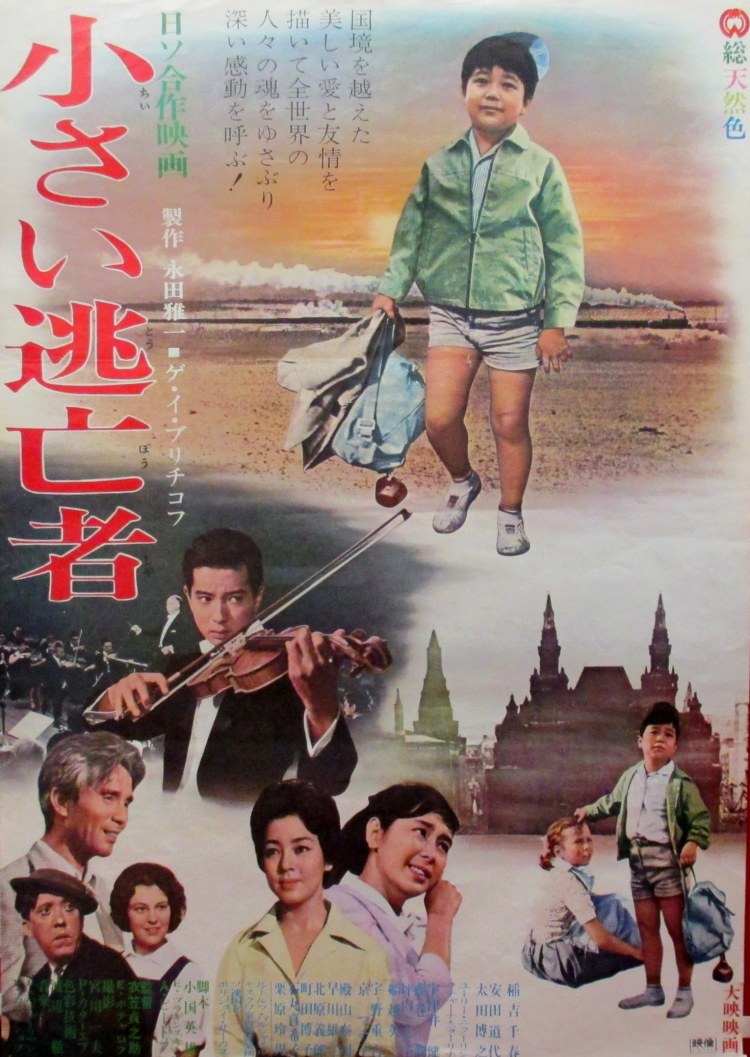 Teinosuke Kinugasa maybe best known for his avant-garde masterpiece The page of Madness even if his subsequent work leant towards a more commercial direction. His final film is just as unusual, though perhaps for different reason. In 1966, Kinugasa co-directed The Little Runaway (小さい逃亡者, Chiisai Tobosha) with Russian director Eduard Bocharov in the first of such collaborations ever created. Truth be told, aside from the geographical proximity, the Japan of 1966 could not be more different from its Soviet counterpart as the Eastern block remained mired in the “cold war” while Japan raced ahead towards its very own, capitalist, economic miracle. Perhaps looking at both sides with kind eyes, The Little Runaway has its heart in the right place with its messages of the universality of human goodness and endurance but broadly makes a success of them if failing to disguise the obvious propaganda gloss.
 Junichiro Tanizaki is widely regarded as one of the major Japanese literary figures of the twentieth century with his work frequently adapted for the cinema screen. Those most familiar with Kon Ichikawa’s art house leaning pictures such as war films The Burmese Harp or Fires on the Plain might find it quite an odd proposition but in many ways, there could be no finer match for Tanizaki’s subversive, darkly comic critiques of the baser elements of human nature than the otherwise wry director. Odd Obsession (鍵, Kagi) may be a strange title for this adaptation of Tanizaki’s well known later work The Key, but then again “odd obsessions” is good way of describing the majority of Tanizaki’s career. A tale of destructive sexuality, the odd obsession here is not so much pleasure or even dominance but a misplaced hope of sexuality as salvation, that the sheer force of stimulation arising from desire can in some way be harnessed to stave off the inevitable even if it entails a kind of personal abstinence.
