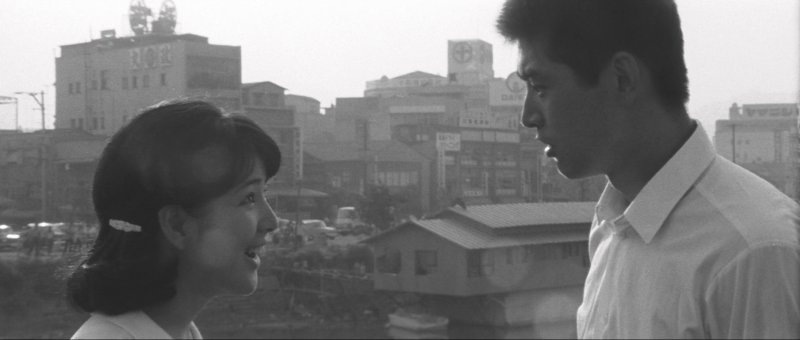
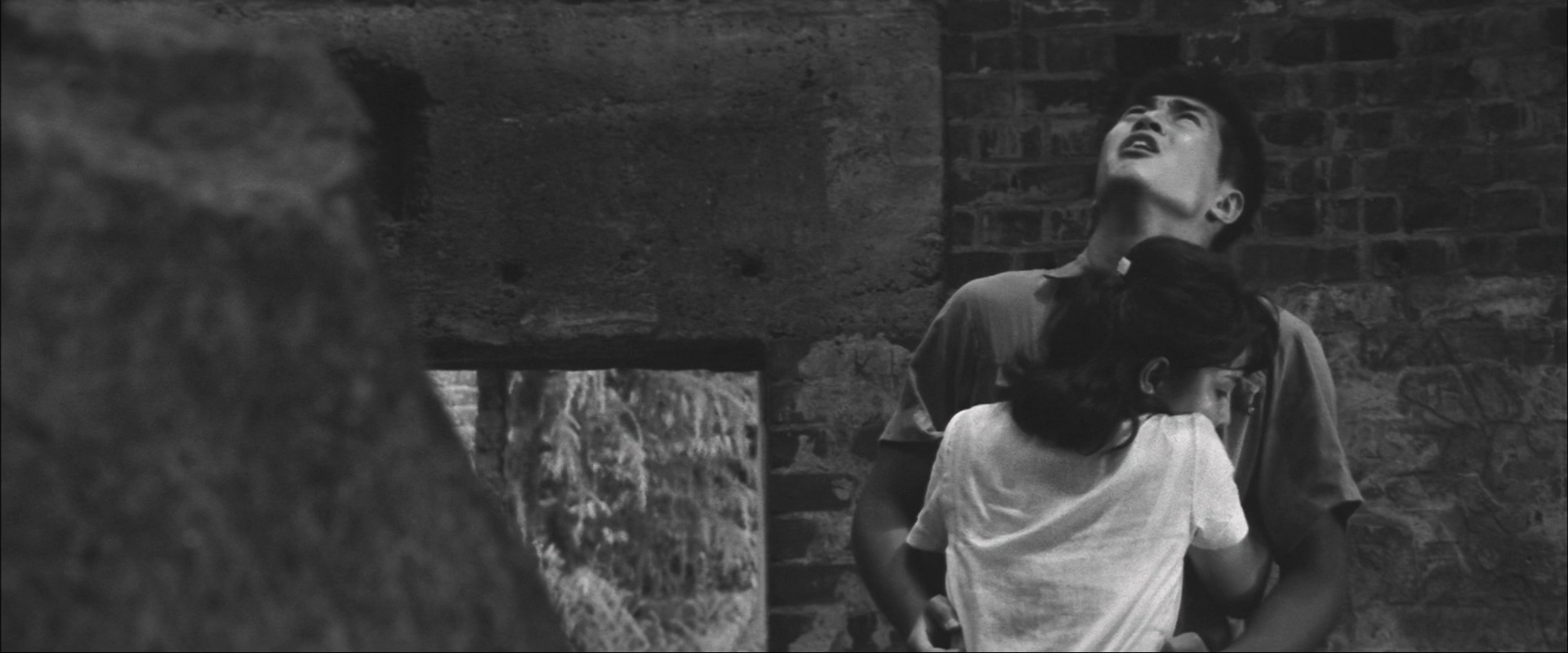
The Heart of Hiroshima (愛と死の記録, Koreyoshi Kurahara, 1966)

Sayuri Yoshinaga was the top female star at Nikkatsu in the mid-1960s. Together with her regular co-star Mitsuo Hamada, she starred in a series of hit youth romances such as The Mud-Spattered Pure Heart, The Sound of Waves, and Gazing at Love and Death which was Nikkatsu’s biggest box office success at the time. The Heart of Hiroshima (愛と死の記録, Ai to Shi no Kiroku) was intended as the latest in the series, but Mitsuo Hamada was attacked by a drunk customer at a bar shortly before filming after which he needed surgery to save his eyesight. Normally, the film would be postponed, but Nikkatsu was having financial difficulties at the time and refused to wait despite pleas from Yoshinaga and even from the actor who replaced him, Tetsuya Watari, who was a good friend of his. 

At the same time, Yoshinaga was now 21 years old and uncertain how long she could convincingly go on performing in Nikkatsu’s typical teen dramas. The studio was also worried about the possibility of losing their top star if she decided to move into more serious dramatic roles while they did not believe they had a suitable replacement. They were currently on bad terms with Ruriko Asaoka who ended her exclusive contract that year and moved to Ishihara Pro, and were worried that their other popular actresses such as Chieko Matsubara weren’t ready to take on that kind of responsibility. To try to convince Yoshinaga that the film would be more artistic in nature they hired New Wave director Koreyoshi Kurahara rather than studio stalwarts like Buichi Saito who’d directed Gazing at Love Death, but when she again tried to refuse insisting they wait for Hamada, they forced her hand by simply beginning to shoot the film on location in Hiroshima without her. Casting Tetsuya Watari may have also been an attempt to shake up the franchise as at that point he was known more for action and hadn’t really played this kind of very intense, romantic role before.

Though it follows a familiar pattern in exploring a doomed romance between a boy and a girl whose pure love is obstructed by social division, the film does deal with some quite controversial themes in touching on the discrimination faced by those who were affected by the atomic bomb. Yukio (Tetsuya Watari) lost his whole family in the blast and was taken in by Mr Iwai (Asao Sano) after being released from a long-term hospital stay. He’s doing well working at Mr Iwai’s print shop and has no current health worries when he has a meet cute with Kazue (Sayuri Yoshinaga) knocking into her on his bike and smashing some records she was carrying which he insists he compensate her for, though he doesn’t know she works in a record shop so it doesn’t really matter. After a comical misunderstanding in which Yukio mistakenly thinks Kazue is dating his friend, and she thinks he’s a creep who’s coming on to her while dating another girl from the shop, they fall in love and want to get married.

However, Yukio’s symptoms start to resurface and he asks himself if he really has a right to start a romantic relationship and get married, especially as there’s a risk any children he may have could be born with genetic abnormalities. Because of the stigma directed towards those who were affected by radiation from the bomb, he feels he can’t explain any of this to Kazue and continues to blow hot and cold, while she too is close to a young woman (Izumi Ashikawa) who seems to have had a romantic past with her brother but once tried to take her own life because she has a large radiation scar on her face. She has since resigned herself to living for her parents, suggesting that she will not marry. When Yukio eventually has to tell Kazue, he does it inside the dome at the Hiroshima Peace Memorial Park where she, of course, says it doesn’t matter and is only hurt and upset that he suggested they break their engagement.

The underlying suggestion is that those who were affected by the atomic bomb are being denied love by an unforgiving society that has avoided fully processing its traumatic past. Though it’s strongly suggested to her that Yukio will not survive his leukaemia, Kazue remains devoted to nursing to him but is also placed into an impossible position. She tells Yukio that she is already his wife and will stay with him, but is persuaded to leave by her mother and sister-in-law who tell her it’s “improper” for her to be with him overnight in the hospital despite the fact he’s in a communal ward with several other people there all the time as well as the medical staff. Her friend advises her to leave permanently, but then also calls her heartless knowing Yukio has no one else when Kazue begins to waver and suggests he may give in to the pressure given the emotional toll the whole experience is already taking on her. Nevertheless, she never really gives up on Yukio and is ultimately unable to reconcile herself to a world in which he would become “a man that no one could love”. The film ends on a rather bleak and ghostly note as a group of school children walk past the dome, suggesting that to some these comparatively recent events have already become history rather than a living memory and lingering trauma hanging over a rapidly changing society.


The Boy Who Came Back (踏みはずした春, Seijun Suzuki, 1958)

the boy who came back posterSeijun Suzuki may have been fired for making films that made no sense and no money, but he had to start somewhere before getting the opportunity to push the boat out. Suzuki’s early career was much like that of any low ranking director at Nikkatsu in that he was handed a number of program pictures often intended to push a pop song or starring one of the up and coming stars in the studio’s expanding youth output. The Boy Who Came Back (踏みはずした春, Fumihazushita Haru, AKA The Spring that Never Came) is among these early efforts and marks an early leading role for later pinup star Akira Kobayashi paired with his soon to be frequent leading lady, Ruriko Asaoka. A reform school tale, the film is a restrained affair for Suzuki who keeps the rage quelled for the most part while his hero struggles ever onward in a world which just won’t let him be.

Keiko (Sachiko Hidari) is a conductress on a tour bus, but she has aspirations towards doing good in the world and is also a member of the volunteer organisation, Big Brothers and Sisters. While the other girls are busy gossiping about one of their number who has just got engaged (but doesn’t look too happy about it), Keiko gets a message to call in to “BBS” and is excited to learn she’s earned her first assignment. Keiko will be mentoring Nobuo (Akira Kobayashi) – a young man getting out of reform school after his second offence (assault & battery + trying to throttle his father with a necktie, time added for plotting a mass escape). Nobuo, however, is an angry young man who’s done all this before, he’s not much interested in being reformed and just wants to be left alone to get back to being the cool as ice lone wolf that he’s convinced himself he really is.

Made to appeal to young men, The Boy Who Came Back has a strong social justice theme with Keiko’s well meaning desire to help held up as a public service even if her friends and family worry for her safety and think she’s wasting her time on a load of ne’er do wells. Apparently an extra-governmental organisation, BBS has no religious agenda but is committed to working with troubled young people to help them overcome their problems and reintegrate into society.

Reintegration is Nobuo’s biggest problem. He’s committed to going straight but he’s proud and unwilling to accept the help of others. He turns down Keiko’s offer to help him find work because he assumes it will be easy enough to find a job, but there are no jobs to be had in the economically straightened world of 1958 – one of the reasons Keiko’s mother thinks the BBS is pointless is because no matter how many you save there will always be more tempted by crime because of the “difficult times”. When he calms down and comes back, agreeing to an interview for work at his mother’s factory Nobuo leaves in a rage after an employee gives him a funny look. There are few jobs for young men, but there are none for “punks” who’ve been in juvie. Every time things are looking up for Nobuo, his delinquent past comes back to haunt him.

This is more literally true when an old enemy re-enters Nobuo’s life with the express intention of derailing it. His punk buddies don’t like it that he’s gone straight, and his arch rival is still after Nobuo’s girl, Kazue (Ruriko Asaoka). If Nobuo is going to get “reformed” he’ll have to solve the problem with Kajita (Jo Shishido) and his guys, but if he does it in the usual way, he’ll land up right in the slammer. Keiko’s dilemma is one of getting too involved or not involved enough – she needs to teach Nobuo to fix his self image issues (which are largely social issues too seeing as they relate to familial dysfunction – a violent father and emotionally distant mother creating an angry, fragile young man who thinks he’s worthless and no one will ever really love him) for himself, rather than try to fix them for him.

A typical program picture of the time, The Boy Who Came Back does not provide much scope for Suzuki’s rampant imagination, but it does feature his gift for unusual framing and editing techniques as well as his comparatively more liberal use of song and dance sequences in the (not quite so sleazy) bars and cabarets that Nobuo and his ilk frequent. Unlike many a Nikkatsu youth movie, The Boy Who Came Back has a happy ending as everyone, including the earnest Keiko, learns to sort out their various difficulties and walks cheerfully out into the suddenly brighter future with a much more certain footing.


The Boy Who Came Back is the first of five films included in Arrow’s Seijun Suzuki: The Early Years. Vol. 1 Seijun Rising: The Youth Movies box set.

Original trailer (English subtitles)

A Chain of Islands (日本列島, Kei Kumai, 1965)

nihon retto posterKei Kumai made just 19 films films in his 40 year career, but even since his earliest days he ranked among the most fearless of directors, ready to confront the most unpleasant or taboo aspects of contemporary Japan. His first film, The Long Death, interrogated wartime guilt through drawing inspiration from a real life 1948 mass poisoning case in which materials manufactured in a Manchurian lab may have led to the deaths of post-war civilians. Having begun in this possibly controversial vein, Kumai pressed on with 1965’s A Chain of Islands (日本列島, Nihon Retto, AKA The Japanese Archipelago) which he set in 1959 as Japanese youth protested the renewal of the ANPO treaty which placed Japan under the military protection of the American Armed forces in return for allowing the presence of those forces on Japanese soil.

Despite the contemporary setting Kumai opens with a explanatory voice over detailing the depth of the American military presence and the function of the CID which exists solely to investigate crimes committed by American servicemen. The CID is staffed by both Americans and Japanese nationals who, the voiceover explains, often feel conflicted in stepping onto American soil each morning as prolonged exposure gradually erodes their sense of difference and finally of “Japaneseness”. Akiyama (Jukichi Uno) is a translator/investigator at CID and he’s about to be handed an unusual request from his boss – reopen a cold case from the previous summer in which an American Sergeant was found floating in Tokyo bay. Akiyama’s new boss was a friend of the late soldier and would like to know what happened.

Akiyama’s investigations lead him down a dark path of corruption, murder, conspiracy, and governmental complicity. Beginning to investigate the case, Akiyama discovers that nothing is quite as it seems. A couple of policeman from the original investigation arrive to help him and echo their frustrations with the way the case was handled. Despite the police investigation, the American authorities did their best to interfere – commandeering the body and claiming jurisdiction in contravention of Japan’s standing as a sovereign nation. The Americans are no longer occupying forces but honoured guests who should obey international protocol in cases like these, but they rarely do. Despite the existence of the CID, crimes by American servicemen are generally covered up as the military insists the matter will be dealt with internally only for suspects to be suddenly “transferred” overseas.

Sgt. Limit was, however, one of the good ones and Akiyama’s investigation seems to point towards a murder and cover up instigated because Limit had got too close to the truth in investigating a sudden flood of counterfeit cash. The Americans, to the surprise of all, are only the middle man in the grand conspiracy which leads right back to the dark heart of Japan and the vast spy networks operated during the militarist era. As might be expected, these valuable networks are left wide open with the collapse of Japanese fascism but are perfectly primed to facilitate widespread crime spanning the Asian world and all with the tacit approval of the American and Japanese states.

Kumai also implicates the spy ring in a series of “mysterious” rail incidents, but makes sure to reserve some of his ire more the more usual injustices. Akiyama is caring for his young nephew whose father was killed in mining explosion which has claimed the lives of nearly every young man in the village leaving his sister unable to cope with her children alone. He is also battling a personal tragedy which is intensely connected to his decision to join CID which is currently inundated with cases of rape and murder in which American servicemen are implicated. The “foreign” becomes suspect but mostly for its hypocrisy as in the Catholic priest who becomes a major suspect in subverting the legitimate devotion of a Godly woman who only sought to live under the Christian teachings of love and kindness, while the American forces claim to stand for honour and justice but actively facilitate organised crime at an interstate level to further the progress of Capitalism whilst also facilitating civil unrest in volatile nations for financial and political gains.

That all of this happens immediately before the renewal of the ANPO treaty is no coincidence and Kumai even includes aerial footage of the mass protests filling the streets around the Diet building as the youth of Japan question why their nation has seen fit to make itself so complicit in the questionable foreign policy of another country. The outcome looks bleak for our protagonists who discover themselves to be mere pawns at the mercy of greater forces which cannot be circumvented or denied, but just as it all looks hopeless a new hope arises. Pledging to fight harder and continue the work which has been started, those left behind dedicate themselves to equipping the young with the tools to build a happier, fairer world in contrast to the one they seem primed to inherit from those who should know better. The final sequence shows us a young woman walking gloomily past the Diet building which seems to be looming over her as a veritable symbol of oppression but then her face brightens, her step quickens and she leaves the Diet far behind to walk forward towards the work which awaits her. 


A comprehensive overview of the 1960 ANPO protests.