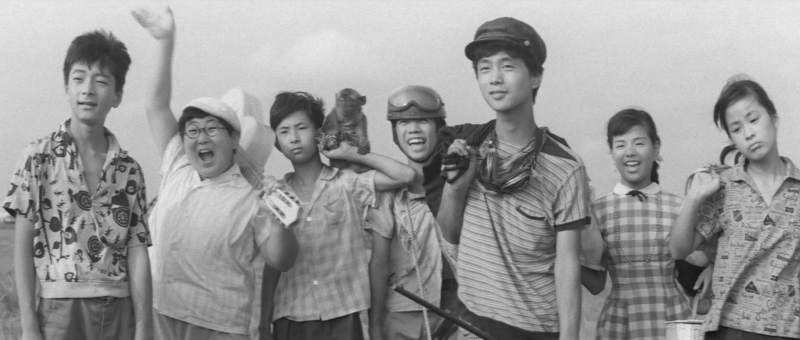
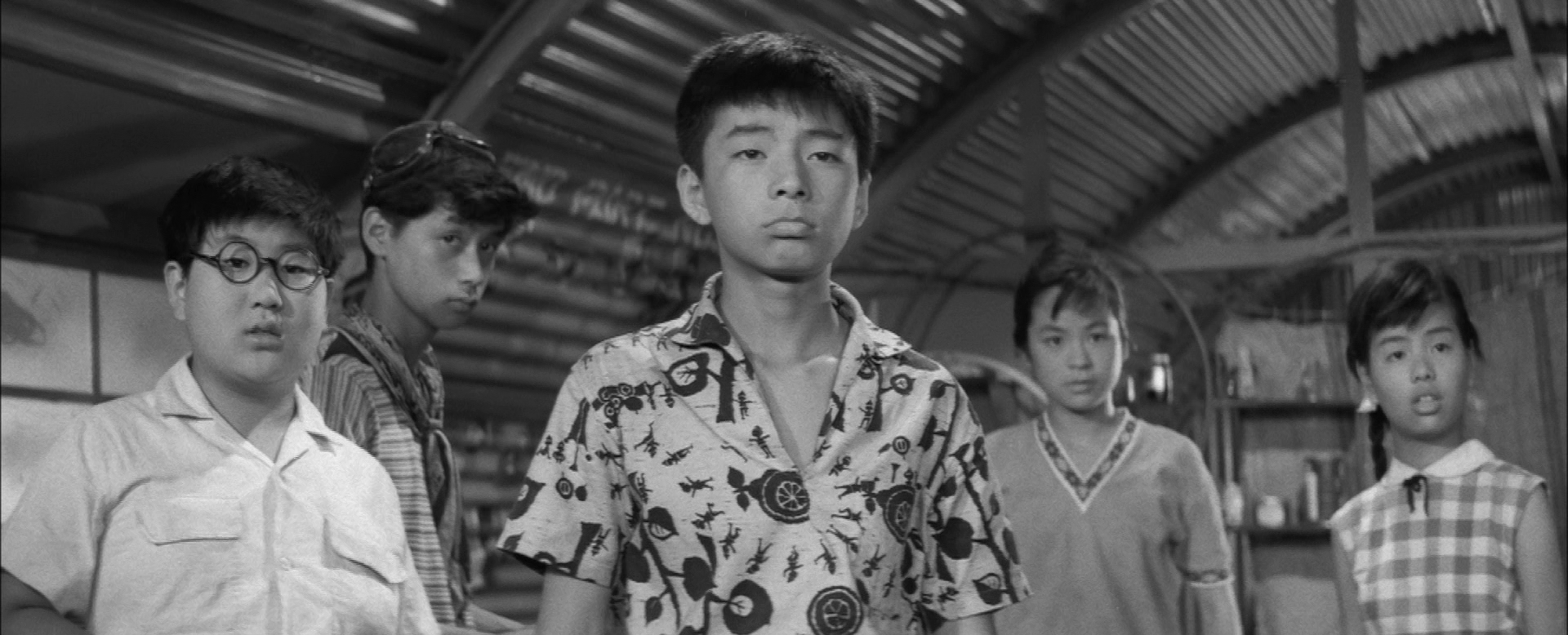
Stylistically speaking, Seijun Suzuki’s Age of Nudity (素ッ裸の年令, Suppadaka no Nenrei) is one of the least interesting of his early phase and features only brief moments of innovation such as using the cameo effect for Sabu’s flashback and elements of his taste for surrealism with unexpected cutting between events. It does however have something a little more interesting to say about the world of 1959 through the eyes of someone in the process of becoming an angry young man.
The film opens with Sabu (Saburo Fujimaki) in his school uniform gazing at motorbikes and exclaiming that adulthood must be wonderful because you can ride a bike whenever you want. Ken (Keiichiro Akagi), the leader of a group of mainly orphaned delinquents, shows him that he could do that now. His gang make a habit of “borrowing” bikes and makes money through reckless drag races. Ken’s instructions that the bikes must be returned afterwards is symbolic of his desire to live a more honest life. When Sabu gets involved with actual crimes such as robbing a local food stand, he becomes very angry with him for compromising his more noble vision of what this group should be.
But Ken is also working with a newspaper reporter and selling him insider stories about pre-teen “delinquents” . It seems as if every day is a slow news day in the Japan in 1959, and the reporter continues to plant scare stories in an effort to create a moral panic about feral children. Ken seems to think that he’ll keep them out of it and not actually report on anything too back that directly involves them, but of course his conviction is naive. Nevertheless, he convinces himself that he’s doing it all for the group so he can get money to buy a fishing boat and support everyone through honest work. But at the same time the fact that it’s the newspapers echoes the ways in which these children have been pushed out of society, while also ironic in that the reason Sabu loses his pair round is because he’s unfairly called a troublemaker when trying to get a reluctant customer to finally pay her bill.
The newspaper round incident bears out the ways in which Sabu is unable to control his temper and his frustration often turns to violence. The reporter asks a friend of his at school hoping he will badmouth him, but the only says that he’s not a bad kid, it’s just that his family’s poor. What Sabu most wants is to stay in school, but his parents won’t pay and his mother even says that he’s getting above himself. Poor people like them don’t go to school they just work. But Sabu’s desire to break that barrier is thwarted by social prejudice and the frustration it arises in him. He first looks up to Ken as a role model, but is also the most betrayed on realising that it was Ken who leaked info on them to the press and that he’s planning to take their share of the loot and make a new life for himself alone in the country.
Humiliated after having been betrayed by the newspaper man, Ken then reverts to Sabu’s way of thinking, that as old as he gets this society won’t respect him. So perhaps he no longer needs to respect it or to stick to the nobility he was trying to teach the kids. Adulthood won’t be what we expected, he tells Yoko, as if he had thought that on turning 20 he’d suddenly be more respected and that he’d be able to forge his own future by buying a boat and becoming a fisherman. The film’s title does not translate particularly well, but the nuance is more like “the naked age” where age refers to that of a person rather than to an era. Sabu goes to the beach and marvels that everyone is “naked”, or rather that they’re all scantily clad in swimwear, and are therefore all the same with the divisions of class and wealth temporarily dissolves. But at the same time it’s more that he himself is naked in that he’s at his most raw and vulnerable. He feels himself to be alone, and has no role models to look to for how he should live his life. Resenting his father for bowing and screaming and his mother for her lack of ambition, he wants more for himself but also can’t find a way to get it.
The fact that Ken is eventually killed in a fiery crash signals him out as a false prophet. The person the children should have been listening to was the homeless old man (Bokuzen Hidari) who appears in a vision of beatific pastorally at the film’s conclusion posed on a green hill with the sun behind him. Though the children sometimes make fun of him for his disability and what they see as a failure at life, the old man laughs it off and is constantly happy living in a tent with his little dog. He encourages the children and gives them helpful advice that helps to overcome the failures of their birth parents, while his presence suggests that true happiness is to be found only on escaping contemporary capitalist society. Sabu too perhaps comes to a similar conclusion, realising that their “independence” is an illusion when they have to compromise themselves morally in order to earn money. Ken may have given them false hope, but perhaps the old man is different in living his own “independent” life defined by humanism and simplicity free from the constraints of a society which only values and status.


