

Radiance (光, Naomi Kawase, 2017)

radiance posterAs a producer claims part way through Naomi Kawase’s Radiance (光, Hikari), the aim of cinema is to connect with other people’s lives. Yet connection is something each of our conflicted protagonists seem to struggle with and something which continues to elude them as they try and fail to find the meaning in the messages of sound and image. Radiance wants to guide us to the light, but its clearest dialogue is with itself or more practically in discussion of translation as an act of intense connection even as its messages flicker in the breeze, caught in a moment of transition from one soul to another. Yet what Kawase finds is that the message is carried, even if it cannot be “translated” into text, or image, or sound, it is felt all the same.

As the film opens a young woman, Misako (Ayame Misaki), observes the world around her and turns her observations into a poetic monologue. Her actions are a kind of rehearsal for her day job which involves creating the script for an audio description that will enable people with visual impairments to enjoy cinema. In order to improve her practice, Misako and her producer hold a number of focus meetings with a group of visually impaired people who can critique her script and point out any potential weak points or moments of confusion. Most of the members of the group are of a mind to be helpful though perhaps overly polite but one, Nakamori (Masatoshi Nagase), is particularly critical of Misako’s approach and unforgiving when voicing his concerns.

Unlike most of the other participants, Nakamori is partially sighted but is suffering from a degenerative condition in which he will eventually lose his sight entirely. This fact is particularly difficult for him to come to terms with as he had previously been an award winning photographer and is losing a key part of his identity in having to face the day when he will have to put his camera down for good.

One of the other ladies at the focus session, pointing out that Misako’s script for the audio description of the film is in effect a subjective commentary, elaborates that what she got from Misako’s narration was a sense of ruined of beauty, of sadness, and the inescapable sense of loss for something that can never be recovered. The film itself is, apparently, the story of a lifelong romance approaching its end as a husband prepares to say goodbye to his wife as she slips away from him. The themes, as we later find out, are ones eerily relevant to Misako who is still mourning the loss of her father while she watches her mother fade away as dementia takes its hold.

The beauty of transience, of the sense of loss before loss, becomes the central message of the film within the film – the message that Misako could not seem to see because she was afraid to look. Fed up with Nakamori’s constant criticisms, she accuses him of lacking imagination but her own act of “seeing” is then exposed as superficial, merely a catalogue of actions without meaning or import but delivered with a subjectivity that, as Nakamori cruelly points out, “gets in the way” of his ability to connect fully with the visual world that Misako is trying to create. 

Misako misses the messages because there are things that cannot be directly understood without conscious effort – the elderly film director tells her that her interpretation of the final scenes is too “hopeful”, as a young woman she cannot comprehend the futility of a old man’s desire for life. Age cannot talk to youth, and sound cannot talk to image but still the attempt is made and a message delivered albeit imperfectly. Nakamori, having given his life to the art of photography, is eventually forced to abandon the thing he loves most only to discover something else existing underneath it while Misako is forced to confront the superficiality of her act of “seeing” which makes her attempt to “translate” image into sound a hollow exercise – something which can only be corrected by a willingness to accept that the medium is not the message. Kawase’s messages may be trite, on one level, but there is something beautiful in continuing to chase the light as it dwindles knowing that in the darkness the flame still burns.


International trailer (English subtitles/captions)
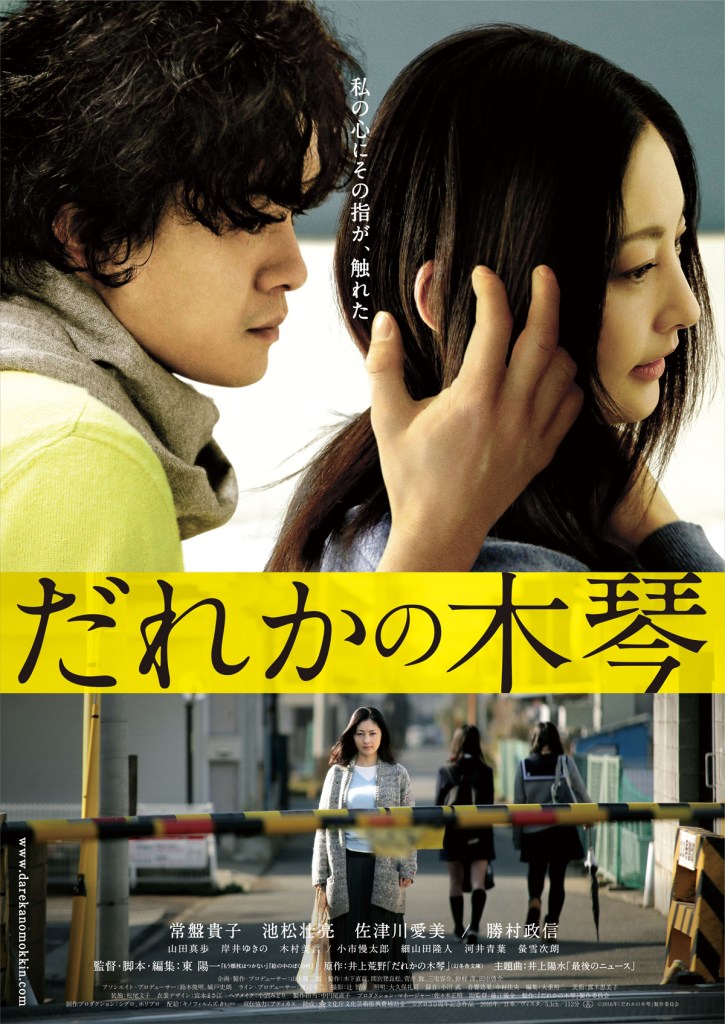
Someone’s Xylophone (だれかの木琴, Yoichi Higashi, 2016)

someones-xylophoneYoichi Higashi has had a long and varied career, deliberately rejecting a particular style or home genre which is one reason he’s never become quite as well known internationally as some of his contemporaries. This slightly anonymous quality serves the veteran director well in his adaptation of Arane Inoue’s novel which takes a long hard look at those living lives of quiet desperation in modern Japan. Though sometimes filled with a strange sense of dread, the world of Someone’s Xylophone (だれかの木琴, Dareka no Mokkin) is a gentle and forgiving one in which people are basically good though driven to the brink by loneliness and disconnection.
Middle aged housewife Sayoko (Takako Tokiwa) has just moved into a new area with her security alarm salesman husband, Kotaro (Masanobu Katsumura), and teenage daughter, Kanna (Mikoto Kimura). By all appearances the home seems to be a happy one, and the atmosphere is pleasant, if ordinary. Even so, stopping into an upscale salon one day Sayoko gets a haircut from the very good looking and warm hearted hairdresser Kaito (Sosuke Ikematsu). Hoping for repeat business Kaito gives her a business card and she reciprocates with one of her own so that she can be added to the mailing list. After some awkward chitchat, she leaves but when she gets a typical “thank you for visiting, please come again” text message, Sayoko makes the unusual decision to reply. Not wanting to seem rude, Kaito continues the strange text correspondence but Sayoko’s growing interest in the good looking young man, and later even in his girlfriend, soon crosses the line from harmless fixation to inappropriate obsession, threatening to derail her otherwise “normal” happy family life.

Higashi begins the film with a naturalistic sequence travelling from early morning light to bright sunshine as Kaito takes his bike out for a ride before returning to make breakfast for his still sleeping girlfriend, Yui (Aimi Satsukawa) – a model/store assistant at the upscale Lolita brand Baby the Stars Shine Bright. Accompanied by a thrumming, modern jazz funk soundtrack, these scenes reflect the film’s baseline reality. Kaito and Yui may live in the real world, to a point at least, whereas Sayoko has her head in the clouds and almost lives there too. A middle aged housewife, her life has begun to lose its purpose now that her daughter is almost grown and needs her much less than she ever has before. Though Sayoko and her husband appear to have a good relationship, she seems to want something more – bored with his caresses and long since past the point where there is nothing left to talk about.

The delivery of a new bed prompts a very particular fantasy of being fondled by both men at the same time though what exactly she wants from Kaito remains unclear. If her original decision to reply to a standard confirmation email could be dismissed as friendly innocence, sending a picture of your new bed to someone you just met is decidedly strange. Nevertheless, Kaito feels the need to keep replying even once it becomes clear that Sayoko has also tracked down his apartment and seems intent on further infiltrating his life. When she takes the decision to visit Yui at her work (the brand is not one which ordinarily caters to women of Sayoko’s age), the younger woman starts to get worried and eventually takes some direct action of her own.

Sayoko remains something of a cypher, a woman who can’t seem to figure herself out. The xylophone of the title refers to a dream or vision she has of a girl in far off window banging away at the instrument but never quite getting the tune – eventually she realises the girl is her, still trying to find her inner rhythm all these years later. Kotaro, by contrast, seems to have more worldly anxieties despite his outwardly calm and kindly manner. When his daughter asks him if they really need the security system they have at home he tells her about a long unsolved family murder before explaining that it just makes him feel safer when he can’t be there in person to protect his wife and daughter. Kanna, a bright child, points out that more threat is posed by accidents in the home than by intruders – to which Kotaro is forced to agree, lamenting that there is no alarm system to prevent a domestic accident. Thus when Kanna calls him to say that there has been an “incident” at home, the metaphor is an apt one – nobody was looking, and now everything’s falling apart.

Despite the expectation for grand scenes or bloody violence, Someone’s Xylophone consistently refuses to follow the signposted direction preferring a more adult resolution born of self reflection and mutual understanding. A subplot involving a very particular young man who comes to the salon solely for female contact hints at a darker path for unresolved loneliness and repressed emotion, but even if Sayoko and Kotaro make ill advised decisions in search of closeness their sojourns in alternate realities ultimately allow them to rediscover their mutual universe (for a time, at least). The xylophone finally plays out a recognisable tune as a more settled Sayoko fantasises about a phantom blanket rather than an illicit ménage à trois but whether this craving for warmth will provoke a similar crisis as the need for passion remains to be seen.


Screened as part of the Japan Foundation Touring Film Programme 2017.

Original trailer (no subtitles)

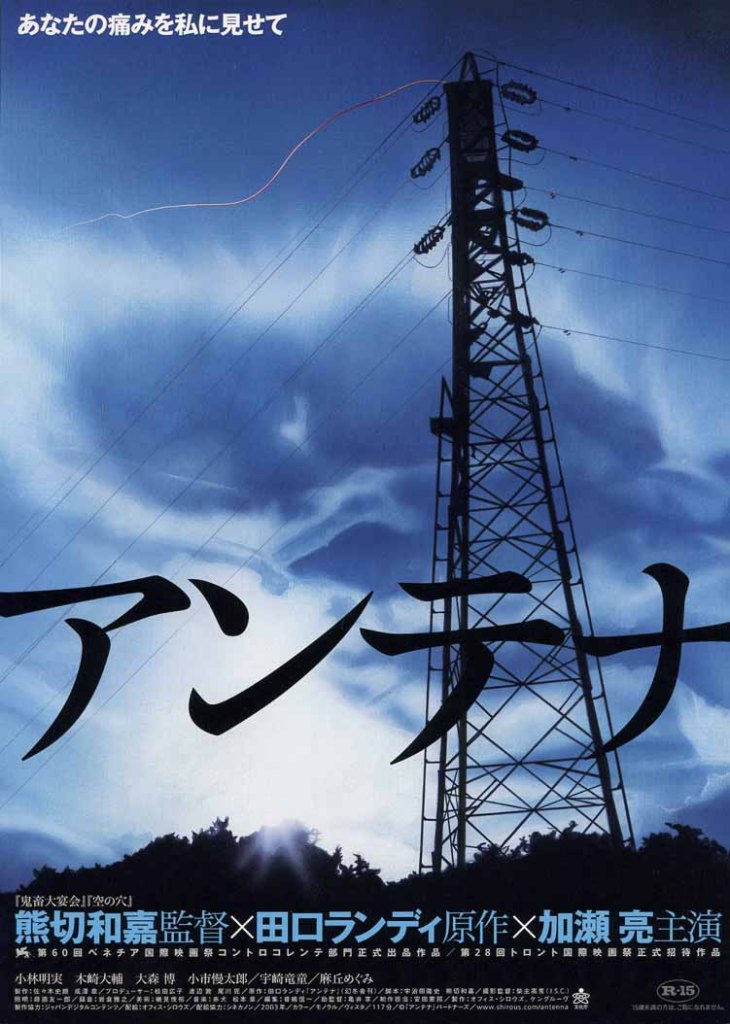
Antenna (アンテナ, Kazuyoshi Kumakiri, 2004)

AntennaScarring, both literal and mental, is at the heart of Kazuyoshi Kumakiri’s third feature, Antenna (アンテナ). Though it’s ironic that indentation should be the focus of a film whose title refers to a sensitive protuberance, Kumakiri’s adaptation of a novel by Randy Taguchi is indeed about feeling a way through. Anchored by a standout performance from Ryo Kase, Antenna is a surreal portrait of grief and repressed guilt as a family tragedy threatens to consume all of those left behind.

Philosophy student Yuichiro (Ryo Kase) is currently working on a project which aims to reevaluate how pain is felt through attempting to identify with the pain of others. To do this he plans to investigate the S&M scene but before he can get started, a painful episode from his past is reawakened by current events. Yuichiro’s younger sister, Marie, has been missing since failing to return home from school one day when she was only eight years old. When news reports appear that another girl around the same age has been held captive in a nearby apartment complex since around the time Marie went missing hopes are sparked only to be dashed. Still no closer to discovering what happened to his younger sister, Yuichiro carries the guilt of having been unable to protect her as well as the inability to remember exactly what happened on that fateful day.

Matters come to a head when Yuichiro’s younger brother (their mother was pregnant with him at the time of the disappearance) turns up on his doorstep. Yuya (Daisuke Kizaki) repeatedly claims that Marie is about to return as he can feel her through his “antenna” (“like the horns of a snail”) and has a full scale fit aboard the train back. Things being what they are, the doctors advise Yuichiro to spend sometime at home as his distracted mother is no shape to cope with Yuya’s increasingly odd behaviour. A dutiful son, Yuichiro does what he can for what’s left of his family but his childhood home is far from a good environment for him.

Soon after Marie’s disappearance, both Yuichiro’s father and his uncle Shige who’d lived with them both died, leaving only Yuichiro’s mother and baby brother behind them. Unable to come to terms with Marie’s disappearance, Yuichiro’s mother has found religion, hosting Buddhist prayer sessions at the house and bringing in Feng Shui experts to try and heal the lingering sense of tragedy still present in the house. She has also become convinced that her second son, Yuya, is in fact the returned spirit of her daughter, raising him as a girl and dressing him in Marie’s clothes. This may explain some of Yuya’s conflicting behaviour and repeated insistence that his sister is “returning” in so much as something of her personality has become the ghost in his machine.

Once back in the house, Yuichiro’s mental state becomes ever more precarious as his memories of his sister’s disappearance begin to flicker to the surface. Overcome with repressed guilt, Yuichiro once again begins self harming by slashing his chest with a box cutter. Easing the mental pain with the physical, Yuirichiro finally begins to address some of his long buried trauma through repeated meetings with the dominatrix he was interviewing for his project. Undergoing a kind of S&M lead sex therapy, Yuichiro is slowly guided back through his memories to events he was too young to understand at the time and only now is fully able to comprehend.

Throughout his flashbacks Yuichiro is always sidelined, perched behind barriers or shut away by closed doors as the adults argue and loudly discuss things they claim are not suitable for children to hear. Crucial moments find him peaking through keyholes and seeing something he knew was not quite right but without knowing why. These incomplete and incomprehensible memories are the ones which haunt him, unresolvable but still trailing the guilt behind them of having seen yet done nothing.

Told in a slight non-linear fashion through frequent flashbacks, the film adopts a dreamlike tone and surreal imagery to make sense of the more extreme elements. The final sequence itself is either a hallucination or a dream that takes on a magical realist quality as the past is finally allowed to drift away from its lodging place, freeing up a space for light to return to the otherwise darkened house.

An intense exploration of buried trauma and childhood guilt, Antenna is a dark tale but does offer a glimmer of hope after all its hellish meandering. Kumakikri keeps things straightforward but his considered compositions have a strange kind of beauty despite the ugliness of the narrative. Embracing a number a taboo subjects coupled with strong emotion and explicit content, Antenna is not an easy watch but rewarding for those who can brave its extremes.


Original trailer (no subtitles)