Dawn Chorus (暁の合唱, Hiroshi Shimizu, 1941)

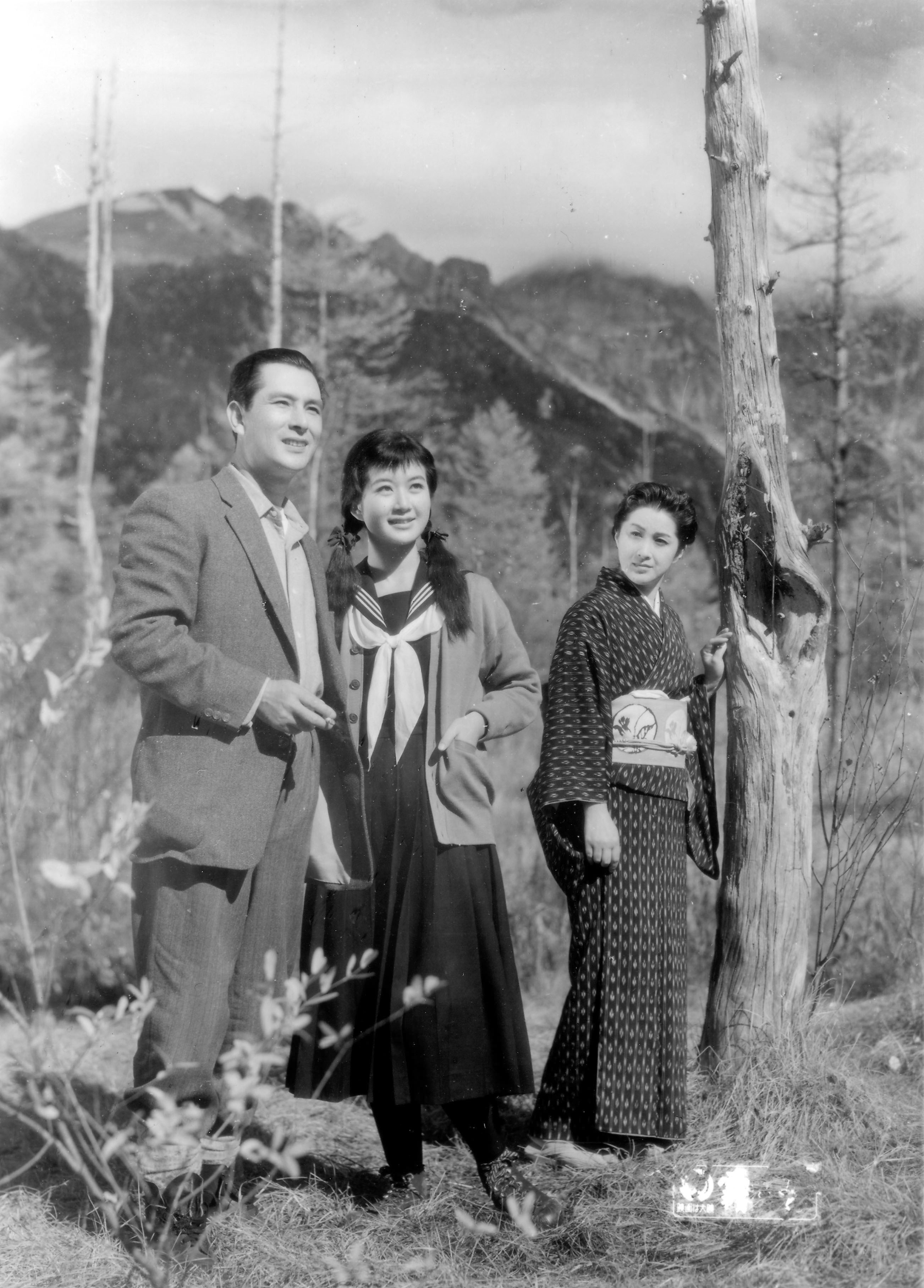
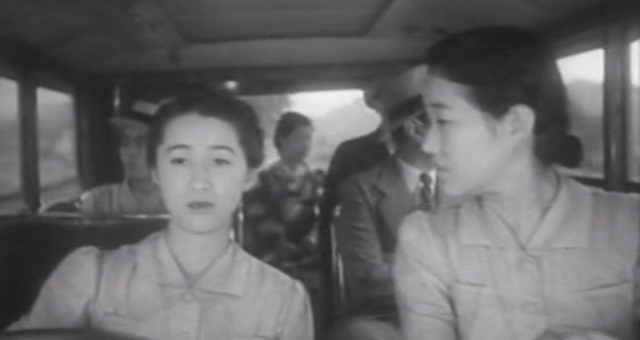
“Before me flows a wide and serene river of life,” a young woman writes in an unexpectedly poetic essay, “I beg you to pray for my just and happy future.” Yet Tomoko (Michiyo Kogure) does appear to be pretty happy with her choice, even if the just future she’s forging for herself might not be what others see as just. Though she cites her family’s poverty and a minor disability as her reason for giving up on education, there seems to be another side of her that eagerly embraces independence and looks for it in unexpected places.

That would be her desire to become a bus driver, an occupation then thought to be inherently masculine. Perhaps in that way, it reflects her desire to be in control of her own destiny, while her apparent love of life on the bus hints at another for travel and ever-expanding horizons. Another of Shimizu’s travelling films, he often as in Mr Thank You includes scenes shot through the bus’ rear window including that of a flock of boys off to school on their bikes that makes Tomoko think of her stepbrother Ginjiro (Giichi Okita) who has a voracious appetite despite their family’s poverty. There are indeed all kinds of people who get on the bus, including, at one point, a melancholy woman in a bridal outfit who nevertheless pitches in when the bus gets stick in a ditch and needs a push. Tomoko fixes the bride’s makeup and gives her her compact, but there’s no avoiding the fact that she looks miserable despite the joy of the older women accompanying her.

Even Tomoko remarks that she isn’t sure whether her tears were in joy or sorrow even while wishing her a broad-shouldered husband. Later the bus catches her again trailing behind the man to whom she was married, older than her and not particularly handsome, pulling a cart. She still doesn’t look very happy, and is presumably bound for a life of drudgery over which she has little say. Her fate contrasts with that of Tomoko who is actively choosing her way forward even if the bride’s plight forces Tomoko to think about marriage and her womanhood as does the birth of a baby on the bus. Everyone is always telling Tomoko that she ought to get married quickly, and not least among them Eiko (Kiyoko Hirai) who declares herself tired by life. Working for a newspaper, she had apparently been the girlfriend of Saburo (Toshiaki Konoe) whose late brother once owned the company while now he runs a cinema. Saburo has apparently tired of her, though he appears to have developed a fondness for Tomoko which might seem slightly problematic to modern eyes because of Tomoko’s relative youth while she is in the process of coming of age and into herself uncertain if marriage is even something that she’s interested in.

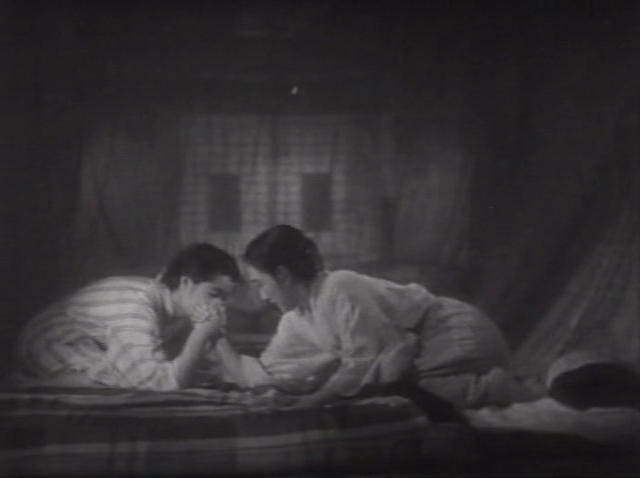
On the other hand, her tomboyish qualities leave her in a slightly liminal space as reflected in her desire to become a driver, rather than a conductress. In learning to drive, she mostly wears trousers while Eiko remarks on her “big hands” and she prides herself on her physical strength when engaging in an impromptu arm wrestling match with Yoneko (Hiroko Kawasaki), the widow of Saburo’s brother who now manages the bus company and has a crush on handsome driver Ukita (Shin Saburi) who also had to drop out of university for undisclosed reasons. Tomoko loses the match because she’s overcome by tears without really knowing why, which might in its way be a manifestation of her returning femininity along with her maturity, but there’s also something strangely transgressive about the scene featuring two women under mosquito net randomly arm-wrestling in the middle of the night.

Nevertheless, Tomoko’s life seems otherwise happy and pretty care free even if there are signs of corruption all around her. One of her first challenges while working as a conductress is an old woman (Choko Iida) who tries to get out of paying. It seems like the old woman probably can’t really afford to pay, but puts on a show of having tried to cheat them deliberately to save face. She suggests to Tomoko that she simply neglect to punch a ticket and pocket the money she’s already given her, until the bus driver, a man, gets out to exert his authority and tell her off despite Tomoko’s offer to make up the shortfall out of her own money. Later it’s discovered that two of the other conductresses have been made unhappy enough to consider quitting their jobs and are deliberately avoiding riding with one particular driver because he’s forcing them to embezzle ticket money in this way on his behalf, hinting at a kind of greed and immorality that might not necessarily be motivated by abject poverty.

It is though a presence Tomoko is able to dispel, bringing on Kimie (Chiyoko Fumiya) as her own conductress when she finally becomes a driver in her own right. Though the film hints at her feelings for Saburo, it does not end on marriage but with Tomoko’s personal fulfilment if tempered by the idea that a woman must now be useful and productive in the wider world while the men are away which might be how it gets around the censors despite otherwise avoiding overtly patriotic or imperialistic themes. Based on a novel by Yojiro Ishizaka, the film rather validates Tomoko’s desire to take charge of her life and drive off towards the future as an independent woman.
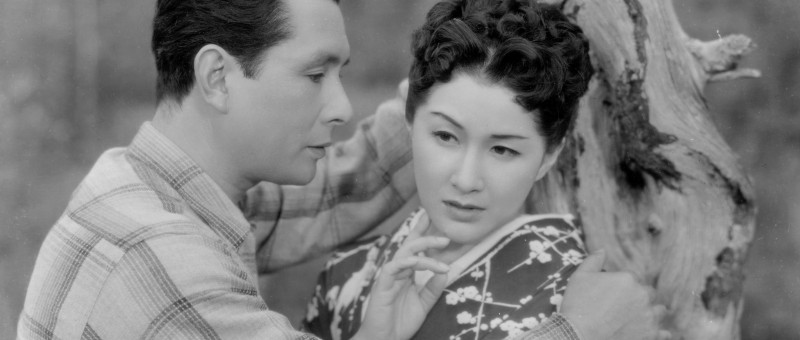
Okuni and Gohei (お國と五平, Mikio Naruse, 1952)

“It’s a rough and difficult road.” The heroes of Mikio Naruse’s Okuni and Gohei (お國と五平, Okuni to Gohei), adapted from a kabuki play by Junichiro Tanizaki, are two displaced between the old world and the possibility of a new one if only they were brave enough to step away from the beaten path. Unbeknownst to them, they are being followed by the man they are seeking whose shakuhachi playing haunts them wherever they go as if taunting them with its presence. 

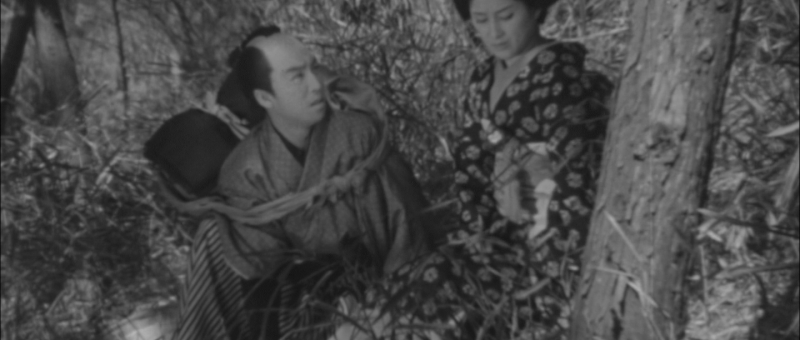
In this iteration of the tale, Tomonojo (So Yamamura) takes on a slippery quality almost if he were some supernatural devil sent to torment Okuni (Michiyo Kogure) and Gohei (Tomoemon Otani) leading them either towards or away from their salvation or damnation. In Okuni’s flashback, which is obviously coloured with her own nostalgia and regret, he’s a sensitive young man who promised himself in marriage to Okuni. But she is forced to refuse him. Her father rejects Tomonojo because he is without standing or prospects, and instead demands she marry a wellborn man of his choosing, Iori (Jun Tazaki). Iori is then killed in the street, uttering only Tomonojo’s name before he dies. It could then be that this is Tomonojo’s revenge on a society that has rejected him and robbed him of his love, yet the Tomonojo we later meet is much different than this idealised version in Okuni’s memory. He never denies killing Iori and offers no justification for it, but corners Okuni when she’s alone to tell her to free herself by dropping her quest for revenge. He’s also subtly blackmailing her, implying he heard her having sex with her manservant Gohei the previous night and in reality wheedling away pleading for his life.

For her part, Okuni seems torn in her motivations, uncertain whether she’s looking for Tomonojo to reunite with him or kill him, or perhaps is deliberately avoiding finding him at all. She was not married to Iori for very long and he was at the very least an insensitive and emotionally distant husband who spent most of his time at his friend’s house, claiming that it was “boring” to stay home with her. She has no great emotional desire for revenge, but has been told she must accomplish it in order to return to the samurai world, having been condemned to a kind of limbo as the widow of a murdered man. Even so, she has tired of her quest and asks herself what’s to become of them if Tomonojo is already dead. She repeatedly hints to Gohei that they should give up on finding him and on returning home, instead contenting themselves with their life on the road or else find somewhere to settle together in a new world in which a lady and her retainer could live as man and wife.

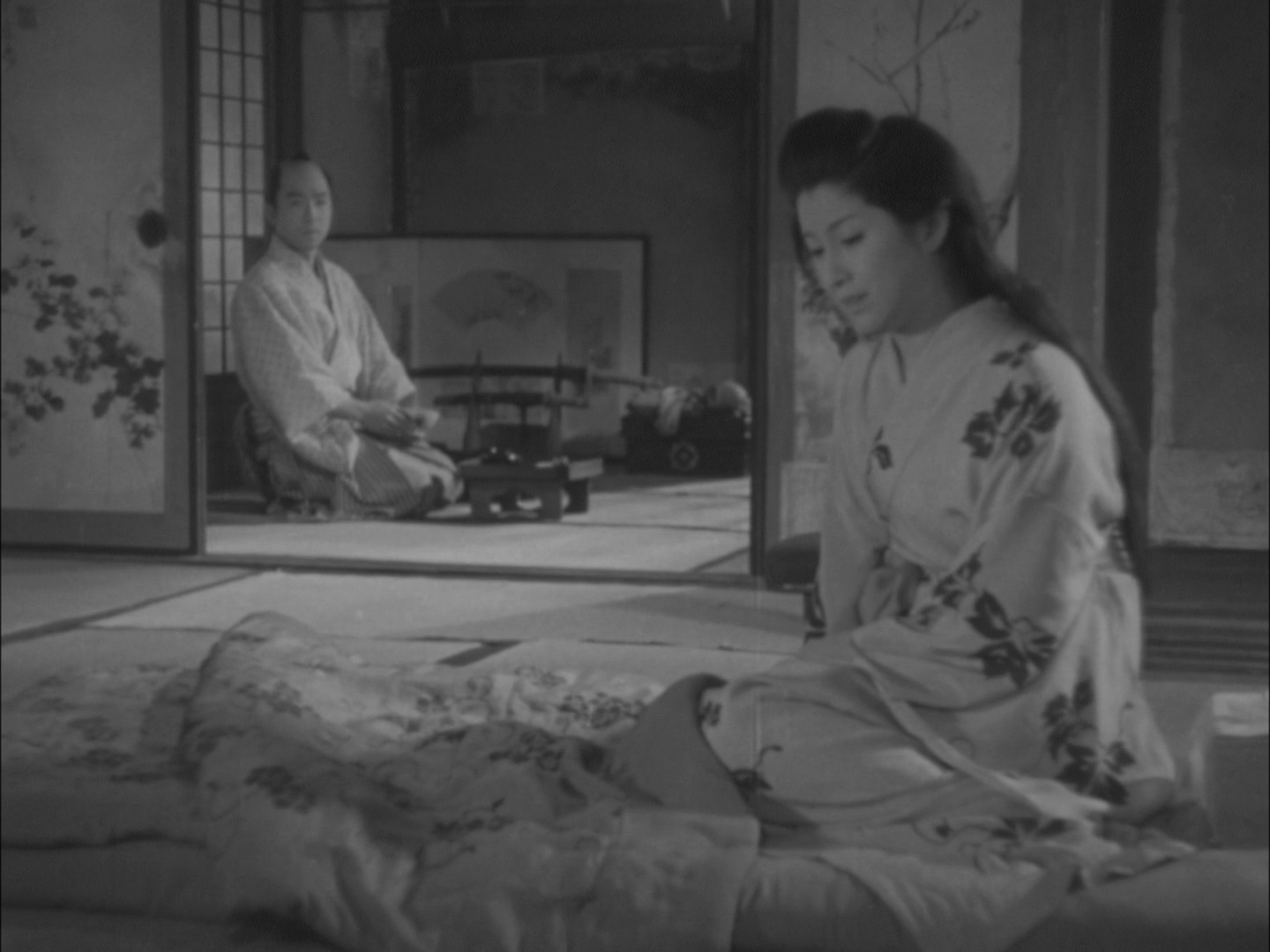
The film is both coy and somewhat transgressive in its depiction of the growing sexual tension between Okuni and Gohei from his taking hold of her injured foot and tender care for her when she falls ill, to the way they draw closer and then instinctively move apart. Passion later gets the better of them and it’s heavily implied that they sleep together, but Gohei instantly regrets it and cannot accept his class transgression. Given this development in their relationship, Okuni asks him to stop calling her “madam” but as she does so she is on one side of the fusuma and he on the other, so they remain in separate rooms divided by the ridge in the tatami. Gohei cannot let go of the old ways and is desperate to complete their quest so that his debt to Iori will be repaid and he can return in glory to be rewarded with position and the esteem of being a true samurai. Even if he tells Okuni that this quest has been his happiness in being on the road with her and knows that killing Tomonojo will end it, he does not turn back.

But the implication is that they can never escape Tomonojo who will, in fact, forever be following them. He taunts the pair with his shakuhachi and visits them in disguise. When they catch up to him, he tries again to convince them to give up their quest and live quietly together in a place free from the constraints of the samurai world, but Gohei cannot do it. Okuni first picks up her dagger and one wonders whether she about to use it on herself, but then turns on Tomonojo though it’s uncertain whether she now does so out of resentment or as revenge of herself for the way Tomonojo has again ruined her life. Just as she was a pawn of her father married off against her will to an indifferent man, she is further imprisoned by patriarchal social codes as Tomonojo needles Gohei that he had slept with her before her marriage. She has in fact already confessed to this to Gohei who transgressed by asking her what exactly Tomonojo was doing with his “shakuhachi” when they were courting, though she did so obliquely in telling him to remember his place and that he should “forget about the past.” Nevertheless she denies it now, but Gohei continues to see her as a “loose” woman with Tomonojo’s words ringing in his ears as a final revenge on the morally compromised lovers.

Their inability to let go of the quest, to do as Okuni suggests and continue on as they are along the rough and difficult path to a more egalitarian future spells their damnation. You can’t go back again. Their “home” is already lost to them. As a pedlar tells the pair along the way, they’ve already been forgotten and the village is filled with other gossip, but now they really have nowhere to go. The message may be for the coming post-occupation era that they shouldn’t try to turn back but keep moving forward into the new Japan or else risk becoming lost in a purgatorial world of confusion like Okuni and Gohei haunted by the choice to betray love for the outdated ideal of samurai honour. Haunted alternately by Tomonojo’s shakuhachi and the words of the villagers who told them they couldn’t be accepted until they fulfilled this quest, they find themselves displaced, unbalanced and uncertain amid the shifting power dynamics of class and gender, their duty and their feelings, but ultimately trapped by their cowardice in their unwillingness to cross the threshold to claim their freedom and happiness.


Sound in the Mist (霧の音, Hiroshi Shimizu, 1956)

In the opening scenes of Hiroshi Shimizu’s Sound in the Mist (霧の音, Kiri no Oto), a young woman tells another that “as women, we need to create our own happiness,” though as it turns out it’s something that neither of them are really able to do. A classic melodrama, the film once again hints at Shimizu’s mistrust of romance and the frustrating inability of men and women to communicate or embrace their love for one another even when the seeming barriers preventing it have been removed.

To that extent, it’s interesting that the chief disagreement between unhappily married botanist Kazuhiko (Ken Uehara) and his wife Katsuyo is over her feminist politics and desire to devote herself to women’s emancipation under the new post-war constitution. The main bone of contention is that she wants to sell a mountain owned by Kazuhiko’s family to fund her political career though as he later says this mountain is his life. In any case he lets her sell it, believing there’s no point putting up a fight. He puts up even less of one in his relationship with Tsuruko (Michiyo Kogure), his assistant who is hopelessly in love with him yet after his wife’s angry visit decides to absent herself feeling as if she’s in the way.

It was her friend Ayako, a Tokyo dancer, who told her that women need to make their own happiness but in the end she couldn’t do it either. She was similarly involved with a weak-willed married man who continued to vacillate over leaving his wife offering the justification that he didn’t want to mess things up for his children. Eventually the pair find escape through double suicide which only emphasises the futility of their romantic connection. Tsuruko similarly makes several comments about the idea of death and dying, stating that if she were to die she’d want to go to a particular spot in the mountain which seems like heaven to her.

Though Katsuyo describes it as a “filthy” place the cabin does indeed become a kind of haven, a bubble of apparently chaste love and longing inhabited only by Kazuhiko and Tsuruko as the voiceover says hiding out from post-war chaos. Tsuruko seems to be the kind of woman Kazuhiko regards as the ideal wife in that she cares for him and supports his work even if he tells Katsuyo he just needed someone to run errands and do the grocery shopping so Tsuruko is there as his maid. Both are at pains to emphasise that no physical relationship exists between them but are otherwise prevented from acting on the their love because of Kazuhiko’s marriage along the existence of his daughter, Yuko (Keiko Fujita), who may be adversely affected by her parents’ decision to divorce in an age when such things were less common.

Kazuhiko continues to return to the mountain cabin which has since become an inn at regular intervals to see the Harvest Moon, as does Tsuruko though she also carries a degree of shame that makes her fear re-encountering Kazuhiko having become a geisha apparently solely to ensure her proximity to the mountain. Once again filming with the gentle lateral motion familiar from his later films, Shimizu focuses on the landscape and suggests that these lovers are only free to love in the natural world unconstrained by the petty concerns of civilisation which prevent them from embracing their desires. The sound in the mist is perhaps that of Kazuhiko’s latent romanticism and the implication that to him it may be better to suffer for love than to accept it. The same may be true for Tsuruko who is equally powerless if filled with regret that in the end she gave up so easily rather than fight for the love of her life.

On the other hand, the cabin seems to have given rise to a love match between Kazuhiko’s daughter Yuko and her husband who vow to continue the tradition of coming to the inn on the occasion of the Harvest Moon which marks both their wedding anniversary and the time they met. Yuko’s melancholy expression on coming to an understanding of her father’s “special memories” suggests a gentle sympathy but also that this younger generation is freer to love though no less romantic.The poignant closing scenes in which Kazuhiko wanders into the mist are nevertheless filled with irresolution, regret, and a longing that express only a deep sadness for the misconnections and misunderstandings of a less open past.


Sound in the Mist screens at Japan Society New York on May 23/30 as part of Hiroshi Shimizu Part 2: The Postwar and Independent Years.

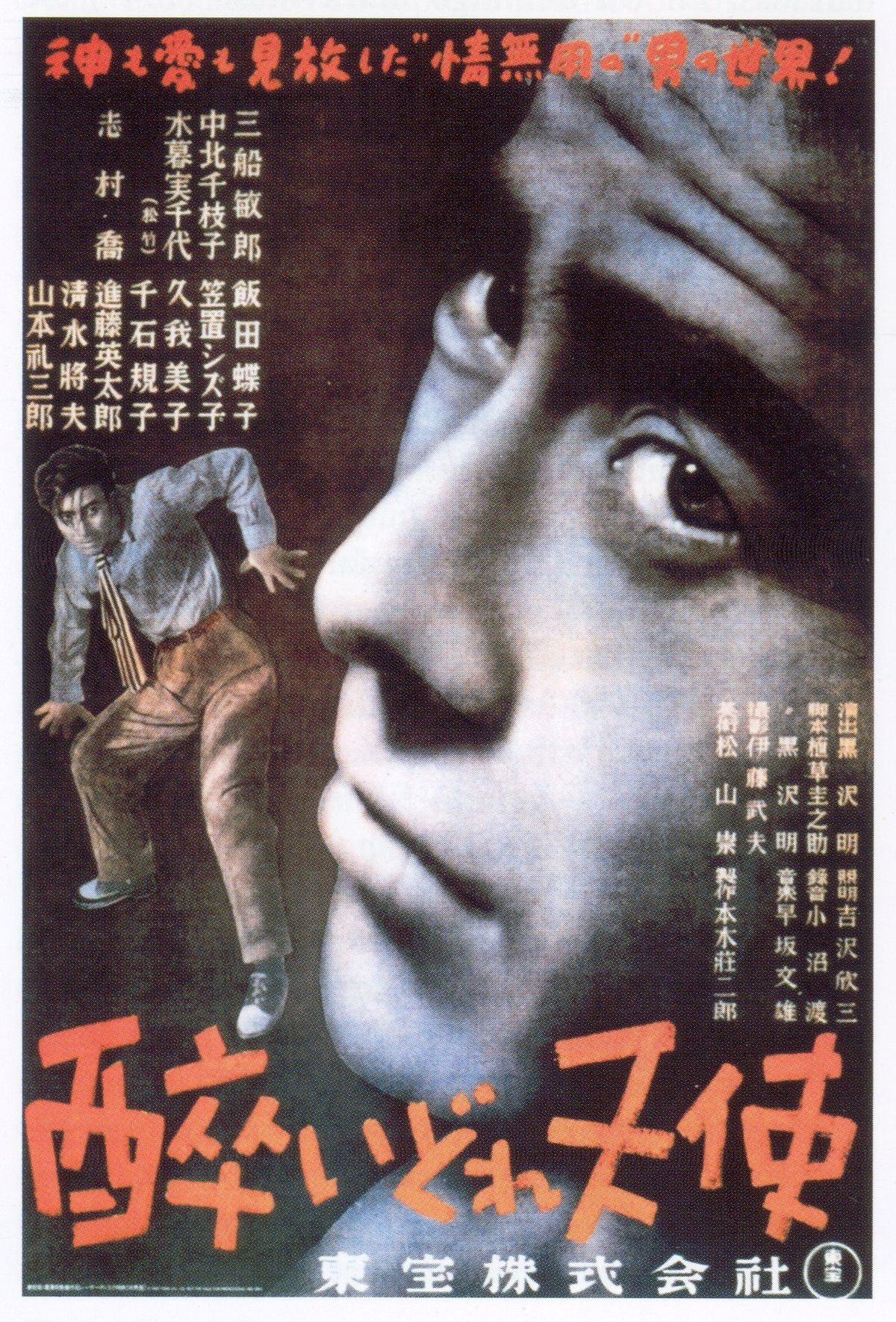
Drunken Angel (酔いどれ天使, Akira Kurosawa, 1948)

A gruff yet well intentioned doctor does his best to cure the ills of post-war Japan in a rundown slum on the edge of a fetid swamp in Akira Kurosawa’s noir tragedy, Drunken Angel (酔いどれ天使, Yoidore Tenshi). The doctor is most obviously the drunken angel of the title though it could equally apply to the unhappy yakuza he tries so hard to redeem whom most agree is not suited to that kind of life and trapped by the feudalistic thinking of the pre-war past.

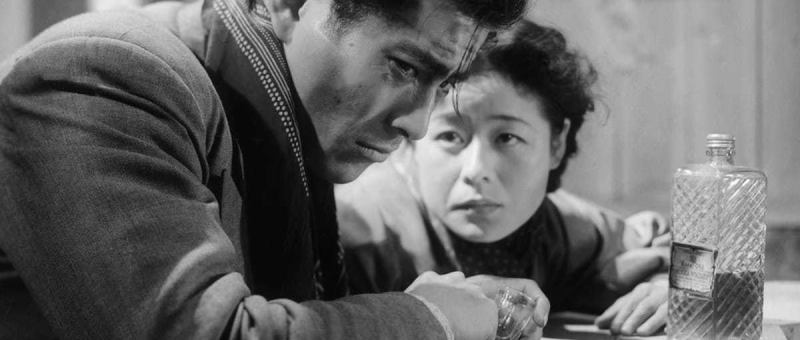
Matsunaga (Toshiro Mifune) is the big man around town, but jaded physician Sanada (Takashi Shimura) sees straight through him. “He acts tough and swaggers around but I know in his heart he’s incredibly lonely,” Sanada tells his assistant, Miyo (Chieko Nakakita), a young woman he took in to help her escape the clutches of the violent yakuza ex who left her with syphilis. Miyo bemoans Sanada’s terrible bedside manner and tendency to bully his patients but praises his dedication and remarks that few doctors go as far for those under their care as he does especially ones like these who don’t often have the money to pay. This is a little ironic given Matsunaga’s original objection that he doesn’t trust doctors because it’s not in their best interests to cure you, something which Sanada jokingly acknowledges while expressing the futility he feels in the face of the mass sickness that confronts him. 

When Matsunaga first comes into his office, Sanada remarks that’s its not just his lungs that are sick, he’s sick to the core. But still he seems to think that Matsunaga can be saved, not just physically but spiritually redeemed if only he can coax him away from the yakuza underworld. Matsunaga is suffering from tuberculosis, a common disease of the post-war era and closely linked to the squalid conditions in which he lives which are themselves symbolised by the swamp in the centre of town onto which Sanada’s clinic backs. Sanada tries to warn the local children not to play in it because of the risk of typhus not to mention the mosquitos it attracts but the kids don’t really listen to him and shout back that he’s “just a drunk”. Yet the swamp represents a world upside-down, the neon sign for the No. 1 cabaret bar constantly reflected in its bubbling waters while as the film opens we see a trio of sex workers preparing to head into the red light district and a pair of petty thugs fighting while a young man plays Spanish guitar on the ruins of a bomb damaged building. 

It’s as if it were this world that is slowly consuming Matsunaga, an old-school yakuza who insists “we still believe in things like honour and loyalty” certain that the big boss will side with him against the returned upstart Okada (Reizaburo Yamamoto), Miyo’s yakuza ex, even as Sanada tells him it’s money that matters and Matsunaga no longer makes any. Everyone tells him that he already looks like a ghost, his appearance increasingly gaunt in his parallel decline as the illness takes hold and he begins to lose his status to Okada only to overhear his boss call him an “amateur” that he was only keeping around as a potential sacrifice. In the end, Matsunaga is too good for this world. Naively believing in things like honour and loyalty which no longer mean anything in the dog-eat-dog post-war society he is left with nothing other than a nihilistic bid for vengeance and a desire to repay Sanada’s faith in him if only in the most ironic of ways. 

Like Matsunaga, Sanada sometimes says the opposite of what he means claiming that he doesn’t care what happens to Matsunaga but is determined to wipe out the TB inside him to stop it spreading it to others. He’s on a mission to “sterilise this contaminated town” by eradicating the twin threats of disease and the yakuza, calling Matsunaga a coward for failing to face his fear and loneliness succumbing to the quick fixes of his hedonistic yakuza lifestyle. He’s not perfect either, a doctor who drinks his medical ethanol supplies and berates his patients when he them catches out them out drinking when he told them not to, but is also very at home with who he is and doing his best with it. His disappointment in Matsunaga is mainly in his swagger, the false bravado that masks his human frailty and unwillingness to face his fear of death which manifests itself in a hauntingly expressionistic dream sequence. Using silent cinema composition and canted angles Kurosawa conjures a world of constant uncertainty amid the vagaries of the post-war society in which the only sign of salvation is a drunken doctor and his “rational approach” to the sickness of the age.


Drunken Angel screens at the BFI Southbank, London on 2nd & 10th February 2023 as part of the Kurosawa season.

Freelance Samurai (桃太郎侍, Kenji Misumi, 1957)

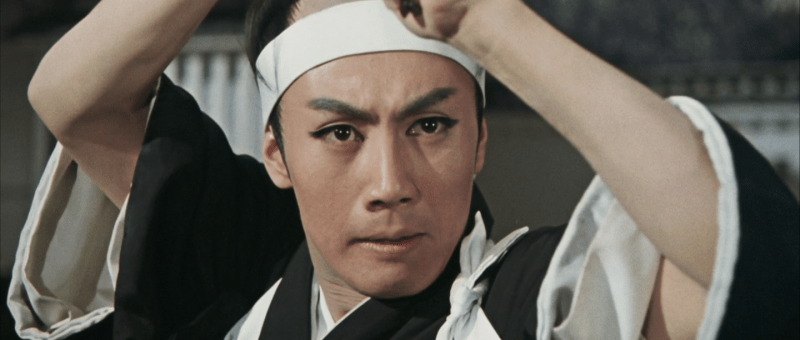
An abandoned son resolves to wander Japan killing the “demons” of Edo-era society in Kenji Misumi’s adaptation of the popular novel by Kiichiro Yamate, Freelance Samurai (桃太郎侍, Momotaro-Zamurai, AKA The Demon Crusader). Starring a young Raizo Ichikawa in dual roles as twins separated at birth, a familiar jidaigeki plot device, Misumi’s drama is among his most conventional but still finds the demon-hunting hero of the title resolutely rejecting the “silly rules of the samurai” in refusing to serve or be served while resisting the persistent corruptions of the feudal society. 

First spotted returning a paper balloon to some children playing in the street, the hero (Raizo Ichikawa) later gives his name as “Momotaro”, the legendary folklore champion who was born from a peach and then went on to befriend various forest creatures travelling with them to fight the cruel demons who had been oppressing the peasants of the farmland where his adoptive parents lived. The name is a sense ironic in that it reflects his own fatherless existence having discovered that he is actually Shinjiro, the younger brother of the heir to a nearby clan, Shinnosuke (also Raizo Ichikawa). At this particular cultural moment, twins were thought inauspicious with one usually cast out, Momotaro in someways more fortunate than most in that he was sent away and raised by his mother to whom he was apparently devoted. In fact, as he says, he only delayed his demon-killing mission out of consideration for her but that now that she has sadly passed away he is free to pursue justice as a wandering ronin determined to serve no master but himself. 

This insistence on justice and opposition to samurai oppression is made plain in the opening scene in which he rescues pickpocket Kosuzu (Michiyo Kogure) from two samurai she’d robbed who were hassling her. She of course falls in love with him, but is also party to the central conspiracy engineered by high ranking retainer Shuzen (Shosaku Sugiyama) who is plotting to unseat Shinnosuke in favour of the lord’s illegitimate young son Mantaro (Junta Yamamoto) with the help of ambitious underling Iga (Seizaburo Kawazu). Momotaro is swept into the intrigue when he rescues the beautiful daughter of loyal retainer Iori (Gen Shimizu), Yuri (Yoko Uraji), from an attempted kidnapping. Both sides want to recruit him for his bravery and sword skill, but Momotaro is reluctant to help either of them especially on discovering the ironic coincidence that he finds himself caught up in a succession struggle in the very clan which previously cast him out. 

Deciding to help when hearing that Shinnosuke has been poisoned, Momotaro demonstrates his strategic abilities in coming up with a ruse to trick the conspirators but remains somewhat conflicted remembering his mother’s dying words that he should hold no grudges even as a part of him continues to resent his abandonment. That may in part explain his defiant rejection of the hierarchal society, ignoring the “silly” rules of the samurai while insisting on equality in refusing to serve or be served by anyone else. In a nod to the folktale, his greatest friend is a humble peddler, Inosuke “the monkey man” (Shunji Sakai) who gives him a place to stay in the rundown tenement where he lives affectionately known as “ghost apartments”. Even so, Inosuke as much servant as sidekick, and while he is in a sense torn between the earthy pickpocket Kosuzu who is later redeemed through her loyalty to him and the beautiful samurai daughter Yuri it seems fairly clear that he will eventually opt for his class-appropriate match the only surprising thing being that it is she who transgressively breaks with convention in abandoning her samurai home in order to follow Momotaro out on the road as he hunts other “demons” corrupting the social order all over Japan. 

Shot in colour academy ratio, Freelance Samurai features little of Misumi’s trademark natural vistas save for the poignant pillow shots of flowers growing in the compound though it does reflect his preoccupation with absent fathers and perpetual wandering. In the many dualities in play, it is also interesting that Momotaro is depicted as the more capable of the brothers, Ichikawa’s characterisation of the cosseted Shinnosuke as a kind and compassionate, effete young man rather than the strapping warrior the heir to a clan is expected to be hinting perhaps at the perceived weakness that allowed the conspirators to assume they could usurp him. Similarly, it’s Michiyo Kogure’s tragic pickpocket undone by her love for the noble samurai that makes the deeper impression rather than the rather insipid Yuri who makes her mark only in her final decision to follow Momotaro unbidden. Momotaro’s quest may in a sense be ironic in that he outwardly rejects the superiority of the samurai but effectively preserves it even as he determines to clean out the oppressive “demons” intent on corrupting the land just as his folkloric namesake had done, but in its own way has its defiant nobility in his fierce love of justice and equality. 


In Search of Mother (瞼の母, Tai Kato, 1962)

The toxic hyper-masculinity of the yakuza world conspires against a sensitive young man who longs to reclaim his place in society through reuniting with the mother who was forced to abandon him at five years old in Tai Kato’s hugely moving jidaigeki, In Search of Mother (瞼の母, Mabuta no Haha). Adapted from a kabuki play by Shin Hasegawa, Kato’s wandering tale is perfectly tailored for post-war concerns situating itself in a world of mass displacement, economic inequality, and lonely regret in which the secrets of the immediate past have become a threat to the promise of the near future which may then in itself prove unrealisable. 

As the film opens, 25-year-old Chutaro (Kinnosuke Nakamura) is trying to stop his hot-headed friend Hanji (Hiroki Matsukata) from taking revenge on a rival gang on behalf of their boss who is to them something like a father figure. Chutaro reminds Hanji that he has other ties and should think about the mother and sister who wait for him in his hometown to whom he should return and attempt to live an honest life, the possibility of which Chutaro is deprived because he is an orphan with no home or family to turn to. His pleas fall on deaf ears, Hanji reminding him of the code by which they live. “What’s going to happen to my pride as a man?” he exclaims, later telling his mother “I’m not a man if I don’t accept their challenge”. “If that’s the case then don’t be a man” she counters, physically preventing him from leaving as if Hanji were a still a child but to him it seems life is not worth living if you are not accounted a proper “man” by the values of the society in which he lives. When Hanji’s sister Onui (Hitomi Nakahara) attempts to plead for him, the gangsters explain to her that they are trapped too, they cannot return without fulfilling this debt of honour. “That’s not how it works miss, if we let him go after he attacked our boss we won’t be able to survive in our world.” 

Just as Chutaro searches for his long lost mother in order to reclaim his place in mainstream society, he is pursued by the gangsters desperate to redeem themselves through revenge. Eventually arriving in Edo by winter, he adopts the rather unscientific tactic of stopping every middle-aged woman he comes across and asking her if she might once have had a son. The first of these is a blind shamisen player whom he witnesses being cheated by man who makes a point of dropping the coin he was to give her back in his own pouch to make it sound like he paid when he didn’t and then getting indignant when he she calls him on it. The woman gives her age as 50 though looks 20 years older and relates her own sad story of widowhood and a son she had to give up but is not Chutaro’s mother. In any case he gives her a large amount of money out of a kindness he might hope someone would show to his own mother were they in his position. 

He does something similar with the next woman, Otora (Sadako Sawamura), a sex worker, like him ostracised by the world around her, who had a son who died in infancy and is now rejected by a judgemental society for doing the only thing she can to survive. Kato films each of these poignant moments in long unbroken takes tinged with the desperation and loneliness of two people looking for something from the other which in the end they are not able to give each other only find relief in their shared sorrow. Nevertheless the encounters also expose the difficulties faced by women in this era in which they must be dependent on men, the shamisen player suffering in her widowhood and Otora left with no choice than to engage in sex work which then exiles her from society at large just as Chutaro is rendered an outcast because of his yakuza past yet as he later explains what else could a child without parents have done?

This is something which might press heavily on the minds of a post-war audience in which the plight of war orphans and otherwise displaced children was all too familiar. In terms of cinema, the yakuza is often presented as a surrogate family in which orphaned boys can replace unconditional love with the mutual solidarity of a brotherhood defined by highly codified existence. Yet Chutaro longs to repair his connection to mainstream society by finding his mother, carrying around money he has saved in order to help her should he discover that she, like Otora and the shamisen player, is living in poverty. What he did not consider, however, is that she may reject him. Acting from a tip off from Otora he pays a visit to a local store run by Ohama (Michiyo Kogure) who unlike the other women has been able to build an independent life for herself and is preparing to marry off her daughter Otose (Keiko Okawa) to a wealthy merchant’s son. When Chutaro first appears, she assumes he is a conman fed information by Otora, admitting that she once had a son by his name but was told he had died in an epidemic when he was nine. Just as we’d seen her reject Otora lest she expose her sex worker past, she rejects Chutaro in fear that his yakuza ties will ruin her reputation, wreck her daughter’s marriage, and disrupt the comfortable life which she worked so hard to create just at the moment of its fruition. 

“You are suspicious of people because you have wealth” Chutaro points out, making plain the various ways in which economic inequality continues to disrupt the bonds between people. As we discover, Ohama was forced to abandon him because his father was abusive. In that era it would not have been possible to take her son with her and so she made her peace with leaving him but despite herself is now conflicted on witnessing him crying in front of her like a child while afraid to acknowledge him lest it disadvantage her daughter. The problem here is not that her past is shameful or a secret, Otose knows she had an older brother, but the fact that Chutaro has become a yakuza with judgment unfairly placed upon him for simply doing what he could to survive without parents to care for or guide him. Too late, Ohama realises she has made a terrible mistake. She and Otose go out to look for Chutaro but either too hurt by the rejection or having come to believe that he cannot escape his yakuza past, he lets them pass him by resigning himself to the fate of a lonely wanderer. Shot entirely on stage sets more often from mid-height rather than his characteristically low perspective and with additional fluidity mimicing Chutaro’s restless sense of displacement, Kato’s take on this classic tale is a profoundly moving examination of the effects of oppressive social codes on even the most essential of connections. 


Ghost Cat of Nabeshima (鍋島怪猫伝, Kunio Watanabe, 1949)

When is a ghost cat not a ghost cat? Drawing inspiration from classic folklore and kabuki theatre, the ghost cat movie had been a popular genre of pre-war cinema yet thereafter fell out of favour before a brief resurgence in the 50s and 60s. Inspired by the classic vampire cat legend, 1949’s Ghost Cat of Nabeshima (鍋島怪猫伝, Nabeshima Kaibyo-den) was part of a wave of post-war kaibyo yet in a slightly meta touch features no actual “ghost cat” leveraging instead the superstitious fear of their existence along with a mild prejudice towards otherwise supernaturally cute kitties. 

Set in the feudal era, the central drama revolves around a weakened lord, a supposedly cursed Go board, and local hysteria about a dangerous ghost cat lurking round the palace that has the townspeople nervous enough to have organised a patrol on the look out for suspicious-looking felines. A store owner has recently taken in an ornate Go board which has sent his wife into a minor frenzy because it looks just like the one from the local temple which she knows to be haunted by the vengeful spirit of a man who was killed during a dispute over a particularly heated game. As such, she pushes him to sell it as quickly as possible which he does to a lower level samurai whose gaming companion is so weirded out by the bad vibes emanating from the board that he gives it away to villainous retainer Tanuma (Ureo Egawa). Tanuma then gifts it to the rather effete lord ignoring the advice of his noble rival Komori (Denjiro Okochi) that Go is bad for the lord’s health both mental and physical. 

Komori may in a sense be proved right when, lacking a companion, the lord decides to summon Matashichiro (Haruo Tanaka) who is reputed to be a good player. Matashichiro is something of a Go obsessive and had been planning to leave for Edo in order to train with a true master partly it seems because he is carrying a chip on his shoulder as his family has been reduced in circumstances leaving him with few opportunities. On seeing the board, however, he appears to have something of an episode repeating the earlier tragedy in insisting the lord is playing “unfairly” before starting a fight during which the lord accidentally kills him, Matashichiro’s adorable black kitten Kuro leaving tiny bloody footprints as he scuttles away to relative safety glaring at the lord as he goes.

The lord thereafter develops an intense fear of cats, half-believing Kuro has become a bakeneko out to get him. All of this plays directly into the hands of Tanuma who is secretly plotting against the lord and hopes to capitalise on the ghost cat rumours while simultaneously making the lord seem mad in order to usurp and manipulate him. Tanuma had rejected concern over the cursed nature of the board insisting that “supernatural things don’t exist” while suggesting “weak government” is the reason such rumours were allowed to arise in the first place though it later becomes clear he too is manipulating them later sending out one of his minions in a ghost cat outfit with the instruction to cause trouble to keep the townspeople afraid. Komori, meanwhile, the good samurai later reminds the lord that he brought some of this on himself in his selfishness, failing to properly care for his subjects such as the rebellious Sanpei (Yataro Kurokawa) who openly disparages him while encouraging a peasant revolt in the face of samurai indifference. 

In this, there is perhaps a message for the immediate post-war world in the peasants’ frequent mistaken assertion that greed is good and a necessary tool for survival, Sanpei and the others half-heartedly taking part in a cat cull ordered by the increasingly paranoid lord which creates further animosity towards the samurai authorities from local people who love their cats and won’t stand for their beloved pets being sold off and killed because of a bizarre rumour about a vengeful feline spirit. One of the reasons cited for the decline in popularity of the ghost cat film is that post-war audiences simply no longer took such things seriously and some of that flippancy is indeed seen in the attitudes of some of the townspeople who are quick to dismiss such ridiculous superstition. Yet there are ghostly apparitions only they’re very much human if perhaps mildly linked to feline activity, a dishevelled Matashichiro appearing in front of the lord to remind him of his crime while Tanuma does his best to cover it up. Here more than most, there’s a heavy implication that the spirits of the deceased are mere hallucinations of a guilty mind, but could the Go board really be responsible, it did provoke a violent rage in the otherwise dejected Matashichiro after all?

Then again, when the townspeople regain it, they realise the Go board is just a Go board experiencing very few supernatural incidents despite having it in their possession for over two months and as any cat owner knows, footprints on the tatami are hardly an unusual occurrence. “Did anyone actually see the ghost that everyone was fussing about?” a woman asks to confused silence before someone jokingly points at Matashichiro’s former girlfriend Otoyo (Michiyo Kogure) now guardian to the adorable Kuro looking like butter wound’t melt. Order has in any case been restored, the disruptive Tanuma’s schemes unmasked, the lord reminded of his proper responsibilities whether by supernatural intervention or not, and the townspeople laying aside their “greed” while rediscovering a sense of mutual solidarity not to mention affection for their feline companions. Playful to the last, Watanabe closes with a handheld zoom into the cute kitten sitting innocently atop the cursed board while the drunken townsmen snooze all around him in ominous tranquility. 


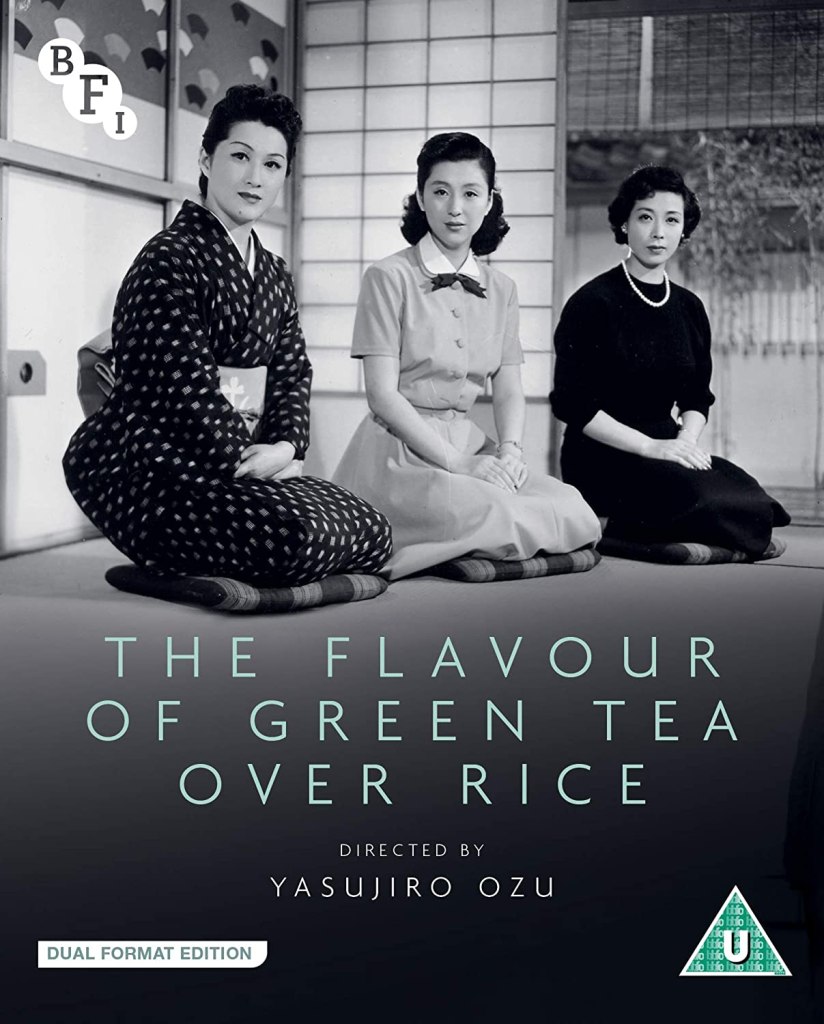
The Flavour of Green Tea Over Rice (お茶漬けの味, Yasujiro Ozu, 1952)

Famously, many of Yasujiro Ozu’s films end with a young woman getting married and the emotional desolation that it provokes in those left behind. Ozu, unlike some of his contemporaries, generally comes down on the side of marriage. His heroines always succumb, rarely finding independence or resignation and settling for a second choice even if their first proved unavailable. The Flavour of Green Tea Over Rice (お茶漬けの味, Ochazuke no Aji), however, takes him in a slightly different direction in asking what, if anything, is to blame when a marriage is unhappy, repurposing the arranged married debate to perhaps imply that wedded bliss is less about romance than it is about endurance and mutual understanding. 

Taeko (Michiyo Kogure), a middle-aged woman, consented to an arranged marriage to Mokichi (Shin Saburi) at the usual age but seems to feel little more than contempt for him. A friend from school, Aya (Chikage Awashima), invites her on an impromptu trip to an onsen and for reasons not entirely clear, Taeko feels she has to lie rather than simply telling Mokichi that she would like to go away with a friend for a couple of days. Aya encourages her to spin a tale that her niece, Setsuko (Keiko Tsushima), who often stays with them in the city, has been taken ill and is in need of urgent care, but the plan is foiled when she swans into their home right as rain before Aya could give her instructions. Caught on the hoof, Taeko is forced to improvise that a different friend is ill, the four women eventually heading off on a girls’ trip leaving Mokichi at home alone and apparently none the wiser. 

Perhaps surprisingly, Mokichi turns out to be a kind and considerate, if perhaps dull, kind of man. We later discover that he knew all along that Taeko was lying but thought it wasn’t worth making a fuss over. He makes a point of chatting with the maid, asking after her family and is apparently well acquainted with her circumstances. Unlike other men, he doesn’t spend his time out drinking or gambling or even overworking, coming home to read instead, but still Taeko is put out when she phones him at work to kickstart the onsen plan and discovers his desk to be empty. It turns out that he met up with the younger brother of an old friend killed in the war who had asked for his help with a recruitment exam. Non-chan (Koji Tsuruta), as everyone calls him, is a cheerful sort guy who openly admits he wears army surplus suits and likes to eat in restaurants which are “good and cheap”, all of which suits Mokichi much better than his wife’s rather more sophisticated tastes. The younger man is quick to introduce him to the pleasures of the age including bicycle racing and pachinko parlours which is where he runs into an old army buddy, Hirayama. 

While Taeko and her old friends break into a rendition of a song from their student days with Setsuko looking on in minor confusion, Mokichi sits around a small table with Hirayama and an equally out of place Non-chan recalling his glory days in Singapore and singing old army songs. They are each, in their own and infinitely parallel ways, mourning the promise of their youth. Taeko’s friends, Aya and Takako, have an equally cynical view of marriage. Takako’s husband has gone to Paris and she, it seems, couldn’t be happier with her newfound freedom, while Aya runs a small boutique and regards hers as little more than a necessary inconvenience. When the ladies take in a baseball game, Aya is surprised to spot her sports-hating husband on the bleachers apparently escorting a woman she recognises from a nearby bar, but she isn’t in any way jealous or angry merely amused and planning to use it as extra leverage to persuade him to buy her a new kimono despite the fact that we later see him asking her for money (which she snatches back as punishment). 

Despite all of that however Taeko’s tragedy maybe that somewhere deep down she wanted her marriage to work. Her open contempt for Mokichi, likening him to a big fat carp and referring to him as “Mr. Bonehead” in assuming he is stupid enough to believe all her lies, annoys the otherwise modern Setsuko who sees their unhappy union as definitive proof that arranged marriages do not work. Interrogated by her exasperated niece who was sure her aunt would support her in her resistance to her parents’ matchmaking, Taeko claims that she is happy and perhaps she is even if in her unhappiness, but Setsuko’s unexpected seizure of her agency though rudely walking out on the omiai brings her own marriage to a crisis point. Mokichi cannot quite say so but tacitly supports Setsuko’s desire to decide her own romantic future even if he disapproves of her irresponsible rudeness to her prospective suitor. “Forcing her to marry against her will would just create another couple like us” he eventually explains to Taeko in boldly saying that which should not be said. 

It would be easy to think that the problem is Taeko and Mokichi simply aren’t suited. There is an obvious class difference that seems to be a continuing problem for the snooty Taeko. It annoys her that he insists on pouring his miso soup into his rice bowl which she feels is common, like his cheap cigarettes and preference for third class rail travel. He explains that it’s not that he’s cheap, simply that these are the things he likes, that he’s familiar with, that make him feel relaxed. Their upbringings are different. Taeko feels relaxed in first class because that’s how she’s always travelled and she likes the finer things because they reassure her in her status. That might be one reason they occupy different areas of a shared home, he with a traditional futon in a tatami mat room, she in a well appointed Western-style boudoir even as she exclusively wears kimono. 

Yet the problem isn’t that they like different things so much as an essential misconnection. Without perhaps knowing, Taeko is so filled with resentment over her lack of control of her romantic destiny that she’s never warmed to her husband or felt secure in her marital home. It’s a cliche to say she doesn’t understand him, but perhaps she wanted something different to what she eventually got. A sudden crisis after the Setsuko episode sees Taeko make a temporary retreat only for Mokichi to be abruptly sent abroad. Sharing the homely comfort food of green tea poured over rice, she finally begins to understand that what she took for indifference was perhaps merely a different way of showing love. Mokichi really is a man who likes the simple things, affection without ceremony, like the flavour of green tea over rice. She knows that unlike Aya’s husband Mokichi will never betray or hurt her. He is infinitely “reliable” which might not sound romantic, but is perhaps the only solid basis for a successful marriage. 

That’s the advice she eventually offers to Setsuko, walking back on her commitment to arranged marriage, a “feudal” tradition she and all the other women had been determined to force onto her despite the fear and pain it caused them in their own youth and beyond, to remind her that marriage is for life. Find someone “reliable”. A flashy suit and a handsome face might look good now, but they might not in 20 years’ time. Setsuko has taken a liking to Non-chan who claims to be “reliable” but his taste for pachinko and bicycle races might suggest otherwise. In any case, after a heartwarming resolution that repairs the fractured marriage of Mokichi and Taeko, Ozu ends on a moment of cheeky ambivalence in which Non-chan says the wrong thing, upsetting Setsuko who retreats into a small hut. Non-chan repeatedly apologises and tries to enter, while she pushes him back out, neatly symbolising the arc of a marriage as an accidental battleground of intimacy though in this case one with a playful resolution. 


The Flavour of Green Tea Over Rice is released on blu-ray in the UK on 18th May courtesy of BFI in a set which also includes an audio commentary by Tony Rayns. The first press edition also comes with a booklet featuring an essay by Tom Milne.

Short clip (English subtitles)

Fireworks Over the Sea (海の花火, Keisuke Kinoshita, 1951)

In the films of Keisuke Kinoshita, it can (generally) be assumed that the good will triumph, that those who remain true to themselves and refuse to give in to cynicism and selfishness will eventually be rewarded. This is more or less true of the convoluted Fireworks Over the Sea (海の花火, Umi no Hanabi) which takes a once successful family who have made an ill-advised entry into the fishing industry and puts them through the post-war ringer with everything from duplicitous business associates and overbearing relatives to difficult romances and unwanted arranged marriages to contend with.

The action begins in 1949 in the small harbour town of Yobuko in Southern Japan. Tarobei (Chishu Ryu) and his brother Aikawa (Takeshi Sakamoto) run a small fishing concern with two boats under the aegis of the local fishing association. The business is in big trouble and they’re convinced the captain of one of the boats has been secretly stealing part of the catch and selling it on the black market. Attempts to confront him have stalled and the brothers are at a loss, unsure how to proceed given that it will be difficult to find another captain at short notice even if they are already getting serious heat from their investors and the association.

Luckily things begin to look up when a familiar face from the past arrives in the form of Shogo (Takashi Miki) – a soldier who was briefly stationed in the town at the very end of the war during which time he fell in love with Tarobei’s eldest daughter, Mie (Michiyo Kogure). Shogo has a friend who would be perfect for taking over the boat and everything seems to be going well but the Kamiyas just can’t seem to catch a break and their attempt to construct a different economic future for themselves in the post-war world seems doomed to failure.

The Kamiyas are indeed somewhat persecuted. They have lost out precisely because of their essential goodness in which they prefer to conduct business honestly and fairly rather than give in to the selfish ways of the new society. Thus they vacillate over how to deal with the treacherous captain who has already figured out that he holds all the cards and can most likely walk all over them. They encounter the same level of oppressive intimidation when they eventually decide to fight unfair treatment from the association all the way to Tokyo only to be left sitting on a bench outside the clerk’s office for three whole days at the end of which Tarobei is taken seriously ill.

However, unlike Kinoshita’s usual heroes, Tarobei’s faith begins to waver. He is told he can get a loan from another family on the condition that their son marry his youngest daughter Miwa (Yoko Katsuragi). To begin with he laughs it off but as the situation declines he finds himself tempted even if he hates himself for the thought. He never wanted to be one of those fathers who treats his daughters like capital, but here he is. Both Miwa, who has fallen in love with the younger brother of the new captain, and her sister are in a sense at the mercy of their families, torn between personal desire familial duty. Mie, having discovered that her husband died in the war, is still trapped in post-war confusion and unsure if she returns Shogo’s feelings but in any case is afraid to pursue them when she knows the depths of despair her father finds himself in because of their precarious economic situation. Shogo is keen to help, but he is also fighting a war on two fronts seeing as his extremely strange (and somewhat overfamiliar) sister-in-law (Isuzu Yamada) is desperate to marry him off to her niece (Keiko Tsushima) in order to keep him around but also palm off her mother-in-law.

Meanwhile, a lonely geisha (Toshiko Kobayashi) who has fallen into the clutches of the corrupt captain is determined to find out what happened to someone she used to know who might be connected to Shogo and the Kamiyas and falling in desperate unrequited love with replacement captain Yabuki (Rentaro Mikuni) who is inconveniently in love with Mie. Kinoshita apparently cut production on Fireworks short in order to jet off to France which might be why his characteristically large number of interconnected subplots never coalesce. Running the gamut from melancholy existential drama to rowdy fights on boats and shootouts in the street, Kinoshita knows how to mix things up but leaves his final messages unclear as the Kamiyas willingly wave their traumatic pasts out to sea with a few extra passengers in tow still looking for new directions.


Titles and opening (no subtitles)

Tokyo Profile (都会の横顔, Hiroshi Shimizu, 1953)

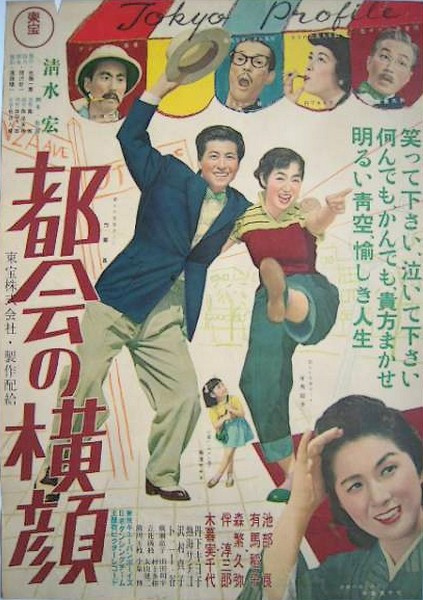
Tokyo Profile posterJudging by the vision presented in the cinema of the time, the Japan of 1953 was one still fighting to emerge from post-war disillusionment and destruction. Set in the glittering Ginza, Hiroshi Shimizu’s Tokyo Profile (都会の横顔,Tokai no Yokogao) is, like much of the director’s work, a more cheerful affair. This world is a very different one from the dingy attics and rundown tenements of the average social drama in which the struggling urban poor battle economic impossibilities while earnestly investing in their future, a somewhat barbed aspirational comedy which lays bare the increasing gap between rich and poor but in a humorous, perhaps resigned fashion save for its strangely cutting finale.

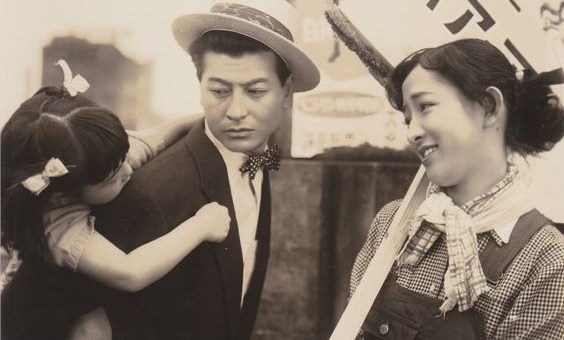
Shooting once again almost entirely on location, Shimizu opens with a lengthy shot captured from the back of a tram traveling through contemporary Ginza – then and now an elegant and refined part of town home to numerous upscale department stores from all around the world. It’s an ordinary Saturday afternoon and the streets are only middling busy. A crowd has gathered around something mysterious, gradually attracting more people and becoming a spectacle in its own right. Thankfully there hasn’t been an accident. A shoeshine girl (Ineko Arima) is trying to comfort a crying child, Michiko (Sachiko Atami), who has become separated from her mother. Michiko is five years old and knows her parents’ names by rote, but all she can tell the concerned people trying to help about her home is the general vicinity it might be located in and that it’s next to Yoshiko’s house, which is not very helpful. Luckily a young man, nicknamed “Mr. Sandwich”  (Ryo Ikebe) because he’s one of Ginza’s many sign carriers, offers to take her to the police station while looking around and attracting attention with his sign (and patented silly walk) in case they spot her mum in the street.

Meanwhile, Michiko’s mother Asako (Michiyo Kogure) is wandering around frantically terrified she might never see her daughter again. Unfortunately she is accosted by a pushy neighbour who promises to help her look for Michiko but keeps pulling her into other business before finally landing her with the bill for two cream sodas which, needless to say, she cannot afford (and didn’t even want).

Michiko and her family are from Meguro which is quite a way out from the centre of the city and one gets the impression this is quite a rare day out for them. Michiko is very excited when she tells the shoeshine girl that they came to buy her a hat and a pair of red shoes, but as we later hear from Asako, Michiko’s presents are tiny splash of luxury in an otherwise economically anxious home. Shinji, Michiko’s father, was a Lieutenant-Commander during in the war but like many of his generation found himself unwanted after its end and struggled to find proper employment. Much to the family’s relief, he’s recently got a steady job as an accountant, but it still doesn’t pay enough to live on. Wanting to buy summer clothes for the children, Shinji worked overtime and walked to work rather than taking the train but little Yoshiko’s parents have bought her little red shoes and now Michiko wants a pair too. Doting parents, Asako and Shinji feel dreadful that they aren’t able to buy their daughter the things that other children have, but today she’s come to Ginza to see what she can do with what she has (which isn’t much either way).

Shimizu follows Michiko as she travels round the city with various adults looking for her mum but also having a grand adventure. Though she was originally quite distressed, Michiko is a clever little girl and quickly decides to start having fun instead of being sad. The sandwich man takes her all around Ginza, bumping into various people that he knows including a philandering boyfriend and the girl waiting for him, the girl he was with who has several boyfriends but has the most fun when standing them up, a shady gangster type not normally around during the day (he’s on his way to Osaka), and a geisha girl who’s taking classes in English for the “service” industry from an extremely camp instructor.

The irony is that Michiko and her family aside, the sandwich man, shoeshine girl, and everyone else they meet are people with no money who earn their living on the streets where rich people come to play. The gangster offers sandwich man a cigarette and he takes it, only to consider throwing it away when he sniffs it and realises it’s a cheap and nasty variety. Meanwhile, Asako’s horrible neighbour convinces her to ask a streetside psychic to help finding Michiko but he keeps interrupting their consultation to chase after discarded cigarette butts which he puts in a big pot and later smokes with the help of his pipe-like cigarette holder. The people who come to Ginza to play don’t care about smoking their cigarettes down to the last because they know they can buy more. Streetside psychics can’t even afford to buy any.

Nevertheless, no one seems to be unhappy with their life in Ginza. Sandwich man is nursing a crush on shoeshine girl which she might or might not return. So obviously good with children he longs for many, which is a problem because the one thing shoeshine girl dislikes about the city is that there are too many people – she only wants two. His desire for a big family means he doesn’t envisage spending the rest of his life as a sandwich man, but then it seems to be alright for the time being while he waits for something better to come along (which he seems to think it will). Shimizu takes us on a jaunty journey through the glitzy Ginza, taking in the musical halls and cafes while now famous tunes celebrating the area play unironically in the background, but as much as he celebrates the aspirational swankiness of the recovering city he’s always keen to remind us that not everyone who lives here lives in the same world and little girls like Michiko risk getting left behind for good if no one stops to think about that.