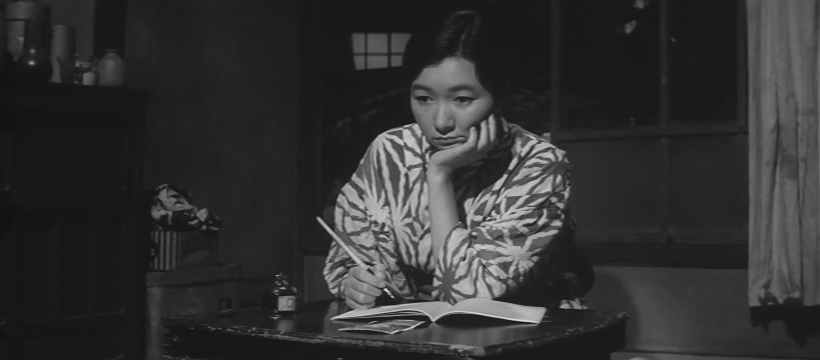
A Wanderer’s Notebook (放浪記, Mikio Naruse, 1962)

Many of Mikio Naruse’s most famous films are adapted from the work of Fumiko Hayashi, a pioneering female author who chronicled the life of a working class woman with startling frankness. Yet his dramatisation of her life, A Wanderer’s Notebook (放浪記, Horo-ki), is both a little more reactionary than one might have expected and surprisingly unflattering even in the heroine’s eventual triumph in escaping her poverty through artistry. Even so if perhaps sentimentalising the economically difficult society of the 1920s in emphasising the suffering which gave rise to Hayashi’s art, the film does lay bare the divisions of class and gender that she did to some extent transgress in pursuit of her literary destiny. 

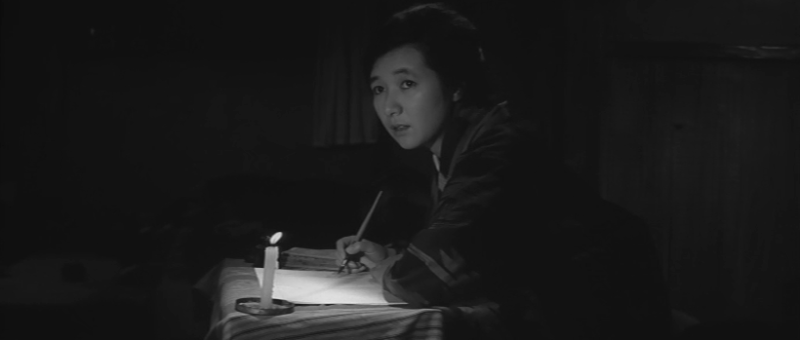
Naruse and his screenwriters Toshiro Ide and Sumie Tanaka bookend the the film with a literal “lonely lane” which the young Fumiko walks with her itinerant salespeople parents. As a small child, she sees her father arrested for a snake oil scam peddling some kind of wondrous lotion, setting up both her disdain for men in general and her determination not to be deceived by them at least unwittingly. She has no formal education but is a voracious reader well versed in the literary culture of the time and intensely resentful of if resigned to her poverty. In the frequent sections of text which litter the screen taken directly from her novels, she details her purchases, wages, and longing for the small luxuries she can in no way afford. 

As an uneducated woman in the 1920s her working opportunities are few. She exasperatedly relates standing in a queue with hundreds of other women waiting for an interview for a company job only to be told they’ll let her know, while her other opportunity involves meeting a theatre director at a station who later takes her to his hotel/office and makes it plain he’s not really interested in her CV. She gets a job at the office of a stockbroker, but lies about being able to do accounts and is flummoxed by double entry bookkeeping getting herself fired on day one. After a brief stint in factory painting toys, she leaves with a friend to become a hostess but is also fired on her first day for getting drunk and being unwilling to ingratiate herself with the boorish men who frequent such establishments. 

Despite her animosity, she is drawn towards men who are callous and self-involved, firstly taking up with a poet and actor who praises her work but turns out to have several “wives” on the go, and then begins living with a broody writer, Fukuchi, who is insecure and violent, resentful at her success in wake of his failure. Perhaps because of her experiences, she seems to resent any hint of kindness though sometimes kind herself, lending money to her friend whose mother is in need and often ready to stand up for others whom she feels are being mistreated. A kindly widower in the boarding house where she lives with her mother, Yasuoka, falls in love with her but she repeatedly rejects him partly as someone suggests because he is not handsome, but mainly because of his goodness and kindness towards her. Nevertheless, he continues to support always ready in her time of need though having accepted that she will never return his feelings or accept his proposal. 

Perhaps her might have liked to have been kinder, but was too wounded by her experiences to permit herself. In any case at the film’s conclusion in which she has achieved success and in fact become wealthy it appears to have made her cold and judgemental. She instructs her maid to send a man away believing he is from a charity set up to help the poor, insisting that the poor must work for industry is the only path out of poverty implying that as she managed it herself those who cannot are simply not applying themselves when she of all people should know how fallacious the sentiment is. As if to bear out the chip on her shoulder, she forces her mother to wear a ridiculous kimono from a bygone era that is heavy for an old woman and makes her feel foolish because of her own mental image of the finery she dreamed of providing her on escaping the persistent hardship of their lives. 

As she says, she’s no interest in the socialist politics espoused by the literary circles in which she later comes to move, pointing out that the poor have no time for waving flags. One of her greatest supporters is himself from a noble family despite his progressive politics and in truth can never really understand the lives of women like Fumiko. He describes her work as like upending a rubbish bin and poking through it with a stick, at once fascinated and repulsed by a frankness he may see as vulgar. At one point he accuses her of writing poverty porn, playing on her humble origins for copy and becoming something of a one note writer. 

In truth, the film is not really based on the novel from which it takes its title but on the play that was adapted from it, while the novel itself was apparently reworked and republished several times in response to reader taste giving rise to a series of questions both about its essential authenticity and what it was that it was attempting to convey. In the film at least, moments after her literary success, Fumiko is challenged by a fellow female writer, Kyoko, who was once her love rival, that she cheated in a contest by failing to submit Kyoko’s entry until after the deadline had passed, though as it seems she would have won anyway. She is occasionally underhanded, perhaps because she feels she has no other choice, but then as we can see there is no particular solidarity between women save the kindly landladies who often let her delay her rent payments. Fumiko feels herself to be alone and her quest is not really for literary success but simply for her next meal, though she feels the slights of the bitchy women and arrogant men who mock her commonness while simultaneously exploiting it as entertainment. 

On the one hand, her success seems to signal a triumph of independence having freed herself from the need to depend on terrible men though she also she seems to have met and married a warmhearted painter who cares for her and supports her work while she has also been able to give her mother the level of comfort they both once dreamed of. Even so, the unavoidable fact that she dies at such a young age implies she’s worked herself into an early grave in a sense punishing her for her rejection of contemporary social norms undercutting her achievements with some regressive moralising while the one thing she still desires, rest, is given to her only in death. In Takamine’s highly stylised performance, as some have implied perhaps intended to mimic the silent screen, Fumiko is at once a carefree young woman who dances and sings and a melancholy fatalist with a self-destructive talent for choosing insecure and self-involved men, but above all else a woman walking a lonely road towards her own fulfilment while searching for a way out of poverty that need not transgress her particular sense of righteousness. 


Original trailer (no subtitles)

Snow Country (雪国, Shiro Toyoda, 1957)

Closely associated with literary adaptation, Shiro Toyoda had been wanting to adapt Yasunari Kawabata’s Snow Country (雪国) since its serialisation and apparently spent four years preparing his treatment ahead of the 1957 film starring Ryo Ikebe as the solipsistic aesthete at the novel’s centre. Characteristically, however, he takes several liberties with the source material, notably introducing an entirely different conclusion which perhaps helps in re-centring the tale away from the hero Shimamura to the melancholy geisha who apparently falls for him because of his intense loneliness. 

A brief reference to a failed military insurrection in Manchuria sets us firmly in the mid-1930s as do repeated mentions of the ongoing depression which causes additional anxiety to local business owners in a small holiday resort town. Mimicking the novel’s famous opening, Toyoda opens with a POV shot of a train exiting a tunnel into the snow-covered landscape, the hero Shimamura (Ryo Ikebe) sitting sadly gazing out of a window and eventually captivated by the reflection of a young woman devotedly caring for a young man who appears to be in poor health. Meanwhile, another young woman, Komako (Keiko Kishi), gazes at her own reflection in a train station window, waiting once again as if unable to depart. As we discover, Shimamura has returned with the intention of seeing Komako with whom he’d struck up a relationship during a summer trip but is somewhat disappointed to learn that she has since become a geisha.

In a flashback to their first meeting, Komako asks Shimamura if he has come for “escape”, a question he doesn’t exactly answer while petulantly complaining about his lack of artistic success as someone who paints pictures apparently out of step with his times. When the head of the local commerce association tries to involve him in conversation about the failed insurrection, he bluntly tells him that he’s an artist and as such has no interest in such things, but it does indeed seem that he is looking for some kind of escape from the turbulent times, expressing that here the war seems very far away as does “the depression”. Komako, a more modern and perhaps prophetic figure than it might at first seem, is the only one to bring up the war directly speculating that it may be about to intensify while the frustrated affair between the two seems to be informed by the mounting tensions against which they are attempting to live their lives. 

Rather self-absorbed, Shimamura in a sense may even identify with Komako explaining that he too has a “patron” and implying that his flight is perhaps a response to his sense of powerlessness, that he feels constrained by his financial dependency presumably on his father-in-law though his relative economic superiority which leads Komako to frequently remark on his “extravagance” obviously affords him the freedom to make these random solo trips to ski resorts and indulge his career as a painter regardless of its capacity to support himself and his family. Komako must know on some level that the relationship is a fantasy, yet she believes in it enough to end her connection with an elderly patron on suspecting that she is carrying Shimamura’s child only to have her hopes dashed when he does not turn up for a local festival as promised with the consequence that all of her dependents are turfed out of the home he had provided for her. 

Komako is not “free” in the same way that Shimamura evidently is, her entire life dictated by the fact that she is poor and female. Fostered by a shamisen teacher, she may have been technically engaged to the young man, Yukio (Akira Nakamura), Shimamura saw on the train being cared for by Yoko (Kaoru Yachigusa), Komako’s foster sister in love with him herself, but intensely resents the burdens she is expected to bear quite literally with her body. She later tells Shimamura that she didn’t become a geisha for Yukio in order to pay his medical bills but out of a sense of obligation, while she is also responsible for her birth family, the now bedridden shamisen teacher, and Yoko who intensely resents her for her callous treatment of Yukio and generally “dissolute”, selfish way of living. During the famous fire in a cinema that closes the novel (but not the film), Komako even exclaims that her life would be easier if Yoko burned to death, but on witnessing her either fall or jump from the burning building she can do nothing other than run to her side. 

Indeed, the novel’s climax finds Shimaura standing alone indifferent to the fate of Yoko, a young woman he had come to admire if only for her contrary qualities, admiring instead the beauty of the night sky. In Toyoda’s characterisation, Yoko is in one sense the conventionally good woman whose selfless devotion to the sickly Yukio so captivates Shimamura, but her goodness is nevertheless undercut by the degree of her animosity towards Komako even as the two women remain trapped in a complex web of frustrated affection and intense resentment, each perhaps knowing they neither can have the man they want and are condemned to an eternal unhappiness as the snow mounts all around them in this perpetually cold and depressing moribund resort town. Switching between studio matte paintings ironically mimicking Shimamura’s art and on-location footage of the deepening snows, Toyoda’s sense of near nihilistic melancholy evoking the atmosphere of Japan in the mid-1930s hints at grand tragedy but finds resolution only in stoicism as the heroine picks up her shamisen and trudges onward amid the quickening blizzard.  


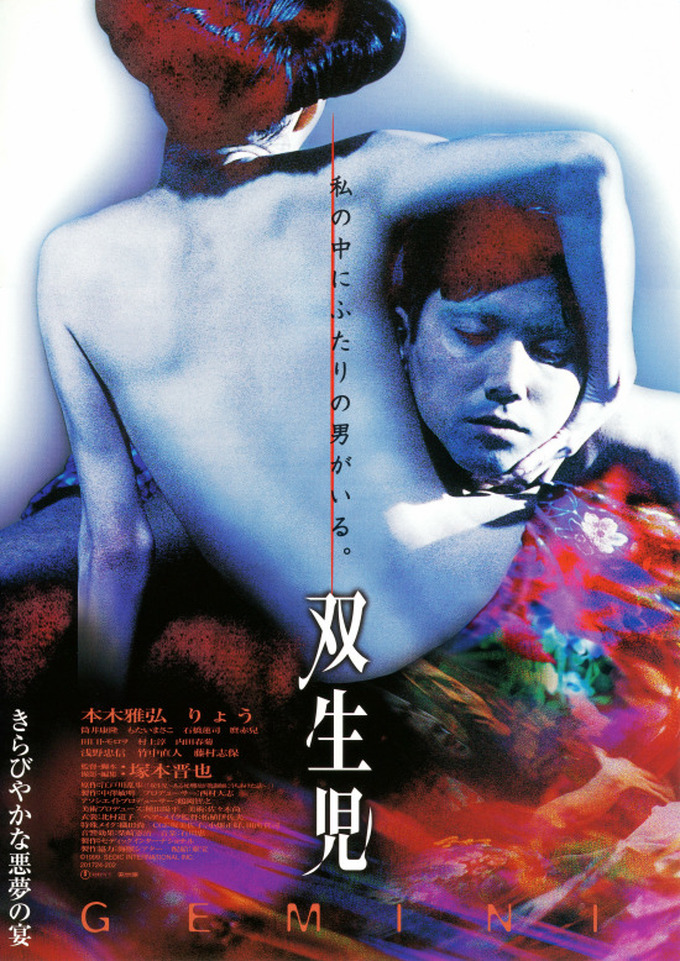
Gemini (双生児 GEMINI, Shinya Tsukamoto, 1999)

Shinya Tsukamoto made his name as a punk provocateur with a series of visually arresting, experimental indie films set to a pounding industrial score and imbued with Bubble-era urban anxiety. Inspired by an Edogawa Rampo short story, 1999’s Gemini (双生児 GEMINI, Soseiji Gemini) is something of a stylistic departure from the frenetic cyberpunk energy of his earlier career, marked as much by stillness as by movement in its strikingly beautiful classical composition and intense color play. Like much of his work, however, Gemini is very much a tale of societal corruption and a man who struggles against himself, unable to resist the social codes which were handed down to him while simultaneously knowing that they are morally wrong and offend his sense of humanity. 

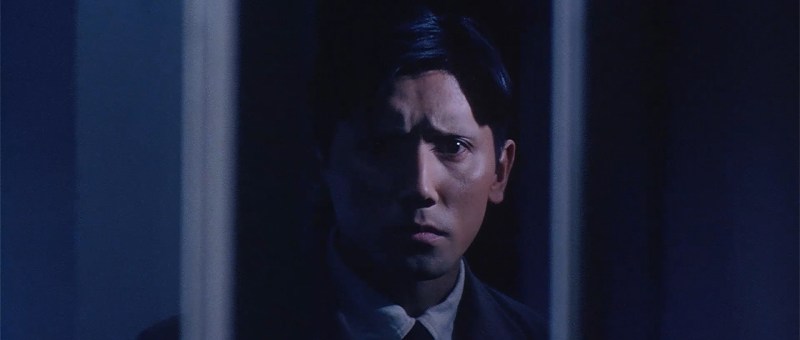
Yukio (Masahiro Motoki) is a war hero, decorated for his service as a battlefield medic saving the life of a prominent general during the first Sino-Japanese War. He’s since come home and taken over the family business where his fame seems to have half the well-to-do residents of the area inventing spurious excuses to visit his practice, at least according to one little boy whose mum has brought him in with a bump on the head after being beset by kids from the slums. “They’re just like that from birth” Yukio later tells his wife echoing his authoritarian father, “the whole place should be burned to the ground”. A literal plague is spreading, but for Yukio the slums are a source of deadly societal corruption that presents an existential threat to his way of life, primed to infect with crime and inequity. His home, which houses his practice, is hermetically sealed from those sorts of people but lately he’s begun to feel uneasy in it. There’s a nostalgia, a sadness, a shadowy presence, not to mention a fetid stench of decay which indicates an infection has already taken place, the perimeter has been penetrated. 

The shadowy presence turns out to belong to his double, Sutekichi whose name literally means “abandoned fortune”, a twin exposed at birth as unworthy of the family name owing to his imperfection in the form of a snake-like birthmark on his leg and raised by a travelling player in the slums. Having become aware of his lineage, Sutekichi has returned to make war on the old order in the form of the parents who so callously condemned him to death, engineering their demise and then pushing Yukio into a disused well with the intention of stealing his identity which comes with the added bonus that Yukio’s wife, Rin (Ryo), was once his. 

Rin’s presence had already presented a point of conflict in the household, viewed with contempt and suspicion by Yukio’s mother because of her supposed amnesia brought on by a fire which destroyed her home and family. Yukio had reassured her that “you can judge a person by their clothes”, insisting that Rin is one of them, a member of the entrenched upper-middle class which finds itself in a perilous position in the society of late Meiji in which the samurai have fallen but the new order has not quite arrived. In Rin modernity has already entered the house, a slum dweller among them bringing with her not crime and disease but a freeing from traditional austerity. In opposing his parents’ will and convincing them to permit his marriage, Yukio has already signalled his motion towards the new but struggles to free himself from the oppressive thought of his father. He confesses that as a battlefield physician he doubted himself, wondering if it might not have been kinder to simply ease the suffering of those who could not be saved while his father reminds him that the German medical philosophy in which he has been trained insists that you must continue treatment to the very last. 

This is the internal struggle Yukio continues to face between human compassion and the obligation to obey the accepted order which includes his father’s feelings on the inherent corruption of the slum dwellers which leads him to deny them his medical knowledge which he perhaps thinks should belong to all. The dilemma is brought home to him one night when a young woman is found violently pounding on his door wanting help for her sickly baby, but just as he makes up his mind to admit her, putting on his plague suit, a messenger arrives exclaiming that the mayor has impaled himself on something after having too much to drink. Yukio treats the mayor and tells his nurses to shoo the woman away, an action which brings him into conflict with the more compassionate Rin who cannot believe he could be so cynical or heartless. 

Where Yukio is repressed kindness, a gentle soul struggling against himself, Sutekichi is passion and rage. Having taken over Yukio’s life, he takes to bed with Rin who laughs and asks him why it is he’s suddenly so amorous. She sees or thinks she sees through him, recognising Sutekichi for whose return she had been longing but also lamenting the absent Yukio who was at least soft with her in ways Sutekichi never was. “It’s a terrible world because people like you exist” Sutekichi is told by a man whose fiancée he robbed and killed. Yukio by contrast is unable to understand why this is happening to him, believing that he’s only ever tried to make people happy and has not done anything to merit being thrown in a well, failing to realise that his very position of privilege is itself oppressive, that he bears his parents’ sin in continuing to subscribe to their philosophy in insisting on their innate superiority to the slum dwellers who must be kept in their place so that they can continue to occupy theirs. 

Apart, both men are opposing destructive forces in excess austerity and violent passion, only through reintegration of the self can there be a viable future. Tsukamoto casts the austerity of the medical practice in a melancholy blue, contrasting with the fiery red of the post-apocalyptic slums, eventually finding a happy medium with the house bathed in sunshine and the family seemingly repaired as a doctor in a white suit prepares to minister to the poor. Having healed himself, he begins to heal his society, treating the plague of human indifference in resistance to the prevalent anxiety of the late Meiji society. 


Gemini is released on blu-ray in the UK on 2nd November courtesy of Third Window Films in a set which also includes a commentary by Tom Mes, making of featurette directed by Takashi Miike, behind the scenes, make up demonstration featurette, Venice Film Festival featurette, and original trailer.

Original trailer (English subtitles)

River Washes Away the Moon (残月大川流し, Yasushi Sasaki, 1963)

River Washes Away the Moon posterTimes are changing fast in Edo. Hibari Misora reunites with director Yasushi Sasaki for another jidaigeki adventure only this time one with much less song and dance and fewer tomboy antics for the often spiky star. Set in 1868 in the immediate aftermath of the fall of the Tokugawa Shogunate, River Washes Away the Moon (残月大川流し, Zangetsu Okawa Nagashi) is, in its own way, a story of revolutions, personal and political, as sides are picked and alliances forged in midst of a city in flux.

Edo, 1868. The Tokugawa Shogunate has been drummed out of the capital by the collective forces of Satsuma, Choshu, and Tosa but a new regime has yet to solidify itself. While some remain loyal to the Tokugawa cause, others join the new imperial armies leaving Edo a fractured state in which loyalists are on the run and violence rules the streets. Meanwhile, ordinary Edoities are trying to go about their everyday business. Ogin (Hibari Misora), an orphan, is a member of a pickpocketing gang run by a cruel mistress who metes out extreme punishments to those deemed to have transgressed her stringent rules, most often by trying to keep some of the money for themselves rather than hand it to the bosses for “redistribution”. Ogin is good at pickpocketing, but she has a noble heart and feels sorry for the country bumpkins who often become her prey. The madame wants her to take over the gang, but she wants out of the criminal life as soon as possible.

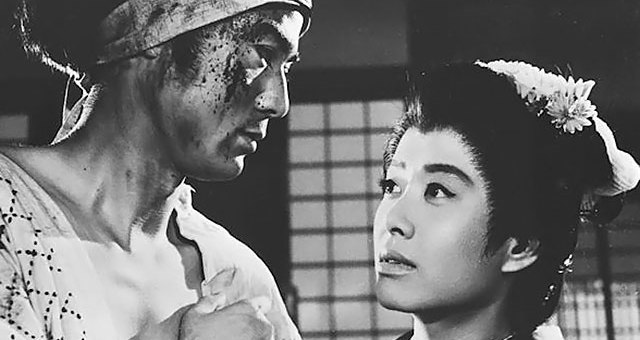
With things the way they are, the the loyalists ask the pickpockets for a favour – steal the shoulder badges off the Imperialist mercenaries so they won’t be able to return to their camps. The madame declares herself apolitical and declines but Ogin, a true child of Edo, feels quite differently and is only too keen to support the loyalists in whichever way she can. She gets her opportunity when a wounded soldier, Shinzaburo (Yoshitomo Ogasawara), creeps into the house she hides out in to get away from the gang. Ogin bravely hides Shinzaburo from the Imperialist troops and then hides him again when he returns sometime later after another battle with a lost little girl in tow. The pair grow closer, but Shinzaburo is under the impression Ogin is a wealthy merchant’s daughter and has no idea she is a poor orphan forced to pick pockets on the streets in return for safe harbour.

Unlike many of Misora’s jidaigeki heroines, Ogin is a much more “feminine” figure – she never gets to do any fighting of her own and the (extremely subdued) romance with Shinzaburo becomes the film’s main focus. She is however steadfast and bold. She stands up to her madame as much as feels she is able and is desperate to extract herself from the criminal world. As an orphan without any other means of support, however, her options are limited and even when she tries to do good it’s thrown back in her face.

Even Shinzaburo whose ideals one would hope to be more compassionate is after all a loyalist and not a revolutionary. His ideals are conservative if bending towards the moral good and therefore when he finds out what Ogin really is their connection is broken, he loses respect for her and though she never lied to him he blames her for the life she was forced to lead. A man like Shinzaburo might have lost his place, but he’s never known the kind of hardship a woman like Ogin has had to endure and the concepts are alien to him.

After getting her heart broken by Shinzaburo, Ogin finds the strength to break away from her criminal family by becoming an itinerant musician which gives Misora a chance to sing another song – her only other musical number is a full on set piece taking place during a community show held to raise money for orphans and possibly reunite dislocated people with their families in the process. Nevertheless Misora delivers an impressive performance as the continuously lovelorn Ogin, convinced that her world is limited by the circumstances of her birth and only latterly realising she has the power to change her fate (if for the slightly dubious reasons of proving herself worthy of Shinzaburo). Ogin opts for her personal revolution while Shinzaburo opts for a political one. By 1963 the winds of change were indeed blowing through Tokyo once again, though if there are any political messages to be found in River Washes Away the Moon they are fairly subtle and lean more towards compassionate living and finding the strength to live by your principles than advocating for direct agitation as the best path towards a fairer world.


Hibari’s musical numbers (no subtitles)

https://www.youtube.com/watch?v=UVKtBrUsS5c