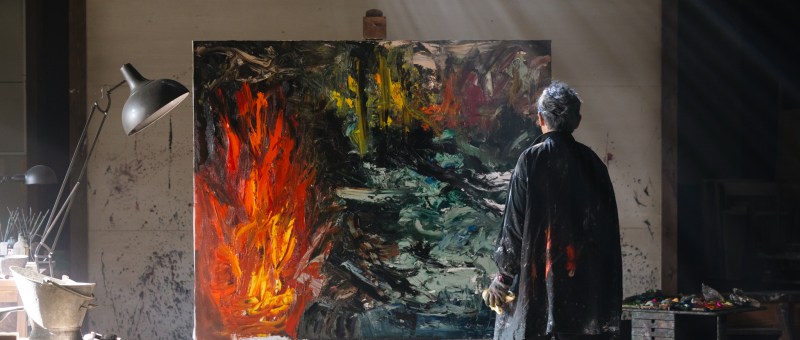
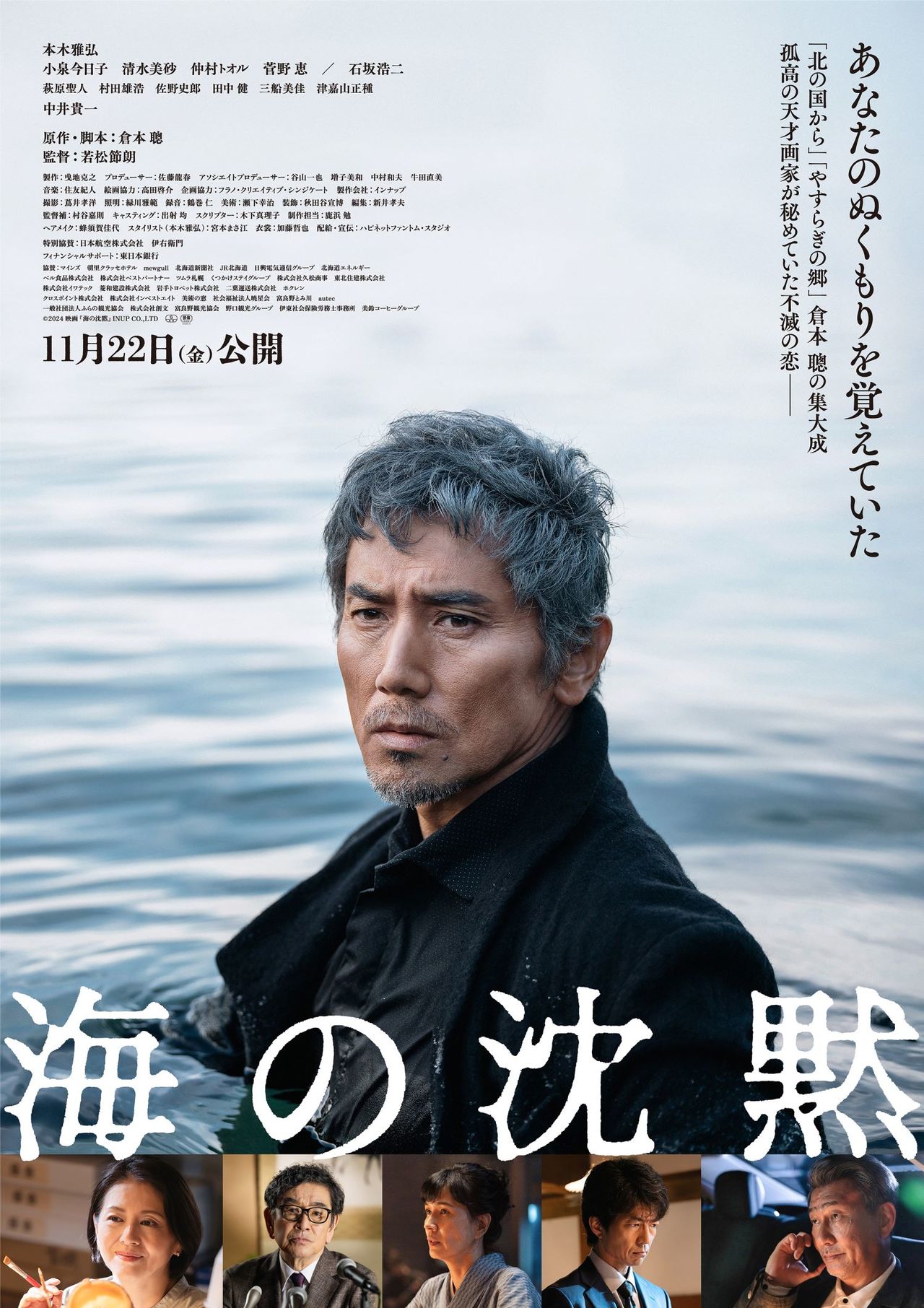
Can there be any greater humiliation than having your work plagiarised and the other person’s being better? Renowned artist Tamura (Koji Ishizaka) feels he has to say something on seeing an old painting at an exhibition honouring his late mentor and realising it’s not the one he painted. He doesn’t think he ever had the ability to paint something with this kind of power even when he was young, and he didn’t even use the materials which appear to have given this version a emotional depth that the original never had.
In some ways, this is Tamura’s past literally coming to the surface to show him that his life has been a series of mistaken choices and whatever success he may have achieved it’s come at the cost of his artistic soul. The first part of Setsuro Wakamatsu’s Silence of the Sea (海の沈黙,, Chinmoku no Umi) ponders why Tamura might be so keen to confess this work isn’t his when he admits that it’s objectively “better”, but even if that might be true, he has to concede it isn’t him and therefore shouldn’t have his name on it. Though he appears to have become greedy and vain, trading on his connections and more of a celebrity artist than someone with real and urgent ideas to express, he is apparently willing to burn all his bridges on the altar of authenticity while simultaneously refusing to divorce his wife, the daughter of his late mentor, despite living with another woman and their child on the other side of the country.
But as someone else says, does it matter whose name is on the painting when it is beautiful in itself? Then again, this beauty is intended both to cover something up and to expose it. In his youth, Tamura apparently threw another artist, Lyuji (Masahiro Motoki), under the bus. 40 years later, Lyuji is a master forger living a life in the shadows tattooing young women with his fevered artistic visions. It’s true enough that he seems to see them only as “canvases” and otherwise rejects personal connection while still carrying a torch for Tamura’s now wife Anna (Kyoko Koizumi). He seems to be stuck in the past, forever meditating on a particular pairing, The Silence of the Sea, which reflected his own moment of trauma when his parents both drowned when he was a child.
The film seems to pain Tamura and Lyuji as two sides of the same coin. The more Tamura’s star rose, the sicker and more humble Lyuji became as if he were literally bleeding him dry. In the words of his assistant, Lyuji had an imperative to depict beauty, but art seems to deplete him. He literally vomits blood on the canvas while struggling to recreate his lost painting and thereby return to the source of his trauma. The sea for him seems to represent life and death along with life’s beauty and terror, while for Tamura it is perhaps merely picturesque even if for both of them the sun is always setting.
One man has almost painted over the other, stolen a life that might have been meant for him though his talent may lie more in an ability to play the game than in art itself. But at the same time, Lyuji has destroyed himself through his selfishness and single-minded obsession with his art along with the internal traumas it turns out he cannot simply paint over. His life is like the candle that Anna makes in his image, slowly melting away and producing only a single tear from a lonely soul. His eventual conviction is that beautiful things need only exist in our hearts and minds as memory rather than as material things. As he says, measuring art in money is mere foolishness, which paints his career of forgery as an ironic revenge against the art world which values only what’s popular and has become a game for the rich to play to enhance their status little caring for the nature of the art itself. Yet this covering up and later revealing of a truth has led to several deaths, among them a man who lived for art and a woman who yearned for love only to end up a scorned muse of an emotionally distant man. The sea took them all, but for Lyuji at least it may finally have fallen silent in the final perfection of his art.
Silence of the Sea screens as part of this year’s Japan Foundation Touring Film Programme.
Trailer (English subtitles)
Images: © 2024 Eiga Umi no Chinmoku INUP Co.,Ltd


 Based on the contemporary manga by the legendary Fujiko F. Fujio (Doraemon), Future Memories: Last Christmas (未来の想い出 Last Christmas, Mirai no Omoide: Last Christmas) is neither quiet as science fiction or romantically focussed as the title suggests yet perhaps reflects the mood of its 1992 release in which a generation of young people most probably would also have liked to travel back in time ten years just like the film’s heroines. Another up to the minute effort from the prolific Yoshimitsu Morita, Future Memories: Last Christmas is among his most inconsequential works, displaying much less of his experimental tinkering or stylistic variations, but is, perhaps a guide its traumatic, post-bubble era.
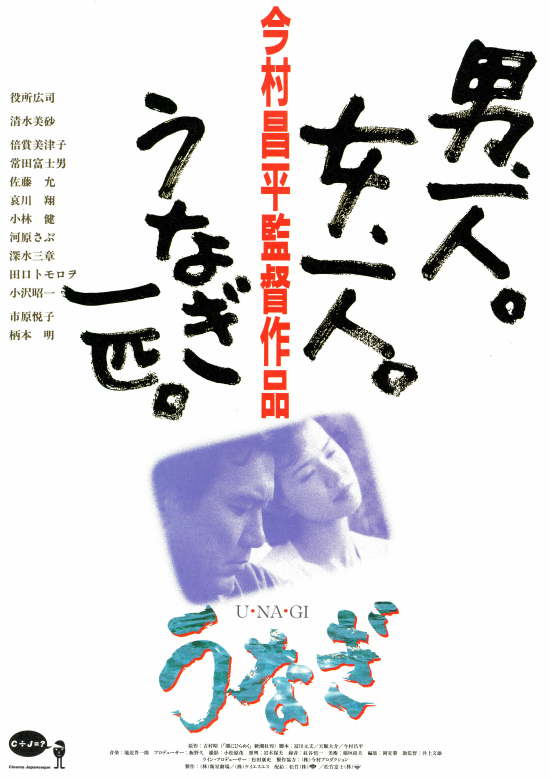 Director Shohei Imamura once stated that he liked “messy” films. Interested in the lower half of the body and in the lower half of society, Imamura continued to point his camera into the awkward creases of human nature well into his 70s when his 16th feature, The Eel (うなぎ, Unagi), earned him his second Palme d’Or. Based on a novel by Akira Yoshimura, The Eel is about as messy as they come.
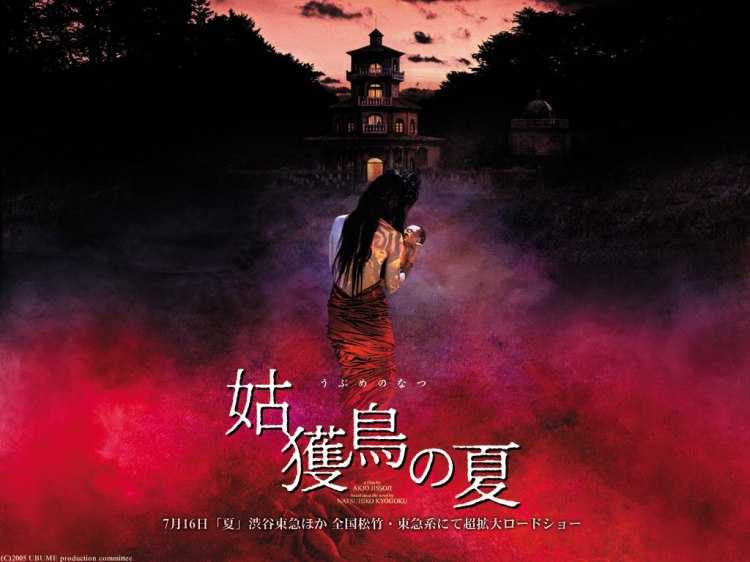 Akio Jissoji has one of the most diverse filmographies of any director to date. In a career that also encompasses the landmark tokusatsu franchise Ultraman and a large selection of children’s TV, Jissoji made his mark as an avant-garde director through his three Buddhist themed art films for ATG. Summer of Ubume (姑獲鳥の夏, Ubume no Natsu) is a relatively late effort and finds Jissoji adapting a supernatural mystery novel penned by Natsuhiko Kyogoku neatly marrying most of his central concerns into one complex detective story.
 Considering how well known sumo wrestling is around the world, it’s surprising that it doesn’t make its way onto cinema screens more often. That said, Masayuki Suo’s Sumo Do, Sumo Don’t (シコふんじゃった, Shiko Funjatta) displays an ambivalent attitude to this ancient sport in that it’s definitely uncool, ridiculous, and prone to the obsessive fan effect, yet it’s also noble – not only a game of size and brute force but of strategy and comradeship. Not unlike Suo’s later film for which he remains most well known, Shall We Dance, Sumo Do, Sumo Don’t uses the presumed unpopularity of its central activity as a magnet which draws in and then binds together a disparate, originally reluctant collection of central characters.
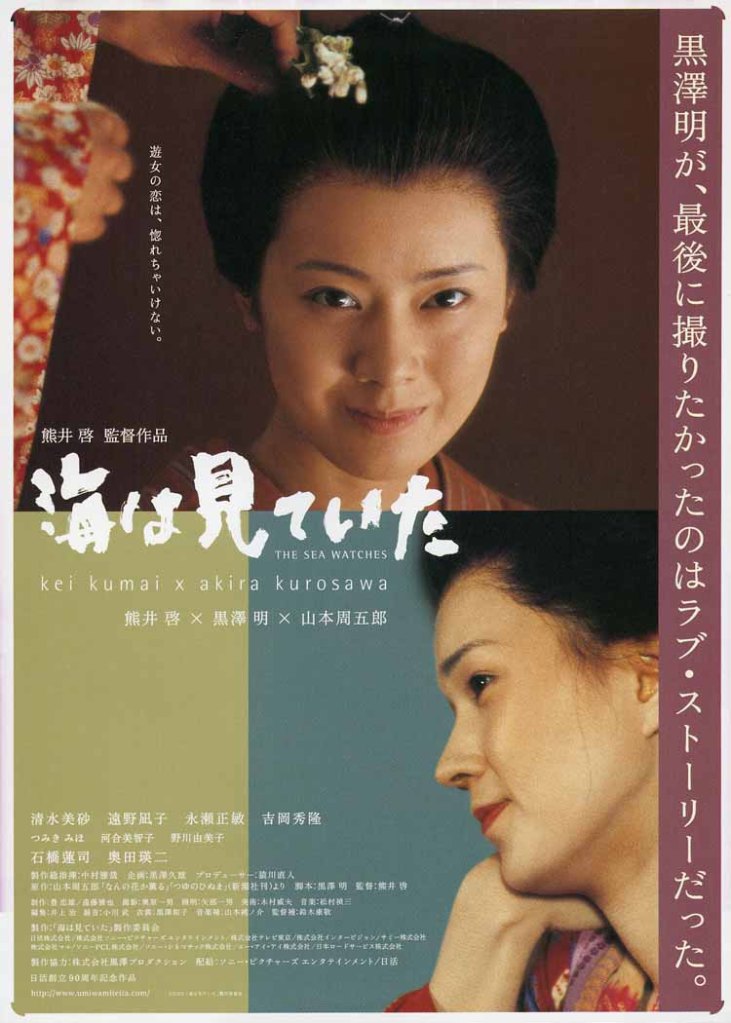 Akira Kurosawa’s later career was marred by personal crises related to his inability to obtain the kind of recognition for his films he’d been used to in his heyday during the golden age of Japanese cinema. His greatest dream was to die on the set, but after suffering a nasty accident in 1995 he was no longer able to realise his ambition of directing again. However, shortly after he died, the idea was floated of filming some of the scripts Kurosawa had written but never proceed with to the production stage including The Sea is Watching (海は見ていた, Umi wa Miteita) which he wrote in 1993. Based on a couple of short stories by Shugoro Yamamoto, The Sea is Watching would have been quite an interesting entry in Kurosawa’s back catalogue as it’s a rare female led story focussing on the lives of two geisha in Edo era Japan.
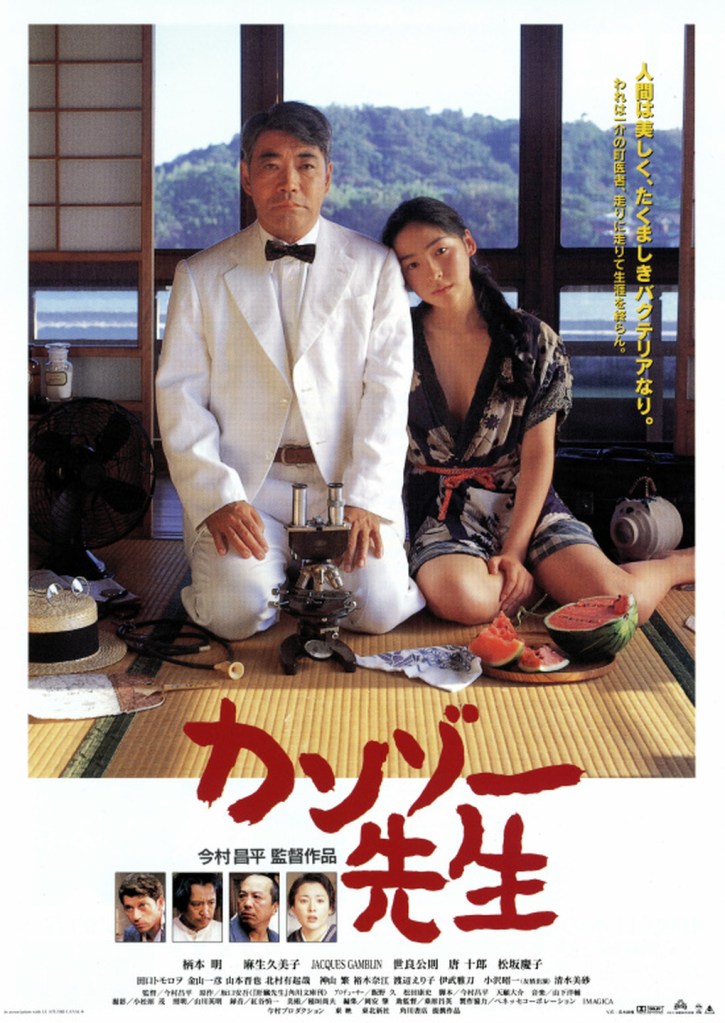 A late career entry from socially minded director Shohei Imamura, Dr. Akagi (カンゾー先生, Kanzo Sensei) takes him back to the war years but perhaps to a slightly more bourgeois milieu than his previous work had hitherto focussed on. Based on the book by Ango Sakaguchi, Dr. Akagi is the story of one ordinary “family doctor” in the dying days of World War II.
 Windows on Worlds