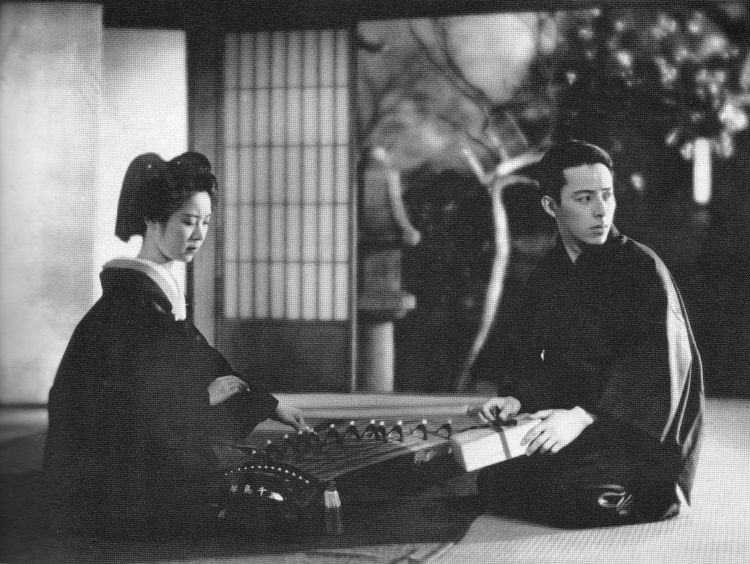
 Yasujiro Shimazu had been a pioneer of the “shomin-geki” – naturalistic tales of ordinary working people in the contemporary era, but 1935’s Okoto and Sasuke (春琴抄 お琴と佐助, Shunkinsho: Okoto to Sasuke) sees him step back from the modern world in adapting a soon to be classic novella by contemporary novelist Junichiro Tanizaki. Published in 1933 under the title Shunkinsho and set in late Meiji, Okoto and Sasuke is another in the author’s long series of dark erotic dramas which aim to explore the baser elements of the human heart while engaging in a kind of cultural soul searching. The first of many adaptations, Shimazu’s scales back on Tanizaki’s taste for the perverse as well as his wry sense of humour, spinning a tender tale of love which finally finds its home only in the shared darkness of two becoming one in self imposed exile from the visible world.
Okoto (Kinuyo Tanaka) has been blind since she was nine and, though her parents appear to dote on her, has a proud and imperious manner which sees her mistreat those who only seek her friendship. Fearing that, due to her disability, Okoto will never find a suitable husband, the family have decided to let her study the koto and shamisen (traditionally strong areas for the blind) so that she might be able to support herself and have some degree of accomplishment. Sasuke (Kokichi Takada), a young servant at the pharmacy run by Okoto’s father, began escorting Okoto to her classes for no especial reason but as he is one of the few who can cope with Okoto’s moods, and is one of the few Okoto seems to tolerate, he quickly became her personal companion.
Sasuke remains completely devoted to Okoto even when she treats him cruelly. So many areas of their relationship are an inversion of the customs of the time – Okoto is the mistress, while Sasuke is the servant, she is strong while he is weak, she is cruel and he is kind. She has all the power, and he has none but seems to revel in his degradation, obeying each and every one of Okoto’s commands and rarely minding even when she strikes him. Nevertheless, despite her outward contempt for him Okoto is also dependent of Sasuke – not only for the assistance he provides, but for the gentle touch of his hands and his willingness to place himself entirely under her authority in worshipful devotion.
The relationship between the pair is one of (seemingly) chaste sadomasochism in which both reject the “normal” romantic affectations of their time. Despite the obvious class difference, Okoto’s family are secretly hoping Okoto and Sasuke will someday marry – an idea floated with intense seriousness when it is discovered that Okoto has become pregnant though she refuses to name the father of the child, denying that her lover is Sasuke and vowing that she would find it “humiliating” to be married to a mere servant.
There is something, as uncomfortable as it is, which presents Okoto’s pride as a kind of rebellion born of her blindness, a rejection of the world which has rejected her as “imperfect” and which she literally cannot see. Despite her family’s reservations Okoto does acquire a suitor, but he is only interested in her precisely because of her blindness. A playboy, Ritaro has fetishised Okoto’s “difference” and sees her almost as a trophy, captivated by her intense beauty and only spurred on by her haughtiness. A friend of Sasuke’s, by contrast, hearing the rumour of Okoto’s pregnancy, expresses horror at the idea of a “disabled” woman with a child, avowing that society would never stand for such a thing, rejecting and salivating over the salacious rumour at the same time. Okoto will pay a heavy price for her violent rejection of Ritaro’s attempt to reduce her to a mere conquest, ironically allowing him to rob her of something, but eventually leading her towards the destiny which will bind her forever to her devoted servant, Sasuke.
Okoto, having suffered facial disfigurement, comes to realise the true nature of her feelings for Sasuke but cannot bear for him to see her ruined face, and he, dutifully, resolves to keep his eyes closed as if blind. Ultimately Sasuke opts for the traditionally female act of sacrifice in deciding to shift from his own world into that of Okoto. Together they cut themselves off from the outside world, electing to live in a world made for two alone in which none else may enter. Their act is one of intense individualism taken as a pair who have become one in their mutual devotion, rejoicing in a love born of darkness. Shimazu undercuts Tanizaki’s need for discomfort to present the final union of Okoto and Sasuke as the uncomplicated realisation of a love deep and true – concluding with an intertitle rather than succumb to the inherently melodramatic resolution of Tanizaki’s eroguro love story. Nevertheless through the powerful performance of Kinuyo Tanaka as the increasingly conflicted Okoto, Shimazu manages to capture something of the “pure” love of equals who find their place in a changing world only by removing themselves from it.
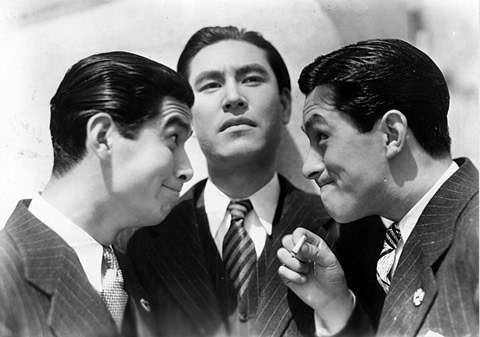
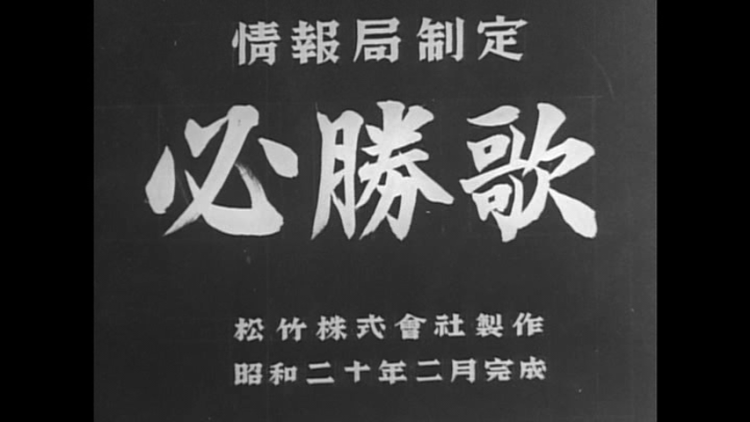 Completed in 1945, Victory Song (必勝歌, Hisshoka) is a strangely optimistic title for this full on propaganda effort intended to show how ordinary people were still working hard for the Emperor and refusing to read the writing on the wall. Like all propaganda films it is supposed to reinforce the views of the ruling regime, encourage conformity, and raise morale yet there are also tiny background hints of ongoing suffering which must be endured. Composed of 13 parts, Victory Song pictures the lives of ordinary people from all walks of life though all, of course, in some way connected with the military or the war effort more generally. Seven directors worked on the film – Masahiro Makino, Kenji Mizoguchi, Hiroshi Shimizu, Tomotaka Tasaka, Tatsuo Osone, Koichi Takagi, and Tetsuo Ichikawa, and it appears to have been a speedy production, made for little money though starring some of the studio’s biggest stars in smallish roles.
 Japan’s political climate had become difficult by 1938 with militarism in full swing. Young men were disappearing from their villages and being shipped off to war, and growing economic strife also saw young women sold into prostitution by their families. Cinema needed to be escapist and aspirational but it also needed to reflect the values of the ruling regime. Adapted from a novel by Katsutaro Kawaguchi, Aizen Katsura (愛染かつら) is an attempt to marry both of these aims whilst staying within the realm of the traditional romantic melodrama. The values are modern and even progressive, to a point, but most importantly they imply that there is always room for hope and that happy endings are always possible.
 Isn’t it sad that it’s always the kids that end up hurt when parents fight? Throughout Shimizu’s long career of child centric cinema, the one recurring motif is in the sheer pain of a child who suddenly finds the other kids won’t play with him anymore even though he doesn’t think he’s done anything wrong. Four Seasons of Children (子どもの四季, Kodomo no Shiki) is actually a kind of companion piece to
 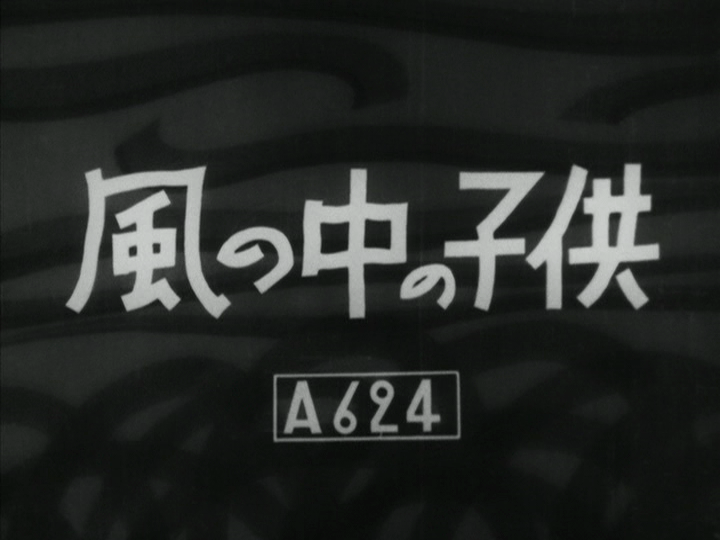 It would be a mistake to say that Hiroshi Shimizu made “children’s films” in that his work is not particularly intended for younger audiences though it often takes their point of view. This is certainly true of one of his most well known pieces, Children in the Wind (風の中の子供, Kaze no Naka no Kodomo), which is told entirely from the perspective of the two young boys who suddenly find themselves thrown into an entirely different world when their father is framed for embezzlement and arrested. Encompassing Shimizu’s constant themes of injustice, compassion and resilience, Children in the Wind is one of his kindest films, if perhaps one of his lightest.
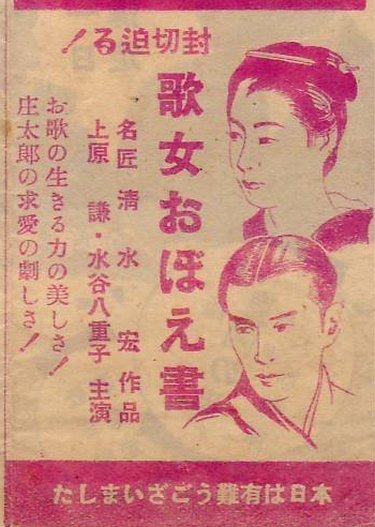 Filmed in 1941, Notes of an Itinerant Performer (歌女おぼえ書, Utajo Oboegaki ) is among the least politicised of Shimizu’s output though its odd, domestic violence fuelled, finally romantic resolution points to a hardening of his otherwise progressive social ideals. Neatly avoiding contemporary issues by setting his tale in 1901 at the mid-point of the Meiji era as Japanese society was caught in a transitionary phase, Shimizu similarly casts his heroine adrift as she decides to make a break with the hand fate dealt her and try her luck in a more “civilised” world.
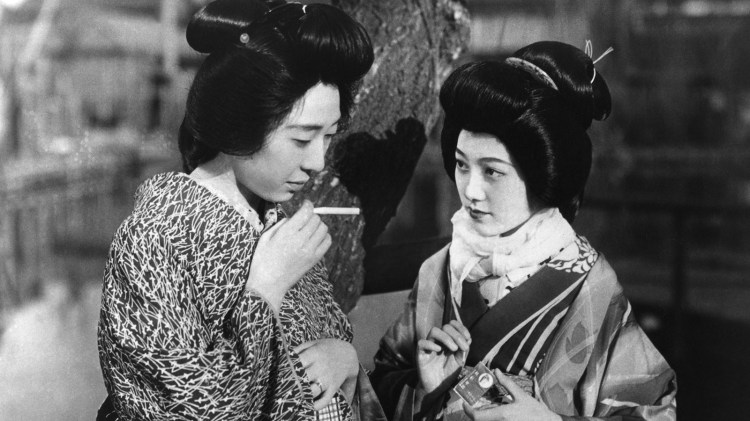 Naruse’s critical breakthrough came in 1933 with the intriguingly titled Apart From You (君と別れて, Kimi to Wakarete) which made it into the top ten list of the prestigious film magazine Kinema Junpo at the end of the year. The themes are undoubtedly familiar and would come dominate much of Naruse’s later output as he sets out to detail the lives of two ordinary geisha and their struggles with their often unpleasant line of work, society at large, and with their own families.
