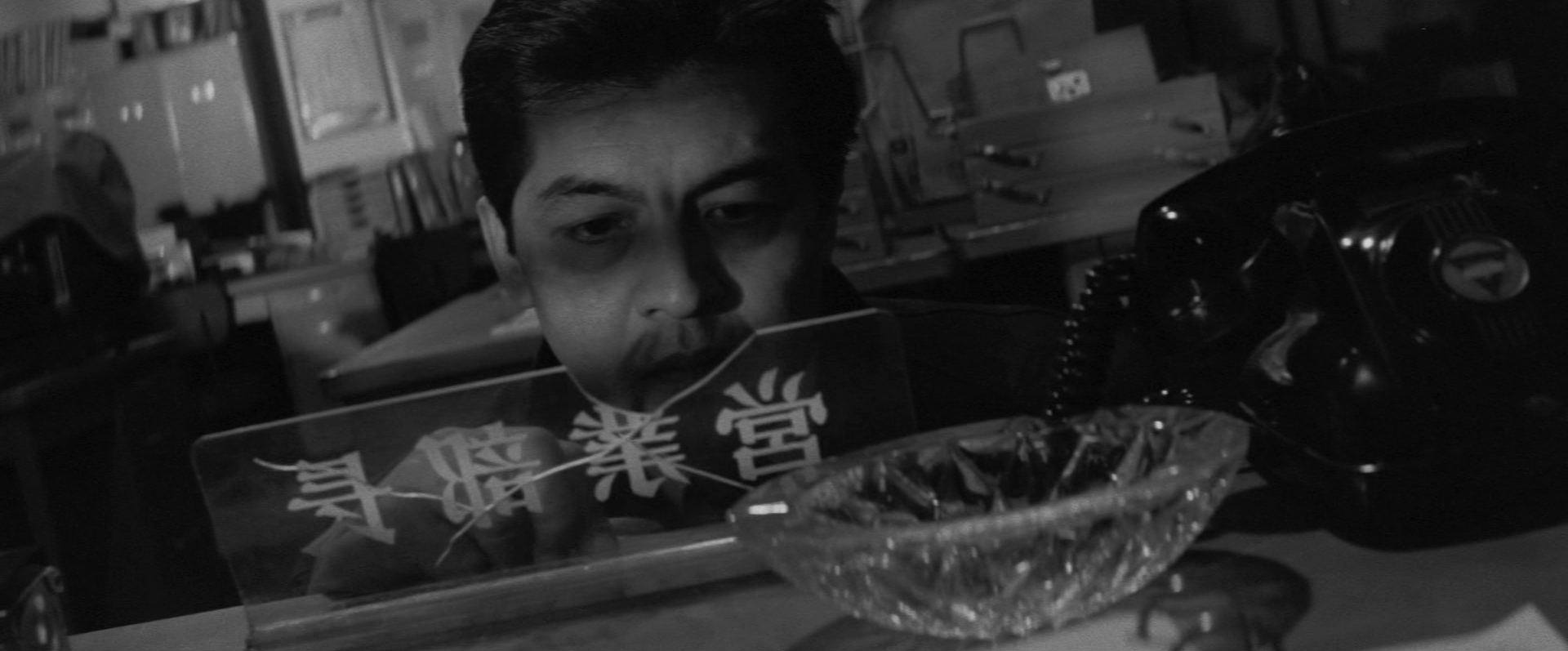
Husband and Wife (夫婦, Mikio Naruse, 1953)

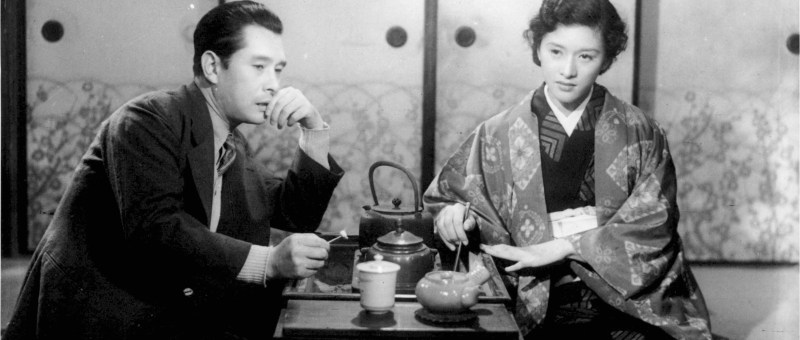
Kikuko (Yoko Sugi) climbs the stairs to the roof of a department store and pauses at the top looking down on her friends below, but they appear to be looking down on her. They’re disappointed. She looks so “provincial”, even though she has no children and therefore more time to spend on herself. They’re envious of her “freedom” to return home late while they have to get back to their husbands or in-laws, but Kikuno isn’t really free at all while trapped in a stifling marriage to the incredibly dull and petulant Isaku (Ken Uehara). 

One of a series of films about marriage and originally envisaged as a sequel to Repast until Setsuko Hara fell ill, Husband and Wife (夫婦, Fufu) paints a rather bleak picture of married life even by Naruse’s standards. The couple are quite literally but also spiritually “homeless” in that they cannot find a home to share, while the absence of a domestic space to call their own prevents them from solidifying their marriage. They’re pushed out of Kikuko’s parents’ home because her brother’s getting married and they need the space, but Isaku drags his feet over finding somewhere else and leaves much of the legwork to Kikuko alone. The main problem seems to be that Isaku can’t afford anything decent, which places a strain on his male pride, but in a repeated motif, rather than confront the situation, he ignores it completely and then crassly presses his recently widowed colleague to let them rent a room in his now much emptier house. 

It’s a mystery why Isaku has so many financial problems when he and Takemura (Rentaro Mikuni) work for the same company, save that Isaku had evidently spent some time working in the provinces, and his colleague had already bought a home with no apparent money worries, but it further sets the two men apart and fuels Isaku’s sense of inadequacy. Having returned from a leave of absence following his wife’s death, Takemura is grief-stricken and apparently uxorious. He complains that he’ll never find another woman like his late wife, all while Isaku won’t shut up about the house and others relentlessly encourage him to remarry. Nevertheless, after the couple move in with him, a natural connection arises between Kikuko and Takemura who is Isaku’s total opposite, both in his treatment of Kikuko and general personality. Where Isaku is sullen and resentful, Takemura is cheerful despite his grief and generous of spirit. Kikuko effectively becomes a wife to both men, taking care of each of them by cooking and cleaning, but while Takemura goes out of his way to thank her, all Isaku does is run her down and humiliate her in front of company.

Then again, having fallen in love with Kikuko precisely because she is a “proper wife,” Takemura then runs his own late wife down by complaining that she wasn’t very pretty and couldn’t cook. The only thing she had going for her was her health, and then she died. He says got a bum deal, and that Kikuko has shown him a different side of womanhood. When two colleagues come to the house and compliment Kikuko’s cooking but are surprised when she eats nothing herself (because they have no money), Isaku responds to their assertion that it’s difficult to be a housewife by replying that men work hard all day while women “only” have to look after the house. For her part, Kikuko says that she was happier when she was working. Men can fall in love several times, but once a woman’s married her romantic life is over. As her friend tells her, men soon get bored of their wives and hers has already taken a mistress at work. 

At several points and with the women in earshot, the men warn each other about the pitfalls of marriage. Irritated that Kikuko has returned to their home on New Year’s Eve after becoming fed up with Isaku, her father advises her brother that women show their true faces after six or seven years and it’s going to horrify him. Isaku tells him not to be too nice or obedient during the early days because his wife will get used to it, while Kikuko counters that men are overgrown children and as long as you make sure to cradle them like babies everything will be fine. Neither of them seem to have a very positive idea of what marriage should be and frame it almost in terms of a war in which they are continually at odds with each other. Isaku describes a husband and wife as a pair of scissors, intending it as a positive metaphor about how one half can’t cut alone, before reframing it as two knives coming together. He becomes unpleasant and chauvinistic, blaming Kikuko for everything by complaining that it’s her fault that he wears a torn up old coat that causes him some embarrassment in front of his boss and a tactless geisha, while criticising her for not having the bath ready when he comes home tired from working all day. Kikuko points out that men seem to assume they’re the only ones who get tired while her loved up brother swears he’ll be different and even if they’re in the honeymoon phase, they do seem much happier and more suited than the already resentful Kikuko and Isaku.

It’s the sister-in-law who throws them a lifeline by introducing them to a relative looking to rent a vacant room, allowing them a means to save their marriage by leaving Takemura’s house. Increasingly resentful of the growing attachment between Kikuko and Takemura, Isaku starts avoiding coming home and hanging out with a young woman at the office with, at least, the danger of a burgeoning affair for which he’s taken to task by Takemura. As Takemura says, it’s not much of a marriage if Isaku can’t trust his wife while Kikuko is eventually so sick of the cold shoulder and constant denigration that she considers leaving him. The new apartment finally gives them a domestic space they can call their own, but it comes with the caveat. The landlady doesn’t allow children because the tenant next door is an ikebana teacher who demands peace and quiet, but Kikuko is in fact already pregnant which might present another means of saving their marriage by becoming a family but Isaku immediately rejects it. He complains he doesn’t have any more money to move again and tells Kikuko to get an abortion, strong-arming her when she refuses. Kikuko can’t go through with it and the nicest thing Isaku says to her in the entire picture is that they can go home, he’s giving in and will raise the child even if it’s difficult. But even this bittersweet moment seems more like condemning them to marriage rather than repairing their relationship with Isaku only grudgingly accepting, most likely because he realises that his marriage is dead anyway if he forces Kikuko to give up their child against her wishes. Despite the changing season, the air between them remains frosty, and marriage is exposed for the prison that it is trapping each of them in loneliness and resentment rather than bringing them together in joy as they prepare to become a family rather than just husband and wife.


Husband and Wife  screened at Japan Society New York as part of Mikio Naruse: The World Betrays Us – Part I.
My Wonderful Yellow Car (吹けよ春風, Senkichi Taniguchi, 1953)

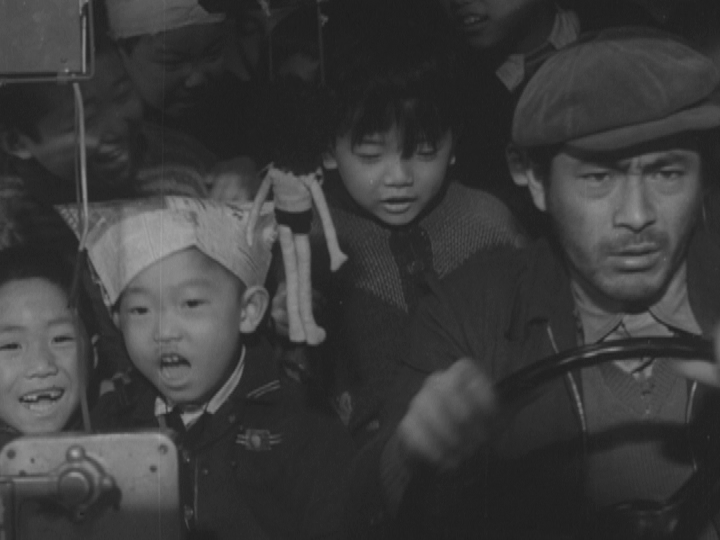
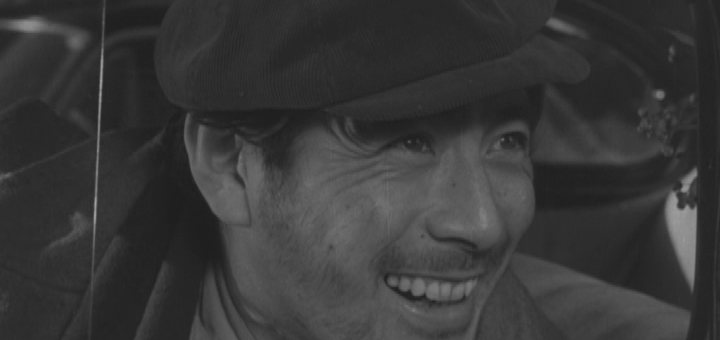
A kind-hearted taxi driver becomes our guide to the post-war society in a cheerful omnibus movie co-scripted by Akira Kurosawa and directed by Senkichi Taniguchi, My Wonderful Yellow Car (吹けよ春風, Fukeyo, Haru Kaze). Inspired by a Reader’s Digest column titled “human nature as seen in the rearview mirror”, the film follows cheerful cabbie Matsumura (Toshiro Mifune) as he drives around Tokyo in 1953 picking up various fares and sometimes adding commentary or trying to help with whatever kind of problem seems to be bothering them.

Then again, he stays well out of the first fare’s business as a young couple have obviously had some kind of falling out. Bursting into tears, the girl (Mariko Okada) announces that she wants to postpone the wedding and maybe even rethink this whole thing, while the boy reiterates with slight irritation that he’s said he’s sorry with the implication that that should be the end of it though we have no idea what (if anything) he’s actually done. In any case, they eventually patch things up over some canoodling in the back seat and ask to be dropped off so they can get something to eat. In some ways, the young couple represent a more hopeful vision of post-war youth who have no apparent worries besides their tiff and are financially comfortably enough not only to be getting married but can afford to travel by taxi and pay for a meal on the same occasion. 

Their situation is later contrasted with that of an older couple who’ve moved from Osaka to Tokyo in their old age and have bought a box of live lobsters to celebrate their silver wedding anniversary but as Matsumura notes though they appear to be quite well off they also seem somehow sad. That turns out to be because they lost their only son the previous summer and have moved into his old apartment. The old lady also cries in the back seat, but for a completely different reason. As they’ve only just moved here, they don’t have friends or anything to do and are completely lost in the wake of their son’s death. Matsumura’s kindness is demonstrated when he borrows three flowers from a bouquet delivered to a girl at the petrol station and presents them as an anniversary gift. The couple are so touched they invite him to enjoy their anniversary dinner with them and by the end of it have made the decision that they should go back to Osaka and restart their lives by re-opening their old business.

Throughout all this, Matsumura is very conscious of the meter. Every second he spent in the old couple’s apartment cost him money, but as he’s fond of saying you can’t always think of things like that. Even so, he reminds himself he has a wife and child so should be mindful of the clock but still turns down a fare to go back to the station and check on a young girl he’s pretty sure is trying to run away from home. A weird guy was sniffing around her and was in fact just about to lead her off when Matsumura gets back and announces he’s come to pick her up. Matsumura spends the rest of the ride trying to convince her to go home, repeatedly reminding her that most of the “panpans”, or streetwalking sex workers catering to US servicemen, were also once runaway girls. To more modern eyes we might wonder if sending her home is what’s best without knowing the reasons she wanted to leave. He goes so far as to buy her ramen which costs him more money on top of the lost fare which doesn’t collect from her either when he, a little less responsibly, abandons her when she refuses to tell him where she lives. Thankfully, it all seems to work out. The girl made a sensible decision to go home after all and is later seen happily doing her Christmas shopping with her mother who also thanks him for looking out for her.

Perhaps these kinds of altruistic acts of kindness explain why Matsumura’s own clothes are quite ragged with a hole in his jumper and a tear to the shoulder of his jacket. He’s driving the cab in straw sandals which apart from anything else is probably quite cold in the winter. He spends another afternoon giving a free ride to some children, about 15 of them, who’ve crowdfunded 100 yen because they’ve never been in a car before and want to go as far it’ll take them having no idea that 100 yen is actually the initial charge so you can’t go anywhere on it all. Of course, Matsumura ends up taking them a bit further, and then realises he’ll have to take them back to where they were because they won’t have any other way of getting there or of knowing where they are now.

On the other hand, sometimes he ends up with nuisance fares such as two drunk guys who keep singing their university song. One of them even climbs out of the window and up onto the roof, causing Matsumura to assume he’s fallen off somewhere and he’ll have to go back and look for him to make sure he’s not hurt only to find him burbling in the footwell. He also ends up getting hijacked by a crook with a gun on his way back from Yokohama but getting a telling off from the police rather than a thank you for catching him after unwisely taking hold of the gun himself and messing up all the fingerprints. 

One might think the time he had a famous actress in the back of his cab who even sang along with the jingle he’d written for the cheerful yellow vehicle might make up for all that, but he says the story that best exemplifies why he loves driving a taxi is that of a middle-aged couple he picked up at the harbour shortly after a boat had docked repatriating people from China. Even in 1953, some had not yet returned after becoming trapped by the Chinese Civil War and eventual Communist victory. The man is dressed in military uniform and says he’s just been demobbed when Matsumura asks him, trying to lighten the mood while there’s obviously some degree of tension between the man and his wife. But as we gradually come to understand, it’s all just a ruse and he has in fact been in prison in Japan for the last seven years for an unspecified crime.

His wife asks Matsumura to drive around the city and attempts to show him how much things have recovered, suggesting that they can now put the past behind them and start over. But the man remains sullen and grumpy. He’s afraid to go home, afraid to face the neighbours worrying if they know what he did and that he’s been in prison. But most of all he’s afraid to face his children, the youngest of which he’s never met. The kids have been teaching themselves to say “Welcome home, Daddy,” in Mandarin believing he’s been in China all this time which the wife has to explain before they get there. The man tells his wife he understands if she doesn’t want him back, but she assures him that the children are excited as is she to start their new life together. Nevertheless, though they’ve been eagerly practicing, the older two children simply freeze when confronted by this anxious stranger who turns around to leave again feeling as if he doesn’t have the right to come back here after all only for the youngest one to suddenly pipe up with the phrase note perfect. It’s this kind of scene, getting people to where they need to be physically and emotionally, that seems to make Matsumura’s job worthwhile. In essence, he’s ferrying people towards the cheerful post-war future his cute yellow cab represents while driving round the rapidly changing city wondering who it is that’s going to end up in the rearview mirror today.


Title song (no subtitles)

Luminous Moss (ひかりごけ, Kei Kumai, 1992)

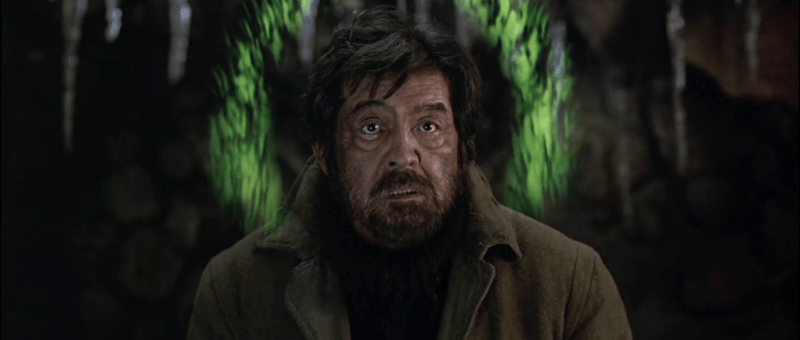
At the end of the increasing surreal trial which concludes the play within a play in Kei Kumai’s Luminous Moss (ひかりごけ, Hikarigoke), the protagonist turns to the people of the court and asks them to look at him. He wants to know if they see the ring of light around his head that looks like the luminescent plants inside the cave where he spent three months or so after being shipwrecked in the middle of the war. His plea is as much to ask what would you have done and if we can ever really judge him when we ourselves have never been faced with his dilemma.

It is however a dilemma many were faced with, and one tacitly suggested in other earlier films such as Kon Ichikawa’s Fires on the Plain though at that point too taboo and painful to address openly. In the framing sequence which bookends the film, an author visits a town in Northern Hokkaido in search of inspiration and is guided to a cave, now reachable by a roadway built after the war, where luminous moss grows. The man who takes him, a headmaster (Rentaro Mikuni), also tells him of an incident which took place there in which four shipwrecked men swam to shore and took refuge within the cave. Only the captain (also played by Rentaro Mikuni) survived, making a perilous trek across the ice a few months later when his food source depleted and he was left with no other choice.

The middle of the film is presented as a flashback, but actually the play the author is writing based on the investigations of the headmaster who says that he increasingly came to sympathise with the captain because of his own experiences as a prisoner of war in Siberia. Hachizo (Kunie Tanaka), a middle-aged father to a large family who refuses to eat the corpse of the first man to die, Gosuke (Tetta Sugimoto), because he promised him he wouldn’t, describes the captain as a “resourceful man” in both positive and negative senses of the word. He assumes the captain is already calculating when the current supply will run out, and when his own body will have consumed, leaving him with a dilemma about what to do next. The captain is in no real doubt about the necessity of eating Gosuke’s flesh and feels no guilt about it, after all he died of natural causes after consuming seawater and is now, in the captain’s view, simply meat so not eating him is just a pointless waste. Perhaps the situation would be different if he had killed him deliberately in order to eat him, but on the other hand it would not really be advantageous to do so given that the captain’s end goal is surviving until the end of the winter when it will be possible to return to the mainland. Thus he waits for his men to die and leaves the rest up to fate. 

The situation only comes to light when a wooden box is washed to shore containing the bones of Private Nishikawa (Eiji Okuda), whom the captain did actually kill but accidentally while he was trying to commit suicide so that the captain would not be able to eat him. Nishikawa is originally a thorn in the side to the stranded men, a brainwashed militarist who insists they must survive out of loyalty to the emperor. He refuses to eat Gosuke’s corpse on moral grounds, but is eventually unable to resist unconsoled by Hachizo’s well-meaning advice that he should tell himself he did it for the emperor. Knowing that he did it solely for his own survival shatters his illusions of himself as a loyal subject and fractures his sense of identity. He cannot live with himself having eaten human flesh, while as the captain says those who were going to die were always going to while those who must survive must to everything to do so. 

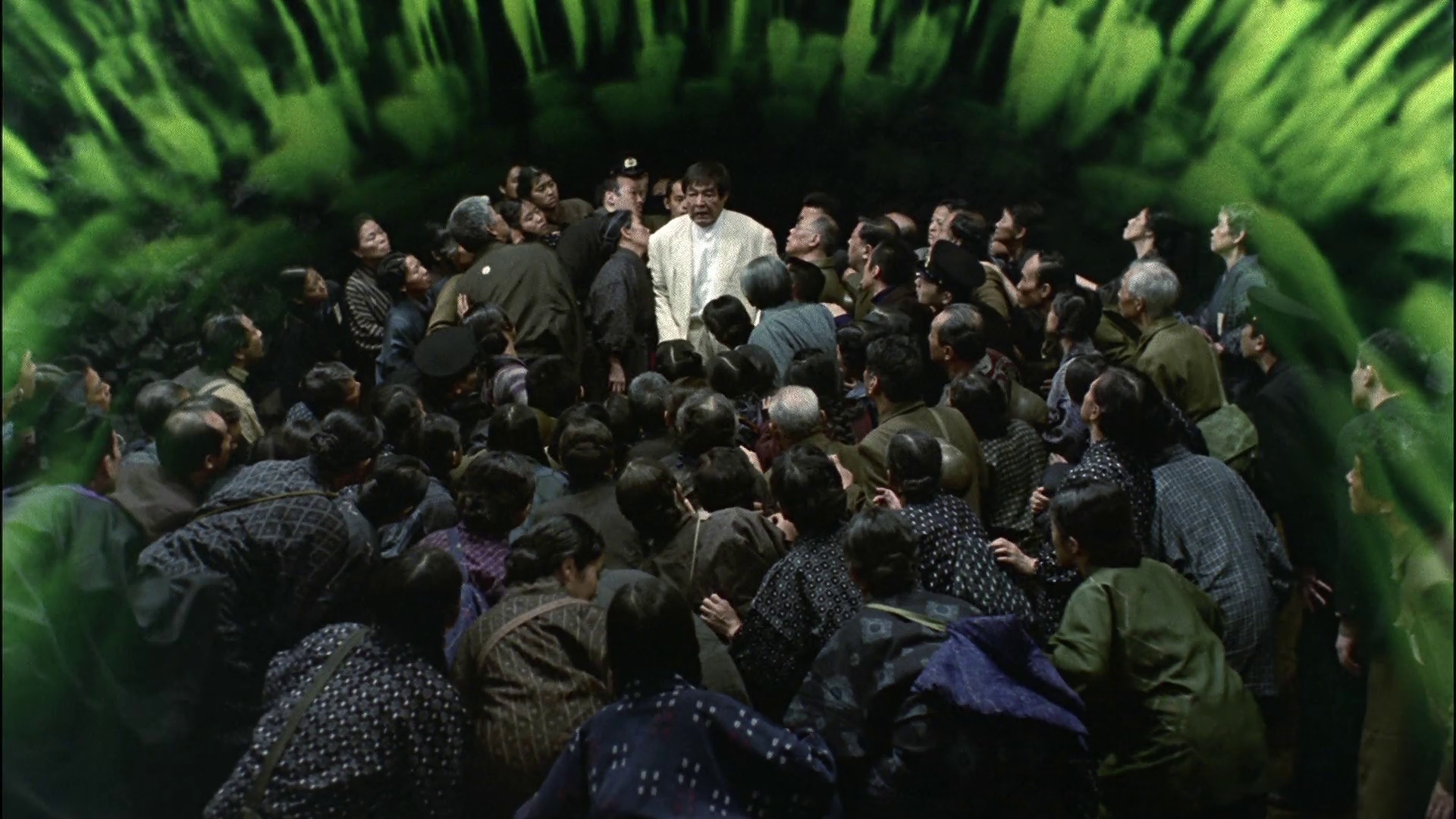
Thus at his trial, in which he appears to have lost his mind, he stresses that though he does not object to the legal process or its consequences he will not feel himself to have been judged by the prosecutor (Hisashi Igawa) as he has never eaten human flesh nor had his own flesh eaten. While in the cave, Hachizo had claimed to see a glowing ring around Nishikawa’s face which he attributed to a folk belief that such a ring resembling the green glow of luminescent moss was a signifier of his guilt visible only from a certain angle and for a short time only to those who look for it. It’s this ring that captain asks others to look for at his trial, to show him the signifier of his own guilt so that he may himself accept it. But then he may actually have a point that those who have never experienced what he has experienced are incapable of judging him. At the critical moment, the trial is interrupted by an air raid, there after becoming increasingly surreal as the location is shifted back to the cave as if it were all taking place within the captain’s mind. 

The prosecutor tries to attack him for attempting to blame it all on nation and society, suggesting that his actions have disgraced all of Japan and brought shame on the emperor about whom the captain makes an inappropriate remark suggesting that the emperor too is human and merely “enduring” his circumstances. Pressed to explain himself, the captain only says that he is “enduring” many things and that during his time in the cave he simply “endured”, doing what seemed to him the only thing he could do. The prosector points out that Hachizo refused and chose death, while Nishikawa attempted suicide to atone for his actions, asking what right the captain had choose survival but the only ones who can really judge him the three men he cannibalised each of whom appear as (almost) silent ghosts whose judgement cannot be interpreted. 

Though the film is not as visually striking as others in Kumai’s earlier career, he succeeds in conjuring a sense of primeval eeriness in the swirling mists and oddly shaped icicles of the cave while avoiding any sense of gore in the act of cannibalism itself which might otherwise unbalance the ethical dimensions he wishes to address. In the closing sequence, both the writer and the headmaster are positioned behind the bars which now protect the moss as if this kind of primal impulse could really be restrained or tempered by our civility. After the death of Gosuke and given the objections of the other two men, the captain suggests waiting a day or two to see how long their “human feelings” could hold in the face of their survival, the answer perhaps being less than you’d hope and about as long as you’d expect.


The Last Dance (大病人, Juzo Itami, 1993)

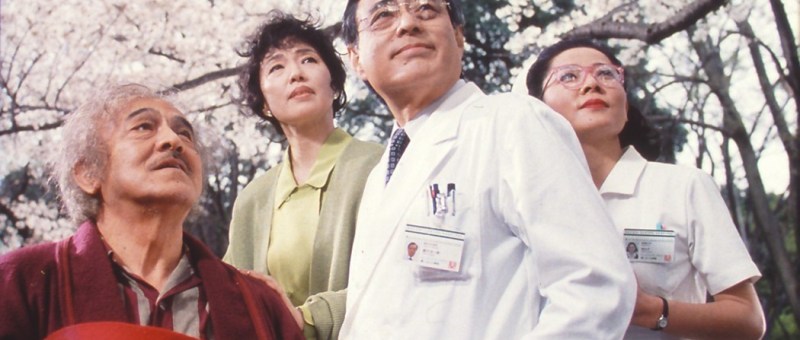
A self-involved film director gets a lesson in what it is to live when he discovers that he has terminal cancer in a lighthearted melodrama from Juzo Itami, The Last Dance (大病人, Daibyonin). Itami was apparently inspired by his own stay in hospital after being attacked by yakuza offended by his previous film Minbo and like his debut The Funeral the film has a few questions to ask about the nature of death along with the functioning of the medical system. 

That’s partly because film director Buhei Mukai (Rentaro Mikuni) is not initially told of his diagnosis. His well-meaning doctor, Ogata (Masahiko Tsugawa) a old university friend of his wife, elects to tell him only that he has a stomach ulcer in keeping with an old-fashioned policy that worries patients may lose hope and give up too easily on discovering the extent of their illness. Buhei meanwhile continues to obsess about his condition, convinced it must be cancer and that his wife, Mariko (Nobuko Miyamoto), and the medical staff are lying to him, at one point pretending to be his own uncle in order to tease the truth out of Ogata over the phone and attempting suicide when he accidentally implies that Buhei may not have long left. 

His distress is compounded by the irony that in the film he was working on when he became ill he was starring as a composer with advanced cancer whose wife has also been diagnosed with a more aggressive form of the disease. Whatever we might think about Buhei, it’s fair to say that the film’s sexual politics have not aged well. Not only was he having an affair with the actress playing his wife, but continues to flirt inappropriately with the medical staff and at one point even tries to force himself on his wife who was in the process of leaving him when he was first diagnosed. His lechery seems primed to appeal to men of a similar age while hinting at his virility and desire for life, but is nevertheless crass and often uncomfortable. Nevertheless, as Mariko says he’s like a child inside cheekily joking with the doctors about his drinking and smoking habits while running away from anything unpleasant and trying to get out of having to undergo treatment. 

Itami had often remarked on the weaknesses of Japanese men who “can’t stand loneliness, can’t make decisions alone, can’t face anyone who disagrees with them and can’t accept responsibility for their mistakes,” Buhei seemingly possessing all four. In part regretting her decision to keep the seriousness of his illness from him, Mariko reflects that in the end all they did was leave Buhei alone in his fear and anxiety as the only one who didn’t know the truth, engineering a kind of conspiracy as they cheerfully told him to “soldier on” knowing there was no hope. Yet during his time in the hospital, Buhei is also confronted by the ethical dilemmas of medical treatment on witnessing doctors desperately try to resuscitate a man who was miserable, in pain, bedridden, and unable to communicate, just waiting for the end. As even his grieving wife calls out to the doctors to let him go, Buhei wonders if it’s right to preserve life at all costs especially when the patient has not been given a choice in his treatment and may not have been informed that they have no possibility of recovery. 

Coming to a new realisation he challenges Ogata’s conviction that death is his enemy, telling him that he should see it less as defeat than acceptance reflecting on the irony that he never felt so alive as when dying. Whimsical if occasionally maudlin, Itami throws in a surrealist dream sequence in which Buhei approaches the other side and comes to realise that death might not be so frightening after all even as he watches himself from above in an out of body experience witnessing the accidental violence inflicted on his body by those trying to save it. In some senses, Buhei is fairly unredeemed, winking at his indifferent mistress even on his death bed, but is in others humbled as he looks back on his life with its regrets and unfulfilled promises, repairing his relationship with his long suffering wife while admitting that under different circumstances he and Ogata might have become good friends. Offering a sometimes critical view of medical practice and ethics, Itami’s poetic meditation on what it is to die loses none of his ironic humour even in its unfolding tragedy. 


The Eagle and the Hawk (鷲と鷹, Umetsugu Inoue, 1957)

Strapping sailors meditate on revenge and forgiveness while trapped aboard a moribund cargo ship in Umetsugu Inoue’s otherwise charming musical youth drama, The Eagle and the Hawk (鷲と鷹, Washi to Taka). One of several films Inoue released starring muse of the moment Ishihara, the film uses the boat as a kind of metaphor for a reluctance to deal with the unfinished past as several of its crew members are actively engaged in a self-imposed limbo wilfully remaining in a transient space floating between two harbours with no plans to disembark. 

This is most obviously true for the zombified Ken (Kinshiro Matsumoto) who wanders around the boat in a depressive daze unable to get over a girlfriend who left him for another man though as it turns out the bosun too is hiding out at sea waiting for the statue of limitations to run out on the murder of his lover 30 years previously. When two new recruits show up from the sailors union despite only one having been requested, many are under the assumption that they too are running from something on land though the boat itself is a confined environment from which there is no real escape so it’s also an ideal space for confrontation. 

The thing they may be running from is the murder of the boat’s chief engineer in the film’s noirish opening sequence in which a middle-aged man in a sailor’s cap is stalked by a youngster in jeans before being knifed with a ceremonial dagger. If they were running from that particular crime, it might be ironic that they chose this particular boat but then as the murdered man’s son, First Mate Goro (Hiroyuki Nagato), discovers the dagger was part of a set and the other one’s owned by the captain who seems very alarmed by the whole affair. Meanwhile, the captain’s daughter, Akiko (Ruriko Asaoka), has secretly stowed away along with Akemi (Yumeji Tsukioka), the heartbroken former girlfriend of one of the two new guys, Senkichi (Yujiro Ishihara). 

Women are regarded as unlucky on board, and it’s not difficult to guess why with Goro offering strict instructions to the new guys not to try anything with Akiko while one of the other sailors later attempts to rape Akemi with a palpable desperation existing within the crew. There is also a degree of homoerotic tension between the two new guys, the other being Sasaki (Rentaro Mikuni) who typically walks around shirtless in a pair of tight jeans and works hard to give the impression of having a mysterious past all of which leads Senkichi to suspect he’s an undercover cop possibly there after him or one of the other crew members though unbeknownst to (almost) everyone there is another crime in motion on board. 

As usual, it’s the past that’s come calling with Senkichi on the boat ironically running towards rather than away from a confrontation while others desperately try to cover up their crimes or deflect their responsibility for the dodgy dealings of their youth. Both Senkichi and Sasaki immediately remark that the boat’s a “junker” as soon as they get on board, implying that it too is on its way out, its disrepair a sign of its captain’s lack of respect and care for ship and crew alike. Then again, it seems the crew were intent on drinking half the cargo, most of them clearly happy in their work and enjoying a pleasant sense of camaraderie even on this crummy ship and its presumably not quite above board trip to Hong Kong which might hint at why Akemi shows up in cheongsam though for stowaways both women seem to have brought extensive wardrobes which in all honesty are not particularly well suited to life at sea. 

In any case, the boat becomes an unexpected place of healing and forgiveness largely brokered by manly magnanimity as Goro, on learning the truth behind his father’s murder, accepts that the killer’s motivations are “understandable” even while cautioning them against the fallacy of revenge which he insists will only create more hate and violence. He’s also fairly okay with Senkichi romancing his girl, Akiko, who sadly tells him she sees him more like a brother and isn’t interested in marrying him even if that’s what her father also expects neatly reflecting the dynamic which arises between Akemi and the lovelorn Ken who begins to cheer up and consider leaving the boat to open a transistor radio shop only for Akemi to describe him as a little brother while continuing to chase Senkichi despite his interest in Akiko. An expressionistic storm scene provides some divine justice, but also provokes a bittersweet romantic resolution which suggests it’s time to get off the boat and the face the past but with a kind of cheerfulness for the future otherwise at odds with the rage and violence of the original crime. Of course, this being a vehicle for Yujiro Ishihara, Inoue works in a few romantic scenes with his ukulele and a mournful song about the moon and ocean but finally sends him back to dry land a little more “grounded” for having found his sea legs.


The Threat (脅迫, Kinji Fukasaku, 1966)

An ambitious executive is confronted with the emasculating nature of the salaryman dream when escaped convicts invade his home in an early thriller from Kinji Fukasaku, The Threat (脅迫, Odoshi). The threat in this case is to his family and implicitly his manhood in his ability or otherwise to protect them while accepting that his aspirational life has come at the expense of his integrity and left him, ironically, hostage to the whims of his superiors.

This much is obvious from the opening sequence which takes place at a wedding where Misawa (Rentaro Mikuni) is giving a speech congratulating two employees on their marriage. Misawa’s speech is long and boring, as such speeches tend to be, and according to some of the other guests disingenuous in giving glowing reports of two ordinary office workers while skirting around the elephant in the room which is that Misawa has played matchmaker to convince an ambitious junior to marry his boss’ mistress for appearance’s sake. As Misawa himself has done, the employee has sacrificed a vision of masculinity for professional gain in accepting that his wife’s body will “belong” to another man and it is the boss who will continue sleeping with her. 

The only person not aware what’s going on is Misawa’s naive wife, Hiroko (Masumi Harukawa), who enjoyed the wedding and remarked that the couple seemed very well suited giving rise to an ironic laugh from Misawa who of course knows that not to be the case. They return by car to a nice-looking home but one that stands alone at the end of a street preceded by a series of vacant lots presumably available to other similarly aspirant salarymen yet to make a purchase. Shortly after they arrive, two men force their way in and insist on staying explaining that they are the pair of escaped death row convicts that have been in the papers and are in fact in the middle of a kidnapping having taken the grandson of a prominent doctor with the intention of using the ransom money to illicitly board a ship and leave the country. 

Naked and covered in soap suds having been caught in the bath, Misawa is fairly powerless to resist and can only hope to appease the men hoping they will leave when their business is done. His acquiescence lowers his estimation in the eyes of his young son, Masao (Pepe Hozumi), who later calls him a coward and is forever doing things to annoy the kidnappers such as attempting to raise the alarm with visitors by smashing a glass or speaking out against them while Misawa vacillates between going along with the kidnapper’s demands or defying them to contact the police. After failing to retrieve the money when ordered to act as the bag man, Misawa stays out trying to find another way to get the cash and Masao wonders if he’ll come back or will in fact abandon them and seek safety on his own. Misawa really is tempted, darting onto a train out of the city his eyes flitting between the sorry scene of a small boy with a tearstained face tugging the sleeves of his father who seems to have fallen down drunk on the station steps, and a woman across from him breastfeeding an infant. He gets off the train only at the last minute as it begins to leave the station as if suddenly remembering his role as a father and a husband and deciding to make a stand to reclaim his patriarchal masculinity. 

The brainier of the kidnappers, Kawanishi (Ko Nishimura), had described Misawa as a like robot, idly playing with Masao’s scalextrics insisting that he could only follow the path they were laying down for him much as he’d already been railroaded by the salaryman dream. During a car ride Kawanishi had asked Misawa what he’d done in the war. Misawa replied that he was in the army, but had not killed anyone. Kawanishi jokes that he’d probably never raped a woman either, but to that Misawa gives no answer. Realising that the other kidnapper, Sabu (Hideo Murota), had tried to rape Hiroko he turns his anger towards her rather than the kidnappers striking her across the face and later raping her himself avenging his wounded masculinity on the body his of wife while unable to stand up to either of the other men. 

Kawanishi giggles and describes him as exactly the kind of man he assumed him to be but he’s both wrong and right. Misawa had been spineless, insecure in the masculinity he largely defined through corporate success though as Kawanishi points out most of what’s in the house is likely being paid for in instalments meaning that technically none of it’s actually his. He defined his position as a father as that of a provider, ensuring a comfortable life his wife and son rather than placing importance on his ability to protect them physically from the more rarefied threats of the contemporary society such as crime and violence. On leaving the train, another symbol of the path laid down for him both by the salaryman existence and by Kawanishi, he is able to reclaim a more primal side of his manhood in formulating a plan of resistance to lure the kidnappers away from his wife and son. 

But then in another sense, it’s Hiroko who is the most defiant often telling the kidnappers exactly what she thinks of them while taking care of the kidnapped baby and doing what she can to mitigate this awful and impossible situation in light of her husband’s ineffectuality and possible disregard. She is the one who finally tells Kawanishi that she no longer cares if he kills her but she refuses bow to his authority and he no longer has any control over her. Even so, the film’s conclusion is founded on Misawa’s reacceptance of his paternity in a literal embrace of his son, redefining his vision of masculinity as seen through the prism of that he wishes to convey to Masao as an image of proper manhood. Fukasaku sets Misawa adrift in a confusing city lit by corporatising neon in which the spectre of the Mitsubishi building seems to haunt him amid the urgent montage and tilting angles of the director’s signature style still in the process of refinement as Misawa contemplates how to negotiate the return of his own kidnapped family from the clutches of a consumerist society. 


Wind, Woman and Road (風と女と旅鴉, Tai Kato, 1958)

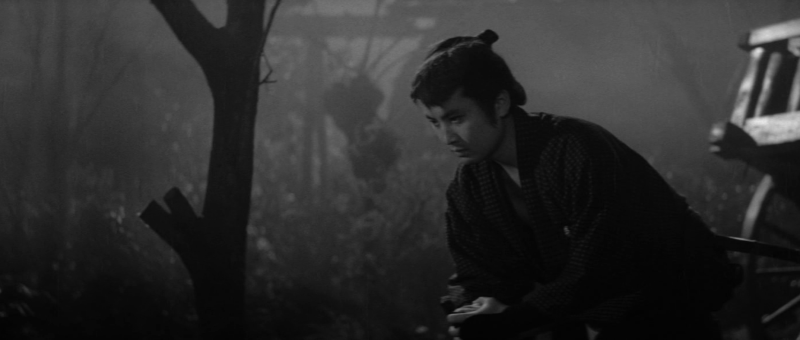
Tai Kato joined Toei’s Kyoto studio in 1956 having made his directorial debut at the independent production house Takara Productions in 1951 shortly after being letting go from Daiei in 1950 during the Red Purge (he had been chief secretary for studio’s the labour union). Heavily influenced by and a great admirer of Daisuke Ito, Kato had a passion for chanbara and jidaigeki which were Toei’s mainstays at the time, but even while making what were essentially programme pictures his approach was anything but conventional. With 1958’s Wind, Woman, and Road (風と女と旅鴉, Kaze to Onna to Tabigarasu), Kato embarked on what would become a signature style of “realistic” period drama otherwise at odds with the formulaic nature of the genre. 

As he would continue to do, Kato instructed his cast not to wear makeup and while casting kabuki actor/chanbara megastar Kinnosuke Nakamura insisted on a more modern performance style than the sometimes mannered theatricality of the traditional samurai film. Ginji is cocksure young man living on the road after being kicked out of the hometown he is now travelling towards because of a crime supposedly committed by his long absent father. On the way, he runs into Sentaro (Rentaro Mikuni), a middle-aged man recently released from prison who is struck by his appearance and immediately asks how old he is realising that Ginji is about the same age as his own son who died as a result of a fight. 

The two begin walking together and Ginji tells Sentaro that his village sends gold to the governor around this time every year as a bribe to get lower taxes which doesn’t make a lot of economic sense but evidently works for them. Last year, the gold was stolen by notorious bandit Hanzo the Shark (Eitaro Shindo) and two villagers were killed during the robbery. Ginji half jokes about teaming up to steal it, and then playfully attacks Sentaro leading the entourage escorting this year’s payment to flee in terror leaving the gold behind. Sentaro encourages Ginji to take the money back to the village, but he is later shot by the returning villagers who think they must be Hanzo’s henchmen pulling the same stunt as last year. 

Unlike the typical chanbara hero, Ginji is petulant and resentful. He has a very modern way of speaking and is rebellious in character as you might well expect him to be given his life experiences. The other villagers are not happy to see him and continue tar him with his father’s brush, sure that the son of a thief can’t be any better while Ginji pines for his late mother claiming that the villagers’ harassment along with the inability to support herself economically led her to take her own life. Once a member of Hanzo’s gang he vacillates between a desire to be accepted by the village and that to take his revenge on it. Sentaro meanwhile is determined to save him, regretful that he could not save his own son from the life that he had led as a yazkuza and petty criminal. 

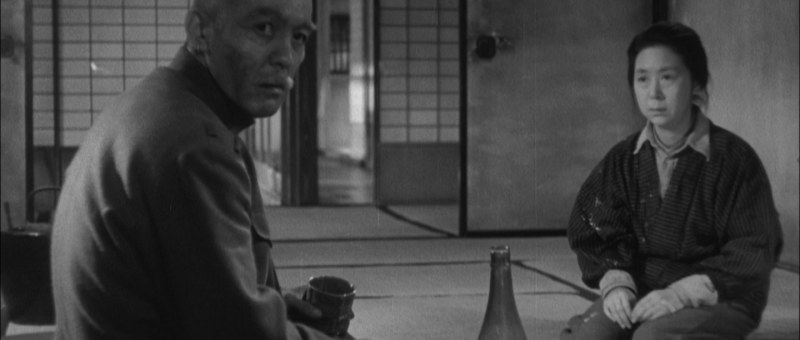
There is a persistent sense that everyone here is at heart a wanderer. The doctor’s daughter Ochika (Yumiko Hasegawa) who develops a fondness for both men relates that she was lured away from the village by an itinerant actor and fell into a life of ruin before returning to discover that her mother had passed away. The headman’s adopted daughter Oyuki (Satomi Oka) with whom Ginji falls in love tells him that she too is an orphan, her father was a medicine pedlar who dropped dead in the village which then took her in. Echoing a sense of rootlessness in the post-war world, they are all in someway displaced and looking to restore connections which have previously been broken but largely failing or unable to do so. Ginji is torn between his criminal past and the reformed future offered to him by the more positive paternal relationship he develops with Sentaro who, unlike his own father, is readily accepted by the village which is unaware that he previously spent time in prison. 

The final showdown takes place in a windswept clearing filled with Kato’s trademark mist as Ginji finally picks a side only to realise that that in the end he will always be a wanderer, a rootless figure whose only home is the road. Kato shoots a little higher than he would subsequently but still rests a little lower than the norm, emphasising a sense of destabilisation in Ginji’s volatility along with a painful longing that keeps him a lonely soul lost in the fog and on perpetual journey towards a long forgotten home. 


The Possessed (妖婆, Tadashi Imai, 1976)

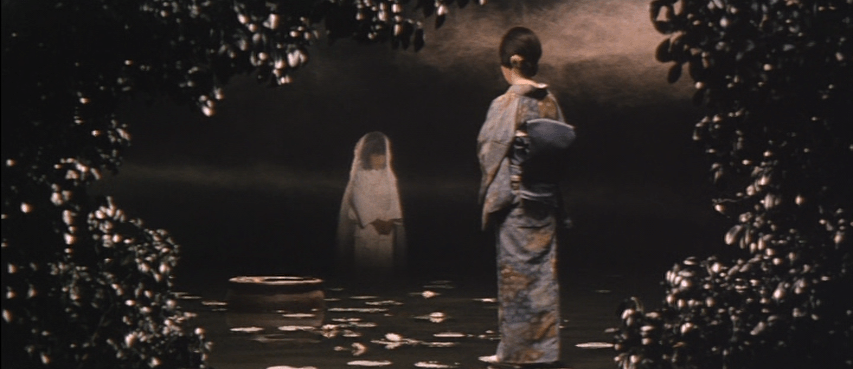
Shinto priests, black magic, and demonic possession. As the opening voiceover of Tadashi Imai’s The Possessed (妖婆, Yoba) remarks, you can hardly believe that such things could happen in the modern world alongside cars, trains, and telephones yet the tale we’re about to be told begins in 1919. Based on a story by Akutagawa, the film is however less a contemplation of ancient superstition amid rising modernity than the destructive patterns of class and patriarchy which conspire against the lives of two women who had once been good friends. 

In 1919, Shima (Machiko Kyo) marries Shinzo (Shinjiro Ehara) who has taken her name and become the presumptive heir of her family. Everyone at the wedding remarks on what a good catch he is, adding almost as an after thought that Shima seems happy about it too. The problem is that Shinzo is repeatedly unable to consummate the marriage. Part of this seems to be down to his wounded masculinity in having married into the family. He resents being under the thumb of his father-in-law along with the rumours that he only married Shima for her money even though this appears to be exactly what he has done. Perhaps further humiliated by his inability to perform, Shinzo tells Shima that it’s her fault because there is something wrong with her body that prevents him from becoming sufficiently aroused. Being a sheltered woman of the Taisho era, Shima wonders if her husband has a point and visits a doctor to find out but as expected he tells her there’s nothing at all wrong with her and it’s most likely Shinzo’s performance anxiety that is to blame. 

However, when her cousin Sawa’s (Kazuko Ineno) comb is found inside Shinzo’s kimono sleeve, the family begin to realise that the problem is he prefers her. He later admits as much and reveals that he’s planning to move closer to the family’s goldmine in Hokkaido and install Sawa in a house there as his common law wife with Shima left behind as a spouse of symbolic value. Shima has already felt herself haunted, but it’s at this point that the family brings in a Shinto priest who explains that Shinzo is possessed by an evil spirit though also giving the more rational advice that she should probably divorce him. Shima is forced to endure a strange ritual including purification by waterfall, but is also sexually assaulted by the randy priest though it it’s not completely clear that she fully realises what has happened to her. 

The implication is that the family treated Sawa as a kind of poor relation they trotted out to keep Shima company because she was an only child. Having grown resentful of Shima’s class privilege, Sawa’s jealousy manifested as covetousness that made her intent on taking whatever Shima had. She too later resorts to shamanistic black magic, fearful that Shima bears her a grudge for ruining her life and hoping to neuter any dark energy that she might be emanating in order to protect her teenage daughter Toshi (Miki Jinbo) who, ironically, has been betrothed to the son of a kimono shop named Shinzo (Taro Shigaki). 

Sawa never married and bore her child out of wedlock. She implies that she depended on men for financial support but never elaborates further. Shima, meanwhile, has been able to build an independent life for herself as a well-respected tailor. “It’s not normal for someone to suffer this much” a shamanically-inclined midwife later tells her when she too becomes pregnant out of wedlock but loses both the child and the man. The boot is perhaps on the other foot, Shima envies the life Sawa has with the one thing that will always be denied her, a child of her own. The midwife had once again told her that she was possessed, this time by the vengeful spirit of her lover’s daughter with his legal wife she fears may have been drowned deliberately by her mother out of jealousy. 

Shima is given a talisman of beads from the goddess of mercy, Kanon, and told that she can have what she wants if she prays hard enough, but Sawa is told the same thing and ends up going too far with the help of a shamaness praying to Basara Okami who later affirms that Sawa’s request comes with a price for the god wants Shima as a human sacrifice which is not really what Sawa had in mind. There is perhaps something symbolic in Shima’s gradual wasting away, becoming old before her time in her loneliness and sorrow (she is only supposed to be 33 at the film’s conclusion, actress Machiko Kyo was 52 at the time) even if she were not having the life force sucked out of her by a supernatural entity, though both women eventually pay a heavy price for their jealousy set against each other by a fiercely patriarchal and classist society which forces them to compete for husbands and standing. 

Imai’s photography is noticeably eerie if occasionally surreal as in the frequent and increasing sight of frogs, usually sign of good fortune or fertility but here ominous harbingers of supernatural dread in league with dark shamanistic forces. As the voiceover admits, it’s difficult to believe that these primitive ideas can exist side by side with the motor car but then again jealousy is as old as time itself and unlikely to disappear from the human psyche anytime soon even if in this case it could have been avoided if only the world were a little more equal. The film’s conclusion suggests it may now be, in a way, with a love match in the younger generation bringing the cycle of envy and resentment to a close even if the vengeful ghost of Shima may still be lurking somewhere in the shadows. 


Crossroad (死の十字路, Umetsugu Inoue, 1956)

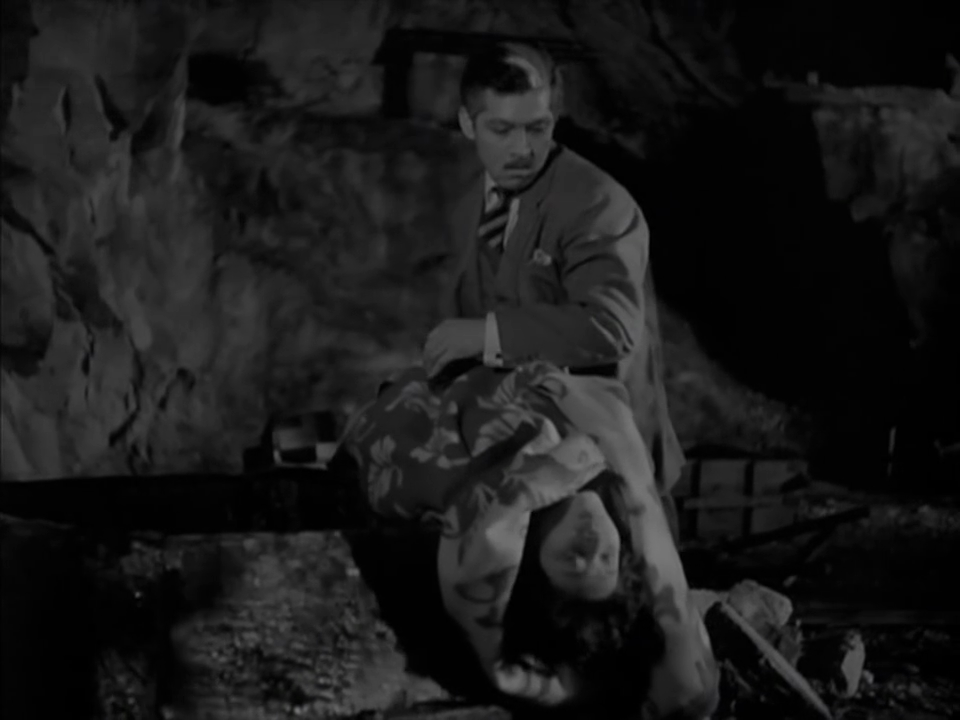
An adulterous industrialist finds himself in a sticky situation after accidentally killing his wife in Umetsugu Inoue’s bizarre noir Crossroad (死の十字路, Shi no Jujiro). Based on a story by Edogawa Rampo, the film like any good noir suggests that in the end you can’t outrun your fate and all transgressions must be paid for but also turns on cosmic irony and strange coincidence in the great “tapestry” of life in which everything really is connected.

Shogo Ise (an aged-up Rentaro Mikuni) is the director of a construction firm about to complete a hugely expensive dam project which requires the sinking of a village and quarry. Apparently unhappily married to a woman obsessed with Nichiren Buddhism believing it helped to cure her of a serious illness during the war, he more or less lives with his secretary/mistress Harumi (Michiyo Aratama) who has been receiving incredibly weird and definitely threatening letters from Shogo’s wife Tomoko (Hisano Yamaoka). Tomoko claims that she has received an order from the “Child of the Sun” insisting that she must exact vengeance for the “great sin” Harumi has committed. The letter seems to be the last straw for Shogo who has decided to leave his wife, despite her incredible wealth, and set up home with Harumi permanently. 

Shogo hadn’t taken the threat very seriously, but sure enough Tomoko later shows up with some kind of ceremonial dagger and barges in to attack Harumi in the bath. During the struggle, Shogo accidentally kills Tomoko while trying to wrestle the knife from her. After briefly considering turning himself in, he realises that doing so will involve them all in scandal so he decides the best thing to do is dump her body in a well at the quarry which is shortly to be sunk. However, the plan soon goes awry and not least because a random man with a head injury climes into his car after he has a fender bender on a set of crossroads and later dies there leaving Shogo no choice but dump him alongside Tomoko. 

Inoue casts the abandoned quarry in truly eerie light, filled with gothic winds as if Shogo were being chastised by the gods themselves. In a sense, he’s paying not only for his sexual transgression but for the breaking of a taboo. A homeless man who once lived in the village later relates that he stayed until the last day because he did not want to leave his ancestors’ land. Shogo is part of the post-war construction boom but there’s also an underlying implication that this industrialisation is harmful to the land itself, not least in constraining a natural flow with the imposition of a dam in addition to causing a displacement of the people who once lived in the village while literally drowning the ancestral spirits. 

Harumi too speaks of feeling as if they’re both sinking beneath the waves, chasing a happiness to which they have no entitlement though she herself seems completely blameless save for her involvement in an extra-marital affair and strangely wholesome in comparison to the film’s otherwise sordid atmosphere. Even for a noir, Inoue’s sensibility is surprisingly sleazy for the world of 1956 and more than a little suggestive. A detective that randomly shows up, Minami (Shiro Osaka), lives with his foxy assistant and the interaction between them is constantly sexually charged while Inoue frequently returns to the backstreets of a neon city and the bars that line the streets approaching the crossroads where Shogo’s fate will align. 

It could be inferred that Shogo is a man whose life was marked by the war, his marriage perhaps in haste and then regretted while his wife developed her illness and subsequent obsession with Nichiren because of its corruption. Nevertheless, he’s portrayed as a basically “good” man in a very bad situation who made some very bad choices he wasn’t in the end bad enough to carry through properly hence the amazing series of collisions that seal his fate. On the one hand, like the young couple related to the drunk man who ended up in Shogo’s car, he and Harumi are just two otherwise ordinary people who decided to chase happiness albeit through an extra-marital affair only to pay a heavy price for daring to dream of a better future. Inoue has his usual amount of fun playing with noir archetypes as men strike matches in darkened alleyways and silhouettes of mysterious men in trench coats line the walls, not to mention the gothic sense of dread in the abandoned quarry, while constantly wrong footing us only to set us on our own collision course with the vagaries of post-war morality. 


Stepbrothers (異母兄弟, Miyoji Ieki, 1957)

The destructive effects of militarist folly are borne out in the fortunes of one bifurcated family in Miyoji Ieki’s impassioned social drama, Stepbrothers (異母兄弟, Ibou Kyodai). Ieki had joined Shochiku in 1940 and served as an assistant director to Minoru Shibuya making his directorial debut in 1944 taking over a project Shibuya had begun before being drafted, Torrent. After the war he became the head of the studio’s union and was subsequently dismissed during the Red Purge of 1950. Adapted from the novel by Torahiko Tamiya, Stepbrothers was produced by Dokuritsu Eiga which became a kind of refuge for left-leaning directors and makes a direct attack on lingering feudalism and the militarist past. 

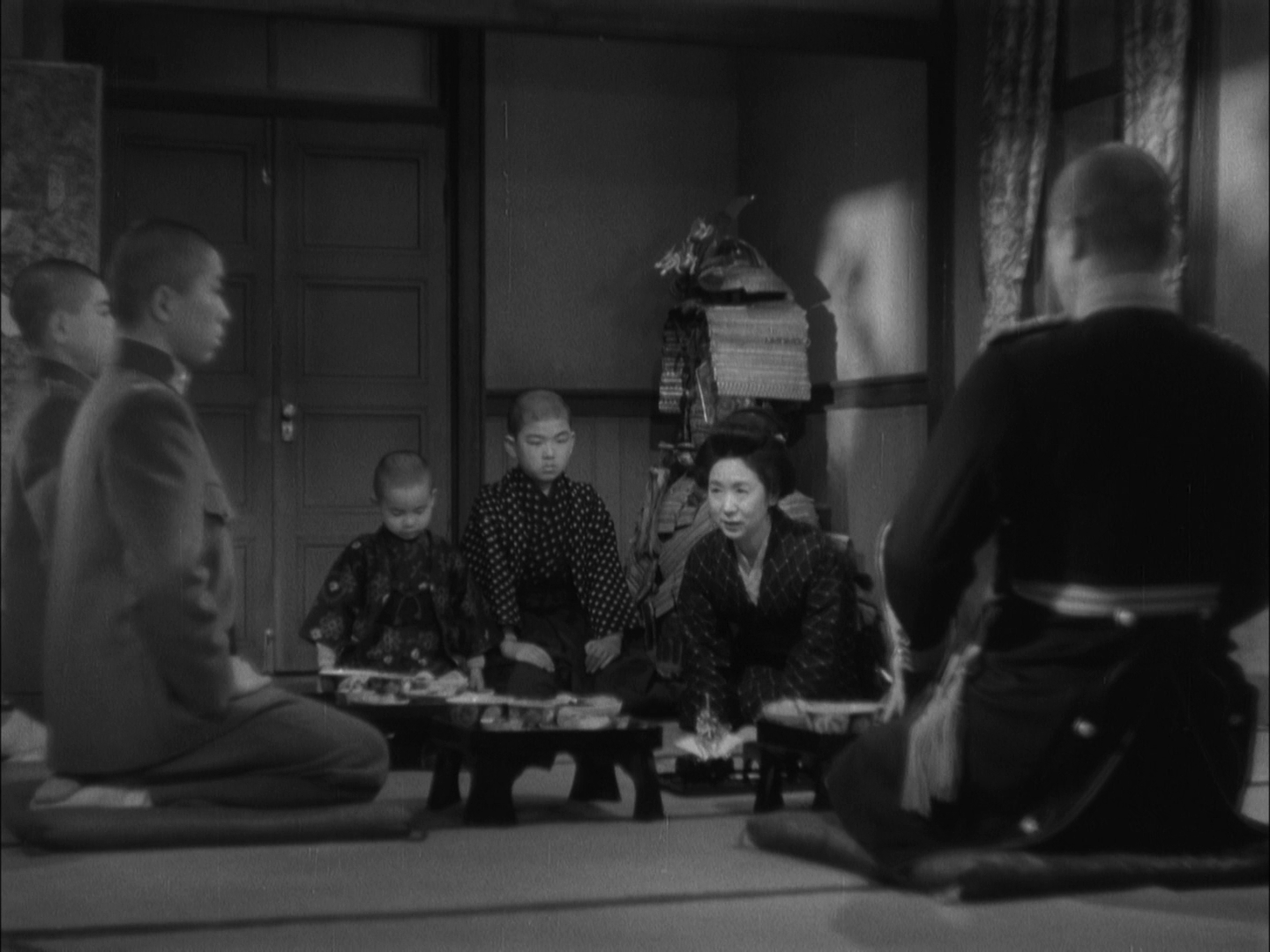
Spanning 25 years, the film opens in 1921 with pompous military officer Hantaro Kido (Rentaro Mikuni) riding his horse before immediately slapping his stableboy on dismounting apparently dissatisfied with his service in insisting there is something wrong with one of the horse’s shoes. This fear is later confirmed by the new maid he has just hied, Rie (Kinuyo Tanaka), who is the daughter of a recently deceased carriage driver. She has been hired because Hantaro’s wife is chronically ill and bedridden, no longer able to care for their two brattish sons Ichiro and Gojiro who imitate their father by pointing swords and guns at people while ordering them around. After asking Rie to check on the horse and observing her treating it with tenderness before pointing out the problem with its shoe unprompted, Hantaro loses control of himself, pushes her into the straw, and rapes her. With nowhere to turn Rie goes to the family friend who got her the job who discourages her from having an abortion and tries to make Hantaro take responsibility but he refuses to compensate her finally scoffing that there’s no way he would marry the mere daughter of a carriage driver. 

Challenged by his superior officer, however, he pledges to do just that in order to save the honour of the Kido family along with that of the regiment but is soon sent off to a less prestigious provincial position. In appointing Rie as a maid, Hantaro had expounded at length on his family lineage as guardians of a particular style of kendo, but there’s no denying that he has acted dishonourably while Rie is forced to marry the man who raped her and is then rendered little more than an unpaid servant in his home who is essentially raped every night for the remainder of her married life. After giving birth to the baby, a son Yoshitoshi, she has another some years later, Tomohide, but she and her children are not regarded as members of the family and are forced to sleep in the kitchen. Ichiro and Gojiro still call her Rie rather than mother and order her around like a servant while Hantaro simultaneously rejects her sons and insists they follow the family tradition by becoming fine soldiers. 

A poignant scene sees Gojiro looking on at Rie as Yoshitoshi and Tomohide cheerfully play cards with some of the servants one New Year implying he may in fact miss maternal closeness but is unable to express it because of his father’s code of manliness later tearfully asking his brother for memories of their mother when they are both grown men. The difference between the boys can seen in their names, those of Hantaro’s sons from his first marriage meaning something like “first son boss” and “strong second son” while those of Rie’s sons are much warmer, Yoshitoshi using the characters for good and benefit, and Tomohide’s wisdom and excellence. Ichiro and Gojiro continue to mercilessly bully Yoshitoshi and Tomohide, insulting them as sons of mistresses a term which Yoshitoshi does not fully understand but instantly associates with the way his family has been treated as other and inferior, confined to the parts of the house otherwise occupied by servants. When he says he’s no desire to become a soldier, Hantaro locks him in the cupboard under the stairs and seemingly never talks to him again. 

Rie tells him that he will understand her actions when he’s older but he continues to blame her for them, angry that could not reject Hantaro’s authority to protect him nor would she escape the situation by simply leaving it. His criticism is unfair and ignores her continued suffering given the reality that as a young woman with no family or fortune she is left with no means of supporting herself that would make it possible to escape. But he may also have a point in that she is also the product of a feudal and patriarchal society and is spiritually unable to refuse Hantaro’s corrupt authority over her even as he dismisses her as a carriage driver’s daughter and her sons as unworthy by his name. She suffers and placates him to protect them but Yoshitoshi sees only her complicity. 

Yet Hantaro’s pompous austerity which is also the code of the age later destroys him. He prattles on about his supposed military prowess while telling one of his sons that soldiers should be thought of as pawns to be sacrificed for the emperor only to lose both of them to the inevitable defeat. Portraits of his two sons sit proudly under a map of the Japanese empire now shorn of the flags he’d pinned to mark their victories, while Rie’s are hidden away on the shelf of a cupboard itself one of the few pieces of furniture they had not sold to survive in the difficult post-war period. Hantaro had rejected Tomohide (Katsuo Nakamura) who craved his approval because he was in poor physical health and therefore unable to fulfil his vision of manliness but it is he who alone survives having rejected his name after his father beat him for singing and sent Haru (Hizuru Takachiho), the cheerful servant girl he loved, away to be sold off to a brothel by her impoverished family. 

When Tomohide returns home after some years of wandering to a mother who thought him dead only for Hantaro to reject him, his only living son, Rie finally finds the strength to reject his authority. This time she refuses to leave, insisting that the house is rightfully Tomohide’s and he should not surrender it to a Hantaro who is now beaten and defeated, a pitiful old man who can barely walk and is perhaps consumed by the humiliation of his life’s folly. It’s his hypocrisy and moral cowardice along with the cold austerity of mindless militarism that have ruined all their lives, yet in Tomohide who truly crossed the barriers of class in continuing to help Haru with her chores there is a hope for a new future as his mother and he fill the bath together and assume ownership in equality of the home which has always been their own.