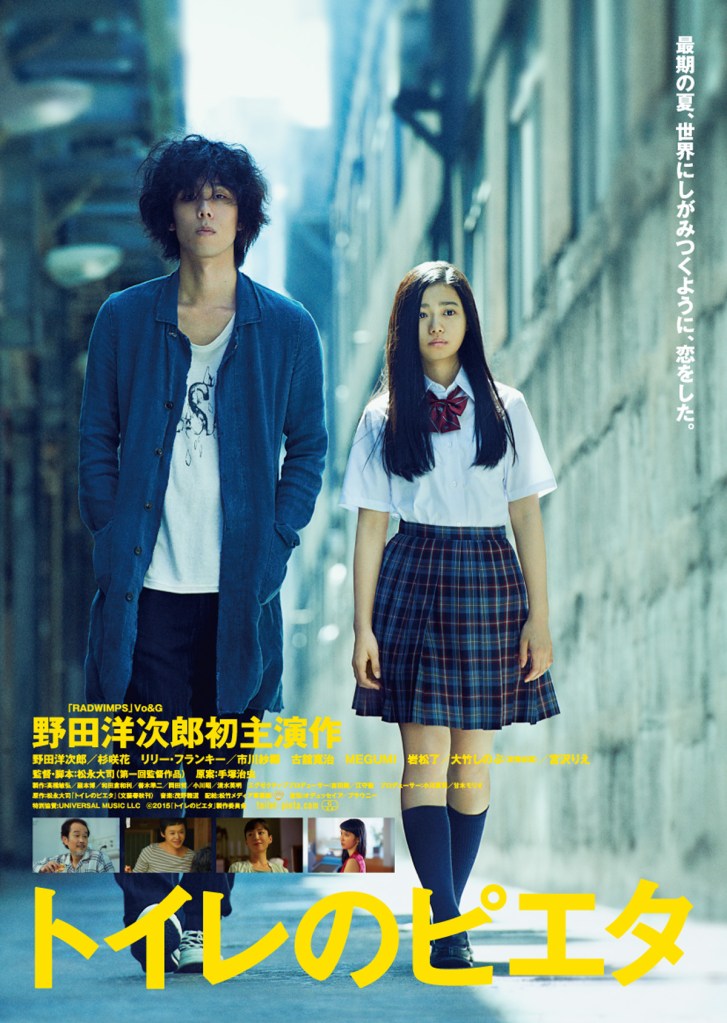
Pieta in the Toilet (トイレのピエタ, Daishi Matsunaga, 2015)

pieta-in-the-toiletSomewhere near the beginning of Daishi Matsunaga’s debut feature, Pieta in the Toilet (トイレのピエタ, Toire no Pieta), the high rise window washing hero is attempting to school a nervous newbie by “reassuring” him that the worst thing that could happen up here is that you could die. This early attempt at black humour signals Hiroshi’s already aloof and standoffish nature but his fateful remark comes back to haunt him after he is diagnosed with an aggressive and debilitating condition of his own. Noticeably restrained in contrast with the often melodramatic approach of similarly themed mainstream pictures, Pieta in the Toilet is less a contemplation of death than of life, its purpose and its possibilities.

Having left his country home for Tokyo to become a painter, Hiroshi (Yojiro Noda) has become a bitter man, wilfully drowning in his own broken dreams. A chance encounter with an old flame, Satstuki (Saya Ichikawa), further deepens Hiroshi’s sense of inadequacy – she is about to open a solo exhibition in the very building which Hiroshi is currently engaged in washing the windows of. After having so sarcastically made fun of his new colleague’s fear of the rig, it’s Hiroshi who finds himself collapsing on the job and requiring medical treatment.

Seeing as the hospital have requested he bring a family member along with him for the results of the examination, it’s probably not good news. Not wanting to involve his parents, Hiroshi persuades Satsuki to masquerade as his younger sister only to restart an old argument in the waiting room prompting his former love to remember why they aren’t together anymore and hightail it out of there. Spotting a high school girl arguing with a salaryman she says has torn her uniform, Hiroshi decides to offer the job to her. Mai (Hana Sugisaki) plays her part to perfection but the news is even worse than he’d feared – aggressive stomach cancer requiring immediate hospitalisation and sustained chemotherapy if he is to have any chance at all of surviving more than a couple of months at most.

Prior to his illness, Hiroshi is a difficult man, permanently grumpy and irritated as if carrying a great sense of injustice. Despite several different voices reminding him that he had talent, Hiroshi has given up drawing in the belief that his artistic career was always doomed to failure. Intent on punishing himself for just not being good enough to succeed, Hiroshi’s decision to make window washing his career signals his lack of personal ambition, content to simply keep existing while a silent rage bubbles under the surface.

After the original failed reconnection with Satsuki who, we later discover, has moved in another direction using her society connections to advance her career in a way of which Hiroshi does not approve, Hiroshi’s illness brings him into contact with a number of people who each do their bit to reopen his heart. The most important of these is the feisty high school girl, Mai, who refuses to simply disappear from Hiroshi’s life after the awkward bonding experience of being present at the cancer diagnosis of a total stranger. As angry and defeated as Hiroshi, Mai’s difficult homelife has brought her untold suffering but unlike the brooding painter, hers in an externalised rage which sends her reeling into the world, looking for reaction and recognition rather than the introspective craving for disappointment and indifference which marks Hiroshi’s approach to his internalised sense of inadequacy.

Hiroshi’s hospital stay produces twin motivators from both ends of the spectrum in the form of an older man in the next bed, Yokota (Lily Franky), who enjoys taking photographs (especially of pretty girls), and a terminally ill little boy who remains cheerful, polite and friendly despite Hiroshi’s rather rude attempt to shake him off. It’s on a visit to the hospital chapel with the boy, Takuto (Riku Sawada), and his mother (Rie Miyazawa) that Hiroshi first comes across the statue of the pieta which inspires his ultimate, life affirming act which sees him turn the smallest room of the house into a new Sistine Chapel with a large scale installation recasting Mai as Mary, arms outstretched ready to receive her sorrowful burden.

Hiroshi’s life had been mere existence but reaching an acceptance of its end forces him into a process of more positive self reflection and a desire to leave something more permanent behind. Inspired by a few words found on the final page of the diary kept by the godfather of manga, Osamu Tezuka, himself battling stomach cancer at the time, Pieta in the Toilet puts art at the core of life as Hiroshi picks up his paint brush, Yokota his camera (albeit with slightly less than artful intentions), and Takuto his painstakingly collected colour-in heroes. Necessarily melancholy yet somehow life affirming Pieta in the Toilet offers a nuanced though no less powerful contemplation of life, death and art in which each gives meaning to the other, ensuring the richness of a life fully lived.


Screened as part of the Japan Foundation Touring Film Programme 2017.

Original trailer (English subtitles)

Pale Moon (紙の月, Daihachi Yoshida, 2014)

Pale-Moon_MainDaihachi Yoshida’s last venture into human dynamics, The Kirishima Thing, took the high school environment as a microcosm for society as a whole. In some senses painting on a large canvas by illuminating the inner lives of these teenagers acting as both individuals and as members of a group, The Kirishima Thing was equal parts ensemble character drama and probing social commentary. Pale Moon (紙の月, Kami no Tsuki) is no different in this regard although it focuses more tightly on one individual and shifts age groups from turbulent adolescence to middle aged desperation. Set in 1994 just after the bubble burst, this gleefully cheeky (im)morality tale takes another sideways glance at the social norms of contemporary Japan.

Rika (Rie Miyazawa) is a demure woman in her early forties. A childless former housewife, she’s recently moved from a part time position at a bank to a full time job where she works as a kind of personal banking assistant visiting wealthy clients at home to discuss their financial needs and physically depositing their money in the bank for them. Efficient, reserved, reliable – Rika is the perfect employee, that is until one day she spends some of a client’s money because there isn’t quite enough in her purse. She takes the money straight out of an ATM and replaces it right away, of course, but a line has been crossed. It’s a quick step from a gentle misappropriation of funds to a series of interestingly decorated hotel rooms with a boy half your age, embezzlement on a grand scale, blackmail, bank fraud – the list goes on. How did it ever come to this? Yet, it’s the strangest thing – Rika has never felt more alive.

Money – it’s the life blood of capitalism. It makes the world go round and drives people crazy as they try to amass even more little bits of paper with numbers written on them. It’s fake, an illusion that we’ve all bought into – no more real than a paper moon (to go by the film’s original Japanese title), though we continue to set all of our hopes afloat on its surface. When Rika finally convinces her financially challenged young lover to accept her (stolen) money, she tries to convince him that nothing will change but, of course, it does. The dynamics fluctuate and money gets in the way, the toxicity of debt starts to eat away at any genuine connection that may have existed. The irony is, Rika is one of those people who steals in order to give away. It sounds selfless, even altruistic, but is in fact the most intensely selfish action that can be taken. “It’s better to give than to receive” goes the mantra of the nuns of the Catholic school where young Rika was educated, but they also council that charity should never have anything to do with your own gratification. This is the lesson that Rika finds so hard to learn, it feels so good to give – how can it be wrong to take?

It’s easy to say that the world has changed a lot in the intervening twenty years between now and the time the bulk of the action takes place, but maybe it hasn’t. The first thing that strikes you is how extraordinarily sexist Rika’s world is. It’s not long before she’s being asked questions about her marital status whilst being made to feel uncomfortable, alone in the home of her elderly male client. Then at the office her boss praises her efforts whilst sadly lamenting that women have more “tools” at their disposal than men do, which is both insultingly crude and a put down of her skills and hard work. Rika only gets her permanent position because another woman, an employee of nineteen years standing, has been forced out through a campaign of constructive dismissal because the big wigs don’t like paying higher salaries to older female workers but they won’t promote them past a certain level either. Her younger colleagues make fun of their “spinster” supervisor, Sumi (Satomi Kobayashi), who, only a generation older, had to make a clear cut choice between work and family and having chosen a career now sees the rug being pulled out from under her with the standard “transfer to head office” game plan in place to force her into retirement.

Rika’s home life offers a similar level of hope for the future. Her husband is probably well meaning, but totally insensitive and the marriage is at best unfulfilling. He pooh-poohs his wife’s thriftiness and her new “hobby” at the bank, totally failing to understand her motivation. At one point he announces he’s being transferred abroad so she’ll have to give her notice – it never occurs to him she may not wish to go, let alone that she’d refuse over something so trivial as her own job. It’s little surprise then that she’d so quickly fall for a handsome and attentive stranger. An “amour fou”, an old story but no less potent than it ever was.

Rika knows none of it’s real – that her temporary crime fuelled reprieve can’t go on forever, but that only makes her feel more free. In one telling episode, Rika is talking to a granny she’s in the process of swindling and remarks on her beautiful new necklace. What a shame it’s fake, Rika says, but the old lady replies that she knows it’s only imitation but she doesn’t care – it’s pretty, she likes it and she’s happy. That perhaps is the answer. Rika saw her chance and she took it. That takes some courage and whatever the moral outrage one might feel, there’s something undeniably admirable, even exciting, about Rika’s dramatic escape from the constraints of conventional social behaviour.


Pale Moon is receiving its UK Premier at the Glasgow Film Festival on 19th February so if you’re in the Glasgow area be sure to check it out!