Invincible Swordsman (笑傲江湖, Luo Yiwei, 2025)

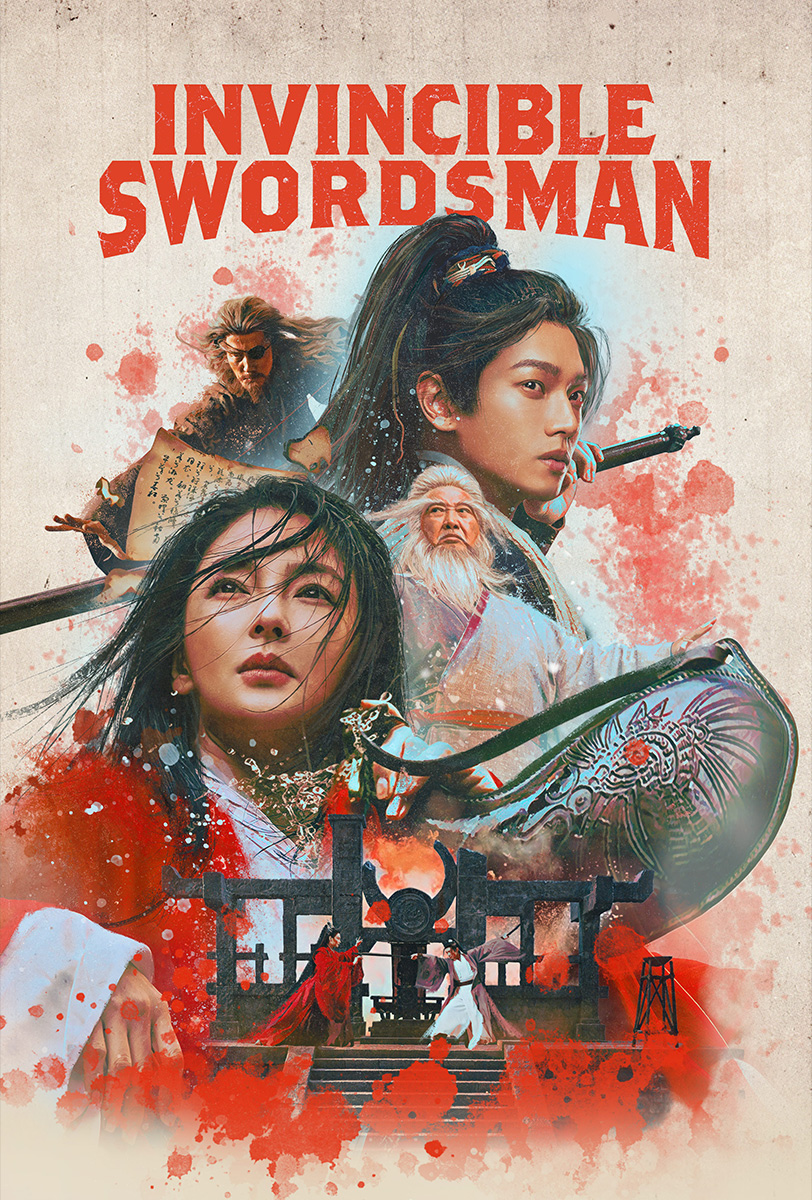
Adapted from Jin Yong’s wuxia classic The Smiling Proud Warrior, Invincible Swordsman (笑傲江湖,
xiào ào jiānghú) has a hard battle to fight in covering the same ground as 1992’s Swordsman II which featured an iconic performance from Brigitte Lin as the androgynous Invincible Asia. Produced by streaming network IQYI and Tencent, the film has a more epic feel than the studio’s similarly pitched wuxia and was also released in cinemas but is undoubtedly a much more conventional affair let down by an over-reliance on CGI.

To recap, Ren Woxing (Terence Yin Chi-Wai) led the demonic Sun and Moon Sect in despotic fashion slaughtering many of his own followers. Consequently, they flocked behind Invincible East (Zhang Yuqi ) to free them who eventually defeated Woxing and has imprisoned him in the basement of their lair. Meanwhile, drunken but earnest swordsman of the Mount Hua sect Linghu Chong (Tim Huang) has befriended Woxing’s daughter Ren Yinging (Xuan Lu) through their shared love of music and is kicked out of the clan for treason. Nevertheless, he’s taken on as a disciple by the charismatic Feng Qingyang (Sammo Hung Kam-Bo) who continues teaching him martial arts before he’s called back to the world of Jianghu by Yingying who warns him his friends are in danger after teaming up to defeat Invincible East who has now become even more despotic than Woxing in drinking the blood of their victims to stay young.

Even so, breaking Woxing out of containment so he can take out Invincible East seems like a bold plan given there’s no guarantee he’ll actually do that and even less he won’t just go back to his old ways afterwards. Linghu Chong only participates out of loyalty to his men and as a favour to Yingying and is therefore constantly insisting that none of this is anything to do with him because he’s leaving the martial arts world. It’s a fault with the source material, but it’s quite frustrating that all these women are hopelessly in love with the actually quite bland Linghu Chong who has a nasty habit of turning up every time a woman is about to fight someone and heroically standing in front of her. Ironically, that’s how he meets “Invincible East” without realising, or at least the nameless final substitute of Invincible East who has become the public face of the legendary warrior. 

Christened “Little Fish,” by a besotted Linghu Chong who believes her to be a damsel in distress, she is the only female substitute of Invincible East who has undergone self-castration in order to achieve a higher level of martial arts and in the film’s conception thereby feminised. Unlike the ’92 version, however, Little Fish is concretely female and bar a brief flirtation with some of her maids more preoccupied with her lack of individual identity in having no name of her own. Consequently, her love of Linghu Chong becomes an opposing identity though she feels herself forced to take on the persona of Invincible East. Linghu Chong too is fascinated by her mystery which causes him to act in a caddish way towards Yingying who is otherwise positioned as his rightful love interest even if their romance is frustrated by the relationships of their respective clans.

What they’re really fighting is Invinsible East’s corruption of Jianghu which it wants to rule in its entirety. The corruption has already worked its way into the Mount Hua sect as ambitious couturiers vie for power and throw their lot in with the Sun and Moon sect in the hope of advancement. Luo does his best to conjure a sense of the majestic in the elaborate action set pieces, but the over-reliance on wire work and CGI particularly for the swords leaves them feeling inconsequential while there’s barely any actual martial arts content as the fights revolve around the martial arts stances rather than combat. Frequent homages to the ’92 film including the use of its iconic song also serve to highlight the disparity in scope and vision though even if Zhang Yuqi appears to be channelling Brigitte Lin there is genuine poignancy in her tragic love for Linghu Chong which is also the longing for freedom and another identity that is forever denied her. With his belief in Jianghu well and truly destroyed, Linghu Chong finds himself a lonely wanderer and refugee from a martial arts world largely devoid of hope or honour and adrift with seemingly no destination in sight.


Invincible Swordsman is released on Digital 19th August courtesy of Well Go USA.

Trailer (English subtitles)

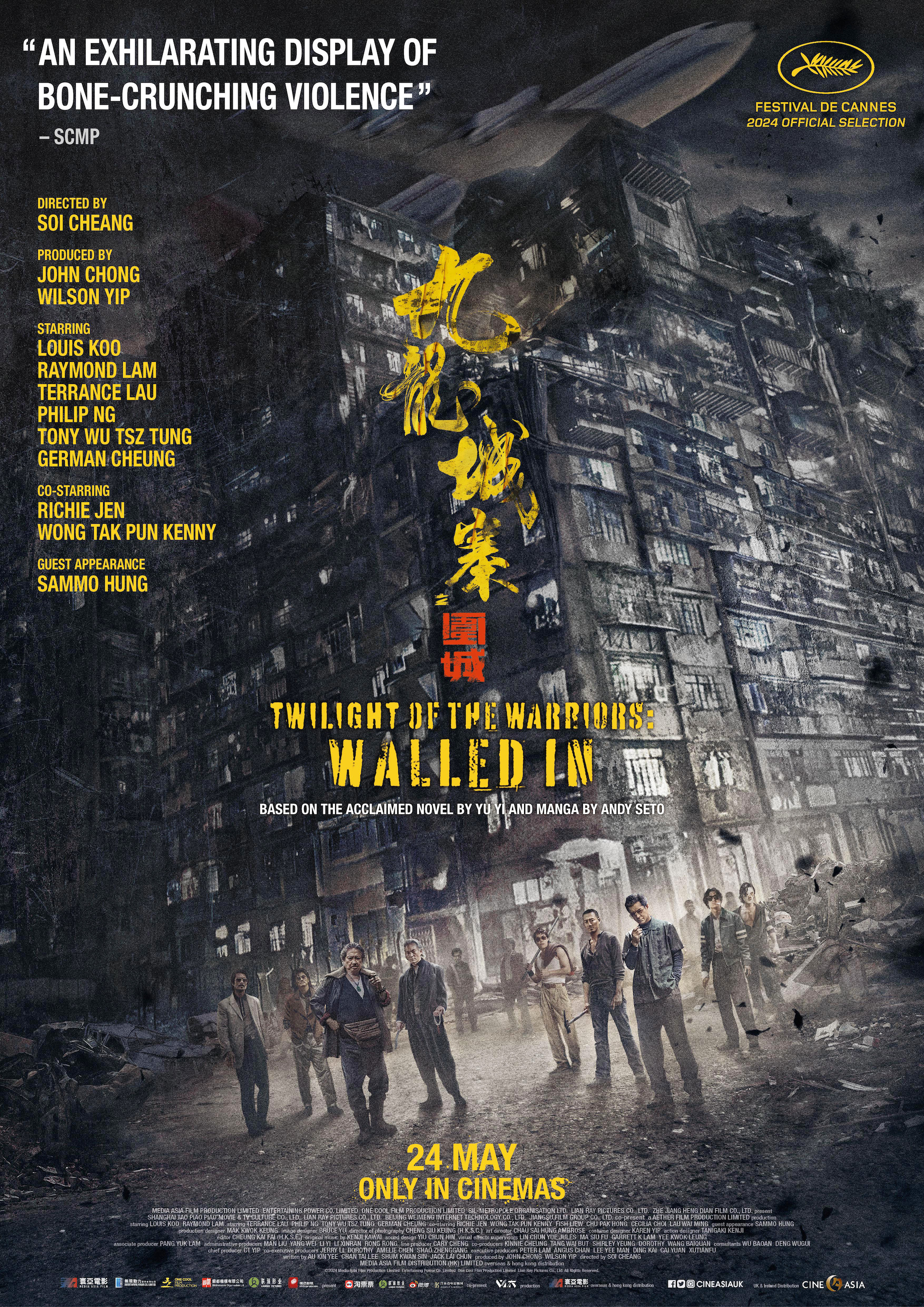
Twilight of the Warriors: Walled In (九龍城寨.圍城, Soi Cheang, 2024)

In Kowloon Walled City, you give help, you get help. Sometimes described as a colony within a colony, by the late 1980s the settlement was largely ungovernable and literal law unto itself save for the triads who maintained what little order there was. Yet in Soi Cheang’s Twilight of the Warriors: Walled In (九龍城寨.圍城) it’s a place of comfort and security, a well functioning community that as its leader Cyclone (Louis Koo Tin-lok) points out may be unpalatable for “normal” people but provides a point of refuge for the exiled and hopeless.

It’s difficult not to read it and Cyclone himself as embodiments of Hong Kong that is slowly disappearing. Dying of lung cancer, Cyclone is aligned with the fate of the walled city as someone whose time is running out, tired and world weary but still hanging on. In the opening sequence set 20 or so years before, we see Cyclone stand up to an apparent dictatorship and institute what seems to be a more egalitarian form of government though one obviously defined by violence. Nevertheless, when refugee Lok (Raymond Lam Wui Man) lands up there originally suspicious of Cyclone having been duped by local gangster Mr Big (Sammo Hung Kam-bo), he discovers him to be a stand up guy looking after those in his community and generally keeping the peace. Nevertheless, Lok’s arrival is the fatalistic catalyst for the opening of old wounds amid the free for all of the mid-80s society in which the Walled City, sure to be bulldozed, has just become a lucrative property investment.

Mr Big and his crazed henchman King represent this new order, amoral capitalistic consumerists who care little for the conventional rules of gangsterdom. Their bid to seize the Walled City has its obvious overtones as they seek to replace the (generally) peaceful egalitarian rule of Cyclone with something that appears much more authoritarian and ruthless. Believing himself to be a stateless orphan, Lok tries to keep his head down saving everything he can to buy a fake Hong Kong ID card which is also in its way a quest for identity not to mention a homeland and a sense of belonging. He finds all of these things, along with a surrogate father figure, in the Walled City only to have the new home he’s discovered for himself ripped out from under him because of a twist of fate. When he teams up with a trio of other young men who all owe their lives to Cyclone and the Walled City to attempt to take it back, it’s also an attempt to reclaim an older, more autonomous Hong Kong that exists outside of any kind of colonial control as evidenced by his final statement that no matter what happens some things don’t change.

This sensibility extends to the casting of the film which includes a series of Hong Kong legends including a notable appearance from the legendary Sammo Hung not to mention Louis Koo alongside a generation of younger stars such as Tony Wu and Terrance Lau Chun-him. Adapted from the manhua City of Darkness by Andy Seto, the film opens with a flashback to the original war for control of the Walled City that hints at deeper, extended backstories otherwise unexplored though equally mythologised by those who impart them to them Lok, a prodigal son and eventual inheritor of the City’s legacy. Even so, the comic book elements sometime distract from Soi Cheang’s otherwise evocative if hyperreal recreation of the Walled City slum or the political subtext that can be inferred in the presence of supernatural abilities such as those which seem to grant King near invincibility.

In any case, Soi Cheang looks back equally towards the history of heroic bloodshed in particular in his tale of brotherhood and loyalty in which the secondary antagonist is literally imprisoned by his own futile desire for a pointless vengeance on the descendent of a man who had wronged him but was already long dead himself. As he’d said, the future of the Walled City is in the hands of the younger generation who choose to end the cycle by setting him free rather than imprison themselves along with him while defending their home as well as they can. With some incredibly well designed action sequences including one that make its way onto a double-decker bus, Soi Cheang’s beautifully staged action thriller as its name suggests has a rather elegiac quality but also the spirit of resistance in its gentle advocation for the importance of supportive communities.


Twilight of the Warriors: Walled In is in UK cinemas from 24th May courtesy of CineAsia.

UK trailer (Traditional Chinese & English subtitles)

A Touch of Zen (俠女, King Hu, 1971)

“A man has his code” a late villain explains in King Hu’s radical Buddhist wuxia epic, A Touch of Zen (俠女, Xiá Nǚ), justifying his villainy with weary fatalism as a matter dictated by the world in which he lives and of which he is merely a passive conduit. Based on a story by Pu Songling, Hu’s meandering tale begins as gothic horror yet ends in enlightenment parable that in itself reflects the values of Jianghu as a warrior monk achieves nirvana in the apotheosis of his righteousness. 

Hu begins however with slowly mounting tension as lackadaisical scholar Gu Shengzhai (Shih Chun) begins to notice something strange going on in the sleepy rural backwater where he lives. There are several strangers in town from the recently arrived pharmacist Dr Lu (Xue Han), to the blind fortune teller Shi (Bai Ying), and a young man who stops into his shop to have a portrait done (Tien Peng) but is behaving somewhat suspiciously. Shengzhai has also noticed unexpected activity at a house opposite his long thought to be “haunted”, activity which turns out to be caused by a young woman, Miss Yang (Hsu Feng), living in penury with her bedridden mother. 

Shengzhai is often described as feckless or immature, his mother (Zhang Bing-yu) constantly complaining that he refuses to take the civil service exam and has stubbornly wasted his life with “pointless” study while they live harsh lives with little comfort. Shengzhai is, however, an unconventional jianghu hero who has rejected a world of courtly corruption in order to live by his own principles even if that means a poor but honest existence. In a sense he becomes a man through his brief relationship with Yang who turns out to be a noblewoman on the run from the East Chamber after being sentenced to death because of her father’s attempt to expose the corruption of a high ranking eunuch. After he and Yang enjoy a single night of passion in the middle of a thunderstorm, Shengzhai becomes determined to protect her and reveals he has spent much of his life studying military strategy, but he also fully accepts Yang’s agency and right dictate her future walking back his claim of feeling duty-bound because they are “almost married” to be content to help “even as a friend”. 

Nevertheless, there is something of boyish glee in the machinations of his trickery, repurposing the gothic horror of the “haunted” fort as a means to “demoralise” the enemy. His second antagonist, Men Da (Wang Rui), refuses to take the rumours, ably spread by Shengzhai’s gossipy mother panel to panel through a series of expanding split screens, seriously describing them as something only “ignorant country folk” would believe but later falls victims to Shengzhai’s elaborate setup. After his victory, Shengzhai walks through the fort laughing his head off playing with the lifeless mannequins he positioned as ghosts and idly tapping various traps and mechanisms, but it’s not until he leaves the ruined building and ventures outside that he realises the true cost of his childish game in the rows of bodies stretching out and around before realising Yang is nowhere to be found. Shengzhai becomes a man again, forced to accept the consequences of his actions, but also defiant, ignoring advice and instruction on leaving home in search of a woman who asked him not to look for her. 

As he later discovers, Yang and her retainer have renounced the world for a monastic life returning to the Buddhist temple in which Yang learned martial arts during her two years of exile under the all powerful master Hui Yuan (Roy Chiao) who is now it seems close to achieving enlightenment though that won’t stop him helping Yang deal with her “unfinished business”. Like the heroes of jianghu, Yang removes herself from a world of infinite corruption though in this case to pursue spiritual enlightenment and thereafter forgoes her revenge, acting in defence only rather striking back at Eunuch Wei or the East Chamber. At the film’s conclusion, Hui Yang’s act of compassion brings about his betrayal but through it his enlightenment. Struck, he bleeds gold blood and sits atop a rocky outcrop as the sun radiates around his head in a clear evocation of his transcendence witnessed at a distance even by Shengzhai alone and placed once again in a traditionally feminine role literally left holding the baby but perhaps freed from the web of intrigue in which he had been trapped spun all around him just like that weaved by the spider in the film’s gothic opening. 

Stunningly capturing the beauty of the Taiwanese countryside with its ethereal rolling mists and sunlit forests, Hu’s composition takes on the aesthetic of a classic ink painting finding Shengzhai lost amid the towering landscape while eventually veering into the realms of the experimental in the transcendent red-tinted negative of spiritual transition. For Hu’s jianghu refugees, there can be no victory in violence only in the gradual path towards enlightenment born of true righteousness and human compassion.


A Touch of Zen streams in the US until Sept. 28 as part of the 13th Season of Asian Pop-Up Cinema.

International restoration trailer (English subtitles)

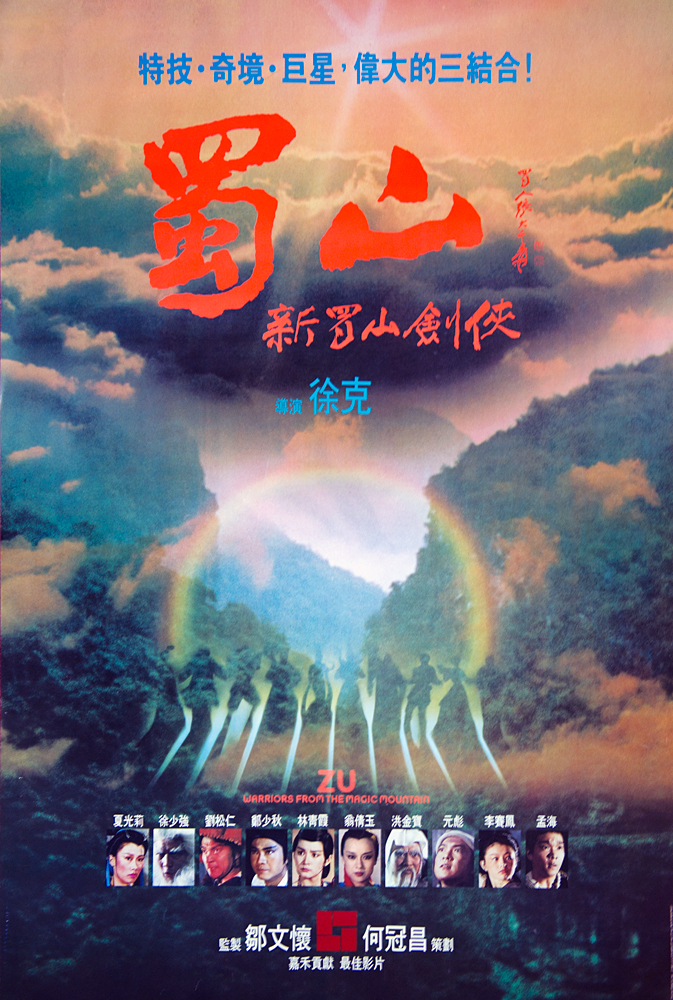
Zu: Warriors from the Magic Mountain (新蜀山劍俠, Tsui Hark, 1983)

“I never imagined that the righteous would not only refuse to unite, but also be incapable of action” laments a reluctant soldier realising there are no heroes coming to the rescue in Tsui Hark’s SFX-laden fantasy wuxia, Zu: Warriors from the Magic Mountain (新蜀山劍俠). Inspired by the work of Huanzhulouzhu (Li Shoumin), Tsui’s feudal fable marked a departure from the more “realistic” swordplay movies which were popular at the time harking back to an earlier era of fantastic adventures which drew inspiration from traditional Chinese folklore. It was also, however, an attempt to prove that Hong Kong could rival Hollywood in the post-Star Wars world, blending what might now be viewed as fairly camp but then cutting-edge special effects with classic wuxia action. 

Accordingly, after a brief voice over, Tsui opens with a world in chaos in which several factions are currently vying for hegemony over the hotly contested, mystical and mountainous terrain of Shu. Lowly retainer Ti Ming-Chi (Yuen Biao) has been tasked with delivering a message regarding troop movements to his superiors, but there is a difference of opinion in the chain of command as to whether to attack by land or sea. Placed in an impossible position, Ming-Chi eventually sees himself pledge to obey both captains, only for infighting to emerge within the group forcing him to flee for his life which is how he encounters “Fatty” (Sammo Hung Kam-Bo), a soldier from a rival faction and discovers, quite ironically, that they are from neighbouring villages which makes their rivalry all the more ridiculous. In the course of his attempt to escape, Ming-Chi falls into a mountain crevasse and finds himself entering a mysterious cave which takes him to another world in which he becomes similarly embroiled in a war against the evil Demon Cult which apparently practices child sacrifice and then uses the bones as a kind of magical armour. 

A reluctant soldier, Ming-Chi finds himself captivated by the “Great Hero” Ting Yin (Adam Cheng Siu-Chow) and determines to become his disciple while the pair form an uneasy alliance with a pair of similarly matched Buddhist monks, master Hsiao Yu (Damian Lau Chung-Yan) and his assistant I-Chen (Mang Hoi), also hot on the trail of the Demon Cult. Finding this world also confusing, he is nevertheless reassured by I-Chen’s simple explanation “they’re bad, we’re good” as the two masters face off against the Demon Lord, but comes to discover it’s not quite all as black and white as it seems and this world too is torn apart by chaos and disorder because “the hearts of men are so corrupt.” Ming-Chi begs Ting Yin to use his “peerless martial arts skills” to “save mankind”, but Ting Yin cynically tells him his best course of action is to retreat into the mountains and avoid human society because “neither you nor I have the ability to bring about change”. 

Yet Ming-Chi remains pure of heart, certain that “as long as everyone puts in the effort, peace can be restored under heaven”. “Teach me martial arts and once I’ve mastered it, I can fight oppression, help the weak, and save the masses” he pleads, but Ting Yin once again refuses him. In fact, in one of the later SFX sequences, Ting Yin will “transfer” his martial arts knowledge near instantly via a laying on of hands assisted by some elaborate prosthetics which see Ming-Chi’s body warp and bubble to accept it. Nevertheless, the lesson that Ming-Chi begins to learn, bonding with fellow assistant I-Chen who ignored his master’s petty parting words to bid him goodbye to hope they meet again along the way, is that the masters care only for themselves and are no better than the warring nobles from his own lands, obsessed with their rival sects and ideologies. If they want to save the world they’ll have to save themselves through mutual solidarity in pursuit of their goal, tracking down a pair of mystical swords which are the only way to end the demonic threat for good. 

There might of course be an added dimension to this allegory in the Hong Kong of 1983 which is perhaps also beginning to feel like disputed territory coveted by duplicitous elites who fight amongst themselves while ordinary people suffer, but Tsui is in any case more interested in zany action and excuses to employ zeitgeisty special effects making full use of the technology of the day from lasers to animation along with in-camera stunts to recreate his epic fantasy world in which old men can keep evil at bay for as long as 49 days using nothing but their powerfully hairy eyebrows and a fancy mirror. With small roles for Brigitte Lin and Moon Lee as an ice queen with a warm heart presiding over an all female palace and her spiky guard respectively, Tsui’s bonkers fairytale moves on at a glorious, confusing pace but is nevertheless filled with warmth and humanity as the goodhearted heroes attempt to head off the folly of war with human solidarity. 


Zu: Warriors from the Magic Mountain streams in the UK 9th to 15th February as part of Focus Hong Kong

Eureka release trailer (english subtitles)

Moon Warriors (戰神傳說, Sammo Hung, 1992)

“In fact, some stories are true. Especially the heartbreaking ones” according to a melancholy fisherman in Sammo Hung’s tragic wuxia romance, Moon Warriors (戰神傳說). Arriving in the middle of a fantasy martial arts boom, Moon Warriors boasts some of the biggest stars of the day in a beautifully composed tale of intrigue and derring-do as well as featuring an A-list creative team with such high profile talent as Mabel Cheung, Alex Law, Ching Siu-Tung, and Corey Yuen also involved in the production. 

Somewhere in feudal China, 13th Prince Shih-san (Kenny Bee) is on the run after being usurped by his evil brother, the predictably named 14th Prince (Kelvin Wong Siu) who burnt down his castle and has been following him throughout the land razing villages wherever he goes. Accompanied by trusty bodyguard Merlin (Maggie Cheung Man-Yuk) who is silently in love with him, Shih-san is desperate to get in touch with the Lord of Langling (Chang Yu), also the father of his betrothed princess Moony (Anita Mui Yim-Fong), in the hope of uniting their forces to retake the country together. Meanwhile, goodhearted yet eccentric fisherman Philip (Andy Lau Tak-Wah) is doing a spot of hunting in a bamboo grove during which he notices Shih-san and the others wading into a trap and leaps to the rescue, helping to despatch the black-clad assassins. As Shih-san is badly injured, he takes them back to his cheerfully idyllic village, serves them the local delicacy of spicy shark fin soup, and generally befriends them before 14th Prince’s goons track them all down again at which point he takes them to his secret hideout which turns out to be an ancient temple dedicated to Shih-san’s emperor ancestors. 

We find out just how evil 14th Prince is when he gets his minions to kill all of Moony’s ladies-in-waiting and dress up in their clothes to mount a sneak attack on the Langling estate while holding on to the pretty kites Moony was flying before the gang arrived. Though petulantly flying kites seems like quite a childish activity for a princess about to be married off, Moony more than holds her own in the fight even if finding it difficult to deal with having killed someone for the first time. Sent to protect her, Philip is less than sympathetic, but after a few arguments, a near death experience, and some magic glitter, the pair begin to fall in love, which is a problem because Moony is betrothed to Shih-san. 

What develops is a complicated love square in which Merlin pines for Shih-san who seems more interested in Philip, while Philip repeatedly tries to leave the group because of his conflicted loyalties and a feeling of inferiority as a peasant suddenly mixed up in imperial intrigue and forbidden romance. Moony tries to give him her half of a precious jade talisman which plays beautiful music, but her melancholy suggestion that it will sound better with his flute than with the other half which is held by Shih-san flies right over his head. Shih-san, meanwhile, who was spying on them talking, suddenly decides to give him his half too, leaving Philip holding the whole thing. Merlin, as it turns out, has a series of interior conflicts of her own that leave her resentful of just about everyone except Shih-san. 

Eventually, however, nowhere is safe from the destructive effects of political instability and Philip’s fishing village is soon a target for the vicious 14th Prince, ensuring he enters the fight with the help of his improbable best friend, a killer whale named “Sea-Wayne”. Before the romantic dilemmas can be resolved, the courtly intrigue collapses in on itself, fostering an accidental revolution in the literal implosion of an old order, suddenly becoming dust as in some long forgotten prophecy. In a strange moment of flirtatious smalltalk, Philip had remarked that legend has it the flowers in these fields are only so beautiful because they grow on top of bodies buried far below, something he later discovers to be more than just a fanciful story. 

There might be something in the tragic tale of two branches of elites destroying each other in order to take control of a disputed territory while the ordinary man is left behind alone to reflect on the fall of empires, but perhaps that’s a reading too far in a melancholy wuxia of 1992 and its unexpectedly gloomy ending in which true feelings are spoken only when all hope is lost. Nevertheless, with all of its high octane fight scenes, painful stories of romance frustrated by the oppressions of feudalism, and surreal killer whale action, Moon Warriors is a strangely poetic affair as doomed love meets its end in political strife.


Trailer (no subtitles)