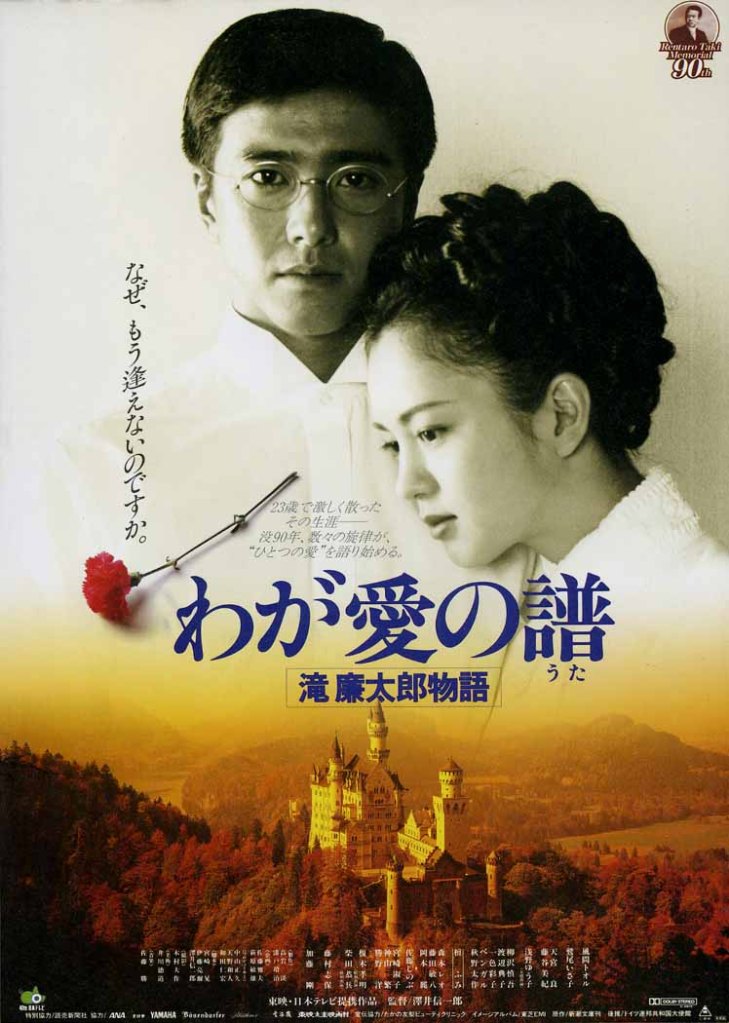
 All those songs and rhymes you learnt as a child, somehow it’s strange to think that someone must have written them once, they seem to just exist independently. In Japan, the name behind many of these familiar tunes is Rentaro Taki – the first composer to set Japanese lyrics to European style “classical” music. It’s important to remember that even classical music was once contemporary, and along with the opening up of the nation during the Meiji era came a desire to engage with the “high culture” of other developed nations. The Tokyo Music School was founded in 1887 and Taki graduated from it just four years later in 1901. However, his career was to be a short one as his health gradually declined until he passed away of tuberculosis at just 23 years old. Bloom in the Moonlight (わが愛の譜 滝廉太郎物語, Waga Ai no Uta: Taki Rentaro Monogatari), also the title of one of his most well known and poignant songs, is the story of his musical career but also of the history of early classic music in Japan as the country found itself in a moment of extreme cultural shift.
Defying his father’s wishes and travelling to Tokyo to pursue a musical education, Rentaro Taki (Toru Kazama) becomes fascinated by the piano and is determined to become a high level pianist. Even knowing how hard it is to conquer the instrument and that many of his contemporaries have been studying since early childhood, Rentaro refuses to lose heart and pushes himself to become the best piano player that he can possibly be. Always a sickly child, Rentaro’s intense devotion to his instrument begins to threaten his health but his ambition knows no limit. The purpose of the school leans more towards the study and dissemination of Western music among ordinary people but soon Rentaro and some of his fellow pupils grow tired of the idea that their role is that of teachers and scholars and begin composing their own work. Rentaro’s songs become what is really the first kind of modern folk music, marrying the European classical music of the foreign elites and the more egalitarian, everyman quality of the accompanying lyrics to create a new kind of Japanese music.
The tale is narrated at times by a fellow pupil, Yuki Nakano (Isako Washio), who encounters Rentaro at the same time as he encounters the piano. The star pupil at the school and sister of an already internationally famous concert pianist, Yuki is nevertheless insecure about her own skills. Rentaro quickly surpasses her though the two become close and eventually a source of mutual inspiration. Adding to the melancholy nature of the tale, Yuki falls in love with Rentaro and his musical intensity but the pair are separated when she is selected as one of the first pupils to be sent abroad to learn from the classical music masters in Germany. A year later, Rentaro is also permitted to go and the pair are briefly reunited but it will be for the last time as Rentaro’s illness intensifies and brings an early end to his musical career.
Times being what they are, Rentaro and Yuki are denied the possibility of pursuing a romance, adding to the theme of poignancy and missed opportunities running through the film. Indeed, the final piece Rentaro composes and which he is still working on right up to the end is for Yuki and is titled “Regret”. Dedicating himself to music above all else, Rentaro leaves behind him a musical legacy but still, as one of his songs puts it, longs for the “brightness of bygone days”.
Rentaro was from a wealthy family, and even if his father did not approve of his decision to study music, he continued to support him even whilst worrying about his constant ill health. Many of his fellow pupils were not so lucky including his good friend Suzuki (Ryo Amamiya) who is forced to leave the school when his father becomes ill leaving him responsible for each of his siblings. Eventually Suzuki is able to return to the world of music as a teacher, playing Rentaro’s folk songs for the local village children and helping to make his friend’s work some of the most well known in Japan.
Little is seen outside of the rarefied world of wealthy students and their internationally focussed cultural pursuits but at times the other world is allowed to slink in, particularly in the case of an inn girl who is charged with looking after Rentaro during one of his periods of convalescence. The girl, Fumi (Miki Fujitani), also becomes fascinated with Rentaro’s intense love music but any attachment on her part can only lead to tragedy. All else aside, Rentaro is the oldest son of a wealthy family and not seriously considering a formal arrangement with someone like Fumi. Eventually she will be sold off as a concubine to a wealthy man, there are no better options for her even in the bright new Meiji era.
As in much of his other work, Sawai neatly avoids the more sentimental elements of the story even if melodrama is a necessary part of its appeal. Bloom in the Moonlight is among his more straightforward efforts sticking to the prestige picture approach without any of the stranger or more expressive sequences which often crop up in films such as W’s Tragedy or Maison Ikkoku. As a neutral biopic, the treatment of its subject is at times superficial, skipping other interesting details of Rentaro Taki’s life such as his late conversion to Christianity preferring to focus on the tragic love story which becomes the genesis of his final, unfinished work. Nevertheless, Bloom in the Midnight succeeds in telling the sad story of a musical genius who poured all of his intensity into a few short years leaving a body of work behind him likely to outlive us all.
Rentaro Taki’s songs are still very popular today and if you’ve spent any time at all watching Japanese films you will definitely have heard them.
One of the most recognisable – Hana
And one of the most well known – Kojo no Tsuki (with footage from Throne of Blood!)
 Kon Ichikawa may be best remembered for his mid career work, particularly his war films The Burmese Harp and
