

“Don’t take any detours,” the hero of Yoshimasa Ishibashi’s Six Singing Women (唄う六人の女, Utau Rokunin no Onna) is warned by his partner though it’s advice he’ll end up not taking if not entirely of his own volition. Even so, it may be that it’s the society that has gone off track, poisoning the environment and losing respect for the land that has always nurtured and protected us. Part eco-drama, Ishibashi’s surreal odyssey into an etherial realm of nature and spirits has its share of eeriness but also a kind of comfort in the embrace of the natural world.
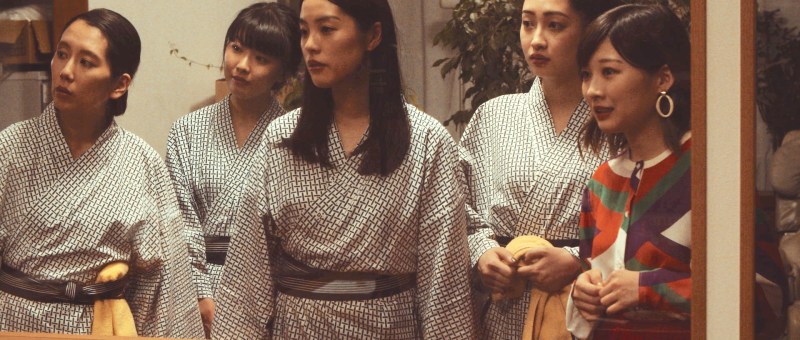
Only that’s not how it first seems to Shin (Yutaka Takenouchi). After receiving a phone call to inform him his estranged father has passed away, he leaves his partner Kasumi (Rena Takeda) at home in Tokyo and travels into the mountains with the intention of selling his father’s house. But when he arrives, he finds himself in a place stranger than your average remote country hamlet and after signing a contract with the slimy Uwajima (Takayuki Yamada) is kidnapped by a band of mysterious, apparently mute women. While he is looked after in the house. Uwajima is tied up in the shed and tortured.
As we later discover Shin and Uwajima are embodiments of light and dark, a protector of nature and its destroyer. When Shin had asked him what Uwajima’s company, which has also bought up all the neighbours’ land, plans to do with his father’s house he tells him they just want to protect nature but his answer is of course ironic. He represents a corporate entity that cares nothing at all for the mountain but is simply looking to make some money by dumping potentially harmful stuff where no one will find it. Realising that his father had been on some kind of quest to stop the corporate take over, Shin begins to investigate his death and the wider fate of the mountain taking him ever deeper into the woods.
What he finds there is a another realm, a place of spirits that seems somehow sacred if dangerous. Unable to speak, the women appear to have a message a for him but it’s only after reconnecting with his father and accepting his legacy that Shin finally begins to understand. His mother had told him that his father had been “possessed by the mountains,” and there may be something in Shin’s mania as if the spirits had indeed taken him over aside from merely captivating him. Yet despite his newfound desire to protect these women as embodiments of a natural order, he is powerless to do so alone and especially against the destructive corporatism of Uwajima.
Ishibashi strays into folk horror territory in that the strange place Shin finds himself in has the trappings of a cult. He witnesses strange rituals and is prevented from leaving a place he cannot understand by the women who cannot speak to him nor explain themselves. Bees, spiders, frogs and snakes surround him with an air of malice but are perhaps trying to protect, both him and themselves or else realising Shin is no threat to them but a prodigal son returning to accept and claim the legacy he sought to reject from a misunderstood father like him possessed by the mountains. Finally he finds the answer to the question his father asked him, in the woods exactly where he said it would be.
His solution runs contrary to that of the estate agent who encouraged him to sell his father’s home, that the world is what it is as if it could not be changed and resisting destructive capitalism is merely foolish when it would be better to take the money and run. Ishibashi rams him message home with his haunting capture of the woods as a dreamlike idyll though not without its sense of darkness while lending an air of surreality to Shin’s ethereal quest with all its owl women and inscrutable ritual that somehow hint at a natural order of things that is deeper and older than our society and with which we tussle at our peril for nature is never quite as passive as we thought for all the compassion it may otherwise hold for its prodigal sons and daughters yet to return to the fold.
Six Singing Women screens in New York July 12 as part of of this year’s JAPAN CUTS.
Trailer (English subtitles)








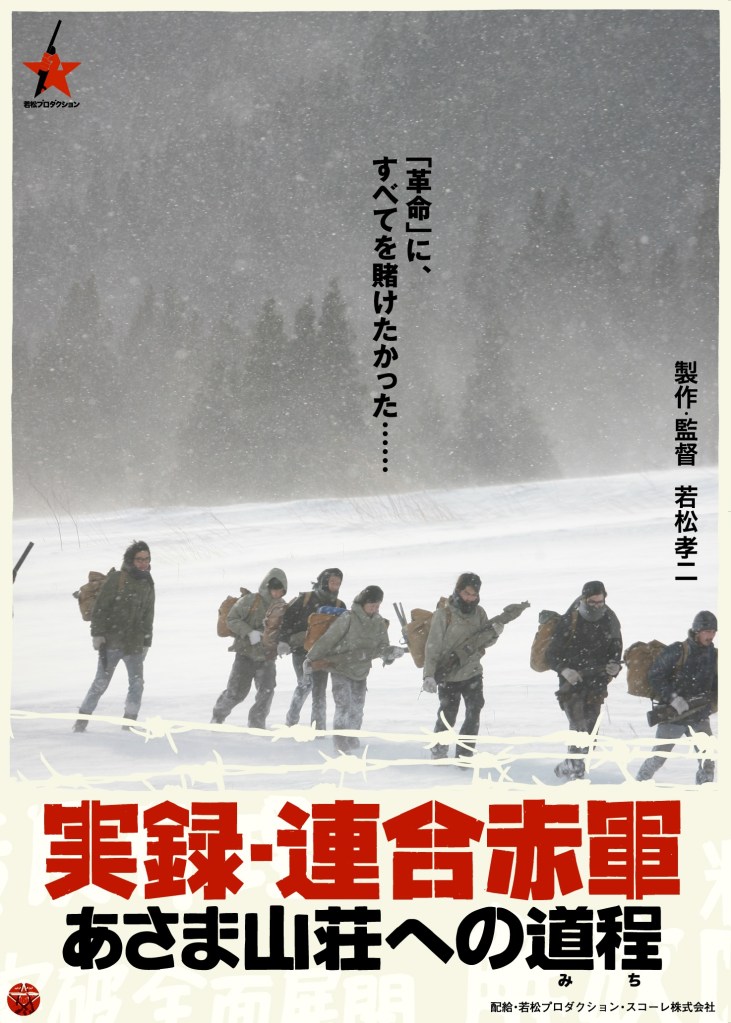 Koji Wakamtasu had a long and somewhat strange career, untimely ended by his death in a road traffic accident at the age of 76 with projects still in the pipeline destined never to be finished. 2008’s United Red Army (実録・連合赤軍 あさま山荘への道程, Jitsuroku Rengosekigun Asama-Sanso e no Michi) was far from his final film either in conception or actuality, but it does serve as a fitting epitaph for his oeuvre in its unflinching determination to tell the sad story of Japan’s leftist protest movement. Having been a member of the movement himself (though the extent to which he participated directly is unclear), Wakamatsu was perfectly placed to offer a subjective view of the scene, why and how it developed as it did and took the route it went on to take. This is not a story of revolution frustrated by the inevitability of defeat, there is no romance here – only the tragedy of young lives cut short by a war every bit as pointless as the one which they claimed to be in protest of. Young men and women who only wanted to create a better, fairer world found themselves indoctrinated into a fundamentalist political cult, misused by power hungry ideologues whose sole aims amounted to a war on their own souls, and finally martyred in an ongoing campaign of senseless death and violence.
 Windows on Worlds