

The landed gentry find themselves haunted by the feudal legacy in Nobuo Nakagawa’s Meiji-era ghost story, Snake Woman’s Curse (怪談蛇女, Kaidan Hebi-onna). Though the figure of the vengeful ghost is rightly feared, they are rarely directly dangerous pushing their targets to damn themselves as they rail against the manifestation of their deeply buried guilt, yet the guilt here is perhaps buried deeper still as those who once had power find themselves floundering in the death throws of feudalism.
As the opening voice over explains, the screen oppressively letterboxed to an extreme degree, the tale takes place in Onuma, a small village yet to be Westernised where the ruling family brutally exploit the tenant farmers still regarded as part of their fief. Old Yasuke (Ko Nishimura) chases after the local lord Onuma (Seizaburo Kawazu) and begs him not to kick him off his land, vowing that even if he has to eat dirt he will repay his debts. Onuma pays him no attention and Yasuke is soon thrown by the wayside after trying to catch hold of his cart. Concussed, all he can do is repeat his pleas not to lose the farm, and though he seems to recover passes away some days later leaving his wife Sue (Chiaki Tsukioka) and daughter Asa (Yukiko Kuwahara) alone. Heartless, Onuma evicts the women and knocks the house down to plant mulberry trees in its place while offering them “jobs” in his household for which they will not be paid for at least 10 years while they work off Yasuke’s debts.
In addition to terrorising the peasants on the land, we discover that the Onumas are also running a sweatshop, a sign on the wall of Asa’s new place of employment reading that she must rise at 4am and be at work by 5 where she must stay until 9pm. There is to be no talking between the women in the workplace. Sue meanwhile is enlisted as a maid, but Onuma’s wife Masae (Akemi Negishi) immediately takes against her while she is continually sexually harassed by Onuma. Like father like son, the young master Takeo (Shingo Yamashiro) has also taken a fancy to Asa, though he is soon to be married to the daughter of the local mayor (Yukie Kagawa), a match all seem to regard as auspicious.
Immediately after his soul vacates his body, Yasuke fetches up to haunt Onuma who is perhaps more affected by his guilt than his feudal upbringing would allow him to admit. Questioned later, he likens the peasants on his land to worms in the earth claiming that the deaths of one or two are no real matter and in any case nothing at all to do with him. “You people can survive drinking water and eating anything” he cruelly snaps back seconds after exclaiming he will fire the entire weaving staff as if that would put an end to the curse, paying little consideration to the fact he’s likely just condemned them to starvation. An exploitative landlord, he cares nothing for his feudal responsibility and all for his privileges. He and his son reserve the right to do as they please, regarding peasant women as theirs to be taken and having no real right to refuse. They do not believe there are any consequences for their actions because they are in a sense above the law of the land.
Yet modernity is coming. We see our first uniformed policemen descend on the village after Sutematsu (Kunio Murai), Asa’s intended before her virtual enslavement through debt bondage, creates a scene at Takeo’s wedding in protest of the family’s treatment of Asa. Onuma’s attempts to reject the authority of the police in refusing their summons, describing it as “rude”, roundly fail, as do his attempts to leverage his feudal privilege in threatening to have the police chief fired in order to avoid answering his questions. His grip on authority is weakening as power necessarily reverts to the mechanisms of the state rendering him in some senses equal with those who till the soil.
Even so, it’s spiritual rather than Earthly justice which will eventually do for him. The ghosts, such as they are, are mere echoes of time repeating the essential messages of the moments in which they died. Yasuke pleads for his land, he does not harm Onuma directly but causes Onuma to harm himself as he thrashes around trying in vain to vanquish a ghost with his gentleman’s cane. The family is, essentially, crushed under the weight of their feudal injustices as their noble house collapses all around them with modernity knocking on the door. Shooting in unusually lush colour, Nakagawa makes the most of his famously effective ghostly apparitions, finally drenching the screen itself in blood, but closes with an image of serenity in which justice of a kind at least has been served leaving the wronged to walk peacefully towards salvation while their tormentors will perhaps be travelling in another direction condemned not only for their own heartless venality but for that of the system that allowed them so ruthlessly to exploit those they ought to have protected.
Original trailer (no subtitles)


 Cops vs Thugs – a battle fraught with friendly fire. Arising from additional research conducted for the first
  Ogami (Tomisaburo Wakayama), former Shogun executioner now a fugitive in search of justice after being framed for treason by the villainous Yagyu clan who are also responsible for the death of his wife, is still on the Demon’s Way with his young son Daigoro (Akihiro Tomikawa). Five films into this six film cycle, the pair are edging closer to their goal as the evil Lord Retsudo continues to make shadowy appearances at the corners of their world. However, the Demon’s Way carries a heavy toll, littered with corpses of unlucky challengers, the road has, of late, begun to claim the lives of the virtuous along with the venal. Conflicted as he was in his execution of a contract to assassinate the tragic Oyuki in the previous instalment,
 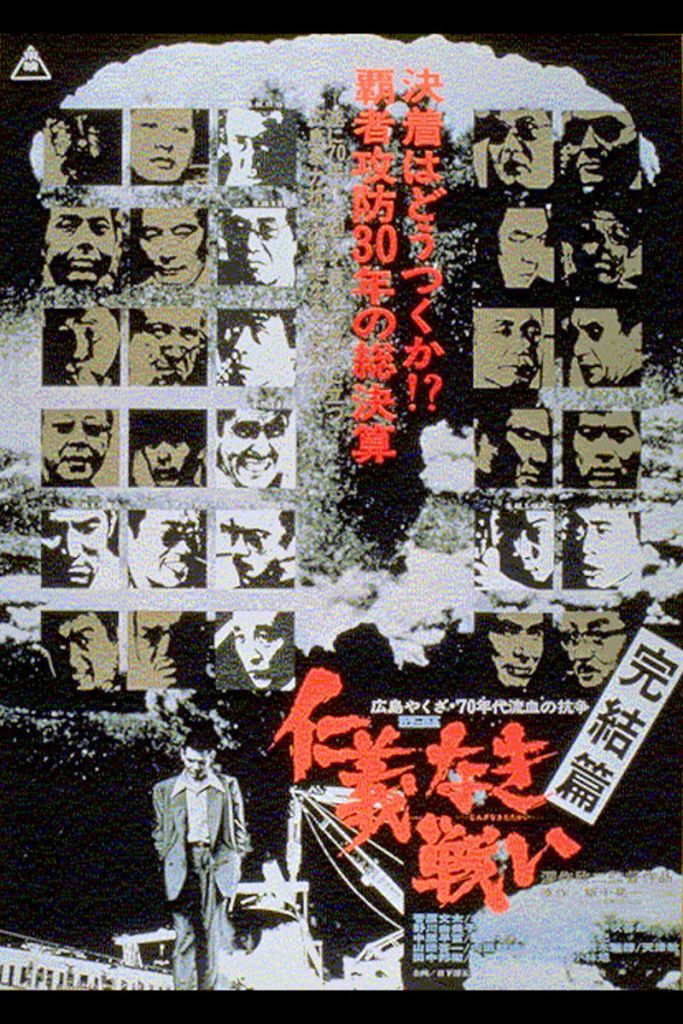 And so, the saga finally reaches its conclusion. Final Episode (仁義なき戦い: 完結篇, Jingi Naki Tatakai: Kanketsu-hen) brings us ever closer to the contemporary era and picks up in the mid ‘60s where Hirono is still in prison and Takeda, released on a technicality, has decided to move the yakuza into the legit arena. The surviving gangs have united and rebranded themselves as a political group known as the Tensei Coalition. However, not everyone has joined the new gangsters’ union and the enterprise is fragile at best.
 It’s 1963 now and the chaos in the yakuza world is only increasing. However, with the Tokyo olympics only a year away and the economic conditions considerably improved the outlaw life is much less justifiable. The public are becoming increasingly intolerant of yakuza violence and the government is keen to clean up their image before the tourists arrive and so the police finally decide to do something about the organised crime problem. This is bad news for Hirono and his guys who are already still in the middle of their own yakuza style cold war.
 Three films into The Yakuza Papers or Battles Without Honour and Humanity series, Fukasaku slackens the place slightly and brings us a little more intrigue and behind the scenes machinations rather than the wholesale carnage of the first two films. In Proxy War we move on in terms of time period and region following Shozo Hirono into the ’60s where he’s still a petty yakuza, but his fortunes have improved slightly.
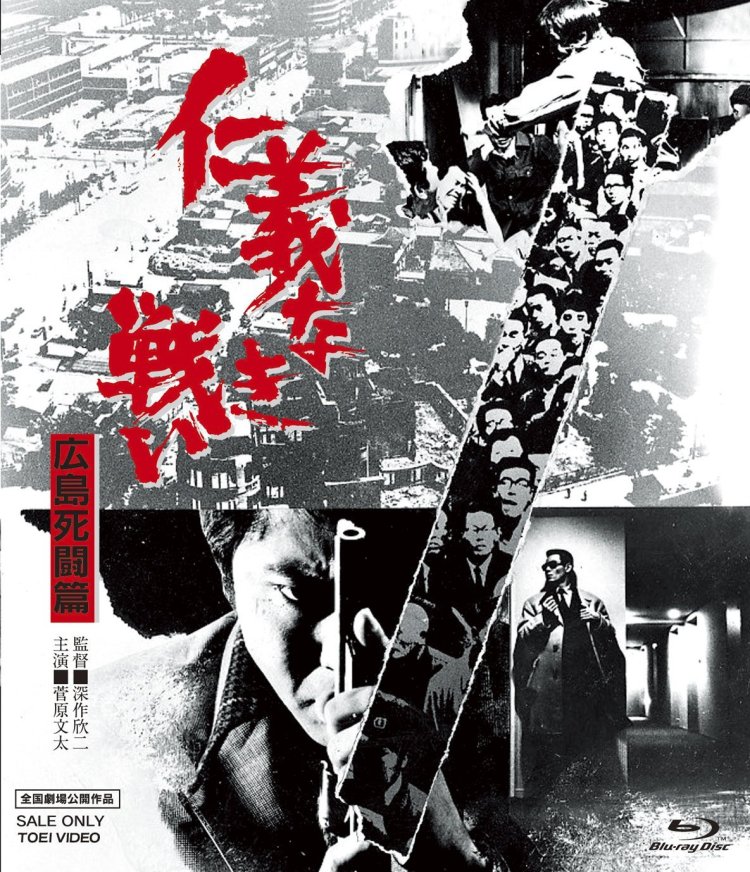 If you thought the story was over when Hirono walked out on the funeral at the end of
  Windows on Worlds