Wolves of the Night (夜の狼, Yoichi Ushihara, 1958)

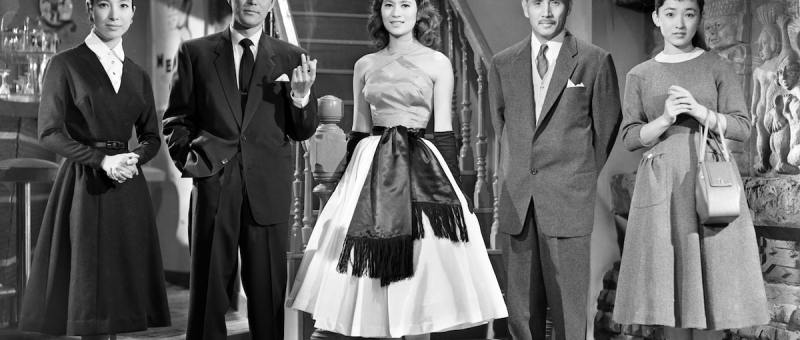
A cold-hearted yakuza starts to get second thoughts when confronted with the misery his actions create in Yoichi Ushihara’s slice of Nikkatsu Noir, Wolves of the Night (夜の狼, Yoru no Okami). Though the hero is ostensibly Tsukida (Ryoji Hayama), the conflicted gangster unable to reconcile himself with the fact that he has fallen in love with a women he himself destroyed, it’s equally about the women who get caught in the crossfire of a burgeoning gang war and are each victims of male greed and indifference.

In any case, gang boss Tachibana (Somesho Matsumoto) brings a lot of this on himself. The secondary narrative revolves around a woman, Takako (Mari Shiraki), who borrowed money from the Manji gang to build her bar, but now that it’s complete Tachibana swindles her by calling in the debt and foreclosing on the property, passing ownership to Tsukida with instructions to kick Takako out. She, however, doesn’t take well to this and is resentful of Tachibana for screwing her over so she vows revenge. Her original attempt to get it by seducing Tsukida doesn’t work out, so she recruits a yakuza from a rival gang to extort them claiming that they have mole and he’ll only reveal their identity when they hand over the cash. This plan has some pretty tragic consequences and not least for Tachibana himself, but none of this would have happened if he hadn’t behaved so badly in cheating Takako out of the bar she worked so hard to build. He’d also told Tsukida that the bar owner was a beauty and it was understandable if wanted to try seducing her. 

But by this point Tsukida has developed a fondness for Katsumi (Izumi Ashikawa), a young woman he first meets when she’s caught by some of his guys offering herself for sex work in their territory. The other ladies describe Katsumi as “odd” and “an outsider”. It’s clear from her behaviour and the way she’s dressed, not to mention a lack of awareness of the rules of the gang, that she’s never done this before and is terrified. Tsukida calls his men off and tells her to go home, but later realises that it’s his own fault she was put in this situation because he was responsible for collecting the debt her parents owed to Tachibana taken out because her father is bedridden. Tsukida seems shaken by the old lady’s intense resentment, but still takes their money if attempting to convince Tachibana not to pursue them any further because they have nothing left to give, correctly assuming that Katsumi resorted to sex work to get the money. 

It maybe the sense of guilt that proved the last straw as the old couple then take their own lives but rather than freeing her lead Katsumi on a lonely path of self-destruction driven only by her hated for Tachibana and Tsukida. The fact that she later becomes ill further emphasises her positioning as a symbol of a despoiled nation poisoned by the ruthless inhumanity of the post-war society, along with literal a embodiment of Tsukida’s guilty conscience. Tsukida rejects Takako as a person more like himself, an example of corrupted femininity using her body to manipulate men in a world in which a woman has little other power, and instead is drawn to Katsumi who was once innocent, demure, and cheerful but who he himself has destroyed through his own greed and heartlessness.

Spending some time in hospital following a failed suicide attempt seems to heal her in body body and soul, though the total about face in Katsumi’s feelings for Tsukida seems somewhat bewildering even if he did visit her every day and presumably win her over despite her resentment towards him for contributing to her parents’ deaths. Nevertheless, it’s his feelings for Katsumi that see Tsukida longing to quit the yakuza and retreat to the country to live a small, honest life with her free of the city’s corruption. But as so often in the movies, it’s not that simple and this time it’s a tragic consequence born of male failure and insecurity that eventually costs him his shot at a normal life even as his frenemy, a local policeman he often sees in the same bar and gives him unsolicited advice about how he should quit the yakuza, remains surprisingly supportive suggesting that his redemption may merely be on hold rather than cancelled. In any case, though shooting almost entirely on stage sets, Ushihara makes good use of stock footage of contemporary Ginza as a place of bright lights and equally dark shadows where gangsters lurk on every corner and mercy is in desperately short supply.

The Eagle and the Hawk (鷲と鷹, Umetsugu Inoue, 1957)

Strapping sailors meditate on revenge and forgiveness while trapped aboard a moribund cargo ship in Umetsugu Inoue’s otherwise charming musical youth drama, The Eagle and the Hawk (鷲と鷹, Washi to Taka). One of several films Inoue released starring muse of the moment Ishihara, the film uses the boat as a kind of metaphor for a reluctance to deal with the unfinished past as several of its crew members are actively engaged in a self-imposed limbo wilfully remaining in a transient space floating between two harbours with no plans to disembark. 

This is most obviously true for the zombified Ken (Kinshiro Matsumoto) who wanders around the boat in a depressive daze unable to get over a girlfriend who left him for another man though as it turns out the bosun too is hiding out at sea waiting for the statue of limitations to run out on the murder of his lover 30 years previously. When two new recruits show up from the sailors union despite only one having been requested, many are under the assumption that they too are running from something on land though the boat itself is a confined environment from which there is no real escape so it’s also an ideal space for confrontation. 

The thing they may be running from is the murder of the boat’s chief engineer in the film’s noirish opening sequence in which a middle-aged man in a sailor’s cap is stalked by a youngster in jeans before being knifed with a ceremonial dagger. If they were running from that particular crime, it might be ironic that they chose this particular boat but then as the murdered man’s son, First Mate Goro (Hiroyuki Nagato), discovers the dagger was part of a set and the other one’s owned by the captain who seems very alarmed by the whole affair. Meanwhile, the captain’s daughter, Akiko (Ruriko Asaoka), has secretly stowed away along with Akemi (Yumeji Tsukioka), the heartbroken former girlfriend of one of the two new guys, Senkichi (Yujiro Ishihara). 

Women are regarded as unlucky on board, and it’s not difficult to guess why with Goro offering strict instructions to the new guys not to try anything with Akiko while one of the other sailors later attempts to rape Akemi with a palpable desperation existing within the crew. There is also a degree of homoerotic tension between the two new guys, the other being Sasaki (Rentaro Mikuni) who typically walks around shirtless in a pair of tight jeans and works hard to give the impression of having a mysterious past all of which leads Senkichi to suspect he’s an undercover cop possibly there after him or one of the other crew members though unbeknownst to (almost) everyone there is another crime in motion on board. 

As usual, it’s the past that’s come calling with Senkichi on the boat ironically running towards rather than away from a confrontation while others desperately try to cover up their crimes or deflect their responsibility for the dodgy dealings of their youth. Both Senkichi and Sasaki immediately remark that the boat’s a “junker” as soon as they get on board, implying that it too is on its way out, its disrepair a sign of its captain’s lack of respect and care for ship and crew alike. Then again, it seems the crew were intent on drinking half the cargo, most of them clearly happy in their work and enjoying a pleasant sense of camaraderie even on this crummy ship and its presumably not quite above board trip to Hong Kong which might hint at why Akemi shows up in cheongsam though for stowaways both women seem to have brought extensive wardrobes which in all honesty are not particularly well suited to life at sea. 

In any case, the boat becomes an unexpected place of healing and forgiveness largely brokered by manly magnanimity as Goro, on learning the truth behind his father’s murder, accepts that the killer’s motivations are “understandable” even while cautioning them against the fallacy of revenge which he insists will only create more hate and violence. He’s also fairly okay with Senkichi romancing his girl, Akiko, who sadly tells him she sees him more like a brother and isn’t interested in marrying him even if that’s what her father also expects neatly reflecting the dynamic which arises between Akemi and the lovelorn Ken who begins to cheer up and consider leaving the boat to open a transistor radio shop only for Akemi to describe him as a little brother while continuing to chase Senkichi despite his interest in Akiko. An expressionistic storm scene provides some divine justice, but also provokes a bittersweet romantic resolution which suggests it’s time to get off the boat and the face the past but with a kind of cheerfulness for the future otherwise at odds with the rage and violence of the original crime. Of course, this being a vehicle for Yujiro Ishihara, Inoue works in a few romantic scenes with his ukulele and a mournful song about the moon and ocean but finally sends him back to dry land a little more “grounded” for having found his sea legs.


The Balloon (風船, Yuzo Kawashima, 1956)

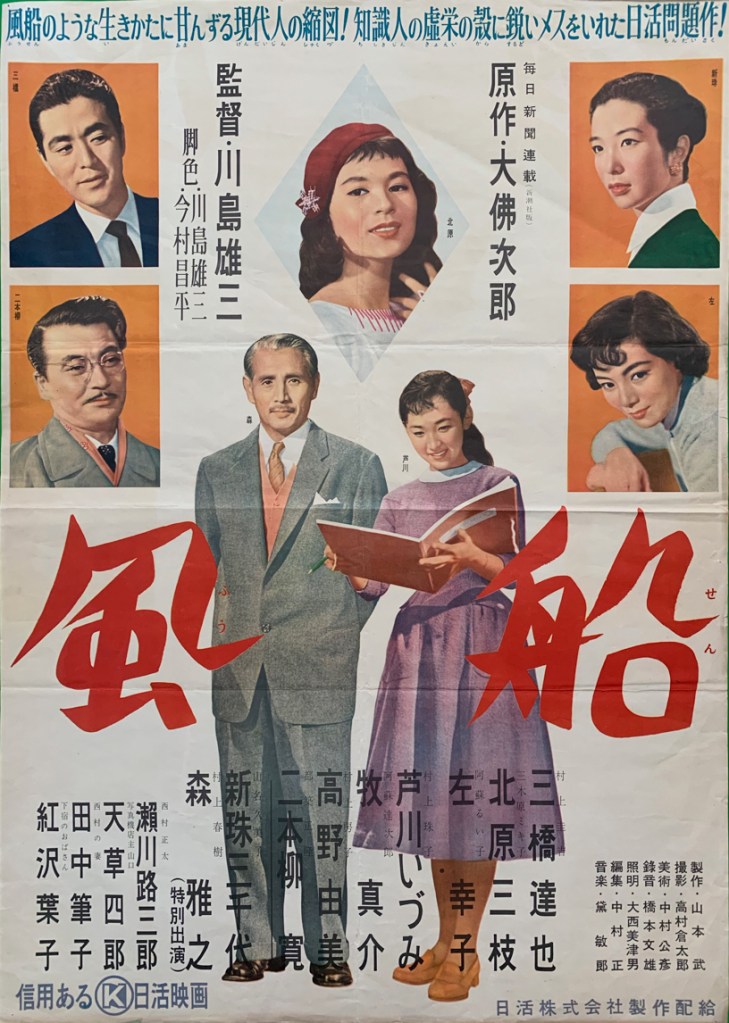
The uncertainties of the post-war world are often conveyed through the familiar “cloud” metaphor, but in characteristic fashion Yuzo Kawashima opts for something earthier in the manmade “Balloon” (風船, Fusen). Less representative of its troubled humanists than the amoral villain Tsuzuki (Hiroshi Nihonyanagi) who likes to know which way the wind is blowing so he can go that way too, these balloons are up in the air because they’re afraid to land fearing the inevitable pop if they pick the wrong spot.

Our hero, former painter Murakami (Masayuki Mori), has become the head of a successful camera firm. His son, Keikichi (Tatsuya Mihashi), works with him, while his 20-year-old daughter Tamako (Izumi Ashikawa) is a reluctant student still living in the family home. Out of step with his times, he’s known as a decent and compassionate boss, offering his staff a significant wage increase in excess of that recommended by the union just because he thinks it’s the right thing to do. Unfortunately, Keikichi is much more like his conservative mother and does not quite share his father’s egalitarian principles. He’s currently engaged in a “relationship” with widowed bar hostess Kumiko (Michiyo Aratama) but treats her extremely badly, throwing money on the side table as he leaves her apartment to make it clear that he views himself as a customer and not as a lover. When Murakami re-encounters a family friend, Tsuzuki, at his father’s funeral it sets off a chain of events that will change his life completely. Now a shady nightclub entrepreneur, Tsuzuki is dead set on making his singer, Mikiko (Mie Kitahara), a star and thinks a good way to help make that happen might be to get her married to someone with money, like, for instance, Keikichi. 

Raised in Shanghai, singing in French, and forever wearing berets, Mikiko may indeed be the face of avaricious post-war youth, apparently having floated along with Tsuzuki halfway across the world in search of a place in the sun. Urged on by her manager, she goes to war against Kumiko who, in contrast to the “bar girl” image, is earnest and naive. Working as a hostess places her on the fringes of the sex trade, but does not necessarily imply that she makes a living by sleeping with her customers, and she certainly seems less than grateful to receive money from Keikichi whom she believes to be her boyfriend. Mikiko willingly weaponises her sex appeal and seemingly endures no consequences for doing so, while Kumiko is roundly rejected as a “fallen woman” and deemed an unsuitable match by Keikichi’s snooty mother. 

Tamako, by contrast, actively reaches out to Kumiko and attempts to make her a member of the family, never for a second considering that she might not be welcome because she can see that Kumiko is a “nice” person. Much more like her kindly father, she finds herself uncomfortable at home and mostly holes up in the attic painting. After suffering childhood polio, she’s been left with muscle weakness in her left arm and is treated like a child by her mother and brother who openly tell people that the illness has also made her “simple”. Despite all that, however, she sees only the best in people and desperately wants those around her to be happy. 

The difference in her own family is brought home to her when her father takes her with him on a business trip to the much quieter, more traditional Kyoto where he has reunited with a pair of youngsters whose late parents once rented him a room when he was temporarily displaced by post-war confusion. Like Kumiko, Rui (Sachiko Hidari) is a kind person in difficult circumstances. She too is working in a bar and has done some work as a photo model, even glamour shots to earn money to pay her brother’s university fees. Rui doesn’t want to go on doing that in the future, but doesn’t feel too bad about it either because she only exposed the outside of herself, and really who cares about that. 

Beginning to regret some of his life choices, Murakami wonders if he mightn’t be better to move back into the attic room in Kyoto and pray at the temple everyday like before instead of trying to make money he feels has slowly corrupted his family. Confronted with Keikichi’s near sociopathic self-involvement over his relationships with Kumiko and Mikiko, he comes to the conclusion that all he can do is cut him loose and hope he learns some humility through being forced to stand on his own two feet. Given a talking to by his father Keikichi doubles down with his misogynistic world view, insisting that “all women are whores” and all relationships are essentially transactions while claiming that he, himself, as well as men in general, is the real victim because he’s being forced to carry the can for the way the world works. Murakami isn’t having any of it, calmly asking him if he’d say the same thing to his mother, which he sheepishly admits he couldn’t. 

Mikiko likens Tsuzuki to one off his metaphorical balloons, pointing out that he was an imperialist in Shanghai and now seems to have it in for the bourgeoisie, but for all his cynicism he seems to have a kind of admiration for a woman like Kumiko who carried on loving one man no matter how poorly he treated her. If only he had a woman like that, he might have found a place to land and his life would have been very different, he muses. Murakami, meanwhile, has rejected the modern city, certain that his son is the way he is because his life has been too easy and access to wealth has given him a superiority complex that’s put him out of touch with ordinary people. Disappointed with his own family, he decides to make a new one with the two cheerful youngsters in Kyoto, hoping that he will at least be able to save his daughter from the ravages of a rapidly declining society which seems primed to swallow the sensitive whole.


Currently available to stream on Mubi in the US.

Blackmail is My Life (恐喝こそわが人生, Kinji Fukasaku, 1968)

81eOlRLzY4L._SL1200_Suffice to say, if someone innocently asks you about your hobbies and you exclaim in an excited manner “blackmail is my life!”, things might not be going well for you. Kinji Fukasaku is mostly closely associated with his hard hitting yakuza epics which aim for a more realistic look at the gangster life such as in the Battles Without Honour and Humanity series or his bloody tale of high school warfare, Battle Royale but he also made a few comedies too and often has his tongue firmly in his cheek. Blackmail is My Life (恐喝こそわが人生, Kyokatsu Koso Waga Jinsei) is nominally a crime film, it follows the adventures of a group of young people having a lot of fun doing crime and crime related activities, but the whole thing’s so flippant and ironic that it threatens to drown itself in late ‘60s cool. It doesn’t, of course, it swims around in it whilst looking cool at the same time.

Shun starts the film with a slightly melancholy voiceover (a technique much borrowed in the ‘90s). He was young, he was ambitious but the best thing was he had friends who were more like family. He breaks up with his girlfriend and mopes about his awful job cleaning toilets at a cabaret bar but one day he overhears something about a scam going on with the whiskey they’ve been selling. Shun spots a business opportunity to get his own back on the cabaret owners and get some dough in the process. So begins his life as a petty blackmailer and it’s not long before he’s got his three best mates trapping businessmen into compromising situations so they can film it and blackmail them. The gang carry out petty crime and everything would probably be OK for them if they had stuck to shallower waters, not tried to get revenge for a family member’s death and, crucially, known when they were in way over their heads. Could it really ever be any other way for a self confessed small time punk?

Shun is a bit of an odd duck really. As a girlfriend points out, he’s always thinking about the past like an old man rather than the future, like a young one. He has an irreverent attitude to everything and a vague sense of entitlement mixed with resentment at having missed out in Japan’s post-war boom town. The blackmailing not only allows him to feel smugly superior to everyone else as if he’s some kind of mastermind trickster, but of course also allows him to live the highlife on the proceeds with far less time spent working himself to the bone like the average salaryman.

However, he also has this unexplained sadness, almost as if he’s narrating the film from the point of view of its ending despite being smack in the middle of it. When thinking of happy things he always comes back to his gang of friends enjoying a joyful, innocent day on the beach but later he starts having flashes of rats drowned in the river. Somehow or other he fears he’ll end here, dead among the detritus of a world which found no place for him. He tries to convince himself he’s bucking the system, trying to start a revolution for all the other young punks out there but at the end of the day he’s just another hungry scrapper terrified he’s going to land up on the trash heap.

Like a lot of Fukasaku’s other work, Blackmail is My Life is bright and flashy and cool. Full of late ‘60s pop aesthetics, the film seems to have a deep affinity with the near contemporary work of Seijun Suzuki, in fact one of the characters is always whistling Tokyo Nageremono, the theme tune to Suzuki’s pop art masterpiece Tokyo Drifter. Having said that Fukasaku swaps nihilistic apathy for a sort of flippant glibness which proves a much lighter experience right through until the film’s fairly shocking (yet inevitable?) ending.

Not quite as strong as some of his later efforts, Blackmail is My Life nevertheless brings out Fukasaku’s gift for dynamic direction though the comparatively more mellow scenes at the sea are the film’s stand out. Pulling out all the stops for his crazed, POV style ending with whirling cameras and unbalanced vision Fukasaku rarely lets the tension drop for a second as Shun and co. get hooked on crime before realising its often heavy tarrifs. Another bleak and cynical (though darkly comic) look at the unfairness of the post-war world, Blackmail is My Life may not rank amongst Fukasaku’s greatest achievements but it wouldn’t have it any other way.


Blackmail is My Life is available with English subtitles on R1 US DVD from Homevision and was previously released as part of the Fukasaku Trilogy (alongside Black Rose Mansion and If You Were Young: Rage) by Tartan in the UK.