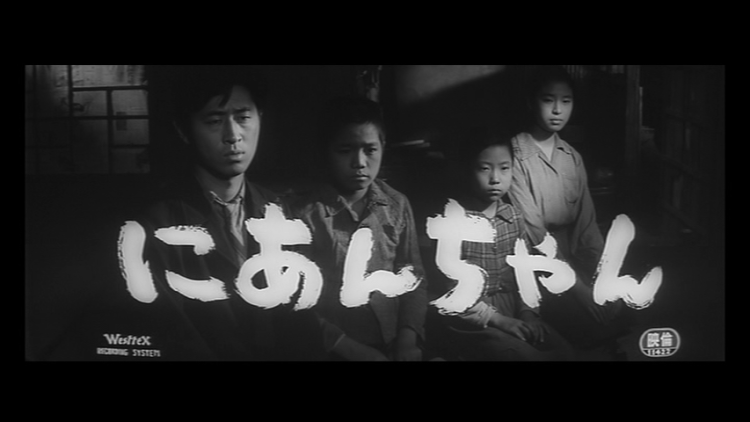
My Second Brother (にあんちゃん, Shohei Imamura, 1959)

vlcsnap-2017-01-07-22h53m01s073Like most directors of his era, Shohei Imamura began his career in the studio system as a trainee with Shochiku where he also worked as an AD to Yasujiro Ozu on some of his most well known pictures. Ozu’s approach, however, could not be further from Imamura’s in its insistence on order and precision. Finding much more in common with another Shochiku director, Yuzo Kawashima, well known for working class satires, Imamura jumped ship to the newly reformed Nikkatsu where he continued his training until helming his first three pictures in 1958 (Stolen Desire, Nishiginza Station, and Endless Desire). My Second Brother (にあんちゃん, Nianchan), which he directed in 1959, was, like the previous three films, a studio assignment rather than a personal project but is nevertheless an interesting one as it united many of Imamura’s subsequent ongoing concerns.

Set in the early 1950s, the film focuses on four children who find themselves adrift when their father dies leaving them with no means of support. The father had worked at the local mine but the mining industry is itself in crisis. Many of the local mines have already closed, and even this one finds itself in financial straits. Despite the foreman’s promise that he will find a job for the oldest son, Kiichi (Hiroyuki Nagato), there is no work to be had as workers are being paid in food vouchers rather than money and strike action frustrates what little production there is. After receiving the unwelcome suggestion of work in a “restaurant” in another town, Yoshiko (Kayo Matsuo) manages to find a less degrading job caring for another family’s children (though she receives only room and board, no pay for doing so). With younger brother Koichi (Takeshi Okimura) and little sister Sueko (Akiko Maeda) still in school, it seems as if the four siblings’ days of being able to live together as a family may be over for good.

Based on a bestselling autobiographical novel by a ten year old girl, My Second Brother is one of the first films to broach the Zainichi (ethnic Koreans living in Japan) issue, even if it does so in a fairly subtle way. The four children have been raised in Japan, speak only Japanese and do not seem particularly engaged with their Korean culture but we are constantly reminded of their non-native status by the comments of other locals, mostly older women and housewives, who are apt to exclaim things along the lines of “Koreans are so shiftless” or other derogatory aphorisms. Though there are other Koreans in the area, including one friend who reassures Kiichi that “We’re Korean – lose one job, we find another”, the biggest effect of the children’s ethnicity is in their status as second generation migrants which leaves them without the traditional safety net of the extended family. Though they do have contact with an uncle, the children are unable to bond with him – his Japanese is bad, and the children are unused to spicy Korean food. They have to rely first on each other and then on the kindness of strangers, of which there is some, but precious little in these admittedly difficult times.

In this, which is Imamura’s primary concern, the children’s poverty is no different from that of the general population during this second depression at the beginning of the post-war period. The film does not seek to engage with the reasons why the Zainichi population may find itself disproportionately affected by the downturn but prefers to focus on the generalised economic desperation and the resilience of working people. The environment is, indeed, dire with the ancient problem of a single water source being used by everyone for everything at the same time with all the resultant health risks that poses. A young middle class woman is trying to get something done in terms of sanitation, but her presence is not altogether welcome in the town as the residents have become weary of city based do-gooders who rarely stay long enough to carry through their promises. The more pressing problem is the lack of real wages as salaries are increasingly substituted for vouchers. The labour movement is ever present in the background with the Red Flag drifting from the mass protests in which the workers voice their dissatisfaction with the company though the spectre of mine closure and large scale layoffs has others running scared.

One of the most moving sequences occurs as Koichi and another young boy ride a mine cart up the mountain and talk about their hopes for the future. They both want to get out of this one horse town – Koichi as a doctor and his friend as an engineer, but their hopes seem so far off and untouchable that it’s almost heartbreaking. Sueko skipped school for four days claiming she had a headache because her brother didn’t have the money for her school books – how could a boy like Koichi, no matter how bright he is, possibly come from here and get to medical school? Nevertheless, he is determined. His father couldn’t save the family from poverty, and neither could his brother but Koichi vows he will and as he leads his sister by the hand climbing the high mountain together, it almost seems like he might.
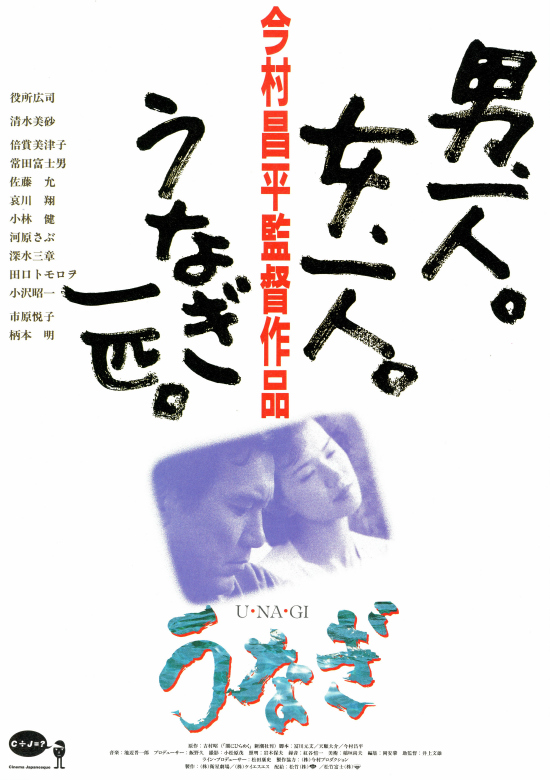


The Eel (うなぎ, Shohei Imamura, 1997)

The EelDirector Shohei Imamura once stated that he liked “messy” films. Interested in the lower half of the body and in the lower half of society, Imamura continued to point his camera into the awkward creases of human nature well into his 70s when his 16th feature, The Eel (うなぎ, Unagi), earned him his second Palme d’Or. Based on a novel by Akira Yoshimura, The Eel is about as messy as they come.
Mild-mannered salary man Yamashita (Kouji Yakusho) receives a handwritten letter filled with beautiful calligraphy delivering the ugly message that his wife has been entertaining another man whilst he enjoys his weekly all night fishing trips. Confused at first, the note begins to work its way into Yamashita’s psyche and so he decides to leave his next fishing trip a little earlier than usual. Peeping through the keyhole, he finds his beloved wife enjoying energetic, passion filled sex with another man. Drawing a knife from a nearby shelf, he enters the room and attacks the pair killing the woman but letting the lover get away.

Yamashita immediately and with perfect calmness turns himself in at the local police station, still covered in his wife’s blood and carrying the murder weapon. Released on a two year probationary period after eight years in jail, there is no one to meet Yamashita when he comes out and so he remains under the guardianship of a Buddhist priest in a nearby town. Accompanied by his only friend, a pet eel, Yamashita takes possession of a local disused barbershop and sets about trying to rebuild his life.

Things change when Yamashita comes across an unconscious woman lying in the grass while he’s out looking for things to feed his eel. The strange thing is, this woman looks exactly like his wife. Eventually, Keiko (Misa Shimizu) recovers and comes to work with Yamashita in his new enterprise but as the pair grow closer the spectres of both of their troubled pasts begin to intrude.

As the small town residents of Yamashita’s new home often remark, Yamashita is a strange man. His deepest relationship is with his eel which the prison guards, who seem quite well disposed towards him, allowed him to keep in the prison pond even though pets are not generally allowed. When asked why he likes his eel so much, Yamshita replies that the eel listens to him and doesn’t tell him the things he does not wish to hear. Like Yamashita, the eel is isolated inside his tank, content to absent himself from interacting with other creatures, both protected and constrained by transparent walls.

After his release from prison, Yamashita begins to reflect on his crime which he doesn’t so much regret but has no desire to repeat. His other double arrives in the form of fellow inmate and double murderer Tamasaki (Akira Emoto) who keeps trying to convince Yamashita that he is living dishonestly by not having visited his wife’s grave or read sutras for her. Though Yamashita pays no heed to most of his advice which is more self-pity and anger than any real concern for Yamashita’s soul, some things begin to get to him, most notably that perhaps the fateful letter never existed at all and is nothing more than the manifestation of Yamashita’s jealous rage.

Though the film presents everything that happens to Yamashita as “real”, his state of mind is continually uncertain. Not only is the provenance of the letter doubted, he doubts the existence of Keiko because she looks (to him at least) like the returned ghost of the woman he killed, and even the final confrontational arguments with Tamasaki take on an unreal quality, as if Yamashita were arguing with himself rather than another man who also represents his own worst qualities – impulsivity, violence, self doubt and insecurity. The film is so deeply embedded in Yamashita’s subjective viewpoint that almost nothing can be taken at face value.

Yamashita is, in a sense, trapped in a hall of mirrors as his own faults are reflected back at him through the people that he meets. Keiko, rather than being physically murdered by a jealous lover, attempted to take her own life after being misused by a faithless (married) man. Her past troubles are, in some ways, the inverse of Yamashita’s as she finds herself at the mercy of dark forces but internalises rather than externalises her own anger. Cheerful and outgoing, she quickly turns Yamshita’s barbershop into a warm and welcoming place which the local community takes to its heart.

Yamashita, however, remains as closed off as ever though he does strike up something of a relationship with a lonely young man who wants to use his barber’s pole to try and call aliens. When Yamashita asks him what he’s going to do if the aliens actually come, the young man replies that he wants to make friends with them. Yamashita astutely remarks that the young man’s desire to meet aliens is down to a failure to connect with people from his own planet – an idea which the young man equally fairly throws back at him. Perhaps out of fear rather than atonement, Yamashita exiles himself from the world at large though gradually through continued exposure to the genial townsfolk and Keiko’s deep seated faith in him, he does begin to swim towards the surface.

Imamura adopts his usual, slightly ironic tone to lighten this otherwise heavy tale allowing the occasional comic set piece to shine through. Yakusho delivers another characteristically nuanced performance as this entirely unformed man, unsure of reality and trapped in a spiral of self doubt and confusion. His original crime of passion is at once chilling in its calmness but also messy and violent as he gives in to animalistic rage. After showing us a street lamp glowing an ominous red, Imamura steeps us in blood as his camera becomes progressively more stained making it impossible to forget the shocking betrayal of this unexpected violence.

Yamashita remarks at one point that he died that day alongside his wife. The Eel is a story of rebirth as its protagonists begin to swim towards the shore in support of each other, though like the titular marine creature there is no guarantee that they will make there alive. Yamashita is a cold blooded murderer and creature of suppressed rage yet Imamura is not interested in moral judgements as much as he is in the messier sides of human nature. A chance offering of redemption for the unredeemable, The Eel offers hope for the hopeless in a world filled with goodhearted eccentrics where all faults are forgivable once they are understood.


Original trailer (no subtitles)

https://www.youtube.com/watch?v=yAC3KZth7E0

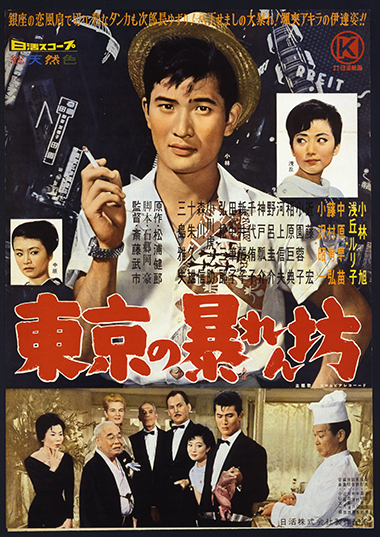
Tokyo Mighty Guy (東京の暴れん坊, Buichi Saito, 1960)

Tokyo Mighty GuyThe bright and shining post-war world – it’s a grand place to be young and fancy free! Or so movies like Tokyo Mighty Guy (東京の暴れん坊, Tokyo no Abarembo) would have you believe. Casting one of Nikkatsu’s tentpole stars, Akira Kobayshi, in the lead, Buichi Saito’s Tokyo Mighty Guy is, like previous Kobayashi/Saito collaboration The Rambling Guitarist, the start of a franchise featuring the much loved neighbourhood big dog, Jiro-cho.

In this first instalment, Jiro (Akira Kobayashi) has just returned from some overseas study in Paris where, rather than the intellectual pursuits that he planned, Jiro mostly wound up with a love of French cuisine. His parents have just opened a small French restaurant in fashionable Ginza and Jiro is now working there too despite the more lucrative paths that might be open for someone with a college education, language skills and overseas experience.

Jiro is also a hit with the ladies, and the daughter of the family that run a nearby bathhouse, Hideko (Ruriko Asaoka), has quite a crush on him though Jiro seems fairly oblivious to this fact despite her revealing to him that her family have received an offer of arranged marriage. After a high ranking official crashes his car into the family restaurant, Jiro becomes embroiled in a series of complicated local political and shady business plots which conflict strongly with his righteous and individual nature.

Tokyo Mighty Guy begins with a cute musical title sequence that would be much more at home in a glossy musical of the time than in a smalltime gangster flick which is what lurks around the edges of this feel good, youthful tale. Indeed, Kobayashi gets ample opportunity to show off those pipes as he sings to himself alone in the male side of the bathhouse and later repeats snatches of the song throughout the film. There’s a single being peddled here, but it’s being done in a fun, if unsubtle, way.

Jiro is very much a man of his age. He’s the big man in the neighbourhood – middle class, educated, studied abroad, likes the finer things such as foreign food and sharp suits, but he’s got the words social justice engraved on his heart so you know you can go to him with your troubles and he’ll help you figure them out. He doesn’t take any nonsense from anyone; he sends the yakuza protection mob packing and even convinces one of them to go straight with a trainee chef job in his restaurant. No wonder the animal loving former politician has taken such a liking to him – he’s the kind of man it’s hard not to like.

That’s not to say Jiro’s a saint, he’s out for himself just like everyone else. We can see how much distress there is for others when we venture into a rundown tenement filled with the genuine poor who have too many children and not enough resources. Actually, the film isn’t terribly kind about these people and treats them more or less as an embarrassing joke but it does demonstrate how the bigwigs have exploited the needs of the lower orders in more ways than one. Jiro, at least, won’t stand for this kind of deception and misuse of traditional social bonds but he will still use it as leverage to bring things to a fittingly ironic solution that is to the benefit of everyone aside from those that were originally in the wrong.

Cute and quirky is definitely the theme and even where there are darker elements, the cheerful atmosphere is tailor made to eclipse them. Saito doesn’t roll out any particularly impressive directorial tricks but allows the absurd humour of the script to do his work for him, highlighting it with surreal touches such as the face of an absent lover appearing in the moon or the celebratory feeling of hundreds of advertising leaflets dropping from the sky like confetti. Light and fluffy as it is, Tokyo Mighty Guy is time capsule from the socially mobile youth of Tokyo in 1960 who don’t want arranged marriages or to take over the family business. The world has opened up for them with a new vista of foreign culture and multicultural cool. The message is clear, the future belongs to guys like Jiro, and by extension to the Jiro wannabes lining up to watch him prosper from their cinema seats.


Tokyo Mighty Guy is the first of three films included in the second volume of Arrow’s Nikkatsu Diamond Guys box set.

Robinson on the Beach (砂の上のロビンソン, Junichi Suzuki, 1989)

Robinson on the Beach

“Family Drama” is often said to be the mainstay of Japanese film. From Ozu to Koreeda, drama in the basic social unit has often been exploited to create a wider dialogue about society at large. However, In the wake of Yoshimitsu Morita’s condemnation of modern family values in The Family Game the nature of the conversation shifted. As Japan eased into its bubble era, concerns began to grow about what exactly the rise of consumerism meant for traditional values. Robinson on the Beach (砂の上のロビンソン, Suna no Ue no Robinson, AKA A Sandcastle Model Family Home) takes things one step further than The Family Game in that it repackages the entire idea of “the ideal family” as something that can itself be bought and sold and therefore manipulated as the perfect marketing tool.

At the beginning of the film, the Kidos are a fairly ordinary lower middle class family of five all living a modest apartment. They’re a little cramped – in fact so much so that mum and dad have to sneak into the wardrobe to get some alone time together just watching movies on a tiny TV set and sharing a set of earphones between them. The kids are always at each other’s throats but broadly they’re happy. However, when both husband Shouhei and wife Ryoko spot an advert for a new scheme which promises a “free” house to a “model family” they decide that this is their best chance at a new life. The deal does have a few drawbacks – they all have to play the part of a perfect family for a whole year and let the public into their lives to prove it.

Things were a little more innocent back in 1989. Reality TV hadn’t yet kicked in and the Kido’s don’t quite understand what it is they’re letting themselves in for when they agree to this too good to be true offer. The house they’ve been given is a veritable mansion – a huge, sprawling Western style home with a bedroom each for the children, a dedicated study for Shouhei and as many walk-in closets as anyone could wish for. However, the cars in the garage are only for show and even if the house is in the same general area as their old flat, Shouei still has to cram himself inside the sardine tin of the morning commuter train every day just like before.

He does at least have the luxury of being allowed to leave the house, unlike Ryoko who becomes a bizarre “first lady” to this new show home empire expected to play a role somewhere between real estate agent and princess as she welcomes prospective buyers and allows them to poke and prod all over her nice new home spreading thinly veiled judgement wherever they go. Suddenly she has people going through her fridge and oggling her washing left hanging up to dry . The liaison lady from the company even has the gaul to criticise Ryoko’s nightwear as “frumpy” and orders her to buy something a little more glamorous which will match the “upmarket” appeal of the house.

After she gives in and does this she just has to listen as two visitors describe the new nightwear as “slutty” and wonder how a “respectable” wife could wear such a thing (it’s just a regular pink negligee nightdress, nothing unusual about it at all save for being a little more career woman than mumsy in appeal). In fact, the family’s new found circumstances only cause resentment in those around them and Ryoko in particular is plagued by nuisance callers who repeatedly accuse her of having prostituted herself to win the house.

In the economic reality of Tokyo at the time, there was just no feasible way a family like the Kidos would ever be able to afford to own their own house. They probably wouldn’t even be able to rent one or get anything bigger than the apartment they occupied at the beginning of the film. Shohei provokes the ire of his boss after moving into the show home because it’s already better than anything his boss could afford and he already owns a small home far out in the suburban commuter belt. Now everyone has it in for Shohei and he does get a kind of demotion as the company send him to demonstrate their “super slicer” kitchen gadget in a local department store. This is doubly worrying as Shohei is a very shy and nervous man who is not well suited to public speaking leaving the company’s excuse of making use of his new found celebrity as an ironic way of taking revenge on his jumping up the social order through unorthodox means.

All of these stresses gradually build up as even the children are subject to attacks from outside (and some of them very cruel and disturbing in nature). Before long this once happy family begins to buckle under the strain of pretending to be what they once really were. One particularly perverse episode sees them sitting down to a pre-scripted dinner while an audience of onlookers silently judge them as if they were engaged in some kind of performance art – which, of course, they are albeit almost unconsciously. Having gained everything they’d ever wanted, they discover that the costs far outweigh the benefits with Shohei hit hardest after he succumbs to a streak of selfish individualism that has dire consequences for everyone.

Eventually the value of the traditional family is reinforced as everyone starts to realise that the fancy house was never as important as the simple happiness they felt being crammed together in their tiny apartment. Though there is a hopeful resolution at the end, whether or not the damage can be repaired may be a matter for debate though the overriding message of caution about the corrupting influences of rampant consumerism including classism, petty jealousy and a growing tendency towards the voyeuristic is one which finds its way into many of the films from this period and is sadly still worth restating even today.


Scene from near the beginning of the film (with English subtitles):