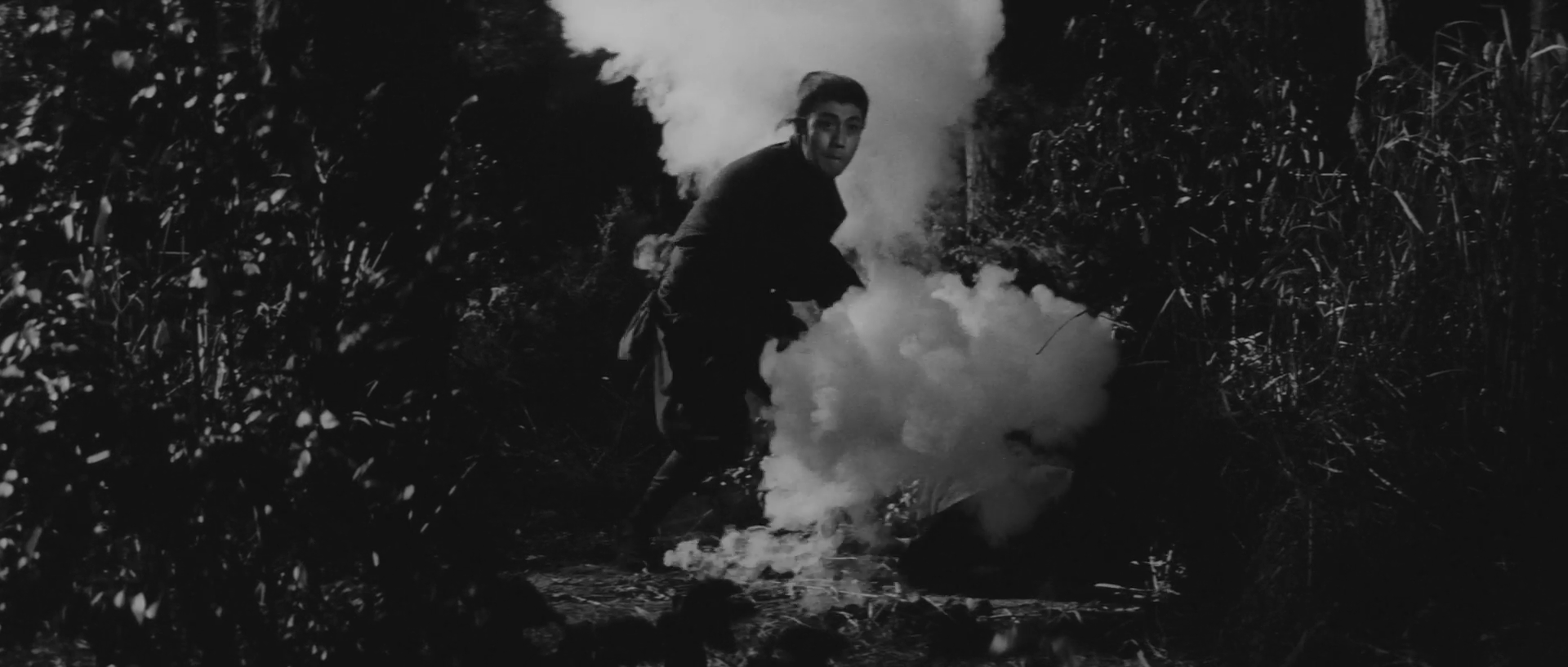
The Blind Menace (不知火検校, Kazuo Mori, 1960)

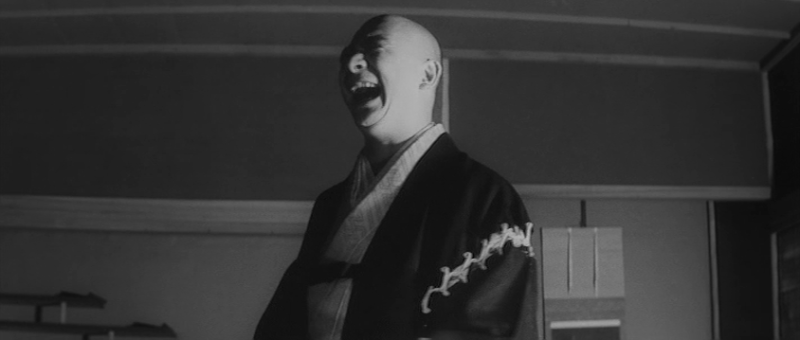
Two years before finding fame as Zatoichi, Shintaro Katsu starred as his mirror image in a tale of pure villainy, The Blind Menace (不知火検校, Shiranui Kengyo). As the title suggests, the film follows the upward trajectory and eventual downfall of an unsighted man who gleefully rapes and pillages his way to becoming the leader of his community aided and abetted by the ills of the feudal era which allow him to profit from his crimes until the past finally catches up with him.

After all as he later says, “as long you as you keep rising in the world, past misdeeds don’t matter.” In any case, even as a child the man who would later be known as Suginoichi (Shintaro Katsu) is incredibly unpleasant. In the opening festival sequence he picks his nose and flicks it in a barrel of sake so that the men drinking will abandon it. The only sign of possible goodness in him is that he takes the sake home for his mother to enjoy, though he seems to relish the idea of her unwittingly drinking his snot so perhaps that was the real purpose. Other hobbies of his include conning wealthy passersby out of a ryo with a well worn scam in which he asks them to read a letter from his uncle which mentions that it should include one ryo only what’s in there is a stone. When the reader explains the situation, he accuses them of trying to take advantage of his blindness and makes a fuss about it until they’re embarrassed into coughing up a ryo of their own (not a small sum for the time period). 

In some ways his poverty and disability might explain his behaviour. His family set up is subverted with his mother much like him money hungry and willing to do anything to get it while his saintly, henpecked father is gentle and honest. This might have taught him the wrong lessons about masculinity that lead him to see his father as weak in allowing the world to trample him while taking his mother’s advice to heart that if they only had a 1000 ryo they could get him trained up properly so that he might one day become a Kengyo which is a little bit like a community leader for the blind with social status and political influence. 

It’s this kind of social affirmation he seems to crave, but is essentially a narcissistic sociopath who takes advantage a stereotype that in some ways infantilises the blind and those with other disabilities who are believed to be pure-hearted and incapable of intrigue or evil. He seems to come to the rescue of a noblewoman who asked his boss, the Kengyo, to lend her money secretly because her brother has been caught embezzling but then rapes her, asks for the money back, and blackmails her into further acts of sexual exploitation offering her only 5 ryo a time knowing she needs 50. He thinks nothing of using his acupuncture skills to kill a man who was carrying 200 ryo to buy a “boneless girl” for a freak show and then framing a man who saw him do it but agreed to say nothing for a 50% cut for the crime. Suginoichi later teams up with “Severed Head” Kurakichi (Fujio Suga) to commit a series of burglaries including that of the Kengyo master who he also has killed to usurp his postion. 

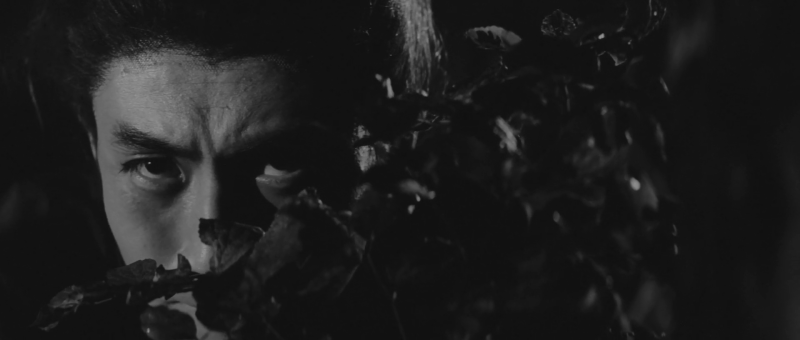
But as he said, once his recognition is in sight with an invitation from the shogun everything begins to fall apart as all his wrongdoing starts to catch up with him. The feudal world had allowed him to prosper partly because of other people’s greed but also the social codes that favour shame and secrecy along with people’s unwillingness to accept that a blind man can also be selfish and evil despite a lot of evidence to the contrary. Elegantly lensed by Kazuo Mori who brings a sense of realism to the hardbitten backstreets of the feudal poor, the film may suggest that the wealthy only get that way by trickery and exploitation and the only way to rise to the loftiest place is to be like Suginoichi and not care what you do to get there but is clear that once you arrive you won’t stay very long because one day the past will really will come back to bite you. 


4K restoration trailer (no subtitles)

Miss Oyu (お遊さま, Kenji Mizoguchi, 1951)

“I never realised how heavy this kimono was” a young woman exclaims towards the conclusion of Kenji Mizoguchi’s Miss Oyu (お遊さま, Oyu-sama), adapted from the Junichiro Tanizaki short story The Reed Cutter, finally collapsing under its weight having committed what amounts to an act of spiritual suicide in an internalised betrayal. Mizoguchi’s highly selective adaptation excises much of Tanizaki’s trademark perversity and targets instead the repressive social codes of the era which proceed to ruin three lives in frustrated affection, shame, and self-harming guilt. 

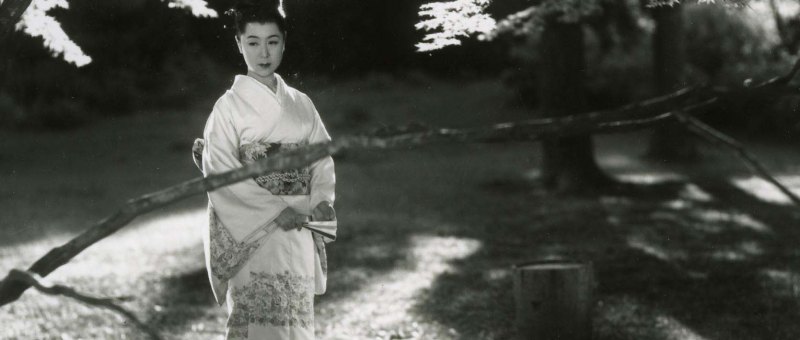
The trouble begins when Shinnosuke (Yuji Hori), a young man in search of a wife, mistakes his prospective bride for her sister and is forever smitten. Oyu (Kinuyo Tanaka), a widow with a young son, is only accompanying her younger sister, Oshizu (Nobuko Otowa), but is perhaps herself taken with the handsome suitor whom she repeatedly brands a “fine gentleman”. Having objected to all of Oshizu’s previous matches, she encourages her sister to marry this one not least because of his physical proximity that would allow the pair to visit each other regularly. The pain on Oshizu’s face is however readily apparent as Oyu relates the amusing incident to their brother, the younger sister clearly consumed with an inferiority complex in the shadow of the beautiful and elegant Oyu. 

It’s never quite clear to what extent Oyu is aware of her sister’s feelings, if she says these things thoughtlessly or with an intent to wound though she obviously cares deeply for Oshizu. Similarly the extent of her feelings for Shinnosuke remains oblique. As a woman well aware of her beauty and its power, perhaps she simply enjoys being desired or is so accustomed to male attention as to barely notice that Shinnosuke has fallen in love with her. Then again perhaps she knows all too well and for the sake of politeness pretends not to though in that case the decision to encourage her sister to marry him would seem perverse or suggest that she is attempting to deny her own feelings which she may not even understand by rendering Shinnosuke a “brother” in an attempt to remove him from the pool of potential romantic suitors. 

Even so there is an underlying quality of incestuous desire of Oshizu for her sister to whom she remains devotedly besotted, willing to sacrifice her own happiness in the hope of ensuring Oyu’s. After agreeing to marry Shinnosuke, she explains to him that she intends their marriage to be purely symbolic. She refuses to consummate their union on the grounds that it would be a betrayal of Oyu whom she knows to be in love with Shinnosuke while realising that he has married her only to be connected with her sister. When the trio take a trip together the strangeness of the ménage à trois is brought home by the confusion of the hotel maid who assumes that Oyu and Shinnosuke are the married couple, commiserating with Oshizu for being a third wheel. While Oyu childishly makes light of it, Oshizu is hurt and confused, jealous in two directions but pleading with Shinnosuke to be only his sister rather than a wife. 

Yet the wrongness of the arrangement is signalled on Oyu’s return home when she discovers not only that her son, Hajime, has fallen mortally ill in her absence but that rumours have begun to circulate about her unusual relationship with her brother-in-law. It is impossible to avoid the implication that Oyu is being punished firstly for betraying her maternity in having gone on holiday without her son to experience freedom as a woman, secondly for feeling sexual desire, and thirdly for feeling it for a married man who is now technically a brother in being her sister’s husband though as we know no one’s sexual desires are currently being fulfilled in this incredibly complicated and destructive arrangement. 

Though Tanizaki might have been more interested in exploring the darker aspects of human sexuality, Mizoguchi pulls back from the author’s trademark perversity to take aim at the repressive social codes of a patriarchal society which brought such a fraught situation into being. Oyu is unable to marry Shinnosuke because she is bound to her late husband’s family and by the responsibility to her son whom she would have to leave behind even if she were given permission to take another husband. Once her son dies, her ties to marital family are severed and they, disapproving of the rumours surrounding her unconventional relationship with her sister and brother-in-law, send her back to her brother who is also reluctant to accept her. On learning of the reality of her sister’s marriage, she decides to accept a proposal from a sake merchant in another town but the separation breeds only more destruction. Oshizu and and Shinnosuke move to Tokyo and three years later are living in poverty, Shinnosuke now dishevelled and dressing in Western suits with a modern haircut and a scraggly, half-hearted moustache. Oshizu’s eventual pregnancy which confirms that theirs is now a “full” union while Oyu’s is “symbolic” only the slows implosion of the trio’s repressed desires. 

Mizoguchi stops short of arguing for a transgressively new arrangement that would have allowed the trio to live together as a family but nevertheless attacks the repressive social codes that prevent them from speaking honestly about their feelings and force them into self-sacrificing acts of subterfuge which create only more suffering. He dramatises the claustrophobia of their lives through the obvious artificially of the stage sets which stand in such stark contrast to the expansive beauty of nature albeit sometimes unruly but always free, while lending their tragic tale a hint of the parabolic in its mists and rugged gardens as Shinnosuke finds himself alone under the cold light of the moon on a distant shore, a romantic exile from a repressive society. 


A Certain Killer (ある殺し屋, Kazuo Mori, 1967)

A nihilistic hitman safeguards the post-war future in Kazuo Mori’s chivalrous B-movie noir, A Certain Killer (ある殺し屋, Aru Koroshiya). Set against the backdrop of the Vietnam War with US airplanes flying constantly overhead, Mori’s crime thriller situates itself in the barren wasteland of a rehabilitated city in which betrayal, exploitation and duplicity have become the norm while a former tokkotai pilot turned killer for hire takes his revenge on social hypocrisy as a product of his society, a man who did not die but knows only killing. 

Shiozawa (Raizo Ichikawa) runs a stylish restaurant by day and supplements his income by night as a killer for hire, apparently highly regarded by the local underworld. As such, he’s approached by a yakuza underling, Maeda (Mikio Narita), on behalf of the Kimura gang who want him to off another gangster, Oowada (Tatsuo Matsushita), who double crossed them in contravention of the yakuza codes of honour. Shiozawa is resolutely uninterested in yakuza drama and so turns the job down but changes his mind when he’s paid a visit by boss Kimura (Asao Koike) himself who sells him a different kind of mission. Kimura characterises Oowada as a “bad” yakuza, one has subverted the traditional gangster nobility by dealing in the “dirty” sides of organised crime, corrupting the modern society by trafficking in illegal prostitution, drugs, and extortion, where as he is a “good” yakuza mostly running construction scams and therefore building the post-war future. His crime is, literally, constructive, where Oowada’s is not. 

Shiozawa doesn’t quite buy his justifications, but men like Oowada represent everything he hates. “They’re not worthy of this world. They’re nothing but cockroaches” he laments, recalling the young men who served with him and gave their lives because they believed in a country which betrayed them. He agrees to take the job in rebellion against post-war venality, but only at a price, asking for four times the original fee. Kimura is willing to pay, because his true aim is profit more than revenge. He plans to take over Oowada’s remaining business concerns. 

Fully aware of this, Shiozawa seems almost uninterested in the money despite having asked for so much of it. He runs his shop as a front for his side business and otherwise lives a quiet, unostentatious life keeping mostly to himself. He is not, it would seem, a cold blooded killer, often making a point of leaving those who get in his way incapacitated but alive. Targeted by a street punk for supposedly messing with his girl he cooly disarms him and walks away, only for the girl to follow attracted partly by his icy manliness and partly by the thickness of his wallet as glimpsed when he made the fatal decision to offer to pay for her meal in order to save the chef from embarrassment over her attempts to pay with things other than money. Unable to get by on her own, Keiko (Yumiko Nogawa) attaches herself to various capable men beginning with the pimp, transferring her affections to Shiozawa whom she petitions to marry her, and then to Maeda, eventually vowing to find a new partner and make lots of money. 

Both Maeda and Keiko chase Shiozawa and are rebuffed. Impressed by his cool handling of the Oowada affair, not to mention the amount of money he now realises you can make in his line of business, Maeda asks to become his pupil in order to become a “real man”. Shiozawa doesn’t regard his work as something “real men” do, and in any case prefers to work to alone. Maeda repeatedly asks to be allowed to accompany him even after plotting betrayal, only to be rejected once again as Shiozawa tells him that he doesn’t like people who don’t know the difference between the job and romance, flagging up the homoerotic subtext for those not paying attention. Maeda parrots his words back to Keiko with whom he had begun a halfhearted affair as joint revenge against Shiozawa’s indifference. 

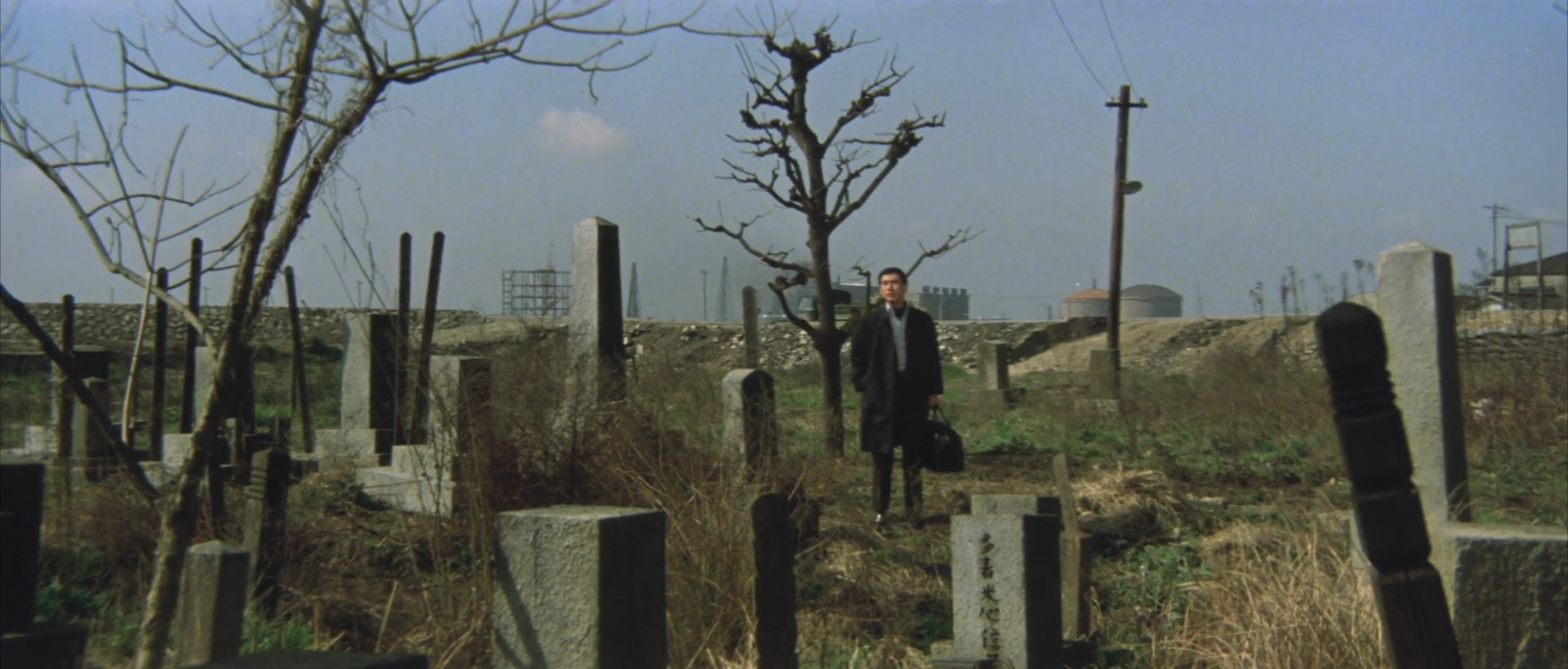
Following the successful offing of the mob boss, Shiozawa finds himself coopted into another job robbing a drug handoff between Oowada’s former associates, the illicit narcotics ironically packaged inside cartons intended for baby powder. Shiozawa apparently doesn’t object to profiting off the drug trade himself, but later abandons the loot in protest while the remainder is lost or squandered during the final battle with the remaining gang members, Shiozawa’s cartons left sitting ironically on top of a gravestone taken by no one. Cool as ice, Shiozawa places himself above petty criminality, always one step ahead, trusting no one and looking out for himself but reacting as a man created by his times, forged by a war he was a not intended to survive while looking on at another cruel and senseless conflict across the sea. Adapting the hardboiled novel by Shunji Fujiwara, Yasuzo Masumura’s jagged, non-linear script (co-written with Yoshihiro Ishimatsu) is imbued with his characteristic irony but also coloured with nihilistic despair for the post-Olympics society and its wholesale descent into soulless capitalistic consumerism.


Update, 13th February 2025: now available to stream via Arrow Player.

Original trailer (no subtitles)

Invisible Man Appears (透明人間現る, Nobuo Adachi, 1949)

Invisible man appearsReleased in 1949, The Invisible Man Appears (透明人間現る, Toumei Ningen Arawaru) is the oldest extant Japanese science fiction film. Loosely based on the classic HG Wells story The Invisible Man but taking its cues from the various Hollywood adaptations most prominently the Claude Rains version from 1933, The Invisible Man Appears also adds a hearty dose of moral guidance when it comes to scientific research.

Once again the action centres around an esteemed chemist, Professor Nakazato, who has been working on a serum to render living things invisible. So far he has a sample which works on animals but is reluctant to move on to human testing as A) he hasn’t found a way to reverse the procedure, and B) there are some unpleasant side effects in which the subject becomes increasingly violent and irrational. The professor currently has two top students who are helping him towards his goal and, inconveniently, both have taken a shine to his daughter, Machiko. Half joking, the professor remarks that whoever can solve the problem first will win his daughter’s hand.

A business associate of the professor, Kawabe, is also interested in Machiko and also in the rights to the professor’s important new discovery. The professor, however, is a responsible man and refuses to sell it in case it falls into the wrong hands. Shortly after the professor is kidnapped by a gang of armed thugs who plan to use the serum to steal a set of diamonds known as The Tears of Amour.

There’s plenty of intrigue with various twists and turns to the original story which keep the viewer on their toes as they try to figure out who exactly is the invisible man and what he’s really after. Actually, the solution is sort of obvious and heavily signposted but that doesn’t make it any less fun. Kawabe is a moustache twirling villain from the get go and it’s obvious he has various things going on in the background but there’s more to the story than a greedy business man trying to manipulate everyone around him for his own gains. There’s also an interesting subplot in which the younger sister of one of the scientists is a top actress at the Takarazuka Review and turns out to have a connection to the Tears of Amour.

All of the classic B-movie hallmarks are here from the slightly ridiculous sci-fi jargon to the classic women in peril shenanigans as the serum starts to take hold and the Invisible Man becomes increasingly paranoid. There’s nothing good or bad but thinking makes it so – so it would be for science as far as the film is concerned. According to the message at the film’s beginning and end, there is no scientific discovery which is innately “evil” but each is apt to be misused. It’s not difficult to see why this would be a popular, even essential, message in the Japan of 1949 and indeed it recurs in many films of this type including, of course, the original Godzilla. The professor takes responsibility for having invented something which, although not created with evil intent, has wrought such destruction on society but finds himself with nothing left to do other than apologise.

Director Nobuo Adachi uses a lot of classic silent cinema techniques such as dissolves and montages with a fair amount of handheld camera and some location shooting (though the majority of the film is studio bound). The special effects were supervised by Eiji Tsuburaya who would later become the founding father of tokusatsu and co-creator of the Godzilla franchise and are top notch for the time period. An enjoyably silly B-movie, The Invisible Man appears is a well crafted addition to the Invisible Man corpus and a fantastic example of Daiei’s post-war genre output.


Original trailer (English subtitles) – I wish all trailers were this much fun!