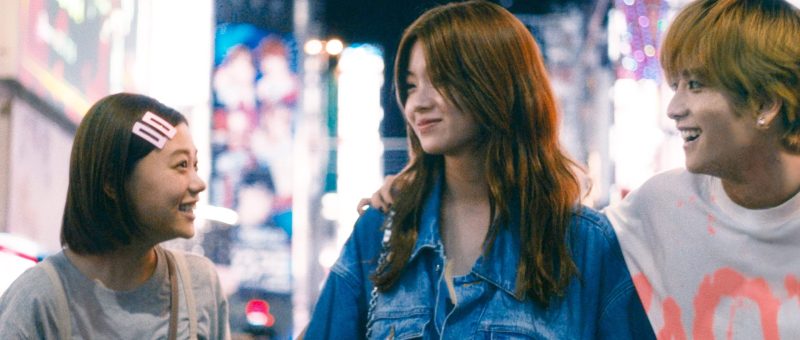

Adapted from the novel by Hitomi Kanehara, Daigo Matsui’s Meets the World (ミーツ・ザ・ワールド) takes its name from the heroine’s love of a BL manga in which all the characters are anthropomorphised versions of various cuts of meat that can be ordered at yakiniku restaurants. But it’s also, in a way, an apt description of her experiences as she begins to open herself up to the act of living while considering where it is she belongs and what it is that will actually make her happy.
This comes about largely due to an encounter with the mysterious Rai (Kotona Minami), a beautiful yet melancholy young woman who rescues her one night while she’s drunk and disorientated in the street. Rai offers her a literal sanctuary, but also challenges Yukari’s (Hana Sugisaki) view of the world by constantly questioning and undermining things that she had assumed to be true but without telling her what she should think or do. Rai offers her these little nudges, but at the same time lives in an apartment strewn with rubbish and repeatedly says that she longs for death. Yukari begins by clearing up, reminding her that one’s living arrangements reflect the state of one’s mind, but she finds it much more difficult to clean up Rai’s mental state or relieve her internalised listlessness and lack of enthusiasm for living.
In some senses, it’s true that Yukari becomes more fixated on the idea of saving Rai as a means of saving herself than she does on her personal growth, but at the same time gains greater experience and understanding through interacting with Rai’s social circle at the aptly named Loneliness bar. The irony is that though she becomes frustrated that she can’t seem to truly connect with Rai or reduce her desire for death, she rejects the same kind of interest from her mother (Mariko Tsutsui) whose calls she is forever avoiding. Her mother only really wants the same thing that Yukari wants from Rai and would seemingly be happy enough with a few texts as proof of life, though it’s something that Yukari doesn’t want to give her for whatever reason. She says that she didn’t like living alone with her mother after her father’s death, but there’s the same kind of absence felt in Rai’s apartment which she previously shared with the only person she claims to have loved but is now no longer in her life.
It speaks to Yukari’s naivety that she thinks she could heal Rai simply by reuniting her with this person, while she comes to realise that romance may not be the answer she was looking for either. Yukari had enthusiastically begun looking for a husband at 27 despite never having dated before because she thought it was what she was supposed to do, yet what makes her happiest is her obsessive interest in her favourite manga. These kinds of hobbies are often looked down by the surrounding society and it’s clear that Yukari has a degree of internalised shame regarding her interest in them. Even at her mother’s house, she hides all anime merch behind a curtain out of sight and keeps it a secret from her colleagues at the bank where she works. When Yukari eventually does mention her love of anime, her colleague begins to smirk a little as if she thinks that explains quite a lot and is internally laughing at Yukari while remaining superficially polite. Yukari’s prim and proper supervisor, meanwhile, gives her a stern look though it isn’t clear if that’s because she thinks Yukari’s hobbies are inappropriate for a woman her age, or because she may have similar hobbies of her own.
In any case, it’s true that through her friendship with Rai she learns to be open about her interests and be fully herself in all environments, accepting that love and dating may not be right for her or at least that she doesn’t need to force them to satisfy the demands of others. It could be said that what she has with her anime characters is a one-sided relationship, but that’s also true of those around her including the host Asahi (Rihito Itagaki) who sees his marriage founder as his wife grows tired of supporting him as the number one host while he can’t win her back just as himself. Ironically, these kinds of one-sided relationships are a professional hazard that can otherwise lead to toxicity and violence. A gloomy writer, Yuki (Yu Aoi), also recounts the postnatal depression that led to the end of her marriage and subsequent realisation that what she had was the kind of happiness that someone who thought themselves unhappy wanted to find, but did not actually work out for her.
What they are is in effect a series of bubbles that occasionally float close to each other or perhaps intersect without really connecting. Nevertheless, they offer each other a gentle sense of solidarity just by existing. Matsui films in a 4:3 ratio that seems constrained, but also has a cosy, protective quality while implying that loneliness is a natural fact of life that can’t be entirely cured, yet even if someone is not actually with you physically, or may not even physically exist, one’s love for them can still endure and be a healthy source of comfort and support while everyone has the right to live as they please free from the judgement of others.
Meets the World screened as part of this year’s Camera Japan.
Trailer (no subtitles)

