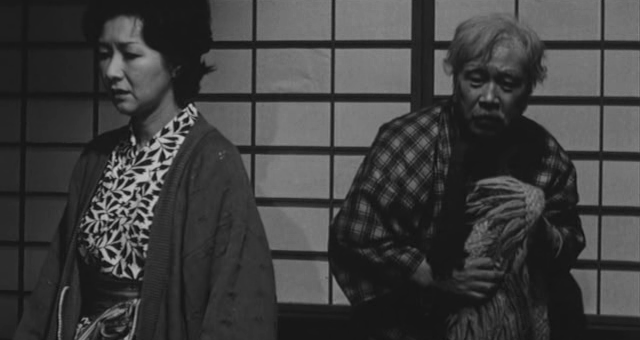
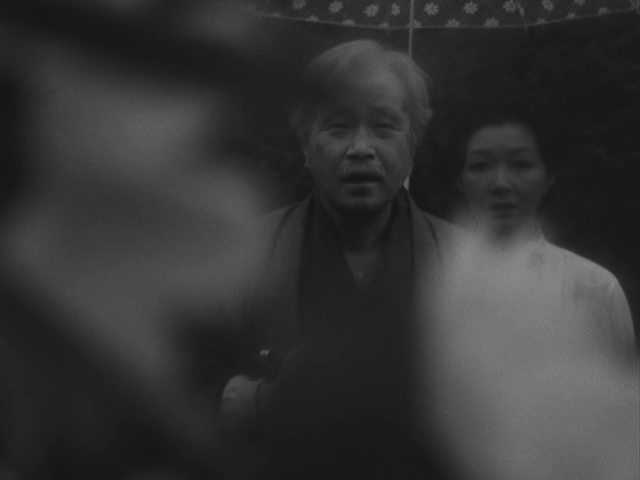
The Twilight Years (恍惚の人, Shiro Toyoda, 1973)

In the early 1970s Japanese society was not as concerned with population slowdown as it would come to be, but Shiro Toyoda’s sympathetic ageing drama The Twilight Years (恍惚の人, Kokotsu no Hito) is evidence of a growing consciousness that traditional ideas about how one cares for the elderly may now be becoming incompatible with the functioning of modern society. Based on a best-selling novel by Sawako Ariyoshi, the film has profound empathy both for the ageing patriarch once apparently a tyrant but now a meek and frightened child, and the daughter-in-law to whom his care largely falls.

In fact, it’s caring for Shigezo (Hisaya Morishige) that some believed shortened the lifespan of his late wife who passes away in the film’s opening scenes. Already somewhat detached from reality, Shigezo simply reports that his wife won’t wake up no matter how much he tries to wake her, much like a child who’s discovered someone no longer living. While his daughter-in-law Akiko (Hideko Takamine) rushes to her room with a sense of foreboding, Shigezo merely stays in the kitchen eating boiled potatoes straight out of the pan. It’s the odd behaviour that seems to irk his son Nobuyoshi (Takahiro Tamura) but it’s only now that the couple seem to be realising that there’s something wrong especially as Shigezo does not appear to understand that his wife has died. Pitiably, he chides her for lounging around so late in the day when she’s already been laid out for her funeral.

When his daughter, Kyoko (Nobuko Otowa), arrives having actually missed the funeral itself due to transport issues and a conflicting responsibility to act as a matchmaker at a wedding, Shigezo doesn’t recognise her. He continues to ask for Akiko and gradually forgets most of the other people in his life, screaming when encountering Nobuyoshi and instructing Akiko to call the police to report a burglar in their home. According to both women, Shigeyoshi had treated Akiko poorly ever since she joined their family, which makes caring for him so much harder. The reason he becomes so attached to Akiko is likely simply that she is the person who is always around him so he has less time to forget her. He may realise on some level that she may not wish to care for him given his previous behaviour which may be why he becomes preoccupied with the idea she may “disappear” and cries out in the night when he can no longer see her.

But Akiko also has other responsibilities including a job outside the home and a teenage son studying for his exams. Nobuyoshi expresses regret that he hasn’t been more help and voluntarily tries to pitch in, but lets himself off the hook given that his father doesn’t recognise him and becomes anxious in his presence. Satoshi (Izumi Ichikawa) meanwhile does try to do his bit but is young and a little resentful of the responsibility. As his dementia becomes more severe, Shigezo begins calling Satoshi “Dad” as if he were a child again. Which is all to say, Shigezo becomes Akiko’s responsibility and the strain of caring for him begins to affect her own mental and physical health leading her to fear that she too may die younger than she otherwise might have. 

Yet in exploring her options, Akiko finds little by way of support. Most nursing homes won’t accept patients with complex needs like Shigezo and conditions such dementia are often regarded as mental illnesses meaning her only option might be to put him in an asylum. Shigezo was attending an old person’s daycare centre, but later says he doesn’t want to go anymore because it’s full of old people and therefore no fun. While the film is sympathetic towards Akiko and the difficulties she is facing in caring for her father-in-law it also has profound empathy for Shigezo for though he has so many people who are doing their best to look after him, his increasing mental confusion quite obviously leaves him isolated and he must be incredibly lonely while trapped within his own reality. He develops a habit of saying “hello, hello,” as if he were answering the telephone which may be his attempt to communicate while he is also fascinated with a caged bird which may reflect his own sense of being constrained by his condition.

Later, the bird seems to symbolise Akiko too, trapped as she is within the domestic environment where all responsibility seemingly falls to her. Even so a young student couple she rents the annex to for a lower price in exchange for keeping an eye on Shigezo during the day remark that he may be in the ideal state for a human being having returned to early childhood in which there are no concerns or responsibilities and he is therefore unburdened by the weight of what is to live. Toyoda often uses handheld camera to symbolise the desperation and destabilisation of Shigezo’s existence in which Akiko has become his only fixed point. One of Nobuyoshi’s friends remarks that perhaps it was better when the average life expectancy was 50 and Nobuyoshi’s mother might have been lucky passing away peacefully while otherwise in good health. Still, as Nobuyoshi says, it comes for us all in the end and we should all try to be kinder to each other while we’re here.

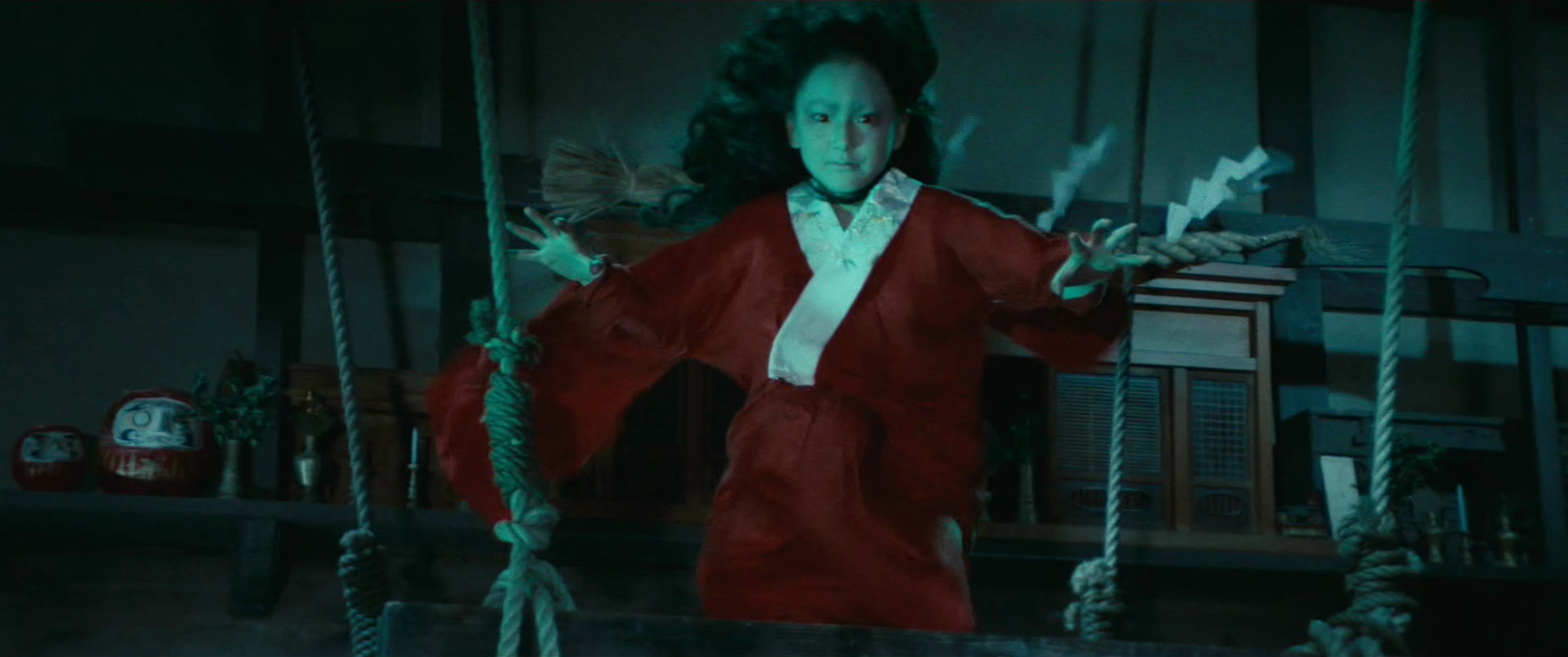
Curse of the Dog God (犬神の悪霊, Shunya Ito, 1977)

By the late 1970s, Japan was a very prosperous place and the cutting edge of modernity yet old beliefs die hard and those who run afoul of a natural order they assumed had long been forgotten will pay a heavy price for their arrogance. After a four-year hiatus following the third of the Female Prisoner Scorpion films, Shunya Ito returned with a strange slice of folk horror The Curse of the Dog God (犬神の悪霊, Inugami no Tatari) in which it is indeed the city invaders who have transgressed these ancient boundaries in their wilful indifference to the natural world.

The conflict between these two Japans is clear in the opening sequence in which three men pass through a tunnel in a truck bearing the logo of a nuclear power company and emerge into a village where a group of boys jump out from behind a row of tiny haystacks wearing masks made of leaves. The boys crowd around the van asking the strangers why they’re here and they jokingly tell them that they’ve come to look for “treasure,” which turns out to be a quest to find uranium in the local mountains. Otherwise uninterested in the village or the landscape, the men back their truck into a dilapidated roadside shrine which then collapses, and subsequently run over a little boy’s dog which had attempted to stop their car by barking fiercely at them. Rather than stop to apologise or comfort the boy who is cradling his dead dog in his arms, the men sheepishly drive off as if embarrassed. 

Of course, the shrine turns out to belong to the Dog God who is guardian deity of these mountains and now incredibly annoyed not just by the destruction of the shrine and killing of the dog, but by the men’s intention to tear the natural world apart looking for something which could prove very destructive even if they claim they want to use it responsibly to fuel the economic rocket which is Japan in the 70s. The Kenmochi family, the head of which, Kozo, is the local mayor are very receptive to the firm’s entreaties and immediately grant them access to their land while arranging a marriage which at least in part dynastic between Kozo’s daughter, Reiko (Jun Izumi), and the head of the expeditionary group Ryuji (Shinya Owada). But once they return to the city, the other two men die in mysterious circumstances, one entering a kind of trance and walking off the roof of the hotel after the couple’s formal wedding reception and the other attacked by a pack of wild German Shepherds in the middle of Tokyo. 

Reiko is quick to exclaim that it’s all the fault of the Dog God, though it’s never quite clear whether or not she is aware that her family is the subject of an ancestral curse because they themselves offended the deities by getting their hands on the land cheaply when it was used as collateral for a loan. In contrast to the Tarumis, the family of Reiko’s best friend Kaori (Emiko Yamauchi) and her little brother Isamu (Junya Kato) who is the boy whose dog they killed, the Kenmochis put on heirs and graces and as if they were the ancestral aristocracy of this area rather than having made a speedy class transition thanks to someone else’s misfortune and the vagaries of the post-war era. The Tarumis, meanwhile, live in a much more humble home and dress in a much more traditional mountain village manner. Patriarch Kosaku (Hideo Murota) point-blank refuses to sell his land and will have little truck with Ryuji or the mine once it opens, leaving the family regarded as outcasts within the village. 

But then there is a definite and literal pollution signalled by the arrival of the prospectors. At a meeting, it’s suggested that the sulphuric acid they’re using to flush out the uranium in inaccessible areas of the mine could contaminate the local groundwater which is a problem when many families are still taking their water from wells but they all laugh it off. Sometime later Ryuji is horrified to see dead fish floating in the river, while his own in-laws, the older generation of the Kenmochi family, are also killed by ingesting contaminated water. A rumour arises that the culprit is the Tarumis who have poisoned the wells out of spite, and when Ryuji tries to raise the alarm after getting a positive result for sulphuric acid in the water supply the company tell him to pin it on them instead. 

The intrusion of modernity has interrupted the careful, if woefully feudal, balance of the village with terrifying and tragic consequences. Yet Kosaku is also surprised, asking how a city man like Ryuji could really believe in something like a “curse”. The shamans they bring in to do a ritual also blame everything on the Terumis, adding the suggestion that the ill will is motivated by Kaori’s sexual jealousy over Ryuji giving rise to yet another interpretation of the curse’s origin besides the Kenmochi’s class transgression and the unintentional offence caused by the destruction of the shrine. Then again, perhaps it really is all because of the Dog God in a great confluence of coincidences that have led to this incredibly strange and unfortunate situation. In the end, even the film’s purest character, the Kenmochi’s small daughter Mako (Masami Hasegawa), is possessed by the evil spirit and made to take her revenge with a remorseful Ryuji desperately trying to repair what he himself broke in the acceptance that he should not have come here and was the catalyst for this confrontation with fate. Weird and haunting even in its bizarre obscurity the film nevertheless makes a case for the protection of the dark heart beating at the centre of the contemporary society which speaks of something older that cannot be crossed and most specially by those hellbent on a hubristic path to prosperity that has little respect for the land.


Mother (おかあさん, Mikio Naruse, 1952)

The hahamono or mother movie is a mainstay of post-war cinema, obsessed as it is with self-sacrificing maternity. Mikio Naruse, however, is not a name you’d expect to see associating itself with the genre and his 1952 film Mother (おかあさん, Okaasan), adapted from a child’s essay, is indeed subtly subversive, transgressively questioning the institution of motherhood itself while ostensibly remaining faithful to genre norms even as it makes an accidental villain of its teenage heroine who closes the film plaintively praying for her mother’s happiness having not so long ago shut down perhaps her only real hope of achieving it. 

The Fukuhara family ran a successful laundry before the war, but these days father Ryosuke (Masao Mishima) works at a factory and is nicknamed Papa Popeye by his kids because of his finely tuned muscles born of a lifetime training the iron. Matriarch Masako (Kinuyo Tanaka) and 18-year-old daughter Toshiko (Kyoko Kagawa), our narrator, help the family finances by running street food stalls, while oldest son Susumu (Akihiko Katayama) has become ill with a lung complaint caused by poor conditions at the wool factory where he was working. In addition to youngest daughter Chako who is still in school, the family has also taken in little Tetsu (Takashi Ito) the son of Masako’s sister Noriko (Chieko Nakakita) who is now a widow recently repatriated from Manchuria. 

Like many films of the occupation period, the family at the centre of Mother is determined to rebuild, pinning all their hopes on being able to renovate their home in order to be able to reopen the laundry. The war is very much a background presence but its influence is still deeply felt not least in the ruins and devastation glimpsed around the house and the constant references to loss and widowhood which seem to plague Masako, so many women having lost sons and husbands in the conflict. The tragedy is that Masako will eventually in one sense or another lose all her children by the end of the picture, Susumu succumbing to his illness after having discharged himself from hospital out of guilt and loneliness missing his mother, Chako eventually taken in by wealthier relatives who lost their son in the war, Tetsu soon to be retrieved by his mother, and Toshiko herself clearly heading towards marriage with the cheerful and surprisingly progressive baker Shinjiro (Eiji Okada) with whom she has become close. 

Perhaps surprisingly Toshiko seems remarkably immature for her age, her voiceover taken as it is from a child’s essay has a slightly stilted quality that nevertheless makes plain her poor grasp of the adult world and most particularly the reality of her mother’s life. Masako later tells us that she started working at 14 and continued until she married at not so much older than Toshiko is now despite later stating that Toshiko is too young to marry only to find her self shocked when confronted by the sight of her in a wedding dress stifling a brief wave of despair that her daughter may soon be a wife. Originally complaining about not being able to take dressmaking classes like some of the other girls, Toshiko belatedly swears to help support the family firstly to prevent Chako going to stay with relatives and secondly because her boyfriend inadvertently gives her the impression there’s truth in a local rumour that her mother plans to remarry following her husband’s death from overwork and poverty with a friend of their father’s who’s been helping them out in the shop, “Uncle POW” Mr. Kimura (Daisuke Kato). 

Shinjiro is quick to tell her that she’s being unreasonable. In the modern world parents shouldn’t be expected to sacrifice their personal desires for their children, her mother is also a woman and has the right to pursue happiness in marrying again if she chooses. On the other hand, there is nothing particularly concrete between Masako and Mr. Kimura besides a genial domesticity, the rumour is partly local wishful thinking in knowing that remarriage is sensible economic choice and the pair seem well suited. Toshiko objects strongly to the idea out of fear, jealousy, and outdated moralising resenting her mother for betraying her father’s memory but also fearing further changes in her familial relationships in an already uncertain world. 

In this her otherwise saccharine closing monologue in which she looks on as her mother plays with Tetsu and wonders if she’s really “happy” achieves its final irony, transgressively undercutting the primacy of the self-sacrificing mother to question the ideology of motherhood itself when it requires women to sacrifice their lives and desires in service of an ideal of “family”. Nevertheless, Mother is among the most ostensibly cheerful of Narusean dramas in the gentle comedy and naturalistic depiction of a warm and loving family committed to compassion, kindness, and mutual support as pathways towards a better post-war future.  


Mother is currently available to stream in the US via Criterion Channel

Akanezora: Beyond the Crimson Sky (あかね空, Masaki Hamamoto, 2007)

Akanezora - Beyond the Crimson Sky poster“It’s not all about tofu!” screams the heroine of Akanezora: Beyond the Crimson Sky (あかね空), a film which is all about tofu. Like tofu though, it has its own subtle flavour, gradually becoming richer by absorbing the spice of life. Based on a novel by Ichiriki Yamamoto, Akanezora is co-scripted by veteran of the Japanese New Wave, Masahiro Shinoda and directed by Masaki Hamamoto who had worked with Shinoda on Owl’s Castle and Spy Sorge prior to the director’s retirement in 2003. Like the majority of Shinoda’s work, Akanezora takes place in the past but echoes the future as it takes a sideways look at the nation’s most representative genre – the family drama. Fathers, sons, legacy and innovation come together in the story of a young man travelling from an old capital to a new one with a traditional craft he will have to make his own in order to succeed.

The story opens in the early 18th century when a couple stop to chat to a friend and, while they aren’t paying attention, their small son Shokichi wanders off after a doll show. Fastforward a decade or so and a young man, Eikichi (Masaaki Uchino), arrives from Kyoto intent on opening up a tofu shop in the capital. Enjoying the delicious local water, he runs into cheerful local girl, Ofumi (Miki Nakatani), who insists on helping him find his way around an unfamiliar city.

Ofumi proves invaluable in helping him set up his small neighbourhood store, but as skilled as Eikichi is, Kyoto tofu and Edo tofu are much more different than one might think. Eikichi’s tofu is smaller in size and fluffy where Edo tofu is larger yet solid, and though its flavour is superior, it does not suit the local taste or cuisine. Ofumi helps him out again, and once the shop is doing better the two marry. Flashforward another 18 years and the couple have three children, two sons and a daughter, but as successful as they are, they are no longer free of familial disharmony.

Strange coincidences are in play, such as Eikichi’s tofu making heritage lining up perfectly with that of a lonely couple, Oshino (Shima Iwashita) and Seibe (Renji Ishibashi), still grieving the loss of their little boy whose fate remains an open mystery. Though their son remains lost to them, Oshino and Seibe see something of the man he might have been in Eikichi who is also a practitioner of the trade they intended to pass on to him. Eikichi is a down to Earth southerner – naive, in one sense, yet honest, straighforward, kind and courteous. Though all agree his craftsmanship is first rate and his tofu excellently made, they privately advise he consider firming it up in keeping with local tastes. Eikichi is as stubborn as he is genial – he will not betray the “tradition” which has been passed down to him from his master and which he fully intends to hand down to his sons, purveyors of refined Kyoto tofu in fashionable Edo.

Thanks to Seibe’s generous patronage and Ofumi’s perseverance, Eikichi is a success but clashes with his eldest son and presumptive heir, Eitaro (Kohei Takeda), who resents his role as a kind of sales rep for his dad’s company. Following a volcanic eruption and subsequent poor harvest, grain prices are at a premium yet Eikichi, following the “Kyoto way”, refuses to raise prices, much to the consternation of fellow merchants who take out their displeasure on the young and impressionable Eitaro. One in particular launches a plan to ruin Eikichi’s tofu shop and gain access to the best of the city’s wells by befriending the lonely young son, getting him hooked on gambling and then bankrupting him with the help of local gangster boss Denzo (Masaaki Uchino).

Eikichi’s tofu, as someone later puts it, prospered not only because of his hard work and dedication, but because it was made with the heart. His overwhelming dedication to his craft might seem to blunt his dedication to those he loves but he cares deeply about his wife and children even if his “straightforward” character means he has a funny way of showing it. A running joke circles around Eikichi’s country bumpkin Kyoto accent and though the culture clash goes further than debating the proper texture of tofu, he finds himself a home thanks to the kindness of strangers. Akanezora, like Eikichi’s tofu, proves a little too spongy, its narrative connections too subtle in flavour to make much of an impact when fed only with Hamamoto’s serviceable if plain visuals, the unexpectedly chirpy performance of Miki Nakatani as the energetic Ofumi, and Masaaki Uchino’s impressive double duty as the earnest Eikichi and omnipotent Denzo. Tragedy breaks one family only to bring another back together, somehow restoring a once broken cycle yet even if Akanezora’s rosy skies suggest a resurgent warmth, it isn’t quite enough to solidify its otherwise watery brew.


Screened as part of the Japan Foundation Summer Explorers 3 season dedicated to films about food.

Dreams (夢, Akira Kurosawa, 1990)

dreamsDespite a long and hugely successful career which saw him feted as the man who’d put Japanese cinema on the international map, Akira Kurosawa’s fortunes took a tumble in the late ‘60s with an ill fated attempt to break into Hollywood. Tora! Tora! Tora! was to be a landmark film collaboration detailing the attack on Pearl Harbour from both the American and Japanese sides with Kurosawa directing the Japanese half, and an American director handling the English language content. However, the American director was not someone the prestigious caliber of David Lean as Kurosawa had hoped and his script was constantly picked apart and reduced.

When filming finally began, Kurosawa was fired and replaced with the younger and (then) less internationally regarded Kinji Fukasaku and Toshio Masuda. The film was an unmitigated failure which proved hugely embarrassing to Kurosawa, not least because it exposed improprieties within his own company. Other than the low budget Dodesukaden, Kurosawa continued to find it difficult to secure funding for the sort of films he wanted to make and in 1971 attempted suicide, thankfully unsuccessfully, but subsequently retreated into domestic life leaving a large question mark over his future career in cinema.

American directors who’d been inspired by his golden age work including George Lucas and Martin Scorsese were keen to coax Kurosawa back into the director’s chair, helping to fund and promote his two biggest ‘80s efforts – Ran, and Kagemusha, both large scale, epic jidaigeki more along the line of Seven Samurai than the arthouse leaning smaller scale of his contemporary pictures. The success of these two films and the assistance of Steven Spielberg, allowed him to move in a radically different direction for his next film. Dreams (夢, Yume) is an aberration in Kurosawa’s back catalogue, a collection of thematically linked vignettes featuring surreal, ethereal, noh theatre inspired imagery, it was unlike anything the director had attempted before and a far cry away from the often straightforward naturalism which marked his career up to this point.

Inspired by Kurosawa’s own dreams from childhood to the present day, Dreams is divided into eight different chapters beginning with a solemn wedding and ending in a joyous funeral. Each of the segments takes on a different tone and aesthetic, but lays bare many of the themes which had recurred throughout Kurosawa’s career – namely, man’s relationship with the natural world, and its constant need to tear itself apart all in the name of progress.

Casting his central protagonist simply as “I”, Kurosawa begins with an exact recreation of his childhood home and a little boy who disobeys his mother in leaving the house during a spell of sun streaked rain. Weather like this is perfect for a “kitsune” wedding, only fox spirits do not like their rituals to be witnessed by humans and punishment is extreme if caught, still, the boy has to know. His fate is echoed in the second story in which the still young I is lured to the spot where his family’s orchard once stood to be berated by the spirits of the now departed peach blossoms in the guise of the traditional dolls given to little girls at the Hina Matsuri festival. The spirits are upset with the boy, who starts crying, but not, as the spirits originally think because he’s mourning all of the peaches he’ll never eat but because he truly loved the this place and knows he’ll never see the glory of the full orchard in bloom ever again.

The spirits recognise his grief and contritely agree to put on a display of magic for him so that he may experience the beauty of peach trees in full blossom one last time. However, the illusion is soon over and the boy is left among the stumps where his beloved trees once stood. Later, the adult I finds himself in a monstrous nuclear apocalypse which has now become much harder to watch as the Ishiro Honda inspired horror of the situation has turned mount Fuji and the surrounding sky entirely red with no escape from the invisible radioactive poison. Quickly followed by I traipsing through a dark and arid land in which giant mutant dandelion provide the only sign of life aside from the remnants of post-apocalyptic humanity reduced to devouring itself in scenes worthy of Bruegel, these sequences paint the price of untapped progress as humans burn their world all the while claiming to improve it.

Humans are, in a sense, at war with nature as with themselves. The Tunnel sees an older I return from the war to encounter first an aggressive dog and then the ghosts of men he knew who didn’t make it home. Apologising that he survived and they didn’t, I contrives to send the blue faced ghosts back into the darkness of the tunnel while he himself is plagued by the barking, grenade bearing dog outside. The mountaineers of the blizzard sequence are engaged in a similar battle, albeit a more straightforwardly naturalistic one of human endurance pitted against the sheer force of the natural world. That is, until the natural becomes supernatural in the sudden appearance of the Snow Woman which the mountaineer manages to best in his resilience to the wind and cold.

The better qualities of humanity are to be found in the idyllic closing tale which takes place in a village lost to time. Here there is no electric, no violence, no crime. People live simply, and they die when they’re supposed to, leaving the world in celebration of a life well lived rather than in regret. People, says the old man, are too obsessed with convenience. All those scientists wasting their lives inventing things which only make people miserable as they tinker around trying to “improve” the unimprovable. As the young I says, he could buy himself as many peaches as he wanted, but where can you buy a full orchard in bloom?

Of course, Kurosawa doesn’t let himself off the hook either as the middle aged I finds himself sucked into a van Gogh painting, wandering through the great master’s works until meeting the man himself (played by Martin Scorsese making a rare cameo in another director’s film) who transforms his world through his unique perception but finds himself erased by it as his art consumes him to the point of madness. I wanders back through van Gogh’s landscapes, now broken down to their component parts before eventually extricating himself and arriving back in the gallery as a mere spectator. Even if the work destroyed its creator through its maddening imperfection it lives on, speaking for him and about him as well about a hundred other things for an eternity.

For all of the fear and despair, there is hope – in humanity’s capacity for endurance as in the Blizzard, in its compassion as in The Tunnel, and in its appreciation for the natural world as in The Peach Orchard alongside its need to re-envision its environment through the glorious imperfection of art. There is the hope that mankind may choose to live in The Village of the Water Mills rather than the hellish post apocalyptic world of fear and greed, however small and slim that hope maybe. Creating a living painting filled with hyperreal colour and a misty dreaminess, Kurosawa’s Dreams, like all dreams, speak not only of the past but of the future, not only of what has been but what may come. Equal parts despair and love, Kurosawa’s vision is bleak yet filled with hope and the intense belief in art as a redemptive, creative force countering humanity’s innate capacity for self destruction.


Original international trailer (irritating English language voiceover only)