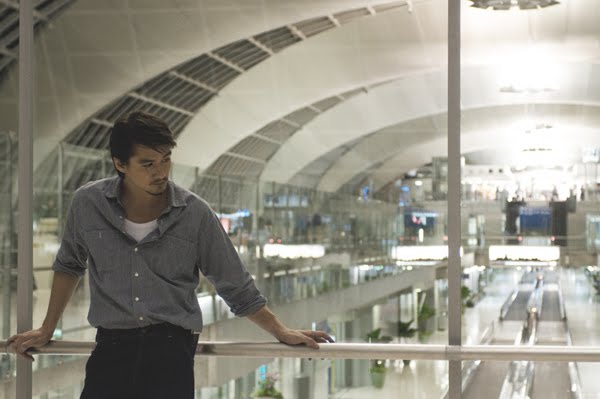

Bangkok Nites (バンコクナイツ, Katsuya Tomita, 2016)

bangkok-nites“Asia is a paradise for men” though not for anyone else, if Bangkok Nites (バンコクナイツ) is anything to go by. In Tomita’s previous film, Saudade, he explored the intercultural exchange between Thailand and Japan with one character having tried to escape there and failed, and another idly dreaming of running away with his Thai mistress. Five years later he revisits the same idea but from the other side as he weaves a meandering trail through the Japan-centric element of Bangkok’s red light district which eventually leads him on to other neighbouring nations whose landscapes still bear the scars of war and colonialism decades into a supposedly enlightened age.

We begin with Luck (Subenja Pongkorn), caught in reflection against a swanky hotel window overlooking her city. Her client is a Japanese man, clingy in the extreme though it’s unclear if his desire to avoid paying is out of consideration to his wallet or a genuine case of affection. Nevertheless, his whining is too much for Luck who eventually manages to escape the room and get back to work. Employed by a bar on Thaniya Road, an area of Bangkok’s red light district popular with Japanese tourists, Luck’s job involves sitting on a shelf in a large stable area where she and her colleagues wear colour coded badges so the customer can see their rates and services offered at a single glance.

Good friends with a Japanese man who works as a kind of procurer for the club, Luck ends up at a party where she runs into Ozawa (Katsuya Tomita) – a quasi-customer with whom she’d developed a deeper relationship around five years previously but subsequently lost contact. A former Self Defence Force soldier, Ozawa first came to Asia on a peacekeeping mission to Cambodia and has been back and fore ever since. During this most recent stay he’s begun to strike up a friendship with fellow Japanese guys working around the edges of the sex industry and related businesses including the drugs trade. After getting to know each other again, Luck takes Ozawa to her peaceful, rural, hometown beginning a journey which is to have a profound impact on his view of the continent.

There’s something a little sad about the small, sleazy world of the red light district and its collection of melancholy ex-pats eking out a living by exploiting desperate local women. Ozawa hovers on the fringes of this group, obviously a visitor to the brothels of Thaniya Road, but not quite a devotee. The other guys repeatedly refer to Thailand and other surrounding countries as “paradise” or a “utopia” where the women are “easy” and can be had at will and with few strings. One visitor remarks that he can have twenty nights of debauchery in Bangkok for the cost of one fancy night out in Roppongi. Yet for every one like him just trying to blow in and blow out with no fuss, there are a handful who can’t separate a transaction from a romance, becoming overly attached to women merely providing a service who, naturally, are not particularly seeking a long-term relationship with the sort of man who thinks a woman can be bought wholesale.

Luck is the number one on Thaniya Road, though she’s aware her time is limited. The work pays well and she’s been able to acquire an elegant Bangkok apartment as well as a house for her mother and siblings back in the country, but her heart is set on saving enough money to open an upscale European restaurant when she finally leaves the sex trade behind. Taking Ozawa back to her hometown, she explains to him that her life in Bangkok is just what happens to girls from the country. Children are raised by aunts while mothers live in the city, sending money back home, until they swap places and the children head to the city while the women return to raise the children of relatives. Most of her friends are also involved in the local sex trade, catering to foreign travellers with less than romantic ideas about the country and its “exotic” women.

Tomita paints this as another ongoing echo of the colonial past as foreign men come to Thailand for purposes of discreet pleasure, giving little thought to the interior lives of the real breathing women in front of them. Taking Ozawa around her home town, Luck shows him the beautiful European style mansion she grew up in with her mother’s second husband (her step-father and the only positive male input she ever mentions) who was an American working at a local air base. The bases are a relic of the Vietnam war, the legacy of which also rears its head once Ozawa makes his way into Laos where giant bomb craters still scar the landscape like pock marks on the face of the Earth more than forty years later. Ultimately these colonial wars trace themselves back to the first waves of colonisation but when Luck tries to look forwards she only sees the past – her desires are for the European, fancy restaurants and urban sophistication.

Ozawa looks at Luck’s hometown and (thinks he) sees a “paradise”, a calm and peaceful place where people drink and smoke their lives away with no worries. He thinks this ought to be enough, and perhaps he’s right, but women like Luck and her friends are still left with no other choice than to enter the sex industry in order to feed their families while the men bum around smoking, drinking, and whoring with other women. It could be a paradise for Ozawa, but it would only be supported by the private hell of the women all around him.

Tomita shoots in a straightforward style but also adds epic sweeping pastoral shots thanks to drone  camerawork and occasional touches of the surreal such as groups of shadowy figures in the forests who may be real or imagined, perhaps the ghostly spirits of past rebellions. Another figure encountered by Ozawa may also be a manifestation of these long-standing ghosts as he recites patriotic speeches and asks for money to help look after the refugees flooding into the forests thanks to the Vietnam war. Ozawa later meets the descendant groups of the guerrillas in Laos which includes disaffected Filipinos, Japanese, and Thais all looking for alternative ways of living.

Harnessing the power of popular song from classic ‘60s Thai pop to indie folk tunes about sold daughters and karaoke covers of The Carpenters, Tomita demonstrates how even music receives external influence but repurposes and exports it as a form of popular protest. Everyone is looking for an elusive form of paradise which does not exist, but their own actions and desires are often the very thing which prevents them from finding it. Tomita’s four years of research have been put to good use in creating a nuanced, thoughtful dissection of the ongoing effects of colonialism in a land still scarred by war and the painful wounds of the unexamined past.


Reviewed at the 2016 London East Asia Film Festival.

International trailer (dialogue free)
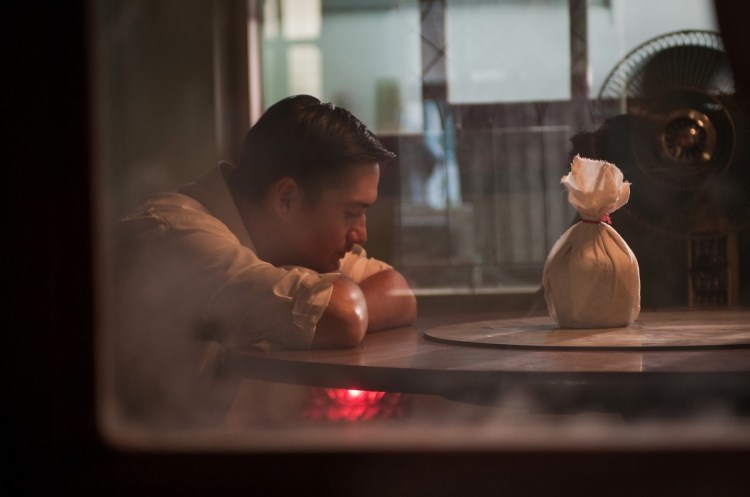
Concrete Clouds (ภวังค์รัก, Lee Chatametikool, 2014)

Concrete CloudsI reviewed this flawed yet interesting film, Concrete Clouds, for UK Anime Network. Probably I think I liked it a bit more than the score suggests but it does have its problems. Also ’90s (or maybe ’80s?) Thai pop is kind of amazing.


Up to now Lee Chatametikool has been best known as the regular editor on the films of Apichatpong Weerasethakul (Uncle Boonmee, Tropical Malady) but with Concrete Clouds he’s finally stepped out of the edit suite and behind the camera to direct his very first feature film. However, Concrete Clouds owes less to Apichatpong Weerasethakul or any of the other well known Thai directors he’s been working with over the last decade than it does to early period Tsai Ming-Liang and the Taiwanese new wave. A mood piece heavy on directorial flair but light on detail, Concrete Clouds never quite comes together but still manages to offer a few rewards for the patient viewer.

Set in 1997 just as the Asian Economic crisis begins to take hold, long time emigré Mutt (Ananda Everingham) gets a late night phone call from his high school age brother to say their father has just jumped off the roof. Mutt goes home for the first time in a long time aiming to lay a few ghosts – less that of his father than that of his teenage self and half forgotten love. Meanwhile, younger brother Nic has formed a tentative romance with a girl from the next building who appears to be living more or less alone and has just begun working in a hostess club. Just like his brother he’ll have to decide whether to abandon his love in Thailand to seek new dreams overseas or chase an ever elusive future in the land of his birth.

To be frank, the somewhat shocking and early death of the father retains little impact after the fact as neither of the now orphaned sons seems to dwell very long on the loss of their only parental figure and there’s no real soul searching over why he did what he did. The blueprints for new buildings he was looking at right before and the constant financial concern on the news screens seem to be evidence enough of his ultimate motives. Neither is much mention made of the absent mother who, one assumes, has been absent for a relatively long time. The age gap between the brothers also means that their relationship is not as close as you might assume brothers to be as Mutt must have left for America when Nic was little more than a toddler. Nevertheless, both boys are cast adrift by the older man’s decision, taken alone and with seemingly little concern for those around him.

The historical context is fairly key to the film though may be impenetrable for those less versed in recent history. In setting the story in 1997, the director intends both to imply that many of Thailand’s present social and economic problems stem back to the Asian Financial Crisis and the new Thai constitution which was created around that time but also to deal with the fragile nature of memory and our own tendencies to over romanticise our pasts by falling in love with a fantasy of our own creation. Mutt has dreamed of his high school girlfriend, Sai, ever since leaving her to go to college in America. He lives with a woman in New York but their relationship doesn’t seem particularly serious and she has not accompanied him to Thailand for his father’s funeral. Even though years have passed he’s remained faithful to the image of Sai he has in his mind and however much he tells himself nothing has changed it’s his own self created image that he’s wedded to, rather than the flesh and blood Sai who’s been busy getting on with her own life in the intervening ten years.

In a another cloud based film, Mikio Naruse’s Floating Clouds, the title refers to the the central characters who are unable to re-root themselves after the disruption caused to their lives firstly in failed Manchurian expedition and then by the after effects of the war. They float aimlessly trying to find something they can cling on to that will allow them to move forward with their lives and ultimately never find it. In Concrete Clouds it’s almost the opposite problem, the characters are weighed down by their dreams, almost crushed by them and unable to move. Their dreams will never lift off the ground because they can’t bear to let go of the past, of the people they once were and things they once thought they wanted.

The most notable element of Concrete Clouds is its unusual shooting style which incorporates everything from snatches of archival footage to long stretches of fantasy sequences played out as karaoke videos to late ‘90s Thai pop songs. The film has an interesting aesthetic which appropriately matches its melancholy and slightly wistful tone though it fails to capture the exact emotional ache that it seems to be going for. Ultimately its disparate elements never quite seem to coalesce into something more and though Concrete Clouds has plenty to admire it stops short of capturing the heart. Nevertheless it’s an impressive debut from Lee Chatametikool who has marked himself out as new talent to look out for in Thai cinema.


This is getting a release from Day For Night in the UK and here’s the trailer

And here’s a clip of one of the karaoke sequences

And another from the OST

(I don’t know any Thai at all, what is this music?)

Hi-So + Q&A, Curzon Renoir 1st March 2013

Hi-So 1

As the film begins, a bewildered young woman is being shown to her room by a strangely attentive hotel staff in what seems to be luxury Thai resort. She is there to visit her Thai boyfriend, recently returned from study abroad in America and now it seems the star of an upcoming motion picture. Ananda, born and bred in Thailand but brought up in an affluent, bilingual family converses with his girlfriend in English but with everyone else in Thai. He is obviously busy with film work and his girlfriend is largely left to her own devices in the otherwise entirely empty hotel. As time moves on the geographical shift seems to have exposed the cracks in the couple’s relationship – the crew complain about Americanisms creeping into Ananda’s on screen performance and his girlfriend soon gets bored of all the attention that goes with dating a film star. It soon becomes obvious that she’s in the way, a distraction and unwelcome intrusion of the outside into Ananda’s life in Thailand.

Soon after she returns home the film seems to jump on a few months and Ananda is now living in an apartment in Bangkok with a woman from the PR company. Although the couple seem happy, or at least happier, Ananda still seems restless – perhaps more so now that his film work is finished leaving him with little else to do. Evidently Ananda’s family were fairly wealthy – the apartment the two share is one of many in a previously luxury but ‘under renovation’ apartment block owned by Ananda’s often absent mother.

In telling episodes of symmetry, Ananda never really seems to fit in anywhere. Constantly at odds with himself he seems to be a Thai in Thailand and an American in America. Whilst filming he rejects his American girlfriend leaving her forced to alleviate her isolation by inviting herself to a hotel employee’s birthday party where she can’t communicate because she doesn’t speak Thai and the hotel employees only have basic English skills. Moving forward, where it seems Ananda might have become reconciled to his life in Thailand with May, a visit from his American university friends leaves May equally isolated and sidelined as Ananda parties American style with his college buddies. Whilst in ‘Thai’ mode, Ananda seems like a quiet, respectable and respectful young man but with his American friends he’s loud and energetic, youthful and extroverted.

It’s very clear there are two Anandas each in constant struggle with the other. A privileged upbringing rich in overseas influence and an extended period abroad have led to an intense feeling of disconnection with his native culture, yet once abroad Ananda is Thai and forever a foreigner. His inability to be more than one thing at once, to be a complete person at any one moment seems to be tearing his life apart. In unwatched moments he appears intensely melancholic, frustrated and more than a little lost. He drifts from one thing to another, not really doing anything or taking anything seriously enough to fully commit to it.

Hi-So, short for High Society – the slightly aimless world in which Ananda and many others like him are living, is a very interesting film about the crushing ennui of the modern, monied man. Though it touches briefly on the collective trauma of the tsunami and the country’s rapid economic growth, this is very much a film about one man’s cultural confusion and ultimately how it’s left him feeling even as an outsider to himself. Undoubtedly this is one of those films where some will say that nothing really happens and others will reply that’s because everything is happening but for those willing to look deep enough Hi-So is certainly worthy of attention.