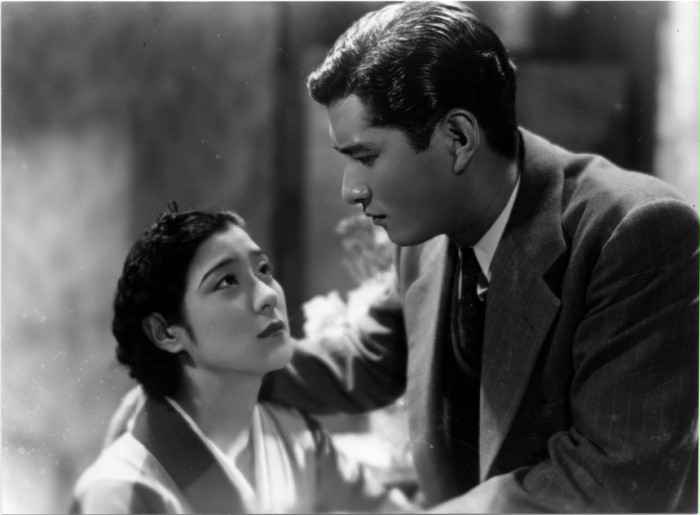
A Brother and His Younger Sister (兄とその妹, Yasujiro Shimazu, 1939)

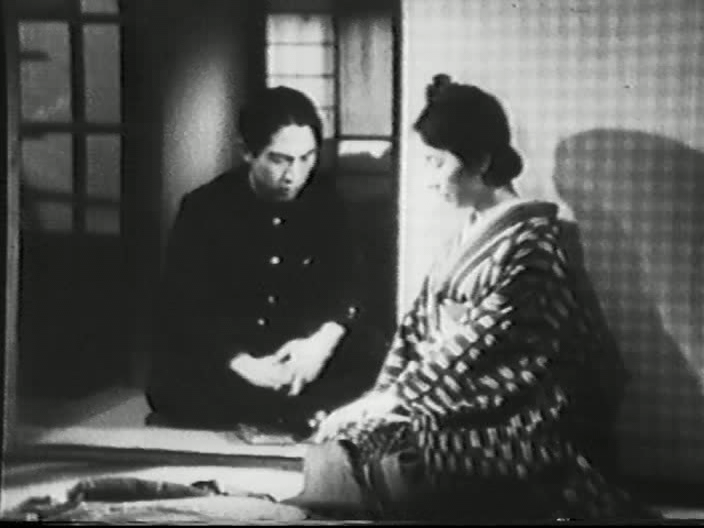
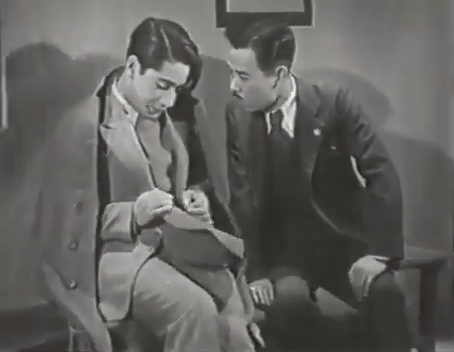
A young man’s love of go ends up getting him into hot water at work in Yasujiro Shimazu’s surprisingly progressive shomingeki, A Brother and his Younger Sister (兄とその妹, Ani to Sono Imoto). It seems office politics might not have changed all that much in the last 80 years even if many other things have, but conversely the film seems to have more to say about the changing nature of gender roles and attitudes towards women in a time in which it was becoming possible for a woman to live a fully independent life. 

This window wouldn’t last very long and the situation largely reversed itself even amid the supposed equality enshrined in the post-war constitution, but Fumiko (Michiko Kuwano) at least has a well paying job as a secretary at a large company and consequently little desire to marry even at the comparatively late age of 24. Her earning capacity is later put forward as a reason that there “aren’t many opportunities” for marriage as men apparently feel threatened and embarrassed especially if their salary is lower than hers. It’s not exactly that she’s against marriage, but as she can support herself and is otherwise happy living with her brother Keisuke (Shin Saburi) and his wife Akiko (Kuniko Miyake). She doesn’t see the need to rush into such an important decision. Though she might change her mind if the right person came along, for the moment she just isn’t interested. Then again, Akiko’s sucking of her finger when she’s ironically cut by a thorn on a bouquet of roses from an unwanted admirer might suggest another reason marriage is not on her radar.

Her suitor, Michio (Ken Uehara), despite his handsomeness is a little creepy in his courtship and cannot seem to take a hint that Fumiko isn’t interested in him. A friend of her boss, he has a habit of dropping into the office for no real reason and attempts to ask her out when the boss isn’t there. She lies and tells him she’s married already (to a penniless painter!) but after the boss reveals the truth it doesn’t seem to occur to Michio that if she made up a story like that it’s because she doesn’t want to go out with him. We’re told that Michio studied at Oxford and is attracted to Fumiko because he’s impressed by her language skills, but he’s also some kind of stockbroker which quickly paints him as no good seeing as the film seems to have a minor message about how dabbling in stocks and shares is little better than gambling and definitely dangerous.

One of Keisuke’s colleagues has been given a warning because there’s a rumour that he’s into shares while another has apparently been demoted because it came to light that he had a fondness for horse racing. More than a moral judgement, it seems the reason is that these sorts of hobbies may eventually lead someone towards embezzling from the company to cover their debts. Keisuke’s supervisor is also worried that his 18-year-old son is refusing to go to university and apparently wants to join some kind of “investment society” which admittedly does not sound like a good idea so he wants Keisuke to talk him out of it. The big boss, meanwhile, who is also Michio’s uncle, turns out to be into shares himself which makes him a very compromised authority figure. 

Keisuke is not into shares, but he is very into the game of go which causes him to stay out until late at night playing with his bosses. He does this because he genuinely likes playing, but Fumiko worries that his colleagues will come to resent him assuming that he does so to curry favour. Apparently, something similar happened at his previous job which is why he ended up quitting abruptly. As he was quite lucky to get this one despite how impressed everyone seems by his capabilities, it would be better if that didn’t happen again. Nevertheless, the perspicacious Fumiko turns out to be right as as his co-worker Yukito (Reikichi Kawamura) becomes increasingly jealous of his success fearing that he will leapfrog him to take the shortly to open up supervisor position which he believes to be his simply because he’s been there longer (which is generally how things work at Japanese companies). Consequently, starts a series of rumours that Keisuke is a snitch who got the horse racing guy demoted and is only in his position thanks to schmoozing with the bosses.

This obviously leaves him with a huge dilemma when his boss asks him to put in a good word for Michio with Fumiko whom he is pretty sure won’t be interested. To his credit, Keisuke maintains that it’s up to her and his career is nowhere near as important as her happiness though he is also aware it’s going to be embarrassing for him when she says no. Fumiko knows this too, and it’s clear that she also feels incredibly awkward when he puts it to her but only asks for a few minutes to think before offering her primary justification for refusing which would be that she fears Keisuke’s colleagues will resent him even more if they come to the conclusion that he sold his own sister in the hope of career advancement. This does in fact turn out to be the case as Yukito has already started a rumour about a dynastic marriage that turns the rest of Keisuke’s colleagues against him especially as he’s given the promotion immediately before he was going to tell the boss Fumiko isn’t interested. 

Confronted by the horse racing guy, Keisuke ends up quitting again after getting into a physical confrontation with a seemingly remorseful Yukito who probably didn’t mean for it to go that far. Keisuke quits because he won’t have people think he was gossiping behind their backs and is offended by this attack on his integrity, but his decision is also a rebuke against this infinitely corrupt employment regime in which hypocritical bosses hand out jobs to their favourites and maybe do expect that Keisuke will persuade his sister to sacrifice herself for his career. She meanwhile is portrayed as an independent woman, but ironically rejects the marriage to save her brother’s reputation though perhaps equally she feared her “no” would not be enough on its own. Then again, she had apparently turned down several suitors already and no one really expected her to say yes this time unless she’d suddenly begun to feel anxious about her age and declining prospects. 

Nevertheless, it’s refreshing that the film does not force Fumiko into accepting marriage as so many others would and in fact legitimises her opposition to it and right to live as an independent woman for as long as she chooses. Keisuke is also in some ways rewarded for quitting his job at the corrupt company in immediately getting another one from a former co-worker who’s since started his own business and wants to expand to Manchuria. But this final scene almost seems tacked on for the censor’s benefit. It is perhaps a little unusual for 1939 that the film has so far made no mention of Japan’s imperial ambitions nor made any kind of patriotic appeal. It’s even been quite pro-internationalist in the talk of people speaking English and engaging in European trade (even if the currency trading Michio’s doing is definitely framed as bad). Fumiko spots a little patch of grass clinging onto the plane as they take off for Manchuria with Keisuke remarking that he hopes this little piece of Japan will take root on the continent. On one level, it suggests that contemporary Japan was too corrupt for an “honest” man like Keisuke to prosper while Manchuria will offer greater freedom for himself and the independent modern girl Fumiko (who declares she won’t marry until Keisuke’s successful), but it’s also of course an unpalatable advocation for the ongoing imperialist expansion which seems so out of keeping with everything that’s gone before. Even so, the message is clear that it’s Keisuke and Fumiko who are in the right and should be allowed to live just as they are in a society free of judgement and hypocrisy.
My Elder Brother (私の兄さん, Yasujiro Shimazu, 1934)

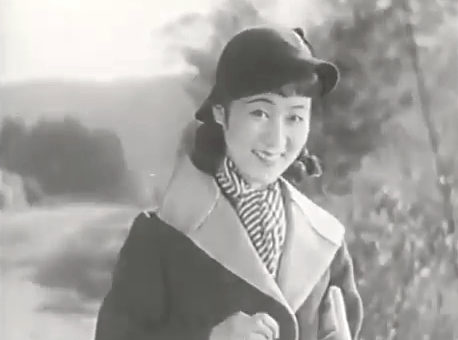
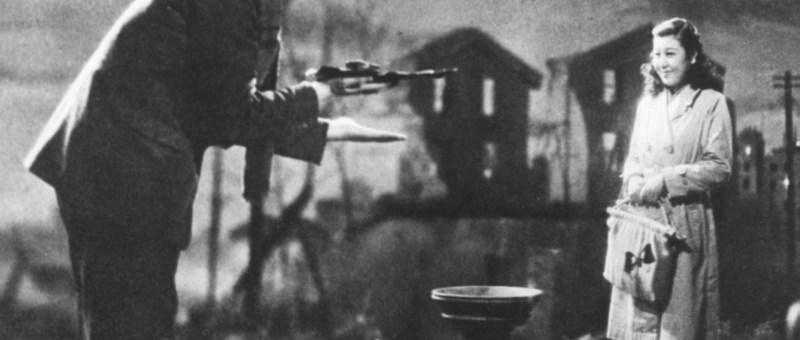
A wastrel son and runaway daughter get a few lessons in filiality in Yasujiro Shimazu’s genial ‘30s comedy, My Elder Brother (私の兄さん, Watashi no Niisan). Reflecting the changing the times, the film is in many ways about navigating the sometimes fraught relationships among a blended family though like many hahamono, it’s the stepson who is most devoted to his mother while the birth son is consumed by a sense of guilt and inadequacy in his accidentally awkward positioning within the family hierarchy.

The filial piety of eldest son Shige (Reikichi Kawamura) is established early on by the fact he’s not at work because his mother is ill and he’s off visiting her. He does in fact return late at night, though there’s a question mark over his qualities as a boss as the drivers at the taxi firm he runs remark that he’s been ignoring their attempts to negotiate with him for better conditions not least the provision of assistants which has been given additional weight by one driver’s experience with a disturbed fare who attempted to strange him with his belt.

The strange and violent opening sequence in which a cabbie is attacked by a crazed passenger is never referenced again and out of keeping with the otherwise lighthearted tone of the film though does add to a sense of danger later echoed in the appearance of two guys who first seem like yakuza but are actually just two grumpy old men trying to retrieve a young woman who’s run away in defiance of an arranged marriage. In any case, tearaway brother Fumio (Kazuo Hasegawa), who arrives drunk in the back of a cab, has indeed fallen into bad company with yakuza whom he describes as his friends though Shige warns him they’re probably just after his money.

Fumio has returned because he’s learned his mother is ill, though he’s reluctant to see her given his present condition. When he does actually meet her, she says that she hates him and calls him a good-for-nothing, worthless man. It seems her animosity is partly motivated by a sense of guilt and embarrassment that her biological son has brought shame to the family she married into and especially to Shige. For his part, Shige acknowledges that he also felt resentful when Fumio and his mother moved in but explains that he was still a child clinging to the memory of his late birth mother. Fumio explains to the young woman he picks up, Sumako (Kinuyo Tanaka), who is on the run from her uncle and the man her stepmother wants her to marry, that he left home because of his precarious status and sense of inadequacy but liked the sense of freedom his independence gave him even if he is ashamed of the kind of life he’s lived on the fringes of the underworld. 

Sumako is experiencing a similar dilemma as she feels herself unable to bond with her stepmother to the extent that she has not been able to articulate that she objects to the arranged marriage her relatives have set up for her. She laments that if it were her birthmother she should be able to tell her everything, but Fumio counters that Shige had been jealous of him because he could exchange harsh words with his mother because of their closeness in a way he never could because he is not her biological son. Reinforcing a sense of obligation between parents and children might have been an important message in the mid-1930s, but the film is perhaps unexpectedly progressive in its openness and desire to embrace these then considered less usual family arrangements born of second marriages in emphasising the brotherly bond between the two men and Sumako’s successful escape from an unwanted marriage simply by speaking her true feelings to her mother not to mention the suggestion of a cross class romance between rich girl Sumako and the middle-class Fumio.

Meanwhile, the film also has an international bent in the prominent signs for Chevrolet and Hollywood-esque aesthetics, drawing inspiration from American and European crime films for the violent opening sequence and underworld setting. Shimazu hints at the shadiness of Fumio’s backstreets life, but equally of Sumako’s uncle and his moustachioed friend lending an undertone of darkness to the mid-30s society but otherwise keeps things light in the innocent courtship between Fumio and Sumako who can mediate their attraction only by remarking on the beauty of a sunset. 


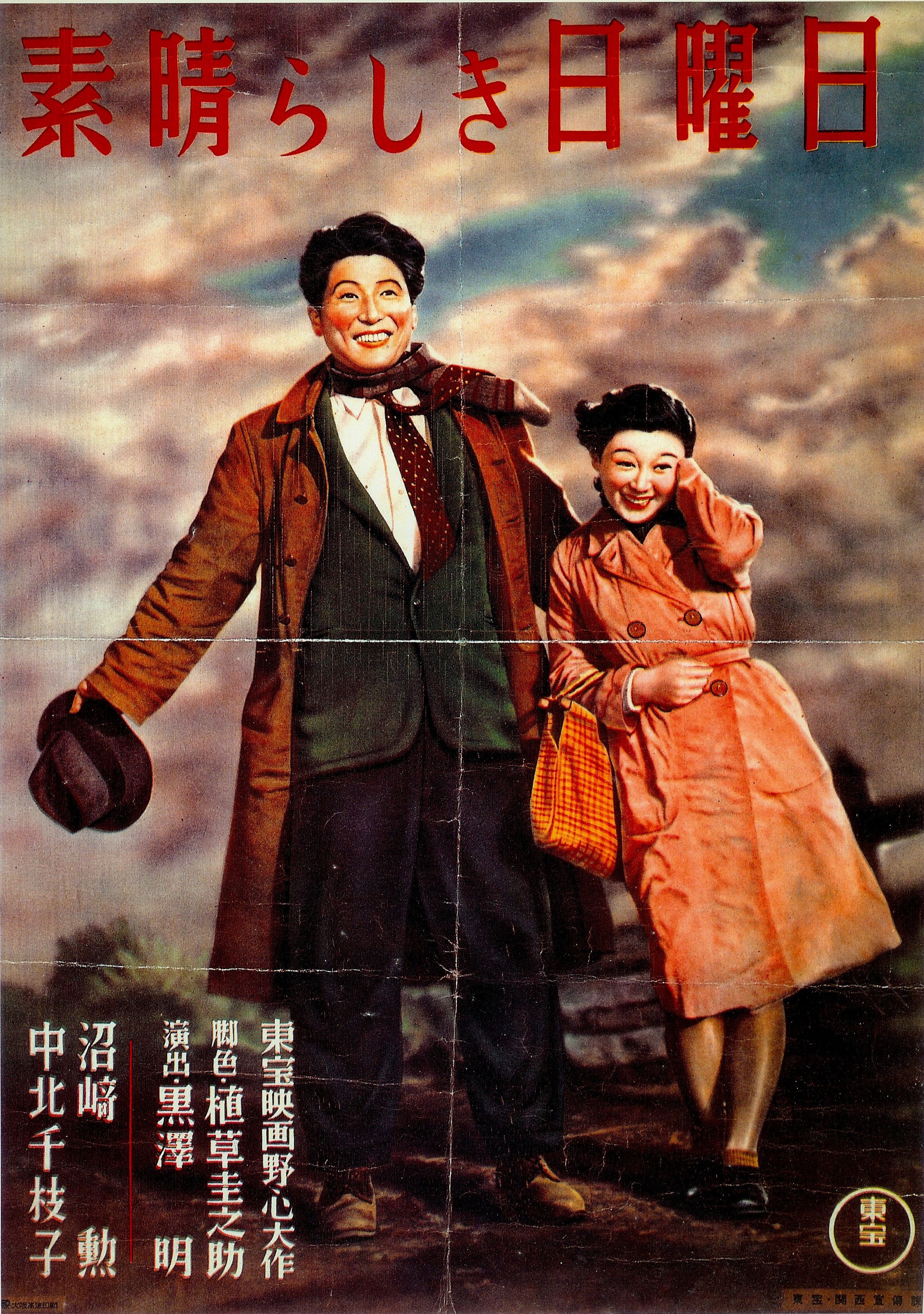
One Wonderful Sunday (素晴らしき日曜日, Akira Kurosawa, 1947)

A young couple attempt to have a nice day out in Tokyo for only 35 yen but eventually discover something much more valuable in Akira Kurosawa’s surprisingly upbeat voyage through the backstreets of the post-war city, One Wonderful Sunday (素晴らしき日曜日, Subarashiki Nichiyobi). Though it may begin with frustration and progress to abject despair, the film allows its dejected heroes to find renewed hope for the future in the ashes of their defeat if only through the power of make-believe. 

Yuzo (Isao Numasaki) and Masako (Chieko Nakakita) are a young(ish) couple who’ve been together since before the war but are unable to marry because their precarious financial situation prevents them from finding a home in which they can live together. Though they are each in full employment, Masako currently lives with her sister and Yuzo with a friend. They can only spend Sundays together, but this particular Sunday Yuzo is fulled with frustration and resentment. He has only 15 yen, not much of a date as he tells Masako with irritation explaining that she’s had a wasted journey. She reveals that she has 20, but Yuzo has his male pride and is reluctant to take “a woman’s money” while internally humiliated not to be able to take her out on the town. Just before she had arrived, Yuzo had stared at an abandoned cigarette butt on the pavement. His desire soon overcame his shame. He picked it up and smoked it, only for Masako to bat it out of his hand as if insisting that he’s better than that. 

For her part, Masako is defiantly upbeat. Perhaps she’s putting on a brave face for Yuzo, but does her best to buoy his spirits so they can have a nice day together. It may be her only nice day all week. While she looks forward, he cannot move beyond the dissatisfying present. Masako begins by suggesting they check out a show home advertised on a billboard as a new kind of residence which is cheaper to build and available for only 100,000 yen for the first 100 buyers. She imagines how their life might be together in this space, while Yuzo merely sulks in the corner and points out the shoddiness of the build amid declining modern standards. It’s advertised as affordable, but they can’t afford it. Meanwhile, another man wanders in with a woman who is clearly his mistress. She exclaims that the place is a dump, “I hate matchbox houses”, while he agrees that it’s cheap for a reason and you get what you pay for. Presumably he already owns a home where his wife and family live and is about to drop a small fortune on a discreet love nest while his mistress, not unreasonably, attempts to haggle her way up to something a bit more fancy. Yuzo knows he won’t ever be able to afford even this “inexpensive” home that a wealthy man disdains as not worthy of his bit on the side. They’ve just come from seeing a crummy flat a few streets away which Masako asks directions to only to be put off by the doorman who warns them that the flat isn’t even really habitable and the landlord is heartless but they couldn’t afford that either even on the assumption they would both keep working (which depending on Masako’s job might not possible once she marries).

The landscape around them is in ruins. Yuzo and Masako wander through a bombed out city not yet ready for reconstruction looking for somewhere to stay out of the cold without eating into their 35 yen. He wants to give up and go home, but she convinces him to attend a concert of the music they heard on their first date before the war only when they get there all the cheaper tickets have been bought up by touts who sell them on at 50% markup. Beaten up for challenging the touts’ uncompromising cynicism, Yuzo hits rock bottom returning to his flat in a rundown tenement where a woman mopping the corridor gives Masako serious side eye. Frustrated, he tries to pressure her into premarital sex, her rock bottom coming a few minutes later when she firstly leaves in outrage and then returns as if admitting that their situation will never improve. 

“The war destroyed that dream” Yuzo had said of Masako’s attempt to rekindle his hopes for the future in the plan they made to open a cafe together after they married, but the reality of their mutual defeat finally seems to inspire defiance in the face of the world’s hostility. On their journey through the city, they’d encountered a ragged street kid who thought them fools after they refused his offer of ten yen for one of their rice balls and simply gave it to him out of human kindness. Yuzo felt himself a fool after trying to visit an old friend who’s done well for himself with a swanky cabaret bar only to be rebuffed and see his own image reflected in a mirror with his threadbare overcoat and battered hat juxtaposed with the image of a fine young couple eyeing him with disdain and suspicion. In the end Masako can only appeal to us, breaking the fourth wall in a moment reminiscent of Peter Pan asking us to clap if we believe in fairies as she tries to revive Yuzo’s sense of naive possibility to conduct an unfinished symphony of their imagined life together in a happier future of post-war Japan. Refusing to give in to their baser instincts, to become cynical and selfish or else simply to give up, this wonderful Sunday does seem to have given them a childish sense of hope that better days are on their way and until then there’s always next week. 


One Wonderful Sunday screens at the BFI Southbank, London on 3rd & 15th January 2023 as part of the Kurosawa season.

The Rose on His Arm (太陽とバラ, Keisuke Kinoshita, 1956)

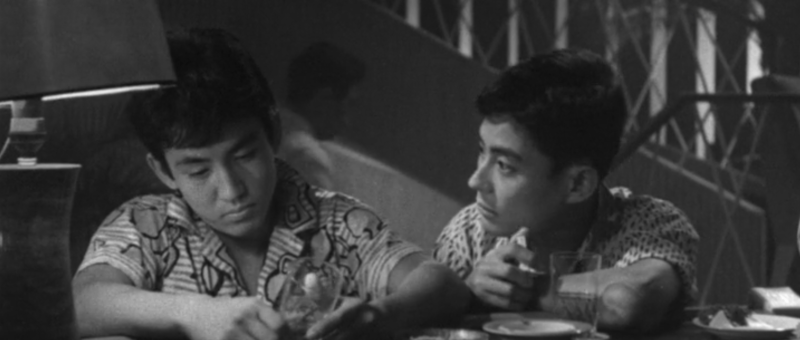
In the mid-1950s, a minor moral panic took hold over the so-called “Sun Tribe” movies which, inspired by the novels of Shintaro Ishihara, depicted a world of crazed abandon in which a collection of bored rich kids lost themselves in the hedonistic pursuits of sex and drugs rejecting the stability the wartime generation had striven so hard to create for their children. Shochiku, at that time the home of polite melodrama, nevertheless attempted to get in on the youth movie boom mostly through commissioning a series of young directors such as Kiju Yoshida and Nagisa Oshima in the hope that they could speak directly to their generation. Meanwhile, the by that point well-established Keisuke Kinoshita also made his own, perhaps surprising, take on the genre with The Rose on His Arm (太陽とバラ, Taiyo to Bara), a youth movie melodrama which nevertheless anticipated the questions others were beginning to ask about the Sun Tribe movies in their very particular view of contemporary class dynamics. 

Our hero, Kiyoshi (Katsuo Nakamura), is like the (anti-)heroes of the post-Sun Tribe youth movies, a poor boy turned delinquent out of a sense of frustrated hopelessness. Quitting one job after another solely because the work is boring, he spends most of his days hanging out at the beach with other no good kids robbing unsuspecting bathers. Kiyoshi’s sense of inferiority is compounded by the fact that his mother (Sadako Sawamura) works as a maid for a wealthy family while making ends meet by crafting paper flowers by night. The young master of the house where his mother works, Masahiro (Akira Ishihama), never misses a chance to lord his wealth over him but later co-opts Kiyoshi into his group of wealthy friends as a source of entertainment (and because his delinquent friend, Yamanaka (Tamotsu Tamura), begins supplying them with drugs).

“I screwed up my life because I was poor, what’s your excuse?” Kiyoshi eventually asks an indifferent Masahiro after beginning to see him for what he is. Like the hero of Punishment Room, Kiyoshi’s internalised resentment is partly down to a paternal failure in that he is deeply ashamed of his late father who died, his mother claimed, saving him but also in the course of his activities as a black marketeer in which he’d forced his son to be complicit. The family had apparently tried to make a life for themselves in the new colonies, in this case Palau, but of course had to return to Japan and were then penniless. People did what they had to do, but no one trusts a black marketeer and it seems to be a stain Kiyoshi (whose name means “pure”) cannot wash off. As a poor boy with no education or prospects, he knows all that awaits him is drudgery, so why not make a fast buck stealing purses at the beach rather than slave away at the factory for a week making less than Masahiro gets in pocket money from his factory owner father? 

Convincing himself he’s no good, Kiyoshi consistently sabotages opportunities but resents himself for doing so. He begins to buckle down at the factory but quickly becomes “bored” and starts taking advantage of his supportive floor manager while sucked into Masahiro’s hedonistic lifestyle even after it becomes obvious that he’s keeping him around to be some kind of hired goon, good for punching other pasty rich boys and hooking him up with underworld thrills. Masahiro is a delinquent because his life is too easy, he has no economic imperative to be responsible and will most likely go to college and then either take over the factory or walk into a lucrative salaryman job. Kiyoshi is a delinquent because he’s desperate and has no other means of living. 

Meanwhile he resents his mother’s love, shamed, in more than one sense, by her continuing industry. She often tells him the story of how he fell ill on Palau only to make a miraculous recovery after which she collapsed into a rose a garden. To spite her, Kiyoshi gets the titular rose tattooed on his arm, something which forever marks him out as a ne’er do well in conservative Japanese society, all but guaranteeing he’ll never get an honest job (he even has to cover the tattoo with bandages in public places to avoid causing offence). Eventually he takes drastic action to end his sense of hopelessness, pursuing what is strangely a darker yet more romantic destiny than that of his post-Sun Tribe compatriots in taking a poetic stand, paper rose in hand, defying his despair only through embracing it. 


The Rose on His Arm is currently available to stream in the US via Criterion Channel.

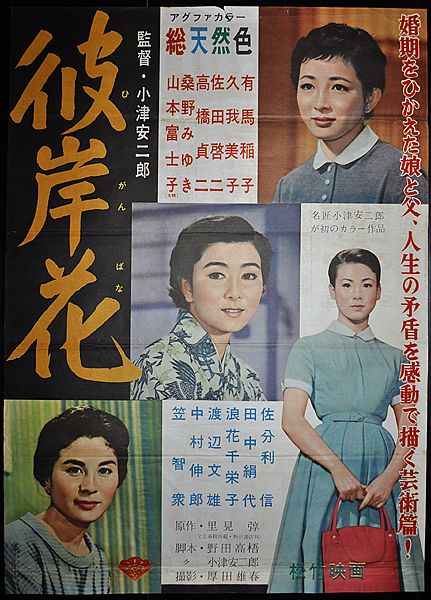
Equinox Flower (彼岸花, Yasujiro Ozu, 1958)

Japanese golden age cinema is famed for its centring of female stories, but while it’s true that many of Yasujiro Ozu’s family dramas revolve around a young woman’s feelings towards marriage, the perspective is often surprisingly male. Equinox Flower (彼岸花, Higanbana), his first film in colour, marks something of a change in direction in its spirited defence of the young, but at heart is still a story as much about impending old age, the responsibilities of fatherhood, and changing times as it is about contemporary family dynamics or female agency. 

The father in question, Hirayama (Shin Saburi), is a high ranking executive with two daughters. The older, Setsuko (Ineko Arima), is working at another company, and the younger, Hisako (Miyuki Kuwano), is still in school. Marriage is on his mind because he’s just attended the wedding of an old school friend’s daughter at which he gave a speech, with his wife Kiyoko (Kinuyo Tanaka) sitting awkwardly next to him, describing the arranged marriage he had with her as “pragmatic, routine” while he envies the young couple’s “fortunate opportunity” to indulge in romance. He and Kiyoko idly discuss the idea of Setsuko’s marriage, it seems as if there is a promising match on the horizon, with Hirayama conflicted while Kiyoko is very much in favour of doing things the traditional way. She’s already mentioned it to her daughter, but all she does is smile demurely which seems to provoke different interpretations from each of the parents. 

While thinking about all of that, Hirayama receives a visit from an old friend who was a notable absence at the wedding asking him to check up on his daughter Fumiko (Yoshiko Kuga) who ran away from home two months ago to live with a musician after he tried to veto her intention to marry without consulting him. Hirayama is sympathetic, perhaps thinking his friend has acted foolishly and pushed his daughter away. After visiting the bar where she works, he comes to the conclusion that as long as she’s happy with her choice then everyone else should be too. That all goes out the window, however, when a young man, Taniguchi (Keiji Sada), visits him unexpectedly at work and asks for permission to marry Setsuko. Hirayama quite rudely asks him to leave and then irritatedly talks the matter over with Setsuko before petulantly refusing his consent, not because he objects to Taniguchi, but because he is hurt on emotional level that she hadn’t talked to him about this first (not least so that they stop worrying about arranging a marriage) while resentful that she’s gone behind his back and undercut his patriarchal authority. 

In addition to the changing nature of family dynamics, Hirayama is perhaps conscious of his advancing age, feeling himself increasingly obsolescent and therefore additionally wounded by this assault on his authority as a father. The generation gap, however, is all too present. Both Setsuko and Fumiko feel as if they simply cannot talk to their parents because they wouldn’t listen and will never understand. Yukiko (Fujiko Yamamoto), the daughter of another friend, feels something similar in her exasperation with her well-meaning single mother who keeps hatching plans to set her up with various men she isn’t interested in. Intellectually, Hirayama sides with the young, envying them their freedoms and advising Yukiko firstly not to marry at all, and then encouraging her desire to resist arranged marriages despite trying to foist them on his own daughters. 

Even Kiyoko eventually describes her husband’s continuing petulance as “inconsistent”. It seems obvious that Kiyoko is siding with her daughter, immediately taking a liking to Taniguchi who politely brought her home after she stormed out following an argument with her father, but she continues to behave as a “good wife” should, politely minding her husband while gently hoping that he will eventually come round. Only once pushed does she try to explain to him, again politely, that he’s being selfish and unreasonable, but he continues on in resentment while causing his daughter emotional pain simply for trying to find her own happiness rather letting him decide for her. Kiyoko is afraid that if it carries on like this, then Setsuko will, like Fumiko, eventually leave and they’ll lose her completely, something which Hirayama either hasn’t fully considered or is actively encouraging through his petulance. 

In the end the conclusion he comes to is that the parents will eventually have to give way or risk losing their children entirely. He tells both Fumiko and Yukiko that all parents want is for their children to be happy and so nothing else matters, but struggles to put his advice into practice when it comes to his own daughter. Like pretty much everyone in an Ozu film, Hirayama is a good, kind person, even if one struggling against himself as he contemplates a loss of authority, a change in standing, and the difficulty of dealing with complex emotions as a man in a patriarchal society. Predictably, it’s women who essentially bully him into making better decisions, Yukiko “interfering” in the nicest of ways, while his wife makes it clear that though she thinks he’s wrong she will continue to stand by him if only in the hope he will eventually see the light. “Life is absurd, we’re not all perfect” he admits, only later realising how his stubborn foolishness may have caused unnecessary suffering to those he loves the most.


Currently streaming in the UK via BFI Player as part of Japan 2020. Also available to stream in the US via Criterion Channel.

Original trailer (no subtitles)

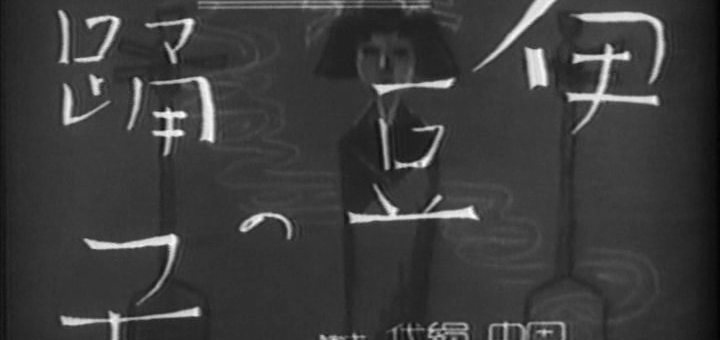
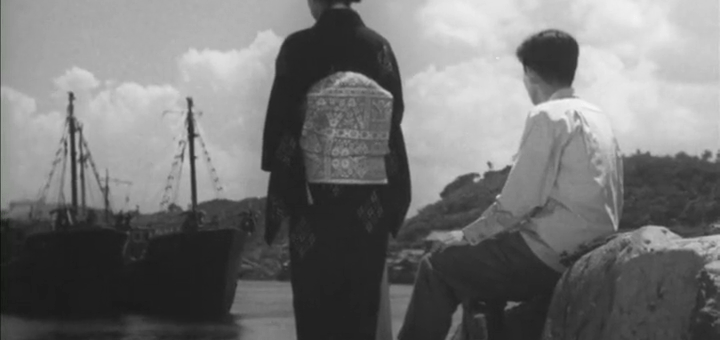
The Dancing Girl of Izu (恋の花咲く 伊豆の踊子, Heinosuke Gosho, 1933)

“Happiness is waiting for you” the melancholy heroine of The Dancing Girl of Izu (恋の花咲く 伊豆の踊子, Koi no Hana Saku Izu no Odoriko) is told by a man who truly loves her, though with his words all her hopes are dashed. Shot on location, Heinosuke Gosho’s 1933 silent is the first of several adaptations of the well-known Yasunari Kawabata story from 1926 and takes a number of liberties with the source material which are partly in keeping with the demands of contemporary cinema and partly an attempt to anchor it more firmly to the increasingly chaotic world of 1933 beset with both economic and political instability thanks to the global depression and Japan’s imperialist ambitions. The price of “happiness” it seems may be love, but perhaps stability as is much as you can ask for in an infinitely unstable world. 

Nominally speaking, the hero of this tale is a young student, Mizuhara (Den Ohinata), through whose eyes we view the transitory nature of young love and the rigidity of a society which will in the end not permit its fulfilment. The “dancing girl” however is our primary focus. Kaoru (Kinuyo Tanaka) is the orphaned younger sister of Eikichi (Tokuji Kobayashi) who inherited a literal goldmine but squandered his inheritance and forced the whole family on the road to earn their keep as travelling players. Such people occupy a kind of underclass, victims of a prejudice against those who have no fixed abode and cannot easily be identified through association with a place or people. Kaoru admits that though she has learned to bear her way of life because at least she’s with her family, signs such as the one they find in a ditch to the effect that beggars and itinerant actors are not welcome in the town fill her with despair. 

Mizuhara meets the actors when they have been unfairly accused of dumping the sign out of frustration (a child later vindicates them after confirming that it was a wandering priest who passed through shortly before). He wades into the fray to urge the angry farmers to exercise a little more patience and ends up agreeing to travel with the family to their next destination as he is himself engaged in a kind of holiday wandering around the picturesque countryside of the Izu peninsula (a popular activity for well to do students of the time). Unbeknownst to him they are already connected by mutual acquaintances in that a friend of Mizuhara’s, Ryuichi (Ryoichi Takeuchi), from the same university also lives in this town and is the son of the man, Zenbei (Arai Atsushi), who bought the goldmine from Eikichi after he went bankrupt. 

The economic subplot concerns an amoral mining engineer, Kubota (Reikichi Kawamura), who apparently has a reputation as a “slave driver” and was responsible for starting the mine which Eikichi’s father owned, the implication being that it failed because of his exploitative business practices and has flourished under Zenbei’s more compassionate ownership in contrast to the picture Kubota is about to paint of him. Having apparently failed at several other endeavours, Kubota has sworn off mines but has convinced himself that he is “owed” something seeing as Zenbei’s mine is now a success and he was the one who found it. He tries to get something out of Ryuichi, but he is unconvinced and eventually offended, accusing of Kubota of blackmail when he insinuates that there was something improper about his buying the mine from Eikichi for much less than it was worth. 

The film’s opening sequence which set up a subplot never resolved about a runaway geisha, however, showed us that Zenbei is as his name suggests a kindhearted man. He reported the geisha’s disappearance to the police not because she took off without clearing her debts but because he was worried for her safety, believing she may have been tricked into running off with an unscrupulous client. Kubota plants the seeds of resentment by convincing Eikichi that he was cheated out of the mine and is owed compensation. Eikichi, feeling humiliated, is determined to “negotiate”, but Zenbei tells him to give them his sister. 

As will be revealed later, Zenbei’s intentions are honourable and he has no thought of replacing the geisha who ran away with Kaoru but wants to take her into his household as an adopted daughter. Eikichi, however, misunderstands but is prepared to sell his sister in order to pursue a pointless revenge against Zenbei by getting money to buy another mine and thereby become even richer. Mizuhara berated him for even considering the idea of trading his sister for money, but in the end even Eikichi only sees her as capital in his rage-fuelled desire to avenge his wounded male pride and sense of impotence. He failed as head of household in losing the family fortune and now has no intention of protecting his sister from the vagaries of the world. 

Mizuhara once again intervenes and learns the truth from Zenbei, that he had been a friend of Eikichi’s father’s and has always been trying to look out for them but has recently lost patience with Eikichi who has already borrowed a lot of money from him. Zenbei is minded towards tough love, convinced his well-meaning attempts to help have only enabled Eikichi’s financial fecklessness. He doesn’t see why Kaoru should pay for his mistakes and has been putting some of the proceeds from the mine into a savings account in her name, hoping also that she may one day marry his son Ryuichi. Mizuhara is at once crushed by the painful goodness he sees in front of him, knowing that his love for Kaoru is now not only impossible but perhaps selfish. All he can do for her now is get out of the way so that she can be saved from the harsh life of an itinerant player, restored to her previous class status, and given the most elusive of all prizes in this chaotic age, stability. 

Zenbei’s plan for Kaoru is in itself a kind of miracle, the best she could ever hope for, but it’s also a minor tragedy in that it both robs her of any kind of agency to make her own choices and destroys the possibility of a romantic future with Mizuhara. To accept everyday comfort and safety, she must resign herself to giving up her love. Mizuhara asks her to do just that in an altruistic act of selflessness which recognises that without money he is powerless to help her. He’s not the one she loves (and we have no idea how he might feel about it), but Ryuichi seems to be a good and kind man, like his father Zenbei who is perhaps the face of compassionate, paternalist capitalism. The world is too chaotic for romance, but there is kindness enough if you’re lucky enough to find it, and if stability is all there is perhaps sorrow is easier to bear than hunger. 


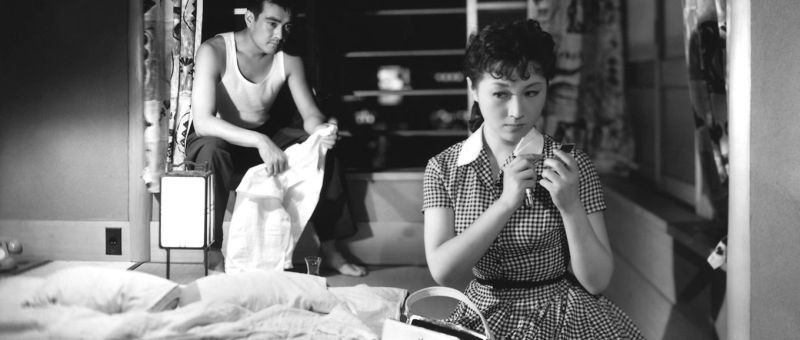
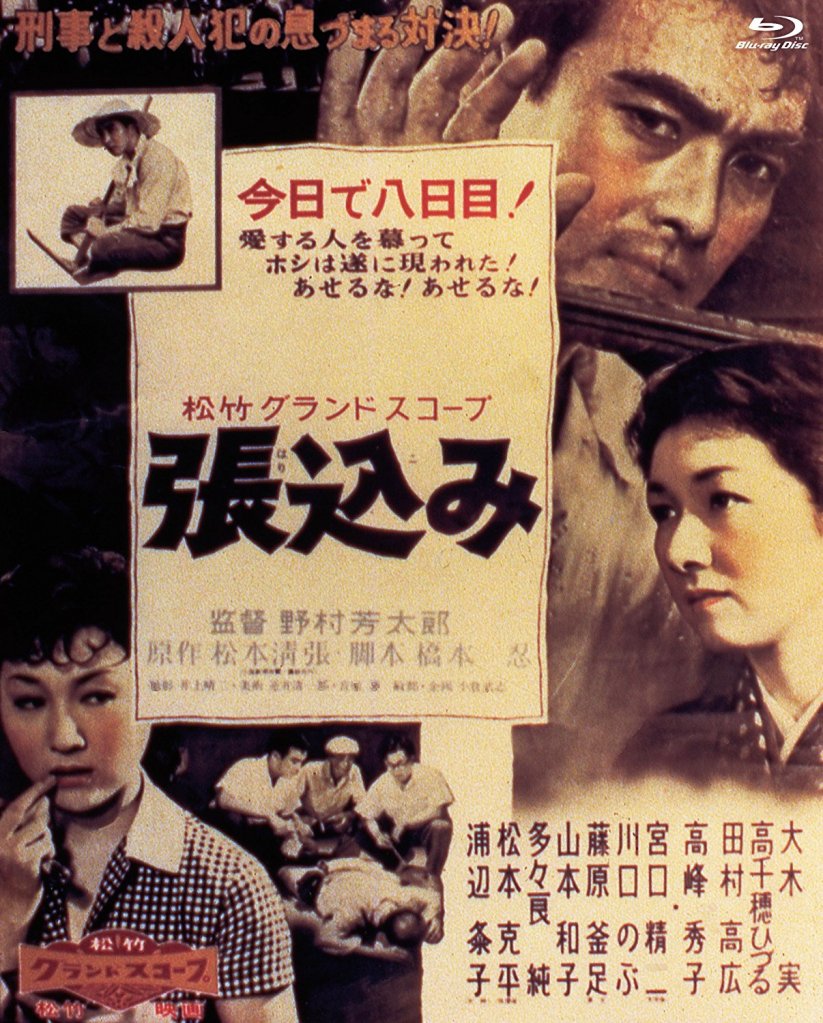
Stakeout (張込み, Yoshitaro Nomura, 1958)

Most closely associated with the crime genre, Yoshitaro Nomura was, like his frequent source of inspiration Seicho Matsumoto, also an insightful chronicler of the lives of ordinary people in the complicated post-war society. Stakeout (張込み, Harikomi), once again inspired by a Matsumoto short story, is on the surface a police procedural but underneath it’s not so much about the fugitive criminal as a policeman on the run, vacillating in his choice of bride, torn between the woman he loves who is afraid to marry him because her family is poor, and the pressure to accept an arranged marriage with the perfectly nice daughter of a local bathhouse. The stakeout becomes, in his eyes, a kind of illustrated parable, going against the socially conventional grain to convince him that making the “sensible” choice may only lead to long years of regret, misery, and loneliness. 

The film opens, as so many of Nomura’s films do, with a journey as two dogged Tokyo cops board a long distance train from Yokohoma travelling all the way down to provincial Kyushu which might as well be a world away from the bustling metropolis. Posing as motor salesmen, they take a room at a local inn overlooking the home of a melancholy housewife, Sadako (Hideko Takamine), the former girlfriend of a man on the run, Ishii (Takahiro Tamura), suspected of being in possession of a gun used to kill the owner of a pawn shop during a robbery. The younger of the policemen, Yuki (Minoru Oki), declares himself faintly disappointed with Sadako, complaining that she looks older than her years and is in fact quite boring, “the epitome of ordinary”. 

His older colleague, Shimooka (Seiji Miyaguchi), reminds him that most people are boring and ordinary, but as he watches her Yuki comes to feel a kind of sympathy for Sadako, seeing her less as a suspect than a fellow human being. Later we hear from Sadako that her marriage has left her feeling tired every day, aimless, and with nothing to live for, that her decision to marry was like a kind of suicide. “A married woman is miserable” Yuki laments on observing Sadako’s life as she earnestly tries to do her best as a model housewife, married to a miserly middle-aged banker who padlocks the rice, berates her for not starting the bath fire earlier to save on coal, and gives only 100 yen daily in housekeeping money while she cares for his three children from a previous marriage. Trying to coax him back towards the proper path, Shimooka admits that marriage is no picnic, but many are willing to endure hardship at the side of the right man. 

The “right man” gets Yuki thinking. Sadako has obviously not ended up with the right man which is why he sees no sign of life in her as if she simply sleepwalks through her existence. He is obviously keen that he wouldn’t want to make another woman feel like that, or perhaps that he would not like to be left feeling as she does at the side of the wrong woman. We discover that his dilemma is particularly acute because he finds himself at a crossroads dithering between two women, faced with a similar choice to the one he increasingly realises Sadako regrets. Shimooka’s wife is acting as a go-between, pressuring him to agree to an arranged marriage with a very nice girl whose family own the local bathhouse. She makes it clear that she’s not trying to force him into a marriage he doesn’t want, but would like an answer even if the answer is no so they can all move forward, but for some reason he hasn’t turned it down. Yuki is in love with Yumiko (Hizuru Takachiho), but Yumiko has turned him down once before because her family is desperately poor, so much so that they’re about to be evicted and all six of them will have to move into a tiny one room flat. She feels embarrassed to explain to her prospective husband that she will need to continue working after they marry but send almost all of her money to her parents rather than committing to their new family. 

Meditating on his romantic dilemma, Yuki begins to sympathise even more with Sadako, resenting their fugitive for having placed her in such a difficult position and repeatedly cautioning the other officers to make sure that the press don’t get hold of Sadako’s name and potentially mess up her comfortable middle class life with scandal when she is entirely blameless. The fugitive, Ishii, is not a bad man but a sorry and desperate one. He went to Tokyo to find work, but became one of many young men lost in the complicated post-war economy, shuffling from one poorly paid casual job to another. Now suffering with what seems to be incurable tuberculosis, he finds himself dreaming of his first love, the gentle tones of famous folksong Furusato wafting over the pair as they lament lost love at a picturesque hot springs while Yuki continues to spy on them from behind a nearby tree. 

They both bitterly regret their youthful decision to part, she not to go and he not to stay. The failure to fight for love is what has brought them here, to lives of desperate and incurable misery filled only with regret and lonliness. Sadako views her present life as a kind of punishment, finally resolving to leave her husband and runaway with Ishii who has told her that he plans to go to Okinawa to drive bulldozers for the next three years, though we can perhaps guess he has a different destination in mind. “That’s the way the world is, things don’t go the way you want” Ishii laments, but the truth is choices have already been made and your course is as set as a railway track. Sadako plots escape, but all Yuki can do is send her back to her husband with sympathy and train fare, leaving us worried that perhaps she won’t go back after all. Buying tickets for his own return journey, Yuki pauses to send a telegram. He’s made his choice. It’s not the same as Sadako’s, a lesson has been learnt. He goes back to Tokyo with marriage on his mind, but does so with lightness in his step in walking away from the socially rigid past towards a freer future, staking all on love as an anchor in an increasingly confusing world.


Original trailer (no subtitles)

Fireworks Over the Sea (海の花火, Keisuke Kinoshita, 1951)

In the films of Keisuke Kinoshita, it can (generally) be assumed that the good will triumph, that those who remain true to themselves and refuse to give in to cynicism and selfishness will eventually be rewarded. This is more or less true of the convoluted Fireworks Over the Sea (海の花火, Umi no Hanabi) which takes a once successful family who have made an ill-advised entry into the fishing industry and puts them through the post-war ringer with everything from duplicitous business associates and overbearing relatives to difficult romances and unwanted arranged marriages to contend with.

The action begins in 1949 in the small harbour town of Yobuko in Southern Japan. Tarobei (Chishu Ryu) and his brother Aikawa (Takeshi Sakamoto) run a small fishing concern with two boats under the aegis of the local fishing association. The business is in big trouble and they’re convinced the captain of one of the boats has been secretly stealing part of the catch and selling it on the black market. Attempts to confront him have stalled and the brothers are at a loss, unsure how to proceed given that it will be difficult to find another captain at short notice even if they are already getting serious heat from their investors and the association.

Luckily things begin to look up when a familiar face from the past arrives in the form of Shogo (Takashi Miki) – a soldier who was briefly stationed in the town at the very end of the war during which time he fell in love with Tarobei’s eldest daughter, Mie (Michiyo Kogure). Shogo has a friend who would be perfect for taking over the boat and everything seems to be going well but the Kamiyas just can’t seem to catch a break and their attempt to construct a different economic future for themselves in the post-war world seems doomed to failure.

The Kamiyas are indeed somewhat persecuted. They have lost out precisely because of their essential goodness in which they prefer to conduct business honestly and fairly rather than give in to the selfish ways of the new society. Thus they vacillate over how to deal with the treacherous captain who has already figured out that he holds all the cards and can most likely walk all over them. They encounter the same level of oppressive intimidation when they eventually decide to fight unfair treatment from the association all the way to Tokyo only to be left sitting on a bench outside the clerk’s office for three whole days at the end of which Tarobei is taken seriously ill.

However, unlike Kinoshita’s usual heroes, Tarobei’s faith begins to waver. He is told he can get a loan from another family on the condition that their son marry his youngest daughter Miwa (Yoko Katsuragi). To begin with he laughs it off but as the situation declines he finds himself tempted even if he hates himself for the thought. He never wanted to be one of those fathers who treats his daughters like capital, but here he is. Both Miwa, who has fallen in love with the younger brother of the new captain, and her sister are in a sense at the mercy of their families, torn between personal desire familial duty. Mie, having discovered that her husband died in the war, is still trapped in post-war confusion and unsure if she returns Shogo’s feelings but in any case is afraid to pursue them when she knows the depths of despair her father finds himself in because of their precarious economic situation. Shogo is keen to help, but he is also fighting a war on two fronts seeing as his extremely strange (and somewhat overfamiliar) sister-in-law (Isuzu Yamada) is desperate to marry him off to her niece (Keiko Tsushima) in order to keep him around but also palm off her mother-in-law.

Meanwhile, a lonely geisha (Toshiko Kobayashi) who has fallen into the clutches of the corrupt captain is determined to find out what happened to someone she used to know who might be connected to Shogo and the Kamiyas and falling in desperate unrequited love with replacement captain Yabuki (Rentaro Mikuni) who is inconveniently in love with Mie. Kinoshita apparently cut production on Fireworks short in order to jet off to France which might be why his characteristically large number of interconnected subplots never coalesce. Running the gamut from melancholy existential drama to rowdy fights on boats and shootouts in the street, Kinoshita knows how to mix things up but leaves his final messages unclear as the Kamiyas willingly wave their traumatic pasts out to sea with a few extra passengers in tow still looking for new directions.


Titles and opening (no subtitles)

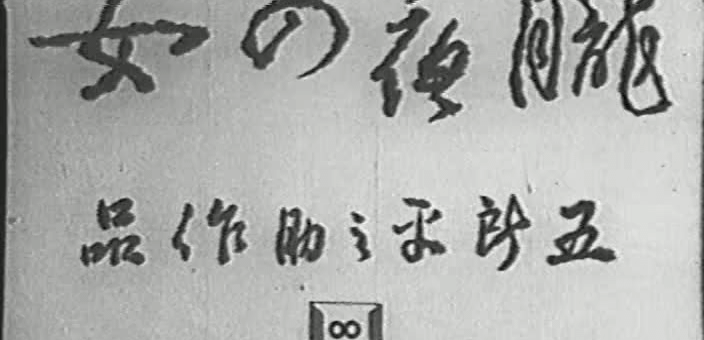
Woman of the Mist (朧夜の女, Heinosuke Gosho, 1936)

vlcsnap-2019-01-21-00h29m30s692The 1930s are often thought of as an era of social rigidity and implacable conservatism, yet even before the war things were changing. The young wanted something different than their parents often had and dared to dream of getting it even if their hopes were often dashed by the times in which they lived. Heinosuke Gosho’s Woman of the Mist (朧夜の女, Oboroyo no Onna) is the story of two youngsters who find themselves in a difficult situation and are offered a solution by elders acting kindness which they are persuaded to take only to find themselves progressively more miserable, burdened by the weight of the sacrifice their society has asked them to make.

Set in the jovial working class world of Shitamachi, Woman of the Mist opens with the hero of the tale, Fumikichi (Takeshi Sakamoto), enjoying a historical lecture regarding Edo era sacrifice for the common good during which his wife, Okiyo (Mitsuko Yoshikawa), comes to fetch him. Members of a local association he belongs to have come looking for him, it turns out for a favour. They want him to assist with some fundraising for a stone lantern to mark the association’s anniversary. Much to his wife’s exasperation, Fumikichi is only too happy to comply. It might seem that Fumikichi is a much respected pillar of the community only it is also true enough that he basks in the flattery of being regarded as someone to be depended upon and is therefore a soft touch (something undoubtedly well known to all around him).

Nevertheless, despite his slight tendency towards narcissistic attention seeking, Fumikichi is a salt of the earth type and willing to help those who need it for largely altruistic reasons. He therefore finds himself a surrogate father (though childless himself) to the son of his widowed sister Otoku (Choko Iida) who enlists him to talk some sense into his law student nephew, Seiichi (Shin Tokudaiji), who has apparently been “disrespecting” his mother and neglecting his studies by reading too many novels. Fumikichi has a word but counsels Seiichi that there’s nothing wrong with reading novels save that it obviously upsets his mum who has worked herself to the bone for the last 20 years dreaming of the day Seiichi becomes a fully fledged lawyer, which is to say a member of the middle classes.

Fumikichi, as he often will, becomes the conciliatory voice at the centre of generational conflict. Seiichi is a young man at the crossroads of life and finds himself torn between youthful idealism and a duty towards his family. He has become disillusioned with the law and would rather transfer to literature, secure in the knowledge that only in novels can you find the truly humane. Fumikichi is careful not to patronise but gives him a knowing look, realising that his confusion is partly born of resentment towards his well meaning yet accidentally possessive mother who has railroaded him into a career he doesn’t want to buy him a future which is her only dream. What he wants is control over his life, but when it comes to it he is still a boy and woefully unprepared for the demands of adulthood.

This becomes obvious when he falls in love and gets his girlfriend into trouble. Teruko (Toshiko Iizuka), a former geisha apparently known to Fumikichi in his younger days now working as a bar hostess, is not exactly the kind of wife his mother might have had in mind. The pair are careful to keep their relationship a secret for just this reason as Seiichi remains conflicted – one moment declaring that he no longer cares if everyone finds out and lying to his mother about her the next. Pregnancy forces the issue. Teruko, mindful of Seiichi’s bright future, declares that she can raise the child alone, glancing sadly at a picture of herself in her former life as a sex worker as if accepting what future sacrifices might be expected of her while half hoping Seiichi will rush forward to save her from such a fate. Seiichi doesn’t exactly rush but does tentatively accept his responsibility in reassuring her that he will soon come of age and is ready to become a father with all of the joys and obligations that entails.

Lost he turns to Fumikichi who hatches a plan which might be accounted a neat solution but is also another instance of the older generation making decisions on behalf of the young without really asking them. Despite being a rather feckless old man, Fumikichi tells his wife the child is his and asks for her forgiveness while also suggesting that they adopt the baby as their own. As expected, Okiyo is not exactly enthused but as Fumikichi calculated she would eventually comes around, ironically enough after a conversation with Otoku who has no idea the baby is really her grandchild. Once the decision is made, everyone rallies round to look after Teruko who finally becomes a (temporary) member of Seiichi’s family even whilst barred from ever becoming his wife and in fact of ever seeing him again as a result of the bargain which has been struck by Fumikichi. Nevertheless, Seiichi vacillates and attempts to change his mind by asking Teruko to marry him only for her to urge him to study hard and live well, sacrificing her happiness for his future.

Uncomfortably enough, it is Teruko who must pay for a series of transgressions against the norms of her society – for being a young woman with a past who seduced a nervous young man and dared to dream of a happier future with a person of her own choosing, though the very fact of her suffering is in itself an attack on these rigid and unfair social codes which do their best to destroy the happiness of ordinary, basically good people who have done nothing wrong other than attempt to live their lives. Fumikichi and his wife are doing their best and they too are good, compassionate people who have made good compassionate choices hoping for the best in a difficult situation even if their choices are defined by the prevailing conservative morality which places Seiichi’s future above a young woman’s life and love.

Then again, Fumikichi’s objections are largely practical – it’s hard to keep a family with no money coming in and Seiichi is still a student with no prospect of immediate employment that would pay enough for a wife and child. Could they be happy after a shotgun wedding and years of penury? Seiichi’s diffidence hints at no, but Teruko’s “purity” hints at yes as she vows to make the kind of sacrifice that proves her “goodness”. The youngsters find themselves beholden to the demands of their elders, torn between their personal desires and duties to those they love. Whatever they do, they lose and are destined to remain unhappy, unable to seize their individual chance of happiness in an oppressive, conformist society. Gosho may leave them at the mercy of such a system, but he does so with immense sympathy and not a little anger as we watch these good people making the best of things while asking ourselves if all of this is really for the best.


So Goes My Love (愛より愛へ, Yasujiro Shimazu, 1938)

(C) Shochiku 1938Yasujiro Shimazu had been a pioneer of the “shomingeki” – naturalistic stories of ordinary lower middle class life, and his early career included several forays into the world of the “tendency film” which carried strong left-wing messages. By the late 1930s however his films have shifted upwards a little and often deal with the lives of the upper middle classes as they find themselves at another moment of transition during the turbulent militarist years. In contrast with many contemporary films, Shimazu’s may seem curiously apolitical but speak volumes solely through their subtlety and direct refusal to engage with the propagandist concerns of the ruling regime.

In So Goes My Love (愛より愛へ, Ai yori Ai e), our lead, Shigeo (Shuji Sano), is a struggling writer living with his girlfriend, Miyako (Sanae Takasugi), who supports them both with her meagre earnings as a bar hostess. As we later discover, Shigeo is the eldest son of a prominent family who have (temporarily) disowned him because they don’t approve of his relationship with Miyako. Realising his dreams of becoming a successful writer are unlikely to be fulfilled, Shigeo has become moody and taciturn. He wants to find a job but isn’t exactly equipped to get one especially when the times are as hard as they are. He asks his uncle for help and gets an interview at a newspaper, but quickly realises that his uncle has set him up – he can only have the job if he “legitimises” his living arrangements. Shigeo leaves in a huff but there’s no denying he’s in a financial fix.

Things start to change when Shigeo runs into his younger sister, Toshiko (Mieko Takamine), by chance at a cafe. Toshiko insists on coming back with him to his lodgings “for future reference” but also out of morbid curiosity as a kind of touristic exercise in surveying the lives of those less fortunate. Shigeo thought Miyako would have already gone out but walks in just as she’s leaving. Though Miyako is shy and quiet, a little perturbed over being suddenly ambushed with a visitor, she does her best to ease the awkwardness between herself and her potential sister-in-law with black tea (foregoing a cup herself) until Toshiko finally consents to sit on their floor cushion. Toshiko looks around the bare, depressing flat and spots Miyako’s sewing box with a pair of freshly darned socks sitting on top. It’s immediately clear to her that Miyako is not, as her parents had suggested, some kind of gold digger (no self-respecting gold digger darns their socks, after all). More than that, she seems “nice”, which is perhaps why she’s able to put up with the petulant Shigeo with so little complaint.

The central problem is a two fold one – Shigeo has attempted to choose his own bride and therefore “modernity” over the “traditionalism” of an arranged marriage. He doesn’t particularly care about being the head of a household or about living in relative squalor save for guilt and wounded male pride that he’s condemned Miyako to live there with him (not to mention sending her out to the degrading world of hostess bars and cabarets just so they can survive). The parents have reacted badly and produced a stand-off. Shigeo’s uncle is trying to manipulate the situation to his advantage by convincing Shigeo to leave Miyako and come home, but Shigeo is a proud young man, even if he leaves Miyako there’s no way he’ll come home with his tail between his legs. If the older generation wants to win the younger one over, it will have to compromise and learn to play by less stringent rules.

Making a knee-jerk judgment, Shigeo’s father and uncle have decided that Miyako is just a passing fad, a floozy or a gold digger best worked out of one’s system young and then forgotten about (preferably so that it wounds you so badly you’re ready to accept the cold comforts of a proper arranged marriage). Rather than the uncle, it’s Toshiko who becomes the bridge when she realises how kind and devoted Miyako really is. Shigeo’s mother is also sympathetic but, sadly, it’s still the men who have the final say and it’s not until uncle pays a Miyako a visit to try and persuade her to leave Shigeo that he too begins to see how “sweet” she is and that allowing her into their family wouldn’t be such a bad thing after all. In fact, as we later realise, Shigeo’s father perhaps wasn’t so opposed as he pretended to be and was simply playing his son at his own game, planning to consent to the match once he proved that it was really “serious” and not just a passing fling. Nevertheless, Miyako’s own meekness proves the final barrier as she finds herself suddenly afraid that Shigeo’s family might think her inherent goodness is some kind of trick and she’s been plotting all along. Only when Toshiko comes to fetch her and Shigeo himself calls her to come does she finally understand it’s going to be alright.

For 1938, this rather frivolous story might seem decadent especially with its warmhearted liberalism as the union of a lower-class woman and upper-class man is finally blessed through nothing more than common sense and empathy. Though Shimazu otherwise steers clear of political concerns, he does send Shigeo, Miyako, and Toshiko to the pictures where they end up watching part of a film made by Leni Reifenstahl featuring beautifully photographed visions of lithe young men in swimming trunks after which Shigeo gets up in a huff to smoke a cigarette. Toshiko didn’t seem to enjoy it much either and tries to improve Shigeo’s mood by insisting that the next one will be better but the message is clear – Shimazu didn’t like that film and he doesn’t think you did either. Among fans of Shimazu, at least, modernity is winning. It may not be perfect (Shigeo is an obvious prig whose self-conscious masculine posturing is almost a self parody), but it’s getting there and if everyone would just forget about the “rules” and treat others with respect, decency, and understanding then perhaps things wouldn’t be in such a mess.


Short scene in which the trio go to the cinema

https://www.youtube.com/watch?v=ZPJHmiNP_cM