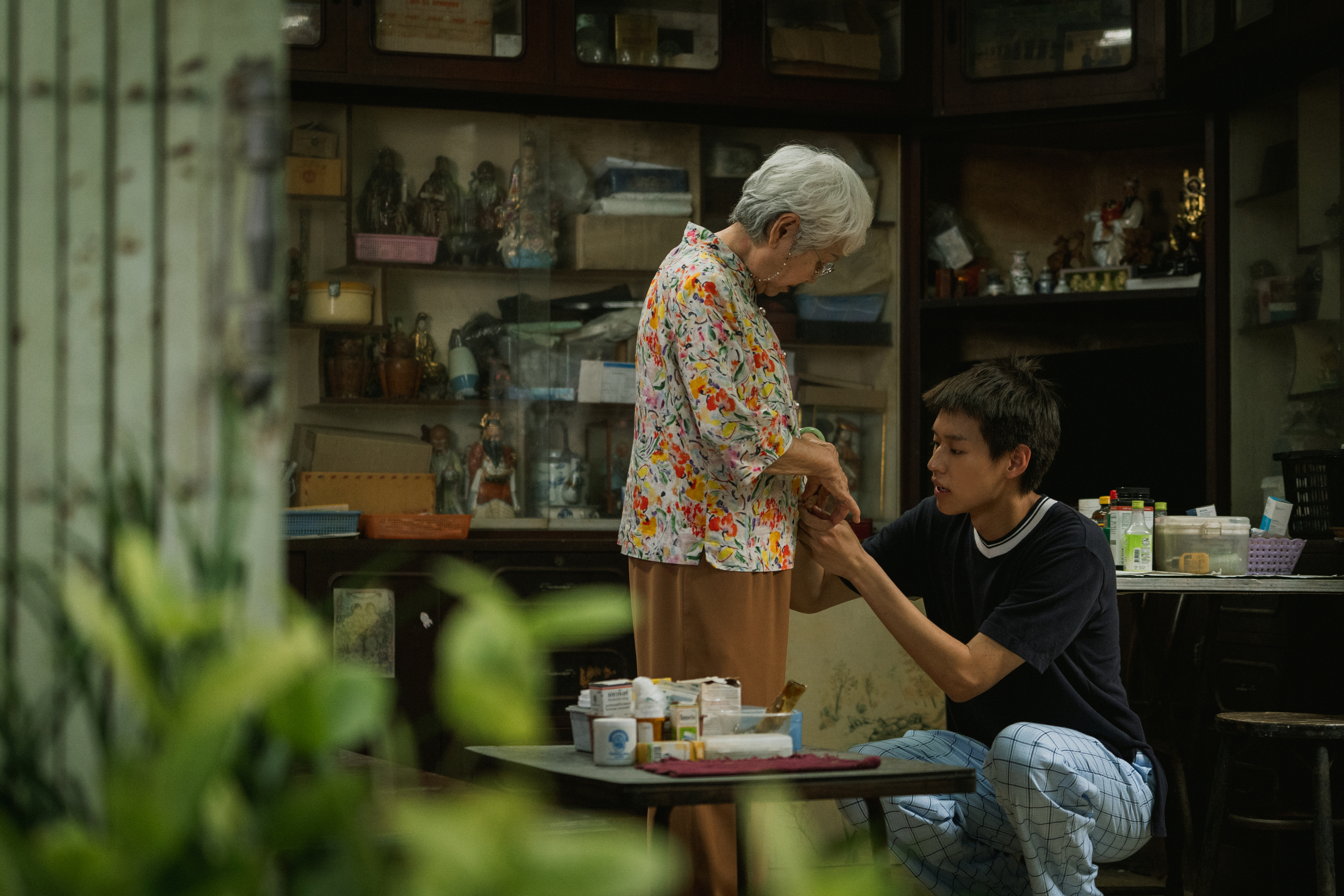

Flat broke and under pressure from a loan shark, Hiou-u (Zheng Runqi) decides there’s only one thing to do. Track down his no-good grandpa who apparently abandoned the family and became rich in Thailand to demand his share of the inheritance. Of course, by the end of the film, he’ll have realised the error of his ways and grown up a little, much like the protagonist of Thai megahit How To Make Millions Before Grandma Dies, by which Lan Hongchun’s tear-jerking melodrama Dear You (给阿嬷的情书, Gěi Āmà de qíngshū) is clearly inspired. It even features Usha Seamkhum in a small role as the older Lamgi at the film’s conclusion.
Shot almost entirely in Teochew, the film is, in other ways, a tale of distance and diaspora which in some ways suggests that a Chinese citizen never really leaves “China” but continues to exist within it even while abroad. Though most of the film takes place in Thailand, it is largely unconcerned with the political and social situation of the nation in the mid-1950s or with the wider geopolitical realities of the era. Remaining largely within the Teochew community, it does not really explore the complicated position of the Chinese community in Thai society either, preferring to focus on their poverty and rootless as the source of their marginalisation. After eloping with a young woman from a wealthy family, Den Bhagseng (Wang Yantong) is forced to flee leaving his three children behind to avoid being drafted into the KMT during the Chinese Civil War. After arriving in Thailand he is unable to return home firstly because of the difficulty of doing so once the Communist regime gained power, though the film also skirts around this, and secondly because he sends almost of all the money back to his wife Sogriu (Wu Shaoqing) meaning he never manages to save enough for his return passage.
The film largely revolves around the qiaopi remittances, letters sent home to family declaring that the sender was safe and often including money. Aside from the sentimental dimension, these letters also reinforce the diaspora community’s ties to the Mainland and the inclusion of several real letters at the film’s conclusion seems intended to act as a mild suggestion that perhaps those living abroad could also send more of their money home, while the film’s themes of yearning and homesickness also seem primed to encourage those living away to return or at least put in a call to their loved ones before it’s too late.
But on the other hand, the fact that the letters were never written by Bhagseng, as he was largely illiterate, but firstly by a series of scribes and then by a heartbroken Lamgi who pens the heart wrenchingly romantic verses that bring so much comfort to Sogriu adds a note of poignancy while perhaps undercutting their sincerity. That these are, in effect, a series of love letters exchanged between two women, though mediated through the absent figure of a man, leads the film an unexpectedly queer undertone complimenting the accompanying messages of female solidarity. Though Sogriu originally harbours resentment towards Lamgi mistakenly believing her to have been Bhagseng’s mistress, she later gains respect for realising not only all that she did for them but they way in which she continued to honour Bhagseng’s memory.
Once of the reasons that the family had believed Bangseng had become rich was that there were several schools with his name on them, leading them to conclude he had sponsored them in some way. This turns out not to be case, but was rather a kind of tribute to his role within the local community having convinced Lamgi to allow a Chinese school to operate within her inn during a time in which the language was actively suppressed. Bangseng had shouted at her, pointing out that these children will be condemned to a life of poverty and exploitation if they, like him, cannot read and write. He also argues that without knowing how to read, write, and speak Chinese, they will lose their cultural roots and connection with the Mainland. This seems to already be true of Lamgi who did not herself know how to read Chinese and felt disconnected from Chinese culture having grown up in Thailand. After learning with the children at the inn, the necessity of writing the letters also encourages Lamgi to become fully literate. The ability to read and write not only allows her to earn an income as a single woman by running her own business and later becoming a teacher, but also reinforces her Chinese roots and sense of cultural identity.
While it therefore presents a bittersweet tale of a love lost and then regained when the truth is revealed, the film also subtly issues a message to the diaspora community about the importance of their links to the greater Chinese community and responsibility towards the Mainland. Repeated references are made to the need to support each other in a foreign land with the Teochew community determined to protect each other against an often hostile environment in which they face exploitation and discrimination, while Lamgi’s sense of responsibility toward Sogriu could also be seen the same way as she willingly takes on the need to provide for Bangsen’s family despite her unrequited feelings for him. Nevertheless, what the film offers most is a sense of catharsis in its tear-jerking tale of young lovers separated by forces outside their control and symbolically reunited through the emotional truths contained within the letters.
Trailer (English / Simplified Chinese subtitles)