A young woman working for a government service tracking down illegal “Omegas” begins to wonder if she’s on the wrong side after becoming suspicious of another young woman much like herself in Park Sye-young’s dystopian drama, The Fin (지느러미, Jineureomi). Following some kind of ecological disaster, Korea has been plunged into a post-apocalyptic existence in which water has become scarce. The nation has been reunified, seemingly with the North in control, while “protected” by various walls which keep the majority population “safe” from an underclass of “mutant” workers who are permitted to exist in return for clearing “toxic waste”.
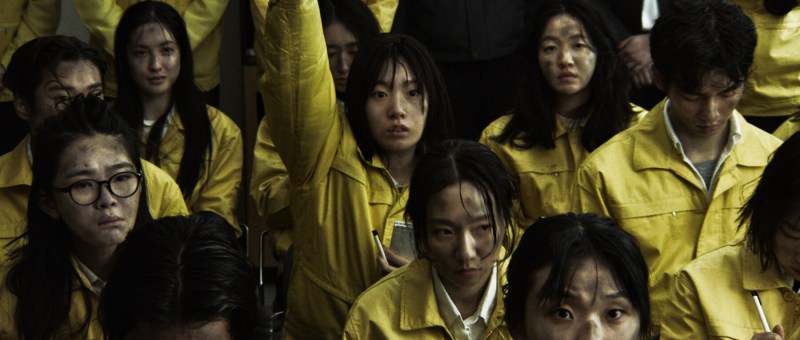
Sujin (Kim Pureum), a member of the Korean Freedom Youth Civil Service, attends a lecture on how to identify Omegas at which she is told that they look like everyone else except for the fact they have three birdlike claw toes and a fin-like appendage at the bottom of the spine which helps them exist in water. The fin is the source of all their toxins, and their bodies are radioactive, so must be disposed of immediately. What’s more, if they scream outside of the water, it could kill you.
It appears that such people actually exist and have become an oppressed underclass, but it’s never clear how much else is true and how much convenient propaganda designed to spread fear and make people suspicious of each other to prevent them from challenging this apparently authoritarian regime. The film is peppered with propaganda announcements and videos which seem to be played to saturation to point so that they’ve become a part of the environment. Looking more closely, some of them seem as if they may have been AI generated, which creates a further sense of doubt in the “reality” presented by an otherwise absent authority which may not even in itself actually exist at all. There’s no way to know what’s on the other side of the great wall, or if the “toxic waste” and water shortage are real. Citizens are encouraged to appear with dirty faces as an act of patriotism to demonstrate their efforts to conserve water.
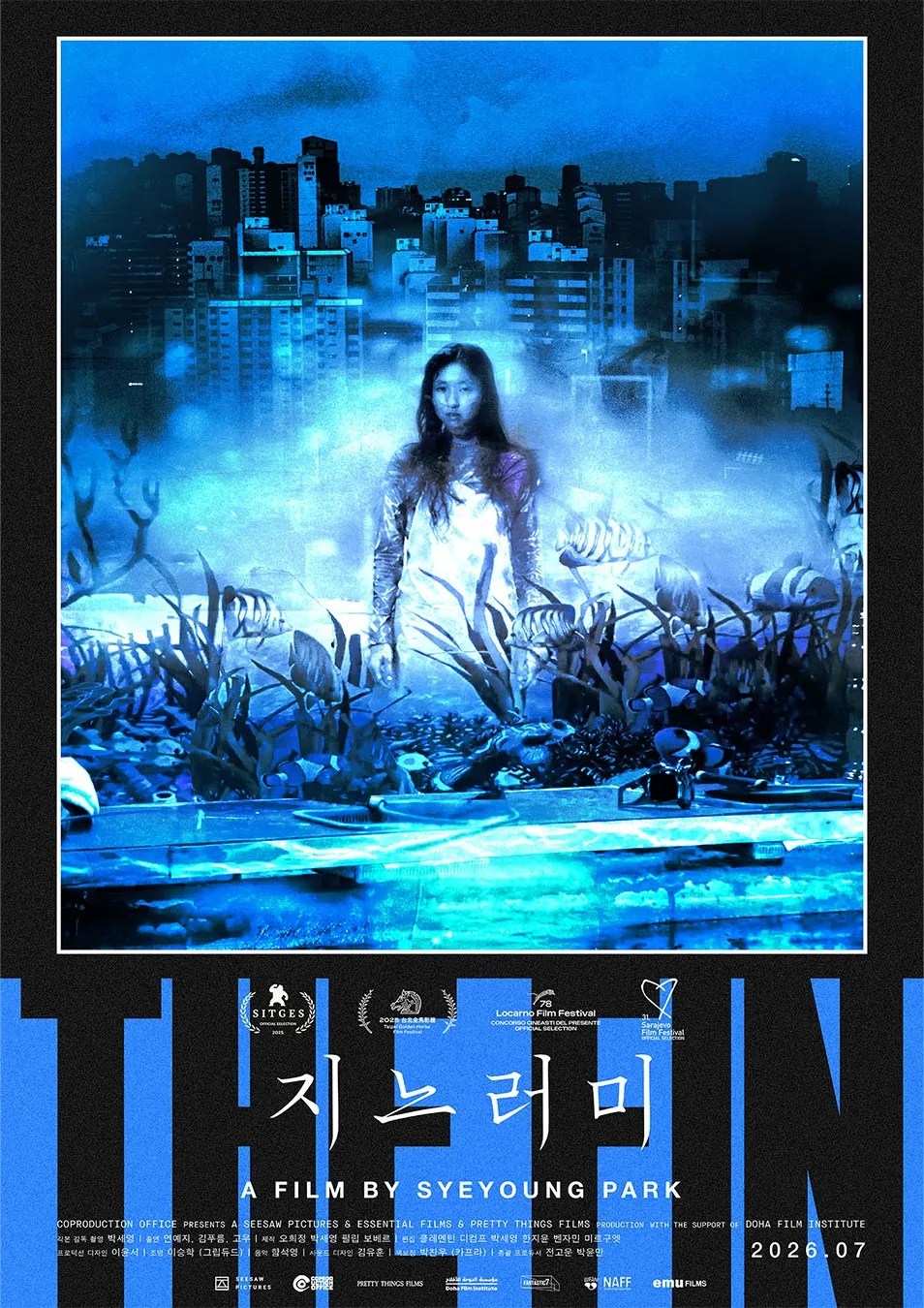
But the “water shortage” is also a means of fuelling resentment towards the Omegas who are blamed for “stealing” it, rather than towards the regime who apparently cannot provide the populace with adequate resources. Sujin’s mother, a hollowed-out figure glued to her TV screen, is forever shouting that they should all be “eradicated” and that their destruction is the only way back to the world of before. This desire to go back is symbolised by the Golden Faith fishing emporium that decadently contains a large pool of water and a selection of fish that people can eat there and then if they catch one. It reminds people of the time in which the sea was blue and open to all, and reflects their yearning to return to a simpler time.
Mia (Yeon Ye-ji), the young woman who works there, is one of many Omegas hiding their identity by cutting off their toes and concealing their fins. An unnamed Omega (Goh-Woo) risks his own life to bring back to her her father’s fin so that she can give him a dignified funeral, only she had no idea her father had been arrested and sent beyond the wall. “It’s because of cowards like you that we’re treated like this,” the man tells her, while crowds rage outside calling for the eradication of all Omega and begging the government to protect them from this mutation.
Outside of the city, which appears to have been at least partially reclaimed by nature, the landscape has taken on a scorched, reddish hue to the extent that the once blue ocean now resembles a sea of fire. The inside of Golden Faith is, however, cooler. Not quite so bland as the brutalist buildings that surround it but light and colourful. Sujin seemingly has a choice to make, or perhaps she doesn’t. In any case, Park’s dystopian vision hints at the compromises we might be able to make in service of preserving a comfortable “reality”, throwing others to the wolves in the hope that they will not come for us.
Trailer (English subtitles)

